

prEN 1429
(Main)Bitumens and bituminous binders - Determination of residue on sieving of bituminous emulsions and determination of storage stability by sieving
- Abstract
This document specifies methods using sieving for the determination of the quantity of coarse particles of binder present in bituminous emulsions and for the determination of storage stability.
WARNING - The use of this document can involve hazardous materials, operations and equipment. This document does not purport to address all of the safety problems associated with its use. It is the responsibility of the user of this document to establish appropriate safety and health practices and to determine the applicability of regulatory limitations prior to use. In addition, for environmental aspects, it is important to limit the quantities of products, solvents and energy sources to reduce the emissions in air and water and the wastes to the minimum required for a valid test realization.
- Status
- Not Published
- Publication Date
- 26-Sep-2027
- Technical Committee
- CEN/TC 336 - Bituminous binders
- Drafting Committee
- CEN/TC 336/WG 2 - Emulsions and fluxed bitumens
- Current Stage
- 4060 - Closure of enquiry - Enquiry
- Start Date
- 03-Sep-2026
- Due Date
- 05-Sep-2026
- Completion Date
- 03-Sep-2026

prEN 1429 is a draft European Standard from CEN for testing bituminous emulsions and bituminous binders. It specifies sieve-based methods to measure coarse particles retained in the emulsion and to assess storage stability after a defined storage period. Laboratories, manufacturers, and quality control teams use it when they need comparable results for specification checks, production control, or referee testing.
What does prEN 1429 specify?
prEN 1429 specifies methods using sieving to determine the quantity of coarse binder particles in bituminous emulsions and to determine storage stability. The document also carries a safety warning about hazardous materials, operations, and equipment, and it asks users to set their own safety, health, and environmental controls before testing.
The document is organized into clauses on scope, normative references, terms and definitions, principle, reagents, apparatus, sampling, two test procedures, calculation, expression of results, precision, and test report, followed by a bibliography. In practice, that structure takes the reader from sample preparation to the final report without needing other instructions.
What are the key requirements of prEN 1429?
Clause 4, Principle: prEN 1429 measures the mass retained on a 0,500 mm sieve, or on 0,500 mm and 0,160 mm sieves, after washing and drying. This is the core measure of coarse material, so it tells the user how much solid-like material is present in the emulsion.
Clauses 5 and 6, Reagents and apparatus: prEN 1429 requires analytical-grade reagents, water of grade 3 to EN ISO 3696:1995, prepared solutions S, and sieves that conform to ISO 3310-1. It also requires balances, ovens, a desiccator, funnels, and a temperature regulated chamber. In practice, the equipment and liquids have to match the method closely for the result to be comparable.
Clause 7, Sampling: prEN 1429 requires the laboratory sample to be taken in accordance with EN 58 and the test sample to be prepared in accordance with EN 12594. The sample is divided into two portions, and both are tested for referee purposes. This matters because sampling and preparation can change the test result as much as the test itself.
Clause 8, Residue on sieving: prEN 1429 gives a step-by-step procedure for washing, drying, weighing, filtering, and reweighing the residue on the 0,500 mm sieve. If the emulsion does not pass the sieve within 5 min, the method allows preheating at (60 ± 5) °C or dilution with the appropriate solution S. For particles between 0,500 mm and 0,160 mm, the filtered emulsion is diluted and passed through the 0,160 mm sieve. In practice, this is the main route for dealing with viscous emulsions and for documenting any adaptation used.
Clause 9, Storage stability by sieving after n days: prEN 1429 tests a stored sample after n days and measures the residue retained on the 0,500 mm sieve. For dispute or referee purposes, storage is at (23 ± 2) °C in a temperature regulated chamber or dark area; otherwise normal laboratory conditions are allowed. This shows whether storage has created more coarse particles that could affect use.
Clauses 10 and 11, Calculation and expression: prEN 1429 converts the weighed masses into mass fractions in %, and reports the result to the nearest 0,01 %. Duplicate tests are required only for referee purposes. This keeps reporting consistent across laboratories.
Clauses 12 and 13, Precision and report: prEN 1429 states repeatability, R, and reproducibility, r, and lists the minimum report content, including sample identification, conditioning, dilution, storage conditions, result, deviations, unusual features, and date. That makes the outcome traceable when the result is used in quality decisions.
What terms does prEN 1429 define?
- Residue on sieving - the mass fraction of particles retained on a sieve of the specified mesh size.
- Storage stability - the ability of a bituminous emulsion not to form more coarse particles during a specified storage period.
- Normal laboratory conditions - a temperature range between 18 °C and 28 °C.
- Repeatability, R - the expected closeness of two results from the same operator, apparatus, and conditions on the same material.
- Reproducibility, r - the expected closeness of results from different operators and laboratories on the same material.
- Solution S - the aqueous phase solution used to wet sieves and prepare samples; the document gives an anionic version and a cationic version.
Who uses prEN 1429?
prEN 1429 is used by laboratories testing bituminous emulsions, by manufacturers checking production quality, and by buyers or specifiers who need a common test for acceptance. It is also used in dispute testing and referee work when the amount of coarse material or the storage behaviour of an emulsion has to be documented in a standard way. The method is relevant to the bitumens, bituminous binders, and sealing materials field.
What changed in prEN 1429 from the previous edition?
prEN 1429 will supersede EN 1429:2013. The foreword states these main changes:
- Clause 2, normative references, has been updated and completed.
- Clause 3 adds the term for normal laboratory conditions.
- Clause 6, apparatus, has been updated and completed.
- Clause 9 introduces a temperature regulated chamber.
- Clause 9 introduces different requirements for reference measures and other types of measure.
- The document has been editorially updated.
Which standards are used with prEN 1429?
| Standard | What it contributes |
|---|---|
| EN 58 | Sampling of bituminous binders. |
| EN 12594 | Preparation of test samples. |
| EN 12597 | Terminology used in the document. |
| EN ISO 3696:1995 | Water quality for analytical laboratory use. |
| ISO 3310-1 | Technical requirements for the test sieves. |
| EN 12847 | Reference point for settling tendency, noted as different from storage stability. |
| ISO 565 | Nominal sieve opening sizes, listed in the bibliography. |
What does the prEN 1429 document contain?
prEN 1429 contains the reagent solutions, the sieve and balance requirements, and the full test sequences for residue on sieving and storage stability. It also gives the calculation formulas, the result expression, the precision statement, and the required test report items. The procedures are written so a laboratory can run the test, calculate the mass fraction, and report the result in a consistent way for quality control or referee use.
Relations
- Effective Date
- 05-Nov-2024
Get Certified
Connect with accredited certification bodies for this standard

DIBt (Deutsches Institut für Bautechnik)
German Institute for Building Technology.
DIN CERTCO
DIN Group product certification.

Element Materials Technology
Materials testing and product certification.
Sponsored listings
Frequently Asked Questions
prEN 1429 is a draft published by the European Committee for Standardization (CEN). Its full title is "Bitumens and bituminous binders - Determination of residue on sieving of bituminous emulsions and determination of storage stability by sieving". This standard covers: This document specifies methods using sieving for the determination of the quantity of coarse particles of binder present in bituminous emulsions and for the determination of storage stability. WARNING - The use of this document can involve hazardous materials, operations and equipment. This document does not purport to address all of the safety problems associated with its use. It is the responsibility of the user of this document to establish appropriate safety and health practices and to determine the applicability of regulatory limitations prior to use. In addition, for environmental aspects, it is important to limit the quantities of products, solvents and energy sources to reduce the emissions in air and water and the wastes to the minimum required for a valid test realization.
This document specifies methods using sieving for the determination of the quantity of coarse particles of binder present in bituminous emulsions and for the determination of storage stability. WARNING - The use of this document can involve hazardous materials, operations and equipment. This document does not purport to address all of the safety problems associated with its use. It is the responsibility of the user of this document to establish appropriate safety and health practices and to determine the applicability of regulatory limitations prior to use. In addition, for environmental aspects, it is important to limit the quantities of products, solvents and energy sources to reduce the emissions in air and water and the wastes to the minimum required for a valid test realization.
prEN 1429 is classified under the following ICS (International Classification for Standards) categories: 75.140 - Waxes, bituminous materials and other petroleum products; 91.100.50 - Binders. Sealing materials. The ICS classification helps identify the subject area and facilitates finding related standards.
prEN 1429 has the following relationships with other standards: It is inter standard links to EN 1429:2013. Understanding these relationships helps ensure you are using the most current and applicable version of the standard.
prEN 1429 is available in PDF format for immediate download after purchase. The document can be added to your cart and obtained through the secure checkout process. Digital delivery ensures instant access to the complete standard document.
Standards Content (Sample)
SLOVENSKI STANDARD
01-julij-2026
Bitumen in bitumenska veziva - Določevanje ostanka bitumenskih emulzij na situ
in ugotavljanje stabilnosti pri skladiščenju s sejanjem
Bitumens and bituminous binders - Determination of residue on sieving of bituminous
emulsions and determination of storage stability by sieving
Bitumen und bitumenhaltige Bindemittel - Bestimmung des Siebrückstandes von
Bitumenemulsionen und Bestimmung der Lagerbeständigkeit durch Sieben
Bitumes et liants bitumineux - Détermination du résidu sur tamis des émulsions
bitumineuses et détermination de la stabilité au stockage par tamisage
Ta slovenski standard je istoveten z: prEN 1429
ICS:
75.140 Voski, bitumni in drugi naftni Waxes, bituminous materials
proizvodi and other petroleum products
91.100.50 Veziva. Tesnilni materiali Binders. Sealing materials
2003-01.Slovenski inštitut za standardizacijo. Razmnoževanje celote ali delov tega standarda ni dovoljeno.
DRAFT
EUROPEAN STANDARD
NORME EUROPÉENNE
EUROPÄISCHE NORM
June 2026
ICS 75.140 Will supersede EN 1429:2013
English Version
Bitumens and bituminous binders - Determination of
residue on sieving of bituminous emulsions and
determination of storage stability by sieving
Bitumes et liants bitumineux - Détermination du résidu Bitumen und bitumenhaltige Bindemittel -
sur tamis des émulsions de bitumineuses et Bestimmung des Siebrückstandes von
détermination de la stabilité au stockage par tamisage Bitumenemulsionen und Bestimmung der
Lagerbeständigkeit durch Sieben
This draft European Standard is submitted to CEN members for enquiry. It has been drawn up by the Technical Committee
CEN/TC 336.
If this draft becomes a European Standard, CEN members are bound to comply with the CEN/CENELEC Internal Regulations
which stipulate the conditions for giving this European Standard the status of a national standard without any alteration.
This draft European Standard was established by CEN in three official versions (English, French, German). A version in any other
language made by translation under the responsibility of a CEN member into its own language and notified to the CEN-CENELEC
Management Centre has the same status as the official versions.
CEN members are the national standards bodies of Austria, Belgium, Bulgaria, Croatia, Cyprus, Czech Republic, Denmark, Estonia,
Finland, France, Germany, Greece, Hungary, Iceland, Ireland, Italy, Latvia, Lithuania, Luxembourg, Malta, Netherlands, Norway,
Poland, Portugal, Republic of North Macedonia, Romania, Serbia, Slovakia, Slovenia, Spain, Sweden, Switzerland, Türkiye and
United Kingdom.
Recipients of this draft are invited to submit, with their comments, notification of any relevant patent rights of which they are
aware and to provide supporting documentation.
Warning : This document is not a European Standard. It is distributed for review and comments. It is subject to change without
notice and shall not be referred to as a European Standard.
EUROPEAN COMMITTEE FOR STANDARDIZATION
COMITÉ EUROPÉEN DE NORMALISATION
EUROPÄISCHES KOMITEE FÜR NORMUNG
CEN-CENELEC Management Centre: Rue de la Science 23, B-1040 Brussels
© 2026 CEN All rights of exploitation in any form and by any means reserved Ref. No. prEN 1429:2026 E
worldwide for CEN national Members.
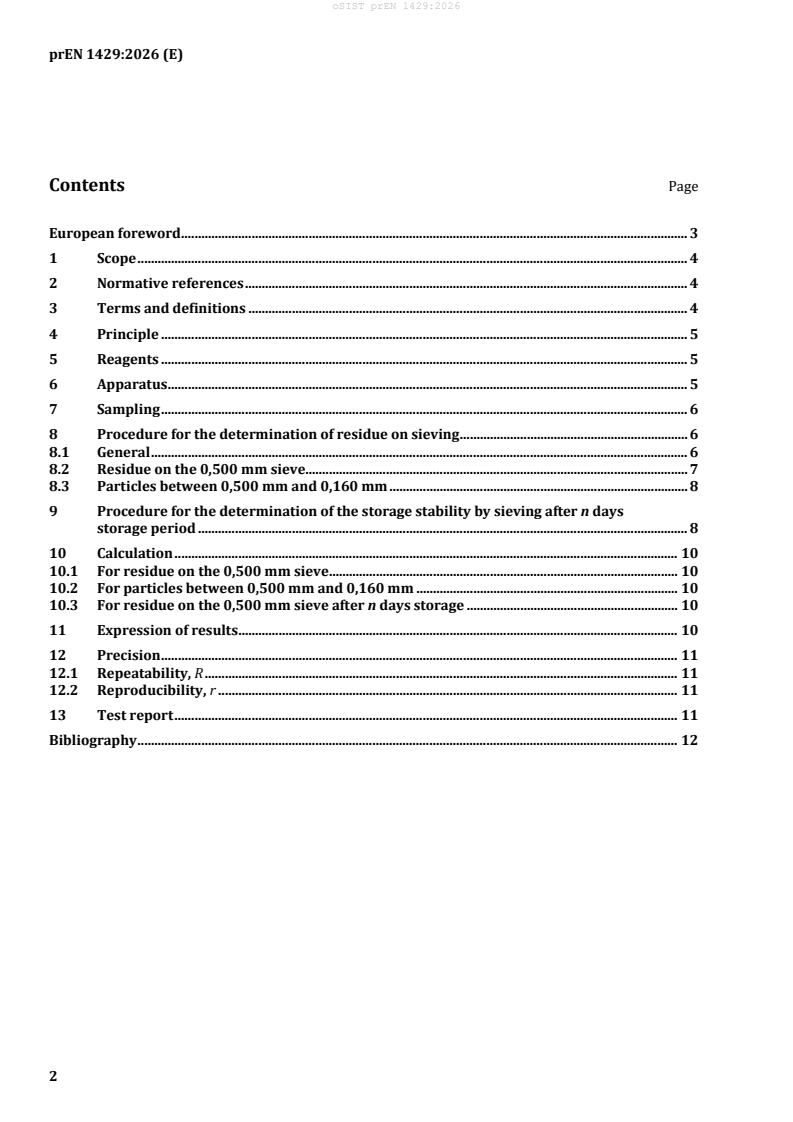
Contents Page
European foreword . 3
1 Scope . 4
2 Normative references . 4
3 Terms and definitions . 4
4 Principle . 5
5 Reagents . 5
6 Apparatus . 5
7 Sampling . 6
8 Procedure for the determination of residue on sieving . 6
8.1 General . 6
8.2 Residue on the 0,500 mm sieve . 7
8.3 Particles between 0,500 mm and 0,160 mm . 8
9 Procedure for the determination of the storage stability by sieving after n days
storage period . 8
10 Calculation . 10
10.1 For residue on the 0,500 mm sieve . 10
10.2 For particles between 0,500 mm and 0,160 mm . 10
10.3 For residue on the 0,500 mm sieve after n days storage . 10
11 Expression of results . 10
12 Precision . 11
12.1 Repeatability, R . 11
12.2 Reproducibility, r . 11
13 Test report . 11
Bibliography . 12
European foreword
This document (prEN 1429:2026) has been prepared by Technical Committee CEN/TC 336 “Bitumens
and Bituminous binders”, the secretariat of which is held by AFNOR.
This document is currently submitted to the CEN Enquiry.
This document will supersede EN 1429:2013.
a) Clause 2 “Normative references” has been updated and completed;
b) in Clause 3 “Terms and definitions”, the term 3.3 defining the “normal laboratory conditions” has
been added;
c) Clause 6 “Apparatus” has been updated and completed;
d) in Clause 9 “Procedure”:
— , the use of a temperature regulated chamber has been introduced (see 6.13);
— differentiated procedure requirements between reference measures and other types of measure
have been introduced (see 9.3);
e) the document has been editorially updated.
1 Scope
This document specifies methods using sieving for the determination of the quantity of coarse particles
of binder present in bituminous emulsions and for the determination of storage stability.
WARNING — The use of this document can involve hazardous materials, operations and equipment. This
document does not purport to address all of the safety problems associated with its use. It is the
responsibility of the user of this document to establish appropriate safety and health practices and to
determine the applicability of regulatory limitations prior to use. In addition, for environmental aspects,
it is important to limit the quantities of products, solvents and energy sources to reduce the emissions in
air and water and the wastes to the minimum required for a valid test realization.
2 Normative references
The following documents are referred to in the text in such a way that some or all of their content
constitutes requirements of this document. For dated references, only the edition cited applies. For
undated references, the latest edition of the referenced document (including any amendments) applies.
EN 58, Bitumen and bituminous binders — Sampling bituminous binders
EN 12594, Bitumens and bituminous binders — Preparation of test samples
EN 12597, Bitumens and bituminous binders — Terminology
EN ISO 3696:1995, Water for analytical laboratory use — Specification and test methods
(ISO 3696:1987)
ISO 3310-1, Test sieves — Technical requirements and testing — Part 1: test sieves of metal wire cloth
3 Terms and definitions
For the purposes of this document, the terms and definitions given in EN 12597 and the following apply.
ISO and IEC maintain terminological databases for use in standardization at the following addresses:
— ISO Online browsing platform: available at https://www.iso.org/obp
— IEC Electropedia: available at https://www.electropedia.org
3.1
residue on sieving
mass fraction in % of particles retained on a sieve of a mesh size specified in this document
3.2
storage stability
ability of a bituminous emulsion not to form more coarse particles within a period specified under an
appropriate emulsion specification
Note 1 to entry: Storage stability is a different concept than settling tendency as defined and measured by
EN 12847 [1]. Although both phenomena are often linked, an emulsion may settle without modification of particle
size distribution (no coalescence of emulsion droplets).
Note 2 to entry: The purpose of the limits fixed by the emulsion specification is to ensure that there cannot be
any disturbance of the workability of the bitumen emulsion under practical conditions.
3.3
normal laboratory conditions
a range of temperature between 18 °C and 28 °C
4 Principle
A known mass of bituminous emulsion is filtered either through a prepared sieve with a mesh size of
0,500 mm or through two prepared sieves with mesh sizes of 0,500 mm and of 0,160 mm. The amount of
binder retained on the sieves is weighed after washing and drying.
Storage stability is determined as the amount of binder retained on the sieve with a mesh size of
0,500 mm after a defined storage period (n days).
5 Reagents
Use only reagents of recognized analytical grade and water conforming to grade 3 of EN ISO 3696:1995.
The aqueous solutions (5.1) and (5.2) may be replaced by aqueous phases of the same ionic structure as
the emulsion under test.
5.1 Solution S
a
Aqueous phase solution of nominal 0,01 mol/l of sodium hydroxide (NaOH) containing a nominal 1 %
mass fraction of sodium oleate. This solution, or the actual aqueous phase, may be used for the
preparation of anionic emulsion samples.
5.2 Solution S
c
Aqueous phase solution of nominal 0,01 mol/l of hydrochloric acid (HCl) containing a nominal 1 % mass
fraction of cetyltrimethylammonium bromide. This solution, or the actual aqueous phase, may be used
for the preparation of cationic emulsion samples.
The solution of 1 % of cetyltrimethylammonium bromide should be prepared slightly above 25 °C (but
not higher than 30 °C). Then it should be stored at a temperature of (25 ± 1) °C before test.
5.3 Efficient rinsing agent
Suitable solvent rinsing agents shall be used.
5.4 Ethanol
96 % minimum or methylated spirit 99 % shall be used.
5.5 Acetone
95 % minimum shall be used.
6 Apparatus
The usual laboratory apparatus and glassware, together with the following, shall be used.
6.1 Sieve, conforming to ISO 3310-1, stainless steel or brass, with a frame diameter within the range
of 75 mm to 100 mm and a mesh size of 0,500 mm.
6.2 Sieve, conforming to ISO 3310-1, stainless steel or brass, with a frame diameter within the range
of 75 mm to 100 mm and a mesh size of 0,160 mm.
6.3 Sieve pans, of corresponding diameter.
6.4 Balance, having a suitable measuri
...