

EN 13126-19:2026
(Main)Building hardware - Hardware for windows and door-height windows - Requirements and test methods - Part 19: Sliding closing devices
- Abstract
This document specifies requirements and test methods for durability, strength, security and functionality of sliding closing devices (SCDs) for windows and door height windows.
This document does not specifically cover the handles used in handle-operated SCDs or the sash fasteners used in cam-operated SCDs, requirements and test methods for which are given in EN 13126 2, EN 13126 3 and EN 13126 14, respectively.
The performance tests incorporated in this document are considered to be reproducible and as such will provide a consistent and objective assessment of the performance of these products throughout CEN Member States.
- Status
- Published
- Publication Date
- 07-Apr-2026
- Technical Committee
- CEN/TC 33 - Doors, windows, shutters and building hardware
- Drafting Committee
- CEN/TC 33/WG 4 - Building hardware
- Current Stage
- 6060 - Definitive text made available (DAV) - Publishing
- Start Date
- 08-Apr-2026
- Due Date
- 28-May-2026
- Completion Date
- 08-Apr-2026

Overview
EN 13126-19:2026 is a European standard developed by CEN for building hardware, focusing specifically on sliding closing devices (SCDs) for windows and door-height windows. The standard establishes clear requirements and test methods that evaluate the durability, strength, security, and functionality of SCDs. Its intent is to ensure performance consistency and safety of sliding closing devices across all CEN member states.
This part of EN 13126 does not address the handles used in handle-operated SCDs or the sash fasteners in cam-operated SCDs, which are covered in EN 13126-2, EN 13126-3, and EN 13126-14 respectively.
Key Topics
- Product Classification: Sliding closing devices are classified using a six-box system detailing their durability, mass capacity, corrosion resistance, test specimen size, hardware type (manual or automatic), and whether the device has a secured locking position.
- Durability and Mechanical Resistance: Test methods verify that SCDs sustain repeated operation (graded as H1, H2, or H3 from 5,000 to 20,000 cycles) without loss of function, excessive wear, or deformation.
- Corrosion Resistance: Devices must meet at least Grade 2 corrosion protection according to EN 1670, ensuring long-term operability even in demanding conditions.
- Safety and Security: The standard includes optional testing for locking mechanisms including torque resistance and static load assessments to enhance security-particularly important for SCDs with key-operated locked positions.
- Marking and Documentation: Products must be traceable by manufacturer, include standard references, classification details, and production date codes on product or documentation.
Applications
Implementing EN 13126-19:2026 ensures that sliding closing devices for windows and door-height windows:
- Align with harmonized European performance criteria, supporting both manufacturers and end users in the selection of reliable, durable, and safe window hardware.
- Are suitable for use in residential, commercial, and public buildings where safety, long term function, and low maintenance are priorities.
- Support architects, specifiers, and construction professionals in compliance with building codes, building hardware requirements, and legal obligations within the European market.
- Provide assurance for facility managers and building owners regarding the longevity and safety of installed window hardware, especially in environments prone to corrosion or high usage.
- Enhance security where optional locked positions are required, including for ground-floor windows or in facilities demanding elevated protection.
Related Standards
EN 13126-19:2026 is part of the wider EN 13126 series dealing with building hardware for windows and doors. Relevant associated standards include:
- EN 13126-1: General requirements common to all types of hardware for windows and doors.
- EN 13126-2: Window fastener handles - applicable to SCDs with handle operation.
- EN 13126-3: Handles for tilt and turn, tilt-first, and turn-only hardware.
- EN 13126-14: Sash fasteners - relevant to cam-operated SCDs.
- EN 1670: Building hardware - Corrosion resistance requirements and test methods.
By referencing and applying EN 13126-19:2026 and its related standards, stakeholders can ensure robust performance, regulatory compliance, and long-term reliability for sliding window and door hardware installations across Europe.
Keywords: sliding closing devices, EN 13126-19:2026, window hardware, building hardware standards, sliding window locks, durability testing, security testing, corrosion resistance, European standard, CEN, door-height windows, hardware classification.
Relations
- Effective Date
- 19-Jan-2023
- Effective Date
- 15-Apr-2026
- Effective Date
- 15-Apr-2026
Get Certified
Connect with accredited certification bodies for this standard

DIBt (Deutsches Institut für Bautechnik)
German Institute for Building Technology.
DIN CERTCO
DIN Group product certification.

Aboma Certification B.V.
Specialized in construction, metal, and transport sectors.
Sponsored listings
Frequently Asked Questions
EN 13126-19:2026 is a standard published by the European Committee for Standardization (CEN). Its full title is "Building hardware - Hardware for windows and door-height windows - Requirements and test methods - Part 19: Sliding closing devices". This standard covers: This document specifies requirements and test methods for durability, strength, security and functionality of sliding closing devices (SCDs) for windows and door height windows. This document does not specifically cover the handles used in handle-operated SCDs or the sash fasteners used in cam-operated SCDs, requirements and test methods for which are given in EN 13126 2, EN 13126 3 and EN 13126 14, respectively. The performance tests incorporated in this document are considered to be reproducible and as such will provide a consistent and objective assessment of the performance of these products throughout CEN Member States.
This document specifies requirements and test methods for durability, strength, security and functionality of sliding closing devices (SCDs) for windows and door height windows. This document does not specifically cover the handles used in handle-operated SCDs or the sash fasteners used in cam-operated SCDs, requirements and test methods for which are given in EN 13126 2, EN 13126 3 and EN 13126 14, respectively. The performance tests incorporated in this document are considered to be reproducible and as such will provide a consistent and objective assessment of the performance of these products throughout CEN Member States.
EN 13126-19:2026 is classified under the following ICS (International Classification for Standards) categories: 91.190 - Building accessories. The ICS classification helps identify the subject area and facilitates finding related standards.
EN 13126-19:2026 has the following relationships with other standards: It is inter standard links to EN 13126-19:2011, EN 13126-1:2011, EN 17610:2022. Understanding these relationships helps ensure you are using the most current and applicable version of the standard.
EN 13126-19:2026 is available in PDF format for immediate download after purchase. The document can be added to your cart and obtained through the secure checkout process. Digital delivery ensures instant access to the complete standard document.
Standards Content (Sample)
SLOVENSKI STANDARD
01-junij-2026
Stavbno okovje - Okovje za okna in zastekljena vrata - Zahteve in preskusne
metode - 19. del: Drsne zapiralne naprave
Building hardware - Hardware for windows and door-height windows - Requirements and
test methods - Part 19: Sliding closing devices
Baubeschläge - Beschläge für Fenster und Fenstertüren - Anforderungen und
Prüfverfahren - Teil 19: Schiebeverschlüsse (SCD)
Quincaillerie pour le bâtiment - Ferrures de fenêtres et portes-fenêtres - Exigences et
méthodes d'essai - Partie 19 : Dispositifs de verrouillage pour ouvrants coulissants
(SCD)
Ta slovenski standard je istoveten z: EN 13126-19:2026
ICS:
91.190 Stavbna oprema Building accessories
2003-01.Slovenski inštitut za standardizacijo. Razmnoževanje celote ali delov tega standarda ni dovoljeno.
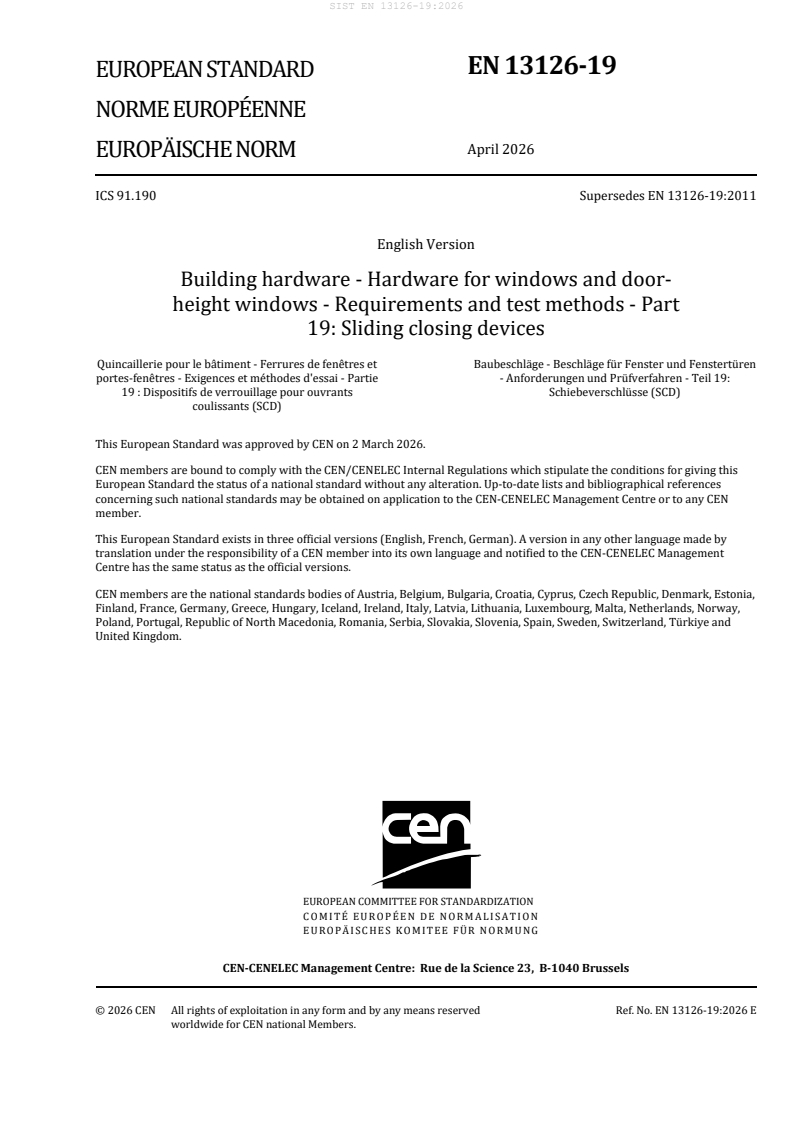
EN 13126-19
EUROPEAN STANDARD
NORME EUROPÉENNE
April 2026
EUROPÄISCHE NORM
ICS 91.190 Supersedes EN 13126-19:2011
English Version
Building hardware - Hardware for windows and door-
height windows - Requirements and test methods - Part
19: Sliding closing devices
Quincaillerie pour le bâtiment - Ferrures de fenêtres et Baubeschläge - Beschläge für Fenster und Fenstertüren
portes-fenêtres - Exigences et méthodes d'essai - Partie - Anforderungen und Prüfverfahren - Teil 19:
19 : Dispositifs de verrouillage pour ouvrants Schiebeverschlüsse (SCD)
coulissants (SCD)
This European Standard was approved by CEN on 2 March 2026.
CEN members are bound to comply with the CEN/CENELEC Internal Regulations which stipulate the conditions for giving this
European Standard the status of a national standard without any alteration. Up-to-date lists and bibliographical references
concerning such national standards may be obtained on application to the CEN-CENELEC Management Centre or to any CEN
member.
This European Standard exists in three official versions (English, French, German). A version in any other language made by
translation under the responsibility of a CEN member into its own language and notified to the CEN-CENELEC Management
Centre has the same status as the official versions.
CEN members are the national standards bodies of Austria, Belgium, Bulgaria, Croatia, Cyprus, Czech Republic, Denmark, Estonia,
Finland, France, Germany, Greece, Hungary, Iceland, Ireland, Italy, Latvia, Lithuania, Luxembourg, Malta, Netherlands, Norway,
Poland, Portugal, Republic of North Macedonia, Romania, Serbia, Slovakia, Slovenia, Spain, Sweden, Switzerland, Türkiye and
United Kingdom.
EUROPEAN COMMITTEE FOR STANDARDIZATION
COMITÉ EUROPÉEN DE NORMALISATION
EUROPÄISCHES KOMITEE FÜR NORMUNG
CEN-CENELEC Management Centre: Rue de la Science 23, B-1040 Brussels
© 2026 CEN All rights of exploitation in any form and by any means reserved Ref. No. EN 13126-19:2026 E
worldwide for CEN national Members.
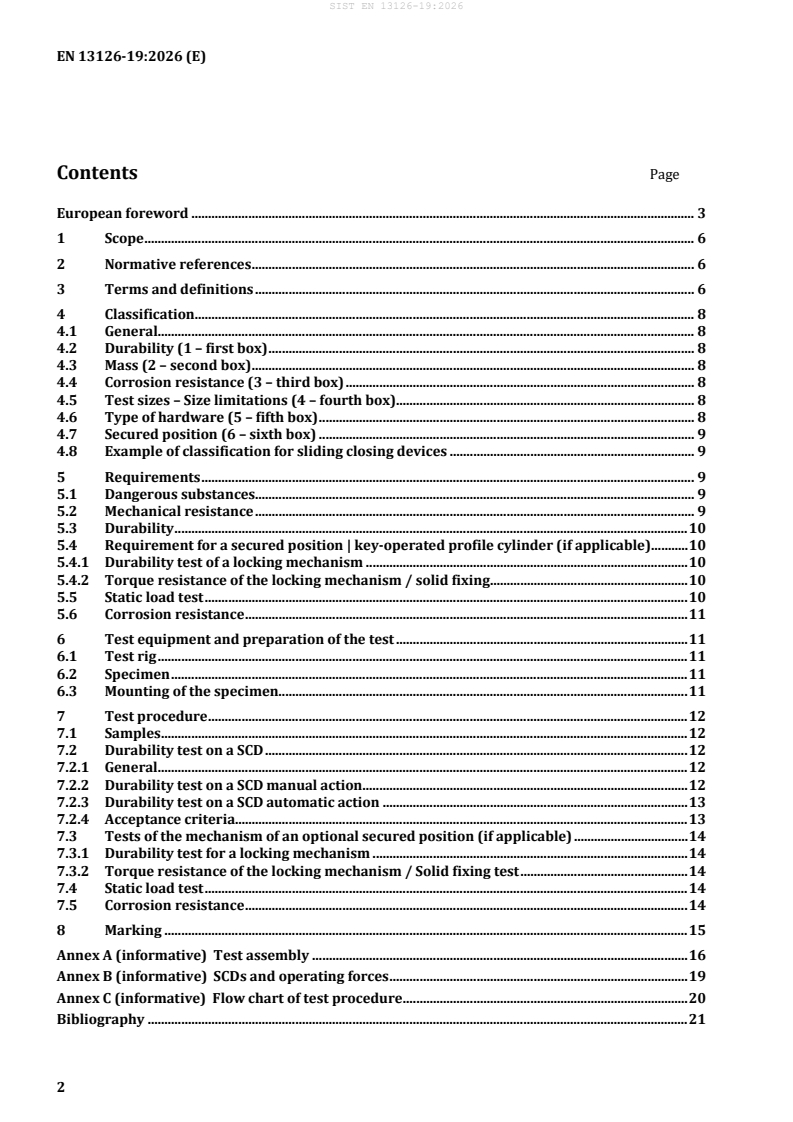
Contents Page
European foreword . 3
1 Scope . 6
2 Normative references . 6
3 Terms and definitions . 6
4 Classification. 8
4.1 General. 8
4.2 Durability (1 – first box) . 8
4.3 Mass (2 – second box) . 8
4.4 Corrosion resistance (3 – third box) . 8
4.5 Test sizes – Size limitations (4 – fourth box). 8
4.6 Type of hardware (5 – fifth box) . 8
4.7 Secured position (6 – sixth box) . 9
4.8 Example of classification for sliding closing devices . 9
5 Requirements . 9
5.1 Dangerous substances. 9
5.2 Mechanical resistance . 9
5.3 Durability . 10
5.4 Requirement for a secured position | key-operated profile cylinder (if applicable) . 10
5.4.1 Durability test of a locking mechanism . 10
5.4.2 Torque resistance of the locking mechanism / solid fixing . 10
5.5 Static load test . 10
5.6 Corrosion resistance . 11
6 Test equipment and preparation of the test . 11
6.1 Test rig . 11
6.2 Specimen . 11
6.3 Mounting of the specimen. 11
7 Test procedure . 12
7.1 Samples . 12
7.2 Durability test on a SCD . 12
7.2.1 General. 12
7.2.2 Durability test on a SCD manual action . 12
7.2.3 Durability test on a SCD automatic action . 13
7.2.4 Acceptance criteria. 13
7.3 Tests of the mechanism of an optional secured position (if applicable) . 14
7.3.1 Durability test for a locking mechanism . 14
7.3.2 Torque resistance of the locking mechanism / Solid fixing test . 14
7.4 Static load test . 14
7.5 Corrosion resistance . 14
8 Marking . 15
Annex A (informative) Test assembly . 16
Annex B (informative) SCDs and operating forces . 19
Annex C (informative) Flow chart of test procedure . 20
Bibliography . 21
European foreword
This document (EN 13126-19:2026) has been prepared by Technical Committee CEN/TC 33 “Doors,
windows, shutters, building hardware and curtain walling”, the secretariat of which is held by AFNOR.
This European Standard shall be given the status of a national standard, either by publication of an
identical text or by endorsement, at the latest by October 2026, and conflicting national standards shall
be withdrawn at the latest by October 2026.
Attention is drawn to the possibility that some of the elements of this document may be the subject of
patent rights. CEN shall not be held responsible for identifying any or all such patent rights.
This document supersedes EN 13126-19:2011.
EN 13126-19:2011:
— EN 13126-19 now is independent from EN 13126-1; all necessary information is included without
the need of any further information from EN 13126-1;
— several editorial changings in the wording for a better understanding;
— new terms added under 3.5 to 3.15;
— under 4.1 classification system changed completely;
— former digit 1 (Category of use) is now box 1 for the grade of cycles for the durability test;
— former digit 3 (Mass) is now box 2;
— former digit 4 (Corrosion resistance) is now box 3;
— former digit 5 (Safety in use) is now box 4 for the test sizes;
— former digit 6 (Corrosion resistance) is now box 3;
— former digit 7 (Security) was deleted;
— former digit 8 (Applicable part) is now box 5 for the type of hardware;
— former digit 9 (Test sizes) is now box 4;
— new box 6 for information on an optional secured position;
— under 4.8 new examples added for a classification;
— under 5.1 new text for dangerous substances added;
— under 5.3 new grades H1 to H3 for the cycles for the durability test defined;
— under 5.4 requirements added for an optional secured position with a key-operated profile cylinder;
— under 5.4.1 grades for a durability test of a locking system added;
— under 5.4.2 requirements for torque resistance of the locking mechanism added;
— static load test is now under 5.5;
— new text for the Corrosion resistance under 5.6;
— several subclauses under 6. Test equipment and preparation of the test added; 6.1 Test rig, 6.2
Specimen, 6.3 Mounting of specimen;
— subclause 7.1 Samples revised;
— subclauses 7.2.2 durability test on a SCD manual action an 7.2.3 durability test on a SCD manual
action added;
— complete subclause 7.3 Test of the mechanism of an optional secured position (if applicable) added;
— in Annex A new figures integrated.
The EN 13126 series consists of the following parts:
— EN 13126-1, Building hardware — Hardware for windows and door height windows — Requirements
and test methods — Part 1: Requirements common to all types of hardware;
— EN 13126-2, Building hardware — Hardware for windows and door height windows — Requirements
and test methods — Part 2: Window fastener handles;
— EN 13126-3, Building hardware — Hardware for windows and door-height windows — Requirements
and test methods — Part 3: Handles, primarily for Tilt and Turn, Tilt-First and Turn-Only hardware;
— EN 13126-4, Building hardware — Requirements and test methods for windows and door height
windows — Part 4: Espagnolettes;
— EN 13126-5, Building hardware — Hardware for windows and door height windows — Requirements
and test methods — Part 5: Devices that restrict the opening of windows and door height windows;
— EN 13126-6, Building hardware — Hardware for windows and door height windows — Requirements
and test methods — Part 6: Variable geometry stay hinges (with or without a friction stay);
— EN 13126-7, Building hardware — Requirements and test methods for windows and door height
windows — Part 7: Finger catches;
— EN 13126-8, Building hardware — Hardware for windows and door height windows — Part 8:
Requirements and test methods for tilt and turn, Tilt-First and Turn-Only hardware;
— EN 13126-9, Building hardware — Requirements and test methods for windows and door height
windows — Part 9: Hardware for horizontal and vertical pivot windows;
— EN 13126-10, Building hardware — Requirements and test methods for windows and door height
windows — Part 10: Arm-balancing systems;
— EN 13126-11, Building hardware — Requirements and test methods for windows and door height
windows — Part 11: Top hung projecting reversible hardware;
— EN 13126-12, Building hardware — Requirements and test methods for windows and door height
windows — Part 12: Side hung projecting reversible hardware;
— EN 13126-13, Building hardware — Hardware for windows and balcony door — Requirements and
test methods — Part 13: Sash balances;
— EN 13126-14, Building hardware — Hardware for windows and door height windows — Requirements
and test methods — Part 14: Sash fasteners;
— EN 13126-15, Building hardware — Hardware for windows and door height windows — Requirements
and test methods — Part 15: Rollers for sliding and hardware for sliding folding windows;
— EN 13126-16, Building hardware — Hardware for windows and door height windows — Requirements
and test methods — Part 16: Hardware for Lift and Slide windows;
— EN 13126-17, Building hardware — Hardware for windows and door height windows — Requirements
and test methods — Part 17: Hardware for Tilt and Slide windows;
— EN 13126-19, Building hardware — Requirements and test methods for windows and door height
windows — Part 19: Sliding Closing Devices
A full contribution to the preparation of this European Standards series has been made by the European
manufacturers’ organization “ARGE” and national standards bodies.
Any feedback and questions on this document should be directed to the users’ national standards body.
A complete listing of these bodies can be found on the CEN website.
According to the CEN-CENELEC Internal Regulations, the national standards organisations of the
following countries are bound to implement this European Standard: Austria, Belgium, Bulgaria, Croatia,
Cyprus, Czech Republic, Denmark, Estonia, Finland, France, Germany, Greece, Hungary, Iceland, Ireland,
Italy, Latvia, Lithuania, Luxembourg, Malta, Netherlands, Norway, Poland, Portugal, Republic of North
Macedonia, Romania, Serbia, Slovakia, Slovenia, Spain, Sweden, Switzerland, Türkiye and the United
Kingdom.
1 Scope
This document specifies requirements and test methods for durability, strength, security and
functionality of sliding closing devices (SCDs) for windows and door height windows.
This document does not specifically cover the handles used in handle-operated SCDs or the sash fasteners
used in cam-operated SCDs, requirements and test methods for which are given in EN 13126-2,
EN 13126-3 and EN 13126-14, respectively.
The performance tests incorporated in this document are considered to be reproducible and as such will
provide a consistent and objective assessment of the performance of these products throughout CEN
Member States.
2 Normative references
The following documents are referred to in the text in such a way that some or all their content constitutes
requirements of this document. For dated references, only the edition cited applies. For undated
references, the latest edition of the referenced document (including any amendments) applies.
EN 1670, Building hardware — Corrosion resistance — Requirements and test methods
3 Terms and definitions
For the purposes of this document, the following terms and definitions apply.
ISO and IEC maintain terminology databases for use in standardization at the following addresses:
— IEC Electropedia: available at https://www.electropedia.org/
— ISO Online browsing platform: available at https://www.iso.org/obp
3.1
sliding closing device
SCD
device allowing the users to open and lock sliding windows and door height windows
3.2
SCD manual action
sliding closing device that is actuated under the “finger operated” or “hand operated” action
3.3
SCD automatic action
sliding closing device that locks the sash when the sash is closed without any additional action
3.4
position of reference for distance between sash and frame
PRD
position from which the distance between sash and frame is to be measured
Note 1 to entry: See Annex A, Figure A.2
3.5
sample
actual hardware components which are due to be tested
3.6
specimen
window without gaskets to accommodate hardware components (samples) for testing
3.7
test rig
testing device onto which the specimen is mounted
3.8
test equipment
series of various testing rigs, devices and machinery enabling testing to be carried out
3.9
supporting sub-frame
supplementary fixing frame surrounding the specimen enabling it to be mounted on the test rig while
testing
3.10
sash width
SW
nominal width of the outer edge of the sash
3.11
sash height
SH
nominal height of the outer edge of the sash
3.12
closed position
position in which the sash rests up against the frame, and the SCD is not fastened
3.13
fastened closed position
position in which the sash rests up against the frame and the SCD is fastened
3.14
fastened closed and secured position
position in which the sash rests up against the frame and the SCD is fastened and secured i.e., by use of a
key-operated profile cylinder
NOTE 1 to entry: This is an option for a SCD.
3.15
rest time
ti
...