

FprEN 13872
(Main)Adhesives - Test method for cementitious and calcium sulfate-based floor levelling compounds - Determination of dimensional change
- Abstract
This document specifies the measurement of dimensional change of set cementitious and calcium sulfate-based floor levelling compounds after mixing with a liquid, e.g. water.
This document applies to cementitious and calcium sulfate-based floor levelling compounds used for the preparation of subfloors to ensure the suitability of the substrate prior to the installation of floor coverings. By using an underlayment, a homogeneous layer is built up on the load-bearing substrate, to ensure consistent absorbency, evenness and strength.
- Status
- Not Published
- Publication Date
- 24-Mar-2027
- Technical Committee
- CEN/TC 193 - Adhesives
- Drafting Committee
- CEN/TC 193/WG 4 - Building adhesives

FprEN 13872 is a draft European Standard from CEN for a laboratory test method on cementitious and calciumsulfate-based floor levelling compounds. It specifies how to measure dimensional change, including shrinkage and expansion, after the compound is mixed with a liquid such as water and used to prepare subfloors before floor coverings are installed.
What does FprEN 13872 specify?
FprEN 13872 specifies the measurement of dimensional change in set cementitious and calciumsulfate-based floor levelling compounds after mixing with a liquid, for example water. The method is aimed at materials used to prepare subfloors so the substrate is suitable before floor coverings are laid.
In practical terms, FprEN 13872 is a test method for checking how much a floor levelling compound moves in length as it sets and ages. The document is organized into clauses on scope, normative references, terms and definitions, principle, apparatus and material, standard test conditions, procedure, evaluation and expression of results, and the test report.
What are the key requirements of FprEN 13872?
FprEN 13872 is built around measuring length change in test specimens of 10 mm × 40 mm × 160 mm at specified times and conditions. That means the user has to prepare specimens in a controlled way and follow the same timing so results can be compared.
- Clause 4, principle - The method assesses shrinkage and expansion by measuring specimen length after storage periods. In practice, the test only works if the specimen size, handling and timing are consistent.
- Clause 5.1, measuring apparatus - The measuring device must read the specimen with an accuracy of ± 0,005 mm. This matters because the reported change is very small and a coarse gauge would hide real movement.
- Clause 5.2 to 5.5, moulds, pegs and reference specimen - The document specifies mould dimensions, options for peg arrangements, a jolting apparatus for poor-flow mixtures, and a steel reference specimen. This gives laboratories a controlled way to make and locate specimens and to set the gauge reliably.
- Clause 6, standard test conditions - Storage and testing take place at 23 ± 2 °C and 50 ± 5 % relative humidity. In practice, the atmosphere must be controlled because temperature and humidity affect drying and dimensional movement.
- Clause 7.1, preparation of moulds - The moulds are sealed, lightly oiled, and preconditioned for at least 24 h, and at least three specimens are required. This reduces leakage, sticking and random variation.
- Clause 7.2, storage A procedure - The compound is filled into the mould immediately after mixing, covered to limit surface drying, demoulded after 24 h, then measured again after 3 d, 7 d, 14 d and 28 d. For the reader, this is the main ageing sequence used to track normal shrinkage or expansion over time.
- Clause 7.3 and Clause 8, optional water immersion and evaluation - After 28 d in air, specimens may be immersed in clean water for a further 28 d and measured wet; results are then expressed as percentage dimensional change and averaged from three values, rounded to 0,01 %. This gives a separate picture of behaviour after water exposure, but the note says it is not by itself a water resistance claim.
What terms does FprEN 13872 define?
FprEN 13872 uses a small set of core terms to describe the measured length change and the storage conditions.
- Dimensional change - the difference in specimen length after a specified time and conditions.
- Shrinkage - a negative dimensional change, meaning the specimen becomes shorter.
- Expansion - a positive dimensional change, meaning the specimen becomes longer.
- Storage A - the sequence of measurements after demoulding while the specimens remain in the standard test atmosphere.
- Storage B - the optional 28 d water-immersion stage after the 28 d air storage.
- Standard test atmosphere - 23 ± 2 °C and 50 ± 5 % relative humidity.
Who uses FprEN 13872?
FprEN 13872 is used by testing laboratories, manufacturers of floor levelling compounds, quality control teams, and technical staff working with flooring materials. It is also relevant to buyers and specifiers who need a test method for comparing products intended for subfloor preparation before floor coverings are installed.
The document is written for people familiar with normal laboratory practice. In daily use, it supports product development, batch control, type testing, and comparison of shrinkage or expansion performance.
What changed in FprEN 13872 from the previous edition?
FprEN 13872:2026 will supersede EN 13872:2004. The foreword states three changes: the term “hydraulic setting floor smoothing and/or levelling compounds” has been replaced with “cementitious and calciumsulfate-based floor levelling compounds”, the scope has been made more specific, and editorial changes have been made.
Which standards are used with FprEN 13872?
FprEN 13872 refers to three other standards for its test setup and terminology.
- EN 196-1 - provides the basis for the mould design and the jolting apparatus used when the mixture has poor flow.
- prEN 1937:2026 - gives the standard mixing procedures and the mixing time to be recorded in the test report.
- ISO 554 - specifies the standard atmosphere used for conditioning and testing.
- EN 923 - supplies terms and definitions used alongside the document.
What does the FprEN 13872 document contain?
FprEN 13872 contains the full laboratory procedure from specimen preparation to reporting. Clause 5 includes apparatus descriptions and figures showing measuring devices, mould details, pegs, a reference specimen, and cover plates.
Clause 7 sets out the practical test sequence: prepare the moulds, mix the compound, fill and level the moulds, demould, measure at the specified times, and optionally continue with water immersion. Clause 8 gives the calculation approach for dimensional change and the way to express the mean result. Clause 9 lists the required items in the test report, including the product designation, mixing method, measured dimensional change values, any curl or distortion, and the test date.
Relations
- Effective Date
- 28-Jan-2026
- Effective Date
- 28-Jan-2026
- Effective Date
- 08-May-2024
Get Certified
Connect with accredited certification bodies for this standard

DIBt (Deutsches Institut für Bautechnik)
German Institute for Building Technology.
DIN CERTCO
DIN Group product certification.

Aboma Certification B.V.
Specialized in construction, metal, and transport sectors.
Sponsored listings
Frequently Asked Questions
FprEN 13872 is a draft published by the European Committee for Standardization (CEN). Its full title is "Adhesives - Test method for cementitious and calcium sulfate-based floor levelling compounds - Determination of dimensional change". This standard covers: This document specifies the measurement of dimensional change of set cementitious and calcium sulfate-based floor levelling compounds after mixing with a liquid, e.g. water. This document applies to cementitious and calcium sulfate-based floor levelling compounds used for the preparation of subfloors to ensure the suitability of the substrate prior to the installation of floor coverings. By using an underlayment, a homogeneous layer is built up on the load-bearing substrate, to ensure consistent absorbency, evenness and strength.
This document specifies the measurement of dimensional change of set cementitious and calcium sulfate-based floor levelling compounds after mixing with a liquid, e.g. water. This document applies to cementitious and calcium sulfate-based floor levelling compounds used for the preparation of subfloors to ensure the suitability of the substrate prior to the installation of floor coverings. By using an underlayment, a homogeneous layer is built up on the load-bearing substrate, to ensure consistent absorbency, evenness and strength.
FprEN 13872 is classified under the following ICS (International Classification for Standards) categories: 91.100.99 - Other construction materials. The ICS classification helps identify the subject area and facilitates finding related standards.
FprEN 13872 has the following relationships with other standards: It is inter standard links to EN 14932:2025, EN 13655:2025, EN 13872:2004. Understanding these relationships helps ensure you are using the most current and applicable version of the standard.
FprEN 13872 is associated with the following European legislation: EU Directives/Regulations: 305/2011. When a standard is cited in the Official Journal of the European Union, products manufactured in conformity with it benefit from a presumption of conformity with the essential requirements of the corresponding EU directive or regulation.
FprEN 13872 is available in PDF format for immediate download after purchase. The document can be added to your cart and obtained through the secure checkout process. Digital delivery ensures instant access to the complete standard document.
Standards Content (Sample)
SLOVENSKI STANDARD
01-april-2026
Lepila - Preskusna metoda za cementne in kalcijsulfatne izravnalne mase za tla -
Ugotavljanje krčenja
Adhesives - Test method for cementitious and calciumsulfate-based floor levelling
compounds - Determination of shrinkage
Klebstoffe - Prüfverfahren für zement- und calciumsulfatbasierte Bodenspachtelmassen -
Bestimmung der Maßänderung
Adhésifs - Méthode d’essai pour les mortiers de nivellement à base de ciment et de
sulfate de calcium - Détermination du retrait
Ta slovenski standard je istoveten z: prEN 13872
ICS:
91.100.99 Drugi gradbeni materiali Other construction materials
2003-01.Slovenski inštitut za standardizacijo. Razmnoževanje celote ali delov tega standarda ni dovoljeno.
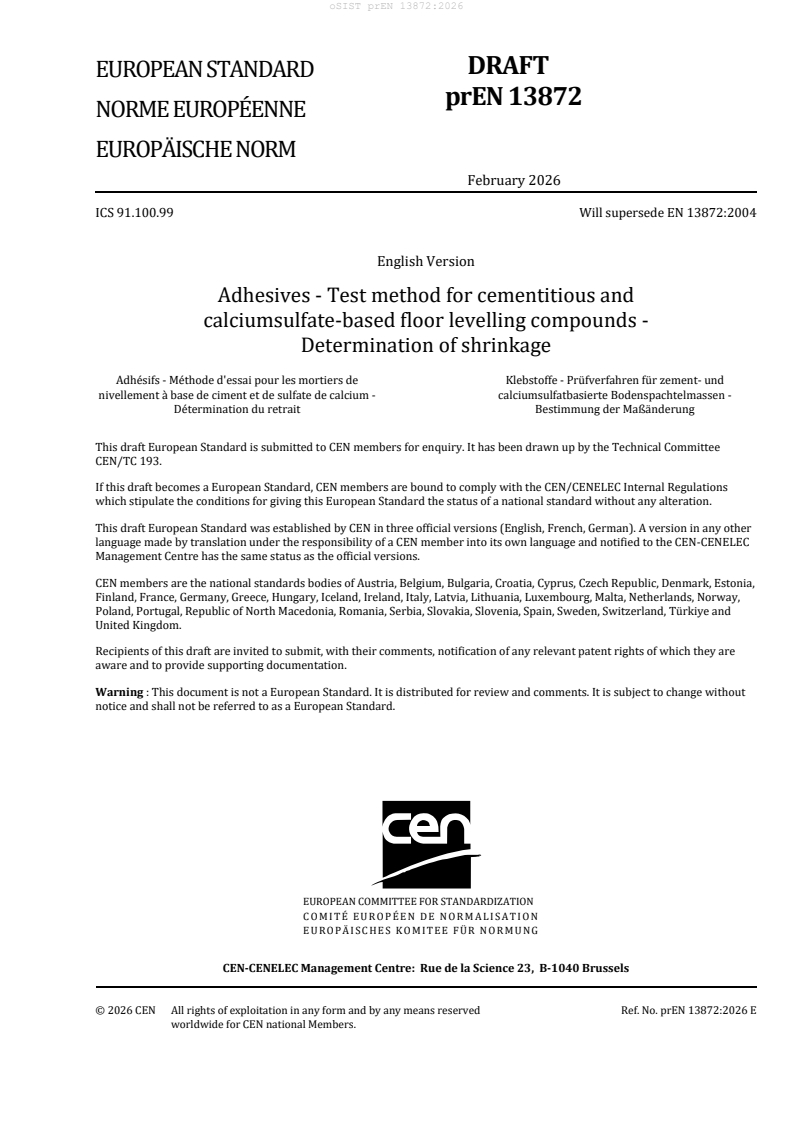
DRAFT
EUROPEAN STANDARD
prEN 13872
NORME EUROPÉENNE
EUROPÄISCHE NORM
February 2026
ICS 91.100.99 Will supersede EN 13872:2004
English Version
Adhesives - Test method for cementitious and
calciumsulfate-based floor levelling compounds -
Determination of shrinkage
Adhésifs - Méthode d'essai pour les mortiers de Klebstoffe - Prüfverfahren für zement- und
nivellement à base de ciment et de sulfate de calcium - calciumsulfatbasierte Bodenspachtelmassen -
Détermination du retrait Bestimmung der Maßänderung
This draft European Standard is submitted to CEN members for enquiry. It has been drawn up by the Technical Committee
CEN/TC 193.
If this draft becomes a European Standard, CEN members are bound to comply with the CEN/CENELEC Internal Regulations
which stipulate the conditions for giving this European Standard the status of a national standard without any alteration.
This draft European Standard was established by CEN in three official versions (English, French, German). A version in any other
language made by translation under the responsibility of a CEN member into its own language and notified to the CEN-CENELEC
Management Centre has the same status as the official versions.
CEN members are the national standards bodies of Austria, Belgium, Bulgaria, Croatia, Cyprus, Czech Republic, Denmark, Estonia,
Finland, France, Germany, Greece, Hungary, Iceland, Ireland, Italy, Latvia, Lithuania, Luxembourg, Malta, Netherlands, Norway,
Poland, Portugal, Republic of North Macedonia, Romania, Serbia, Slovakia, Slovenia, Spain, Sweden, Switzerland, Türkiye and
United Kingdom.
Recipients of this draft are invited to submit, with their comments, notification of any relevant patent rights of which they are
aware and to provide supporting documentation.
Warning : This document is not a European Standard. It is distributed for review and comments. It is subject to change without
notice and shall not be referred to as a European Standard.
EUROPEAN COMMITTEE FOR STANDARDIZATION
COMITÉ EUROPÉEN DE NORMALISATION
EUROPÄISCHES KOMITEE FÜR NORMUNG
CEN-CENELEC Management Centre: Rue de la Science 23, B-1040 Brussels
© 2026 CEN All rights of exploitation in any form and by any means reserved Ref. No. prEN 13872:2026 E
worldwide for CEN national Members.
prEN 13872:2026 (E)
Contents Page
European foreword . 3
Introduction . 4
1 Scope . 5
2 Normative references . 5
3 Terms and definitions . 5
4 Principle . 5
5 Apparatus and material . 6
6 Standard test conditions . 12
7 Procedure . 12
7.1 Preparation of the moulds . 12
7.2 Test procedure . 12
7.3 Dimensional change after water immersion . 13
8 Evaluation and expression of results . 13
9 Test report . 14
prEN 13872:2026 (E)
European foreword
This document (prEN 13872:2026) has been prepared by Technical Committee CEN/TC 193 “Adhesives”,
the secretariat of which is held by UNE.
This document is currently submitted to the CEN Enquiry.
This document will supersede EN 13872:2004.
prEN 13872:2026 includes the following significant technical changes with respect to EN 13872:2004:
— term “hydraulic setting floor smoothing and/or levelling compounds” changed to “cementitious and
calciumsulfate-based floor levelling compounds”;
— concretisation of the scope;
— editorial changes.
prEN 13872:2026 (E)
Introduction
Persons using this document are to be familiar with normal laboratory practice.
This document does not purport to address all the safety problems, if any, associated with its use.
It is the responsibility of the user to establish health and safety practices and to ensure compliance with
any European and national regulatory conditions.
prEN 13872:2026 (E)
1 Scope
This document specifies the measurement of dimensional change of set cementitious and calcium sulfate-
based floor levelling compounds after mixing with a liquid, e.g. water.
This document applies to cementitious and calcium sulfate-based floor levelling compounds used for the
preparation of subfloors to ensure the suitability of the substrate prior to the installation of floor
coverings. By using the floor levelling compound, a homogeneous layer is built up on the load-bearing
substrate, to ensure consistent absorbency, evenness and strength.
2 Normative references
The following documents are referred to in the text in such a way that some or all of their content
constitutes requirements of this document. For dated references, only the edition cited applies. For
undated references, the latest edition of the referenced document (including any amendments) applies.
EN 196-1, Methods of testing cement — Part 1: Determination of strength
prEN 1937:2026, Adhesives — Test method for cementitious and calciumsulfate-based floor levelling
compounds — Standard mixing procedures
ISO 554, Standard atmospheres for conditioning and/or testing — Specifications
3 Terms and definitions
For the purposes of this document, the terms and definitions given in EN 923, prEN 1937:2026 and the
following apply.
ISO and IEC maintain terminology databases for use in standardization at the following addresses:
— ISO Online browsing platform: available at https://www.iso.org/obp/
— IEC Electropedia: available at https://www.electropedia.org/
3.1
dimensional change
difference in length of a test specimen of a set floor levelling compound after specified time and
conditions
3.2
shrinkage
negative dimensional change
3.3
expansion
positive dimensional change
4 Principle
This test method is carried out to assess the shrinkage and expansion of a set cement and calciumsulfate-
based floor levelling compounds by measuri
...