


EN 15429-3:2015
(Main)Sweepers - Part 3: Efficiency of particulate matter collection - Testing and Evaluation
Sweepers - Part 3: Efficiency of particulate matter collection - Testing and Evaluation
This European Standard establishes a method to assess the PM10 and PM2,5 efficiency of road sweepers. PM10 and PM2,5 efficiency includes a sweeper’s ability to:
- Remove and capture PM10 and PM2,5 particulate matter, and coarse size fractions, from typical urban road surfaces;
- Minimize the amount of airborne and entrained PM10 and PM2,5 particulate matter resulting from the sweeping process.
The sweeper’s ability to remove and capture particulate matter and coarse size fractions is assessed using procedures and equipment to determine the amount of a test material (consisting of particulate matter and coarser size fractions) the sweeper is able to remove from a test surface during a controlled test run. This test measurement is used to calculate the removal efficiency for the sweeper.
The sweeper’s ability to minimize the amount of airborne and entrained particulate matter is also assessed using procedures and equipment to determine the airborne concentrations of PM10 and PM2,5 resulting from the sweeping of a test material (consisting of particulate matter and coarser size fractions) during a controlled test run. The test measurements are used to calculate PM10 and PM2,5 emission ratings for the sweeper.
This test allows the use of dust suppression water. Sweepers configured as flushing machines, or equipped with front-mounted spray bars which are not part of a dust suppression water system are not within the scope of this test.
The road sweeper’s performance results are reported in a quantitative numerical format that will allow comparative assessments of similarly classified sweepers. This test does not specify pass/fail criteria for the PM10 and PM2,5 efficiency measurements specified in the test procedure.
This test is applicable to truck mounted, self-propelled, towed and attached sweeping equipment as defined in EN 15429-1:2007, Clause 2.
This test is a model/type test, requiring the sweeper being tested to be representative of all factory production of that particular sweeper model.
Kehrmaschinen - Teil 3: Aufnahmefähigkeit von Feinstaub - Prüfung und Bewertung
Diese Europäische Norm legt ein Verfahren zur Bewertung der Fähigkeit von Straßenkehrmaschinen zur Aufnahme von PM10 Feinstaub und PM2,5 Feinstaub fest. Die Aufnahmefähigkeit von PM10 und PM2,5 Feinstaub schließt die Fähigkeit einer Kehrmaschine ein:
PM10 und PM2,5 Feinstaub und grobe Kornfraktionen von typischen städtischen Fahrbahnen zu entfernen und aufzunehmen;
die sich aus dem Kehrvorgang ergebende Menge an Schwebstoffen und mitgerissenem PM10 und PM2,5 Feinstaub zu minimieren.
Die Fähigkeit einer Kehrmaschine, Feinstaub und grobe Kornfraktionen zu entfernen und aufzunehmen, wird unter Anwendung von Verfahren und Ausrüstungen zur Bestimmung der Menge eines Prüfmaterials (bestehend aus Feinstaub und grobkörnigeren Fraktionen) bewertet, die die Kehrmaschine während einer genau festgelegten Prüffahrt von einer Prüffläche entfernen kann. Die Messwerte dieser Prüfung werden angewendet, um die Kehrleistung der Kehrmaschine zu berechnen.
Die Fähigkeit der Kehrmaschine, die Menge an Schwebstoffen und mitgerissenem Feinstaub zu minimieren wird auch unter Anwendung von Verfahren und Ausrüstungen zum Bestimmen der Konzentrationen an PM10 und PM2,5 in der Luft bewertet, die sich aus dem Aufnehmen eines Prüfmaterials (bestehend aus Feinstaub und gröberen Kornfraktionen) während einer genau festgelegten Prüffahrt ergibt. Die Messwerte dieser Prüfung werden angewendet, um die von PM10 und PM2,5 Emissionswerte für die Kehrmaschine zu berechnen.
Diese Prüfung ermöglicht die Verwendung von Wasser zur Bindung von Staub. Kehrmaschinen, die als Spülfahrzeug ausgelegt oder mit frontseitig montierten Sprühbalken ausgestattet sind, die kein Teil eines Systems zur Bindung von Staub unter Anwendung von Wasser sind, fallen nicht in den Anwendungsbereich dieses Prüfverfahrens.
Die Ergebnisse der Aufnahmefähigkeit der Kehrmaschine werden in einem quantitativen numerischen Format angegeben, das vergleichende Bewertungen von ähnlich klassifizierten Kehrmaschinen ermöglicht. Diese Prüfung legt keine Qualifikationskriterien (Bestanden/Nicht bestanden) für die im Prüfverfahren angegebenen Messungen der Aufnahmefähigkeit von PM10 und PM2,5 Feinstaub fest.
Diese Prüfung ist für Lkw-Aufbau-Kehrmaschinen, selbstfahrende, gezogene und angebaute Kehrmaschinen anwendbar, wie in EN 15429-1:2007, Abschnitt 2, festgelegt.
Diese Prüfung ist ein(e) Modellversuch/Typprüfung, die bei der geprüften Kehrmaschine voraussetzt, dass sie für die gesamte Fabrikproduktion dieses speziellen Kehrmaschinenmodells repräsentativ ist.
Balayeuses - Partie 3: Efficacité de la collecte des matières particulaires - Essai et évaluation
Cet essai établit une méthode permettant d’évaluer l’efficacité d’élimination des MP10 et MP2,5 par les balayeuses de voirie. L’efficacité d’élimination des MP10 et MP2,5 comprend la capacité de la balayeuse :
à éliminer et à capturer les matières particulaires MP10 et MP2,5 ainsi que les fractions granulométriques grossières des chaussées urbaines type ;
à réduire le plus possible la quantité de matières particulaires MP10 et MP2,5 en suspension dans l’air et entraînées résultant du processus de balayage.
La capacité de la balayeuse à éliminer et à capturer les matières particulaires et les fractions granulométriques grossières est évaluée à l’aide de modes opératoires et d’équipements permettant de déterminer la quantité d’un matériau d’essai (composé de matières particulaires et de fractions granulométriques plus grossières) que la balayeuse est capable d’éliminer d’une surface d’essai au cours d’un cycle d’essai contrôlé. Cette mesure d’essai sert à calculer l’efficacité d’élimination de la balayeuse.
La capacité de la balayeuse à réduire le plus possible la quantité de matières particulaires en suspension dans l’air et entraînées est également évaluée à l’aide de modes opératoires et d’équipements permettant de déterminer les concentrations aériennes de MP10 et MP2,5 résultant du balayage d’un matériau d’essai (composé de matières particulaires et de fractions granulométriques plus grossières) au cours d’un cycle d’essai contrôlé. Ces mesures d’essai servent à calculer les taux d’émission de MP10 et MP2,5 de la balayeuse.
Il est admis d’utiliser l’eau de suppression des poussières pour cet essai. Les balayeuses configurées comme des machines d’arrosage ou équipées de rampes de pulvérisation montées à l’avant qui ne font pas partie d’un système d’eau de suppression des poussières ne relèvent pas du domaine d’application de cet essai.
Les résultats de performance de la balayeuse de voirie sont consignés dans un format numérique quantitatif permettant de réaliser des évaluations comparatives des balayeuses classées de manière similaire. Cet essai ne spécifie pas de critères de réussite/d’échec pour les mesures d’efficacité d’élimination des MP10 et MP2,5 qui sont spécifiées dans le mode opératoire d’essai.
Cet essai est applicable aux dispositifs de balayage montés sur camion, autopropulsés, tractés et fixés, tel que défini à l’Article 2 de l’EN 15429-1.
Cet essai est un essai modèle/type nécessitant que la balayeuse soumise à l’essai soit représentative de toute la production en usine de ce modèle particulier.
Stroji za pometanje – 3. del: Učinkovitost zbiranja drobnih delcev - Preskušanje in ocenjevanje
Ta preskus določa metodo za oceno učinkovitosti strojev za pometanje cest PM10 in PM2.5. Učinkovitost strojev za pometanje PM10 in PM2.5 vključuje:
– sposobnost, da PM10 in PM2.5 odstranjujeta in zajemata delce ter dele večjih profilov s tipičnih mestnih cestnih površin;
– sposobnost, da PM10 in PM2.5 kar najbolj zmanjšata količino trdnih delcev, ki se v procesu pometanja dvigujejo v zrak.
Sposobnost stroja za odstranjevanje in zajemanje delcev ter delov večjih profilov se ovrednoti z uporabo postopkov in opreme za določitev količine preskusnega materiala (sestavljenega iz trdnih delcev in delov večjih profilov), ki ga stroj lahko odstrani s preskusne površine v nadzorovanih pogojih preskusa. Preskusno merjenje se uporablja za izračun učinkovitosti delovanja stroja.
Sposobnost stroja, da kar najbolj zmanjša količino trdnih delcev, ki se dvignejo v zrak v procesu pometanja, se prav tako ovrednoti s postopki in opremo za določitev koncentracije delcev v zraku, ki nastanejo pri pometanju preskusnega materiala s strojema PM10 in PM2.5 (pri pometanju delcev in delov večjih profilov) v nadzorovanih pogojih preskusa. Preskusne meritve se uporabljajo za izračun stopnje emisij strojev za pometanje PM10 in PM2.5.
Preskus omogoča uporabo vode za zadušitev prahu. Stroji za pometanje, ki so konfigurirani kot splakovalni stroji ali imajo na sprednjem delu montirana pršila, ki niso del sistema za vodno zadušitev prahu, ne spadajo na področje uporabe tega preskusa.
Rezultati učinkovitosti strojev za pometanje se sporočajo v kvantitativni številčni obliki, ki omogoča primerjavo s podobno razvrščenimi stroji za pometanje. Ta preskus ne določa meritev učinkovitosti strojev PM10 in PM2.5, opredeljenih v postopku preskusa, v obliki preskus opravljen/preskus ni opravljen.
Ta preskus se uporablja za opremo za pometanje, ki je montirana na vozilo, z lastnim pogonom, vlečena in pritrjena, kot je opredeljeno v oddelku 2 standarda EN 15429-1.
Ta preskus je preskus modela/tipa stroja za pometanje, ki je primerek celotne tovarniške proizvodnje zadevnega stroja.
General Information
- Status
- Published
- Publication Date
- 17-Mar-2015
- Withdrawal Date
- 29-Sep-2015
- Technical Committee
- CEN/TC 337 - Winter maintenance and road service area maintenance equipment
- Drafting Committee
- CEN/TC 337/WG 4 - Road cleaning equipment
- Current Stage
- 9093 - Decision to confirm - Review Enquiry
- Start Date
- 01-Oct-2020
- Completion Date
- 23-Sep-2025
Overview
EN 15429-3:2015 (CEN) defines a laboratory-based method to assess the PM10 and PM2.5 efficiency of road sweepers. The standard measures two complementary outcomes: the sweeper’s ability to remove and capture particulate matter (including coarser fractions) from road surfaces, and its ability to minimise airborne and entrained PM10/PM2.5 generated during sweeping. Results are reported as quantitative numerical performance metrics (removal efficiency and PM emission rating) to enable comparative assessments - the standard does not set pass/fail criteria.
Key Topics and Requirements
- Scope and applicability: Applies to truck-mounted, self-propelled, towed and attached sweepers as defined in EN 15429-1. It is a model/type test requiring the tested unit to represent production models.
- Controlled test facility: Tests are performed within an enclosed facility creating a reproducible environment; the central sweeper test area is typically 20 m long.
- Test material and application: A defined test material (particulate matter plus coarser fractions) is applied at known density and location on the test surface to determine removal efficiency.
- Measurements:
- Removal efficiency: Determined by quantifying material removed from the test surface versus material remaining (vacuum collection of residuals recommended).
- PM emission rating: Determined by aerosol dust monitors positioned (e.g., at adult nose height) to record PM10 and PM2.5 concentrations during runs.
- Test procedure details:
- A sweeper test comprises four individual runs; the three most consistent runs with the lowest emission ratings and highest removal efficiencies are averaged for final results.
- Dust suppression water is allowed (application rate must be measured and reported). Flushing machines and front-mounted spray bars that are not part of a dust suppression system are excluded.
- Operational settings must be documented and remain constant for a test series; changes require a new series of four runs.
- Referenced standards: EN 12341 (PM measurement), EN 15429-1, EN 60335-2-69.
Applications and Users
- Municipalities and local authorities evaluating sweeper options to reduce urban particulate pollution.
- Manufacturers and R&D teams validating model/type performance for design optimization and marketing.
- Test laboratories and certification bodies conducting standardized performance assessments.
- Procurement specialists and environmental managers comparing sweepers by objective PM removal and emission metrics.
Related Standards (if applicable)
- EN 15429-1: Classification and Terminology for sweepers - defines vehicle types referenced in EN 15429-3.
- EN 12341: Reference gravimetric method for PM10/PM2.5 - normative reference for size-selective sampling.
- EN 60335-2-69: Requirements for industrial wet/dry vacuums - relevant for residual collection.
Keywords: EN 15429-3:2015, sweepers, PM10, PM2.5, particulate matter testing, removal efficiency, PM emission rating, dust suppression water, road sweeper standards.

Frequently Asked Questions
EN 15429-3:2015 is a standard published by the European Committee for Standardization (CEN). Its full title is "Sweepers - Part 3: Efficiency of particulate matter collection - Testing and Evaluation". This standard covers: This European Standard establishes a method to assess the PM10 and PM2,5 efficiency of road sweepers. PM10 and PM2,5 efficiency includes a sweeper’s ability to: - Remove and capture PM10 and PM2,5 particulate matter, and coarse size fractions, from typical urban road surfaces; - Minimize the amount of airborne and entrained PM10 and PM2,5 particulate matter resulting from the sweeping process. The sweeper’s ability to remove and capture particulate matter and coarse size fractions is assessed using procedures and equipment to determine the amount of a test material (consisting of particulate matter and coarser size fractions) the sweeper is able to remove from a test surface during a controlled test run. This test measurement is used to calculate the removal efficiency for the sweeper. The sweeper’s ability to minimize the amount of airborne and entrained particulate matter is also assessed using procedures and equipment to determine the airborne concentrations of PM10 and PM2,5 resulting from the sweeping of a test material (consisting of particulate matter and coarser size fractions) during a controlled test run. The test measurements are used to calculate PM10 and PM2,5 emission ratings for the sweeper. This test allows the use of dust suppression water. Sweepers configured as flushing machines, or equipped with front-mounted spray bars which are not part of a dust suppression water system are not within the scope of this test. The road sweeper’s performance results are reported in a quantitative numerical format that will allow comparative assessments of similarly classified sweepers. This test does not specify pass/fail criteria for the PM10 and PM2,5 efficiency measurements specified in the test procedure. This test is applicable to truck mounted, self-propelled, towed and attached sweeping equipment as defined in EN 15429-1:2007, Clause 2. This test is a model/type test, requiring the sweeper being tested to be representative of all factory production of that particular sweeper model.
This European Standard establishes a method to assess the PM10 and PM2,5 efficiency of road sweepers. PM10 and PM2,5 efficiency includes a sweeper’s ability to: - Remove and capture PM10 and PM2,5 particulate matter, and coarse size fractions, from typical urban road surfaces; - Minimize the amount of airborne and entrained PM10 and PM2,5 particulate matter resulting from the sweeping process. The sweeper’s ability to remove and capture particulate matter and coarse size fractions is assessed using procedures and equipment to determine the amount of a test material (consisting of particulate matter and coarser size fractions) the sweeper is able to remove from a test surface during a controlled test run. This test measurement is used to calculate the removal efficiency for the sweeper. The sweeper’s ability to minimize the amount of airborne and entrained particulate matter is also assessed using procedures and equipment to determine the airborne concentrations of PM10 and PM2,5 resulting from the sweeping of a test material (consisting of particulate matter and coarser size fractions) during a controlled test run. The test measurements are used to calculate PM10 and PM2,5 emission ratings for the sweeper. This test allows the use of dust suppression water. Sweepers configured as flushing machines, or equipped with front-mounted spray bars which are not part of a dust suppression water system are not within the scope of this test. The road sweeper’s performance results are reported in a quantitative numerical format that will allow comparative assessments of similarly classified sweepers. This test does not specify pass/fail criteria for the PM10 and PM2,5 efficiency measurements specified in the test procedure. This test is applicable to truck mounted, self-propelled, towed and attached sweeping equipment as defined in EN 15429-1:2007, Clause 2. This test is a model/type test, requiring the sweeper being tested to be representative of all factory production of that particular sweeper model.
EN 15429-3:2015 is classified under the following ICS (International Classification for Standards) categories: 43.160 - Special purpose vehicles. The ICS classification helps identify the subject area and facilitates finding related standards.
You can purchase EN 15429-3:2015 directly from iTeh Standards. The document is available in PDF format and is delivered instantly after payment. Add the standard to your cart and complete the secure checkout process. iTeh Standards is an authorized distributor of CEN standards.
Standards Content (Sample)
2003-01.Slovenski inštitut za standardizacijo. Razmnoževanje celote ali delov tega standarda ni dovoljeno.RFHQMHYDQMHKehrmaschinen - Teil 3: Aufnahmefähigkeit von Feinstaub - Prüfung und BewertungBalayeuses - Partie 3: Efficacité de la collecte des matières particulaires - Essai et évaluationSweepers - Part 3: Efficiency of particulate matter collection - Testing and Evaluation43.160Vozila za posebne nameneSpecial purpose vehicles13.030.40Naprave in oprema za odstranjevanje in obdelavo odpadkovInstallations and equipment for waste disposal and treatmentICS:Ta slovenski standard je istoveten z:EN 15429-3:2015SIST EN 15429-3:2015en01-maj-2015SIST EN 15429-3:2015SLOVENSKI
STANDARD
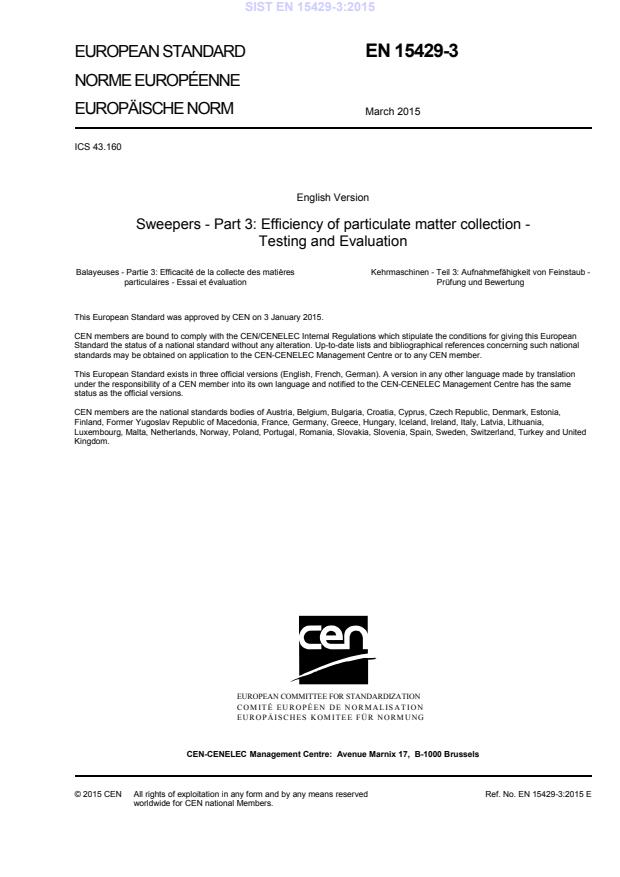
EUROPEAN STANDARD NORME EUROPÉENNE EUROPÄISCHE NORM
EN 15429-3
March 2015 ICS 43.160 English Version
Sweepers - Part 3: Efficiency of particulate matter collection - Testing and Evaluation
Balayeuses - Partie 3: Efficacité de la collecte des matières particulaires - Essai et évaluation
Kehrmaschinen - Teil 3: Aufnahmefähigkeit von Feinstaub -Prüfung und Bewertung This European Standard was approved by CEN on 3 January 2015.
CEN members are bound to comply with the CEN/CENELEC Internal Regulations which stipulate the conditions for giving this European Standard the status of a national standard without any alteration. Up-to-date lists and bibliographical references concerning such national standards may be obtained on application to the CEN-CENELEC Management Centre or to any CEN member.
This European Standard exists in three official versions (English, French, German). A version in any other language made by translation under the responsibility of a CEN member into its own language and notified to the CEN-CENELEC Management Centre has the same status as the official versions.
CEN members are the national standards bodies of Austria, Belgium, Bulgaria, Croatia, Cyprus, Czech Republic, Denmark, Estonia, Finland, Former Yugoslav Republic of Macedonia, France, Germany, Greece, Hungary, Iceland, Ireland, Italy, Latvia, Lithuania, Luxembourg, Malta, Netherlands, Norway, Poland, Portugal, Romania, Slovakia, Slovenia, Spain, Sweden, Switzerland, Turkey and United Kingdom.
EUROPEAN COMMITTEE FOR STANDARDIZATION
COMITÉ EUROPÉEN DE NORMALISATION EUROPÄISCHES KOMITEE FÜR NORMUNG
CEN-CENELEC Management Centre:
Avenue Marnix 17,
B-1000 Brussels © 2015 CEN All rights of exploitation in any form and by any means reserved worldwide for CEN national Members. Ref. No. EN 15429-3:2015 ESIST EN 15429-3:2015
Standard gravimetric measurement method for the determination of the PM10 or PM2,5 mass concentration of suspended particulate matter EN 15429-1:2007, Sweepers
Part 1: Classification and Terminology EN 60335-2-69, Household and similar electrical appliances
Safety
Part 2-69: Particular requirements for wet and dry vacuums, including power brush, for industrial and commercial use (IEC 60335-2-69) 3 Terms and definitions For the purposes of this document, the terms and definitions given in EN 15429-1 and the following apply. SIST EN 15429-3:2015
...
記事のタイトル:EN 15429-3:2015 - スイーパー - 第3部:粒子物質の集塵効率 - 試験と評価 記事の内容:この欧州標準では、道路スイーパーのPM10およびPM2.5の効率性を評価する方法を確立しています。PM10およびPM2.5の効率性には、スイーパーの以下の能力が含まれます: - 典型的な都市道路の表面からPM10およびPM2.5の粒子物質および粗い粒子径分布を取り除き、捕集する能力; - 掃除工程から発生する空中および捕集されたPM10およびPM2.5の粒子物質の量を最小化する能力。 粒子物質および粗い粒子径分布の除去および捕集能力は、制御された試験走行中にテスト表面からスイーパーが除去できる試験材料の量を決定するための手順と機器を使用して評価されます。この試験測定値は、スイーパーの除去効率を計算するために使用されます。 空中および捕集された粒子物質の量を最小化する能力は、また、制御された試験走行中にテスト材料の掃除によって生成されるPM10およびPM2.5の空中濃度を決定する手順と機器を使用して評価されます。試験の測定値は、スイーパーのPM10およびPM2.5の排出評価を計算するために使用されます。 この試験では、防塵用水の使用が許可されます。フラッシュ掃除機や防塵用水システムの一部ではない前方に取り付けられた噴霧棒を装備したスイーパーは、この試験の対象外です。 道路スイーパーの性能結果は、同じように分類された他のスイーパーと比較することができるように、数量的な数値形式で報告されます。この試験は、EN 15429-1:2007、項2で定義されたトラックマウント、自走式、牽引式、取り付け式の掃除機に適用されます。 このテストは、テストされるスイーパーモデルの全ての工場生産を代表する必要があるモデル/タイプテストです。
The European Standard EN 15429-3:2015 establishes a method for assessing the efficiency of road sweepers in collecting particulate matter, specifically PM10 and PM2.5. This includes the sweeper's ability to remove and capture particulate matter from urban road surfaces and minimize the amount of airborne particulate matter during the sweeping process. The assessment is done through controlled tests measuring the amount of test material (particulate matter and coarser size fractions) the sweeper can remove from a test surface, as well as the concentrations of airborne PM10 and PM2.5 during the test. The test results are reported numerically, allowing for comparison between similar sweepers. This test is applicable to various types of sweeping equipment and is representative of the sweeper model being tested.
기사 제목: EN 15429-3:2015 - 스위퍼 - 파트 3: 입자 물질 수집 효율성 - 시험 및 평가 기사 내용: 이 유럽 표준은 도로 스위퍼의 PM10 및 PM2.5 효율성을 평가하는 방법을 제시한다. PM10 및 PM2.5 효율성은 스위퍼의 다음 능력을 포함한다: - 일반 도시 도로 표면에서의 PM10 및 PM2.5 입자 물질 및 거친 입자 크기 분포물을 제거하고 포집하는 능력; - 쓸기 과정에서 발생하는 공중 및 포집된 PM10 및 PM2.5 입자 물질의 양을 최소화하는 능력. 스위퍼의 입자 물질 및 거친 입자 크기 분포물 제거 및 포집 능력은 제어된 시험 운영 중 테스트 표면에서 스위퍼가 제거할 수 있는 시료의 양을 결정하는 절차와 장비를 사용하여 평가된다. 이 테스트 측정치는 스위퍼의 제거 효율성을 계산하는 데 사용된다. 스위퍼의 공중 및 포집된 입자 물질의 양을 최소화하는 능력은 또한 제어된 시험 운영 중 테스트 표면의 쓸기로 인해 발생하는 PM10 및 PM2.5 공중 농도를 결정하는 절차와 장비를 사용하여 평가된다. 이 테스트 측정치는 스위퍼의 PM10 및 PM2.5 배출 평가를 계산하는 데 사용된다. 이 테스트는 먼지 억제용 물 사용을 허용한다. 플러싱 머신으로 구성된 스위퍼나 먼지 억제용 물 시스템의 일부가 아닌 앞 부착식 분무기를 장착한 스위퍼는 이 테스트의 범위에 포함되지 않는다. 도로 스위퍼의 성능 결과는 유사하게 분류된 스위퍼들 간에 비교 평가가 가능하도록 양적 수치 형태로 보고된다. 이 테스트는 테스트 절차에서 지정된 PM10 및 PM2.5 효율성 측정에 대한 합격/불합격 기준을 명시하지 않는다. 이 테스트는 EN 15429-1:2007, 문항 2에서 정의된 트럭 마운트, 자행, 견인 및 부착 스위핑 장비에 적용된다. 이 테스트는 유형 모델 테스트로, 테스트되는 스위퍼가 해당 스위퍼 모델의 공장 생산 전체를 대표하는 것을 요구한다.
Questions, Comments and Discussion
Ask us and Technical Secretary will try to provide an answer. You can facilitate discussion about the standard in here.
Loading comments...