

prEN 2593-001
(Main)Aerospace series — Bases for 10 A electromagnetic plug-in relays, two and four poles double thrown — Part 001: Technical specification
- Abstract
The present document specifies the characteristics, installation and mounting dimensions for plug-in relay bases for use with two and four poles double throw relays in accordance with EN 2548-001.
Relay bases in accordance with this document shall be used at ambient temperatures between −70 °C and 125 °C and at altitudes up to 25 000 m.
- Status
- Not Published
- Publication Date
- 17-Jan-2028
- Technical Committee
- ASD-STAN - Aerospace
- Drafting Committee
- ASD-STAN/D 2/WG 4 - Relays, Switches, Push-Buttons
- Current Stage
- 4020 - Submission to enquiry - Enquiry
- Start Date
- 27-Aug-2026
- Completion Date
- 27-Aug-2026

prEN 2593-001 is a CEN draft European Standard for aerospace bases for 10 A electromagnetic plug-in relays, two and four poles double thrown. It specifies the characteristics, installation and mounting dimensions for plug-in relay bases used with relays in accordance with EN 2548-001, for designers, manufacturers, testers and buyers in aerospace. The document covers bases intended for ambient temperatures from −70 °C to 125 °C and altitudes up to 25 000 m.
What does prEN 2593-001 specify?
prEN 2593-001 specifies the technical specification for plug-in relay bases in the aerospace series. It gives the design, dimensions, materials, qualification testing, quality assurance, marking, delivery, packaging and storage rules that make the base suitable for use with the matching relay family.
The document is organized into 12 clauses plus a bibliography:
- Scope, normative references, and terms and definitions
- Design and description of the base
- Definition drawings and mass
- Qualification tests and quality assurance
- Designation and marking
- Delivery conditions, packaging, and storage
Clause 1 limits the application to two and four poles double throw relays in accordance with EN 2548-001 and states the temperature and altitude range. Clause 2 names the standards that become part of the requirements, while Clauses 7 and 8 set out qualification and acceptance control.
What are the key requirements of prEN 2593-001?
prEN 2593-001 is mainly a construction, compatibility and verification standard. It tells manufacturers how to build the relay base, how to prove it meets the specification, and how to control production.
Design and mounting
- Clause 4.1 requires the base construction to keep the associated components together through normal service life, and the retaining clip to hold the crimp contacts permanently. In practice, the assembly must not loosen or separate in use.
- Clause 4.2 points to EN 2593-003, EN 2593-004 and EN 2593-005 for dimensions. This means the actual mounting geometry is controlled by the matching product standard.
- Clause 5.1 specifies the socket body, sealing rubber and crimp contacts, and Clause 4.8 requires metal parts to meet EN 2349-100, with hardware in non-magnetic corrosion resistance steel. In practice, material selection is part of conformity control, not a free design choice.
- Clause 5.2 requires a silicon rubber interface seal between relay and base, and between base and wiring, with added electrical isolation. This matters because the seal must stop environmental contamination without damaging the assembly.
- Clause 5.3 uses polarizing holes or keying so that the relay can be installed only in the correct base position. That helps prevent mismating during assembly or maintenance.
- Clause 6 requires layouts for all arrangements to be provided. This gives installers and testers the positional information they need for the different base versions.
Qualification and quality assurance
- Clause 7 requires qualification tests, performed with the mating relay, against the EN 2349 test methods listed in the table. The test plan covers visual, dimensional, environmental, mechanical and electrical checks.
- Clauses 8.1 to 8.4 make the manufacturer responsible for materials, process control, qualification testing, acceptance testing and retention of qualification records for at least five years. In practice, the supplier must be able to show evidence of control at any time.
- Clause 8.3 requires product acceptance testing before delivery, and batch acceptance testing when contractually required. Clause 8.4 requires qualification maintenance every three years.
- The acceptance tables use Acceptance Quality Limit (AQL) values for batch control. That gives purchasers a defined inspection basis for lot release.
Marking, delivery and storage
- Clause 9 requires marking on the relay base body, including the EN reference, date of manufacture, manufacturer identification and terminal identification unless otherwise specified.
- Clauses 10 to 12 require accessories to be packed separately, relay bases and accessories to be delivered in individual plastic bags, and storage in the original package under normal conditions with protection from ultraviolet rays.
What terms does prEN 2593-001 define?
- Acceptance Quality Limit (AQL) - The acceptance level used for batch inspection in Clause 8.3.2.
- Product acceptance test - The test set applied to each relay base before delivery to confirm basic conformity.
- Batch acceptance test - The optional lot-level inspection carried out when contract requirements call for it.
- Qualification maintenance - The periodic re-test program used to retain type qualification over time.
- Polarizing holes - Holes in two-pole bases that match the relay polarizing pins and prevent incorrect installation.
- Interface seal - The silicon rubber sealing element between relay, base and wiring that limits environmental ingress and adds isolation.
- Crimp contacts - The electrical contacts used for the relay base connections, specified through EN 3155-017.
Who uses prEN 2593-001?
prEN 2593-001 is used by aerospace relay-base manufacturers, relay suppliers, design engineers, quality managers, and test laboratories. Procurement teams use it to specify the correct base version and acceptance controls, while inspectors use it for qualification, batch acceptance and marking checks. It is also relevant to anyone matching a relay base to an EN 2548-001 relay in a controlled aerospace electrical system.
What changed in prEN 2593-001 from the previous edition?
prEN 2593-001:2026 supersedes EN 2593-001:2014. The foreword states these changes:
- the note on gold-plated crimp-contact finish thickness was removed from 5.1
- Clause 6 now requires layouts for all arrangements
- Clause 9.1 adds the codes E, F, G, H, J and K in the designation
Which standards are used with prEN 2593-001?
| Standard | What it contributes |
|---|---|
| EN 2349 (all parts) | Common test procedures and requirements for switching devices used throughout the document |
| EN 2349-100 | Shared terms and definitions, plus material and construction requirements used in multiple clauses |
| EN 2548-001 | The matching relay specification for the two and four poles double throw relays |
| EN 2593-003 | Dimensions for the corresponding base version with non-captive fixation stud, metric |
| EN 2593-004 | Dimensions for the corresponding base version with melded-in fixation stud, unified |
| EN 2593-005 | Dimensions for the corresponding base version with melded-in fixation stud, metric |
| EN 3155-017 | The female crimp contacts used in the relay base |
What does the prEN 2593-001 document contain?
The document contains design requirements, material and sealing requirements, and keying arrangements for two-pole and four-pole bases. It also contains a qualification test table, product acceptance and batch acceptance tables, and a qualification maintenance sequence that links the relay base to the EN 2349 test methods.
It includes a designation example, marking rules, and instructions for delivery, packaging and storage. Clause 6 refers to layouts for all arrangements, so the document supports both engineering drawings and manufacturing control. The bibliography also identifies the MIL-DTL-12883/40 and MIL-DTL-12883/41 relay-base families from which the bases are derived.
Relations
- Effective Date
- 12-Mar-2025
Get Certified
Connect with accredited certification bodies for this standard

BUREAU VERITAS Certification Germany
Bureau Veritas certification in Germany.

Element Materials Technology
Materials testing and product certification.

AQMS Ltd.
AQMS provides ISO certification to SMEs across the UK.
Sponsored listings
Frequently Asked Questions
prEN 2593-001 is a draft published by the European Committee for Standardization (CEN). Its full title is "Aerospace series — Bases for 10 A electromagnetic plug-in relays, two and four poles double thrown — Part 001: Technical specification". This standard covers: The present document specifies the characteristics, installation and mounting dimensions for plug-in relay bases for use with two and four poles double throw relays in accordance with EN 2548-001. Relay bases in accordance with this document shall be used at ambient temperatures between −70 °C and 125 °C and at altitudes up to 25 000 m.
The present document specifies the characteristics, installation and mounting dimensions for plug-in relay bases for use with two and four poles double throw relays in accordance with EN 2548-001. Relay bases in accordance with this document shall be used at ambient temperatures between −70 °C and 125 °C and at altitudes up to 25 000 m.
prEN 2593-001 is classified under the following ICS (International Classification for Standards) categories: 49.060 - Aerospace electric equipment and systems. The ICS classification helps identify the subject area and facilitates finding related standards.
prEN 2593-001 has the following relationships with other standards: It is inter standard links to EN 2593-001:2014. Understanding these relationships helps ensure you are using the most current and applicable version of the standard.
prEN 2593-001 is available in PDF format for immediate download after purchase. The document can be added to your cart and obtained through the secure checkout process. Digital delivery ensures instant access to the complete standard document.
Standards Content (Sample)
SLOVENSKI STANDARD
01-november-2026
Aeronavtika - Vtičnice za elektromagnetne vtične dvopolne in štiripolne releje za
10 A - 001. del: Tehnične specifikacije
Aerospace series - Bases for 10 A electromagnetic plug-in relays, two and four poles
double thrown - Part 001: Technical specification
Luft- und Raumfahrt - Fassungen für steckbare, elektromagnetische Relais, 10 A, zwei-
und vierpolige Wechselschalter - Teil 001: Technische Lieferbedingungen
S�rie a�rospatiale - Socles pour relais �lectromagn�tiques 10 A, embrochables, deux et
quatre p�les inverseurs - Partie 001: Sp�cification technique
Ta slovenski standard je istoveten z: prEN 2593-001
ICS:
49.060 Letalska in vesoljska Aerospace electric
električna oprema in sistemi equipment and systems
2003-01.Slovenski inštitut za standardizacijo. Razmnoževanje celote ali delov tega standarda ni dovoljeno.
DRAFT
EUROPEAN STANDARD
NORME EUROPÉENNE
EUROPÄISCHE NORM
August 2026
ICS 49.060 Will supersede EN 2593-001:2014
English Version
Aerospace series - Bases for 10 A electromagnetic plug-in
relays, two and four poles double thrown - Part 001:
Technical specification
Se´rie ae´rospatiale - Socles pour relais Luft- und Raumfahrt - Fassungen für steckbare,
e´lectromagne´tiques 10 A, embrochables, deux et elektromagnetische Relais, 10 A, zwei- und vierpolige
quatre po^les inverseurs - Partie 001: Spe´cification Wechselschalter - Teil 001: Technische
technique Lieferbedingungen
This draft European Standard is submitted to CEN members for enquiry. It has been drawn up by the Technical Committee ASD-
STAN.
If this draft becomes a European Standard, CEN members are bound to comply with the CEN/CENELEC Internal Regulations
which stipulate the conditions for giving this European Standard the status of a national standard without any alteration.
This draft European Standard was established by CEN in three official versions (English, French, German). A version in any other
language made by translation under the responsibility of a CEN member into its own language and notified to the CEN-CENELEC
Management Centre has the same status as the official versions.
CEN members are the national standards bodies of Austria, Belgium, Bulgaria, Croatia, Cyprus, Czech Republic, Denmark, Estonia,
Finland, France, Germany, Greece, Hungary, Iceland, Ireland, Italy, Latvia, Lithuania, Luxembourg, Malta, Netherlands, Norway,
Poland, Portugal, Republic of North Macedonia, Romania, Serbia, Slovakia, Slovenia, Spain, Sweden, Switzerland, Türkiye and
United Kingdom.
Recipients of this draft are invited to submit, with their comments, notification of any relevant patent rights of which they are
aware and to provide supporting documentation.
Warning : This document is not a European Standard. It is distributed for review and comments. It is subject to change without
notice and shall not be referred to as a European Standard.
EUROPEAN COMMITTEE FOR STANDARDIZATION
COMITÉ EUROPÉEN DE NORMALISATION
EUROPÄISCHES KOMITEE FÜR NORMUNG
CEN-CENELEC Management Centre: Rue de la Science 23, B-1040 Brussels
© 2026 CEN All rights of exploitation in any form and by any means reserved Ref. No. prEN 2593-001:2026 E
worldwide for CEN national Members.
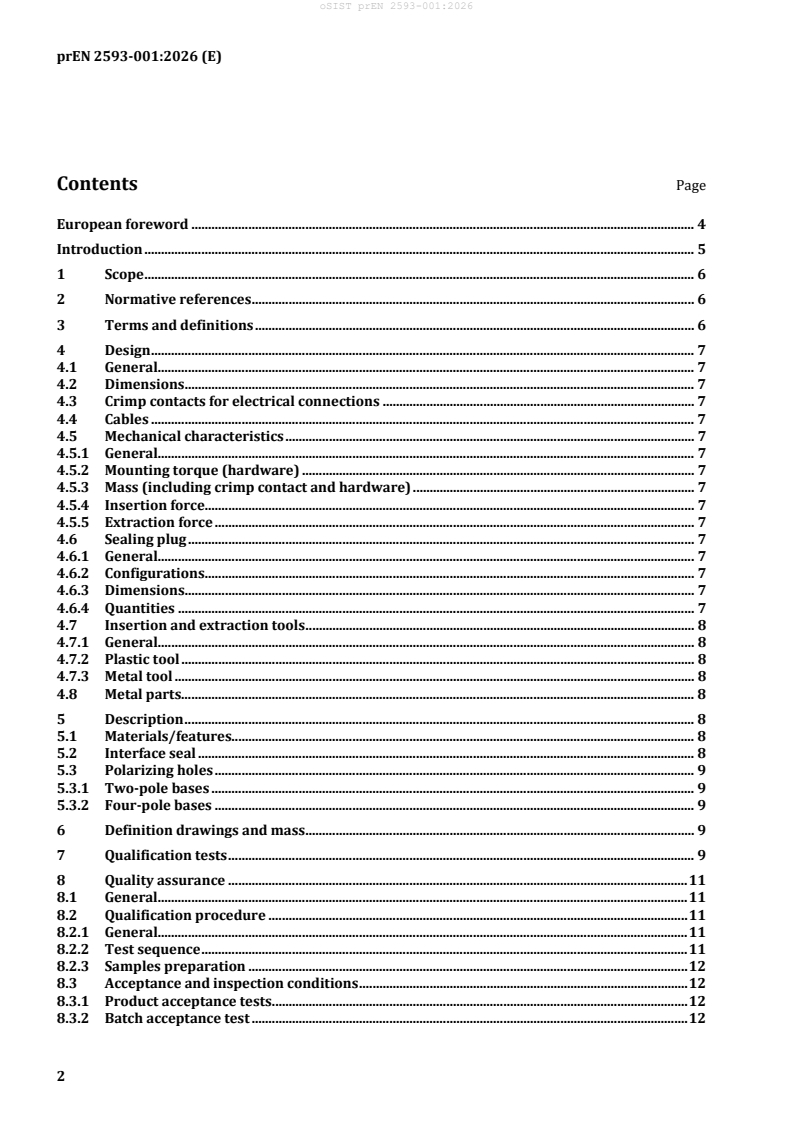
Contents Page
European foreword . 4
Introduction . 5
1 Scope . 6
2 Normative references . 6
3 Terms and definitions . 6
4 Design . 7
4.1 General. 7
4.2 Dimensions. 7
4.3 Crimp contacts for electrical connections . 7
4.4 Cables . 7
4.5 Mechanical characteristics . 7
4.5.1 General. 7
4.5.2 Mounting torque (hardware) . 7
4.5.3 Mass (including crimp contact and hardware) . 7
4.5.4 Insertion force. 7
4.5.5 Extraction force . 7
4.6 Sealing plug . 7
4.6.1 General. 7
4.6.2 Configurations . 7
4.6.3 Dimensions. 7
4.6.4 Quantities . 7
4.7 Insertion and extraction tools . 8
4.7.1 General. 8
4.7.2 Plastic tool . 8
4.7.3 Metal tool . 8
4.8 Metal parts. 8
5 Description . 8
5.1 Materials/features. 8
5.2 Interface seal . 8
5.3 Polarizing holes . 9
5.3.1 Two-pole bases . 9
5.3.2 Four-pole bases . 9
6 Definition drawings and mass . 9
7 Qualification tests . 9
8 Quality assurance . 11
8.1 General. 11
8.2 Qualification procedure . 11
8.2.1 General. 11
8.2.2 Test sequence . 11
8.2.3 Samples preparation . 12
8.3 Acceptance and inspection conditions . 12
8.3.1 Product acceptance tests . 12
8.3.2 Batch acceptance test . 12
8.4 Maintenance of qualification . 12
9 Designation and marking . 14
9.1 Designation . 14
9.2 Marking . 14
10 Delivery conditions . 14
11 Packaging . 14
12 Storage . 14
Bibliography . 15
European foreword
This document (prEN 2593-001:2026) has been prepared by ASD-STAN.
After enquiries and votes carried out in accordance with the rules of this Association, this document has
received the approval of the National Associations and the Official Services of the member countries of
ASD-STAN, prior to its presentation to CEN.
This document is currently submitted to the CEN Enquiry.
This document will supersede EN 2593-001:2014.
EN 2593-001:2014-12:
— remove the mention “The finish of the crimp contacts shall be: gold-plated — Thickness: 1,27 µm
min” in 5.1;
— add the requirement “layouts for all arrangements shall be provided” in 6;
— add the codes E, F, G, H, J and K in the designation in 9.1.
Introduction
The relay bases specified by this document are derived from MIL-DTL-12883/40 and MIL-DTL-
12883/41, latest issue.
1 Scope
The present document specifies the characteristics, installation and mounting dimensions for plug-in
relay bases for use with two and four poles double throw relays in accordance with EN 2548-001.
Relay bases in accordance with this document shall be used at ambient temperatures between −70 °C
and 125 °C and at altitudes up to 25 000 m.
2 Normative references
...