


EN ISO 1833-4:2023
(Main)Textiles - Quantitative chemical analysis - Part 4: Mixtures of certain protein fibres with certain other fibres (method using hypochlorite) (ISO 1833-4:2023)
Textiles - Quantitative chemical analysis - Part 4: Mixtures of certain protein fibres with certain other fibres (method using hypochlorite) (ISO 1833-4:2023)
This document specifies a method, using hypochlorite, to determine the mass percentage of protein fibre, after removal of non-fibrous matter, in textiles made of mixtures of certain non-protein fibres and certain protein fibres, as follows:
— wool, other animal-hair (such as cashmere, mohair), silk, protein,
with
— cotton, cupro, viscose, modal, acrylic, chlorofibres, polyamide, polyester, polypropylene, glass, elastane, elastomultiester, elastolefin, melamine and polypropylene/polyamide bicomponent.
Textilien - Quantitative chemische Analysen - Teil 4: Mischungen aus bestimmten Proteinfasern mit bestimmten anderen Fasern (Hypochlorit-Verfahren) (ISO 1833-4:2023)
Dieses Dokument legt ein Hypochlorit-Verfahren zur Bestimmung des prozentualen Massenanteils an Proteinfasern, nach Abtrennen der nichtfaserigen Begleitstoffe, in Textilien aus Mischungen aus bestimmten Nichtproteinfasern und bestimmten Proteinfasern aus
Wolle, anderen Tierhaaren (wie z. B. Kaschmir, Mohair), Seide, Protein
mit
Baumwolle, Cupro, Viskose, Modal, Polyacryl, Chlorfasern, Polyamid, Polyester, Polypropylen, Glas, Elasthan, Elastomultiester, Elastolefin, Melamin und Polypropylen/Polyamid Bikomponente
fest.
Textiles - Analyse chimique quantitative - Partie 4: Mélanges de certaines fibres protéiniques avec certaines autres fibres (méthode à l'hypochlorite) (ISO 1833-4:2023)
Le présent document spécifie une méthode de détermination, à l’hypochlorite, de la masse exprimée en pourcentage de fibres protéiniques, après élimination des matières non fibreuses, dans les textiles composés de mélanges de certaines fibres non protéiniques et de certaines fibres protéiniques, comme suit:
— laine, autres poils animaux (par exemple cachemire, mohair), soie, protéines;
avec
— coton, cupro, viscose, modal, acrylique, chlorofibres, polyamide, polyester, polypropylène, verre textile, élasthanne, élastomultiester, élastoléfine, mélamine et bicomposant polypropylène/polyamide.
Tekstilije - Kvantitativna kemična analiza - 4. del: Mešanica nekaterih proteinskih vlaken z nekaterimi drugimi vlakni (metoda z uporabo hipoklorita) (ISO 1833-4:2023)
Standard ISO 1833-4:2017 določa metodo za določanje masnega odstotka proteinskih vlaken po odstranitvi nevlakenske snovi v tekstilijah iz mešanic določenih neproteinskih vlaken in določenih proteinskih vlaken z uporabo hipoklorita, kar vključuje:
– volno, druga vlakna živalskega izvora (kot je kašmir, moher), svilo, protein;
– bombaž, kupro vlakna, viskozo, modalna vlakna, akrilna vlakna, klorovlakna, poliamid, poliester, polipropilen, steklena vlakna, elastan, elastomultiester, elastolefin, melamin in polipropilenska/poliamidna dvokomponentna vlakna.
General Information
- Status
- Published
- Publication Date
- 03-Oct-2023
- Technical Committee
- CEN/TC 248 - Textiles and textile products
- Drafting Committee
- CEN/TC 248/WG 30 - Quantitative analysis of fibre mixtures
- Current Stage
- 6060 - Definitive text made available (DAV) - Publishing
- Start Date
- 04-Oct-2023
- Completion Date
- 04-Oct-2023
Relations
- Effective Date
- 18-Jan-2023
- Refers
ISO 1833-1:2020 - Textiles - Quantitative chemical analysis - Part 1: General principles of testing - Effective Date
- 09-Feb-2026
Overview
EN ISO 1833-4:2023 specifies a quantitative chemical method (hypochlorite method) for determining the mass percentage of protein fibres in textile mixtures after removal of non‑fibrous matter. The procedure dissolves protein fibres (wool, other animal hair such as cashmere or mohair, and silk) selectively with an alkaline hypochlorite reagent, leaving a residue of non‑protein fibres that is collected, washed, dried and weighed. The protein fraction is calculated by difference from the known dry mass of the test specimen.
Keywords: EN ISO 1833-4, textiles, quantitative chemical analysis, protein fibres, hypochlorite method, wool, silk, cotton, viscose.
Key topics and technical requirements
- Scope of applicability: mixtures of protein fibres (wool, animal hair, silk) with non‑protein fibres including cotton, cupro, viscose, modal, acrylic, chlorofibres, polyamide, polyester, polypropylene, glass, elastane, elastomultiester, elastolefin, melamine and PP/PA bicomponent.
- Principle: selective dissolution of protein fibres with alkaline hypochlorite; residue mass measured and protein content obtained by difference.
- Reagents:
- Hypochlorite solution prepared from sodium or lithium hypochlorite; sodium hypochlorite must be checked iodometrically (target ~0.9–1.1 mol/L before dilution), lithium hypochlorite provides more stable active‑chlorine content.
- Sodium hydroxide and dilute acetic acid for reagent preparation and washing.
- Apparatus & conditions:
- Conical flask (≥250 ml), filter crucible, water bath maintained at (20 ± 2) °C.
- Use 100 ml hypochlorite solution per gram of specimen; agitation for 40 minutes at specified temperature.
- Controlled washing (water, dilute acetic acid) and drying prior to weighing.
- Accuracy and precision: confidence limits on homogeneous mixtures are ±1 percentage point at a 95% confidence level.
- Edition: Third edition (2023), supersedes EN ISO 1833-4:2017.
Practical applications
- Textile testing and quality control: routine laboratory determination of fibre composition for incoming materials, production checks and finished‑product verification.
- Label compliance and consumer protection: verification of declared wool/silk content on labels and certificates.
- Procurement & supply chain: raw material inspection for mills, converters and garment manufacturers.
- R&D and failure analysis: material characterization in product development or dispute resolution.
Who uses this standard
- Textile testing laboratories and accredited fiber analysis labs
- Manufacturers, spinners, and knitwear/weaving mills
- Quality assurance and compliance teams
- Regulatory bodies and customs authorities
Related standards
- ISO 1833-1 (General principles of quantitative chemical analysis for textiles) - referenced normative guidance for test procedure and reporting.
This standard is essential when accurate, repeatable chemical quantification of protein fibre content is required in mixed‑fibre textiles.

Get Certified
Connect with accredited certification bodies for this standard

Control Union Certifications
Global certification for agriculture and sustainability.

Bureau Veritas Bangladesh
Bureau Veritas certification services in Bangladesh.

ECOCERT France
Leader in organic and sustainability certification worldwide.
Sponsored listings
Frequently Asked Questions
EN ISO 1833-4:2023 is a standard published by the European Committee for Standardization (CEN). Its full title is "Textiles - Quantitative chemical analysis - Part 4: Mixtures of certain protein fibres with certain other fibres (method using hypochlorite) (ISO 1833-4:2023)". This standard covers: This document specifies a method, using hypochlorite, to determine the mass percentage of protein fibre, after removal of non-fibrous matter, in textiles made of mixtures of certain non-protein fibres and certain protein fibres, as follows: — wool, other animal-hair (such as cashmere, mohair), silk, protein, with — cotton, cupro, viscose, modal, acrylic, chlorofibres, polyamide, polyester, polypropylene, glass, elastane, elastomultiester, elastolefin, melamine and polypropylene/polyamide bicomponent.
This document specifies a method, using hypochlorite, to determine the mass percentage of protein fibre, after removal of non-fibrous matter, in textiles made of mixtures of certain non-protein fibres and certain protein fibres, as follows: — wool, other animal-hair (such as cashmere, mohair), silk, protein, with — cotton, cupro, viscose, modal, acrylic, chlorofibres, polyamide, polyester, polypropylene, glass, elastane, elastomultiester, elastolefin, melamine and polypropylene/polyamide bicomponent.
EN ISO 1833-4:2023 is classified under the following ICS (International Classification for Standards) categories: 59.060.01 - Textile fibres in general; 59.060.20 - Man-made fibres. The ICS classification helps identify the subject area and facilitates finding related standards.
EN ISO 1833-4:2023 has the following relationships with other standards: It is inter standard links to EN ISO 1833-4:2017, ISO 1833-1:2020. Understanding these relationships helps ensure you are using the most current and applicable version of the standard.
EN ISO 1833-4:2023 is associated with the following European legislation: EU Directives/Regulations: 1007/2011; Standardization Mandates: M/532. When a standard is cited in the Official Journal of the European Union, products manufactured in conformity with it benefit from a presumption of conformity with the essential requirements of the corresponding EU directive or regulation.
EN ISO 1833-4:2023 is available in PDF format for immediate download after purchase. The document can be added to your cart and obtained through the secure checkout process. Digital delivery ensures instant access to the complete standard document.
Standards Content (Sample)
SLOVENSKI STANDARD
01-december-2023
Tekstilije - Kvantitativna kemična analiza - 4. del: Mešanica nekaterih proteinskih
vlaken z nekaterimi drugimi vlakni (metoda z uporabo hipoklorita) (ISO 1833-
4:2023)
Textiles - Quantitative chemical analysis - Part 4: Mixtures of certain protein fibres with
certain other fibres (method using hypochlorite) (ISO 1833-4:2023)
Textilien - Quantitative chemische Analysen - Teil 4: Mischungen aus bestimmten
Proteinfasern mit bestimmten anderen Fasern (Hypochlorit-Verfahren) (ISO 1833-
4:2023)
Textiles - Analyse chimique quantitative - Partie 4: Mélanges de certaines fibres
protéiniques avec certaines autres fibres (méthode à l'hypochlorite) (ISO 1833-4:2023)
Ta slovenski standard je istoveten z: EN ISO 1833-4:2023
ICS:
59.060.20 Umetna vlakna Man-made fibres
71.040.40 Kemijska analiza Chemical analysis
2003-01.Slovenski inštitut za standardizacijo. Razmnoževanje celote ali delov tega standarda ni dovoljeno.
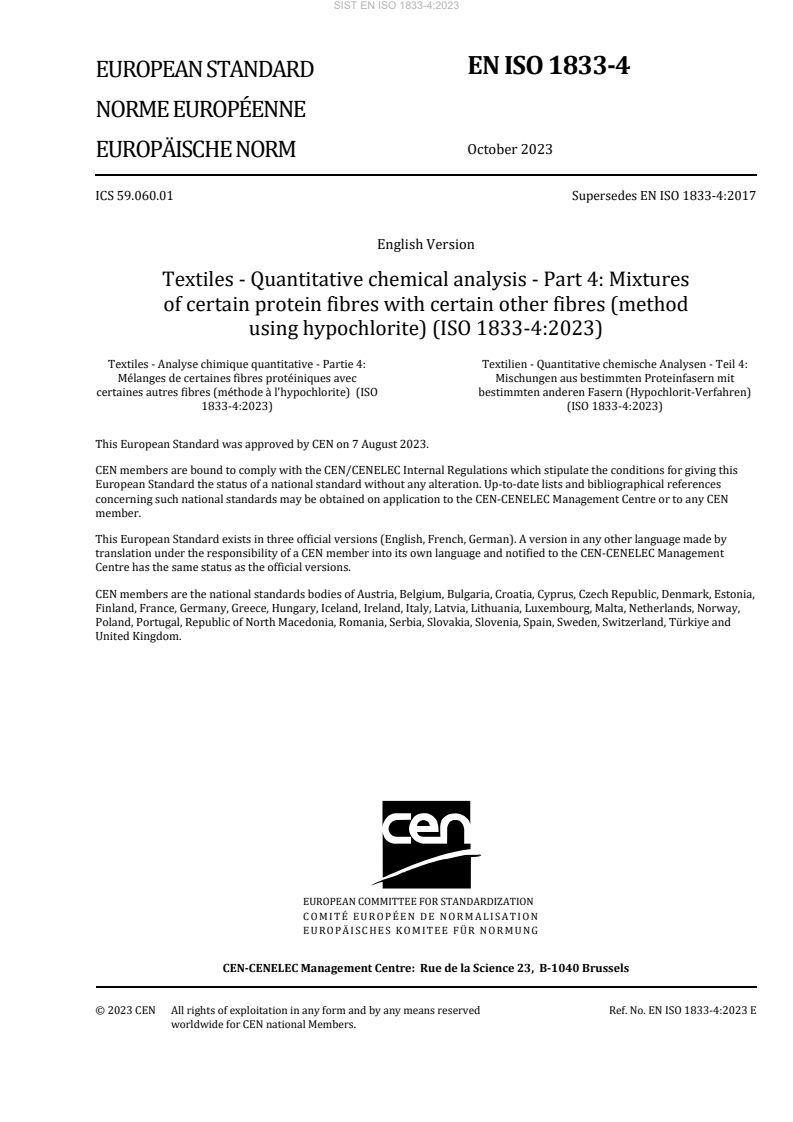
EN ISO 1833-4
EUROPEAN STANDARD
NORME EUROPÉENNE
October 2023
EUROPÄISCHE NORM
ICS 59.060.01 Supersedes EN ISO 1833-4:2017
English Version
Textiles - Quantitative chemical analysis - Part 4: Mixtures
of certain protein fibres with certain other fibres (method
using hypochlorite) (ISO 1833-4:2023)
Textiles - Analyse chimique quantitative - Partie 4: Textilien - Quantitative chemische Analysen - Teil 4:
Mélanges de certaines fibres protéiniques avec Mischungen aus bestimmten Proteinfasern mit
certaines autres fibres (méthode à l'hypochlorite) (ISO bestimmten anderen Fasern (Hypochlorit-Verfahren)
1833-4:2023) (ISO 1833-4:2023)
This European Standard was approved by CEN on 7 August 2023.
CEN members are bound to comply with the CEN/CENELEC Internal Regulations which stipulate the conditions for giving this
European Standard the status of a national standard without any alteration. Up-to-date lists and bibliographical references
concerning such national standards may be obtained on application to the CEN-CENELEC Management Centre or to any CEN
member.
This European Standard exists in three official versions (English, French, German). A version in any other language made by
translation under the responsibility of a CEN member into its own language and notified to the CEN-CENELEC Management
Centre has the same status as the official versions.
CEN members are the national standards bodies of Austria, Belgium, Bulgaria, Croatia, Cyprus, Czech Republic, Denmark, Estonia,
Finland, France, Germany, Greece, Hungary, Iceland, Ireland, Italy, Latvia, Lithuania, Luxembourg, Malta, Netherlands, Norway,
Poland, Portugal, Republic of North Macedonia, Romania, Serbia, Slovakia, Slovenia, Spain, Sweden, Switzerland, Türkiye and
United Kingdom.
EUROPEAN COMMITTEE FOR STANDARDIZATION
COMITÉ EUROPÉEN DE NORMALISATION
EUROPÄISCHES KOMITEE FÜR NORMUNG
CEN-CENELEC Management Centre: Rue de la Science 23, B-1040 Brussels
© 2023 CEN All rights of exploitation in any form and by any means reserved Ref. No. EN ISO 1833-4:2023 E
worldwide for CEN national Members.
Contents Page
European foreword . 3
European foreword
This document (EN ISO 1833-4:2023) has been prepared by Technical Committee ISO/TC 38 "Textiles"
in collaboration with Technical Committee CEN/TC 248 “Textiles and textile products” the secretariat of
which is held by BSI.
This European Standard shall be given the status of a national standard, either by publication of an
identical text or by endorsement, at the latest by April 2024, and conflicting national standards shall be
withdrawn at the latest by April 2024.
Attention is drawn to the possibility that some of the elements of this document may be the subject of
patent rights. CEN shall not be held responsible for identifying any or all such patent rights.
This document supersedes EN ISO 1833-4:2017.
Any feedback and questions on this document should be directed to the users’ national standards
body/national committee. A complete listing of these bodies can be found on the CEN website.
According to the CEN-CENELEC Internal Regulations, the national standards organizations of the
following countries are bound to implement this European Standard: Austria, Belgium, Bulgaria,
Croatia, Cyprus, Czech Republic, Denmark, Estonia, Finland, France, Germany, Greece, Hungary, Iceland,
Ireland, Italy, Latvia, Lithuania, Luxembourg, Malta, Netherlands, Norway, Poland, Portugal, Republic of
North Macedonia, Romania, Serbia, Slovakia, Slovenia, Spain, Sweden, Switzerland, Türkiye and the
United Kingdom.
Endorsement notice
The text of ISO 1833-4:2023 has been approved by CEN as EN ISO 1833-4:2023 without any
modification.
INTERNATIONAL ISO
STANDARD 1833-4
Third edition
2023-09
Textiles — Quantitative chemical
analysis —
Part 4:
Mixtures of certain protein fibres with
certain other fibres (method using
hypochlorite)
Textiles — Analyse chimique quantitative —
Partie 4: Mélanges de certaines fibres protéiniques avec certaines
autres fibres (méthode à l'hypochlorite)
Reference number
ISO 1833-4:2023(E)
ISO 1833-4:2023(E)
© ISO 2023
All rights reserved. Unless otherwise specified, or required in the context of its implementation, no part of this publication may
be reproduced or utilized otherwise in any form or by any means, electronic or mechanical, including photocopying, or posting on
the internet or an intranet, without prior written permission. Permission can be requested from either ISO at the address below
or ISO’s member body in the country of the requester.
ISO copyright office
CP 401 • Ch. de Blandonnet 8
CH-1214 Vernier, Geneva
Phone: +41 22 749 01 11
Email: copyright@iso.org
Website: www.iso.org
Published in Switzerland
ii
ISO 1833-4:2023(E)
Contents Page
Foreword .iv
1 Scope . 1
2 Normative references . 1
3 Terms and definitions . 1
4 Principle . 1
5 Reagents . 1
6 Apparatus . 2
7 Test procedure .2
8 Calculation and expression of results . 3
9 Precision . 3
iii
ISO 1833-4:2023(E)
Foreword
ISO (the International
...
Questions, Comments and Discussion
Ask us and Technical Secretary will try to provide an answer. You can facilitate discussion about the standard in here.
Loading comments...