

EN ISO 25086-1:2026
(Main)Textiles - Determination of the snagging resistance of fabrics - Part 1: Mace (spiked ball) test method (ISO 25086-1:2026)
- Abstract
This document specifies a test method for the determination of snagging resistance of a fabric using a mace (spiked ball).
This test method is applicable to knitted and to woven fabrics.
- Status
- Published
- Publication Date
- 03-Feb-2026
- Technical Committee
- CEN/TC 248 - Textiles and textile products
- Drafting Committee
- CEN/TC 248 - Textiles and textile products
- Current Stage
- 6060 - Definitive text made available (DAV) - Publishing
- Start Date
- 04-Feb-2026
- Due Date
- 21-May-2027
- Completion Date
- 04-Feb-2026

Overview
EN ISO 25086-1:2026 specifies the standardized test method for determining the snagging resistance of textile fabrics using the mace (spiked ball) technique. Published by CEN and ISO, this European Standard is applicable to both knitted and woven fabrics. Snagging, the formation of unwanted loops or pulls on fabric surfaces, poses a significant challenge for textile quality, especially in apparel and upholstery applications. This method provides a repeatable, objective way to assess how well fabrics resist snagging, supporting textile manufacturers, brands, and quality assurance professionals in improving and verifying product durability.
Key Topics
- Snagging Defined: The standard describes a snag as an undesirable loop that forms when the fabric catches on a pointed object. Accurate measurement of snagging resistance is crucial for materials exposed to abrasion and daily wear.
- Mace (Spiked Ball) Test Method: The document details an apparatus where a spiked ball randomly impacts the surface of a fabric sample mounted on a rotating drum. This controlled action simulates real-world snagging events.
- Assessment and Grading: Snagging is evaluated visually by comparing the tested fabric with standard references, and resistance is graded on a scale from 1 (severe snagging) to 5 (no or insignificant snagging).
- Sample Preparation and Test Conditions: The standard specifies guidance for fabric conditioning, sample cutting, mounting procedures, use of reference standards, and assessment environments to ensure repeatability and comparability.
- Reporting Requirements: Results must be documented clearly, including details about test specimens, number of observers, grades awarded, methods used, and any deviations from standardized conditions.
Applications
EN ISO 25086-1:2026 serves several segments of the textile industry and related quality control fields:
- Textile and Apparel Manufacturing: Essential for R&D and quality assurance teams developing knitted and woven products, such as sportswear, casualwear, upholstery, and technical textiles, where fabric durability is critical.
- Product Specification and Sourcing: Buyers and brands may specify compliance with this standard in procurement documents to ensure product performance consistency across suppliers.
- Testing Laboratories: As an accredited test method, it is used by independent labs and in-house testing facilities for performance certification, competitive benchmarking, and root-cause analysis of field failures.
- Consumer Protection and Standards Compliance: Regulatory agencies and industry bodies reference this standard to support claims about product life and suitability, especially for high-wear applications.
- Design Optimization: By quantifying snagging resistance, textile designers can select yarn types, fabric constructions, and finishes that minimize snag formation, extending garment and material life.
Related Standards
Integration with other textile standards enhances the comprehensiveness of snagging resistance evaluation:
- ISO 139 - Textiles: Standard atmospheres for conditioning and testing, ensures consistency in environmental conditions during testing.
- ASTM D3939 - Standard Test Method for Snagging Resistance of Fabrics (Mace), widely used in the US and similar in principle.
- JIS L 1058 - Japanese test methods for snagging of woven and knitted fabrics.
- ISO 12945-4 - Measurement of textile propensity to surface pilling, fuzzing or matting, complementary for assessing other forms of surface degradation.
- BS 8479 - UK standard for snagging using rotating chamber methods.
Keywords: snagging resistance, textiles, ACE test, woven fabrics, knitted fabrics, textile durability, quality control, fabric test methods, EN ISO 25086-1, CEN standards, apparel testing
Adopting EN ISO 25086-1:2026 enhances fabric performance reliability and supports best practices in textile testing and product development across global markets.
Relations
- Effective Date
- 18-Mar-2026
- Effective Date
- 18-Mar-2026
- Consolidated By
ISO 25086-1:2026 - Textiles — Determination of the snagging resistance of fabrics — Part 1: Mace (spiked ball) test method - Effective Date
- 12-Feb-2026
Get Certified
Connect with accredited certification bodies for this standard

Control Union Certifications
Global certification for agriculture and sustainability.

Hohenstein Institut
Textile testing and certification.

Bureau Veritas Bangladesh
Bureau Veritas certification services in Bangladesh.
Sponsored listings
Frequently Asked Questions
EN ISO 25086-1:2026 is a standard published by the European Committee for Standardization (CEN). Its full title is "Textiles - Determination of the snagging resistance of fabrics - Part 1: Mace (spiked ball) test method (ISO 25086-1:2026)". This standard covers: This document specifies a test method for the determination of snagging resistance of a fabric using a mace (spiked ball). This test method is applicable to knitted and to woven fabrics.
This document specifies a test method for the determination of snagging resistance of a fabric using a mace (spiked ball). This test method is applicable to knitted and to woven fabrics.
EN ISO 25086-1:2026 is classified under the following ICS (International Classification for Standards) categories: 59.080.30 - Textile fabrics. The ICS classification helps identify the subject area and facilitates finding related standards.
EN ISO 25086-1:2026 has the following relationships with other standards: It is inter standard links to ISO 139:2005, ISO 3668:2017, ISO 25086-1:2026. Understanding these relationships helps ensure you are using the most current and applicable version of the standard.
EN ISO 25086-1:2026 is available in PDF format for immediate download after purchase. The document can be added to your cart and obtained through the secure checkout process. Digital delivery ensures instant access to the complete standard document.
Standards Content (Sample)
SLOVENSKI STANDARD
01-april-2026
Tekstilije - Ugotavljanje odpornosti tkanin proti trganju - 1. del: Preskusna metoda
Mace (ISO 25086-1:2026)
Textiles - Determination of the snagging resistance of fabrics - Part 1: Mace test method
(ISO 25086-1:2026)
Textilien - Bestimmung des Widerstands gegen Fadenzieher von textilen
Flächengebilden - Teil 1: Mace-Prüfverfahren (ISO 25086-1:2026)
Textiles - Détermination de la résistance à l'éraillure (ou éraillage) des étoffes - Partie 1:
Méthode d'essai à la masse (ISO 25086-1:2026)
Ta slovenski standard je istoveten z: EN ISO 25086-1:2026
ICS:
59.080.30 Tkanine Textile fabrics
2003-01.Slovenski inštitut za standardizacijo. Razmnoževanje celote ali delov tega standarda ni dovoljeno.
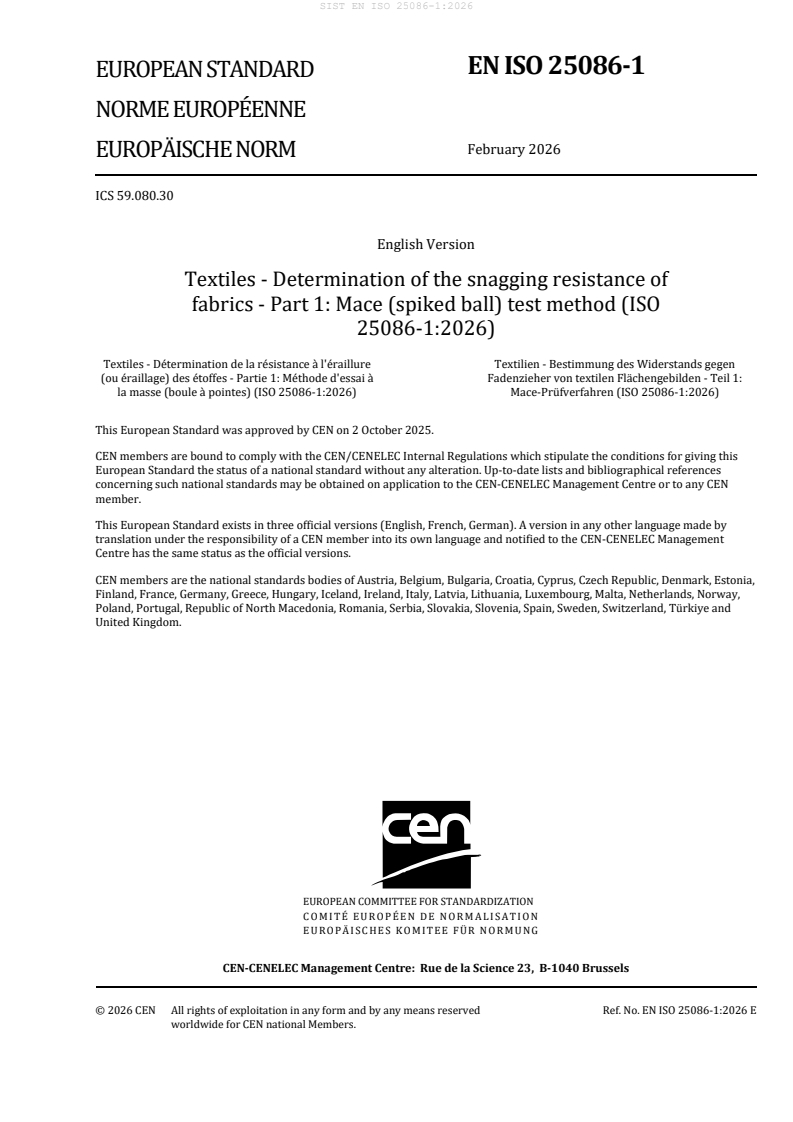
EN ISO 25086-1
EUROPEAN STANDARD
NORME EUROPÉENNE
February 2026
EUROPÄISCHE NORM
ICS 59.080.30
English Version
Textiles - Determination of the snagging resistance of
fabrics - Part 1: Mace (spiked ball) test method (ISO
25086-1:2026)
Textiles - Détermination de la résistance à l'éraillure Textilien - Bestimmung des Widerstands gegen
(ou éraillage) des étoffes - Partie 1: Méthode d'essai à Fadenzieher von textilen Flächengebilden - Teil 1:
la masse (boule à pointes) (ISO 25086-1:2026) Mace-Prüfverfahren (ISO 25086-1:2026)
This European Standard was approved by CEN on 2 October 2025.
CEN members are bound to comply with the CEN/CENELEC Internal Regulations which stipulate the conditions for giving this
European Standard the status of a national standard without any alteration. Up-to-date lists and bibliographical references
concerning such national standards may be obtained on application to the CEN-CENELEC Management Centre or to any CEN
member.
This European Standard exists in three official versions (English, French, German). A version in any other language made by
translation under the responsibility of a CEN member into its own language and notified to the CEN-CENELEC Management
Centre has the same status as the official versions.
CEN members are the national standards bodies of Austria, Belgium, Bulgaria, Croatia, Cyprus, Czech Republic, Denmark, Estonia,
Finland, France, Germany, Greece, Hungary, Iceland, Ireland, Italy, Latvia, Lithuania, Luxembourg, Malta, Netherlands, Norway,
Poland, Portugal, Republic of North Macedonia, Romania, Serbia, Slovakia, Slovenia, Spain, Sweden, Switzerland, Türkiye and
United Kingdom.
EUROPEAN COMMITTEE FOR STANDARDIZATION
COMITÉ EUROPÉEN DE NORMALISATION
EUROPÄISCHES KOMITEE FÜR NORMUNG
CEN-CENELEC Management Centre: Rue de la Science 23, B-1040 Brussels
© 2026 CEN All rights of exploitation in any form and by any means reserved Ref. No. EN ISO 25086-1:2026 E
worldwide for CEN national Members.
Contents Page
European foreword . 3
European foreword
This document (EN ISO 25086-1:2026) has been prepared by Technical Committee ISO/TC 38
"Textiles" in collaboration with Technical Committee CEN/TC 248 “Textiles and textile products” the
secretariat of which is held by BSI.
This European Standard shall be given the status of a national standard, either by publication of an
identical text or by endorsement, at the latest by August 2026, and conflicting national standards shall
be withdrawn at the latest by August 2026.
Attention is drawn to the possibility that some of the elements of this document may be the subject of
patent rights. CEN shall not be held responsible for identifying any or all such patent rights.
Any feedback and questions on this document should be directed to the users’ national standards
body/national committee. A complete listing of these bodies can be found on the CEN website.
According to the CEN-CENELEC Internal Regulations, the national standards organizations of the
following countries are bound to implement this European Standard: Austria, Belgium, Bulgaria,
Croatia, Cyprus, Czech Republic, Denmark, Estonia, Finland, France, Germany, Greece, Hungary, Iceland,
Ireland, Italy, Latvia, Lithuania, Luxembourg, Malta, Netherlands, Norway, Poland, Portugal, Republic of
North Macedonia, Romania, Serbia, Slovakia, Slovenia, Spain, Sweden, Switzerland, Türkiye and the
United Kingdom.
Endorsement notice
The text of ISO 25086-1 has been approved by CEN as EN ISO 25086-1:2026 without any modification.
International
Standard
ISO 25086-1
First edition
Textiles — Determination of the
2026-01
snagging resistance of fabrics —
Part 1:
Mace (spiked ball) test method
Textiles — Détermination de la résistance à l’éraillure (ou
éraillage) des étoffes —
Partie 1: Méthode d’essai à la masse (boule à pointes)
Reference number
ISO 25086-1:2026(en) © ISO 2026
ISO 25086-1:2026(en)
© ISO 2026
All rights reserved. Unless otherwise specified, or required in the context of its implementation, no part of this publication may
be reproduced or utilized otherwise in any form or by any means, electronic or mechanical, including photocopying, or posting on
the internet or an intranet, without prior written permission. Permission can be requested from either ISO at the address below
or ISO’s member body in the country of the requester.
ISO copyright office
CP 401 • Ch. de Blandonnet 8
CH-1214 Vernier, Geneva
Phone: +41 22 749 01 11
Email: copyright@iso.org
Website: www.iso.org
Published in Switzerland
ii
ISO 25086-1:2026(en)
Contents Page
Foreword .iv
Introduction .v
1 Scope . 1
2 Normative references . 1
3 Terms and definitions . 1
4 Principle . 1
5 Apparatus . 2
6 Pre-treatment of fabric . 4
7 Atmosphere for conditioning and testing . 4
8 Preparation of test specimens . 4
9 Procedure . 5
9.1 Mounting of the felt .5
9.2 Checking and adjustment of the mace (spiked ball) .5
9.3 Setting of the testing time .6
9.4 Test specimen mounting .6
9.5 Testing running .6
10 Assessment of snagging . 6
11 Test report . 7
Bibliography . 9
iii
ISO 25086-1:2026(en)
Foreword
ISO (the International Organization for Standardization) is a worldwide federation of national standards
bodies (ISO member bodies). The work of preparing International Standards is normally carried out through
ISO technical committees. Each member body interested in a subject for which a technical committee
has been established has the right to be represented on that committee. International organizations,
governmental and non-governmental, in liaison with ISO, also take part in the work. ISO collaborates closely
with the International Electrotechnical Commission (IEC) on all matters of electrotechnical standardization.
The procedures used to develop this document and those intended for its further maintenance are described
in the ISO/IEC Directives, Part 1. In particular, the different approval criteria needed for the different types
of ISO document should be noted. This document was drafted in accordance with the editorial rules of the
ISO/IEC Directives, Part 2 (see www.iso.org/directives).
ISO draws attention to the possibility that the implementation of this document may involve the use of (a)
patent(s). ISO takes no position concerning the evidence, validity or applicability of any claimed patent
rights in respect thereof. As of the date of publication of this document, ISO had not received notice of (a)
patent(s) which may be required to implement this document. However, implementers are cautioned that
this may not represent the latest information, which may be obtained from the patent database available at
www.iso.org/patents. ISO shall not be held responsible for identifying any or all such patent rights.
Any trade name used in this document is information given for the convenience of users and does not
constitute an endorsement.
For an explanation of the voluntary nature of standards, the meaning of ISO specific terms and expressions
related to conformity assessment, as well as information about ISO's adherence to the World Trade
Organization (WTO) principles in the Technical Barriers to Trade (TBT), see www.iso.org/iso/foreword.html.
This document was prepared by Technical Committee ISO/TC 38, Textiles, Subcommittee SC 24, Conditioning
atmospheres and physical tests for textile fabrics, in collaboration with the European Committee for
Standardization (CEN) Technical Committee CEN/TC 248, Textiles and textile products, in accordance with
the Agreement on technical cooperation between ISO and CEN (Vienna Agreement).
A list of all parts in the ISO 25086 series can be found on the ISO website.
Any feedback or questions on this document should be directed to the user’s national standards body. A
complete listing of these bodies can be found at www.iso.org/members.html.
iv
ISO 25086-1:2026(en)
Introduction
Snagging is a phenomenon in which undesirable loops of varying sizes appear on the surface of a textile
[1] [2] [3] [4] [5] [6] [7]
product, usually as a result of the fabric catching on sharp points or objects. , , , , , , Fabrics made
of filament yarns, both textured and untextured, are most prone to snagging. However, certain fabrics made
of spun staple yarns, and certain fabric structures, can also be prone to snagging. It is important to be able
[8]
to measure the propensity of fabrics to snagging (alike ISO 12945-4 for pilling, fuzzing and matting) so
that fabrics with the lowest propensity to snagging can be selected for making garments.
[9]
A study carried out in France (called "DurHabi", related to the lifespan of textile garments, 2022 ) showed
that the criterion based on the snagging resistance of this document is more discriminatory for sport-wear
(tee-shirts, trousers, etc.) and for ready-made garments made of knitted fabrics (dresses, skirts, etc.) than
ready-made garments made of woven fabrics.
v
International Standard ISO 25086-1:2026(en)
Textiles — Determination of the snagging resistance of
fabrics —
Part 1:
Mace (spiked ball) test method
1 Scope
This document specifies a test method for the determination of snagging resistance of a fabric using a mace
(spiked ball).
This test method is applicable to knitted and to woven fabrics.
2 Normative references
The following documents are referred to in the text in such a way that some or all of their content constitutes
requirements of this document. For dated references, only the edition cited applies. For undated references,
the latest edition of the referenced document (including any amendments) applies.
ISO 139, Textiles — Standard atmospheres for conditioning and testing
ISO 3668, Paints and varnishes — Visual comparison of colour of paints
3 Terms and definitions
For the purposes of this document, the following terms and definitions apply.
ISO and IEC maintain terminology databases for use in standardi
...