

EN 1729-1:2015
(Main)Furniture - Chairs and tables for educational institutions - Part 1: Functional dimensions
General Information
- Abstract
This European Standard specifies functional dimensions and markings for all chairs, stools and tables, for educational institutions, including fixed and adjustable chairs and tables.
It applies to both un-upholstered and upholstered chairs and stools as well as to both non-swivel and swivel chairs. It applies to furniture for use with laptop computers or portable devices.
It does not apply to ranked seating or special purpose workstations.
It does not apply to furniture used by teaching personnel.
Annex A (normative) includes single-sloped chairs and associated tables.
Annex B (normative) includes double-sloped high chairs and associated tables.
Annex C (normative) includes standing-height tables.
Annex D (normative) includes tall chairs and associated tables.
Annex E (normative) includes stools and associated worksurfaces.
Annex F (normative) includes measurement methods.
Annex G (informative) includes guidance on size marks for adjustable chairs and tables.
Annex H (informative) includes guidance on calculating heights of double-sloped chairs and associated tables.
Annex I (informative) includes a rationale for functional dimensions.
- Status
- Published
- Publication Date
- 01-Dec-2015
- Withdrawal Date
- 29-Jun-2016
- Technical Committee
- CEN/TC 207 - Furniture
- Drafting Committee
- CEN/TC 207/WG 6 - Test methods for fire behaviour
- Current Stage
- 9092 - Decision on results of review/2YR ENQ - revise - Review Enquiry
- Start Date
- 15-Dec-2023
- Completion Date
- 30-Sep-2026

Overview
EN 1729-1:2015 - published by CEN - defines the functional dimensions and marking system for chairs, stools and tables used in educational institutions. The standard covers fixed and adjustable furniture, upholstered or not, swivel and non‑swivel seating, and furniture intended for use with laptops or portable devices. It does not apply to ranked auditorium seating, special‑purpose workstations or furniture for teaching personnel. EN 1729‑1 focuses on ergonomic dimensions (not design) and is paired with EN 1729‑2 for safety requirements and test methods.
Key topics and requirements
- Functional dimensions and size marks: Normative annexes specify size marks and colour codes for standard chairs (0–7), double‑sloped high chairs (B0–B7), standing‑height tables (C0–C7), tall chairs (D0–D7) and stools (E0–E7).
- Types covered: single‑sloped seats (Annex A), double‑sloped high chairs (Annex B), standing‑height tables (Annex C), tall chairs (Annex D) and stools/worksurfaces (Annex E).
- Measurement methods: Annex F provides the School Chair Measuring Device (SCMD) method to determine Point S, buttock zone, seat height, seat angles, seat depth and armrest height.
- Guidance and rationale: Annex G and H give calculation guidance for adjustable and double‑sloped furniture; Annex I explains the rationale behind the functional dimensions.
- Marking & labeling: All furniture must carry legible, indelible marks including size mark or colour code, manufacturer identification, and production date. Tall chairs/tables require clear table‑height information via label, web link or QR code.
- Instructions: User instructions in the local official language(s) must explain size marks, maintenance, installation for multi‑size furniture, adjustability operation and safety warnings (e.g., gas lift servicing).
Practical applications
- Product design: use the functional dimensions to design school furniture that promotes good posture and user compatibility across age/size ranges.
- Procurement and specification: specify size marks and compliance to EN 1729‑1 when purchasing classroom furniture to ensure ergonomic fit and interoperability (table/chair matching).
- Compliance and testing prep: manufacturers and test labs use Annex F measurement methods to assess dimensional compliance before applying EN 1729‑2 safety tests.
- Facility planning: school designers and facility managers select appropriate sizes (including tall chairs and stools) and label furniture for correct classroom allocation.
Who uses this standard
- Furniture manufacturers and industrial designers
- School procurement officers and facility managers
- Ergonomists and human factors specialists
- Test laboratories and conformity assessors
- Architects and interior specifiers for educational projects
Related standards
- EN 1729‑2: Furniture - Chairs and tables for educational institutions - Part 2: Safety requirements and test methods (complements EN 1729‑1).
Relations
- Effective Date
- 09-Dec-2015
- Effective Date
- 28-Jan-2026
- Effective Date
- 28-Jan-2026
- Effective Date
- 28-Jan-2026
- Effective Date
- 28-Jan-2026
- Effective Date
- 28-Jan-2026
- Effective Date
- 06-Jul-2016
- Effective Date
- 20-Dec-2023
Frequently Asked Questions
EN 1729-1:2015 is a standard published by the European Committee for Standardization (CEN). Its full title is "Furniture - Chairs and tables for educational institutions - Part 1: Functional dimensions". This standard covers: This European Standard specifies functional dimensions and markings for all chairs, stools and tables, for educational institutions, including fixed and adjustable chairs and tables. It applies to both un-upholstered and upholstered chairs and stools as well as to both non-swivel and swivel chairs. It applies to furniture for use with laptop computers or portable devices. It does not apply to ranked seating or special purpose workstations. It does not apply to furniture used by teaching personnel. Annex A (normative) includes single-sloped chairs and associated tables. Annex B (normative) includes double-sloped high chairs and associated tables. Annex C (normative) includes standing-height tables. Annex D (normative) includes tall chairs and associated tables. Annex E (normative) includes stools and associated worksurfaces. Annex F (normative) includes measurement methods. Annex G (informative) includes guidance on size marks for adjustable chairs and tables. Annex H (informative) includes guidance on calculating heights of double-sloped chairs and associated tables. Annex I (informative) includes a rationale for functional dimensions.
This European Standard specifies functional dimensions and markings for all chairs, stools and tables, for educational institutions, including fixed and adjustable chairs and tables. It applies to both un-upholstered and upholstered chairs and stools as well as to both non-swivel and swivel chairs. It applies to furniture for use with laptop computers or portable devices. It does not apply to ranked seating or special purpose workstations. It does not apply to furniture used by teaching personnel. Annex A (normative) includes single-sloped chairs and associated tables. Annex B (normative) includes double-sloped high chairs and associated tables. Annex C (normative) includes standing-height tables. Annex D (normative) includes tall chairs and associated tables. Annex E (normative) includes stools and associated worksurfaces. Annex F (normative) includes measurement methods. Annex G (informative) includes guidance on size marks for adjustable chairs and tables. Annex H (informative) includes guidance on calculating heights of double-sloped chairs and associated tables. Annex I (informative) includes a rationale for functional dimensions.
EN 1729-1:2015 is classified under the following ICS (International Classification for Standards) categories: 97.140 - Furniture. The ICS classification helps identify the subject area and facilitates finding related standards.
EN 1729-1:2015 has the following relationships with other standards: It is inter standard links to EN 1729-1:2006, EN 1729-2:2012, EN 13150:2020, EN 15170:2008, EN 1729-2:2023, EN 1729-2:2012+A1:2015, EN 1729-1:2015/AC:2016, FprEN 1729-1. Understanding these relationships helps ensure you are using the most current and applicable version of the standard.
EN 1729-1:2015 is available in PDF format for immediate download after purchase. The document can be added to your cart and obtained through the secure checkout process. Digital delivery ensures instant access to the complete standard document.
Standards Content (Sample)
2003-01.Slovenski inštitut za standardizacijo. Razmnoževanje celote ali delov tega standarda ni dovoljeno.Pohištvo - Stoli in mize za vzgojno-izobraževalne ustanove - 1. del: Funkcionalne mereMöbel - Stühle und Tische für Bildungseinrichtungen - Teil 1: FunktionsmaßeMeubles - Chaises et tables pour les établissements d’enseignement - Partie 1: Dimensions fonctionnellesFurniture - Chairs and tables for educational institutions - Part 1: Functional dimensions97.140PohištvoFurnitureICS:Ta slovenski standard je istoveten z:EN 1729-1:2015SIST EN 1729-1:2016en,fr,de01-februar-2016SIST EN 1729-1:2016SLOVENSKI
STANDARDSIST EN 1729-1:20061DGRPHãþD
EUROPEAN STANDARD NORME EUROPÉENNE EUROPÄISCHE NORM
EN 1729-1
December
t r s w ICS
{ yä s v r Supersedes EN
s y t {æ sã t r r xEnglish Version
Furniture æ Chairs and tables for educational institutions æ Part
sã Functional dimensions Ameublement æ Sièges et tables pour établissements d 5enseignement æ Partie
s ã Dimensions fonctionnelles Möbel æ Stühle und Tische für Bildungseinrichtungen æ Teil
sã Funktionsmaße This European Standard was approved by CEN on
u October
t r s wä
egulations which stipulate the conditions for giving this European Standard the status of a national standard without any alterationä Upætoædate lists and bibliographical references concerning such national standards may be obtained on application to the CENæCENELEC Management Centre or to any CEN memberä
translation under the responsibility of a CEN member into its own language and notified to the CENæCENELEC Management Centre has the same status as the official versionsä
CEN members are the national standards bodies of Austriaá Belgiumá Bulgariaá Croatiaá Cyprusá Czech Republicá Denmarká Estoniaá Finlandá Former Yugoslav Republic of Macedoniaá Franceá Germanyá Greeceá Hungaryá Icelandá Irelandá Italyá Latviaá Lithuaniaá Luxembourgá Maltaá Netherlandsá Norwayá Polandá Portugalá Romaniaá Slovakiaá Sloveniaá Spainá Swedená Switzerlandá Turkey andUnited Kingdomä
EUROPEAN COMMITTEE FOR STANDARDIZATION COMITÉ EUROPÉEN DE NORMALISATION EUROPÄISCHES KOMITEE FÜR NORMUNG
CEN-CENELEC Management Centre:
Avenue Marnix 17,
B-1000 Brussels
t r s w CEN All rights of exploitation in any form and by any means reserved worldwide for CEN national Membersä Refä Noä EN
s y t {æ sã t r s w ESIST EN 1729-1:2016
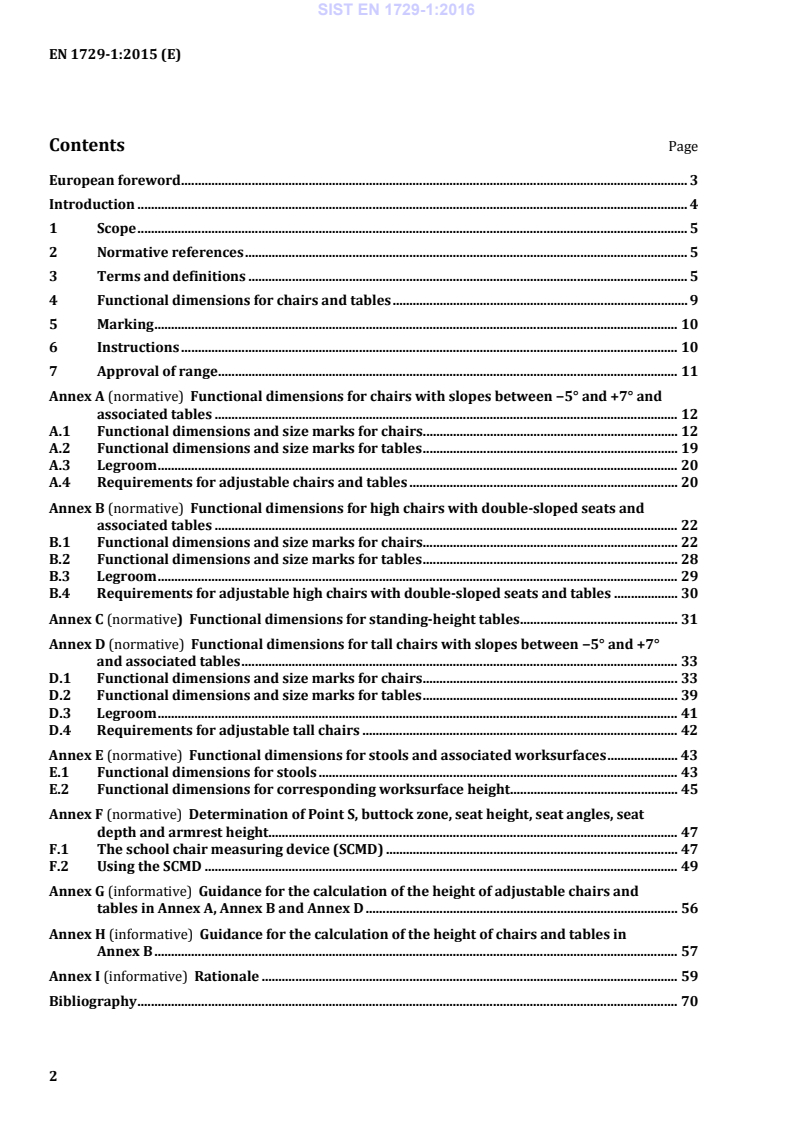
European foreword . 3 Introduction . 4 1 Scope . 5 2 Normative references . 5 3 Terms and definitions . 5 4 Functional dimensions for chairs and tables . 9 5 Marking . 10 6 Instructions . 10 7 Approval of range . 11 Annex A (normative)
Functional dimensions for chairs with slopes between
« w ¹ and
ª y ¹ and associated tables . 12 A.1 Functional dimensions and size marks for chairs . 12 A.2 Functional dimensions and size marks for tables . 19 A.3 Legroom . 20 A.4 Requirements for adjustable chairs and tables . 20 Annex B (normative)
Functional dimensions for high chairs with double-sloped seats and associated tables . 22 B.1 Functional dimensions and size marks for chairs . 22 B.2 Functional dimensions and size marks for tables . 28 B.3 Legroom . 29 B.4 Requirements for adjustable high chairs with double-sloped seats and tables . 30 Annex C (normative)
Functional dimensions for standing-height tables . 31 Annex D (normative)
Functional dimensions for tall chairs with slopes between
« w ¹ and
ª y ¹ and associated tables . 33 D.1 Functional dimensions and size marks for chairs . 33 D.2 Functional dimensions and size marks for tables . 39 D.3 Legroom . 41 D.4 Requirements for adjustable tall chairs . 42 Annex E (normative)
Functional dimensions for stools and associated worksurfaces . 43 E.1 Functional dimensions for stools . 43 E.2 Functional dimensions for corresponding worksurface height. 45 Annex F (normative)
Determination of Point S, buttock zone, seat height, seat angles, seat depth and armrest height. 47 F.1 The school chair measuring device (SCMD) . 47 F.2 Using the SCMD . 49 Annex G (informative)
Guidance for the calculation of the height of adjustable chairs and tables in Annex A, Annex B and Annex D . 56 Annex H (informative)
Guidance for the calculation of the height of chairs and tables in Annex B . 57 Annex I (informative)
Rationale . 59 Bibliography . 70
Part 1: Functional dimensions [the present document]; —
Part 2: Safety requirements and test methods. According to the CEN-CENELEC Internal Regulations, the national standards organizations of the following countries are bound to implement this European Standard: Austria, Belgium, Bulgaria, Croatia, Cyprus, Czech Republic, Denmark, Estonia, Finland, Former Yugoslav Republic of Macedonia, France, Germany, Greece, Hungary, Iceland, Ireland, Italy, Latvia, Lithuania, Luxembourg, Malta, Netherlands, Norway, Poland, Portugal, Romania, Slovakia, Slovenia, Spain, Sweden, Switzerland, Turkey and the United Kingdom. SIST EN 1729-1:2016
Key 1 median plane 2 transverse plane Figure 1 — Illustration of the median and transverse planes 3.3 most forward point of the backrest (Point S) most forward point in the specified range of the backrest on the median plane Note 1 to entry: The specified range of the backrest is shown in Table F.2. Note 2 to entry: See Figure A.3, Figure B.3 and Figure D.3. 3.4 adjustable furniture furniture that can be adjusted by the users (pupils), without the need for tools 3.5 multi-size furniture furniture that is adjustable at installation (not by the users) to change dimensions from one size mark to another 3.6 double-sloped seat seat intended for sitting using either the front part of the seat (leaning forward) or the rear part of the seat (leaning backward), with the feet resting on a footrest or the floor Note 1 to entry: See Figure 5 and Figure B.5. 3.7 inclination of a single-sloped seat and of the front part of a double-sloped seat ( angle formed by the front part of the seat and the horizontal Note 1 to entry: See Figure 2, Figure 3, Figure 4 and Figure 5. SIST EN 1729-1:2016
Key 1 front 2
< 0° (negative for rearward-sloping seats) Figure 2 — Example of a single-sloped seat with a negative seat angle
Key 1 front 2
> 0° (positive for forward-sloping seats) Figure 3 — Example of a single-sloped seat with a positive seat angle
Key 1 front 2
> 0° 3
< 0° Figure 4 — Examples of a single-sloped tiltable seat SIST EN 1729-1:2016
Key 1 front 2
> 0° 3
< 0° Figure 5 — Example of a double-sloped seat (see Annex B) 3.8 inclination of the rear part of a double- angle formed by the horizontal and the rear part of the seat, determined in the median plane Note 1 to entry: See Figure 5. 3.9 stool seating without backrest or armrests and intended for use for short periods Note 1 to entry: See Figure 6. The seat height to the footrest, h8, can be to one size mark and the seat height to the floor, h8, can be to another size mark, as defined in Table E.1. Note 2 to entry: Any upward extension at the back of the stool below the Point S range specified in Table F.2 cannot be considered to be a backrest and the seating can be considered to be a stool (see Figure E.3).
Key 1 footrest h8 seat height for stools as specified in Table E.1 h10 total stool height Figure 6 — Stools with and without footrest SIST EN 1729-1:2016
Key 1 Point S 2 footrest h8 seat height for tall chair as specified in Table D.1 Figure 7 — Tall chair with footrest 3.11 school chair measuring device
SCMD measuring device intended for determining Point S, buttock zone and chair dimensions of school chairs Note1 to entry: Details of the SCMD and the method of use are given in Annex F. 4 Functional dimensions for chairs and tables The functional dimensions and corresponding size marks and colour codes for chairs with slopes between
« w ¹ and
ª y ¹ and associated tables shall be as specified in the normative Annex A. The functional dimensions and corresponding size marks and colour codes for high chairs with double-sloped seats and associated tables shall be as specified in the normative Annex B. The functional dimensions and corresponding size marks and colour codes for standing-height tables shall be as specified in normative Annex C. The functional dimensions and corresponding size marks and colour codes for tall chairs shall be as specified in the normative Annex D. Tables suitable for tall chairs cannot be size marked. Tables shall correspond to the height of tall chairs as in Table D.2. SIST EN 1729-1:2016
Functional dimensions for chairs with slopes between
« w ¹ and
ª y ¹ and associated tables A.1 Functional dimensions and size marks for chairs The dimensions, angles, size marks and colour codes for chairs shall be as given in Table A.1. Where dimensions are stated as ranges, the measured dimension shall be any value in this range. All accessible edges shall be rounded or chamfered. Room for free movement of the buttocks shall be ensured. If the backrest extends below Point S, it shall be angled rearwards such as to maintain the buttock zone as shown in Figure A.3. Raised edges and surfaces shall not dig into thighs. This applies to points or edges on the seat surface or frame in front of the position indicated by the rear pins on the SCMD, outside the planes through the rear pins which are parallel to the median plane, as shown by the shaded area in Figure A.1. This requirement is fulfilled when these points are not higher than 15 mm above the lowest point on the seat surface in the planes through the rear pins and parallel to the median plane for size marks 0 to 3 and 25 mm above the lowest point for size marks 4 to 7.
a) Isometric view of seat pad b) Cross-section of seat parallel to transverse plane Key 1 position on the seat of the rear pins of the SCMD 2 raised edge or surface 3 horizontal bar 4 top surface of seat e height of raised edges or surfaces,
¶ 15 mm for size marks 0 to 3 and
¶ 25 mm for size marks 4 to 7 Figure A.1 — Dimensions of raised seat edges SIST EN 1729-1:2016
shall be determined by the SCMD on the chair under load. On the SCMD, it is the angle between the vertical arm when it is inclined at the angle of the backrest and the top of the base plate. See Annex F and Figure F.1, Figure A.5 and Figure A.6. (o) The width of the armrest is the minimum distance between the sides of the armrest/armrest pad, measured at 5 mm below the top surface of the armrest. See Figure A.4. (p) The height of the armrest above the seat shall be determined by the SCMD on the chair. On the SCMD, it is the vertical distance between the top of the armrests and the bottom of the rear pins of the SCMD. See Annex F and Figure F.1 and Figure A.4. (q) The distance from the backrest to the front of the armrest is the maximum horizontal distance between Point S and the front of the top of the armrest, the position of which is determined by the SCMD. See Figure A.4. (r) The width between the armrests is the minimum horizontal distance between the armrests/armrest pads. See Figure A.4. (n) The length of the armrest is the greatest length in the fore and aft direction of the armrest horizontally within 20 mm below the highest point. See Figure A.4. (x) The distance between Point S and the back of the seat pad is the horizontal distance on the median plane between the rear edge of the seat and the vertical projection of Point S. It shall be determined only if the back of the seat pad does not extend behind Point S. See Figure A.5 and Figure A.6. SIST EN 1729-1:2016
Key b3 width of seat b4 width of backrest r2 horizontal radius of backrest t4 effective depth of seat Figure A.2 — Key dimensions of a chair (plan view)
Key 1 Point S 2 buttock zone t4 effective depth of seat Figure A.3 — Key dimensions of a chair (section view) and the buttock zone (shaded area) SIST EN 1729-1:2016
Key 1 armrest n length of armrest o width of armrest p height of armrest above the seat q distance from backrest to front of armrest r width between armrests Figure A.4 — Key dimensions for armrests SIST EN 1729-1:2016
Key 1 inclination of the table top (the maximum value for a fixed or inclinable table top is 20°) 2 Point S
inclination of single-sloped seat
angle between seat and backrest h1 height of table top h7 height of backrest h8 height of seat t1 depth of table top t4 effective depth of seat x distance between Point S and back of seat pad Figure A.5 — Key dimensions of a chair with a negative seat angle and associated table SIST EN 1729-1:2016
Key 1 inclination of the table top (the maximum value for a fixed or inclinable table top is 20°) 2 Point S
inclination of single-sloped seat
angle between seat and backrest h1 height of table top h7 height of backrest h8 height of seat t1 depth of table top t4 effective depth of seat x distance between Point S and back of seat pad Figure A.6 — Key dimensions of a chair with a positive seat angle and associated table SIST EN 1729-1:2016
v z w ª Stature range (without shoes) 800 –950 930 –1 160 1 080 –1 210 1 190 –1 420 1 330 –1 590 1 460 –1 765 1 590 –1 880 1 740 –2 070 h8 Height of seat ± 10 210 260 310 350 380 430 460 510 t4 Effective depth of seat ± 15 (0–2), ± 25 (3–7) n/a n/a n/a 300 340 380 420 460 b3 Seat width (min) 210 240 280 320 340 360 380 400 x Distance between Point S and back of seat pad (max) n/a n/a n/a 30 30 50 50 50 h7 Backrest height (min) 100 100 100 100 100 100 100 100 b4 Width of backrest (min) n/a n/a n/a 260 270 300 330 360 r2 Horizontal radius of backrest (min) n/a n/a n/a 300 300 300 300 300
n/a n/a n/a - w ¹ to
ª y ¹ - w ¹ to
ª y ¹ - w ¹ to
ª y ¹ - w ¹ to
ª y ¹ - w ¹ to
ª y ¹ seat and backrest n/a n/a n/a 95° to 110° 95° to 110° 95° to 110° 95° to 110° 95° to 110° p Height of armrest above seat
« t r to
ª s r n/a n/a n/a 170 190 210 230 250 r Width between arms n/a n/a n/a 360–410 390–440 420–470 460–510 510 - 570 q Distance from backrest to front edge of armrest (max) n/a n/a n/a n/a 225 250 275 300 o Width of armrest (min) n/a n/a n/a n/a 20 20 20 20 n Length of armrest (min) n/a n/a n/a n/a 80 80 80 80 SIST EN 1729-1:2016
« w ¹ and
ª y ¹ All dimensions in millimetres unless otherwise stated Size mark 0 1 2 3 4 5 6 7 Colour code White Orange Violet Yellow Red Green Blue Brown Popliteal range (without shoes) 200–250 250–280 280–315 315–355 355–405 405–435 435–485
v z w ª Stature range (without shoes) 800–950 930 –1 160 1 080 –1 210 1 190 –1 420 1 330 –1 590 1 460 –1 765 1 590 –1 880 1 740 –2 070 h1 Height of top ± 20 400 460 530 590 640 710 760 820 t1 Depth of top (min) - 500 a 500 a 500 a 500 500 500 500 w1 Width of top, per person at front edge, where pupils sit (min) - 600 b 600 b 600 b 600 b 600 600 600 Surface area per person (min) - 0,15 m2 0,15 m2 0,15 m2 0,15 m2 0,15 m2 0,15 m2 0,15 m2 Horizontal distance between front legs/structure, where pupils sit, per person (min) - 500 c 500 c 500 c 500 c 500 500 500 a Can be reduced to 400 mm (only when required by educational conditions). b Can be reduced to 550 mm (only when required by educational conditions). c Can be reduced to 450 mm (only when required by educational conditions).
a) Table for one pupil
b) Shared table Key t1 depth of top w1 width of top, per person at front edge, where pupils sit Figure A.7 — Examples of different table tops SIST EN 1729-1:2016
Key 1 front of table top h2 legroom height at front of table top h4 height of back of legroom t2 depth of top of legroom t3 depth of bottom of legroom Figure A.8 — Legroom template Table A.3 — Minimum legroom template dimensions for tables for use with chairs with seat slopes between
« w ¹ and
ª y ¹ All dimensions in millimetres Size marks
0 1 2 3 4 5 6 7 h2 325 380 440 495 545 610 665 725 h4 275 325 375 420 465 520 565 620 t2 300 300 300 300 400 400 400 400 t3 400 400 400 400 500 500 500 500 The minimum width of the legroom is given in Table A.2 (horizontal distance between front legs/structure, where pupils sit, per person). A.4 Requirements for adjustable chairs and tables Adjustment controls shall: SIST EN 1729-1:2016
Functional dimensions for high chairs with double-sloped seats and associated tables B.1 Functional dimensions and size marks for chairs The dimensions, angles, size marks and colour codes for chairs shall be as given in Table B.1. Where dimensions are stated as ranges, the measured dimension shall be any value in this range. The depth of the rear part of the seat (t6) shall not be less than 50 % of the seat depth (t4). All accessible edges shall be rounded or chamfered. Room for free movement of the buttocks shall be ensured. If the backrest extends below Point S, it shall be angled rearwards so as to maintain the buttock zone as shown in Figure B.3. Raised edges and surfaces shall not dig into thighs. They shall not be higher than 15 mm above the lowest point on the seat surface in the transverse direction of the seat for size marks 0 to 3 and 25 mm above the lowest point in the transverse direction for size marks 4 to 7. See Figure B.1.
Key 1 raised edge or surface 2 horizontal bar 3 top surface of seat e
height of raised edges or surfaces,
¶ 15 mm for size marks 0 to 3 and
¶ 25 mm for size marks 4 to 7 Figure B.1 — Dimensions of raised seat edges Determination of functional dimensions The determination of the functional dimensions of chairs is specified below. See also Figure B.2, Figure B.3, Figure B.4 and Figure B.5. If the seat and/or backrest is adjustable or tiltable, the seat shall be set to horizontal or as close as possible to horizontal and the backrest shall be set to vertical or as close as possible to vertical. Guidance for the calculation of the height of chairs and tables can be found in Annex H (informative). (h8) The height of the seat is the vertical distance between the highest point of the seat, in the median plane, and the ground. See Figure B.5. SIST EN 1729-1:2016
is defined as the angle between the rear part of the seat and the backrest. It is measured on the median plane, as the angle between the backrest and the line passing through the upper part of the rear edge of the seat and the apex of the seat. See Figure B.5. (o) The width of the armrest is the minimum distance between the sides of the armrest/armrest pad, measured at 5 mm below the top surface of the armrest. See Figure B.4. (p) The height of the armrest above the seat is the vertical distance between the top of the armrest and the apex of the seat. See Figure B.4. (q) The distance from the backrest to the front of the armrest is the maximum horizontal distance between Point S and the front of the top of the armrest. See Figure B.4. (r) The width between the armrests is the minimum horizontal distance between the armrests/armrest pads. See Figure B.4. (n) The length of the armrest is the greatest length in the fore and aft direction of the armrest horizontally within 20 mm below the highest point. See Figure B.4. (x) The horizontal distance between Point S and the back of the seat pad is the horizontal distance on the median plane between the rear edge of the seat and the vertical projection of Point S. It shall be determined only if the back of the seat pad does not extend behind Point S. See Figure B.5. SIST EN 1729-1:2016
Key b3 width of seat b4 width of backrest r2 horizontal radius of backrest t4 effective depth of seat Figure B.2 — Key dimensions of a chair (plan view)
Key 1 Point S 2 buttock Zone t4 effective depth of seat Figure B.3 — Key dimensions of a chair (section view) and the buttock zone (shaded area) SIST EN 1729-1:2016
Key 1 armrest n
length of armrest o
width of armrest p
height of armrest above the seat q
distance from backrest to front of armrest r
width between armrests Figure B.4 — Key dimensions for armrests SIST EN 1729-1:2016
Key 1 inclination of the table top (the maximum value for a fixed or inclinable table top is 20°) 2 Point S 3 footrest
inclination of front part of double-sloped seat
angle between seat and backrest
inclination of rear part of double-sloped seat h1 height of table top h7 height of backrest h8 height of seat h9 height of footrest t1 depth of table top t4 effective depth of seat t5 depth of front part of seat t6 depth of rear part of seat x
distance between Point S and back of seat pad Figure B.5 — Key dimensions of a double-sloped seat and associated table SIST EN 1729-1:2016
250–280
280–315
315–355
355–405
405–435
435–485
v z w ª
Stature range (without shoes) 800–950
930–1160 1 080–1 210
1 190–1 420
1 330–1 590
1 460–1 765
1 590–1 880
1 740–2 070
ª s w ¹
ª s w ¹
ª s w ¹
ª s w ¹
ª s w ¹
ª s w ¹
ª s w ¹
ª s w ¹
r ¹ to
« w ¹
r ¹ to
« w ¹
r ¹ to
« w ¹
r ¹ to
« w ¹
r ¹ to
« w ¹
r ¹ to
« w ¹
r ¹ to
« w ¹
r ¹ to
« w ¹ h8 Height of seat ± 10
t4 Effective depth of seat ± 15 (0–2), ± 25 (3–7) n/a n/a n/a 300 340 380 420 460 b3 Seat width (min) 210 240 280 320 340 360 380 400 x Distance between Point S and back of seat pad (max) n/a n/a n/a 30 30 50 50 50 h7 Backrest height (min) 100 100 100 100 100 100 100 100 b4 Width of backrest (min) n/a n/a n/a 260
270 300
330 360 r2 Horizontal radius of backrest (min) n/a n/a n/a 300 300 300 300 300
n/a n/a n/a 95° to 110° 95° to 110° 95° to 110° 95° to 110° 95° to 110° h9 Height of footrest a n/a n/a n/a h8 - 350 h8 - 380 h8 - 430 h8 - 460 h8 - 510 Length of footrest (min) n/a n/a n/a 300 300 300 300 300 Depth of footrest b (min) n/a n/a n/a 50 50 50 50 50 p Height of armrest above seat
« t r to
ª s r n/a n/a n/a 170 190 210 230 250 r Width between arms n/a n/a n/a 360–410 390–440 420–470 460–510 510–570 q Distance from backrest to front edge of armrest (max) n/a n/a n/a 200 225 250 275 300 o Width of armrest (min) n/a n/a n/a 20 20 20 20 20 n Length of armrest (min) n/a n/a n/a n/a 80 80 80 80 a The footrest can be inclined. The height is measured at the mid point of the depth whether inclined or not. b If the footrest is inclined, the depth shall be determined in the inclined plane SIST EN 1729-1:2016
v z w ª Stature range (without shoes) 800–950 930–1 160 1 080 –1 210 1 190 –1 420 1 330 –1 590 1 460 –1 765 1 590 –1 880 1 740 –2 070 h1 Height of top ± 20 h8
ª
s { r h8
ª
t r r h8
ª
t t r h8
ª
t v r h8
ª
t x r h8
ª
t z r h8
ª
u r r h8
ª
u s r t1 Depth of top (min) - 500 a 500 a 500 a 500 500 500 500 w1 Width of top, per person at front edge, where pupils sit (min) - 600 b 600 b 600 b 600 b 600 600 600 Surface area per person (min) - 0,15 m2 0,15 m2 0,15 m2 0,15 m2 0,15 m2 0,15 m2 0,15 m2 Horizontal distance between front legs/structure, where pupils sit, per person (min) - 500 c 500 c 500 c 500 c 500 500 500 h9 Height of footrest d e - h8 - 260 h8 - 310 h8 - 350 h8 - 380 h8 - 430 h8 - 460 h8 - 510 Length of footrest (min) - 240 280 300 300 300 300 300 Depth of footrest (min) - 100 100 100 200 200 200 200 a Can be reduced to 400 mm (only when required by educational conditions).
b Can be reduced to 550 mm (only when required by educational conditions).
c Can be reduced to 450 mm (only when required by educational conditions).
d The footrest can be placed in the lower leg zone. e The footrest can be inclined. The height is measured at the mid point of the depth whether inclined or not.
a) Table for one pupil
b) Shared table Key t1 depth of top w1 width of top, per person at front edge, where pupils sit Figure B.6 — Examples of different table tops showing table top width and depth B.3 Legroom Legroom beneath the worksurfaces (tables and desks) shall be provided for each size mark in accordance with the minimum dimensions as shown in Table B.3 and Figure B.7. The legroom shall be measured by placing the template on the floor with its higher end in line with the front edge of the table, where pupils sit, transversing between the legs of the table. Overlapping of legroom templates is acceptable for a group of tables.
Key 1 front of table top h2 legroom height at front of table top h4 height of back of legroom t2 depth of top of legroom t3 depth of bottom of legroom Figure B.7 — Legroom template SIST EN 1729-1:2016
0 1 2 3 4 5 6 7 h2 h1-75 h1-80 h1-90 h1-95 h1-95 h1-100 h1-95 h1-95 h4 h1-125 h1-135 h1-155 h1-170 h1-175 h1-190 h1-195 h1-200 t2 300 300 300 300 400 400 400 400 t3 400 400 400 400 500 500 500 500 The minimum width of the legroom is given in Table B.2 (horizontal distance between front legs/structure, where pupils sit, per person). B.4 Requirements for adjustable high chairs with double-sloped seats and tables Adjustment controls shall: a) be easily accessible to the user; b) be possible to operate without the need for tools. Adjustable furniture shall cover two or more size marks. It shall be possible to identify the size marks to which the furniture can be adjusted. Adjustable furniture (chairs and tables) designed to cover a range of size marks shall comply with the dimensional requirements of each size mark covered (see Table B.1 and Table B.2). Adjustments may be continuous or in fixed steps. Examples of dimensions of adjustable chairs and tables are gi
...