

CEN/TR 17654:2021
(Main)Guideline for the implementation of Exchange Information Requirements (EIR) and BIM Execution Plans (BEP) on European level based on EN ISO 19650-1 and -2
- Abstract
This document deals with the processes involved in the procurement and delivery of information to planning and construction projects, specifically with exchange information requirement (EIR) and BIM execution plan (BEP), considering the administrative processes. This document takes into account international standards and specifications as well as recommended practice.
This document is relevant for all parties involved in the tendering of information deliverables. Including both those that require and those that deliver the information. The required information can be relevant for all processes in the life cycle such as design, construction, operation and maintenance and end-of-life processes. It applies above all to e.g. client, asset owners/operators, architects, engineer, contractors, subcontractors etc.
This document provides methodology to appointing parties on how to require and agree the right amount, quality and level of information needs.
It is also important for appointed parties to be able to assess the quality of existing EIRs and identify possible over-specification or gaps. Based on this, it is possible to estimate and calculate the necessary effort for data creation.
This document operationalizes the tendering and appointment process of information deliverables as specified in EN ISO 19650-2:2018. This document does not cover all clauses of EN ISO 19650-2:2018. Its main goal is to provide template examples and guidance for all activities conditioning specification of requirements and deliverables in the production of exchange information requirements and BIM execution plan. Specifically, it covers the “shall” and “shall consider” requirements in EN ISO 19650-2:2018, 5.2.1 (EIR), 5.3.2 (pre-appointment BEP) and 5.4.1 (confirmed BEP). For specification of Scope and out of scope see Table 1 (see Annex A for which part of EN ISO 19650-2:2018 is supported by templates).
- Status
- Published
- Publication Date
- 13-Jul-2021
- Technical Committee
- CEN/TC 442 - Building Information Modelling (BIM)
- Drafting Committee
- CEN/TC 442/WG 3 - Information Delivery Specification
- Current Stage
- 6060 - Definitive text made available (DAV) - Publishing
- Start Date
- 14-Jul-2021
- Due Date
- 01-Jan-2021
- Completion Date
- 14-Jul-2021


Overview
CEN/TR 17654:2021 is a European technical report that provides a practical guideline for implementing Exchange Information Requirements (EIR) and BIM Execution Plans (BEP) in line with EN ISO 19650‑1 and EN ISO 19650‑2. It operationalizes the tendering and appointment processes for information deliverables across planning, design, construction, operation and end‑of‑life stages. The report offers templates, examples and recommended practices to help appointing and appointed parties define the right amount, quality and level of information needed for a project.
Key Topics
- EIR (Exchange Information Requirements): Structure and content required at invitation to tender (EN ISO 19650‑2, 5.2.1). Includes level of information need, acceptance criteria, supporting information and delivery milestones.
- Pre‑appointment BEP: Minimum content and expectations for tender responses (EN ISO 19650‑2, 5.3.2).
- Confirmed BEP (appointment): Requirements for the BEP after appointment, including how it should be confirmed and expanded (EN ISO 19650‑2, 5.4.1).
- Information delivery planning: Federation strategy, high‑level responsibility matrices, task and master information delivery plans.
- Information production methods & project information standard: Guidance on procedures, templates and recommended practice for consistent information creation and quality assurance.
- Tendering workflow: Invitation to tender → Tender response → Appointment; guidance on assessing EIR quality and identifying over‑specification or gaps.
- Templates and examples: Annex A (templates supporting EN ISO 19650‑2), Annex B (project examples), Annex C (delivery planning), Annex D (project’s information standard).
Applications
CEN/TR 17654:2021 is designed to be used to:
- Prepare EIRs and define level of information need for procurement and tendering.
- Structure pre‑appointment and confirmed BIM Execution Plans to meet contractual and operational requirements.
- Assess the quality of incoming EIRs and estimate the effort and resources required for data creation.
- Standardize collaborative information management across project teams and common data environments (CDE).
- Provide a consistent European baseline-templates and examples can be adapted to national or organizational needs.
Who should use this standard
- Clients, asset owners and operators
- Lead appointed parties, architects, engineers and design teams
- Main contractors, subcontractors and BIM coordinators
- Procurement teams and information managers involved in tendering, appointment and lifecycle information delivery
Related Standards
- EN ISO 19650‑1:2018 - Concepts and principles for BIM information management
- EN ISO 19650‑2:2018 - Delivery phase information management
- EN 17412‑1:2020 - Level of Information Need - Concepts and principles
- CEN/TR 17439 - referenced recommended practices
This guidance supports consistent, actionable EIR and BEP production to improve information quality, reduce ambiguity in tendering and enable efficient BIM delivery across Europe.
Relations
- Effective Date
- 28-Jan-2026
- Effective Date
- 28-Jan-2026
- Effective Date
- 28-Jan-2026
Get Certified
Connect with accredited certification bodies for this standard

BSI Group
BSI (British Standards Institution) is the business standards company that helps organizations make excellence a habit.

DIBt (Deutsches Institut für Bautechnik)
German Institute for Building Technology.
DIN CERTCO
DIN Group product certification.
Sponsored listings
Frequently Asked Questions
CEN/TR 17654:2021 is a technical report published by the European Committee for Standardization (CEN). Its full title is "Guideline for the implementation of Exchange Information Requirements (EIR) and BIM Execution Plans (BEP) on European level based on EN ISO 19650-1 and -2". This standard covers: This document deals with the processes involved in the procurement and delivery of information to planning and construction projects, specifically with exchange information requirement (EIR) and BIM execution plan (BEP), considering the administrative processes. This document takes into account international standards and specifications as well as recommended practice. This document is relevant for all parties involved in the tendering of information deliverables. Including both those that require and those that deliver the information. The required information can be relevant for all processes in the life cycle such as design, construction, operation and maintenance and end-of-life processes. It applies above all to e.g. client, asset owners/operators, architects, engineer, contractors, subcontractors etc. This document provides methodology to appointing parties on how to require and agree the right amount, quality and level of information needs. It is also important for appointed parties to be able to assess the quality of existing EIRs and identify possible over-specification or gaps. Based on this, it is possible to estimate and calculate the necessary effort for data creation. This document operationalizes the tendering and appointment process of information deliverables as specified in EN ISO 19650-2:2018. This document does not cover all clauses of EN ISO 19650-2:2018. Its main goal is to provide template examples and guidance for all activities conditioning specification of requirements and deliverables in the production of exchange information requirements and BIM execution plan. Specifically, it covers the “shall” and “shall consider” requirements in EN ISO 19650-2:2018, 5.2.1 (EIR), 5.3.2 (pre-appointment BEP) and 5.4.1 (confirmed BEP). For specification of Scope and out of scope see Table 1 (see Annex A for which part of EN ISO 19650-2:2018 is supported by templates).
This document deals with the processes involved in the procurement and delivery of information to planning and construction projects, specifically with exchange information requirement (EIR) and BIM execution plan (BEP), considering the administrative processes. This document takes into account international standards and specifications as well as recommended practice. This document is relevant for all parties involved in the tendering of information deliverables. Including both those that require and those that deliver the information. The required information can be relevant for all processes in the life cycle such as design, construction, operation and maintenance and end-of-life processes. It applies above all to e.g. client, asset owners/operators, architects, engineer, contractors, subcontractors etc. This document provides methodology to appointing parties on how to require and agree the right amount, quality and level of information needs. It is also important for appointed parties to be able to assess the quality of existing EIRs and identify possible over-specification or gaps. Based on this, it is possible to estimate and calculate the necessary effort for data creation. This document operationalizes the tendering and appointment process of information deliverables as specified in EN ISO 19650-2:2018. This document does not cover all clauses of EN ISO 19650-2:2018. Its main goal is to provide template examples and guidance for all activities conditioning specification of requirements and deliverables in the production of exchange information requirements and BIM execution plan. Specifically, it covers the “shall” and “shall consider” requirements in EN ISO 19650-2:2018, 5.2.1 (EIR), 5.3.2 (pre-appointment BEP) and 5.4.1 (confirmed BEP). For specification of Scope and out of scope see Table 1 (see Annex A for which part of EN ISO 19650-2:2018 is supported by templates).
CEN/TR 17654:2021 is classified under the following ICS (International Classification for Standards) categories: 35.240.67 - IT applications in building and construction industry; 91.010.01 - Construction industry in general. The ICS classification helps identify the subject area and facilitates finding related standards.
CEN/TR 17654:2021 has the following relationships with other standards: It is inter standard links to EN ISO 19650-2:2018, EN 17412-1:2020, EN ISO 19650-1:2018. Understanding these relationships helps ensure you are using the most current and applicable version of the standard.
CEN/TR 17654:2021 is available in PDF format for immediate download after purchase. The document can be added to your cart and obtained through the secure checkout process. Digital delivery ensures instant access to the complete standard document.
Standards Content (Sample)
SLOVENSKI STANDARD
01-oktober-2021
Smernica za izvajanje načrtov za izvedbo BIM-pristopa (BEP) in informacijskih
zahtev naročnika (EIR) na evropski ravni na podlagi EN ISO 19650-1 in EN ISO
19650-2
Guideline for the implementation of BIM Execution Plans (BEP) and Exchange
Information Requirements (EIR) on European level based on EN ISO 19650-1 and -2
Leitfaden für die Implementierung von BIM-Ausführungsplänen (BEP, en: BIM Execution
Plan) und Austausch-Informationsanforderungen (EIR, en: Exchange Information
Requirement) auf europäischer Ebene auf EN ISO 19650-1 und -2 basierend
Ta slovenski standard je istoveten z: CEN/TR 17654:2021
ICS:
35.240.67 Uporabniške rešitve IT v IT applications in building
gradbeništvu and construction industry
91.010.01 Gradbeništvo na splošno Construction industry in
general
2003-01.Slovenski inštitut za standardizacijo. Razmnoževanje celote ali delov tega standarda ni dovoljeno.
CEN/TR 17654
TECHNICAL REPORT
RAPPORT TECHNIQUE
July 2021
TECHNISCHER BERICHT
ICS 35.240.67; 91.010.01
English Version
Guideline for the implementation of Exchange Information
Requirements (EIR) and BIM Execution Plans (BEP) on
European level based on EN ISO 19650-1 and -2
Guide pour la mise en œuvre des exigences en matière Leitfaden für die Implementierung von BIM-
d'échange d'informations (EIR) et de plans d'exécution Ausführungsplänen (BEP, en: BIM Execution Plan) und
BIM (BEP) au niveau européen sur la base des normes Austausch-Informationsanforderungen (EIR, en:
EN ISO 19650-1 et 2 Exchange Information Requirement) auf europäischer
Ebene auf EN ISO 19650-1 und -2 basierend
This Technical Report was approved by CEN on 30 May 2021. It has been drawn up by the Technical Committee CEN/TC 442.
CEN members are the national standards bodies of Austria, Belgium, Bulgaria, Croatia, Cyprus, Czech Republic, Denmark, Estonia,
Finland, France, Germany, Greece, Hungary, Iceland, Ireland, Italy, Latvia, Lithuania, Luxembourg, Malta, Netherlands, Norway,
Poland, Portugal, Republic of North Macedonia, Romania, Serbia, Slovakia, Slovenia, Spain, Sweden, Switzerland, Turkey and
United Kingdom.
EUROPEAN COMMITTEE FOR STANDARDIZATION
COMITÉ EUROPÉEN DE NORMALISATION
EUROPÄISCHES KOMITEE FÜR NORMUNG
CEN-CENELEC Management Centre: Rue de la Science 23, B-1040 Brussels
© 2021 CEN All rights of exploitation in any form and by any means reserved Ref. No. CEN/TR 17654:2021 E
worldwide for CEN national Members.
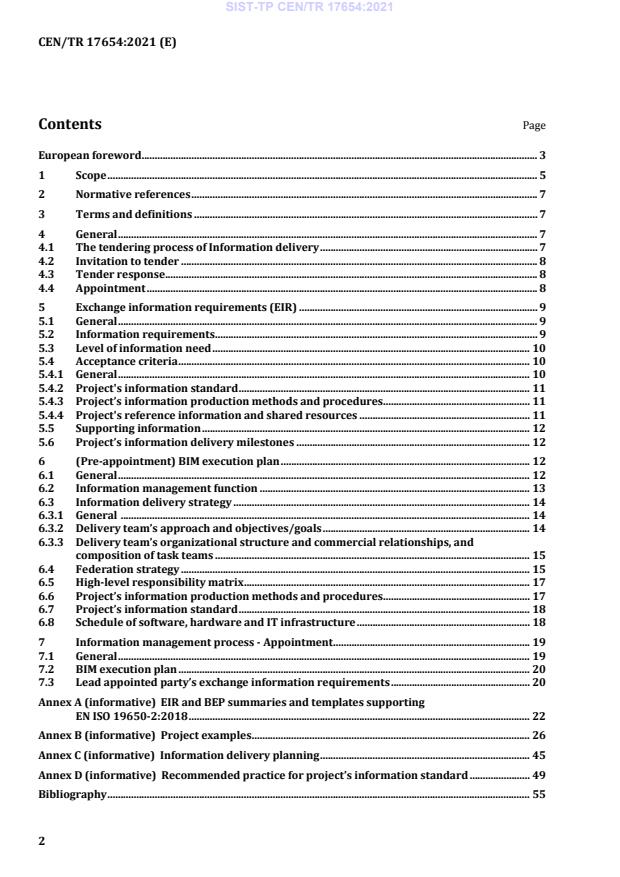
Contents Page
European foreword . 3
1 Scope . 5
2 Normative references . 7
3 Terms and definitions . 7
4 General . 7
4.1 The tendering process of Information delivery . 7
4.2 Invitation to tender . 8
4.3 Tender response . 8
4.4 Appointment . 8
5 Exchange information requirements (EIR) . 9
5.1 General . 9
5.2 Information requirements . 9
5.3 Level of information need . 10
5.4 Acceptance criteria . 10
5.4.1 General . 10
5.4.2 Project's information standard . 11
5.4.3 Project’s information production methods and procedures. 11
5.4.4 Project's reference information and shared resources . 11
5.5 Supporting information . 12
5.6 Project’s information delivery milestones . 12
6 (Pre-appointment) BIM execution plan . 12
6.1 General . 12
6.2 Information management function . 13
6.3 Information delivery strategy . 14
6.3.1 General . 14
6.3.2 Delivery team’s approach and objectives/goals . 14
6.3.3 Delivery team’s organizational structure and commercial relationships, and
composition of task teams . 15
6.4 Federation strategy . 15
6.5 High-level responsibility matrix . 17
6.6 Project’s information production methods and procedures. 17
6.7 Project’s information standard . 18
6.8 Schedule of software, hardware and IT infrastructure . 18
7 Information management process - Appointment . 19
7.1 General . 19
7.2 BIM execution plan . 20
7.3 Lead appointed party’s exchange information requirements . 20
Annex A (informative) EIR and BEP summaries and templates supporting
EN ISO 19650-2:2018 . 22
Annex B (informative) Project examples . 26
Annex C (informative) Information delivery planning . 45
Annex D (informative) Recommended practice for project’s information standard . 49
Bibliography . 55
European foreword
This document (CEN/TR 17654:2021) has been prepared by Technical Committee CEN/TC 442 “Building
Information Modelling”, the secretariat of which is held by SN.
Attention is drawn to the possibility that some of the elements of this document may be the subject of
patent rights. CEN shall not be held responsible for identifying any or all such patent rights.
Any feedback and questions on this document should be directed to the users’ national standards body.
A complete listing of these bodies can be found on the CEN website.
Introduction
Reference to EN ISO 19650-1, EN ISO 19650-2 and CEN/TR 17439.
This document aims at applicability across Europe, and provides, especially with regard to the attached
template in Annex A, a lowest common denominator to help responsible parties to capture and deliver
the most relevant information.
Qualified technical decisions are only possible based on quality-ensured information. The conversion of
the project specific needs for information into technical-formal information requirements is a complex
task that requires special skills and needs experience and a standardized procedure. The tendering of
data can be carried out, as described in this guideline, in the form of exchange information requirements
(EIR).
Another central aspect of BIM according to EN ISO 19650-1 and EN ISO 19650-2 is collaborative work.
Early and regular sharing of work, sharing and using information as opposed to files or “electronic paper”
are core elements of BIM and enable the often experienced and described benefits of better
communication, coordination, efficiency, transparency and control. The conventions, processes, rules and
technical support required for this are referenced in the BIM execution plan (BEP) and form the backbone
of information creation.
All exemplary templates in Annex A and examples of use in Annex B can be adapted, either due to specific
requirements of an organization or region. National bodies can develop complementary national annexes
and guidance to EN ISO 19650-2 based on this document.
1 Scope
This document deals with the processes involved in the procurement and delivery of information to
planning and construction projects, specifically with exchange information requirement (EIR) and BIM
execution plan (BEP), considering the administrative processes. This document takes into account
international standards and specifications as well as recommended practice.
This document is relevant for all parties involved in the tendering of information deliverables. Including
both those that require and those that deliver the information. The required information can be relevant
for all processes in the life cycle such as design, construction, operation and maintenance and end-of-life
processes. It applies above all to e.g. client, asset owners/operators, architects, engineer, contractors,
subcontractors etc.
This document provides methodology to appointing parties on how to require and agree the right
amount, quality and level of information needs.
It is also important for appointed parties to be able to assess the quality of existing EIRs and identify
possible over-specification or gaps. Based on this, it is possible to estimate and calculate the necessary
effort for data creation.
This document operationalizes the tendering and appointment process of information deliverables as
specified in EN ISO 19650-2:2018. This document does not cover all clauses of EN ISO 19650-2:2018. Its
main goal is to provide template examples and guidance for all activities conditioning specification of
requirements and deliverables in the production of exchange information requirements and BIM
execution plan. Specifically, it covers the “shall” and “shall consider” requirements in
EN ISO 19650-2:2018, 5.2.1 (EIR), 5.3.2 (pre-appointment BEP) and 5.4.1 (confirmed BEP). For
specification of Scope and out of scope see Table 1 (see Annex A for which part of EN ISO 19650-2:2018
is supported by templates).
Table 1 — Scope of documentation covered in this document according to EN ISO 19650-2:2018
clause reference
Invitation to tender Tender response Appointment
EIR pre-appointment BEP BEP
5.2.1 Appointing party’s exchange 5.3.2 Delivery team’s 5.4.1 Confirm the
information requirements (pre-appointment) BIM delivery team’s BIM
execution plan execution plan
a) information requirement
a) information 5.4.3 lead appointed
b) level of information need
management party’s exchange
c) acceptance criteria
functions information
d) supporting information
requirements
b) information
e) information delivery dates
delivery strategy
c) federation strategy
d) high-level
responsibility
matrix
e) project’s
information
production
methods and
procedures
f) project’s
information
standard
g) schedule of
software
5.2.4 Invitation to tender 5.3.7 The delivery 5.4.6 Lead appointed
information team’s tender response party’s appointment
documents
− the relevant reference − capability and
information and shared capacity 5.4.7 Appointed party’s
resources (within the project’s assessment appointment
common data environment) summary documents
− the tender response − mobilization plan
requirements and evaluation
− information
criteria (if applicable)
delivery risk
− the project’s information assessment
standard and (within the
project’s common data
environment)
− the project’s information
production methods and
procedure (within the project’s
common data environment)
− the project’s information
protocol
Out of scope In scope
Invitation to tender Tender response Appointment
EIR pre-appointment BEP BEP
5.1.4 Project’s information 5.4.2 Delivery team’s
standard examples in Annex D in detailed responsibility
this document matrix
5.4.4 Task information
delivery plan(s)
5.4.5 Master
information delivery
plan
2 Normative references
The following documents are referred to in the text in such a way that some or all of their content
constitutes requirements of this document. For dated references, only the edition cited applies. For
undated references, the latest edition of the referenced document (including any amendments) applies.
EN 17412-1:2020, Building Information Modelling - Level of Information Need - Part 1: Concepts and
principles
EN ISO 19650-1:2018, Organization and digitization of information about buildings and civil engineering
works, including building information modelling (BIM) - Information management using building
information modelling - Part 1: Concepts and principles (ISO 19650-1:2018)
EN ISO 19650-2:2018, Organization and digitization of information about buildings and civil engineering
works, including building information modelling (BIM) - Information management using building
information modelling - Part 2: Delivery phase of the assets (ISO 19650-2:2018)
3 Terms and definitions
For the purposes of this document, the following terms and definitions apply: the terms and definitions
given in EN ISO 19650-1:2018, EN ISO 19650-2:2018.
ISO and IEC maintain terminological databases for use in standardization at the following addresses:
— IEC Electropedia: available at https://www.electropedia.org/
— ISO Online browsing platform: available at https://www.iso.org/obp
4 General
4.1 The tendering process of information delivery
The workflow for appointing information deliverables as described in EN ISO 19650-2:2018 is as follows
(see Figure 1):
1) Invitation to tender.
2) Tender response.
3) Appointment.
Out of scope although
included in Annexes
4.2 Invitation to tender
The appointing party establishes exchange information requirements (EIR) for each lead appointed party
appointment, considering, where appropriate, the organizational information requirements (OIR), asset
information requirements (AIR) and project’s information requirements (PIR) (see
EN ISO 19650-1:2018, 5.1, Figure 2 and explanations in EN ISO 19650-1:2018, 5.2 to 5.7). The
requirements for the EIR are specified in EN ISO 19650-2:2018, 5.2.1. An EIR is made available for all
prospective lead appointed parties being invited to tender for an appointment.
4.3 Tender response
The prospective lead appointed parties respond to the EIR with a BIM execution plan (pre-appointment).
The minimal requirements to the pre-appointment BIM execution plan are specified in
EN ISO 19650-2:2018, 5.3.2.
4.4 Appointment
When the lead appointed party is selected, the lead appointed party confirms the BIM execution plan and
provides a defined set of information about the execution of the deliverables within the scope of their
appointment. The minimal requirements to the appointment BIM execution plan are specified in
EN ISO 19650-2:2018, 5.4. The detailing of the (pre-appointment) BIM execution plan depends on the
project specific tendering process. If more than one lead appointed party is appointed, the collaborative
aspects of the BIM execution plan cannot always be specified prior to appointment. It should be amended
in the master information delivery plan (MIDP) and the task information delivery plan (TIDP) as part of
the process establishing the appointment.
NOTE 1 The project team can include one or more lead appointed parties.
NOTE 2 The lead appointed party represents one or more appointed parties. When the appointed only
represents one appointed party they are usually the same company with two different functions.
Key
1 tendering process – pre-appointment
1.1 invitation to tender, EIR, guidance in Clause 5
1.2 tender response, pre-appointment BEP, guidance in Clause 6
2 appointment
2.1 appointment, BEP, guidance in Clause 7
A appointing party
B lead appointed party
Figure 1 — The two responsible parties in the pre-appointment process
The shades (black and grey) of the parties in Figure 1 are also used in Annex B, example 2 template
heading to signal whether the information should be provided by the appointing party or the lead
appointed party. This is only as an example on graphical layout.
This document provides examples of templates supporting each set of information to be established by
both the appointing party, lead appointed party and appointed parties. For examples on how to use this
document, refer to Annex B.
5 Exchange information requirements (EIR)
5.1 General
This Clause provides guidance on how to provide required information, according to
EN ISO 19650-2:2018, 5.2.1. See Table 2 for where to find information in EN ISO 19650-1,
EN ISO 19650-2 in this document and in Annex A.
Table 2 — Mapping table for requirements in EN ISO 19650-2:2018, 5.2.1 and template examples
in this document's Annex A
Template
EN ISO 19650-1:2018, EN ISO 19650-2:2018, Clause in this
number in
clauses Clause 5.2.1 document
Annex A
5.5 Exchange information Table A.1 and
Information requirements 5.2
requirements (EIR) Table A2
11.2 Level of information
Level of information need 5.3 Table A.1
need
Acceptance criteria 5.4 Table A.1
Supporting information 5.5 Table A.1
Information delivery dates 5.6 Table A.1
NOTE 1 The project team can include one or more lead appointed parties.
The appointing party establishes the exchange information requirements by listing all applicable
information requirements for the specific appointment. The exchange information requirements are
provided to the potential lead appointed parties.
5.2 Information requirements
The information requirements can state what, when, how produced, and for whom the information is
needed. The information requirements are organizational (OIR), asset (AIR) or project (PIR) and
exchange (EIR) information requirements. It is recommended that the OIR, AIR or PIR, that the EIR is
derived from, are also included in the invitation to tender sent to each prospective lead appointed party,
but this is not mandatory.
Informing each lead appointed party why the information is needed will allow them to innovate in the
method of information production and delivery for the appointing party’s business needs. Stating what
is needed helps each appointed party to focus on the deliverables that the appointing party knows they
need.
Information requirements should be a description of the purpose for organizational objectives, operation
of an asset or delivery of an asset. The information requirement should be referenced between the EIR
and the OIR, AIR and PIR so they can be tracked in other project documentations e.g. BEP.
For example, template on how information can be provided see Table A.1 and A.2. For project examples
see Table B.1 and Table B.2, Figure B.2 and Figure B.3.
The “When” can be referenced to a trigger event or date based on the information delivery milestones
(EN ISO 19650-2:2018, 5.1.3).
The “How” can be referenced to the project’s information standard (EN ISO 19650-2:2018, 5.1.4) or the
project’s information production methods and procedures (EN ISO 19650-2:2018, 5.1.5).
EXAMPLE At the start of operations, the end-user wants to know how to manage the new asset on a day by
day basis. For more information on defining information requirements refer to EN 17412-1 and EN ISO 29481-1
format.
5.3 Level of information need
The level of information need is a framework which defines the extent and granularity of information.
They should be defined by different concepts: geometrical information, alphanumerical information, and
documentation.
Stating the level of information need helps the appointed party to produce only what is needed and saves
time from over or underproduction of information.
Level of information need describes the quality, quantity, and granularity of the information delivery
exchange during each appointment. This is to be done by describing first the purpose of the required
information, when the information is required, by whom and to which object within the breakdown
structure it is associated.
The project’s information standard includes the method to assign the level of information need for the
appointment (EN ISO 19650-2:2018, 5.1.4 c)).
The method of assignment the level of information need should follow the concepts and principles of
EN 17412-1.
EXAMPLE Geometrical information: For facility management purposes: Detail: a boiler can be simplified and
reduced to a box including the volume of the operational space, Dimensionality: 3D, Location: Absolute, against a
reference, Appearance: Cubic volume expressing the boilers outer dimensions and required access for connections
and service access, Parametrical behaviour: None; Alphanumerical information: Identification: Type name,
classification, codification, index, Information content: Type, power, capacity, connections etc.; Documentation: To
get approval of proposed design solutions, e.g. with technical requirements.
A specification of level of information need according to EN 17412-1 will usually not fit into a template
as the examples in Annex A. The level of information need can be specified in a separate documentation
with reference in a table.
For more information on defining level of information need refer to EN ISO 19650-1:2018, 11.2,
EN 17412-1 and CEN/TR 17439:2020, 6.7.
5.4 Acceptance criteria
5.4.1 General
The acceptance criteria are the conditions used to check that the information is delivered in the correct
way, not that the contents of the information are correct. Failing to meet the predetermined conditions
will lead to the information delivery being rejected.
Acceptance criteria can refer to but be more specific than the project’s information standard, the project’s
information production methods and procedures and reference information or shared resources.
The acceptance criteria are used to ensure that deliverables are compliant with the information
requirements.
5.4.2 Project's information standard
The project’s information standard describes project-specific criteria to support the consistency and
exchange of information required for the project. When establishing the project’s information standard,
the following should be considered: Requirements to level of information need, the use of open BIM
standards, the means of structuring and classifying information, information formats needed for further
use of information in later project phases and for asset operation etc.
These considerations ensure that meaningful, reliable and consistent data are provided by the project.
This information is the basis for informed decision-making.
They should prescribe what is required for information exchanges, how information is structured and
classified, how to assess if the information is to the correct level of information need, and how the
information will be used in operation, including who will be using the information if this is known. The
project’s information standard should not specify the methodology for the production of project’s
information. All information should conform to the project's information standard before changing status
in the CDE.
EXAMPLE Acceptance criteria can be stated in the EIR or reference by URL to the documentation that defined
the criteria. LinearUnits: Millimetres, AreaUnits: Squaremetres, VolumeUnits: Cubicmetres, CurrencyUnit: Euros; URL
link [Project Standard Units]
For more information, refer to EN ISO 19650-1:2018, 11.3. Information quality and for a recommended
practice for model, object naming and user-defined properties as part of appointing party's project's
information standard see Annex D.
5.4.3 Project’s information production methods and procedures
Project's information production methods and procedures define the approaches and techniques the
appointed party uses to create, manage and approve information. This may include requirements to
information exchange processes, data security management, quality assurance procedures and other use
cases involving information exchanges etc. This may also include the security or distribution of
information.
They should define the most effective and efficient way to complete tasks. Information production by
these methods and procedures should automatically be to the required standard for the project and
ensure consistency of information.
Project's information production methods and procedures should as much as possible be developed in a
collaborative manner. The appointed parties are required to describe their intended methods and
procedures for the project. They should be repeatable and scalable.
EXAMPLE A protocol for security classification of information deliverables. As information production methods
and procedures are most likely organizational proprietary documentation a URL could be the most suitable method
of specifying this information. URL link [Check, Review, and Approval process map]
5.4.4 Project's reference information and shared resources
Project's reference information and shared resources are existing information that should be used or
referred to by the appointed parties when producing the information deliverables. The appointing party
should make available all existing or predefined information as detailed by the appointment.
By sharing its reference information and shared resources the appointing party will remove redundant
work recreating existing information, templates or libraries and ensure the new information is created
to the correct standard. This can be referenced to existing asset information e.g. utilities underground
layouts.
EXAMPLE A pre-existing asset floorplan. As reference information and shared resources most likely is
additional documentation a URL could be the most suitable method of specifying this information. URL link [pre-
existing asset floorplans].
5.5 Supporting information
Supporting information is existing information that could be used or referred to by the appointed party
when producing the information deliverables or preparing the tender response. The appointing party
should make available all existing or predefined information as detailed by the appointment.
Supporting information can help the lead appointed party to better understand or evaluate the
information required or its acceptance criteria.
This can be referenced to existing asset information or samples of exemplary information deliverables.
EXAMPLE Surveys specifically for this appointment, other documents, guidance's, other standards (international,
national, or industry). As supporting information most likely is additional documentation, a URL could be the most
suitable method of specifying this information. URL link [topographical survey].
5.6 Project’s information delivery milestones
Project’s information delivery milestones specify when the information is needed by the appointing
party. This should accommodate how much time is required to accept the information. This can be a date,
frequency or relative to an event.
Milestones allow the appointing party and the appointed parties to plan and resource the project. They
should be respected by both parties to ensure the delivery schedule is achieved.
Information exchanges can be required to accommodate internal coordination by the appointed party to
quality ensure or other internal processes before the project milestones.
EXAMPLE Milestone delivery date 06.10.2018; Internal information exchanges every first Monday in the month;
Information delivery to be quality ensured starting at latest 15 working days prior to milestone delivery.
For more information refer to the information delivery milestones see EN ISO 19650-2:2018, 5.1.3 and
timing of information delivery EN ISO 19650-1:2018, 10.2.
6 (Pre-appointment) BIM execution plan
6.1 General
This Clause provides guidance on how to respond to the tender, according to EN ISO 19650-2:2018, 5.3.2.
See Table 3 for where to find information from EN ISO 19650-1 and EN ISO 19650-2 in the present
document.
Table 3 — Mapping table for requirements in EN ISO 19650-1 and EN ISO 19650-2:2018, 5.3.2
and template examples in this document Annex A
Clause in Template
EN ISO 19650-2 reference
EN ISO 19650-1
this number
reference
(Clause 5.3.2)
document
Annex A
7 Project and asset Information management functions A.3
6.2
information
management
functions
Information delivery strategy A.4
6.3
10.4 Federation Federation strategy A.5
6.4
strategy
10.3 Responsibility
High-level responsibility matrix A.6
6.5
matrix
Proposed additions or amendments to A.7
6.6
the project’s information production
methods and procedures
Proposed additions or amendments to A.8
6.7
the project’s information standard
Proposed schedule of software, A.9
6.8
hardware and IT infrastructure
NOTE 1 The templates in Annex A provides an example on how requirements can be expressed. Requirements
can be expressed in other ways as demonstrated in Annex B example 2.
6.2 Information management function
The prospective lead appointed party response informs the appointing party who (named individuals)
will be responsible for information management during the project through extension to existing project
roles and/or inclusion of new roles such as information manager. Where the delivery team is using
information managers, the description of information management function should include the lead
appointed party and known task team’s information managers at pre-appointment. At appointment all
task team’s information manager should be included.
The response should demonstrate that the proposed individuals are competent to perform the function.
This also gives the delivery team clarity about the allocation of responsibilities for the information
management from the very start of the project.
This information can be presented on a schedule or organizational chart. The minimum amount of
information to be provided as a list of names and resumes of individuals detailing their previous
experience performing a similar function, including brief descriptions of their information management
responsibility.
For example, template on how information can be provided see Table A.3. For project examples see
Table B.3, Figure B.1 and Figure B.7.
Information to be included in the information management function response:
1) the names of individuals;
2) the organizations they represent;
3) information management responsibilities;
4) links to personal resumes that may be uploaded to a secure area the CDE; (General Data Protection
Regulation (GDPR) should be considered regarding personal details).
EXAMPLE Information management function response will include the lead appointed parties and may include
the task team’s information managers for e.g. architectural, structural engineering, MEP, etc.
Additional information on the information management function is given in CEN/TR 17439:2020, 6.2.
As stated in 4.4 in this document, if more than one lead appointed party is appointed, the collaborative
aspects of the BIM execution plan may be specified prior to appointment and should be amended during
appointment or post-appointment in the master information delivery plan (MIDP) and the task
information delivery plan (TIDP).
6.3 Information delivery strategy
6.3.1 General
The information delivery strategy can be summarized in three topics; how will the deliverables be
completed, what will this achieve and how is the delivery team made up.
The response to this should give the appointing party confidence that the prospective lead appointed
party understands the information requirements and the design team has been arranged to deliver at a
satisfactory level.
For example, template on how information can be provided see Table A.4. For project example see
Table B.4, Figure B.4 and Figure B.5.
6.3.2 Delivery team’s approach and objectives/goals
The response should reflect the lead appointed party’s approach to meeting the information
requirements as specified in the EIR at a high level. The lead appointed party also should set out what
they hope to achieve with the deliverables through their objectives/goals for the collaborative production
of information.
The specified approach should offer the appointing party confidence that the lead appointing party
understands the EIR and makes the right provisions to meeting the information requirements.
The information delivery strategy may be specified with the following information:
1) Information requirement reference, where requirements from the EIR are referenced by codes (e.g.
EIR 01, EIR 02 etc.);
2) Delivery team’s approach, where the delivery team’s procedures to meet with the information
requirement(s) are explained or referenced;
3) It is recommended to include a column to express “acceptance” where the lead appointed party states
whether it accepts the information requirement(s) in question;
4) The delivery team’s objectives/goals for the collaborative production of information.
EXAMPLE The information delivery approach may include e.g. procedures for the recurrent aggregation of
discipline models, model checks and the handling of issues, the use of models for quantity take-off, etc. Conditions
that must be met, may refer to the project’s information standard, the project’s production methods and procedures
and the availability of reference information and shared resources and the CDE.
The specification of objectives/goals for the collaborative production of information may result in descriptions of
how the delivery team’s integral and collaborative approach of the information production will be organized.
E.g. an objective may be to minimize rework and/or to avoid that any task team should have to wait for information
to be delivered by (an) other task team(s). Approach to ensure information coordination between appointed parties
in the delivery team: 1. Bi-weekly exchange of updated models according to the MIDP. 2. Models are aggregated and
controlled for coordination and other model requirements. 3. Coordinated deliverables. Model checks before milestone
delivery are documented.
6.3.3 Delivery team’s organizational structure and commercial relationships, and composition
of task teams
The delivery team configuration should be described to the appointing party, this overview should detail
the organizational structure and commercial relationships, and delivery team’s composition.
This overview should give confidence to the appointing party that the lead appointed party had the
required team in place to successfully deliver the project and communicate relationship between the task
teams.
The overview should identify all members of the design team and could take the form of a schedule, for
the complex project, an organizational chart may be more appropriate.
EXAMPLE
Function/relationship Responsible party
1. Lead appointed party ABC Ltd
1.1 Architect Function ABC Ltd.
1.2 Landscape Function ABC Ltd.
1.3 Structural Function DEF Ltd.
1.4 MEP Function GHI Ltd.
1.4.1 Mechanical Task GHI Ltd.
1.4.2 Electrical Task GHI Ltd.
1.4.3 Plumbing Task GHI Ltd.
1.5 Cost consultant Function JKL Ltd.
6.4 Federation strategy
In order to obtain an integral, complete and coherent design, it is important that information models are
combined into one or more federated information models. These information models may contain
geometrical information, alphanumerical information and reference to documentation. Federation
strategies are purpose driven. Different purposes may result in different federation strategies.
The delivery team’s federation strategy consists of all the arrangements made to ensure the development
of complete and coherent information. The federation strategy allows interdependent contributions of
different disciplines task teams can be aligned in one or more integrated and coherent deliverable. The
lead appointed party’s response as part of the pre-appointment BIM execution plan, to show that the
appointing party’s goals are understood and properly addressed. The federation strategy may be further
elaborated after appointment with the delivery team’s own specific purposes.
At the time of the completion of the pre-appointment BEP not all the information needed for a
comprehensive federation strategy may be available yet. The lead appointed party may provide for a
high-level federation strategy in the pre-appointment BEP that the delivery team can elaborate further
in the post-appointment BEP. For example, template on how information can be provided see Table A.5.
For project examples see Table B.5, Figure B.8 and Figure B.9.
A federation strategy may include:
1) Federation purpose: It is important to identify the clear purpose of federation. More than one
purpose can be used on a project if needed.
2) Federation description: Describe the chosen federation strategy deriving from the purpose.
3) Task team(s) producing information models: Identify which task team is responsible for which
information container. It is possible for a task team to produce more than one information container
in the federation - this depends on the scopes of the appointments made by the appointing party. It
is also important to understand that task teams are may not just be the design disciplines, they may,
dependent on the contract form, also include the contractor and/or certain suppliers.
4) List of information models to be federated: Identify the separate information containers that are to
be federated (combined).
5) Information container breakdown structure: An information container breakdown structure for each
function in the federation may be added to provide more detail of the information model.
EXAMPLE The purpose of “clash detection” may require the aggregation of different information containers
than the purpose of optimizing life cycle costs or sustainable design. Also, the complexity of the project, the assets
and the team structure may be of influence.
It is helpful if information models do not exceed a particular data size, otherwise they can be difficult to
open, update, export and import. The size for this varies according to computational power and formats.
Larger projects will often have to be split into two or more information models when they become more
detailed. This can be in addition to any discipline or functional reason for dividing the project into
multiple information models.
In the context of a project or asset, it is quite common to use a combination of strategies below in a
federation strategy (or a combination of federation strategies) to achieve the agreed objectives. Different
strategies could be to federate information models according to, for example:
— aligning/coordinating the contributions of different disciplines;
— the appointing party’s procurement strategy;
— building sections and/or service systems;
— specific use cases, e.g. energy consumption analysis;
— planning, e.g. the sequence of execution on site;
— software applications and their interoperability;
— maximum data size of information models;
— machine capabilities, etc.
6.5 High-level responsibility matrix
The high-level responsibility matrix communicates the first iteration of the responsibilities for the overall
task team deliverables. This indicates which task team member (appointed party/task team) is
responsible for each component of the information deliverables.
The high-level responsibility matrix communicates how the prospective lead appointed party will assign
their resources for each deliverable. For the delivery team this means that the responsibility for each
deliverable are clearly assigned between the parties. For the appointing party it ensures that the
prospective lead appointed party takes responsibility for the information requirement and that they have
assigned resources to the task.
The high-level responsibility matrix is established pre-appointment and is developed into the detailed
responsibility matrix in the appointment docu
...