


EN 14620-2:2006
(Main)Design and manufacture of site built, vertical, cylindrical, flat-bottomed steel tanks for the storage of refrigerated, liquefied gases with operating temperatures between 0 °C and -165 °C - Part 2: Metallic components
General Information
- Abstract
This European Standard specifies general requirements for the materials, design, construction and installation of the metallic components of refrigerated liquefied gas storage tanks.
This European Standard deals with the design and manufacture of site built, vertical, cylindrical, flat-bottomed steel tanks for the storage of refrigerated, liquefied gases with operating temperatures between 0 °C and –165 °C.
- Status
- Published
- Publication Date
- 12-Sep-2006
- Technical Committee
- CEN/TC 265 - Site built metallic tanks for the storage of liquids
- Drafting Committee
- CEN/TC 265/WG 10 - Revision of EN 14620
- Current Stage
- 9092 - Decision on results of review/2YR ENQ - revise - Review Enquiry
- Start Date
- 17-Jun-2021
- Completion Date
- 17-Sep-2026

Overview
EN 14620-2:2006 is the CEN European Standard that specifies requirements for the metallic components of site-built, vertical, cylindrical, flat‑bottomed steel tanks used to store refrigerated, liquefied gases at operating temperatures between 0 °C and −165 °C. Part 2 of the EN 14620 series focuses on the selection of steels, design rules, fabrication, welding procedures and inspection/testing requirements for cryogenic storage tanks and their metallic parts.
Key Topics
- Materials and temperature limits: requirements for steel selection, material classes and suitability for cryogenic service; differentiation of primary and secondary liquid containers and vapour (outer) containers.
- Design fundamentals: design theory, maximum allowable design stresses, partial load and material factors, membrane design considerations and shell plate thickness rules.
- Welding and procedures: qualification of welding procedures, preheat/post‑weld heat treatment guidance, tack/temporary welds, rules for 9 % nickel steels and welder/operator qualifications.
- Fabrication tolerances: plate preparation, radius and profile tolerances, local weld deformation limits, roof and temporary attachment rules.
- Inspection and NDT: prescribed test methods and acceptance levels including visual, dye penetrant, magnetic particle, radiographic and ultrasonic testing, vacuum box, leak testing (soap bubble, ammonia tightness), and qualification of NDT personnel.
- Testing, fatigue and actions: requirements and informative annexes covering actions on membranes, fatigue (S‑N curves) and methodology for deriving load and fatigue curves.
Applications
EN 14620-2 is used by professionals involved in the lifecycle of cryogenic storage tanks:
- Tank designers and structural engineers specifying metallic components for refrigerated liquefied gas storage (LNG, industrial gases).
- Fabricators and welding supervisors implementing qualified welding procedures and production controls for cryogenic steels.
- NDT inspectors and QA/QC teams applying inspection regimes and acceptance criteria to ensure weld integrity.
- Plant owners, constructors and regulators verifying compliance for safety, durability and operability of site-built cryogenic tanks.
Adoption of EN 14620-2 supports consistent, safe design and manufacture of cryogenic tanks and helps mitigate risks associated with low-temperature embrittlement, fatigue and leakage.
Related Standards
- EN 14620 series (Part 1: General; Part 3: Concrete; Part 4: Insulation; Part 5: Testing/drying/purging)
- Referenced NDT, welding and structural Eurocodes (examples: EN 287‑1, EN 1435, EN 1712, Eurocode 3/ENV 1993 series)
Keywords: EN 14620-2, refrigerated liquefied gas tanks, cryogenic storage tanks, metallic components, site-built vertical cylindrical tanks, welding, NDT, tank design.
Relations
- Effective Date
- 25-Aug-2026
- Effective Date
- 25-Aug-2026
- Effective Date
- 25-Mar-2026
- Effective Date
- 28-Jan-2026
- Effective Date
- 28-Jan-2026
- Effective Date
- 28-Jan-2026
- Refers
EN 1435:1997 - Non-destructive examination of welds - Radiographic examination of welded joints - Effective Date
- 28-Jan-2026
- Effective Date
- 28-Jan-2026
- Effective Date
- 28-Jan-2026
- Effective Date
- 28-Jan-2026
- Effective Date
- 28-Jan-2026
- Effective Date
- 28-Jan-2026
- Effective Date
- 28-Jan-2026
- Effective Date
- 28-Jan-2026
- Effective Date
- 28-Jan-2026
Get Certified
Connect with accredited certification bodies for this standard

Institut za varilstvo d.o.o. (Welding Institute)
Slovenia's leading welding institute since 1952. ISO 3834, EN 1090, pressure equipment certification, NDT personnel, welder qualification. Only IIW Au
Sponsored listings
Frequently Asked Questions
EN 14620-2:2006 is a standard published by the European Committee for Standardization (CEN). Its full title is "Design and manufacture of site built, vertical, cylindrical, flat-bottomed steel tanks for the storage of refrigerated, liquefied gases with operating temperatures between 0 °C and -165 °C - Part 2: Metallic components". This standard covers: This European Standard specifies general requirements for the materials, design, construction and installation of the metallic components of refrigerated liquefied gas storage tanks. This European Standard deals with the design and manufacture of site built, vertical, cylindrical, flat-bottomed steel tanks for the storage of refrigerated, liquefied gases with operating temperatures between 0 °C and –165 °C.
This European Standard specifies general requirements for the materials, design, construction and installation of the metallic components of refrigerated liquefied gas storage tanks. This European Standard deals with the design and manufacture of site built, vertical, cylindrical, flat-bottomed steel tanks for the storage of refrigerated, liquefied gases with operating temperatures between 0 °C and –165 °C.
EN 14620-2:2006 is classified under the following ICS (International Classification for Standards) categories: 23.020.10 - Stationary containers and tanks. The ICS classification helps identify the subject area and facilitates finding related standards.
EN 14620-2:2006 has the following relationships with other standards: It is inter standard links to ISO 965-2:1998, ISO 261:1998, EN 1994-1-1:2026, EN 10216-3:2013, EN 10216-2:2024, EN 10204:2004, EN 1435:1997, EN 1994-1-1:2004, EN ISO 9016:2022, EN ISO 17637:2016, EN ISO 9606-1:2017, EN 10025-4:2019+A1:2022, EN 1515-1:1999, EN 10217-2:2019, EN 14015:2004. Understanding these relationships helps ensure you are using the most current and applicable version of the standard.
EN 14620-2:2006 is available in PDF format for immediate download after purchase. The document can be added to your cart and obtained through the secure checkout process. Digital delivery ensures instant access to the complete standard document.
Standards Content (Sample)
2003-01.Slovenski inštitut za standardizacijo. Razmnoževanje celote ali delov tega standarda ni dovoljeno.Design and manufacture of site built, vertical, cylindrical, flat-bottomed steel tanks for the storage of refrigerated, liquefied gases with operating temperatures between 0 °C and -165 °C - Part 2: Metallic componentsOLConception et fabrication de réservoirs en acier a fond plat, verticaux, cylindriques, construits sur site, destinés au stockage des gaz réfrigérés, liquéfiés, dont les températures de service sont comprises entre 0 °C et - 165 °C - Partie 2 : Constituants métalliquesAuslegung und Herstellung standortgefertigter, stehender, zylindrischer Flachboden-Stahltanks für die Lagerung von tiefkalt verflüssigten Gasen bei Betriebstemperaturen zwischen 0 °C und -165 °C - Teil 2: Metallische BauteileTa slovenski standard je istoveten z:EN 14620-2:2006SIST EN 14620-2:2007en23.020.10UH]HUYRDUMLStationary containers and tanksICS:SLOVENSKI
STANDARDSIST EN 14620-2:200701-januar-2007
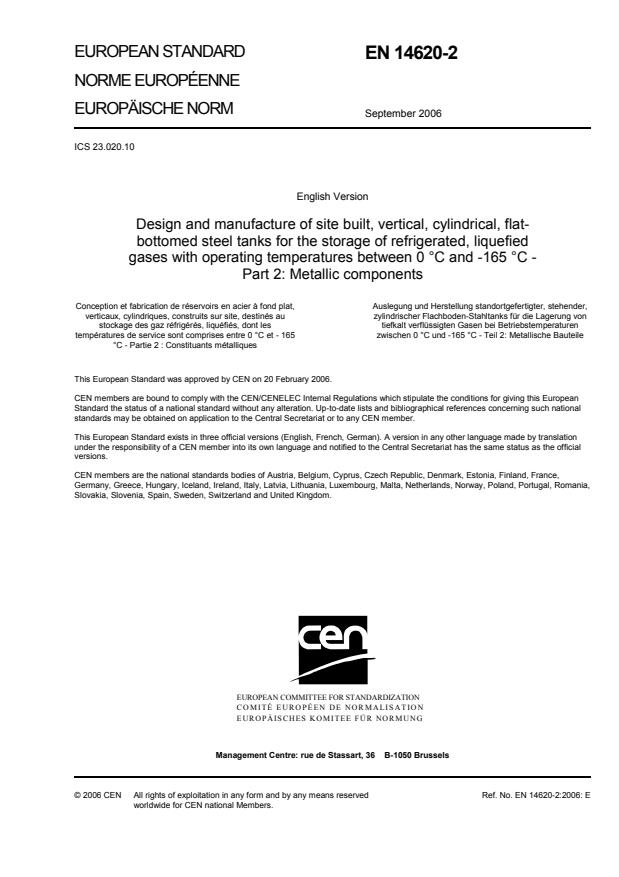
EUROPEAN STANDARD NORME EUROPÉENNE EUROPÄISCHE NORM
EN 14620-2
September 2006 ICS 23.020.10 English Version
Design and manufacture of site built, vertical, cylindrical, flat-bottomed steel tanks for the storage of refrigerated, liquefied gases with operating temperatures between 0 °C and -165 °C - Part 2: Metallic components
Conception et fabrication de réservoirs en acier à fond plat, verticaux, cylindriques, construits sur site, destinés au stockage des gaz réfrigérés, liquéfiés, dont les températures de service sont comprises entre 0 °C et -165 °C - Partie 2 : Constituants métalliques
Auslegung und Herstellung standortgefertigter, stehender, zylindrischer Flachboden-Stahltanks für die Lagerung von tiefkalt verflüssigten Gasen bei Betriebstemperaturen zwischen 0 °C und -165 °C - Teil 2: Metallische Bauteile This European Standard was approved by CEN on 20 February 2006.
CEN members are bound to comply with the CEN/CENELEC Internal Regulations which stipulate the conditions for giving this European Standard the status of a national standard without any alteration. Up-to-date lists and bibliographical references concerning such national standards may be obtained on application to the Central Secretariat or to any CEN member.
This European Standard exists in three official versions (English, French, German). A version in any other language made by translation under the responsibility of a CEN member into its own language and notified to the Central Secretariat has the same status as the official versions.
CEN members are the national standards bodies of Austria, Belgium, Cyprus, Czech Republic, Denmark, Estonia, Finland, France, Germany, Greece, Hungary, Iceland, Ireland, Italy, Latvia, Lithuania, Luxembourg, Malta, Netherlands, Norway, Poland, Portugal, Romania, Slovakia, Slovenia, Spain, Sweden, Switzerland and United Kingdom.
EUROPEAN COMMITTEE FOR STANDARDIZATION
COMITÉ EUROPÉEN DE NORMALISATION EUROPÄISCHES KOMITEE FÜR NORMUNG
Management Centre: rue de Stassart, 36
B-1050 Brussels © 2006 CEN All rights of exploitation in any form and by any means reserved worldwide for CEN national Members. Ref. No. EN 14620-2:2006: E
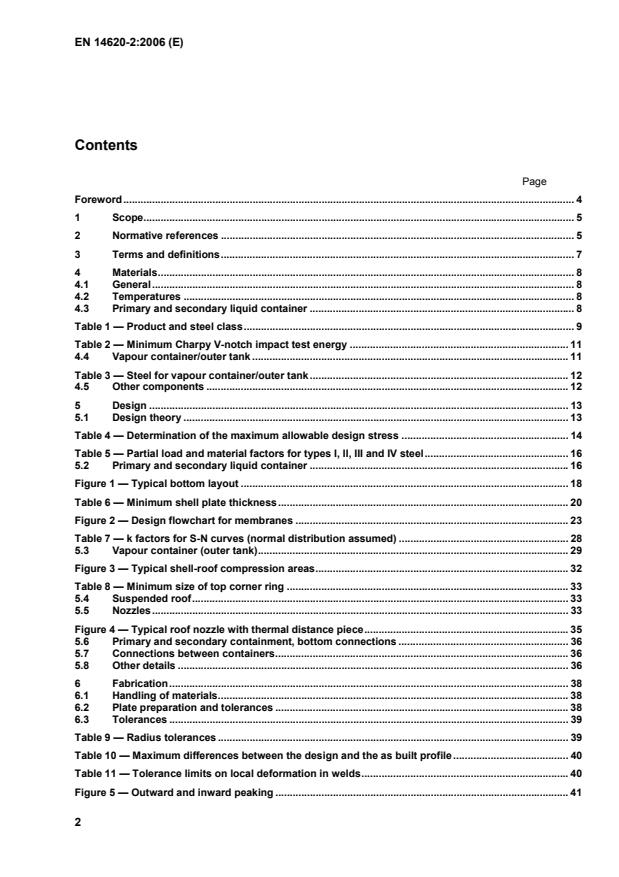
Actions on membrane.55 Table A.1 — Static action.55 Table A.2 — Cyclic action.55 Table A.3 — Accidental action.55 Annex B (informative)
Determination of the load and fatigue curves for membrane.56 Figure B.1 — Flowchart for membranes.56 Bibliography.57
EN 10045-1, Metallic materials — Charpy impact test — Part 1: Test method EN 10160:1999, Ultrasonic testing of steel flat product of thickness equal or greater than 6 mm (reflection method) EN 10204:2004, Metallic products — Types of inspection documents EN 10216-1, Seamless steel tubes for pressure purposes — Technical delivery conditions — Part 1: Non-alloy steel tubes with specified room temperature properties EN 10216-2, Seamless steel tubes for pressure purposes — Technical delivery conditions — Part 2: Non-alloy and alloy steel tubes with specified elevated temperature properties EN 10216-3, Seamless steel tubes for pressure purposes — Technical delivery conditions — Part 3: Alloy fine grain steel tubes EN 10216-4, Seamless steel tubes for pressure purposes — Technical delivery conditions — Part 4: Non-alloy and allow steel tubes with specified low temperature properties EN 10217-1, Welded steel tubes for pressure purposes — Technical delivery conditions — Part 1: Non-alloy steel tubes with specified room temperature properties EN 10217-2, Welded steel tubes for pressure purposes — Technical delivery conditions — Part 2: Electric welded non-alloy and alloy steel tubes with specified elevated temperature properties EN 10217-3, Welded steel tubes for pressure purposes — Technical delivery conditions — Part 3: Alloy fine grain steel tubes EN 10217-4, Welded steel tubes for pressure purposes — Technical delivery conditions — Part 4: Electric welded non-alloy steel tubes with specified low temperature properties EN 10217-5, Welded steel tubes for pressure purposes — Technical delivery conditions — Part 5: Submerged arc welded non-alloy and alloy steel tubes with specified elevated temperature properties
containment tank Membrane tank Typical product storage temperature Butane Type II Type I
- 10 °C Ammonia Type II Type II
- 35 °C Propane/ Propylene Type III Type II Type V - 50 °C Ethane/Ethylene Type IV Type IV Type V - 105 °C LNG Type IV Type IV
Type V - 165 °C NOTE
Service related effects, such as stress corrosion cracking, should be considered during material selection.
4.3.1.2.2 General requirements The following general requirements shall apply: a) Type I steel: A Type I steel is a fine-grained, low carbon steel, which shall be specified for pressure purposes at temperatures down to - 35 °C. The steel shall meet the following requirements: 1) The steel shall be specified to meet the requirements of an established European Standard (e.g. EN 10028-3). Steels with a minimum yield strength greater than 355 N/mm2 shall not be used. 2) The steel shall be in the normalized condition or produced by a thermo mechanical rolled process. 3) The carbon content shall be less than 0,20 %. The carbon equivalent Ceq shall be equal to or less than 0,43 with ()()eqCrMoVNiCuMnC=C6515++++++ b) Type II steel: A Type II steel is a fine-grained low carbon steel, which shall be specified for pressure purposes at temperatures down to - 50 °C. The steel shall meet the following requirements: 1) The steel shall be specified to meet the requirements of an established European Standard (e.g. EN 10028-3). Steels with a minimum yield strength greater than 355 N/mm2 shall not be used. 2) The steel shall be in the normalized condition or produced by a thermo mechanical rolled process. 3) The carbon content shall be less than 0,20 %. The carbon equivalent Ceq shall be equal to or less than 0,43 with
(e.g. EN 10028-7). 4.3.1.2.3 Maximum shell plate thickness The maximum shell plate thickness shall be: Types I, II and III: 40 mm; Types IV: 50 mm; Type V: no upper limit on thickness. When material thickness is required in excess of these values, additional material investigation and testing shall be carried out to demonstrate that the same level of resistance to brittle fracture is available as would be required for the type of material and maximum thickness indicated above. 4.3.1.2.4 Plate tolerances The plate tolerances shall be: in accordance with EN 10029:1991, Class C, for parts where the thickness is established by calculation; in accordance with EN 10029:1991, Class B, for parts where the thickness is based on minimum nominal thickness considerations.
4.3.3 Certification For materials with a design metal temperature below 0 °C an Inspection Certificate in accordance with EN 10204:2004, type 3.1 shall be required.
4.4 Vapour container/outer tank 4.4.1 Material for plate and structural sections The steel of the vapour container/outer tank shall be selected in accordance with Table 3. NOTE Alternative types of steels may be used provided equivalent properties (e.g. chemical composition and mechanical properties) can be demonstrated.
°C mm
TDM ≥ 10 e ≤ 40 S235JRG2 or S275JR or S355JR 10 > TDM ≥ 0 e
≤ 13 13 ≤ e ≤ 40 S235JRG2 or S275JR or S355JR S235JO or S275JO or S355JO 0 > TDM ≥ -10 e ≤ 13 S235J0 or S275J0 or S355J0
13 < e ≤ 40 S235J2G3 or S275J2G3 or S355J2G3 -10 > TDM ≥ -20 e ≤13 S235J2G3 or S275J2G3 or S355J2G3
13 < e ≤ 40 S235J2G3 or S275J2G3 or S355J2G4 For design metal temperatures below -20 °C and/or for thicknesses above 40 mm, the plate shall be impact tested at a temperature not exceeding the design metal temperature and show an impact value of at least 27 J longitudinal. For design metal temperatures below ) 0 °C, the impact tests of the weld metal and the HAZ of the vertical shell joint shall show at least 27 J at the design metal temperature.
4.4.2 Certification For materials with design metal temperatures below 0 °C an inspection certificate in accordance with EN 10204:2004 type 3.1 shall be required. All other materials shall be supplied with a test report in accordance with EN 10204:2004, type 2.2. 4.5 Other components 4.5.1 Bolting 4.5.1.1 Selection of bolting Bolting shall be in accordance with EN 1515-1:1999, Table 1 and Table 2. In selecting the material, the application, design pressure, design temperature and fluid service conditions shall be taken into account. In the case of ferritic and martensitic steels, the bolting bar material shall have a tensile strength
< 1 000 N/mm2 and an elongation A5 > 14 %. Ferritic and martensitic steels for use between –10 °C and –160 °C shall be impact tested at the design metal temperature and shall show an impact energy value of 40 J average in the longitudinal direction. At design metal temperatures below –160 °C, the impact testing shall be performed at –196 °C. NOTE 1 Where austenitic steel is used, bolts may relax on cooling to sub zero temperatures. This is caused by a permanent transformation of the structure from austenitic to martensitic, which results in an increase of length. The extent of transformation increases with the applied stress. NOTE 2 Bolts that cannot be retightened after cooling should be made from steel having a stable structure, such as 25 Cr 20 Ni or nitrogen bearing austenitic steel.
0,43 fu or 0,67 fy
or 260 N/mm2 Type IV the lesser of:
0,43 fu or 0,67 fy Type V the lesser of:
0,40 fu or 0,67 fy
the lesser of: 0,60 fu or 0,85 fy or 340 N/mm2
NOTES 1
fu is minimum ultimate tensile strength in N/mm² and fy is minimum yield strength in N/mm². NOTES 2
For type III and IV steels, fy is equal to 0,2 % of proof stress. NOTES 3
For type V steels, fy is equal to the 1 % proof stress.
In case of seismic design, the allowable stress for OBE shall be 1,33 times the allowable stress for service condition. For SSE, the allowable stress shall be 1,00 fy, in tension, and the critical buckling stress for compression. 5.1.2.2 Tank anchorage The tank anchorage shall be capable of resisting the tank uplift. The allowable tensile stress in the tank anchorage shall be limited to: normal operation: 0,50 fy; test: 0,85 fy; OBE: 0,67 fy; SSE: 1,00 fy. Shell attachments and embedments shall be designed for a load corresponding to the full yield capacity of the uncoroded anchor bolts or anchor straps. NOTE This to prevent possible tearing of the shell. For the design of the anchor bolt chairs see [14].
For Ethane/Ethylene and LNG service, anchors made from Type IV or V materials shall apply the anchor material yield stress at the temperature found in table 1 or colder. 5.1.2.3 Compression area at roof-to-shell junction The allowable compressive stress Sc shall be limited to 120 N/mm2. NOTE See 5.3.1.3.5 for details of compression area.
5.1.3.1 General For the analysis, based on limit state, the following Eurocodes shall be used: EN 1993-1-1, ENV 1993-1-6, ENV 1993-4-2:1999, and EN 1994-1-1. The following shall be taken into account: simplified method in accordance with ENV 1993-4-2:1999, Clause 11 shall not be used; for static analysis of the roof structure, EN 1993-1-1 or EN 1994-1-1 shall be used: design of shells to resist external pressure shall consider the requirements of section 5.2.1.2.3. ENV 1993-1-6 does not apply in this case; requirements of 5.1.3.2 are not the same as the requirements of the ENV 1993-4-2:1999 but shall be followed. 5.1.3.2 Primary and secondary liquid container The partial safety factors of the primary and secondary liquid container of the single, double and full containment tanks shall be adjusted in accordance with Table 5. NOTE The partial load factors and the material factors have been adjusted to arrive at the same shell thickness as used with allowable stress theory.
1,10 1,72/α
1,11 1,57/α − NOTE
α is the tensile to yield strength ratio fu/fy where γF is the partial factor for actions; γM is the factor for material strength; fu is ultimate tensile strength of steel or weld material whichever is the lesser; fy is the yield strength of the steel or weld material whichever is the lesser.
5.2 Primary and secondary liquid container 5.2.1 Single, double and full containment tanks 5.2.1.1 Bottom 5.2.1.1.1 Bottom annular plates The annular plates shall have a minimum thickness (excluding corrosion allowance), ea:
ea = (3,0 + e1/3), but not less than 8 mm where
e1
is the thickness of the bottom shell course, in mm. The minimum width la, between the edge of the sketch plate and the inner side of the shell, as shown in Figure 1c shall be either: a) as given by the following equation: aa240eHl> where
ea
is the thickness of the annular plate, in mm;
H
is the maximum design liquid height, in m; or b) 500 mm whichever is the larger. The following additional requirements shall apply: radial joints between annular plates shall be butt welded;
a) with annular plates at the perimeter
> 5ebeb- b) section A-A, overlap of bottom plates Figure 1 — Typical bottom layout
Figure 1 — Typical bottom layout (concluded)
5.2.1.2 Shell 5.2.1.2.1 Minimum shell plate thickness The minimum shell plate thickness shall be in accordance with Table 6.
D ≤ 10 5 10 < D ≤ 30 6 30 < D ≤ 60 8
60 < D
10 NOTE
The requirement for minimum thickness is needed for construction purposes, and may include any corrosion allowance, provided that the shell is shown by calculation to be safe in the corroded condition.
5.2.1.2.2 Shell plate thickness The thickness of the shell plate shall be the greatest of et, or e or the minimum thickness. a) For operating conditions: cPHWSDe++−=]0,3)([9820 where c is the corrosion allowance, in mm; D is the tank inside diameter, in m; e is the calculated plate thickness, in mm; H is the height from the bottom of the course under consideration to the maximum design liquid level, in m; P is the design pressure, in mbar. Zero for open top inner tank; S is the allowable design stress, in N/mm2; W
is the maximum density of the liquid under storage conditions, in kg/l. b) for hydrostatic test condition: ]0,3)([9820tttttPHWSDe+−=
where
D is the tank inside diameter, in m;
et is the calculated plate thickness, in mm;
Ht is the height from the bottom of the course under consideration to the test liquid level, in m;
Pt is the test pressure, in mbar. Zero for open top inner tank;
St is the allowable stress under test conditions, in N/mm2;
Wt is the maximum density of the test water, in kg/l. No course shall be designed at a thickness less than that of the course above, irrespective of materials of construction, except the compression area. 5.2.1.2.3 Additional requirements a) Shell welds All vertical and horizontal welds shall be butt welded, with full penetration and complete fusion. b) Plate arrangement The distance between vertical joints in adjacent courses shall be not less than 300 mm. c) Attachments Where attachments are made, pad plates shall be used. They shall not be located within 300 mm of a vertical weld or 150 mm of a horizontal weld. Pad plates and reinforcing plates shall have rounded corners with a minimum radius of 50 mm. d) External loading of inner tank shell If applicable, the following loads shall be considered: insulation pressure; inner tank vacuum; pressure between the inner and outer tanks. Biaxial stress
...