

prEN 17022
(Main)Child care articles - Bathing aids and elevated shower aids - Safety requirements and test methods
- Abstract
This document specifies safety requirements and test methods for bathing aids intended to be used in a domestic bathtub or washbasin and to elevated shower aids.
This document does not cover bathing aids designed for children with special needs.
Bathing aids that are intended to be used only in conjunction with a child’s bathtub are not covered by this standard.
NOTE 1 Bathing aids that are intended to be used only in conjunction with a child’s bathtub are covered in prEN 17072:2026, Child care articles — Bath tubs, stands and non-standalone bathing aids — Safety requirements and test methods.
NOTE 2 Where the product has several functions or can be converted into another function, it is due to comply with relevant standard(s).
- Status
- Not Published
- Publication Date
- 28-Feb-2028
- Technical Committee
- CEN/TC 252 - Child use and care articles
- Drafting Committee
- CEN/TC 252/WG 1 - Seating and body care
- Current Stage
- 4020 - Submission to enquiry - Enquiry
- Start Date
- 30-Jul-2026
- Due Date
- 17-Nov-2026
- Completion Date
- 30-Jul-2026
- Directive
- 2001/95/EC - General product safety

Overview
prEN 17022: Child care articles - Bathing aids and elevated shower aids - Safety requirements and test methods is a European draft standard developed by CEN (European Committee for Standardization). This standard specifies rigorous safety requirements and test methods for bathing aids and elevated shower aids intended for use by children in domestic bathtubs, washbasins, or showers. It aims to promote child safety and minimize risks associated with the use of such products by providing a uniform framework for manufacturers and stakeholders across Europe.
Bathing aids covered by this standard are designed to support children during bathing or showering, but do not include products tailored specifically for children with special needs or aids used solely with dedicated child bathtubs (these are covered by EN 17072). The scope applies to products used in standard domestic bathing settings, where risk reduction, product integrity, and clear usage information are essential.
Key Topics
- Safety Requirements: Detailed criteria for design, construction, and materials, ensuring child safety during use. This includes requirements for structural integrity, stability, hazard prevention, and restraint systems.
- Mechanical and Chemical Hazards: Provisions to prevent injuries such as entrapment, choking, suffocation, or chemical exposure. The standard addresses risks like hazardous sharp edges, small parts, entrapment points, and exposure to harmful substances.
- Test Methods: Standardized testing procedures to verify compliance, including mechanical tests for strength, impact, stability, and endurance, as well as chemical analysis per referenced standards.
- Product Marking and User Information: Requirements for clear product labeling, purchase information, and instructions for safe use, ensuring caregivers are well-informed and able to use the products correctly.
- Functional Definitions: Clear definitions for types of bathing aids such as bath cradles, bath seats, washbasin cradles, and elevated shower aids, providing a common language for manufacturers and regulators.
Applications
The prEN 17022 standard is essential for:
- Manufacturers: Ensuring the design, production, and quality assurance of child bathing and shower aids meet European safety regulations. Following these requirements helps manufacturers place safe products on the market, enhancing consumer trust and compliance.
- Product Testing Laboratories: Providing consistent and replicable test methods for third-party conformity assessment, quality checks, and certification processes.
- Retailers and Distributors: Assisting in product selection and due diligence by confirming that bathing aids meet established EU safety benchmarks.
- Consumers and Caregivers: Offering assurance that products have undergone standardized safety testing, promoting safer use in home environments.
- Regulatory Authorities: Enabling the effective enforcement of child safety standards within Europe and strengthening market surveillance.
Related Standards
- EN 17072: Child care articles - Bath tubs, stands and non-standalone bathing aids - Safety requirements and test methods (for aids used exclusively with child bathtubs).
- EN 17826: Child care articles - Chemical hazards - Requirements (chemical safety of child care products).
- ISO 48-4: Rubber, vulcanized or thermoplastic - Determination of hardness - Part 4: Indentation hardness by durometer method.
- Additional references to ISO and IEC terminology support alignment across international standards for child care equipment.
Conclusion
By adhering to prEN 17022, manufacturers and distributors of child bathing and elevated shower aids demonstrate commitment to safety, product quality, and compliance with the latest European safety standards. This standard plays a vital role in reducing the risk of accidents during infant bathing, supporting a safer environment for children and peace of mind for caregivers.
Keywords: prEN 17022, child care articles, bathing aids, elevated shower aids, safety requirements, test methods, European standard, child safety, CEN, mechanical hazards, chemical hazards, product compliance, product testing, bath cradles, bath seats, washbasin cradles.
Relations
- Effective Date
- 28-Aug-2024
Frequently Asked Questions
prEN 17022 is a draft published by the European Committee for Standardization (CEN). Its full title is "Child care articles - Bathing aids and elevated shower aids - Safety requirements and test methods". This standard covers: This document specifies safety requirements and test methods for bathing aids intended to be used in a domestic bathtub or washbasin and to elevated shower aids. This document does not cover bathing aids designed for children with special needs. Bathing aids that are intended to be used only in conjunction with a child’s bathtub are not covered by this standard. NOTE 1 Bathing aids that are intended to be used only in conjunction with a child’s bathtub are covered in prEN 17072:2026, Child care articles — Bath tubs, stands and non-standalone bathing aids — Safety requirements and test methods. NOTE 2 Where the product has several functions or can be converted into another function, it is due to comply with relevant standard(s).
This document specifies safety requirements and test methods for bathing aids intended to be used in a domestic bathtub or washbasin and to elevated shower aids. This document does not cover bathing aids designed for children with special needs. Bathing aids that are intended to be used only in conjunction with a child’s bathtub are not covered by this standard. NOTE 1 Bathing aids that are intended to be used only in conjunction with a child’s bathtub are covered in prEN 17072:2026, Child care articles — Bath tubs, stands and non-standalone bathing aids — Safety requirements and test methods. NOTE 2 Where the product has several functions or can be converted into another function, it is due to comply with relevant standard(s).
prEN 17022 is classified under the following ICS (International Classification for Standards) categories: 97.190 - Equipment for children. The ICS classification helps identify the subject area and facilitates finding related standards.
prEN 17022 has the following relationships with other standards: It is inter standard links to EN 17022:2018. Understanding these relationships helps ensure you are using the most current and applicable version of the standard.
prEN 17022 is associated with the following European legislation: EU Directives/Regulations: 2001/95/EC, 2023/988/EU; Standardization Mandates: M/464. When a standard is cited in the Official Journal of the European Union, products manufactured in conformity with it benefit from a presumption of conformity with the essential requirements of the corresponding EU directive or regulation.
prEN 17022 is available in PDF format for immediate download after purchase. The document can be added to your cart and obtained through the secure checkout process. Digital delivery ensures instant access to the complete standard document.
Standards Content (Sample)
SLOVENSKI STANDARD
01-julij-2026
Izdelki za otroke - Kopalni pripomočki in dvignjeni pripomočki za prhanje -
Varnostne zahteve in preskusne metode
Child care articles - Bathing aids and elevated shower aids - Safety requirements and
test methods
Artikel für Säuglinge und Kleinkinder - Badehilfen - Sicherheitsanforderungen und
Prüfverfahren
Articles de puériculture - Aides au bain - Exigences de sécurité et méthodes d’essai
Ta slovenski standard je istoveten z: prEN 17022
ICS:
97.190 Otroška oprema Equipment for children
2003-01.Slovenski inštitut za standardizacijo. Razmnoževanje celote ali delov tega standarda ni dovoljeno.
DRAFT
EUROPEAN STANDARD
NORME EUROPÉENNE
EUROPÄISCHE NORM
July 2026
ICS 97.190 Will supersede EN 17022:2018
English Version
Child care articles - Bathing aids and elevated shower aids
- Safety requirements and test methods
Articles de puériculture - Aides au bain - Exigences de Artikel für Säuglinge und Kleinkinder - Badehilfen -
sécurité et méthodes d'essai Sicherheitsanforderungen und Prüfverfahren
This draft European Standard is submitted to CEN members for enquiry. It has been drawn up by the Technical Committee
CEN/TC 252.
If this draft becomes a European Standard, CEN members are bound to comply with the CEN/CENELEC Internal Regulations
which stipulate the conditions for giving this European Standard the status of a national standard without any alteration.
This draft European Standard was established by CEN in three official versions (English, French, German). A version in any other
language made by translation under the responsibility of a CEN member into its own language and notified to the CEN-CENELEC
Management Centre has the same status as the official versions.
CEN members are the national standards bodies of Austria, Belgium, Bulgaria, Croatia, Cyprus, Czech Republic, Denmark, Estonia,
Finland, France, Germany, Greece, Hungary, Iceland, Ireland, Italy, Latvia, Lithuania, Luxembourg, Malta, Netherlands, Norway,
Poland, Portugal, Republic of North Macedonia, Romania, Serbia, Slovakia, Slovenia, Spain, Sweden, Switzerland, Türkiye and
United Kingdom.
Recipients of this draft are invited to submit, with their comments, notification of any relevant patent rights of which they are
aware and to provide supporting documentation.
Warning : This document is not a European Standard. It is distributed for review and comments. It is subject to change without
notice and shall not be referred to as a European Standard.
EUROPEAN COMMITTEE FOR STANDARDIZATION
COMITÉ EUROPÉEN DE NORMALISATION
EUROPÄISCHES KOMITEE FÜR NORMUNG
CEN-CENELEC Management Centre: Rue de la Science 23, B-1040 Brussels
© 2026 CEN All rights of exploitation in any form and by any means reserved Ref. No. prEN 17022:2026 E
worldwide for CEN national Members.
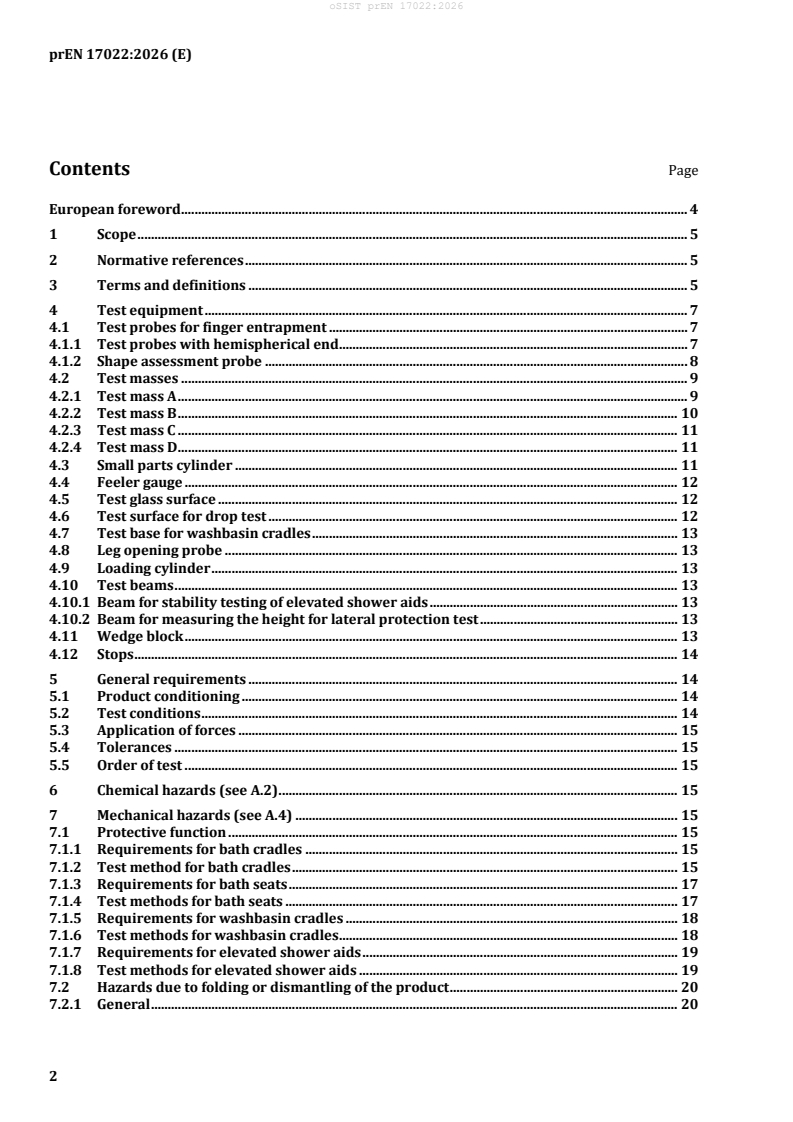
Contents Page
European foreword . 4
1 Scope . 5
2 Normative references . 5
3 Terms and definitions . 5
4 Test equipment . 7
4.1 Test probes for finger entrapment . 7
4.1.1 Test probes with hemispherical end . 7
4.1.2 Shape assessment probe . 8
4.2 Test masses . 9
4.2.1 Test mass A . 9
4.2.2 Test mass B . 10
4.2.3 Test mass C . 11
4.2.4 Test mass D . 11
4.3 Small parts cylinder . 11
4.4 Feeler gauge . 12
4.5 Test glass surface . 12
4.6 Test surface for drop test . 12
4.7 Test base for washbasin cradles . 13
4.8 Leg opening probe . 13
4.9 Loading cylinder . 13
4.10 Test beams . 13
4.10.1 Beam for stability testing of elevated shower aids . 13
4.10.2 Beam for measuring the height for lateral protection test . 13
4.11 Wedge block . 13
4.12 Stops . 14
5 General requirements . 14
5.1 Product conditioning . 14
5.2 Test conditions . 14
5.3 Application of forces . 15
5.4 Tolerances . 15
5.5 Order of test . 15
6 Chemical hazards (see A.2) . 15
7 Mechanical hazards (see A.4) . 15
7.1 Protective function . 15
7.1.1 Requirements for bath cradles . 15
7.1.2 Test method for bath cradles . 15
7.1.3 Requirements for bath seats . 17
7.1.4 Test methods for bath seats . 17
7.1.5 Requirements for washbasin cradles . 18
7.1.6 Test methods for washbasin cradles . 18
7.1.7 Requirements for elevated shower aids . 19
7.1.8 Test methods for elevated shower aids . 19
7.2 Hazards due to folding or dismantling of the product . 20
7.2.1 General . 20
7.2.2 Unintentional release of locking mechanism(s) . 20
7.2.3 Test method for the durability of the locking mechanisms . 21
7.3 Entrapment hazards . 21
7.3.1 Entrapment of fingers . 21
7.4 Hazards due to moving parts . 21
7.4.1 Requirements for compression points . 21
7.4.2 Requirements for shear points . 22
7.5 Entanglement hazards . 22
7.5.1 Requirements . 22
7.5.2 Test method . 23
7.6 Choking and ingestion hazards . 23
7.6.1 Requirements . 23
7.6.2 Test methods . 24
7.7 Suffocation hazards. 24
7.7.1 Plastic packaging . 24
7.7.2 Plastic decals . 25
7.8 Hazardous edges, corners and protruding parts . 25
7.9 Hazards from inadequate structural integrity . 25
7.9.1 Endurance test of the attachment device(s) . 25
7.9.2 Static strength of bath cradles and washbasin cradles . 26
7.9.3 Static strength of elevated shower aids . 27
7.9.4 Strength of movable parts . 28
7.9.5 Strength and retention of suction cups . 28
7.9.6 Drop test . 28
7.10 Hazards due to inadequate stability . 28
7.10.1 Stability of bath seats . 28
7.10.2 Stability of bath cradles . 30
7.10.3 Stability of washbasin cradles . 31
7.10.4 Stability of elevated shower aids . 32
8 Product information (see A.5) . 35
8.1 General . 35
8.2 Marking of the product . 35
8.2.1 Requirements . 35
8.2.2 Durability of markings . 37
8.2.3 Test method for durability of markings . 37
8.2.4 Determination of maximum level of water for bath cradles . 37
8.3 Purchase information . 37
8.4 Instructions for use . 38
Annex A (informative) Rationales . 40
A.1 General . 40
A.2 Chemical hazards (see Clause 6) . 40
A.3 Thermal hazards . 40
A.4 Mechanical hazards (see Clause 7) . 40
A.5 Product information (see Clause 8) . 42
Annex ZA (informative) Relationship between this European Standard and the safety
requirements of Regulation (EU) 2023/988 aimed to be covered . 43
Bibliography . 45
European foreword
This document (prEN 17022:2026) has been prepared by Technical Committee CEN/TC 252 “Child care
articles”, the secretariat of which is held by AFNOR.
This document is currently submitted to the CEN Enquiry.
This document will supersede EN 17022:2018.
The main changes compared with EN 17022:2018 are as follows:
— …
This document has been prepared under a standardization request addressed to CEN by the European
Commission. The Standing Committee of the EFTA States subsequently approves these requests for its
Member States.
For the relationship with EU Legislation, see informative Annex ZA, which is an integral part of this
document.
1 Scope
This document specifies safety requirements and test methods for bathing aids intended to be used in a
domestic bathtub or washbasin and to elevated shower aids.
This document does not cover bathing aids designed for children with special needs.
Bathing aids that are intended to be used only in conjunction with a child’s bathtub are not covered by
this standard.
NOTE 1 Bathing aids that are intended to be used only in conjunction with a child’s bathtub are covered in
prEN 17072:2026, Child care articles — Bath tubs, stands and non-standalone bathing aids — Safety requirements
and test methods.
NOTE 2 Where the product has several functions or can be converted into another function, it is due to comply
with relevant standard(s).
2 Normative references
The following documents are referred to in the text in such a way that some or all of their content
constitutes requirements of this document. For dated references, only the edition cited applies. For
undated references, the latest edition of the referenced document (including any amendments) applies.
EN 17826:2025, Child care articles — Chemical hazards — Requirements
ISO 48-4:2018, Rubber, vulcanized or thermoplastic — Determination of hardness — Part 4: Indentation
hardness by durometer method (Shore hardness)
3 Terms and definitions
For the purposes of this document, the following terms and definitions apply.
ISO and IEC maintain terminology databases for use in standardization at the following addresses:
— ISO Online browsing platform: available at https://www.iso.org/obp
— IEC Electropedia: available at https://www.electropedia.org/
3.1
bathing aid
product, other than an elevated shower aid, that does not provide containment of water by itself and
that provides support for the child during bathing by a carer (Figure 1)
3.1.1
bath cradle
bathing aid designed to keep a child in a reclined position during bathing
Note 1 to entry: These products are intended for use from birth and until the child is able to sit upright
unassisted.
3.1.2
bath seat
bathing aid designed to keep a child in a seated position during bathing
Note 1 to entry: These products are intended for use with a child who is able to sit upright unassisted and until
the child begins pulling up to a standing position.
3.1.3
washbasin cradle
bathing aid designed to keep a child in a reclined position during bathing and intended to be used in a
washbasin
Note 1 to entry: These products are intended for use from birth and until the child starts to roll.
Key
A bath cradle
B bath seat
C washbasin cradle
Figure 1 — Examples of bathing aids
3.2
elevated shower aid
product, that does not provide containment of water by itself and that provides support for the child
during showering by a carer, where the child is positioned at a height greater than 200 mm from the
shower tray (Figure 2)
Figure 2 — Examples of elevated shower aid
3.3
attachment device
device to secure the product to the bathtub, washbasin or bathing enclosure
EXAMPLE Suction cup.
4 Test equipment
4.1 Test probes for finger entrapment
4.1.1 Test probes with hemispherical end
0 +01,
Probes made from plastic or other hard, smooth material of diameters 7 mm and 12 mm
( ) ( )
−01, 0
with a full hemispherical end that can be mounted on a force-measuring device, see Figure 3.
Mesh probe made from plastic or other hard, smooth material as shown in Figure 4.
Dimensions in millimetres
Key
Probe type 7 mm probe 12 mm probe
Diameter A 0
+01,
−01,
Radius RB half of diameter A half of diameter A
1 Line scribed around circumference showing depth of penetration
Figure 3 — Test probes with hemispherical end
Dimensions in millimetres
Key
Probe type Mesh probe
Diameter A 0
−01,
Diameter B 0
5,6
−01,
Radius RB half of diameter B
Figure 4 — Test probe for mesh
4.1.2 Shape assessment probe
Probe made from plastics or other hard, smooth material with the dimensions shown in Figure 5.
Dimensions in millimetres
Key
A front view
B top view
C side view
D 3D view
Figure 5 — Shape assessment probe
4.2 Test masses
4.2.1 Test mass A
A rigid cylinder (160 ± 5) mm in diameter and (300 ± 5) mm in height, having a mass of 9 kg and with
its centre of gravity in the centre of the cylinder. All edges shall have a radius of (5 ± 1) mm. Two
anchorage points shall be provided. These shall be positioned (150 ± 2,5) mm from the base and at 180°
to each other around the circumference (Figure 6).
Dimensions in millimetres
Key
1 radius: (5 ± 1) mm
2 anchorage points
Figure 6 — Test mass A and D
4.2.2 Test mass B
A rigid cylinder (200 ± 5) mm in diameter and (300 ± 5) mm in height, having a mass of 15 kg and with
its centre of gravity in the centre of the cylinder. All edges shall have a radius of (5 ± 1) mm. Two
anchorage points shall be provided. These shall be positioned (150 ± 2,5) mm from the base and at 180°
to each other around the circumference (Figure 7).
Dimensions in millimetres
Key
1 radius: (5 ± 1) mm
2 two anchorage points
Figure 7 — Test mass B
4.2.3 Test mass C
A cylinder with a mass of 5 kg and a diameter of 100 mm.
4.2.4 Test mass D
A rigid cylinder (160 ± 5) mm in diameter and (300 ± 5) mm in height, having a mass of 6,5 kg and with
its centre of gravity in the centre of the cylinder. All edges shall have a radius of (5 ± 1) mm. Two
anchorage points shall be provided. These shall be positioned (150 ± 2,5) mm from the base and at 180°
to each other around the circumference (Figure 6).
4.3 Small parts cylinder
Cylinder for the assessment of small components, having dimensions in accordance with Figure 8.
Dimension in millimetres
Figure 8 — Small parts cylinder
4.4 Feeler gauge
Gauge with a thickness of (0,4 ± 0,02) mm and an insertion edge radius of (3 ± 0,5) mm (Figure 9).
Dimensions in millimetres
Figure 9 — Feeler gauge
4.5 Test glass surface
A rigid plane covered with uncoated tempered float glass that has a smooth surface and thickness of
6 mm.
4.6 Test surface for drop test
A 4 mm thick steel plate with a 2 mm thick rubber mat, with hardness (75 ± 10) Shore A according to
ISO 48-4:2018, and which is placed on a non-flexible horizontal surface.
4.7 Test base for washbasin cradles
Test base for washbasin cradles representing the upper rim of a sink section made of hard and smooth
material with dimensions in accordance with Figure 10.
Dimensions in millimetres
Key
1 inside
2 outside
Figure 10 — Cross section; bath test base, right side
4.8 Leg opening probe
+2
A rigid cylinder made of a hard smooth material, ( ) mm in diameter and (200 ± 1) mm in length.
−0
4.9 Loading cylinder
A cylinder with a mass of 5 kg and a diameter of 100 mm.
4.10 Test beams
4.10.1 Beam for stability testing of elevated shower aids
A beam, not less than 900 mm long, with a square section of 25 mm x 25 mm and with a mass of
(0,5 ± 0,01) kg.
4.10.2 Beam for measuring the height for lateral protection test
A beam, 86 mm wide and with a mass of (0,5 ± 0,01) kg.
4.11 Wedge block
A block made of plastic or other hard, smooth material and with dimensions according to Figure 11.
Dimensions in millimetres
Top view
Front view Side view
Figure 11 — Wedge block
4.12 Stops
Stops to prevent the item under testing from sliding but not tilting, no higher than 12 mm except in
cases where the design of the item necessitates the use of higher stops, in which case the lowest stops
that will prevent the item from sliding shall be used.
5 General requirements
5.1 Product conditioning
Products containing vulcanized rubber and thermoplastic elastomer parts (but not silicone parts) shall
be artificially aged for seven days in an aerated drying cabinet at a temperature of (70 ± 2) °C.
In case the elastomeric parts are the suction cups, contact of the suction cups with the surface of the
cabinet shall be avoided during the ageing treatment. The product shall be placed in a position in which
suction cups are unloaded.
All products shall be conditioned for at least 40 h, in a standard atmosphere at a temperature of
(23 ± 2) °C and relative humidity of (50 ± 5) %.
5.2 Test conditions
The tests shall be carried out at a temperature of (21 ± 6) °C.
The tests are designed to be applied to a product that is fully assembled according to the manufacturer’s
instructions and ready for use.
If the instructions allow for different adjustments or configurations of components, the most onerous
combination shall be used for each test, unless otherwise specified in the test method.
Unless otherwise specified in the test method, all tests shall be carried out in dry condition (i.e. product
and test surfaces not wet).
5.3 Application of forces
The forces in the static load tests shall be applied sufficiently slowly to ensure that negligible dynamic
force is applied.
5.4 Tolerances
Unless otherwise stated, the following tolerances apply:
— Forces: ±5 % of the nominal force;
— Masses: ±0,5 % of the nominal mass;
— Dimensions: ±1,0 mm;
— Angles: ±0,5°;
— Positioning of loading pads: ±5 mm;
— Time: ±1 s.
The tests are described in terms of the application of forces. Masses can however be used: 1 kg mass
may be used for 10 N force.
Unless otherwise specified, the test forces may be applied by any suitable device which does not
adversely affect the results.
5.5 Order of test
Unless otherwise stated, the requirements of Clause 7 shall be assessed on the same product in the
order listed in this standard.
6 Chemical hazards (see A.2)
The migration of elements from materials on exterior surfaces shall comply with EN 17826:2025, cl. 4.2
(migration of certain elements).
Parts made of textile materials intended to be in prolonged contact with the skin of the child shall
comply with EN 17826:2025, cl. 4.4 (aniline) and cl. 4.6 (formaldehyde).
NOTE EN 17826:2025 cl. 4.1 gives a definition of prolonged skin contact.
A separate sample may be used for these tests.
7 Mechanical hazards (see A.4)
7.1 Protective function
7.1.1 Requirements for bath cradles
Bath cradles shall have a distance H > 50 mm measured in accordance with 7.1.2.
Bath cradles shall have a length not less than 380 mm measured in accordance with 7.1.2.
No harness shall be provided as a child restraint system.
Inflatable and/or floating bath cradles are not allowed.
7.1.2 Test method for bath cradles
Place the bath cradle on flat rigid horizontal surface according to the manufacturer’s instructions.
Position test mass A (4.2.1) on the product and guide it to reach the lowest point.
Measure the distance H between the lowest point of the test mass and the projection, parallel to the test
mass, of the highest point on the bath cradle in front of the mass (Figure 12 and Figure 13).
Measure the length L between the lowest point of the test mass and the projection, parallel to the test
mass, of the highest point on the bath cradle at the back of the test mass (Figure 12 and Figure 13).
Key
H height
L length
Figure 12 — Measurement of length L and height H for hammock type cradles
Key
H height
L length
Figure 13 — Measurement of length L and height H for non-hammock type cradles
7.1.3 Requirements for bath seats
Bath seats shall provide a child support completely surrounding a seated child during bathing (see
Figure 14). The minimum height of the child support from the sitting surface shall be 140 mm in any
position around the child, when tested in accordance with 7.1.4.1.
Bath seats shall have a crotch restraint, connected to both the sitting surface and the child support, such
that the product cannot be used without the crotch restraint being used.
Key
A child support
B crotch restraint
C sitting surface
Figure 14 — Example of bath seat
The maximum internal distance shall be less than or equal to 250 mm at any point, when tested in
accordance with 7.1.4.2.
Each leg opening shall allow the passage of the leg opening probe when tested in accordance with
7.1.4.3.
No harness-based restraint system shall be provided.
Inflatable and/or floating bath seats are not allowed.
7.1.4 Test methods for bath seats
7.1.4.1 Test method for measurement of the height
Place the bath seat on a flat horizontal surface.
Position the test beam (4.9.1) across on the child support.
Measure, perpendicular to the bar, the vertical distance between the sitting surface and the bottom of
the bar at all points on the seat.
7.1.4.2 Test method for measurement of the internal distance
Place the bath seat on a flat horizontal surface.
The bath seat internal distance is measured parallel to the horizontal, 10 mm above the upper point of
the sitting surface.
7.1.4.3 Test method for leg openings
Place the bath seat on a flat horizontal surface.
Insert the leg opening probe (4.8) into each leg opening from outside the bath seat and check if the leg
opening probe can freely pass through and be taken out from above the seat unit (e.g. by pulling,
without twisting or making sharp turns). See Figure 15.
Key
1 leg opening probe
Figure 15 — Test method for leg openings
7.1.5 Requirements for washbasin cradles
Washbasin cradles shall have a length not less than 380 mm measured in accordance with 7.1.6.
No harness shall be provided as a child restraint system.
Inflatable washbasin cradles are not allowed.
7.1.6 Test methods for washbasin cradles
Place the wash basin cradle in accordance with the manufacturer instructions, with the attachment
device (e.g. suction cups) on the test glass surface (4.5) and with the top of the cradle against the test
base (4.7) as in Figure 16.
Position test mass A (4.2.1) on the product and guide it, without pushing it, to reach the lowest point.
Measure the length L between the lowest point of the test mass and the projection, parallel to and in the
centre of the test mass, of the highest point on the bath cradle at the back of the test mass (Figure 16).
Key
L length
Figure 16 — Measurement of length L for washbasin cradles
7.1.7 Requirements for elevated shower aids
Elevated shower aids shall comply with the following requirements:
a) it shall be fitted with lateral protection that extend up to the horizontal component and that have a
height of at least 140 mm along the whole length when measured in accordance with 7.1.8.1; and
b) it shall have a crotch restraint, connected to both the sitting surface and the horizontal member,
such that the product cannot be used without the crotch restraint being used; and
c) the leg openings shall not allow passage of the wedge block when tested in accordance with 7.1.8.2;
and
d) the horizontal distance between the front surface of the backrest and the crotch restraint shall be
less than 216 mm when measured in accordance with 7.1.8.3; and
e) the horizontal distance between the front surface of the backrest and the horizontal member shall
be less than 250 mm when measured in accordance with 7.1.8.3.
No harness-based restraint system shall be provided.
7.1.8 Test methods for elevated shower aids
7.1.8.1 Test method for measurement of the lateral protections
Position the loading cylinder (4.9) with its base on the centre of the seat.
Position the test beam (4.10) across the lateral protection with the 86 mm side in a horizontal position.
Measure the minimum height of the lateral protection as the vertical distance between the under
surface of the beam and the under surface of the loading cylinder.
7.1.8.2 Test method for leg openings
The elevated shower aid shall be placed on the floor in the normal position of use. Restrain the product
so that it cannot slide on the floor surface or tip over.
Position the wedge block (see 4.11) on the seat with the tapered end towards the leg opening, keeping
its main axis perpendicular to the opening.
Gradually pull the wedge block by its hook from the outside of the elevated shower aid with a force of
30 N in a straight direction along the wedge block main axis.
7.1.8.3 Test method for measurement of the horizontal distance between the front surface of the
backrest and the crotch restraint / horizontal member
Adjust the backrest to the most upright position (if adjustable) and the crotch restraint to the position
furthest from the backrest (if adjustable).
Measure the horizontal distance between the front surface of the uncompressed backrest and the
uncompressed crotch restraint, 10 mm above the lowest point of the uncompressed seat surface along
the centreline of the seat.
Measure the maximum horizontal distance between the front surface of the uncompressed backrest and
the inner surface of the horizontal member.
7.2 Hazards due to folding or dismantling of the product
7.2.1 General
Connecting screws (e.g. self-tapping screws) shall not be used to fasten any component that is designed
to be removed or loosened when dismantling the product to transport or store it.
When the product is placed in any manufacturer’s recommended use position(s), products that fold
shall have a locking mechanism(s) or other means to prevent the product from folding or collapsing
during use.
NOTE “Other means” could include, but are not limited to, designs which utilize the occupant, an added
component, or the water that is placed into the product to act in opposition to the folding action or collapse of the
product.
7.2.2 Unintentional release of locking mechanism(s)
To avoid the hazards due to unintentional release of locking mechanisms, if any, one of the following
conditions shall be fulfilled before and after testing in accordance with 7.2.3:
a) at least one operating device requires an operating force greater than 50 N measured with and
without test mass A (4.2.1) on the product, or
b) folding is only possible if at least one locking mechanism requires the use of a tool, or
c) at least one operating device requires at least two consecutive actions, the first of which shall be
maintained while the second is carried out, or
d) at least one locking mechanism is released when two independent operating devices are
simultaneously operated.
If the weight of the child has a positive effect on the locking, this is accepted as an operating device.
7.2.3 Test method for the durability of the locking mechanisms
Operate 300 times any locking mechanism(s).
7.3 Entrapment hazards
7.3.1 Entrapment of fingers
7.3.1.1 Requirement
With the exception of the back of the backrest and parts of the product from the floor up to and
including the under-surface of the seating / lying surface, there shall be no completely bounded
openings that let the 7 mm probe (see 4.1.1) go through unless the depth of penetration is less than
10 mm or unless the shape assessment probe (see 4.1.2) enters, when tested in accordance with 7.3.1.2.
The above requirement only applies to components made of materials with a Shore A hardness greater
than 60.
There shall be no accessible openings in mesh that allow the test probe for mesh, see 4.1.1, to penetrate
up to the 7 mm diameter section, when tested in accordance with 7.3.1.2.
NOTE A mesh is generally intended as a textile product composed of interlaced threads; a perforated sheet
(e.g. of plastic or elastomeric materials) is therefore not considered as a mesh
The test shall be carried out with the product in any intended position of use without any test mass and
with test mass A (4.2.1).
7.3.1.2 Test method
Check whether the 7 mm probe, 4.1.1, with an applied force of up to 30 N, enters 10 mm or more into
any accessible completely bounded opening in any possible orientation.
If the 7 mm probe enters 10 mm or more, then the shape assessment probe (see 4.1.2) shall also enter
10 mm or more with an applied force of up to 5 N.
Check whether the test probe for mesh, 4.1.1, with an applied force of up to 30 N, penetrates accessible
openings in mesh up to the 7 mm diameter section.
7.4 Hazards due to moving parts
7.4.1 Requirements for compression points
After the product has been set up for use in accordance with the manufacturer’s instructions, there shall
be no accessible compression points which can close to less than 12 mm unless they are always less
than 5 mm, as the result of:
a) the movement of the product; or
b) the movement of body weight by the child using the product; or
c) the application of an external force (either unintentionally by the carer, or by a powered
mechanism).
Movement due to elasticity or play of materials shall not be considered as a compression hazard.
The area of contact between the product and the surface on which the product is fixed is excluded from
this requirement.
7.4.2 Requirements for shear points
After the product has been set up for use in accordance with the manufacturer’s instructions, there shall
be no accessible shear points which can close to less than 12 mm, as the result of:
a) the movement of the product; or
b) the movement of body weight by the child using the product; or
c) the application of an external force (either unintentionally by the carer, or by a powered
mechanism).
Movement due to elasticity of materials or play in mechanical parts shall not be considered as a
shearing hazard.
7.5 Entanglement hazards
7.5.1 Requirements
Cords, ribbons and similar parts shall have a maximum free length of 220 mm when tested in
accordance with 7.5.2.
Where cords, ribbons and similar parts are attached to the product together or within 80 mm of each
other, any single cord shall have a maximum free length of 220 mm and the combined length from one
loose end to the end of another loose end shall be a maximum of 360 mm (Figure 17).
Loops shall have a maximum peripheral dimension of 360 mm, when tested in accordance with 7.5.2.
Monofilament threads shall not be used.
Dimensions in millimetres
Key
D distance between attachment points
L length of cords, ribbons and parts used as ties
Figure 17 — Examples of measuring cords, ribbons or similar parts
7.5.2 Test method
The length of a cord, ribbon or similar part is measured from the fixing point on the product to the free
end of the cord, ribbon or similar part while a 25 N tensile force is applied.
The peripheral dimension of a loop shall be measured while a 25 N tensile force is applied.
7.6 Choking and ingestion hazards
7.6.1 Requirements
Any component or filling material that is considered able to be gripped by a child in accordance with
7.6.2.1 shall be tested in accordance with 7.6.2.2 and 7.6.2.3.
Any component or part of a component or filling material that is removed shall not fit wholly in any
orientation, without compressing or manipulating it, within the small parts cylinder (4.3).
Paper, fabric (including elastic fabric), yarn, string and fuzz are excluded from these requirements.
However, felt and tightly packed stuffed components made of fabric and/or yarn are not excluded from
these requirements.
7.6.2 Test methods
7.6.2.1 Assessment of child’s ability to grip components
A component is considered to be able to be gripped if the child can grip the component between its
thumb and forefinger or between its teeth.
Where it is difficult to assess whether a child can grip a component, establish whether it can be gripped
by inserting the feeler gauge (4.4) between the component and the underlying layer or body of the
product at an angle between 0° and 10° from the surface of the underlying layer or product, using a
force of (10 ± 1) N. If the gauge can be inserted more than 2 mm, the component is considered to be able
to be gripped by the child.
7.6.2.2 Torque test
Apply a torque gradually to the component within a period of 5 s in a clockwise direction until either:
a) a rotation of 180° from the original position has been attained; or
b) a torque of 0,34 Nm is reached.
The maximum rotation or required torque shall be applied for 10 s.
The component shall then be allowed to return to a relaxed condition and the procedure repeated in an
anticlockwise direction.
Where projections, components or assemblies are rigidly mounted on an accessible rod or shaft,
designed to rotate together with the projections, components or assemblies, during the test the rod or
shaft shall be clamped to prevent rotation.
If a component attached by a screw thread becomes loosened during application of the required torque,
the torque shall continue to be applied until the required torque is exceeded or the component
disassemble
...