

EN 71-8:2026
(Main)Safety of toys - Part 8: Activity toys for domestic use
- Abstract
This document specifies requirements and test methods for activity toys.
This document also specifies requirements for:
- separately sold accessories for, and components of activity toys;
- separately sold swing elements that are ready for use on or in combination with an activity toy;
- construction packages for activity toys including components used to build activity toys in accordance with a scheduled building instruction.
The scope of this document excludes:
- playground equipment intended for public use dealt with in the EN 1176 series;
- bow-mounted rocking activity toys such as rocking horses and similar toys, which are covered by specific requirements in EN 71-1;
- toy pools with maximum depth of water over 400 mm measured, between the overflow level and the deepest point within the pool;
NOTE 1 For information regarding the classification of pools as toys see European Commission guidance document No. 8 on the application of the Directive 2009/48/EC on the safety of toys - Pools [1].
- pools with maximum depth of water over 400 mm measured, between the overflow level and the deepest point within the pool, without play elements covered e.g. by the EN 16582 series or EN 16927.
NOTE 2 There is an enhanced risk of drowning in pools where the depth of water is in excess of 400 mm.
- toy slides designed to be used in conjunction with domestic in-ground swimming pools;
- trampolines for domestic use dealt with in EN 71-14;
- powered blowers used to continuously inflate inflatable activity toys.
NOTE 3 Powered blowers used to continuously inflate inflatable activity toys are considered to be a household appliance and covered by requirements given in EN 60335-2-80.
See also Clause A.1.
- Status
- Published
- Publication Date
- 27-Jan-2026
- Technical Committee
- CEN/TC 52 - Safety of toys
- Drafting Committee
- CEN/TC 52/WG 10 - Activity toys
- Current Stage
- 6060 - Definitive text made available (DAV) - Publishing
- Start Date
- 28-Jan-2026
- Due Date
- 24-Oct-2025
- Completion Date
- 28-Jan-2026
- Mandate
- M/589 Amd 1 - M/589 AMD 1

Overview
EN 71-8:2026, developed by the European Committee for Standardization (CEN), specifies safety requirements and test methods for activity toys intended for domestic use. This standard is part 8 of the EN 71 series, which covers multiple aspects of toy safety. EN 71-8:2026 focuses on ensuring that activity toys-such as swings, slides, carousels, climbing structures, paddling pools, and inflatable toys-are designed and manufactured to minimize hazards for children in home environments.
The standard also addresses safety aspects of separately sold accessories, swing elements, and construction packages that contribute to the safe use of activity toys. Notably excluded are playground equipment for public areas, rocking horses covered by EN 71-1, pools with depths over 400 mm without play elements, trampolines (covered by EN 71-14), and powered blowers for inflatables deemed household appliances under EN 60335-2-80.
Key Topics
Scope and Definitions
Defines "activity toys" as toys with stationary support structures that bear children while they climb, jump, swing, slide, rock, spin, paddle, crawl, or creep. Clarifies exclusions to focus on domestic-use toys as opposed to commercial playground equipment.Safety Requirements
Covers design elements such as barriers, handrails, ladders, stability, entrapment hazards, slide dimensions and inclination, swing clearance, see-saws, carousels, and inflatable toys. Emphasis on preventing falls, entrapment, and injuries through precise construction and material criteria.Testing Methods
Includes stability tests, static and dynamic strength tests, entrapment evaluations (head and neck), slide inclination measurements, rope diameter assessments, impact determination of swings, and inflatable toy deflation tests. These methods ensure that activity toys meet rigorous mechanical and safety performance standards.Warnings and Instructions
Specifies mandatory warning labels, markings, assembly instructions, and maintenance guidance to ensure safe use, installation, and upkeep of activity toys.
Applications
EN 71-8:2026 is essential for manufacturers, distributors, and retailers of activity toys designed for home use. Applying this standard helps:
- Optimize toy design for child safety during common activities such as climbing, swinging, sliding, and paddling.
- Mitigate risks associated with structural failure, falls, entrapment, and drowning hazards, particularly in small paddling pools.
- Ensure that accessories and construction kits are safe when added to or used to build activity toys.
- Guide product testing and certification processes to comply with European safety regulations including Directive 2009/48/EC on toy safety.
- Enhance consumer trust by providing clear warnings and maintenance instructions that aid in safe toy operation.
Related Standards
To fully understand and implement toy safety, EN 71-8:2026 should be considered alongside related EN 71 series parts and other relevant standards:
- EN 71-1: Mechanical and physical properties of toys, including rocking horses excluded from EN 71-8.
- EN 71-14: Safety requirements for trampolines for domestic use.
- EN 60335-2-80: Safety of household appliances, covering powered blowers for inflatable toys.
- EN 1176 series: Safety of playground equipment for public use – excluded from this standard.
- European Commission Guidance Document No. 8: Classification of pools as toys for compliance with Directive 2009/48/EC.
- EN ISO 7010: Safety signs and markings relevant for toy warnings.
- Additional parts of EN 71 covering chemical, microbiological, and specific safety aspects of toys.
Conclusion
EN 71-8:2026 is a comprehensive standard critical for ensuring the safety of domestic activity toys. It provides clear requirements and test methods that assist manufacturers and regulators in minimizing injuries and hazards. By harmonizing safety practices, it helps protect children during everyday play activities while supporting compliance with European toy safety legislation. Use of EN 71-8:2026 enhances product reliability and consumer confidence in home activity toys.
Relations
- Effective Date
- 23-Aug-2023
- Effective Date
- 01-Apr-2026
- Effective Date
- 25-Feb-2026
- Effective Date
- 11-Feb-2026
- Effective Date
- 02-Jun-2026
- Effective Date
- 04-Feb-2026
- Effective Date
- 04-Feb-2026
- Effective Date
- 04-Feb-2026
- Effective Date
- 04-Feb-2026
- Effective Date
- 04-Feb-2026
Frequently Asked Questions
EN 71-8:2026 is a standard published by the European Committee for Standardization (CEN). Its full title is "Safety of toys - Part 8: Activity toys for domestic use". This standard covers: This document specifies requirements and test methods for activity toys. This document also specifies requirements for: - separately sold accessories for, and components of activity toys; - separately sold swing elements that are ready for use on or in combination with an activity toy; - construction packages for activity toys including components used to build activity toys in accordance with a scheduled building instruction. The scope of this document excludes: - playground equipment intended for public use dealt with in the EN 1176 series; - bow-mounted rocking activity toys such as rocking horses and similar toys, which are covered by specific requirements in EN 71-1; - toy pools with maximum depth of water over 400 mm measured, between the overflow level and the deepest point within the pool; NOTE 1 For information regarding the classification of pools as toys see European Commission guidance document No. 8 on the application of the Directive 2009/48/EC on the safety of toys - Pools [1]. - pools with maximum depth of water over 400 mm measured, between the overflow level and the deepest point within the pool, without play elements covered e.g. by the EN 16582 series or EN 16927. NOTE 2 There is an enhanced risk of drowning in pools where the depth of water is in excess of 400 mm. - toy slides designed to be used in conjunction with domestic in-ground swimming pools; - trampolines for domestic use dealt with in EN 71-14; - powered blowers used to continuously inflate inflatable activity toys. NOTE 3 Powered blowers used to continuously inflate inflatable activity toys are considered to be a household appliance and covered by requirements given in EN 60335-2-80. See also Clause A.1.
This document specifies requirements and test methods for activity toys. This document also specifies requirements for: - separately sold accessories for, and components of activity toys; - separately sold swing elements that are ready for use on or in combination with an activity toy; - construction packages for activity toys including components used to build activity toys in accordance with a scheduled building instruction. The scope of this document excludes: - playground equipment intended for public use dealt with in the EN 1176 series; - bow-mounted rocking activity toys such as rocking horses and similar toys, which are covered by specific requirements in EN 71-1; - toy pools with maximum depth of water over 400 mm measured, between the overflow level and the deepest point within the pool; NOTE 1 For information regarding the classification of pools as toys see European Commission guidance document No. 8 on the application of the Directive 2009/48/EC on the safety of toys - Pools [1]. - pools with maximum depth of water over 400 mm measured, between the overflow level and the deepest point within the pool, without play elements covered e.g. by the EN 16582 series or EN 16927. NOTE 2 There is an enhanced risk of drowning in pools where the depth of water is in excess of 400 mm. - toy slides designed to be used in conjunction with domestic in-ground swimming pools; - trampolines for domestic use dealt with in EN 71-14; - powered blowers used to continuously inflate inflatable activity toys. NOTE 3 Powered blowers used to continuously inflate inflatable activity toys are considered to be a household appliance and covered by requirements given in EN 60335-2-80. See also Clause A.1.
EN 71-8:2026 is classified under the following ICS (International Classification for Standards) categories: 97.200.50 - Toys. The ICS classification helps identify the subject area and facilitates finding related standards.
EN 71-8:2026 has the following relationships with other standards: It is inter standard links to EN 71-8:2018, EN ISO 21920-2:2022, EN 71-1:2026, EN ISO 7010:2020, CEN/CLC Guide 14:2009, EN 71-1:2011+A2:2013, EN 71-1:2014+A1:2018, EN 71-1:2014, EN 71-1:2011, EN 71-1:2011+A3:2014. Understanding these relationships helps ensure you are using the most current and applicable version of the standard.
EN 71-8:2026 is associated with the following European legislation: EU Directives/Regulations: 2009/48/EC; Standardization Mandates: M/589, M/589 Amd 1. When a standard is cited in the Official Journal of the European Union, products manufactured in conformity with it benefit from a presumption of conformity with the essential requirements of the corresponding EU directive or regulation.
EN 71-8:2026 is available in PDF format for immediate download after purchase. The document can be added to your cart and obtained through the secure checkout process. Digital delivery ensures instant access to the complete standard document.
Standards Content (Sample)
SLOVENSKI STANDARD
01-julij-2026
Nadomešča:
SIST EN 71-8:2018
Varnost igrač - 8. del: Igrače za prostočasne aktivnosti za domačo uporabo
Safety of toys - Part 8: Activity toys for domestic use
Sicherheit von Spielzeug - Teil 8: Aktivitätsspielzeug für den häuslichen Gebrauch
Sécurité des jouets - Partie 8 : Jouets dactivité à usage familial
Ta slovenski standard je istoveten z: EN 71-8:2026
ICS:
97.200.50 Igrače Toys
2003-01.Slovenski inštitut za standardizacijo. Razmnoževanje celote ali delov tega standarda ni dovoljeno.
EN 71-8
EUROPEAN STANDARD
NORME EUROPÉENNE
January 2026
EUROPÄISCHE NORM
ICS 97.200.50 Supersedes EN 71-8:2018
English Version
Safety of toys - Part 8: Activity toys for domestic use
Sécurité des jouets - Partie 8 : Jouets d'activité à usage Sicherheit von Spielzeug - Teil 8: Aktivitätsspielzeug
familial für den häuslichen Gebrauch
This European Standard was approved by CEN on 10 November 2025.
CEN members are bound to comply with the CEN/CENELEC Internal Regulations which stipulate the conditions for giving this
European Standard the status of a national standard without any alteration. Up-to-date lists and bibliographical references
concerning such national standards may be obtained on application to the CEN-CENELEC Management Centre or to any CEN
member.
This European Standard exists in three official versions (English, French, German). A version in any other language made by
translation under the responsibility of a CEN member into its own language and notified to the CEN-CENELEC Management
Centre has the same status as the official versions.
CEN members are the national standards bodies of Austria, Belgium, Bulgaria, Croatia, Cyprus, Czech Republic, Denmark, Estonia,
Finland, France, Germany, Greece, Hungary, Iceland, Ireland, Italy, Latvia, Lithuania, Luxembourg, Malta, Netherlands, Norway,
Poland, Portugal, Republic of North Macedonia, Romania, Serbia, Slovakia, Slovenia, Spain, Sweden, Switzerland, Türkiye and
United Kingdom.
EUROPEAN COMMITTEE FOR STANDARDIZATION
COMITÉ EUROPÉEN DE NORMALISATION
EUROPÄISCHES KOMITEE FÜR NORMUNG
CEN-CENELEC Management Centre: Rue de la Science 23, B-1040 Brussels
© 2026 CEN All rights of exploitation in any form and by any means reserved Ref. No. EN 71-8:2026 E
worldwide for CEN national Members.
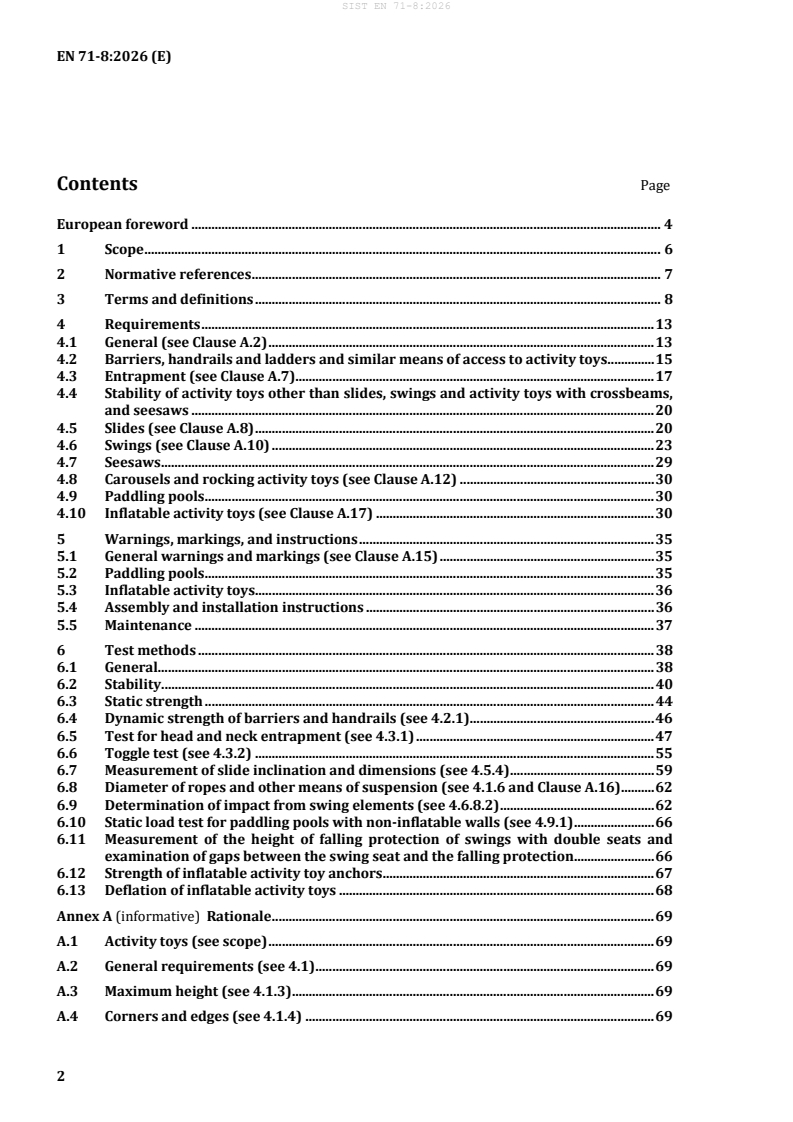
Contents Page
European foreword . 4
1 Scope . 6
2 Normative references . 7
3 Terms and definitions . 8
4 Requirements . 13
4.1 General (see Clause A.2) . 13
4.2 Barriers, handrails and ladders and similar means of access to activity toys . 15
4.3 Entrapment (see Clause A.7). 17
4.4 Stability of activity toys other than slides, swings and activity toys with crossbeams,
and seesaws . 20
4.5 Slides (see Clause A.8) . 20
4.6 Swings (see Clause A.10) . 23
4.7 Seesaws . 29
4.8 Carousels and rocking activity toys (see Clause A.12) . 30
4.9 Paddling pools . 30
4.10 Inflatable activity toys (see Clause A.17) . 30
5 Warnings, markings, and instructions . 35
5.1 General warnings and markings (see Clause A.15) . 35
5.2 Paddling pools . 35
5.3 Inflatable activity toys . 36
5.4 Assembly and installation instructions . 36
5.5 Maintenance . 37
6 Test methods . 38
6.1 General. 38
6.2 Stability . 40
6.3 Static strength . 44
6.4 Dynamic strength of barriers and handrails (see 4.2.1). 46
6.5 Test for head and neck entrapment (see 4.3.1) . 47
6.6 Toggle test (see 4.3.2) . 55
6.7 Measurement of slide inclination and dimensions (see 4.5.4) . 59
6.8 Diameter of ropes and other means of suspension (see 4.1.6 and Clause A.16). 62
6.9 Determination of impact from swing elements (see 4.6.8.2) . 62
6.10 Static load test for paddling pools with non-inflatable walls (see 4.9.1) . 66
6.11 Measurement of the height of falling protection of swings with double seats and
examination of gaps between the swing seat and the falling protection . 66
6.12 Strength of inflatable activity toy anchors . 67
6.13 Deflation of inflatable activity toys . 68
Annex A (informative) Rationale . 69
A.1 Activity toys (see scope) . 69
A.2 General requirements (see 4.1) . 69
A.3 Maximum height (see 4.1.3) . 69
A.4 Corners and edges (see 4.1.4) . 69
A.5 Barriers (see 4.2) . 69
A.6 Ladders and similar means of access to activity toys (see 4.2.2) . 70
A.7 Entrapment (see 4.3) . 70
A.8 Slides (see 4.5) . 71
A.9 Retaining sides for slides (see 4.5.3) . 71
A.10 Swings (see 4.6) . 71
A.11 Clearance between swing elements and the ground for crossbeams with a maximum
height of 1 200 mm (see 4.6.6) . 72
A.12 Rocking activity toys and similar toys (see 4.8) . 72
A.13 Stability of swings and other activity toys with crossbeams (see 6.2.4.1.1) . 72
A.14 Drowning hazards (see 4.1.7) . 72
A.15 Warnings (see Clause 5) . 73
A.16 Ropes and other means of suspension (see 4.1.6 and 6.8) . 73
A.17 Inflatable activity toys (see 4.10) . 75
A.18 Falling hazards (see 4.2 and 5.4) . 76
Annex ZA (informative) Relationship between this European Standard and the essential
requirements of Directive 2009/48/EC aimed to be covered . 79
Bibliography . 80
European foreword
This document (EN 71-8:2026) has been prepared by Technical Committee CEN/TC 52 “Safety of toys”,
the secretariat of which is held by DS.
This European Standard shall be given the status of a national standard, either by publication of an
identical text or by endorsement, at the latest by July 2026, and conflicting national standards shall be
withdrawn at the latest by January 2027.
Attention is drawn to the possibility that some of the elements of this document may be the subject of
patent rights. CEN shall not be held responsible for identifying any or all such patent rights.
This document supersedes EN 71-8:2018.
This document has been prepared under a standardization request addressed to CEN by the European
Commission. The Standing Committee of the EFTA States subsequently approves these requests for its
Member States.
For the relationship with EU Legislation, see informative Annex ZA, which is an integral part of this
document.
This document constitutes the eighth part of the EN 71 series of standards on safety of toys.
EN 71, Safety of toys, consists of the following parts:
— Part 1: Mechanical and physical properties;
— Part 2: Flammability;
— Part 3: Migration of certain elements;
— Part 4: Experimental sets for chemistry and related activities;
— Part 5: Chemical toys (sets) other than experimental sets;
— Part 7: Finger paints — Requirements and test methods;
— Part 8: Activity toys for domestic use (this document);
— Part 10: Organic chemical compounds — Sample preparation and extraction;
— Part 11: Organic chemical compounds — Methods of analysis;
— Part 12: N-Nitrosamines and N-nitrosatable substances;
— Part 13: Olfactory board games, cosmetic kits and gustative games;
— Part 14: Trampolines for domestic use;
— Part 15: Formamide in foam toy materials (content);
— Part 16: Certain chlorinated phosphorus flame retardants (TCEP, TCPP, TDCP) in toy materials;
— Part 17: Certain isothiazolinones (MIT, CIT, BIT) in aqueous toy materials;
— Part 18: Phenol in aqueous (content) and polymeric (migration) toy materials;
— Part 19: Migration of bisphenol A from toy materials;
— Part 20: Microbiological safety of toys containing accessible aqueous media.
It is up to the user of the standard to determine whether or not a toy is included in the scope of several of
the above parts of the EN 71 series, and to apply each applicable standard accordingly. Normative
references from one part of the EN 71 series to another, are therefore normally not provided in the
individual parts.
NOTE 1 In addition to the above parts of EN 71, the following deliverables have been published:
— CEN/TR 15071, Safety of toys — National translations of warnings and instructions for use in the EN 71 series;
— CEN/TR 15371 (all parts), Safety of toys — Interpretations;
— CEN/TR 16918, Safety of toys — Children's mouthing behaviour in contact with toys;
— CEN/TR 17695, Safety of toys — Mechanical and physical properties — Guidance on categorisation of projectile
toys within EN 71-1;
— CEN/TS 17973, Safety of toys — Categorization of slime type materials;
— CEN/TR 18217, Safety of toys — Migration of certain elements from polymers;
— CEN/TR 18240, Safety of toys — Mechanical and physical properties — Guidance on the requirements for food-
imitating toys in EN 71-1; and
— CEN ISO/TR 8124-8, Safety of toys — Part 8: Age determination — First age grade for the appropriate play of
toys.
NOTE 2 Words in italics (apart from document titles) are defined in Clause 3 (Terms and definitions).
The following significant changes have been implemented in this new edition:
Change
Clause/Paragraph/Table/Figure
1 The scope has been revised to remove the exclusion for
inflatable activity toys, thus including them in the scope.
3 New terms and definitions for constant-air inflatable activity
toy (3.6), contained-air inflatable activity toy (3.7), grasp (3.15),
grip (3.16) and inflatable activity toy (3.18) have been added.
4.1.6 Requirements for means of suspension for swing elements have
been revised.
4.2.2 Requirements for ladders and similar means of access to
activity toys have been revised.
4.3 Requirements for entrapment, in particular of head and neck
(4.3.1) and of fingers (4.3.4), have been revised.
4.6.4 Requirements for minimum clearance between adjacent swing
devices and adjacent structures have been revised.
4.10 Requirements for inflatable activity toys have been added.
Clause/Paragraph/Table/Figure Change
5.4 Requirements on assembly and installation instructions have
been slightly revised.
6.7 The title of 6.7 has been changed to “Measurement of slide
inclination and dimensions” and an additional test method on
measurement of slide dimensions (6.7.3) has been added.
6.8 The test method for diameter of ropes and other means of
suspension has been revised.
6.12 A new test method for strength of inflatable activity toy anchors
has been added.
6.13 A new test method for deflation of inflatable activity toys has
been added.
Annex A Several rationales, e.g. on activity toys/scope (Clause A.1),
Ladders and similar means of access to activity toys
(Clause A.6) and entrapment (Clause A.7) have been revised
and new rationales on diameter of ropes and other means of
suspension (Clause A.16), inflatable activity toys (Clause A.17)
and falling hazards (Clause A.18) have been added.
Any feedback and questions on this document should be directed to the users’ national standards body.
A complete listing of these bodies can be found on the CEN website.
According to the CEN-CENELEC Internal Regulations, the national standards organisations of the
following countries are bound to implement this European Standard: Austria, Belgium, Bulgaria, Croatia,
Cyprus, Czech Republic, Denmark, Estonia, Finland, France, Germany, Greece, Hungary, Iceland, Ireland,
Italy, Latvia, Lithuania, Luxembourg, Malta, Netherlands, Norway, Poland, Portugal, Republic of North
Macedonia, Romania, Serbia, Slovakia, Slovenia, Spain, Sweden, Switzerland, Türkiye and the United
Kingdom.
1 Scope
This document specifies requirements and test methods for activity toys.
This document also specifies requirements for:
— separately sold accessories for, and components of activity toys;
— separately sold swing elements that are ready for use on or in combination with an activity toy;
— construction packages for activity toys including components used to build activity toys in accordance
with a scheduled building instruction.
The scope of this document excludes:
— playground equipment intended for public use dealt with in the EN 1176 series;
— bow-mounted rocking activity toys such as rocking horses and similar toys, which are covered by
specific requirements in EN 71-1;
— toy pools with maximum depth of water over 400 mm measured, between the overflow level and the
deepest point within the pool;
NOTE 1 For information regarding the classification of pools as toys see European Commission guidance
document No. 8 on the application of the Directive 2009/48/EC on the safety of toys – Pools [1].
— pools with maximum depth of water over 400 mm measured, between the overflow level and the
deepest point within the pool, without play elements covered e.g. by the EN 16582 series or
EN 16927.
NOTE 2 There is an enhanced risk of drowning in pools where the depth of water is in excess of 400 mm.
— toy slides designed to be used in conjunction with domestic in-ground swimming pools;
— trampolines for domestic use dealt with in EN 71-14;
— powered blowers used to continuously inflate inflatable activity toys.
NOTE 3 Powered blowers used to continuously inflate inflatable activity toys are considered to be a
household appliance and covered by requirements given in EN 60335-2-80.
See also Clause A.1.
2 Normative references
The following documents are referred to in the text in such a way that some or all of their content
constitutes requirements of this document. For dated references, only the edition cited applies. For
undated references, the latest edition of the referenced document (including any amendments) applies.
EN 71-1:2026, Safety of toys — Part 1: Mechanical and physical properties
EN ISO 7010:2020, Graphical symbols — Safety colours and safety signs — Registered safety signs
(ISO 7010:2019, Corrected version 2020-06)
EN ISO 21920-2:2022, Geometrical product specifications (GPS) — Surface texture: Profile — Part 2:
Terms, definitions and surface texture parameters (ISO 21920-2:2021, Corrected version 2022-06)
3 Terms and definitions
For the purposes of this document, the following terms and definitions apply.
ISO and IEC maintain terminology databases for use in standardization at the following addresses:
— ISO Online browsing platform: available at https://www.iso.org/obp/
— IEC Electropedia: available at https://www.electropedia.org/
3.1
activity toy
toy for domestic use, in which the support structure remains stationary while the activity is taking place
and which is intended for the performance by a child of any of the following activities: climbing, jumping,
swinging, sliding, rocking, spinning, paddling, crawling and creeping, or any combination thereof
Note 1 to entry: Examples of such toys are swings, slides, carousels, climbing frames, rigid playhouses, paddling
pools and inflatable activity toys. In contrast, ride-on toys are not considered as activity toys.
3.2
anchor
device used to fix an activity toy to the standing surface
3.3
attachment slide
slide for which access to the starting section is possible only by passing via another activity toy or parts
of an activity toy
Note 1 to entry: Such activity toys include climbing nets, bridges, platforms, inclined planes, other climbing devices.
[SOURCE: EN 1176-3:2017, 3.3; modified — “equipment” has been replaced by “activity toy”]
3.4
barrier
device intended to prevent the user from falling and from passing beneath
[SOURCE: EN 1176-1:2017+A1:2023, 3.24]
3.5
collapse
sudden or unexpected folding of a structure
[SOURCE: EN 71-1:2026, 3.12]
3.6
constant-air inflatable activity toy
inflatable activity toy, relying on a continuous supply of air to maintain its shape
3.7
contained-air inflatable activity toy
inflatable activity toy that is inflated by filling with air which is contained with a closure(s) in order to
maintain its shape
3.8
crossbeam
bar or beam which forms a main load bearing part of certain activity toys (see Figure 4)
3.9
declined plane
surface which could be used for gliding downward in a sitting or lying position
3.10
entrapment
hazard presented by a situation in which a body, part of a body, or clothing is entrapped
3.11
exposed edge
edge intended to be touched and/or gripped by a child during the use of an activity toy
Note 1 to entry: Exposed edges are commonly found on doors, windows, shutters, ladders, steps, handrails,
retaining sides for slides and seats.
3.12
forced movement
movement of the user caused by the activity toy (e.g. swinging, sliding, carousel rotation etc.) which, once
started, cannot be totally controlled by the user
Note 1 to entry: Falls are not considered forced movement as they are not imposed on the user by the activity toy
but occur for other reasons.
[SOURCE: EN 1176-1:2017+A1:2023, 3.34, modified — An original Note 2 to entry is not reproduced here
and “equipment” has been replaced by “activity toy”.]
3.13
free height of fall
greatest vertical distance from the clearly intended body support to the impact area below
[SOURCE: EN 1176-1:2017+A1:2023, 3.7, modified — An original Note 1 to entry is not reproduced here.]
3.14
free space
space in, on or around the activity toy that can be occupied by a user undergoing a forced movement
caused by use of the activity toy (e.g. swinging, sliding, rocking, revolving)
Note 1 to entry: The definition of free space does not include the three-dimensional space in which a falling
movement takes place.
3.15
grasp
holding of the hand round part of the circumference of a support
Note 1 to entry: See Figure 1.
Figure 1 — Grasp
[SOURCE: EN 1176-1:2017+A1:2023, 3.17]
3.16
grip
holding of the hand round the entire circumference of a support
Note 1 to entry: See Figure 2.
Figure 2 — Grip
[SOURCE: EN 1176-1:2017+A1:2023, 3.16]
3.17
handrail
rail intended to assist the user to balance
[SOURCE: EN 1176-1:2017+A1:2023, 3.22]
3.18
inflatable activity toy
activity toy, with a structure made of flexible material, inflated by air, intended for children to play on or
in, excluding paddling pools and toys intended to be used on or in water
EXAMPLE Bouncy castle, inflatable slides (see Figure 3).
Note 1 to entry: There are two types of inflatable activity toys: contained-air inflatable activity toys and constant-air
inflatable activity toys.
Note 2 to entry: Inflatable activity toys can also include a paddling pool element.
Figure 3 — Examples of inflatable activity toys
3.19
paddling pool
toy pool with a maximum depth of water of 400 mm measured between the overflow level and the
deepest point within the pool
Note 1 to entry: Examples of typical paddling pools can be found in the European Commission Guidance Document
No. 8 on the application of the Directive 2009/48/EC on the safety of toys – Pools [1].
3.20
platform
raised surface where one or more users can stand without the need of hand support
Note 1 to entry: The classification of a platform will vary depending on the function of the activity toy. Surfaces
where the user is only able to stand with the aid of hand supports are not classified as platforms. Exclusion of
surfaces from the definition can be achieved by a number of means, e.g.:
— reducing the surface area to restrict free movement and encourage holding on;
— incline the surface to encourage holding on;
— introducing movement to the surface to encourage holding on.
[SOURCE: EN 1176-1:2017+A1:2023, 3.21, modified — The wording of the Note 1 to entry was modified.]
3.21
resilient material
material which is capable of regaining its original shape, position or absorbing shock after bending,
stretching, compression, impact or other actions
3.22
slide
structure with inclined surface(s) on which the user slides in a defined track
Note 1 to entry: Inclined planes, designed primarily for other purposes, such as roofs, do not constitute slides.
3.23
suspension connector
device which forms the direct contact between a crossbeam and the means of suspension (see Figure 4)
3.24
swing
structure incorporating a crossbeam, suspension connectors and a swing device with swing element,
suspension coupling and means of suspension
Note 1 to entry: Examples of swings are shown in Figure 4.
a) Example of a flat seat
b) Example of a gondola
Key
1 swing device
2 crossbeam
3 upper suspension connector
4 upper suspension coupling
5 lower suspension connector
6 lower suspension coupling
7 means of suspension
8 swing element (e.g. seat, rings, bar, gondola)
NOTE A swing device can include one or more footrests. Footrests are considered as parts of the swing
elements.
Figure 4 — Diagrammatic representation of examples of swings
4 Requirements
4.1 General (see Clause A.2)
4.1.1 Assembly
Activity toys shall be assembled using self-locking fasteners which, to avoid unintentional disassembling
due to dynamic forces during use, may include spring washers and/or self-locking nuts.
NOTE Self-tapping screws are considered as self-locking fasteners. Smooth nails are not considered as self-
locking fasteners.
4.1.2 Static strength
Activity toys other than swings and paddling pools, when tested in accordance with 6.3.2 (strength of
activity toys other than swings and paddling pools), shall not collapse such that they do not continue to
comply with the relevant requirements of EN 71-1:2026.
NOTE Static strength requirements for swings are given in 4.6.2 and for paddling pools in 4.9.1.
4.1.3 Maximum height (see Clause A.3)
When measured from the ground, there shall be no part of the activity toy where the child is able to climb,
sit or stand above a height of 2 500 mm.
4.1.4 Corners and edges (see Clause A.4)
Exposed edges shall be rounded.
Corners and exposed edges on moving parts shall have a minimum radius of 3 mm. This requirement does
not apply to swing elements with a mass of 1 000 g or less, the corners and edges of which shall be
rounded.
4.1.5 Protruding parts
The requirements in 4.1.5 apply to protruding parts situated on accessible moving parts and in places
where the user is running, sliding, climbing, sitting or lying down.
There shall be no protruding nails, projecting wire rope terminations or components. Protruding bolt
threads within any accessible part of the activity toy shall be permanently covered, e.g. dome headed nuts.
Nuts and bolt heads that project less than 8 mm shall be free from burrs.
NOTE 1 Figure 5 shows examples of protection for nuts and bolts.
Protruding parts within the space occupied by the user that protrude more than 8 mm, and which are not
shielded by adjacent areas that are not more than 25 mm from the end of the projecting part, shall be
rounded off. The minimum radius of the curve shall be 3 mm.
NOTE 2 This requirement is intended only to prevent injuries caused by unintended contact with components.
Protruding parts with a radius less than 3 mm may be in other accessible parts of the activity toy only if
they are not sharp in accordance with EN 71-1:2026, 8.11 and 8.12.
Dimensions in millimetres
a) Examples of protection for nuts and bolts
b) Examples of permissible parts
Figure 5 — Examples of protection for nuts and bolts
4.1.6 Diameter of ropes and other flexible means of suspension (see Clause A.16)
When measured in accordance with 6.8 (diameter of ropes and other means of suspension), ropes and
other flexible means of suspension shall have dimensions in accordance with Table 1.
Table 1 — Dimension of ropes and other flexible means of suspension
Ropes fixed at both ends Diameter between 16 mm and 45 mm
Ropes used in climbing nets and Diameter between 10 mm and 45 mm
ladders
Free-hanging ropes fixed at Diameter between 25 mm and 45 mm
upper end
Means of suspension for swing Ropes with circular section Minimum diameter 10 mm
elements
Chains Minimum diameter 10 mm
Straps or similar means of Minimum cross section 40 mm
suspension and minimum circumference
60 mm
4.1.7 Water accumulation (see Clause A.14)
Except when intended for water play, all parts of activity toys should be designed so that they do not
accumulate water which could produce drowning hazard.
4.2 Barriers, handrails and ladders and similar means of access to activity toys
4.2.1 Barriers and handrails preventing a child from falling down (see 6.5.1, Clause A.5)
Any platform 1 000 mm or more from the ground shall be equipped with a barrier on all sides that face
outwards from the toy.
The openings between the surface of the platform and the lower edge of the barrier, and the openings in
the barrier, shall not allow the passage of probe C (see Figure 22) and probe E (see Figure 24), except for
entrance and exit openings necessary for each play element. Probe C and probe E shall be applied in
accordance with 6.5.1, (head and neck entrapment in accessible completely bound openings).
Openings to give access to slides, climbing structures and ladders are allowed.
The minimum height of the barrier shall be 600 mm.
For barriers with an uneven top design, a ruler of (200 ± 5) mm shall be used for measuring minimum
height. Place the ruler horizontally on top of the barrier. Measure the vertical distance between the
platform and the bottom of the ruler. The distance shall in no place be less than 600 mm.
NOTE Special requirements apply to slides (see 4.5.3 retaining sides for slides and 4.5.4 starting, sliding and
run-out sections on slides).
After testing in accordance with 6.4 (dynamic strength of barriers and handrails), no part of the barrier
or handrail shall collapse so that the toy does not comply with the relevant requirements of EN 71-1:2026.
4.2.2 Ladders and similar means of access to activity toys (see Clause A.6)
The requirements in 4.2.2 do not apply to activity toys with a platform height of 600 mm or less.
Ladders and similar means of access to activity toys shall comply with the following requirements:
a) any opening shall comply with 4.3.1 (head and neck entrapment);
b) where a ladder or a stair is used, the lateral width of the tread or rung shall be 240 mm or more
[see Figure 6 a)];
c) the distance between the upper surfaces of the treads or rungs shall not exceed 310 mm when
measured vertically as indicated in Figure 6 b). This requirement does not apply to the vertical
distance between the ground and the upper surface of the first step;
d) the surface of the tread shall not be slippery. This can be achieved by corrugation of the steps or by
the use of non-slippery types of materials;
e) when ladders are provided with rungs, the cross-sectional dimension of the rungs shall be not less
than 16 mm and not more than 45 mm;
f) the depth of treads on closed step ladders shall be 120 mm or more [see Figures 6 c) and 6 d)];
g) the inclination for ladders that are fixed to a toy shall be between 55° and 90° to the horizontal;
h) Ladders any part of which reaches a height of 1 200 mm or more from the ground shall be provided
with handrails from a height of not more than 600 mm from the ground to the top of the platform or
starting section [see Figure 6 a)].
This requirement does not apply to ladders with rungs or stiles if their cross sections comply with
the requirements of grip or grasp:
— the cross-section of any support designed to be gripped for support of full body weight (see 3.16
and Figure 2) shall have a dimension of not less than 16 mm and not more than 45 mm in any
direction, when measured across its centre, or
— the cross-section of any support designed to be grasped (see 3.15 and Figure 1) shall have a
width not exceeding 60 mm.
Dimensions in millimetres
a) Dimensions of ladders
b) Details of a step ladder
c) Details of closed stairs
d) Details of a closed ladder
Figure 6 — Ladders
4.3 Entrapment (see Clause A.7)
4.3.1 Entrapment of head and neck
Activity toys shall be constructed so that any openings do not create head and neck entrapment hazards
either by head first or feet first passage.
Hazardous situations in which this type of entrapment can be encountered include the following:
— completely bound openings through which a user can slide feet first or head first;
— partially bound or V-shaped openings;
— other openings (e.g. shearing or moving openings).
a) Accessible completely bound openings with a lower edge more than 600 mm above ground, or above
any other surface which is of such a size that it will support a child, shall be tested in accordance with
6.5.1 (head and neck entrapment in accessible completely bound openings). Probe C (see Figure 22)
or probe E (see Figure 24) shall not pass through any opening unless it also allows the passage of the
large head probe D (see Figure 23).
b) Accessible completely bound openings, that allow the free passage of probe C (see Figure 22), when
tested in accordance with 6.5.1 (head and neck entrapment in accessible completely bound openings)
shall have no parts that converge in the downward direction at an angle of less than 60° if the lower
edge is 600 mm or more above the ground (V-shaped opening).
c) Partially bound and V-shaped openings with an entrance at 600 mm or more above the ground, or
above any other surface which is of such a size that it will support a child, shall be constructed so that
either:
1) the opening is not accessible as defined in Figure 27 (method of insertion of the “B” portion of
probe F), when tested in accordance with 6.5.2.3 a) (head and neck entrapment in partially
bound and V-shaped openings); or
2) if the opening is accessible at a position of 600 mm or more above ground when tested in
accordance with 6.5.2.3 a) (head and neck entrapment in partially bound and V-shaped
openings), depending on the angular orientation range of the opening (see Figure 25, checking
all insertion angles to determine range), it shall conform to the following:
i. Range 1: (probe F [see Figure 26] centre line ± 45° from vertical); when the probe F apex
contacts the base of the opening, the depth of the opening shall be less than the length of
probe F to the underside of the shoulder section.
ii. Range 2: (probe F centre line from horizontal to +45°); when the probe F apex contacts the
base of the opening, the depth of the opening shall be less than the ‘A’ portion of probe F. If
the depth of the opening is greater than the ‘A’ portion of probe F all parts of the opening
above the ‘A’ portion shall also allow insertion of the shoulder section of probe F or probe D
(see Figure 23).
iii. Range 3: No probe test requirements.
d) Non-rigid members (for example ropes) shall not overlap if, by doing so, they create openings that do
not conform to the requirements for completely bound openings.
e) Openings between flexible parts of suspended bridges and any rigid side members shall not be less
than 230 mm in diameter under the most onerous condition of loading. Both loaded and unloaded
situations shall be considered.
f) Swing devices with at least two flexible means of suspension hanging from a crossbeam shall not
create a head and neck entrapment in the area of the starting and sliding sections of slides which is
the case when
1) the flexible means of suspension can be voluntarily passed over or through the barrier (if
present) between the slide and the swing device and
2) the flexible means of suspension can be retained by the structure and
3) the swing element can be positioned on the starting section and the sliding section.
For adjustable means of suspension, the most onerous length shall be used where the maximum
length should be understood as setting the swing device to the lowest position allowed by 4.6.6
(longest cord length).
NOTE There could be situations where the most onerous length would be when the cord length is adjusted to
a shorter length than the longest cord length in accordance with 4.6.6.
4.3.2 Entrapment of clothing and hair
a) Slides, firefighter’s poles and roofs shall be constructed so that hazardous situations in which clothing
or hair can be entrapped are not created. Such situations can be created by:
1) gaps or V-shaped openings in which parts of clothing can become entrapped while, or
immediately before, the user is undergoing a forced movement;
2) protrusions; and
3) spindles/rotating parts.
When tested in accordance with 6.6 (toggle test), entrapment of the toggle or chain shall not occur.
Application of the toggle test, as described in 6.6, is restricted to the free space, as practical experience
has shown that natural material and connections between different parts can vary over time.
b) Slides and firefighter’s poles shall be constructed so that openings located within the free space do
not entrap the toggle or chain when tested in accordance with 6.6 (toggle test).
c) Roofs shall be constructed so that they do not entrap the toggle or chain when tested in accordance
with 6.6 (toggle test).
d) Spindles and rotating parts shall have means of preventing entanglement of clothing or hair.
NOTE Prevention of entanglement can be achieved by use of suitable covering or shields.
4.3.3 Entrapment of feet
The requirement in 4.3.3 does not apply to nets for climbing or walking, or net bridges.
Surfaces intended for standing, running or walking shall not contain any gaps likely to cause foot or leg
entrapment. There shall be no gaps greater than 30 mm measured in one direction (see Figure 7,
measurement of surface gap on running and walking levels).
Dimensions in millimetres
Figure 7 — Measurement of surface gap on running and walking levels
4.3.4 Entrapment of fingers
4.3.4.1 General
The requirements in 4.3.4 do not apply to weather-induced dry cracks in solid wood.
Activity toys shall be constructed so that hazardous situations in which entrapment can occur are not
created.
If an activity toy is intended for children under 36 months use a rod of 5 mm diameter instead of a rod
with 7 mm diameter. Specific requirements for chains are given in 4.6.7 (suspension connectors and
swing devices).
4.3.4.2 Requirements addressing risks related to forced movement
Holes, slots and gaps in any rigid material that are within the reach of a child during use of the toy, when
the body of the child is in a forced movement shall not allow a 7 mm diameter rod to be inserted to a depth
of 10 mm or more, unless a 12 mm diameter rod can also be inserted.
4.3.4.3 Requirements addressing risks related to falling
Circular holes at a height of more than 1 000 mm from the supporting surface in any rigid material that
are within the reach of a child during use of the toy, when there is a risk of finger entrapment combined
with the risk of falling down, shall not allow a 7 mm diameter rod to be inserted to a depth of 10 mm or
more, unless a 12 mm diameter rod can also be inserted.
4.4 Stability of activity toys other than slides, swings and activity toys with crossbeams,
and seesaws
4.4.1 General
NOTE Stability requirements for slides are given in 4.5.2; for swings and other activity toys with crossbeams in
4.6.1; and for seesaws in 4.7.1.
Activity toys supplied with anchors which, in accordance with the instructions for use, are intended to be
permanently fixed (e.g. in concrete) when in use, shall not be subjected to stability tests.
Activity toys supplied with removable ground anchors shall be tested with anchors fixed to the standing
surface in accordance with the instructions for use.
Activity toys not supplied with anchors shall be subjected to stability tests.
4.4.2 Stability of activity toys with a free height of fall of 600 mm or less
Activity toys with a free height of fall of 600 mm or less shall not tip over when tested in accordance with
6.2.1 (stability of activity toys with a free height of fall of 600 mm or less).
4.4.3 Stability of activity toys with a free height of fall of more than 600 mm
Activity toys with a free height of fall of more than 600 mm shall not tip over when tested in accordance
with 6.2.2 (stability of activity toys with a free height of fall of more than 600 mm).
4.5 Slides (see Clause A.8)
4.5.1 General
The requirements in 4.5 do not apply to declined planes, which meet the following requirements:
— the free height of fall is less than 600 mm, and the overall declination of the declined section is less
than 30° from the horizontal; or
— the free height of fall is less than 400 mm.
The requirements also do not apply to Inflatable slides with a height of less than 600 mm in paddling
pools if they have a suitable padding in the floor in the area of the end of the slide. Suitable padding
includes, for example, air chambers with a shape that prevents air distribution during impact.
The height of starting section (hs) is measured in accordance with Figure 35.
4.5.2 Stability of slides
Slides supplied with anchors and intended to be permanently fixed (e.g. in concrete) when in use in
accordance with the instructions for use, shall not be subjected to stability tests.
Slides supplied with removable ground anchors shall be tested with anchors fixed to the standing surface
in accordance with the instructions for use.
Slides not supplied with anchors shall be subjected to stability tests.
Slides (excluding attachment slides) shall not tip over when tested in accordance with 6.2.3 (stability of
slides).
NOTE Attachment slides are tested in conjunction with that activity toy in accordance with the relevant
subclause.
4.5.3 Retaining sides for slides (see Clause A.9)
Retaining sides for slides shall comply with the following requirem
...