

EN 1871:2020
(Main)Road marking materials - Paint, thermoplastic and cold plastic materials - Physical properties
- Abstract
This document covers testing of physical properties of road marking materials by laboratory methods.
The products covered and specified by this document are white and yellow paint, thermoplastic and cold plastic materials, with or without premix glass beads, to be used for permanent and/or temporary road markings on highways and other areas used by vehicular traffic. Other products and colours intended for road markings are not covered in this document.
Not all physical properties listed in this document have to be specified.
- Status
- Published
- Publication Date
- 27-Oct-2020
- Withdrawal Date
- 29-Apr-2021
- Technical Committee
- CEN/TC 226 - Road equipment
- Drafting Committee
- CEN/TC 226/WG 2 - Horizontal road signs
- Current Stage
- 9060 - Closure of 2 Year Review Enquiry - Review Enquiry
- Start Date
- 04-Jun-2026
- Completion Date
- 04-Jun-2026


Overview
EN 1871:2020 - published by CEN - specifies laboratory methods for testing the physical properties of road marking materials. It applies to white and yellow paint, thermoplastic, and cold plastic road marking products (with or without premix glass beads) intended for permanent and/or temporary markings on highways and other vehicular areas. Other colours and product types are outside the scope. Not all physical properties listed in the standard are mandatory for every specification.
Key topics and technical requirements
- Product definitions: clear distinctions between paint (solvent/water-based film-forming products), thermoplastic (solvent-free molten-applied materials), and cold plastic (multi-component chemically curing materials).
- Colour and appearance: paint and cold plastic colour is defined by luminance factor (β) and CIE chromaticity (x,y) coordinates.
- Example luminance classes for paint:
- White: LF5 ≥ 0.75, LF6 ≥ 0.80, LF7 ≥ 0.85
- Yellow: LF1 ≥ 0.40, LF2 ≥ 0.50
- Example luminance classes for paint:
- Comprehensive test methods (laboratory procedures) are included for each product group (Clause 5 and Annexes). Typical tests described in normative annexes include:
- Luminance factor and chromaticity (Annex A, F)
- Hiding power (Annex B)
- Storage stability and ease of remixing (Annex C)
- Bleed resistance for paints (Annex D)
- Alkali resistance for paints, thermoplastic and cold plastic (Annex E)
- Thermoplastic-specific: softening point, heat stability, cold impact resistance, indentation value (Annexes G, H, I, J)
- Test scope note: The standard provides many physical-property tests, but contractual or procurement specifications decide which properties are required.
Applications and users
EN 1871:2020 is used to ensure consistent, repeatable laboratory testing and quality control of road marking materials. Typical users include:
- Road authorities and highway agencies specifying material performance for safety and visibility
- Manufacturers of road marking paints, thermoplastics, and cold plastics for product development and certification
- Independent testing laboratories performing conformity or acceptance testing
- Procurement teams and specifiers writing performance-based contracts for pavement markings Benefits include harmonized test methods, clearer product classification, and improved interchangeability across CEN member countries.
Related standards
Relevant standards referenced by EN 1871:2020 include:
- EN 1436:2018 - Road marking performance for road users and test methods
- EN 12802, EN 13459 - Identification and sampling methods
- EN ISO standards for pigments, test panels, resistance to liquids, and UV exposure (e.g. EN ISO 787-11, EN ISO 1514, EN ISO 2812-1, EN ISO 4892-3)
Keywords: EN 1871:2020, road marking materials, road marking paint, thermoplastic road marking, cold plastic, physical properties, CEN standard, luminance factor.
Relations
- Effective Date
- 08-Jun-2022
- Effective Date
- 28-Jan-2026
- Effective Date
- 28-Jan-2026
- Effective Date
- 28-Jan-2026
- Effective Date
- 28-Jan-2026
- Refers
EN 1436:2018 - Road marking materials - Road marking performance for road users and test methods - Effective Date
- 28-Jan-2026
- Effective Date
- 28-Jan-2026
- Referred By
EN 12970:2000 - Mastic asphalt for waterproofing - Definitions, requirements and test methods - Effective Date
- 28-Jan-2026
- Effective Date
- 28-Jan-2026
- Effective Date
- 28-Jan-2026
Get Certified
Connect with accredited certification bodies for this standard

Zavod za gradbeništvo Slovenije (ZAG) - Inšpekcija
ZAG inspection body for construction products, structures, and materials.
Sponsored listings
Frequently Asked Questions
EN 1871:2020 is a standard published by the European Committee for Standardization (CEN). Its full title is "Road marking materials - Paint, thermoplastic and cold plastic materials - Physical properties". This standard covers: This document covers testing of physical properties of road marking materials by laboratory methods. The products covered and specified by this document are white and yellow paint, thermoplastic and cold plastic materials, with or without premix glass beads, to be used for permanent and/or temporary road markings on highways and other areas used by vehicular traffic. Other products and colours intended for road markings are not covered in this document. Not all physical properties listed in this document have to be specified.
This document covers testing of physical properties of road marking materials by laboratory methods. The products covered and specified by this document are white and yellow paint, thermoplastic and cold plastic materials, with or without premix glass beads, to be used for permanent and/or temporary road markings on highways and other areas used by vehicular traffic. Other products and colours intended for road markings are not covered in this document. Not all physical properties listed in this document have to be specified.
EN 1871:2020 is classified under the following ICS (International Classification for Standards) categories: 93.080.20 - Road construction materials. The ICS classification helps identify the subject area and facilitates finding related standards.
EN 1871:2020 has the following relationships with other standards: It is inter standard links to EN 1871:2000, EN ISO 4892-3:2024, EN ISO 2812-1:2017, EN 12802:2011, EN ISO 787-11:1995, EN 1436:2018, EN ISO 1514:2024, EN 12970:2000, EN 13459:2011, EN 13212:2011. Understanding these relationships helps ensure you are using the most current and applicable version of the standard.
EN 1871:2020 is associated with the following European legislation: EU Directives/Regulations: 305/2011; Standardization Mandates: M/111. When a standard is cited in the Official Journal of the European Union, products manufactured in conformity with it benefit from a presumption of conformity with the essential requirements of the corresponding EU directive or regulation.
EN 1871:2020 is available in PDF format for immediate download after purchase. The document can be added to your cart and obtained through the secure checkout process. Digital delivery ensures instant access to the complete standard document.
Standards Content (Sample)
SLOVENSKI STANDARD
01-december-2020
Nadomešča:
SIST EN 1871:2002
Materiali za označevanje vozišča - Barve, vroče in hladne plastične mase -
Fizikalne lastnosti
Road marking materials - Paint, thermoplastic and cold plastic materials - Physical
properties
Straßenmarkierungsmaterialien - Markierungsfarben, Kaltplastikmassen und
Heißplastikmassen - Physikalische Eigenschaften
Produits de marquage routier - Peintures, enduits à froid et à chaud - Propriétés
physiques
Ta slovenski standard je istoveten z: EN 1871:2020
ICS:
93.080.20 Materiali za gradnjo cest Road construction materials
2003-01.Slovenski inštitut za standardizacijo. Razmnoževanje celote ali delov tega standarda ni dovoljeno.
EN 1871
EUROPEAN STANDARD
NORME EUROPÉENNE
October 2020
EUROPÄISCHE NORM
ICS 93.080.20 Supersedes EN 1871:2000
English Version
Road marking materials - Paint, thermoplastic and cold
plastic materials - Physical properties
Produits de marquage routier - Peintures, enduits à Straßenmarkierungsmaterialien - Markierungsfarben,
froid et à chaud - Propriétés physiques Kaltplastikmassen und Heißplastikmassen -
Physikalische Eigenschaften
This European Standard was approved by CEN on 19 July 2020.
CEN members are bound to comply with the CEN/CENELEC Internal Regulations which stipulate the conditions for giving this
European Standard the status of a national standard without any alteration. Up-to-date lists and bibliographical references
concerning such national standards may be obtained on application to the CEN-CENELEC Management Centre or to any CEN
member.
This European Standard exists in three official versions (English, French, German). A version in any other language made by
translation under the responsibility of a CEN member into its own language and notified to the CEN-CENELEC Management
Centre has the same status as the official versions.
CEN members are the national standards bodies of Austria, Belgium, Bulgaria, Croatia, Cyprus, Czech Republic, Denmark, Estonia,
Finland, France, Germany, Greece, Hungary, Iceland, Ireland, Italy, Latvia, Lithuania, Luxembourg, Malta, Netherlands, Norway,
Poland, Portugal, Republic of North Macedonia, Romania, Serbia, Slovakia, Slovenia, Spain, Sweden, Switzerland, Turkey and
United Kingdom.
EUROPEAN COMMITTEE FOR STANDARDIZATION
COMITÉ EUROPÉEN DE NORMALISATION
EUROPÄISCHES KOMITEE FÜR NORMUNG
CEN-CENELEC Management Centre: Rue de la Science 23, B-1040 Brussels
© 2020 CEN All rights of exploitation in any form and by any means reserved Ref. No. EN 1871:2020 E
worldwide for CEN national Members.
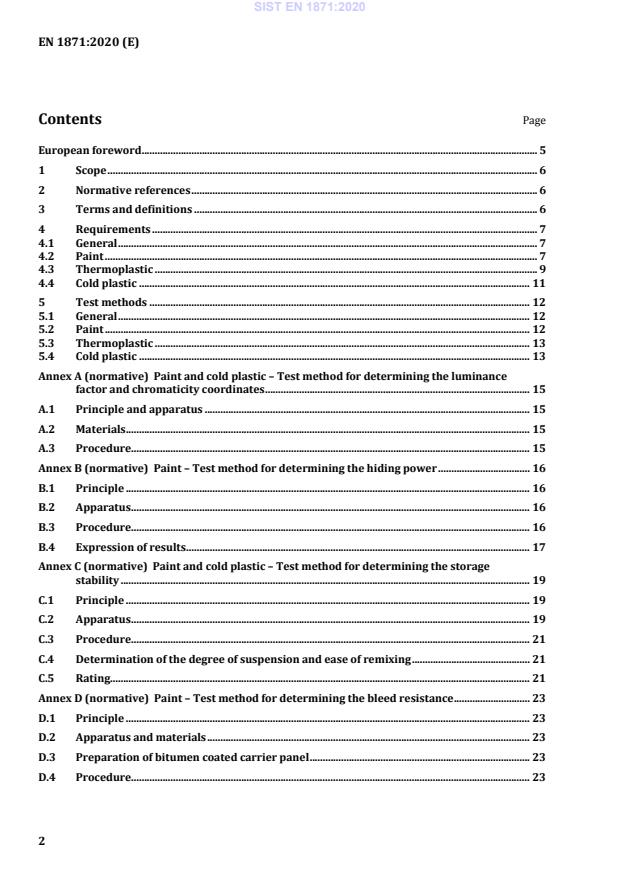
Contents Page
European foreword . 5
1 Scope . 6
2 Normative references . 6
3 Terms and definitions . 6
4 Requirements . 7
4.1 General . 7
4.2 Paint . 7
4.3 Thermoplastic . 9
4.4 Cold plastic . 11
5 Test methods . 12
5.1 General . 12
5.2 Paint . 12
5.3 Thermoplastic . 13
5.4 Cold plastic . 13
Annex A (normative) Paint and cold plastic – Test method for determining the luminance
factor and chromaticity coordinates . 15
A.1 Principle and apparatus . 15
A.2 Materials . 15
A.3 Procedure. 15
Annex B (normative) Paint – Test method for determining the hiding power . 16
B.1 Principle . 16
B.2 Apparatus . 16
B.3 Procedure. 16
B.4 Expression of results . 17
Annex C (normative) Paint and cold plastic – Test method for determining the storage
stability . 19
C.1 Principle . 19
C.2 Apparatus . 19
C.3 Procedure. 21
C.4 Determination of the degree of suspension and ease of remixing . 21
C.5 Rating. 21
Annex D (normative) Paint – Test method for determining the bleed resistance . 23
D.1 Principle . 23
D.2 Apparatus and materials . 23
D.3 Preparation of bitumen coated carrier panel . 23
D.4 Procedure. 23
Annex E (normative) Paint, cold plastic and thermoplastic – Test method for determining
the alkali resistance of the materials . 25
E.1 Principle . 25
E.2 Apparatus and reagents . 25
E.3 Number of tests . 26
E.4 Preparation of test panels . 26
E.5 Testing . 27
E.6 Evaluation of the surface conditions . 27
E.7 Precision and repetition . 27
Annex F (normative) Thermoplastic – Test method for determining the chromaticity
coordinates and luminance factor . 28
F.1 Principle . 28
F.2 Apparatus . 28
F.3 Procedure . 28
Annex G (normative) Thermoplastic – Test method for determining the softening point . 29
G.1 Principle . 29
G.2 Apparatus . 29
G.3 Samples . 29
G.4 Preparation of the ring . 29
G.5 Procedure . 31
G.6 Expression of the result . 31
Annex H (normative) Thermoplastic – Test method for determining the heat stability . 32
H.1 Principle . 32
H.2 Apparatus . 32
H.3 Preparation of sample . 32
Annex I (normative) Thermoplastic – Test method for determining the cold impact
resistance. 37
I.1 Principle . 37
I.2 Apparatus and reagents . 37
I.3 Procedure . 38
Annex J (normative) Thermoplastic – Test method for determining the indentation value . 39
J.1 Principle . 39
J.2 Summary . 39
J.3 Apparatus . 39
J.4 Preparation of the sample . 41
J.5 Testing . 42
J.6 Calculation. 42
J.7 Interpretation of the results . 42
J.8 Reporting . 42
Bibliography . 43
European foreword
This document (EN 1871:2020) has been prepared by Technical Committee CEN/TC 226 “Road
equipment”, the secretariat of which is held by AFNOR.
This European Standard shall be given the status of a national standard, either by publication of an
identical text or by endorsement, at the latest by April 2021, and conflicting national standards shall be
withdrawn at the latest by April 2021.
Attention is drawn to the possibility that some of the elements of this document may be the subject of
patent rights. CEN shall not be held responsible for identifying any or all such patent rights.
This document supersedes EN 1871:2000.
According to the CEN-CENELEC Internal Regulations, the national standards organisations of the
following countries are bound to implement this European Standard: Austria, Belgium, Bulgaria,
Croatia, Cyprus, Czech Republic, Denmark, Estonia, Finland, France, Germany, Greece, Hungary, Iceland,
Ireland, Italy, Latvia, Lithuania, Luxembourg, Malta, Netherlands, Norway, Poland, Portugal, Republic of
North Macedonia, Romania, Serbia, Slovakia, Slovenia, Spain, Sweden, Switzerland, Turkey and the
United Kingdom.
1 Scope
This document covers testing of physical properties of road marking materials by laboratory methods.
The products covered and specified by this document are white and yellow paint, thermoplastic and
cold plastic materials, with or without premix glass beads, to be used for permanent and/or temporary
road markings on highways and other areas used by vehicular traffic. Other products and colours
intended for road markings are not covered in this document.
Not all physical properties listed in this document have to be specified.
2 Normative references
The following documents are referred to in the text in such a way that some or all of their content
constitutes requirements of this document. For dated references, only the edition cited applies. For
undated references, the latest edition of the referenced document (including any amendments) applies.
EN 1436:2018, Road marking materials - Road marking performance for road users and test methods
EN 12802, Road marking materials - Laboratory methods for identification
EN 13459, Road marking materials - Sampling from storage and testing
EN ISO 787-11, General methods of test for pigments and extenders - Part 11: Determination of tamped
volume and apparent density after tamping (ISO 787-11)
EN ISO 1514, Paints and varnishes - Standard panels for testing (ISO 1514)
EN ISO 2812-1, Paints and varnishes - Determination of resistance to liquids - Part 1: Immersion in liquids
other than water (ISO 2812-1)
EN ISO 4892-3, Plastics - Methods of exposure to laboratory light sources - Part 3: Fluorescent UV lamps
(ISO 4892-3)
3 Terms and definitions
For the purposes of this document, the following terms and definitions apply.
ISO and IEC maintain terminological databases for use in standardization at the following addresses:
— ISO Online browsing platform: available at https://www.iso.org/obp
— IEC Electropedia: available at http://www.electropedia.org/
3.1
paint
liquid product which contains binders, pigments, fillers, solvents and additives, which can be supplied
in single or multi-component systems and which, when applied, produces a cohesive film by the process
of solvent/water evaporation or the process of solvent/water evaporation and a chemical reaction or
coalescence process (in the case of water based product)
3.2
thermoplastic
solvent-free marking product which is supplied in block, granular, powder forms or preformed (e.g. as
tape), which is heated to a molten state prior to application to road surfaces, and which forms a
cohesive film by cooling
3.3
cold plastic
viscous products supplied in multi-component forms (at least one main component and a hardener
system), the cohesive film being formed after mixing of all components only by a chemical reaction
following which the cold plastic becomes a solid
4 Requirements
4.1 General
This clause gives three separate lists of requirements for the product groups: paint, thermoplastic and
cold plastic.
4.2 Paint
4.2.1 Luminance factor and chromaticity coordinates
The colour shall be defined by luminance factor β and (x,y) chromaticity coordinates of the CIE standard
system.
When measured according to 5.2.1, the results of the test for the luminance factor shall comply with
Table 1.
Table 1 — Classes of luminance factor
Colour Class Luminance factor β
LF5 ≥ 0,75
White LF6 ≥ 0,80
LF7 ≥ 0,85
LF1 ≥ 0,40
Yellow
LF2 ≥ 0,50
When measured according to 5.2.1, the chromaticity coordinates shall lie within the regions defined by
the corner points given in Table 2.
Table 2 — Chromaticity coordinates of white and yellow road marking products
Corner point N°
Chromaticity
coordinates
1 2 3 4
x 0,355 0,305 0,285 0,335
White
y 0,355 0,305 0,325 0,375
x 0,494 0,545 0,465 0,427
Yellow
y 0,427 0,455 0,535 0,483
4.2.2 Hiding power
The test measures the capacity of the paint to reduce the contrast between a black surface and a white
surface over which the paint has been applied and dried.
When measured according to 5.2.2, the result, expressed as the contrast ratio, shall comply with
Table 3.
Table 3 — Classes of hiding power
Colour Class Hiding Power (contrast ratio)
HP0 No value requested
HP2 ≥ 90 %
White
HP3 ≥ 92 %
HP4 ≥ 95 %
HP0 No value requested
Yellow HP1 ≥ 88 %
HP2 ≥ 90 %
4.2.3 Storage stability
The paint shall be free from skin and settlement that cannot be re-incorporated by stirring. When tested
in accordance with 5.2.3, the paint shall have a rating equal to or above 4.
4.2.4 UV ageing
A film of paint is submitted to cycles of UV radiation and condensation and examined for discolouration.
When tested in accordance with 5.2.4, the difference in luminance factor Δβ shall be as in Table 4
(where Δβ is the difference between luminance factor before and luminance factor after test).
Table 4 — Classes of difference in luminance factor after UV ageing
Colour Class Δβ
UV0 No value requested
White and Yellow UV1 ≤ 0,05
UV2 ≤ 0,10
For classes UV1, UV2 the chromaticity coordinates shall lie within the regions defined by the corner
points given in Table 2.
4.2.5 Bleed resistance
This test is only applicable for paint which is intended to be applied directly to asphaltic surfaces. The
film of paint applied to a bituminous surface is examined for discolouration.
When tested in accordance with 5.2.5, the difference in luminance factor Δβ shall be as in Table 5
(where Δβ is the difference between luminance factor before and luminance factor after test).
Table 5 — Classes of difference in luminance factor after bleed resistance test
Colour Class Δβ
BR0 No value requested
White and Yellow BR1 ≤ 0,03
BR2 ≤ 0,05
For classes BR1, BR2 the chromaticity coordinates shall lie within the regions defined by the corner
points given in Table 2.
4.2.6 Alkali resistance
This test is only applicable for paint which is intended to be applied directly to hydraulic concrete
surfaces. The film of paint is submitted to the effect of a solution of sodium hydroxide and examined for
surface deterioration.
When tested in accordance with 5.2.6, the paint film shall show no signs of partial or complete film
destruction, surface roughening or discolouration.
4.3 Thermoplastic
4.3.1 General
Thermoplastic materials need to be melted before application so that their characteristics should
remain stable after supporting a period of heating. This is the reason why the standard includes
requirements before and after a heating cycle.
4.3.2 Tests before heat stability
4.3.2.1 Luminance factor and chromaticity coordinates
The colour shall be defined by luminance factor β and (x,y) chromaticity coordinates of the CIE standard
system.
When measured according to 5.3.2.1, the results of the test for the luminance factor shall comply with
Table 6.
Table 6 — Classes of luminance factor for thermoplastic and cold plastic
Colour Class Luminance factor β
LF3 ≥ 0,65
LF4 ≥ 0,70
White
LF5 ≥ 0,75
LF6 ≥ 0,80
LF1 ≥ 0,40
Yellow
LF2 ≥ 0,50
The chromaticity coordinates shall lie within the regions defined by the corner points given in Table 2.
4.3.2.2 Softening point
The test measures the temperature at which a given layer of thermoplastic material experiences a given
deformation under the action of a steel ball.
When measured in accordance with 5.3.2.2, the softening point of the thermoplastic material shall
comply with Table 7.
Table 7 — Classes of softening point for thermoplastic
Softening point
Class
in °C
SP0 No value requested
SP1 ≥ 65
SP2 ≥ 80
SP3 ≥ 95
SP4 ≥ 110
4.3.2.3 Alkali resistance
This test is only applicable for thermoplastic which is intended to be applied directly to hydraulic
concrete surfaces. The thermoplastic is submitted to the effect of a solution of sodium hydroxide and
examined for surface deterioration.
When tested in accordance with 5.3.2.3, the thermoplastic film shall show no signs of partial or
complete film destruction, surface roughening or discolouration.
4.3.2.4 Cold impact resistance
This test measures the resistance of thermoplastic material, at cold temperature, to the impact of a
falling steel ball.
When tested in accordance with 5.3.2.4 the number of specimens passing the test shall comply with
Table 8.
Table 8 — Classes for cold impact resistance
Temperature of test
Class Ball Number of specimens passing
in °C
CI 0 No requirement – No value requested
CI 1 0 a 6
CI 2 −10 ± 3 a 6
CI 3 −10 ± 3 b 6
NOTE Steel ball type (a) and (b) are specified in Annex I.
4.3.2.5 UV ageing
A film of thermoplastic is submitted to cycles of UV radiation and condensation and examined for
discolouration.
When tested in accordance with 5.3.2.5, the difference in luminance factor Δβ shall be as in Table 4
(where: Δβ is the difference between luminance factor before and luminance factor after test).
For Classes UV1, UV2 the chromaticity coordinates shall lie within the regions defined by the corner
points given in Table 2.
4.3.3 Tests after heat stability
4.3.3.1 Luminance factor and chromaticity coordinates
When tested in accordance with 5.3.3.2, the difference in luminance factor Δβ shall be no more than
0,10 for both white and yellow. The chromaticity coordinates shall be as given in Table 2.
4.3.3.2 Softening point
When tested in accordance with 5.3.3.3, the difference in softening point ΔSP (where: ΔSP is the
difference between softening point before and softening point after heating) shall not be more
than ± 10 °C.
4.3.3.3 Indentation
It is the time required for a standardized cylinder to sink 10 mm into the thermoplastic at a given
temperature.
When tested in accordance with 5.3.3.4, the mean value for the indentation time shall comply with
Table 9.
Table 9 — Classes for indentation
Class Indentation time
IN0 No value requested
IN1 5 s to 45 s
IN2 46 s to 2 min
IN3 2 min 1 s to 5 min
IN4 5 min 1 s to 20 min
IN5 > 20 min
Table 10 — Standardized temperature for test
Temperature (°C)
4.4 Cold plastic
4.4.1 Luminance factor and chromaticity coordinates
The colour shall be defined by luminance factor β and (x,y) chromaticity coordinates of the CIE standard
system.
When tested in accordance with 5.4.1, for the luminance factor, the results of the test shall comply with
Table 6.
The chromaticity coordinates shall lie within the regions defined by the corner points given in Table 2.
4.4.2 Storage stability
The products shall be free from skin and settlement that cannot be re-incorporated by stirring.
When tested in accordance with 5.4.2, the product shall have a rating equal to or above 3.
NOTE See C.3.2 for components containing peroxides.
4.4.3 UV ageing
A film of cold plastic is submitted to cycles of UV radiation and condensation and examined for
discolouration.
When tested in accordance with 5.4.3, the difference in luminance factor Δβ shall be as in Table 4
(where Δβ is the difference between luminance factor before and luminance factor after test).
For classes UV1, UV2 the chromaticity coordinates shall lie within the regions defined by the corner
points given in Table 2.
4.4.4 Alkali resistance
This test is only applicable for cold plastic which is intended to be applied directly to hydraulic concrete
surfaces. A film of cold plastic is submitted to the effect of a solution of sodium hydroxide and examined
for surface deterioration.
When tested in accordance with 5.4.4, the cold plastic film shall show no signs of partial or complete
film destruction, surface roughening or discolouration.
5 Test methods
5.1 General
This clause gives three separate lists of test methods. Paint, thermoplastic and cold plastic.
If not specified in the relevant test method sampling shall be made according to EN 13459.
5.2 Paint
5.2.1 Chromaticity coordinates and luminance factor
The (x,y) chromaticity coordinates and luminance factor β shall be measured as specified in Annex A.
5.2.2 Hiding power
It shall be tested in accordance with Annex B applying the paint at a rate of (300 ± 30) µm (wet film).
5.2.3 Storage stability
Each of the components of paint shall be tested separately in different containers. It shall be tested in
accordance with Annex C.
5.2.4 UV ageing
The paint shall be applied as in A.3 to panels as described in A.2. The specimens shall be tested in
accordance with EN ISO 4892-3 for 168 h under lamp type II (UVB - 313) in cycles of 8 h of radiation at
(60 ± 2) °C and 4 h of condensation at (50 ± 2) °C.
5.2.5 Bleed resistance
It shall be tested in accordance with Annex D.
5.2.6 Alkali resistance
It shall be tested in accordance with Annex E.
5.3 Thermoplastic
5.3.1 General
The thermoplastic shall be melted according to the manufacturers recommendations. If nothing is
stated, follow Annex H.
5.3.2 Tests before heat stability test
5.3.2.1 Chromaticity coordinates and luminance factor
The (x,y) chromaticity coordinates and luminance factor β shall be measured as specified in Annex F.
5.3.2.2 Softening point
It shall be tested in accordance with Annex G.
5.3.2.3 Alkali resistance
It shall be tested in accordance with Annex E.
5.3.2.4 Cold impact resistance
It shall be tested in accordance with Annex I.
5.3.2.5 UV ageing
The thermoplastic shall be applied at the manufacturer's stated thickness to panels as described in A.2
and tested in accordance with EN ISO 4892-3 for 168 h under lamp type II (UVB - 313) in cycles of 8 h of
radiation at (60 ± 2) °C and 4 h of condensation at (50 ± 2) °C.
5.3.3 Tests after heat stability
5.3.3.1 General
It shall be carried out after submitting the thermoplastic to heat stability according to Annex H.
5.3.3.2 Chromaticity coordinates and luminance factor
The (x,y) chromaticity coordinates and luminance factor β shall be measured as specified in Annex F.
5.3.3.3 Softening point
It shall be tested in accordance with Annex G.
5.3.3.4 Indentation
It shall be tested in accordance with Annex J.
5.4 Cold plastic
5.4.1 Chromaticity coordinates and luminance factor
The (x,y) chromaticity coordinates and luminance factor β shall be measured as specified in Annex A.
5.4.2 Storage stability
The components of cold plastic shall each be tested separately in different containers. They shall be
tested in accordance with Annex C.
5.4.3 UV ageing
The cold plastic shall be applied at the manufacturer's stated thickness to test panels as described in A.2
and tested in accordance with EN ISO 4892-3 for 168 h under lamp type II (UVB - 313) in cycles of 8 h of
radiation at (60 ± 2) °C and 4 h of condensation at (50 ± 2) °C.
5.4.4 Alkali resistance
It shall be tested in accordance with Annex E.
Annex A
(normative)
Paint and cold plastic – Test method for determining the luminance factor
and chromaticity coordinates
A.1 Principle and apparatus
The principle of measurement and the choice of apparatus are given in EN 1436:2018, Annex C.
The equipment shall have geometry of 45°/0° and set up with observer angle 2°, Illuminant D
65.
A.2 Materials
Test panels shall be made of aluminium, of minimum size 150 mm × 75 mm × 0,60 mm, prepared for
test by solvent cleaning.
A.3 Procedure
A.3.1 Paint
Prepare the aluminium panel and apply the paint to the panel to give a wet film thickness of
400 μm ± 40 μm using shims and a doctor blade. In the case of paint containing premix glass beads a
coating equivalent to 1 000 g/m may be applied. Allow the panel to dry for a minimum of 24 h in a
horizontal position at (23 ± 5) °C and 75 % relative humidity (max), out of sunlight and with protection
from dust. Measure in accordance with EN 1436.
A.3.2 Cold plastic
Prepare the aluminium panel and apply the cold plastic to the panel to give a wet film in accordance
with the tolerance, instructions and method described in technical sheet of the producer. Allow the
panel to dry for a minimum of 24 h in a horizontal position at (23 ± 5) °C and 75 % relative humidity
(max), out of sunlight and with protection from dust. Measure in accordance with EN 1436.
An alternative method for cold plastic products that form rough texture (and therefore are difficult to
measure) is to cast the material onto a smooth and non-adhesive surface. In this case the measurement
shall be reported for the cast surface.
Annex B
(normative)
Paint – Test method for determining the hiding power
B.1 Principle
In the specific case of paint dry films, the hiding power can be understood as the capacity of the paint to
reduce the contrast between a black surface and a white surface over which the paint has been applied
and dried.
The test method is based in determining the contrast ratio when the paints are applied at a fixed
dosage.
B.2 Apparatus
a) A film applicator type Doctor Blade or similar.
b) A device provided with an engine, a driving system and a suction plate to move the Doctor Blade at
a constant speed on a flat surface.
c) A reflectometer or colourimeter in accordance with the specifications given in EN 1436.
d) Cards impervious to paint solvents, flat surface and enough surface to allow good adherence to the
suction plate. One card side shall be marked with black and white alternative squares or stripes of
at least 40 mm size. The luminance factor, measured as described in EN 1436, shall be 0,02 as
maximum for the black surface and 0,80 as minimum for the white surface.
e) Precision balance with a minimum resolution of 0,001 g.
f) Measuring instrument able to evaluate 0,5 mm.
B.3 Procedure
B.3.1 Sampling
Representative sample of the paint shall be taken as specified in EN 13459.
B.3.2 Preparation of test films
Weight the card on the precision balance and place it over the suction plate taken care that it is
completely adhered to the surface. Immediately before the application mix the paint thoroughly by
vigorous stirring taking care not to incorporate air bubbles. The paint is then applied across the card at
an intended dosage of 300 μm ± 30 μm driving the applicator “Doctor Blade” at a constant speed by
means of the automatic device. The applied paint width shall be higher than the relevant width of the
white and black parts of the card.
The procedure shall be repeated to obtain six paint film cards for testing.
In order to assess that the resulting test film is inside the intended interval and just after the
application, the applied thickness may be measured. Appropriate instruments for measuring thickness
may be used for this purpose.
Keep the test films to dry in horizontal position at (23 ± 5) °C and 75 % max of relative humidity for at
least 24 h and not more than 48 h, taken care that they are well protected from direct radiation and
dust.
B.3.3 Determination of the applied weight
Take a new card with a weight not differing more than ± 0,3 % with regard to the other cards used for
preparing the test films and cut pieces of black and white surfaces with a minimum width of 40 mm to
be used as weight zero (z).
Once the test films have dried and before manipulating them, measurements of reflectance shall be
taken in accordance with the indications given in B.3.4. To be validated afterwards, they shall be taken
at the same positions on which the weight of applied paint is to be determined.
From each of the six cards with the test films dried in accordance with the specifications given in B.3.2,
cut carefully identical pieces of black and white substrates with the same dimensions as for the new one
abovementioned. The surface (A) shall be computed from the measured dimensions and expressed in
. The weight of dry paint actually applied (WA) on the test films shall be determined by difference
cm
between the weight of these pieces and the relevant weight zero and expressed in mg. The dosage of dry
paint per surface unit (DS) shall be expressed in g/m2 from the formula:
Dosage of dry paint: DS = 10·WA/A
To transform the dosage of dry paint (DS) into dosage of liquid paint (DL) it is necessary to determine
the non-volatile content (S) which shall be determined in accordance with the test method specified in
EN 12802. The final result, i.e. the dosage of the liquid paint actually applied, shall be expressed in g/m
from the formula:
Dosage of liquid paint: DL = 100·DS/S
DS and DL are expressed in g/m and S in %.
B.3.4 Measurement of the luminance factor
Measurement of the luminance factor shall be carried out on coated cards over the surfaces of each of
the weighted pieces of black and white substrates in accordance with the specifications given in
EN 1436.
B.4 Expression of results
The hiding power of a dry film of paint, for a fixed dosage, shall be expressed by means of the contrast
ratio (r ) defined as a percentage for each coated card or film from the average luminance factor over
C
the black substrates (β ) and over the white substrates (β ) from the formula:
1 2
β
r × 100
C
β
(B.1)
where
r is the contrast ratio of the dry film of paint;
C
β is the average value of the luminance factor of the dry film of paint applied over the weighted black
substrates of each coated card;
β is the average value of the luminance factor of the dry film of paint applied over the weighted white
substrates of each coated card.
=
It is assumed that for the narrow interval of 300 μm ± 30 μm of liquid paint, the contrast ratio is a linear
function of the dosage of liquid paint. Consequently, the value of the contrast ratio for the exact dosage
of 300 μm ± 30 μm shall be obtained by graphical interpolation in the resulting diagram representing
the contrast ratios versus the determined liquid dosages for each of the six tested cards.
Annex C
(normative)
Paint and cold plastic – Test method for determining the storage stability
C.1 Principle
The test method covers the determination of the degree of pigment suspension and ease of remixing a
shelf-aged sample of paint or cold plastic to a homogeneous condition suitable for immediate use.
C.2 Apparatus
a) Three 250 ml wide-neck bottles (test vessels) of clear glass, 55 mm in diameter, 110 mm in height,
with an opening 45 mm in diameter with an ISO thread and a screw-type plastic (PE) inset top.
b) Steel spatula weighing 45 g ± 1 g, square, 123 mm ± 1 mm in length and with a blade
20,5 mm ± 0,5 mm in width: the spatula shall be made by cutting the top from an ordinary 127 mm
flexible steel laboratory spatula to obtain the specified length.
c) Warming cabinet, with forced ventilation capable of reaching a temperature of either (45 ± 3) °C or
(60 ± 3) °C.
d) Tamping apparatus in accordance with EN ISO 787-11 (see Figure C.1).
e) Holder for the test vessel (see Figure C.1).
f) Precision balance with a minimum resolution of 0,01 g.
Dimensions in millimetres
Key
1 rubber sleeve 1 mm
2 holder for vessel
3 shaft
4 sleeve
5 anvil
6 cam
7 tamping apparatus in accordance with EN ISO 787-11
Figure C.1 — Tamping volumeter
C.3 Procedure
C.3.1 Paint
Place a sample of the paint in each of the three 250 ml wide-neck bottles, taking care to ensure that the
level of paint in each test vessel is identical and reaches the lower edge of the thread (approximately
20 mm below the screw top but to a maximum of 80 % of the volume).
The edges and thread of the test vessels shall be thoroughly cleaned using cellulose and solvent. The
test vessels are then hermetically closed and labelled 1 to 3. The samples shall be then weighed to the
nearest 0,1 g and stored in the warming cabinet and subjected to 4 cycles of storing and tamping for a
total of 28 days at (45 ± 3)°C or if the boiling point allows for 88 h at (60 ± 3)°C. After each 7 day period,
or after each 22-h period if applicable, the samples shall be subjected to 25 000 strokes of the automatic
tamping equipment. By observing the samples through the glass it can be seen whether the phases
separate.
After each series of 25 000 strokes the samples shall be returned into the warming cabinet. All three
samples shall be reweighed immediately after storage under accelerated conditions (action of heat and
tamping) in order to determine any loss of mass. Loss of weight shall not exceed 2 %. Should any
samples exceed a loss of mass of 2 % then the test shall be repeated.
C.3.2 Cold plastic
Cold plastic shall be tested in the same way as paint but using only the cycle of 28 days at 45 °C (for
safety reasons). The components of cold plastic shall be tested for the presence of peroxides prior to
testing.
The components containing peroxides shall not be stored in the warming cabinet but at room
temperature and shall not be subjected to the tamping test.
C.4 Determination of the degree of suspension and ease of remixing
After weighing, open the three test vessels carefully without shaking or agitation and examine the
samples. Do not remove any surface layer that may have formed on the samples (skin formation). Use a
spatula to examine the extent to which portions of the paint or cold plastic have separated to form a
layer at the bottom of the test vessel during storage and tamping. Hold one end of the spatula so that it
is perpendicular to the central area of the sample and its bottom edge is level with the top of the test
vessel. Drop the spatula from this height, then move the spatula manually over the bottom of the test
vessel in a lateral direction. Assess the resistance of the cake of settled pigment to this movement and
the ease of remixing for all three samples in accordance with C.5, after which determine and record the
average rating for the three samples.
C.5 Rating
Rate the sample for degree of settling on a scale of 10 to 0 in accordance with Table C.1. Give
intermediate conditions the appropriate odd number.
Table C.1 — Rating scale for storage stability
Rating Description of product condition
10 Perfect suspension. No change from the original condition of the product.
Settling has definitely taken place. A slight deposit is raised when the spatula is
8 dropped into the product. No significant resistance to sideways movement of the
spatula.
Definite cake of settled pigment. Spatula drops through cake under its own weight.
6 Definite resistance to sideways motion of the spatula. Coherent portions of cake may
be removed on spatula. Product can be remixed readily to a homogeneous state.
Spatula does not fall through cake to bottom of test vessel under its own weight.
Difficult to move spatula through cake sideways and slight edgewise resistance.
Product can be remixed readily to a homogeneous state.
Definite resistance to edgewise movement of the spatula after it has been pushed
3 through the settled layer by exerting slight pressure on it. Product can be remixed to a
homogeneous state by stirring manually with a small amount of effort.
When spatula has been forced through the settled layer it is very difficult to move
2 spatula sideways. Definite edgewise res
...