

EN 18233:2026
(Main)Determination of characteristic load resistance and characteristic plate stiffness of plate anchors in the ETICS kit
- Abstract
This document covers the determination of the characteristic load resistance Fp and the characteristic plate stiffness kp of plate anchors.
- Status
- Not Published
- Publication Date
- 01-Dec-2026
- Technical Committee
- CEN/TC 88 - Thermal insulating materials and products
- Drafting Committee
- CEN/TC 88/WG 18 - External thermal insulation composite systems
- Current Stage
- 5060 - Closure of Vote - Formal Approval
- Start Date
- 24-Sep-2026
- Due Date
- 30-Jun-2025
- Completion Date
- 24-Sep-2026

EN 18233 is a CEN standard for determining the characteristic load resistance and characteristic plate stiffness of plate anchors in the ETICS kit. It sets out a tensile test method, the calculation approach and the reporting items needed to compare plate anchors in a consistent way. The document is intended for test laboratories, manufacturers and others who need measurable performance data for ETICS anchoring systems.
What does EN 18233 specify?
EN 18233 specifies how to determine the characteristic load resistance and the characteristic plate stiffness of plate anchors used in ETICS (external thermal insulation composite systems) kits. It focuses on a laboratory test on a plate anchor pulled through a metal ring under defined conditions.
The document is organized into clauses on scope, normative references, terms and definitions, principles, test equipment, test specimen preparation, test conditions, procedure, calculation and expression of results, and the test report. Clause 1 gives the scope, Clause 4 explains the test principle, Clauses 5 to 8 describe the setup and test run, and Clause 9 gives the calculation rules.
What are the key requirements of EN 18233?
EN 18233 requires a fixed tensile test setup, a defined number of specimens and specific calculation rules so that results from different labs can be compared. In practice, this means the anchor, the machine and the data treatment all have to follow the same sequence.
Test principle and apparatus
Clause 4 states that the anchor plate is pulled through a metal ring at a defined tensile load. Clause 5 requires a solid support ring, a displacement transducer, clamping jaws and a tensile testing machine with stated accuracy levels. This matters because the support geometry and measuring accuracy directly affect the measured resistance and stiffness.
Specimen preparation and conditioning
Clause 6 requires 5 test specimens. The setup depends on the anchor type shown in Figure 1, with different measuring points for type 1 and type 2 anchors.
Plate anchors made of polar plastic material have to be conditioned at (23 ± 2) °C and (50 ± 5) % RH until mass constancy. That matters in practice because moisture can change the behavior of some plastics, so conditioning helps make the results reproducible.
Test conditions and procedure
Clause 7 requires testing at (23 ± 2) °C and (50 ± 5) % RH after conditioning, if needed. Clause 8 requires the tensile load to be increased at (1 ± 0.2) kN/min until failure, while recording the maximum load and the displacement of the measuring point.
This gives a controlled loading rate and a clear end point, which is important for comparing anchors that may fail in different ways.
Calculation of characteristic values
Clause 9 defines the characteristic load resistance from the 5 %-quantile of the maximum loads at a 90 % confidence level. It also specifies the statistical treatment needed to turn a small test series into a characteristic value.
For plate stiffness, Clause 9 uses the mean value of the tangent stiffness from the tests. The tangent stiffness can be determined graphically or by regression, and the graph-based method uses the slope at 1 mm displacement. This is what gives designers and evaluators a stiffness value that relates to deformation under load, not just failure load.
Test report
Clause 10 requires the report to identify the anchor product, list the test conditions and amendments to the procedure, and record the maximum loads, characteristic load resistance, standard deviations, tangent stiffness values and characteristic plate stiffness. In practice, this makes the result traceable and easier to use in product documentation or technical assessment.
What terms does EN 18233 define?
- Expansion element - the screw or nail that spreads the anchor’s expansion zone inside the substrate.
- Expansion zone - the part of the anchor sleeve that is expanded by the expansion element.
- Characteristic load resistance - the characteristic resistance value derived from the maximum loads of the test series.
- Characteristic plate stiffness - the characteristic stiffness value calculated from the tangent stiffness of the tested anchors.
- Tangent stiffness - the slope of the load-displacement response at 1 mm displacement for a single test.
- Polar plastic material - a plastic material that needs moisture conditioning before testing, such as polyamide.
Who uses EN 18233?
EN 18233 is used by test laboratories that measure anchor performance, by manufacturers of plate anchors for ETICS kits, and by technical staff who need characteristic values for product evaluation. It is also relevant to quality managers and buyers who compare anchor products on the basis of standardized test results.
Which standards are used with EN 18233?
- EN ISO 9229:2007 - supplies vocabulary for thermal insulation terms used in the document.
- ISO 12491:2019 - provides the statistical methods used for quality control, variation and the characteristic-value calculations.
- EN 17237 - provides the ETICS product context and the terms that apply to ETICS kits.
What does the EN 18233 document contain?
EN 18233 contains a test principle, a specified apparatus, specimen preparation rules and conditioning instructions. Figure 1 shows the test setup and distinguishes the two anchor types used for the stiffness measurement points. Figure 2 gives the load-displacement diagram used for tangent stiffness, and Clause 9 gives the calculation formulas for characteristic load resistance and characteristic plate stiffness.
The report clause lists the results and metadata that need to be recorded, including product identification, test conditions, individual maximum loads, standard deviations and stiffness values. This makes the document useful both for laboratory testing and for traceable product documentation.
Get Certified
Connect with accredited certification bodies for this standard

DIBt (Deutsches Institut für Bautechnik)
German Institute for Building Technology.
DIN CERTCO
DIN Group product certification.

Aboma Certification B.V.
Specialized in construction, metal, and transport sectors.
Sponsored listings
Frequently Asked Questions
EN 18233:2026 is a draft published by the European Committee for Standardization (CEN). Its full title is "Determination of characteristic load resistance and characteristic plate stiffness of plate anchors in the ETICS kit". This standard covers: This document covers the determination of the characteristic load resistance Fp and the characteristic plate stiffness kp of plate anchors.
This document covers the determination of the characteristic load resistance Fp and the characteristic plate stiffness kp of plate anchors.
EN 18233:2026 is classified under the following ICS (International Classification for Standards) categories: 91.100.60 - Thermal and sound insulating materials. The ICS classification helps identify the subject area and facilitates finding related standards.
EN 18233:2026 is available in PDF format for immediate download after purchase. The document can be added to your cart and obtained through the secure checkout process. Digital delivery ensures instant access to the complete standard document.
Standards Content (Sample)
SLOVENSKI STANDARD
oSIST prEN 18233:2025
01-november-2025
Ugotavljanje karakteristične nosilnosti in karakteristične togosti ploščatih sidrnih
plošč v kompletu ETICS
Determination of characteristic load resistance and characteristic plate stiffness of plate
anchors in the ETICS kit
Wärmedämmstoffe für das Bauwesen - Bestimmung der charakteristischen Tragfähigkeit
und der charakteristischen Steifigkeit von Tellerdübeln
Détermination de la résistance caractéristique à la charge et de la raideur caractéristique
des chevilles à rosace dans le kit ETICS
Ta slovenski standard je istoveten z: prEN 18233
ICS:
91.100.60 Materiali za toplotno in Thermal and sound insulating
zvočno izolacijo materials
oSIST prEN 18233:2025 en,fr,de
2003-01.Slovenski inštitut za standardizacijo. Razmnoževanje celote ali delov tega standarda ni dovoljeno.
oSIST prEN 18233:2025
oSIST prEN 18233:2025
DRAFT
EUROPEAN STANDARD
prEN 18233
NORME EUROPÉENNE
EUROPÄISCHE NORM
August 2025
ICS 91.100.60
English Version
Determination of characteristic load resistance and
characteristic plate stiffness of plate anchors in the ETICS
kit
Détermination de la résistance caractéristique à la Wärmedämmstoffe für das Bauwesen - Bestimmung
charge et de la raideur caractéristique des chevilles à der charakteristischen Tragfähigkeit und der
rosace dans le kit ETICS charakteristischen Steifigkeit von Tellerdübeln
This draft European Standard is submitted to CEN members for enquiry. It has been drawn up by the Technical Committee
CEN/TC 88.
If this draft becomes a European Standard, CEN members are bound to comply with the CEN/CENELEC Internal Regulations
which stipulate the conditions for giving this European Standard the status of a national standard without any alteration.
This draft European Standard was established by CEN in three official versions (English, French, German). A version in any other
language made by translation under the responsibility of a CEN member into its own language and notified to the CEN-CENELEC
Management Centre has the same status as the official versions.
CEN members are the national standards bodies of Austria, Belgium, Bulgaria, Croatia, Cyprus, Czech Republic, Denmark, Estonia,
Finland, France, Germany, Greece, Hungary, Iceland, Ireland, Italy, Latvia, Lithuania, Luxembourg, Malta, Netherlands, Norway,
Poland, Portugal, Republic of North Macedonia, Romania, Serbia, Slovakia, Slovenia, Spain, Sweden, Switzerland, Türkiye and
United Kingdom.
Recipients of this draft are invited to submit, with their comments, notification of any relevant patent rights of which they are
aware and to provide supporting documentation.
Warning : This document is not a European Standard. It is distributed for review and comments. It is subject to change without
notice and shall not be referred to as a European Standard.
EUROPEAN COMMITTEE FOR STANDARDIZATION
COMITÉ EUROPÉEN DE NORMALISATION
EUROPÄISCHES KOMITEE FÜR NORMUNG
CEN-CENELEC Management Centre: Rue de la Science 23, B-1040 Brussels
© 2025 CEN All rights of exploitation in any form and by any means reserved Ref. No. prEN 18233:2025 E
worldwide for CEN national Members.
oSIST prEN 18233:2025
prEN 18233:2025 (E)
Contents Page
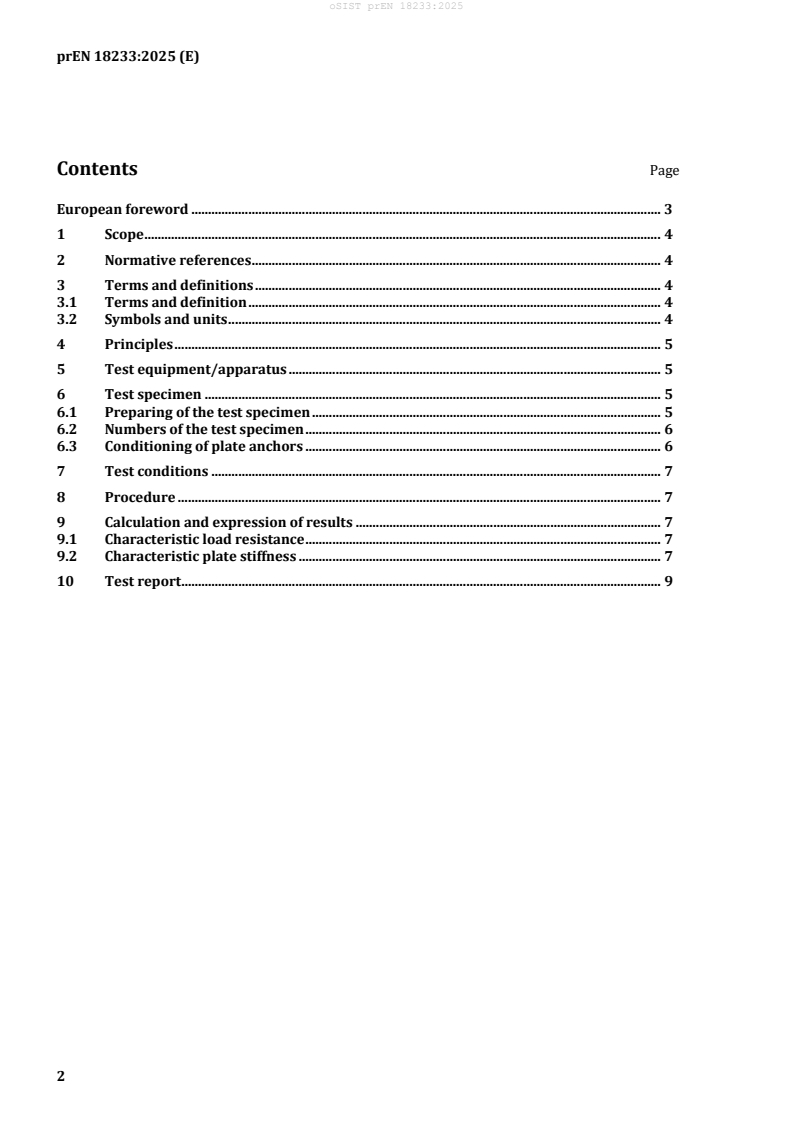
European foreword . 3
1 Scope . 4
2 Normative references . 4
3 Terms and definitions . 4
3.1 Terms and definition . 4
3.2 Symbols and units . 4
4 Principles . 5
5 Test equipment/apparatus . 5
6 Test specimen . 5
6.1 Preparing of the test specimen . 5
6.2 Numbers of the test specimen . 6
6.3 Conditioning of plate anchors . 6
7 Test conditions . 7
8 Procedure . 7
9 Calculation and expression of results . 7
9.1 Characteristic load resistance . 7
9.2 Characteristic plate stiffness . 7
10 Test report . 9
oSIST prEN 18233:2025
prEN 18233:2025 (E)
European foreword
This document (prEN 18233:2025) has been prepared by Technical Committee CEN/TC 88 “Thermal
insulating materials and products”, the secretariat of which is held by DIN.
This document is currently submitted to the CEN Enquiry.
oSIST prEN 18233:2025
prEN 18233:2025 (E)
1 Scope
This document covers the determination of the characteristic load resistance F and the characteristic
p
plate stiffness k of plate anchors.
p
2 Normative references
The following documents are referred to in the text in such a way that some or all of their content
constitutes requirements of this document. For dated references, only the edition cited applies. For
undated references, the latest edition of the referenced document (including any amendments) applies.
EN ISO 9229:2007, Thermal insulation — Vocabulary (ISO 9229:2007)
ISO 12491:2019, Statistical methods for quality control of building materials and components
(ISO 12491:2019)
EN 17237, Thermal insulation products for buildings — External thermal insulation composite systems
with renders (ETICS) — Specification
3 Terms and definitions
3.1 Terms and definition
For the purposes of this document, the terms and definitions given in EN ISO 9229:2007 and EN 17237
apply.
ISO and IEC maintain terminology databases for use in standardization at the following addresses:
— IEC Electropedia: available at https://www.electropedia.org/
— ISO Online browsing platform: av
...