

EN 12978:2024
(Main)Industrial, commercial and garage doors and gates and pedestrian doorsets - Protective devices for power operated doors and gates - Requirements and test methods
- Abstract
This document specifies requirements and test methods for sensitive protective equipment put separately on the market as safety components to be used with entrance equipment such as power operated industrial, commercial and garage doors, gates and barriers, power operated pedestrian doors and power operated pedestrian entrance control equipment.
NOTE Requirements for the safe function of the combination of protective device and industrial, commercial and garage doors and barriers are given in EN 12453.
This document deals with all significant hazards, hazardous situations and events relevant to the power operation of doors, and gates and barriers when they are used as intended and under conditions of misuse which are reasonably foreseeable as identified in Clause 4.
All lifetime phases of the sensitive protective equipment including transportation, assembly, dismantling, disabling and scrapping are considered by this document.
Whenever the term „door” is used in this document, it is deemed to cover the full scope of types and variances of doors, gates and barriers and entrance control equipment listed in the scope of EN 12453:2017+A1:2021, EN 16005:2012 and EN 17352:2022.
This document is not intended to be used for sensitive protective equipment using ultrasonic, radar, capacitive, inductive, and passive infrared and vision based technologies. For these types of equipment this document can be used as a guide to demonstrate that such a device is allowed.
This document is not applicable to sensitive protective equipment manufactured before the date of its publication.
- Status
- Published
- Publication Date
- 10-Dec-2024
- Technical Committee
- CEN/TC 33 - Doors, windows, shutters and building hardware
- Drafting Committee
- CEN/TC 33/WG 5 - Industrial, commercial and garage doors and gates
- Current Stage
- 6060 - Definitive text made available (DAV) - Publishing
- Start Date
- 11-Dec-2024
- Due Date
- 30-Jan-2023
- Completion Date
- 11-Dec-2024
- Directive
- 2006/42/EC - Directive 2006/42/EC of the European Parliament and of the Council of 17 May 2006 on machinery, and amending Directive 95/16/EC (recast)OJ Ref: 2025/1740, OJ L, OJ L, 2025/1740 OJ Date: 14-Aug-2025

Overview
EN 12978:2024 is a CEN type‑C European standard that specifies requirements and test methods for sensitive protective equipment (safety components) placed separately on the market to be used with power‑operated entrance equipment - including industrial, commercial and garage doors, gates, barriers and pedestrian doorsets. It covers all significant hazards related to power operation, across all lifetime phases (transportation, assembly, use, maintenance, dismantling, disabling and scrapping). The standard supersedes EN 12978:2003+A1:2009 and is aligned with EN ISO 12100 (machine safety).
Key topics and technical requirements
- Scope & exclusions
- Applies to protective devices sold separately as safety components for power‑operated doors and gates.
- Does not replace EN 12453 (which addresses the safe function of the combined protective device and door/gate system).
- Not intended for protective equipment using ultrasonic, radar, capacitive, inductive, passive infrared or vision‑based technologies (though it can be used as a guidance for these types).
- Not applicable to equipment manufactured before publication date.
- Hazard identification
- Comprehensive list of significant hazards (fixing, shape, energy use, optical radiation, loss of safety function, environmental effects, EMC/immunity, etc.) as identified in Clause 4.
- Safety requirements
- Mechanical, electrical, pneumatic and hydraulic safety provisions.
- Requirements addressing environmental influences (temperature, humidity, pollution / IP code), vibration, shock, light interference and detection capability.
- Rules for fixing, shape and energy use that reduce risk during expected use and foreseeable misuse.
- Verification & test methods
- Detailed verification procedures for safety functions, detection capability (PSPE/ESPE), deformation recovery, performance level and electromagnetic immunity.
- Normative annexes specify test pieces and reflection tests (e.g., light curtain/barrier testing).
- Information for use
- Instruction handbook, marking and user information requirements to ensure safe installation, setting and maintenance.
Applications and who uses this standard
- Manufacturers of safety components and sensitive protective equipment for power‑operated doors and gates - to design, test and CE‑mark products.
- Door/gate integrators and installers - to select compatible safety components and follow correct fixing/setting procedures.
- Health & safety bodies, conformity assessors and market surveillance authorities - for assessing compliance with machine safety directives.
- Maintenance and service providers - to follow verification and testing procedures during upkeep and troubleshooting.
Related standards
- EN 12453 - requirements for the safe function of the combination of protective device and industrial/commercial doors and barriers.
- EN ISO 12100 - general principles for risk assessment and machine safety.
- Reference standards for pedestrian entrance doors: EN 16005, EN 17352.
Keywords: EN 12978:2024, protective devices, sensitive protective equipment, power operated doors and gates, safety components, test methods, EN 12453.
Relations
- Effective Date
- 19-Jan-2023
- Effective Date
- 09-Feb-2026
- Effective Date
- 09-Feb-2026
- Effective Date
- 09-Feb-2026
- Effective Date
- 09-Feb-2026
- Effective Date
- 09-Feb-2026
- Effective Date
- 09-Feb-2026
- Effective Date
- 09-Feb-2026
- Effective Date
- 09-Feb-2026
- Effective Date
- 09-Feb-2026
- Effective Date
- 09-Feb-2026
- Effective Date
- 09-Feb-2026
- Effective Date
- 09-Feb-2026
- Effective Date
- 09-Feb-2026
- Effective Date
- 09-Feb-2026
Get Certified
Connect with accredited certification bodies for this standard

DIBt (Deutsches Institut für Bautechnik)
German Institute for Building Technology.
DIN CERTCO
DIN Group product certification.

Aboma Certification B.V.
Specialized in construction, metal, and transport sectors.
Sponsored listings
Frequently Asked Questions
EN 12978:2024 is a standard published by the European Committee for Standardization (CEN). Its full title is "Industrial, commercial and garage doors and gates and pedestrian doorsets - Protective devices for power operated doors and gates - Requirements and test methods". This standard covers: This document specifies requirements and test methods for sensitive protective equipment put separately on the market as safety components to be used with entrance equipment such as power operated industrial, commercial and garage doors, gates and barriers, power operated pedestrian doors and power operated pedestrian entrance control equipment. NOTE Requirements for the safe function of the combination of protective device and industrial, commercial and garage doors and barriers are given in EN 12453. This document deals with all significant hazards, hazardous situations and events relevant to the power operation of doors, and gates and barriers when they are used as intended and under conditions of misuse which are reasonably foreseeable as identified in Clause 4. All lifetime phases of the sensitive protective equipment including transportation, assembly, dismantling, disabling and scrapping are considered by this document. Whenever the term „door” is used in this document, it is deemed to cover the full scope of types and variances of doors, gates and barriers and entrance control equipment listed in the scope of EN 12453:2017+A1:2021, EN 16005:2012 and EN 17352:2022. This document is not intended to be used for sensitive protective equipment using ultrasonic, radar, capacitive, inductive, and passive infrared and vision based technologies. For these types of equipment this document can be used as a guide to demonstrate that such a device is allowed. This document is not applicable to sensitive protective equipment manufactured before the date of its publication.
This document specifies requirements and test methods for sensitive protective equipment put separately on the market as safety components to be used with entrance equipment such as power operated industrial, commercial and garage doors, gates and barriers, power operated pedestrian doors and power operated pedestrian entrance control equipment. NOTE Requirements for the safe function of the combination of protective device and industrial, commercial and garage doors and barriers are given in EN 12453. This document deals with all significant hazards, hazardous situations and events relevant to the power operation of doors, and gates and barriers when they are used as intended and under conditions of misuse which are reasonably foreseeable as identified in Clause 4. All lifetime phases of the sensitive protective equipment including transportation, assembly, dismantling, disabling and scrapping are considered by this document. Whenever the term „door” is used in this document, it is deemed to cover the full scope of types and variances of doors, gates and barriers and entrance control equipment listed in the scope of EN 12453:2017+A1:2021, EN 16005:2012 and EN 17352:2022. This document is not intended to be used for sensitive protective equipment using ultrasonic, radar, capacitive, inductive, and passive infrared and vision based technologies. For these types of equipment this document can be used as a guide to demonstrate that such a device is allowed. This document is not applicable to sensitive protective equipment manufactured before the date of its publication.
EN 12978:2024 is classified under the following ICS (International Classification for Standards) categories: 91.060.50 - Doors and windows. The ICS classification helps identify the subject area and facilitates finding related standards.
EN 12978:2024 has the following relationships with other standards: It is inter standard links to EN 12978:2003+A1:2009, EN 60068-2-14:2009, EN 60335-1:2012/A1:2019, EN 60335-1:2012/A14:2019, EN 62471:2008, EN 60335-1:2012, EN 62368-1:2014, EN IEC 61000-6-1:2019, EN 60068-2-27:2009, EN 60068-2-6:2008, EN 60529:1991/A2:2013, EN IEC 61000-6-2:2019, EN 60335-1:2012/A11:2014, EN 60529:1991, EN IEC 61496-1:2020. Understanding these relationships helps ensure you are using the most current and applicable version of the standard.
EN 12978:2024 is associated with the following European legislation: EU Directives/Regulations: 2006/42/EC; Standardization Mandates: M/396. When a standard is cited in the Official Journal of the European Union, products manufactured in conformity with it benefit from a presumption of conformity with the essential requirements of the corresponding EU directive or regulation.
EN 12978:2024 is available in PDF format for immediate download after purchase. The document can be added to your cart and obtained through the secure checkout process. Digital delivery ensures instant access to the complete standard document.
Standards Content (Sample)
SLOVENSKI STANDARD
01-februar-2025
Vrata za industrijske in javne prostore, garažna vrata in vratni sestavi (garniture)
za pešce - Zaščitne naprave za vrata in vratca na električni pogon - Zahteve in
preskusne metode
Industrial, commercial and garage doors and gates and pedestrian doorsets - Protective
devices for power operated doors and gates - Requirements and test methods
Türen und Tore - Schutzeinrichtungen für kraftbetätigte Türen und Tore - Anforderungen
und Prüfverfahren
Portes et portails industriels, commerciaux et de garage et blocs-portes pour piétons -
Dispositifs de protection pour portes et portails motorisés - Exigences et méthodes
d’essai
Ta slovenski standard je istoveten z: EN 12978:2024
ICS:
91.060.50 Vrata in okna Doors and windows
91.090 Konstrukcije zunaj stavb External structures
2003-01.Slovenski inštitut za standardizacijo. Razmnoževanje celote ali delov tega standarda ni dovoljeno.
EN 12978
EUROPEAN STANDARD
NORME EUROPÉENNE
December 2024
EUROPÄISCHE NORM
ICS 91.060.50 Supersedes EN 12978:2003+A1:2009
English Version
Industrial, commercial and garage doors and gates and
pedestrian doorsets - Protective devices for power
operated doors and gates - Requirements and test
methods
Portes et portails équipant les locaux industriels et Türen und Tore - Schutzeinrichtungen für
commerciaux et les garages et bloc 's-portes pour kraftbetätigte Türen und Tore - Anforderungen und
piétons - Dispositifs de sécurité pour portes motorisées Prüfverfahren
- Prescriptions et méthodes d'essai
This European Standard was approved by CEN on 11 November 2024.
CEN members are bound to comply with the CEN/CENELEC Internal Regulations which stipulate the conditions for giving this
European Standard the status of a national standard without any alteration. Up-to-date lists and bibliographical references
concerning such national standards may be obtained on application to the CEN-CENELEC Management Centre or to any CEN
member.
This European Standard exists in three official versions (English, French, German). A version in any other language made by
translation under the responsibility of a CEN member into its own language and notified to the CEN-CENELEC Management
Centre has the same status as the official versions.
CEN members are the national standards bodies of Austria, Belgium, Bulgaria, Croatia, Cyprus, Czech Republic, Denmark, Estonia,
Finland, France, Germany, Greece, Hungary, Iceland, Ireland, Italy, Latvia, Lithuania, Luxembourg, Malta, Netherlands, Norway,
Poland, Portugal, Republic of North Macedonia, Romania, Serbia, Slovakia, Slovenia, Spain, Sweden, Switzerland, Türkiye and
United Kingdom.
EUROPEAN COMMITTEE FOR STANDARDIZATION
COMITÉ EUROPÉEN DE NORMALISATION
EUROPÄISCHES KOMITEE FÜR NORMUNG
CEN-CENELEC Management Centre: Rue de la Science 23, B-1040 Brussels
© 2024 CEN All rights of exploitation in any form and by any means reserved Ref. No. EN 12978:2024 E
worldwide for CEN national Members.
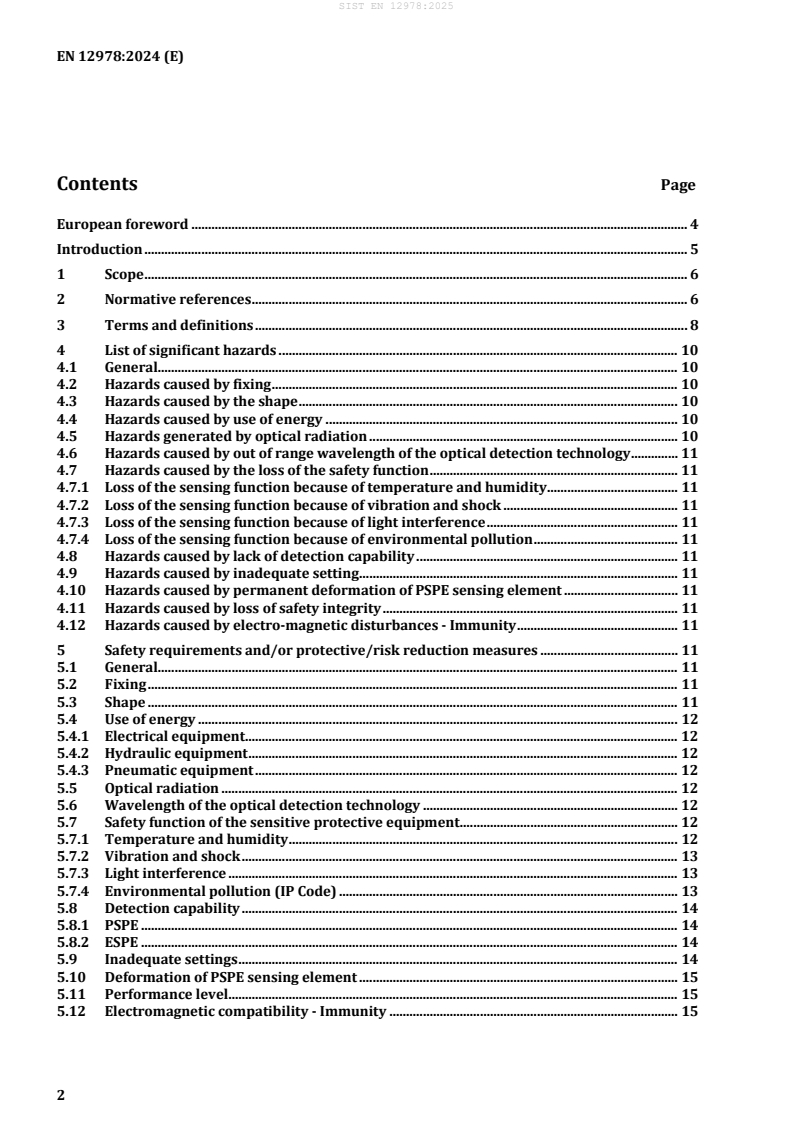
Contents Page
European foreword . 4
Introduction . 5
1 Scope . 6
2 Normative references . 6
3 Terms and definitions . 8
4 List of significant hazards . 10
4.1 General. 10
4.2 Hazards caused by fixing . 10
4.3 Hazards caused by the shape . 10
4.4 Hazards caused by use of energy . 10
4.5 Hazards generated by optical radiation . 10
4.6 Hazards caused by out of range wavelength of the optical detection technology . 11
4.7 Hazards caused by the loss of the safety function . 11
4.7.1 Loss of the sensing function because of temperature and humidity . 11
4.7.2 Loss of the sensing function because of vibration and shock . 11
4.7.3 Loss of the sensing function because of light interference . 11
4.7.4 Loss of the sensing function because of environmental pollution . 11
4.8 Hazards caused by lack of detection capability . 11
4.9 Hazards caused by inadequate setting . 11
4.10 Hazards caused by permanent deformation of PSPE sensing element . 11
4.11 Hazards caused by loss of safety integrity . 11
4.12 Hazards caused by electro-magnetic disturbances - Immunity . 11
5 Safety requirements and/or protective/risk reduction measures . 11
5.1 General. 11
5.2 Fixing . 11
5.3 Shape . 11
5.4 Use of energy . 12
5.4.1 Electrical equipment. 12
5.4.2 Hydraulic equipment . 12
5.4.3 Pneumatic equipment . 12
5.5 Optical radiation . 12
5.6 Wavelength of the optical detection technology . 12
5.7 Safety function of the sensitive protective equipment . 12
5.7.1 Temperature and humidity . 12
5.7.2 Vibration and shock . 13
5.7.3 Light interference . 13
5.7.4 Environmental pollution (IP Code) . 13
5.8 Detection capability . 14
5.8.1 PSPE . 14
5.8.2 ESPE . 14
5.9 Inadequate settings . 14
5.10 Deformation of PSPE sensing element . 15
5.11 Performance level . 15
5.12 Electromagnetic compatibility - Immunity . 15
6 Verification of the safety requirements and/or protective/risk reduction measures . 15
6.1 General . 15
6.2 Fixing . 15
6.3 Shape . 16
6.4 Use of energy . 16
6.4.1 Electrical equipment . 16
6.4.2 Hydraulic equipment . 16
6.4.3 Pneumatic equipment . 16
6.5 Optical radiation . 16
6.6 Wavelength of the optical detection technology . 16
6.7 Safety function of the protective equipment . 16
6.7.1 Temperature and humidity . 16
6.7.2 Vibration and shock . 17
6.7.3 Verification of light interference . 17
6.7.4 Verification of losing sensing function because of environmental pollution (IP Code). 17
6.8 Detection capability . 17
6.8.1 PSPE . 17
6.8.2 ESPE . 18
6.9 Verification of inadequate settings . 19
6.10 Verification of recovery of deformation of PSPE sensing element . 19
6.11 Verification of performance level . 19
6.12 Electromagnetic compatibility - Immunity . 20
7 Information for use . 20
7.1 General . 20
7.2 Instruction handbook . 20
7.3 Marking . 21
Annex A (normative) Test pieces . 22
Annex B (normative) Reflection test . 23
B.1 Testing of light curtains. 23
B.2 Reflection testing of light barriers . 24
Annex C (informative) Relationship between hazards, hazardous situations and hazardous
events covered by this document and relevant requirements and test methods subclauses
........................................................................................................................................................................... 26
Annex ZA (informative) Relationship between this European Standard and the essential
requirements of Directive 2006/42/EC aimed to be covered . 27
Bibliography . 29
European foreword
This document (EN 12978:2024) has been prepared by Technical Committee CEN/TC 33 “Doors,
windows, shutters, building hardware and curtain walling”, the secretariat of which is held by AFNOR.
This European Standard shall be given the status of a national standard, either by publication of an
identical text or by endorsement, at the latest by June 2025, and conflicting national standards shall be
withdrawn at the latest by June 2025.
Attention is drawn to the possibility that some of the elements of this document may be the subject of
patent rights. CEN shall not be held responsible for identifying any or all such patent rights.
This document supersedes EN 12978:2003+A1:2009.
Compared with EN 12978:2003+A1:2009, the following changes have been made:
a) revision according to the requirements of EN ISO 12100:2010 (safety of machines);
b) change of scope ensuring that only basic requirements of protective devices put separately on the
market are covered by this document; requirements for the safe function of the combination of
protective device and industrial, commercial and garage doors are given in EN 12453;
c) modification of the definition of test pieces and test procedures.
This document has been prepared under a standardization request addressed to CEN by the European
Commission. The Standing Committee of the EFTA States subsequently approves these requests for its
Member States.
For the relationship with EU Legislation, see informative Annex ZA, which is an integral part of this
document.
Any feedback and questions on this document should be directed to the users’ national standards body.
A complete listing of these bodies can be found on the CEN website.
According to the CEN-CENELEC Internal Regulations, the national standards organisations of the
following countries are bound to implement this European Standard: Austria, Belgium, Bulgaria, Croatia,
Cyprus, Czech Republic, Denmark, Estonia, Finland, France, Germany, Greece, Hungary, Iceland, Ireland,
Italy, Latvia, Lithuania, Luxembourg, Malta, Netherlands, Norway, Poland, Portugal, Republic of North
Macedonia, Romania, Serbia, Slovakia, Slovenia, Spain, Sweden, Switzerland, Türkiye and the United
Kingdom.
Introduction
This document is a type-C standard as stated in EN ISO 12100.
This document is of relevance, in particular, for the following stakeholder groups representing the market
players with regard to machinery safety:
— machine manufacturers (small, medium and large enterprises);
— health and safety bodies (regulators, accident prevention organizations, market surveillance etc.).
Others can be affected by the level of machinery safety achieved with the means of the document by the
above-mentioned stakeholder groups:
— machine users/employers (small, medium and large enterprises);
— machine users/employees (e.g. trade unions, organizations for people with special needs);
— service providers, e.g. for maintenance (small, medium and large enterprises);
— consumers (in case of machinery intended for use by consumers).
The above-mentioned stakeholder groups have been given the possibility to participate at the drafting
process of this document.
The machinery concerned and the extent to which hazards, hazardous situations or hazardous events are
covered are indicated in the Scope of this document.
When requirements of this type-C standard are different from those which are stated in type-A or type-B
standards, the requirements of this type-C standard take precedence over the requirements of the other
standards for machines that have been designed and built according to the requirements of this type-C
standard.
1 Scope
This document specifies requirements and test methods for sensitive protective equipment put
separately on the market as safety components to be used with entrance equipment such as power
operated industrial, commercial and garage doors, gates and barriers, power operated pedestrian doors
and power operated pedestrian entrance control equipment.
NOTE Requirements for the safe function of the combination of protective device and industrial, commercial
and garage doors and barriers are given in EN 12453.
This document deals with all significant hazards, hazardous situations and events relevant to the power
operation of doors, gates and barriers when they are used as intended and under conditions of misuse
which are reasonably foreseeable as identified in Clause 4.
All lifetime phases of the sensitive protective equipment including transportation, assembly, dismantling,
disabling and scrapping are considered by this document.
Whenever the term „door” is used in this document, it is deemed to cover the full scope of types and
variances of doors, gates, barriers and entrance control equipment listed in the scope of
EN 12453:2017+A1:2021, EN 16005:2023+A1:2024 and EN 17352:2022.
This document is not intended to be used for sensitive protective equipment using ultrasonic, radar,
capacitive, inductive, passive infrared and vision based technologies. For these types of equipment this
document can be used as a guide to demonstrate that such a device is allowed.
This document is not applicable to sensitive protective equipment manufactured before the date of its
publication.
2 Normative references
The following documents are referred to in the text in such a way that some or all of their content
constitutes requirements of this document. For dated references, only the edition cited applies. For
undated references, the latest edition of the referenced document (including any amendments) applies.
EN 12433-1:1999, Industrial, commercial and garage doors and gates — Terminology — Part 1: Types of
doors
EN 12433-2:1999, Industrial, commercial and garage doors and gates — Terminology — Part 2: Parts of
doors
EN 12453:2017+A1:2021, Industrial, commercial and garage doors and gates — Safety in use of power
operated doors — Requirements and test methods
EN 60068-2-6:2008, Environmental testing — Part 2-6: Tests — Test Fc: Vibration (sinusoidal) (IEC 60068-
2-6:2007)
EN 60068-2-14:2009, Environmental testing — Part 2-14: Tests — Test N: Change of temperature (IEC
60068-2-14:2009)
EN 60068-2-27:2009, Environmental testing — Part 2-27: Tests — Test Ea and guidance: Shock (IEC
60068-2-27:2008)
EN 60068-2-78:2013, Environmental testing — Part 2-78: Tests — Test Cab: Damp heat, steady state (IEC
60068-2-78:2012)
EN 60335-1:2012, Household and similar electrical appliances — Safety — Part 1: General requirements
(IEC 60335-1:2010, modified)
EN 60529:1991, Degrees of protection provided by enclosures (IP Code) (IEC 60529:1989)
EN 60825-1:2014, Safety of laser products — Part 1: Equipment classification and requirements
(IEC 60825-1:2014)
EN 62368-1:2014, Audio/video, information and communication technology equipment — Part 1: Safety
requirements (IEC 62368-1:2014, modified)
EN 62471:2008, Photobiological safety of lamps and lamp systems (IEC 62471:2006, modified)
EN IEC 60664-1:2020, Insulation coordination for equipment within low-voltage supply systems — Part 1:
Principles, requirements and tests (IEC 60664-1:2020)
EN IEC 61000-6-1:2019, Electromagnetic compatibility (EMC) — Part 6-1: Generic standards — Immunity
standard for residential, commercial and light-industrial environments (IEC 61000-6-1:2016)
EN IEC 61000-6-2:2019, Electromagnetic compatibility (EMC) — Part 6-2: Generic standards — Immunity
standard for industrial environments (IEC 61000-6-2:2016)
EN IEC 61496-1:2020, Safety of machinery — Electro-sensitive protective equipment — Part 1: General
requirements and tests (IEC 61496-1:2020)
EN IEC 61496-2:2020, Safety of machinery — Electro-sensitive protective equipment — Part 2: Particular
requirements for equipment using active opto-electronic protective devices (AOPDs) (IEC 61496-2:2020)
EN IEC 61496-3:2019, Safety of machinery — Electro-sensitive protective equipment — Part 3: Particular
requirements for active opto-electronic protective devices responsive to diffuse reflection (AOPDDR)
(IEC 61496-3:2018)
EN ISO 4413:2010, Hydraulic fluid power — General rules and safety requirements for systems and their
components (ISO 4413:2010)
EN ISO 4414:2010, Pneumatic fluid power — General rules and safety requirements for systems and their
components (ISO 4414:2010)
EN ISO 12100:2010, Safety of machinery — General principles for design — Risk assessment and risk
reduction (ISO 12100:2010)
EN ISO 13849-1:2023, Safety of machinery — Safety-related parts of control systems — Part 1: General
principles for design (ISO 13849-1:2023)
As impacted by EN 60335-1:2012/AC:2014, EN 60335-1:2012/A1:2019, EN 60335-1:2012/A2:2019,
EN 60335-1:2012/A11:2014, EN 60335-1:2012/A13:2017, EN 60335-1:2012/A14:2019 and EN 60335-
1:2012/A15:2021.
As impacted by EN 60529:1991/A1:2000, EN 60529:1991/A2:2013, EN 60529:1991/A2:2013/AC:2019-02 and
EN 60529:1991/AC:2016-12.
As impacted by EN 60825-1:2014/AC:2017-06, EN 60825-1:2014/A11:2021 and
EN 60825-1:2014/A11:2021/AC:2022-03.
As impacted by EN 62368-1:2014/AC:2015-02, EN 62368 1:2014/AC:2015-05, EN 62368-1:2014/AC:2015-11,
EN 62368-1:2014/AC:2017-03 and EN 62368-1:2014/A11:2017.
As impacted by EN 60664-1:2020/AC:2020-12.
EN ISO 13849-2:2012, Safety of machinery — Safety-related parts of control systems — Part 2: Validation
(ISO 13849-2:2012)
EN ISO 13856-1:2013, Safety of machinery — Pressure-sensitive protective devices — Part 1: General
principles for design and testing of pressure-sensitive mats and pressure-sensitive floors (ISO 13856-1:2013)
EN ISO 13856-2:2013, Safety of machinery — Pressure-sensitive protective devices — Part 2: General
principles for design and testing of pressure-sensitive edges and pressure-sensitive bars (ISO 13856-2:2013)
EN ISO 13856-3:2013, Safety of machinery — Pressure-sensitive protective devices — Part 3: General
principles for design and testing of pressure-sensitive bumpers, plates, wires and similar devices
(ISO 13856-3:2013)
3 Terms and definitions
For the purposes of this document, the terms and definitions given in EN 12433-1:1999,
EN 12433-2:1999, EN 12453:2017+A1:2021, EN ISO 12100:2010 and the following apply.
ISO and IEC maintain terminology databases for use in standardization at the following addresses:
— ISO Online browsing platform: available at https://www.iso.org/obp/ui
— IEC Electropedia: available at https://www.electropedia.org/
3.1
active opto-electronic protective device
AOPD
device whose sensing function is performed by opto-electronic emitting and receiving elements detecting
the interruption of optical radiations generated within the device, by an opaque object present in the
specified detection zone
[SOURCE: EN ISO 12100:2010, 3.28.6, modified: NOTE deleted]
3.2
active opto-electronic protective device responsive to diffuse reflection
AOPDDR
device, whose sensing function is performed by opto-electronic emitting and receiving elements, that
detects the diffuse reflection of optical radiations generated within the device by an object present in a
detection zone specified in two or three dimensions
[SOURCE: EN IEC 61496-3:2019, 3.301, modified: Note 1 to entry and Note 2 to entry deleted]
3.3
light barrier
AOPD comprising one emitting element and one corresponding receiving element forming a single
detection line
Note 1 to entry: Systems with multiple pairs of emitting and receiving elements, are considered as multiple
independent light barriers, if:
— they are not part of an integrated assembly, or
— they have less than three emitting and less than three receiving elements, which can be part of an
integrated assembly.
3.4
light curtain
AOPD comprising an integrated assembly of three or more emitting element(s) and three or more
receiving element(s) forming a detection zone with a specified detection capability specified by the
supplier
3.5
sensitive protective equipment
SPE
equipment for detecting persons or parts of persons which generates an appropriate signal to the control
system to reduce risk to the persons detected
[SOURCE: EN ISO 12100:2010, 3.28.5, modified: NOTE deleted]
3.6
electro-sensitive protective equipment
ESPE
sensitive protective equipment (SPE) consisting of a non-mechanically actuated assembly of devices
and/or components working together for presence sensing purposes and comprising as a minimum:
— a non-mechanical sensing device and
— controlling/monitoring devices and
— output signal switching devices (OSSD) and/or a safety-related data interface
[SOURCE: EN IEC 61496-1:2020, 3.5, modified: NOTE deleted]
3.7
pressure-sensitive protective equipment
PSPE
sensitive protective equipment (SPE) of the „mechanically activated trip” type intended to detect the
touch of a person or body part of a person and comprising as a minimum:
— a sensing device and
— controlling/monitoring devices and
— output signal switching devices (OSSD) and/or a safety-related data interface
Note 1 to entry: PSPE can be mats and floors (see EN ISO 13856-1:2013) or pressure sensitive edges or pressure
sensitive bars (see EN ISO 13856-2:2013) or pressure-sensitive bumpers, plates, wires and similar devices (see
EN ISO 13856-3:2013).
3.8
output signal switching device
OSSD
component of the SPE connected to the machine control system which, when the sensing device is
actuated during normal operation, responds by going to the OFF-state
[SOURCE: EN IEC 61496-1:2020, 3.19]
3.9
OFF-state
state of the output(s) of the SPE which indicates a hazardous situation to the machine
3.10
blanking
optional function that permits an object of a size greater than the detection capability of the ESPE to be
located within the detection zone without causing an OFF-state of the OSSD(s)
Note 1 to entry: Fixed blanking is a technique wherein the locations of the blanked areas of the detection zone do
not change during operation. The detection capability of the other parts of the detection zone remains unchanged.
Note 2 to entry: Floating blanking is a technique wherein the blanked area of the detection zone follows the location
of a moving object(s) during operation. The detection capability of the other areas remains unchanged.
[SOURCE: EN IEC 61496-1:2020, 3.1]
3.11
safety extra-low voltage
voltage not exceeding 42 V between conductors and between conductors and earth, the no load voltage
not exceeding 50 V. When safety extra-low voltage is obtained from the supply mains, it is to be through
a safety isolating transformer or a convertor with separate windings, the insulation of which complies
with double insulation or reinforced insulation requirements
[SOURCE: EN 60335-1:2012, 3.4.2]
4 List of significant hazards
4.1 General
This clause contains all the hazards, hazardous situations and events identified by risk assessment as
significant for this type of machinery and which require action to eliminate or reduce the risk.
Annex C is giving the relationship between the hazards listed in this clause, the safety requirements
and/or protective/risk reduction measures given in Clause 5 and the verification methods described in
Clause 6.
4.2 Hazards caused by fixing
Inadequate fixing of the protective equipment or parts of it can impair the protective function or cause
hazards because of falling objects.
4.3 Hazards caused by the shape
Shape of the protective equipment or parts of it can cause cutting hazards.
4.4 Hazards caused by use of energy
Use of energy for the powered operation of the protective equipment can lead to hazards. This includes
electrical, hydraulic and pneumatic energy.
4.5 Hazards generated by optical radiation
Photobiological hazards can arise from the radiation intensity of light waves (e.g. laser beams, LED).
4.6 Hazards caused by out of range wavelength of the optical detection technology
Hazardous operation can arise from use of a wavelength outside the specified range.
4.7 Hazards caused by the loss of the safety function
4.7.1 Loss of the sensing function because of temperature and humidity
Temperature and humidity can impair the proper functioning of the protective equipment.
4.7.2 Loss of the sensing function because
...