

EN 12139:1999
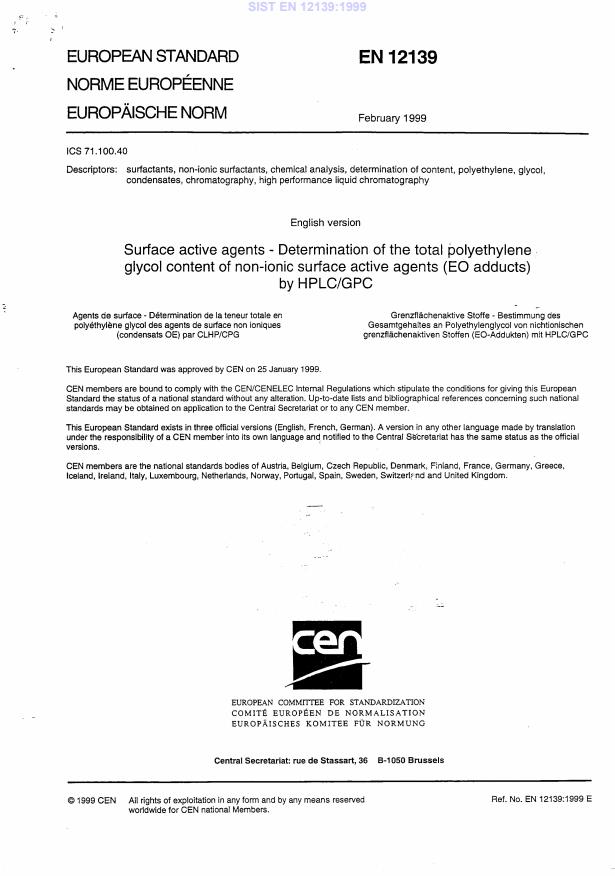
(Main)Surface active agents - Determination of the total polyethylene glycol content of non-ionic surface active agents (EO adducts) by HPLC/GPC
- Abstract
This European Standard specifies a method for the determination of the total polyethylene glycol (PEG) content of aromatic and aliphatic non-ionic surface active agents of the type R - (O - C2H4)p - OH, where p is the mean ethylene oxide (EO) value. It applies for concentrations of PEG higher than approximately 0,1 g/100 g of the laboratory sample.
- Status
- Published
- Publication Date
- 16-Feb-1999
- Withdrawal Date
- 30-Aug-1999
- Technical Committee
- CEN/TC 276 - Surface active agents
- Drafting Committee
- CEN/TC 276/WG 1 - Methods of analysis
- Current Stage
- 9093 - Decision to confirm - Review Enquiry
- Start Date
- 31-Oct-2024
- Completion Date
- 14-Oct-2026

Overview
EN 12139:1999 is a CEN European Standard that defines an analytical method for the determination of total polyethylene glycol (PEG) content in non‑ionic surface active agents (EO adducts) using HPLC/GPC (High‑Performance Liquid Chromatography / Gel Permeation Chromatography). The standard covers aromatic and aliphatic non‑ionic surfactants of the general type R‑(O‑C2H4)p‑OH, where p is the mean ethylene oxide (EO) value. It applies to laboratory samples with PEG concentrations greater than approximately 0.1 g/100 g.
Key topics and technical requirements
- Scope and applicability
- Targets non‑ionic surface active agents (EO adducts) - both aromatic and aliphatic types.
- Minimum detectable/quantifiable PEG content: around 0.1 g/100 g of sample.
- Analytical technique
- Method uses HPLC/GPC for separation and quantification of PEG fractions.
- Focuses on measuring total polyethylene glycol (PEG) rather than individual oligomers.
- Sample type and form
- Applies to liquid or solid laboratory samples of non‑ionic surfactants formulated as R‑(O‑C2H4)p‑OH.
- Reporting and interpretation
- Results are intended for quality control and specification compliance; reporting conventions follow standard analytical practice (chromatographic separation, integration, calibration).
- Standards context
- This is a CEN (European) normative document and aligns with ICS classification for surface active agents.
Applications and users
- Quality control laboratories in surfactant, detergent, cosmetic, and chemical manufacturing - for batch release and supplier verification.
- Formulation chemists who need to control PEG content in non‑ionic surfactants to achieve consistent performance in detergents, emulsifiers, and personal care products.
- Regulatory and compliance teams assessing ingredient composition against labels, safety data sheets, or regional requirements.
- Raw material suppliers verifying the EO (ethylene oxide) adduct composition and PEG levels before shipment.
- Analytical service providers offering chromatographic analysis (HPLC/GPC) for industrial clients.
Related standards
- Other CEN/ISO standards and national methods covering surfactant characterization, EO adduct analysis, or chromatographic determination of polymeric impurities are commonly used alongside EN 12139:1999 for comprehensive quality assessment.
Keywords: EN 12139:1999, surface active agents, non‑ionic surfactants, EO adducts, polyethylene glycol (PEG), HPLC/GPC, chromatographic determination, PEG content, quality control.
Relations
- Effective Date
- 25-Aug-2026
- Effective Date
- 25-Aug-2026
- Effective Date
- 09-Feb-2026
- Effective Date
- 28-Jan-2026
- Effective Date
- 28-Jan-2026
- Effective Date
- 28-Jan-2026
- Effective Date
- 09-Feb-2026
Get Certified
Connect with accredited certification bodies for this standard

ECOCERT
Organic and sustainability certification.

Eurofins Food Testing Global
Global leader in food, environment, and pharmaceutical product testing.

Intertek Bangladesh
Intertek certification and testing services in Bangladesh.
Sponsored listings
Frequently Asked Questions
EN 12139:1999 is a standard published by the European Committee for Standardization (CEN). Its full title is "Surface active agents - Determination of the total polyethylene glycol content of non-ionic surface active agents (EO adducts) by HPLC/GPC". This standard covers: This European Standard specifies a method for the determination of the total polyethylene glycol (PEG) content of aromatic and aliphatic non-ionic surface active agents of the type R - (O - C2H4)p - OH, where p is the mean ethylene oxide (EO) value. It applies for concentrations of PEG higher than approximately 0,1 g/100 g of the laboratory sample.
This European Standard specifies a method for the determination of the total polyethylene glycol (PEG) content of aromatic and aliphatic non-ionic surface active agents of the type R - (O - C2H4)p - OH, where p is the mean ethylene oxide (EO) value. It applies for concentrations of PEG higher than approximately 0,1 g/100 g of the laboratory sample.
EN 12139:1999 is classified under the following ICS (International Classification for Standards) categories: 71.100.40 - Surface active agents. The ICS classification helps identify the subject area and facilitates finding related standards.
EN 12139:1999 has the following relationships with other standards: It is inter standard links to ISO 607:1980, ISO 6353-3:1987, ISO 6353-2:1983, EN 14344:2004, EN ISO 3696:1995, EN 14960:2006, EN IEC 62705:2026. Understanding these relationships helps ensure you are using the most current and applicable version of the standard.
EN 12139:1999 is available in PDF format for immediate download after purchase. The document can be added to your cart and obtained through the secure checkout process. Digital delivery ensures instant access to the complete standard document.
Standards Content (Sample)
2003-01.Slovenski inštitut za standardizacijo. Razmnoževanje celote ali delov tega standarda ni dovoljeno.Grenzflächenaktive Stoffe - Bestimmung des Gesamtgehaltes an Polyethylenglycol von nichtionischen grenzflächenaktiven Stoffen (EO-Addukten) mit HPLC/GPCAgents de surface - Détermination de la teneur totale en polyéthylene glycol des agents de surface non ioniques (condensats OE) par CLHP/CPGSurface active agents - Determination of the total polyethylene glycol content of non-ionic surface active agents
...