

EN 3740:2026
(Main)Aerospace series - Bolts, shouldered, thin hexagonal head, close tolerance shank, short thread, in titanium alloy, anodized, MoS2 coated - Classification: 1 100 MPa (at ambient temperature)/315 °C
- Abstract
This document specifies the characteristics of bolts, shouldered, thin hexagonal head, close tolerance shank, short thread, in titanium alloy, anodized, MoS2 dryfilm coated, for aerospace applications.
Classification: 1 100 MPa1/315 °C2..
- Status
- Published
- Publication Date
- 01-Sep-2026
- Technical Committee
- ASD-STAN - Aerospace
- Drafting Committee
- ASD-STAN/D 3/S 2 - Fasteners
- Current Stage
- 6060 - Definitive text made available (DAV) - Publishing
- Start Date
- 02-Sep-2026
- Completion Date
- 02-Sep-2026
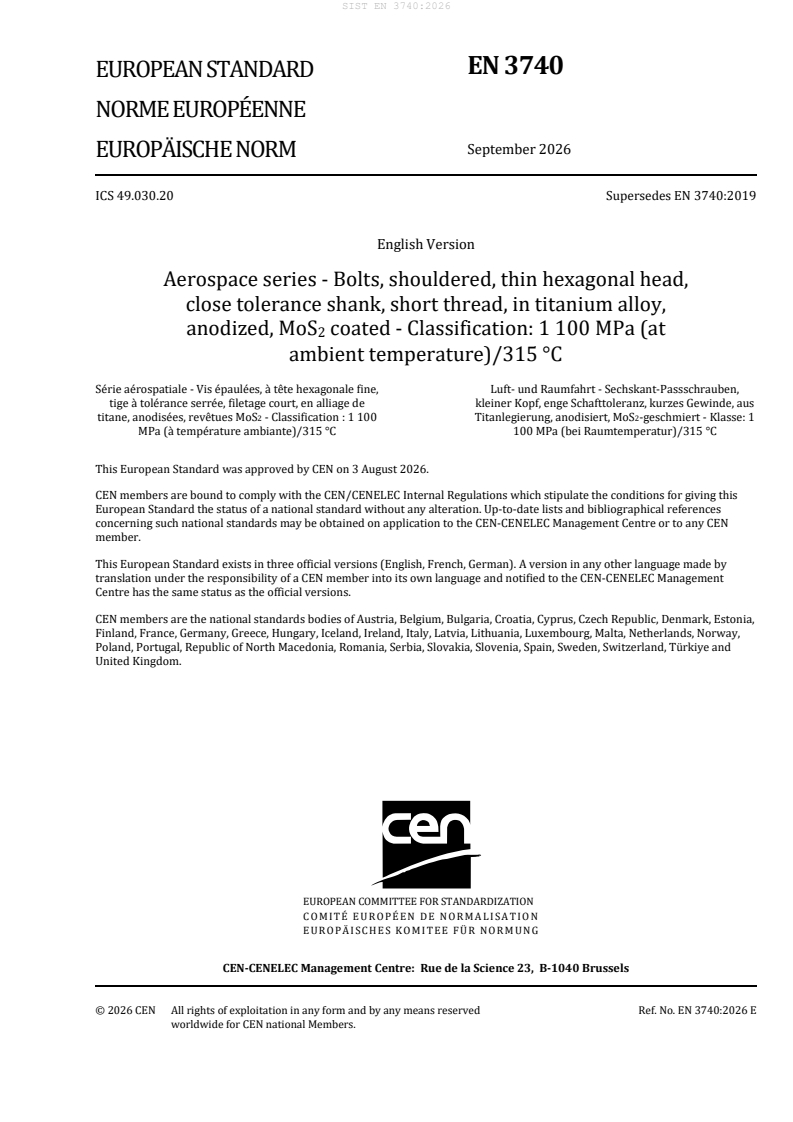

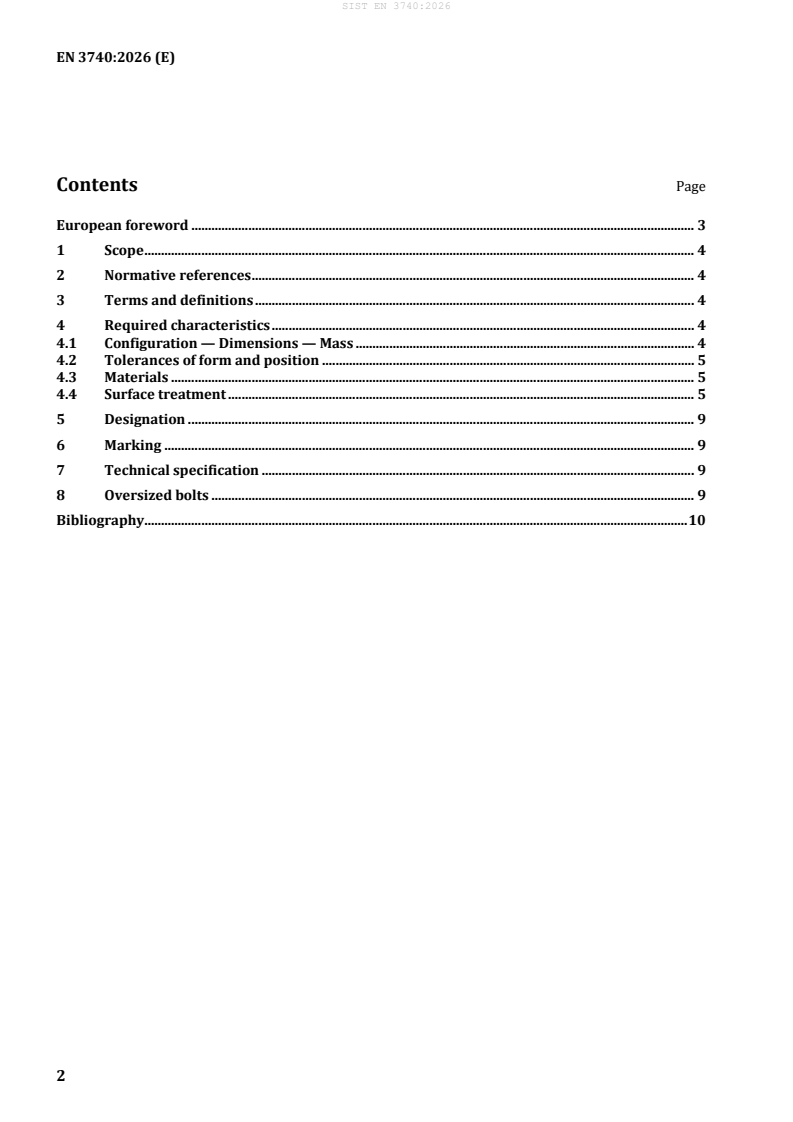
EN 3740:2026 is a CEN European Standard for aerospace bolts with a shouldered, thin hexagonal head, close tolerance shank, short thread, made in titanium alloy and anodized with Molybdenum disulphide (MoS2) dryfilm coating. It specifies the characteristics of these fasteners for aerospace applications, including the classification 1 100 MPa at ambient temperature and 315 °C, so designers, buyers, manufacturers and inspectors can use the same product definition.
What does EN 3740:2026 specify?
EN 3740:2026 specifies the characteristics of the bolt type named in the title and scope, for aerospace applications. It brings the geometry, material, coating, marking and procurement-related requirements into one document so the fastener can be specified and checked in the same way across suppliers.
The document is organized into clauses on scope, normative references, terms and definitions, required characteristics, designation, marking, technical specification and oversized bolts. Clause 4 is the main technical section, supported by Figures 1 and 2 and Table 1 for configuration and dimensions.
What are the key requirements of EN 3740:2026?
EN 3740:2026 sets out the bolt configuration, material, surface treatment and identification rules that control how the part is made and ordered. In practice, these requirements matter because they affect fit, strength, friction, traceability and qualification.
Configuration, dimensions and tolerances
Clause 4.1 requires the configuration to follow Figures 1 and 2 and Table 1, with dimensions and tolerances expressed in millimetres. The dimensions apply after anodizing and MoS dryfilm coating, which means the finished coated bolt is the reference for fit and inspection.
Clause 4.2 requires tolerances of form and position to comply with ISO 7913. For a reader, that means the shank and head geometry must stay within aerospace location and shape limits, not just size limits.
Materials and surface treatment
Clause 4.3 requires materials in accordance with TR 3775 for titanium alloy at strength class 1 100 MPa. This links the bolt to the specified aerospace material family and strength level.
Clause 4.4 requires the coating to be in accordance with TR 4070 and the application to be in accordance with EN 2491, with a thickness of 5 µm to 10 µm. The bolt head may be with or without coating, sharp edges are to be broken to 0.1 to 0.4, and surface roughness requirements apply before coating. In practice, this controls friction, assembly behaviour and surface quality before the final dryfilm is applied.
Designation, marking and procurement
Clause 5 gives the designation format, using the diameter code, length code and coating code. The example designation shows how the standard is intended to be used in orders and product lists, so the buyer can identify the exact variant without ambiguity.
Clause 6 requires marking in accordance with Figure 2 and EN 2424, style C plus “MJ”. That supports traceability on the part itself and ties the bolt to the MJ thread system.
Clause 7 states that the technical specification follows ISO 9152, with added requirements for approved production organization, a quality management system such as EN 9100 or an equivalent aerospace accepted and established system, and qualification using a procedure such as EN 9133 or an equivalent. It also requires mechanical testing on travellers, meaning finished parts with an undrilled, massive shank, so the test piece reflects the real bolt form.
Clause 8 directs oversized bolts to EN 4016. That matters when a design needs an oversized fastener rather than the standard size range.
What terms does EN 3740:2026 define?
EN 3740:2026 does not list formal definitions, but it uses several key terms that matter for using the standard correctly.
- MJ threads - the metric aerospace thread form used for these bolts, with limit dimensions taken from ISO 5855-2.
- Close tolerance shank - a shank held to a tight diameter tolerance so the bolt fits accurately in the joint.
- Travellers - finished parts with an undrilled, massive shank used for mechanical testing.
- MoS2 dryfilm coating - a molybdenum disulphide coating applied to control friction and surface behaviour.
- EN 9100 - the aerospace quality management system example cited for approved production organizations.
- EN 9133 - the qualification procedure example cited for aerospace standard products.
Who uses EN 3740:2026?
EN 3740:2026 is used by aerospace fastener manufacturers, procurement teams, quality managers, inspectors and test laboratories. Designers and buyers use it to specify the bolt type, size, coating and marking. Manufacturers use it for production and surface treatment, while labs and inspectors use it for qualification and mechanical testing.
What changed in EN 3740:2026 from the previous edition?
EN 3740:2026 supersedes EN 3740:2019. The significant technical change stated in the foreword is that clause 4.4 no longer restricts coating to code G or code J, and the document has also been editorially revised.
Which standards are used with EN 3740:2026?
The document relies on these referenced standards and related documents:
| Document | What it contributes |
|---|---|
| EN 2424 | Marking of aerospace products |
| EN 2491 | MoS2 dry lubricant coating methods |
| EN 4016 | Oversized bolts |
| ISO 3353-1 | Lead and runout threads for rolled external threads |
| ISO 5855-2 | MJ thread limit dimensions for bolts and nuts |
| ISO 7913 | Tolerances of form and position |
| ISO 9152 | Procurement specification for titanium alloy MJ bolts, strength class 1 100 MPa |
| TR 3775 | Materials for aerospace bolts and pins |
| TR 4070 | List of commercial MoS2 coating products |
Clause 7 also refers to EN 9100 and EN 9133 as examples for quality management and qualification practice.
What does the EN 3740:2026 document contain?
EN 3740:2026 contains configuration figures, a dimensional and mass table, designation rules, marking requirements and procurement-related technical specification clauses. Table 1 provides the size range and mass data for the listed diameter codes, which supports selection and interchangeability.
Figures 1 and 2 show the bolt configuration for different diameter-code groups, including the location of the thread and marking. Clause 4 also gives the surface treatment rules and the dimensional note that the values apply after anodizing and MoS dryfilm coating.
Clause 5 gives the order designation format, and clause 6 gives the marking basis. Clause 7 adds approval, qualification and mechanical-testing expectations for practical procurement and verification.
Relations
- Effective Date
- 20-Nov-2024
Get Certified
Connect with accredited certification bodies for this standard

BUREAU VERITAS Certification Germany
Bureau Veritas certification in Germany.

Element Materials Technology
Materials testing and product certification.

AQMS Ltd.
AQMS provides ISO certification to SMEs across the UK.
Sponsored listings
Frequently Asked Questions
EN 3740:2026 is a standard published by the European Committee for Standardization (CEN). Its full title is "Aerospace series - Bolts, shouldered, thin hexagonal head, close tolerance shank, short thread, in titanium alloy, anodized, MoS2 coated - Classification: 1 100 MPa (at ambient temperature)/315 °C". This standard covers: This document specifies the characteristics of bolts, shouldered, thin hexagonal head, close tolerance shank, short thread, in titanium alloy, anodized, MoS2 dryfilm coated, for aerospace applications. Classification: 1 100 MPa1/315 °C2..
This document specifies the characteristics of bolts, shouldered, thin hexagonal head, close tolerance shank, short thread, in titanium alloy, anodized, MoS2 dryfilm coated, for aerospace applications. Classification: 1 100 MPa1/315 °C2..
EN 3740:2026 is classified under the following ICS (International Classification for Standards) categories: 49.030.20 - Bolts, screws, studs. The ICS classification helps identify the subject area and facilitates finding related standards.
EN 3740:2026 has the following relationships with other standards: It is inter standard links to EN 3740:2019. Understanding these relationships helps ensure you are using the most current and applicable version of the standard.
EN 3740:2026 is available in PDF format for immediate download after purchase. The document can be added to your cart and obtained through the secure checkout process. Digital delivery ensures instant access to the complete standard document.
Standards Content (Sample)
SLOVENSKI STANDARD
01-november-2026
Aeronavtika - Sorniki, vezi, tanka šesterokotna glava, ozka toleranca, kratek navoj,
iz titanove zlitine, anodizirani, mazani z MoS2 - Klasifikacija: 1100 MPa (pri
temperaturi okolice)/315 °C
Aerospace series - Bolts, shouldered, thin hexagonal head, close tolerance shank, short
thread, in titanium alloy, anodized, MoS2 coated - Classification: 1 100 MPa (at ambient
temperature)/315 °C
Luft- und Raumfahrt - Sechskant-Passschrauben, kleiner Kopf, enge Schafttoleranz,
kurzes Gewinde, aus Titanlegierung, anodisiert, MoS2‑geschmiert - Klasse: 1 100 MPa
(bei Raumtemperatur)/315 °C
Série aérospatiale - Vis épaulées, à tête hexagonale fine, tige à tolérance serrée, filetage
court, en alliage de titane, anodisées, revêtues MoS2 - Classification: 1 100 MPa (à
température ambiante)/315 °C
Ta slovenski standard je istoveten z: EN 3740:2026
ICS:
49.025.30 Titan Titanium
49.030.20 Sorniki, vijaki, stebelni vijaki Bolts, screws, studs
2003-01.Slovenski inštitut za standardizacijo. Razmnoževanje celote ali delov tega standarda ni dovoljeno.
EN 3740
EUROPEAN STANDARD
NORME EUROPÉENNE
September 2026
EUROPÄISCHE NORM
ICS 49.030.20 Supersedes EN 3740:2019
English Version
Aerospace series - Bolts, shouldered, thin hexagonal head,
close tolerance shank, short thread, in titanium alloy,
anodized, MoS coated - Classification: 1 100 MPa (at
ambient temperature)/315 °C
Série aérospatiale - Vis épaulées, à tête hexagonale fine, Luft- und Raumfahrt - Sechskant-Passschrauben,
tige à tolérance serrée, filetage court, en alliage de kleiner Kopf, enge Schafttoleranz, kurzes Gewinde, aus
titane, anodisées, revêtues MoS - Classification : 1 100 Titanlegierung, anodisiert, MoS -geschmiert - Klasse: 1
2 2
MPa (à température ambiante)/315 °C 100 MPa (bei Raumtemperatur)/315 °C
This European Standard was approved by CEN on 3 August 2026.
CEN members are bound to comply with the CEN/CENELEC Internal Regulations which stipulate the conditions for giving this
European Standard the status of a national standard without any alteration. Up-to-date lists and bibliographical references
concerning such national standards may be obtained on application to the CEN-CENELEC Management Centre or to any CEN
member.
This European Standard exists in three official versions (English, French, German). A version in any other language made by
translation under the responsibility of a CEN member into its own language and notified to the CEN-CENELEC Management
Centre has the same status as the official versions.
CEN members are the national standards bodies of Austria, Belgium, Bulgaria, Croatia, Cyprus, Czech Republic, Denmark, Estonia,
Finland, France, Germany, Greece, Hungary, Iceland, Ireland, Italy, Latvia, Lithuania, Luxembourg, Malta, Netherlands, Norway,
Poland, Portugal, Republic of North Macedonia, Romania, Serbia, Slovakia, Slovenia, Spain, Sweden, Switzerland, Türkiye and
United Kingdom.
EUROPEAN COMMITTEE FOR STANDARDIZATION
COMITÉ EUROPÉEN DE NORMALISATIO N
EUROPÄISCHES KOMITEE FÜR NORMUN G
CEN-CENELEC Management Centre: Rue de la Science 23, B-1040 Brussels
© 2026 CEN All rights of exploitation in any form and by any means reserved Ref. No. EN 3740:2026 E
worldwide for CEN national Members.
Contents Page
European foreword . 3
1 Scope . 4
2 Normative references . 4
3 Terms and definitions . 4
4 Required characteristics . 4
4.1 Configuration — Dimensions — Mass . 4
4.2 Tolerances of form and position . 5
4.3 Materials . 5
4.4 Surface treatment . 5
5 Designation . 9
6 Marking . 9
7 Technical specification . 9
8 Oversized bolts . 9
Bibliography. 10
European foreword
This document (EN 3740:2026) has been prepared by ASD-STAN.
After enquiries and votes carried out in accordance with the rules of this Association, this document has
received the approval of the National Associations and the Official Services of the member countries of
ASD-STAN, prior to its presentation to CEN.
This European Standard shall be given the status of a national standard, either by publication of an
identical text or by endorsement, at the latest by March 2027, and conflicting national standards shall be
withdrawn at the latest by March 2027.
Attention is drawn to the possibility that some of the elements of this document may be the subject of
patent rights. CEN shall not be held responsible for identifying any or all such patent rights.
This document supersedes EN 3740:2019.
This document includes the following significant technical changes with respect to EN 3740:2019:
— 4.4 “Surface treatment”, restrictions for coating (“code G or code J”) deleted;
— document editorially revised.
Any feedback and questions on this document should be directed to the users’ national standards body.
A complete listing of these bodies can be found on the CEN website.
According to the CEN-CENELEC Internal Regulations, the national standards organizations of the
following countries are bound to implement this European Standard: Austria, Belgium, Bulgaria, Croatia,
Cyprus, Czech Republic, Denmark, Estonia, Finland, France, Germany, Greece, Hungary, Iceland, Ireland,
Italy, Latvia, Lithuania, Luxembourg, Malta, Netherlands, Norway, Poland, Portugal, Republic of Nort
...