

EN ISO 24442:2022
(Main)Cosmetics - Sun protection test methods - In vivo determination of sunscreen UVA protection (ISO 24442:2022, Corrected version 2024-10)
- Abstract
This document specifies a method for the in vivo determination of UVA protection factor (UVAPF) of sunscreen products. It is applicable to products that contain any component able to absorb, reflect or scatter ultraviolet (UV) rays and which are intended to be placed in contact with human skin.
This document provides a basis for the evaluation of sunscreen products for the protection of human skin against UVA radiation induced by solar ultraviolet rays.
- Status
- Published
- Publication Date
- 21-Jun-2022
- Withdrawal Date
- 30-Dec-2022
- Technical Committee
- CEN/TC 392 - Cosmetics
- Drafting Committee
- CEN/TC 392 - Cosmetics
- Current Stage
- 6060 - Definitive text made available (DAV) - Publishing
- Start Date
- 22-Jun-2022
- Completion Date
- 22-Jun-2022


Overview
EN ISO 24442:2022 (Corrected version 2024-10) - "Cosmetics - Sun protection test methods - In vivo determination of sunscreen UVA protection" - is a CEN-endorsed international standard that specifies an in vivo method to determine the UVA protection factor (UVAPF) of sunscreen products. It applies to cosmetic products containing components that absorb, reflect or scatter ultraviolet (UV) rays and intended for contact with human skin. The standard provides a quantitative basis for evaluating sunscreen performance against UVA radiation from solar ultraviolet rays.
Key topics and technical requirements
The standard defines procedural and technical elements required for reliable in vivo UVA testing:
- Test subjects: selection criteria, skin colour typing, age restrictions, ethics/consent and limits on repeat participation.
- Apparatus and UV source: requirements for UV solar simulators, beam uniformity, spectral quality and radiometric/spectroradiometric monitoring.
- Reference materials: use of reference sunscreen formulations and standard controls for calibration and comparison.
- Test procedure: site preparation, product application (amount, mode of delivery, uniformity), drying time, exposure sub-sites and incremental UV dosing.
- Response assessment: methods for measuring minimal persistent pigment darkening doses (MPPDD), grading scales, timing of assessments and rejection/test-failure criteria.
- Calculation and statistics: computation of individual and product UVAPF, statistical criteria for validation and reporting requirements.
- Quality assurance: maintenance and monitoring of the solar simulator output and data validation procedures.
Applications and practical value
EN ISO 24442 is used to:
- Quantify UVA protection claims on sunscreen labels.
- Support product development by comparing UVA performance across formulations and delivery systems.
- Provide objective evidence for regulatory compliance, marketing claims and safety/risk assessments.
- Calibrate and validate laboratory UV solar simulators and test procedures.
Practical benefits include reproducible comparison of products, standardized reporting formats, and alignment with regulatory expectations for sun protection cosmetics.
Who should use this standard
- Cosmetic formulators and R&D teams developing sunscreen products.
- Independent testing laboratories and clinical research organizations conducting in vivo sun protection tests.
- Regulatory affairs professionals verifying product claims and compliance.
- Quality assurance teams responsible for test method validation and equipment calibration.
Related standards
- Works alongside other sun protection standards (for example, in vivo SPF testing methods) to provide a complete assessment of UVB and UVA protection. Users often pair EN ISO 24442 with SPF test standards for comprehensive sun protection evaluation.
Keywords: EN ISO 24442:2022, UVAPF, UVA protection, in vivo determination, sunscreen testing, sun protection test methods, cosmetic sunscreen, UV solar simulator.
Relations
- Effective Date
- 29-Jun-2022
- Effective Date
- 25-Aug-2026
- Effective Date
- 28-Jan-2026
- Consolidated By
ISO 24442:2022 - Cosmetics — Sun protection test methods — In vivo determination of sunscreen UVA protection - Effective Date
- 12-Feb-2026
Get Certified
Connect with accredited certification bodies for this standard

ECOCERT
Organic and sustainability certification.

Eurofins Food Testing Global
Global leader in food, environment, and pharmaceutical product testing.

Intertek Bangladesh
Intertek certification and testing services in Bangladesh.
Sponsored listings
Frequently Asked Questions
EN ISO 24442:2022 is a standard published by the European Committee for Standardization (CEN). Its full title is "Cosmetics - Sun protection test methods - In vivo determination of sunscreen UVA protection (ISO 24442:2022, Corrected version 2024-10)". This standard covers: This document specifies a method for the in vivo determination of UVA protection factor (UVAPF) of sunscreen products. It is applicable to products that contain any component able to absorb, reflect or scatter ultraviolet (UV) rays and which are intended to be placed in contact with human skin. This document provides a basis for the evaluation of sunscreen products for the protection of human skin against UVA radiation induced by solar ultraviolet rays.
This document specifies a method for the in vivo determination of UVA protection factor (UVAPF) of sunscreen products. It is applicable to products that contain any component able to absorb, reflect or scatter ultraviolet (UV) rays and which are intended to be placed in contact with human skin. This document provides a basis for the evaluation of sunscreen products for the protection of human skin against UVA radiation induced by solar ultraviolet rays.
EN ISO 24442:2022 is classified under the following ICS (International Classification for Standards) categories: 71.100.70 - Cosmetics. Toiletries. The ICS classification helps identify the subject area and facilitates finding related standards.
EN ISO 24442:2022 has the following relationships with other standards: It is inter standard links to EN ISO 24442:2011, ISO 24444:2019, prEN 12489, ISO 24442:2022. Understanding these relationships helps ensure you are using the most current and applicable version of the standard.
EN ISO 24442:2022 is available in PDF format for immediate download after purchase. The document can be added to your cart and obtained through the secure checkout process. Digital delivery ensures instant access to the complete standard document.
Standards Content (Sample)
SLOVENSKI STANDARD
01-september-2022
Nadomešča:
SIST EN ISO 24442:2012
Kozmetika - Metode za preskušanje zaščite pred soncem - Določevanje zaščitnega
faktorja UVA in vivo (ISO 24442:2022)
Cosmetics - Sun protection test methods - In vivo determination of sunscreen UVA
protection (ISO 24442:2022)
Kosmetik - Prüfverfahren für Sonnenschutzmittel - In-vivo-Bestimmung des UVA-
Sonnenschutzes (ISO 24442:2022)
Cosmétiques - Méthodes d’essai de protection solaire - Détermination in vivo de la
protection UVA d’un produit de protection solaire (ISO 24442:2022)
Ta slovenski standard je istoveten z: EN ISO 24442:2022
ICS:
71.100.70 Kozmetika. Toaletni Cosmetics. Toiletries
pripomočki
2003-01.Slovenski inštitut za standardizacijo. Razmnoževanje celote ali delov tega standarda ni dovoljeno.
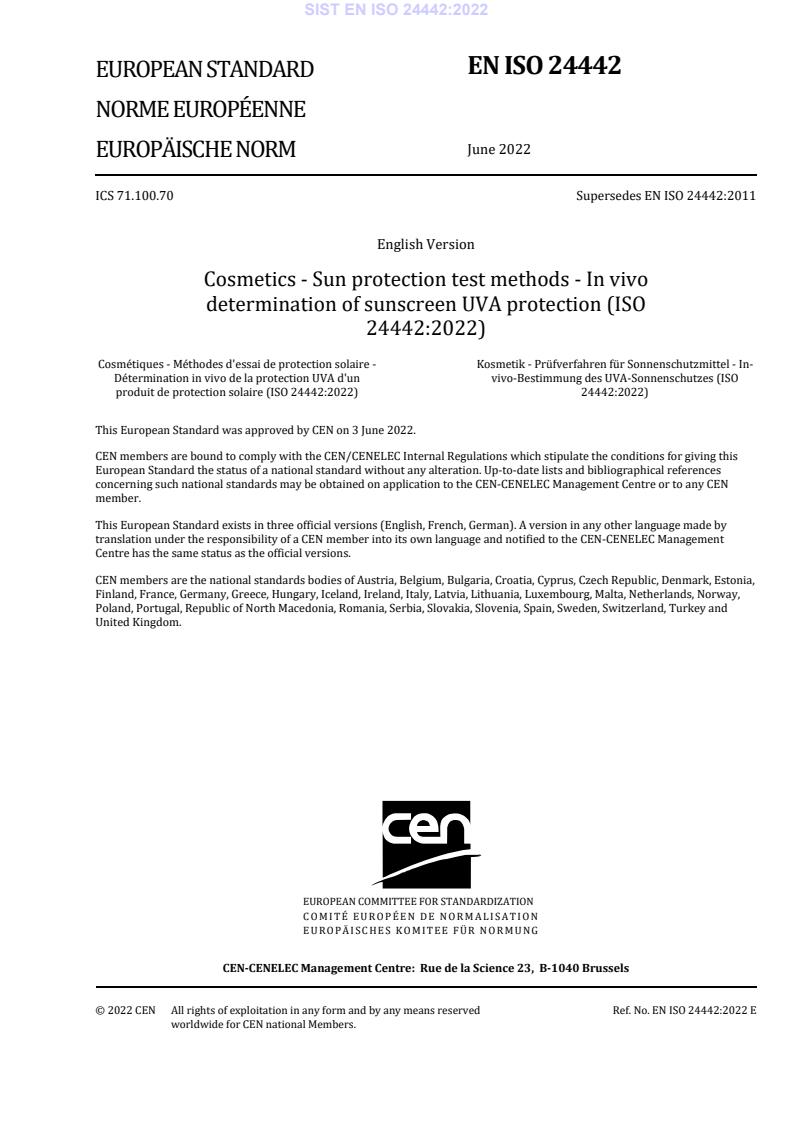
EN ISO 24442
EUROPEAN STANDARD
NORME EUROPÉENNE
June 2022
EUROPÄISCHE NORM
ICS 71.100.70 Supersedes EN ISO 24442:2011
English Version
Cosmetics - Sun protection test methods - In vivo
determination of sunscreen UVA protection (ISO
24442:2022)
Cosmétiques - Méthodes d'essai de protection solaire - Kosmetik - Prüfverfahren für Sonnenschutzmittel - In-
Détermination in vivo de la protection UVA d'un vivo-Bestimmung des UVA-Sonnenschutzes (ISO
produit de protection solaire (ISO 24442:2022) 24442:2022)
This European Standard was approved by CEN on 3 June 2022.
CEN members are bound to comply with the CEN/CENELEC Internal Regulations which stipulate the conditions for giving this
European Standard the status of a national standard without any alteration. Up-to-date lists and bibliographical references
concerning such national standards may be obtained on application to the CEN-CENELEC Management Centre or to any CEN
member.
This European Standard exists in three official versions (English, French, German). A version in any other language made by
translation under the responsibility of a CEN member into its own language and notified to the CEN-CENELEC Management
Centre has the same status as the official versions.
CEN members are the national standards bodies of Austria, Belgium, Bulgaria, Croatia, Cyprus, Czech Republic, Denmark, Estonia,
Finland, France, Germany, Greece, Hungary, Iceland, Ireland, Italy, Latvia, Lithuania, Luxembourg, Malta, Netherlands, Norway,
Poland, Portugal, Republic of North Macedonia, Romania, Serbia, Slovakia, Slovenia, Spain, Sweden, Switzerland, Turkey and
United Kingdom.
EUROPEAN COMMITTEE FOR STANDARDIZATION
COMITÉ EUROPÉEN DE NORMALISATION
EUROPÄISCHES KOMITEE FÜR NORMUNG
CEN-CENELEC Management Centre: Rue de la Science 23, B-1040 Brussels
© 2022 CEN All rights of exploitation in any form and by any means reserved Ref. No. EN ISO 24442:2022 E
worldwide for CEN national Members.
Contents Page
European foreword . 3
European foreword
This document (EN ISO 24442:2022) has been prepared by Technical Committee ISO/TC 217
"Cosmetics" in collaboration with Technical Committee CEN/TC 392 “Cosmetics” the secretariat of
which is held by AFNOR.
This European Standard shall be given the status of a national standard, either by publication of an
identical text or by endorsement, at the latest by December 2022, and conflicting national standards
shall be withdrawn at the latest by December 2022.
Attention is drawn to the possibility that some of the elements of this document may be the subject of
patent rights. CEN shall not be held responsible for identifying any or all such patent rights.
This document supersedes EN ISO 24442:2011.
Any feedback and questions on this document should be directed to the users’ national standards
body/national committee. A complete listing of these bodies can be found on the CEN website.
According to the CEN-CENELEC Internal Regulations, the national standards organizations of the
following countries are bound to implement this European Standard: Austria, Belgium, Bulgaria,
Croatia, Cyprus, Czech Republic, Denmark, Estonia, Finland, France, Germany, Greece, Hungary, Iceland,
Ireland, Italy, Latvia, Lithuania, Luxembourg, Malta, Netherlands, Norway, Poland, Portugal, Republic of
North Macedonia, Romania, Serbia, Slovakia, Slovenia, Spain, Sweden, Switzerland, Turkey and the
United Kingdom.
Endorsement notice
The text of ISO 24442:2022 has been approved by CEN as EN ISO 24442:2022 without any modification.
INTERNATIONAL ISO
STANDARD 24442
Second edition
2022-06
Cosmetics — Sun protection test
methods — In vivo determination of
sunscreen UVA protection
Cosmétiques — Méthodes d’essai de protection solaire —
Détermination in vivo de la protection UVA d’un produit de protection
solaire
Reference number
ISO 24442:2022(E)
ISO 24442:2022(E)
© ISO 2022
All rights reserved. Unless otherwise specified, or required in the context of its implementation, no part of this publication may
be reproduced or utilized otherwise in any form or by any means, electronic or mechanical, including photocopying, or posting on
the internet or an intranet, without prior written permission. Permission can be requested from either ISO at the address below
or ISO’s member body in the country of the requester.
ISO copyright office
CP 401 • Ch. de Blandonnet 8
CH-1214 Vernier, Geneva
Phone: +41 22 749 01 11
Email: copyright@iso.org
Website: www.iso.org
Published in Switzerland
ii
ISO 24442:2022(E)
Contents Page
Foreword .v
Introduction . vi
1 Scope . 1
2 Normative references . 1
3 Terms and definitions . 1
4 General principle .3
5 Test subjects . 3
5.1 Selection of the test subjects . 3
5.1.1 General . 3
5.1.2 Skin colour of the test subjects . 4
5.1.3 Age restriction . . 4
5.1.4 Frequency of participation in tests . 4
5.1.5 Ethics and consent . 4
5.2 Number of test subjects . 4
6 Apparatus and materials— Source of ultraviolet radiation . 4
6.1 General . 4
6.2 Quality of ultraviolet radiation . 5
6.3 Total irradiance (UV, visible and near infrared rays) . 5
6.4 Uniformity of beam . 5
6.4.1 General . 5
6.4.2 Film densitometry . 5
6.4.3 UV sensor . 6
6.4.4 Large beam source . 6
6.4.5 Small beam source . 6
7 Maintenance and monitoring the UV solar simulator output . 7
7.1 Spectroradiometry . 7
7.2 Radiometry . 8
8 Reference sunscreen formulations .8
8.1 General . 8
8.2 Reference standard to be used . 9
9 Procedure .9
9.1 Main steps . 9
9.2 Test conditions . 10
9.3 Position of the test subjects . 10
9.4 Product application . 10
9.4.1 Overview . 10
9.4.2 General . 10
9.4.3 Amount of product applied . 10
9.4.4 Mode of delivery . 11
9.4.5 Evaluation of application uniformity . 13
9.4.6 Drying time between application and UV exposure . .13
9.4.7 Exposure sub-sites . 13
9.5 UV exposure . 13
9.5.1 Provisional MPPDD . 13
iu
9.5.2 Estimated MPPDD .13
iu
9.5.3 Incremental progression of UV dose . 13
9.6 Product removal . 14
9.7 Procedure for MPPDD assessment . 14
9.7.1 General . 14
9.7.2 Time of assessment of MPPDD . 14
9.7.3 Grading scale for the MPPDD s . 15
i
iii
ISO 24442:2022(E)
9.7.4 Erythema responses .15
9.7.5 Data rejection criteria . 15
9.7.6 Test failure criteria . . 16
9.7.7 Expression of MPPDDs . 16
10 Calculation of the UVA protection factor and statistics .16
10.1 Calculation of the individual UVAPF (UVAPF ) . 16
i
10.2 Calculation of product UVAPF . 17
10.3 Statistical criterion . 17
10.4 Validation of the test . 17
11 Test report .17
11.1 Overview . 17
11.2 General information. 17
11.3 Data in tabular for each test subject . 18
11.4 Statistics for the test products . 18
Annex A (normative) Selection criteria for the test subjects .19
Annex B (normative) Definition of the source of UVA radiation .21
Annex C (normative) UVAPF reference sunscreens formulations.24
Annex D (normative) Calculations and statistics .37
Annex E (normative) Colorimetric determination of skin colour typing .43
Annex F (informative) Visual guidance for PPD grading— Visual appearance of PPD .45
Annex G (informative) Sample report form .52
Bibliography .56
iv
ISO 24442:2022(E)
Foreword
ISO (the International Organization for Standardization) is a worldwide federation of national standards
bodies (ISO member bodies). The work of preparing International Standards is normally carried out
through ISO technical committees. Each member body interested in a subject for which a technical
committee has been established has the right to be represented on that committee. International
organizations, governmental and non-governmental, in liaison with ISO, also take part in the work.
ISO collaborates closely with the International Electrotechnical Commission (IEC) on all matters of
electrotechnical standardization.
The procedures used to develop this document and those intended for its further maintenance are
described in the ISO/IEC Directives, Part 1. In particular, the different approval criteria needed for the
different types of ISO documents should be noted. This document was drafted in accordance with the
editorial rules of the ISO/IEC Directives, Part 2 (see www.iso.org/directives).
Attention is drawn to the possibility that some of the elements of this document may be the subject of
patent rights. ISO shall not be held responsible for identifying any or all such patent rights. Details of
any patent rights identified during the development of the document will be in the Introduction and/or
on the ISO list of patent declarations received (see www.iso.org/patents).
Any trade name used in this document is information given for the convenience of users and does not
constitute an endorsement.
For an explanation of the voluntary nature of standards, the meaning of ISO specific terms and
expressions related to conformity assessment, as well as information about ISO's adherence to
the World Trade Organization (WTO) principles in the Technical Barriers to Trade (TBT), see
www.iso.org/iso/foreword.html.
This document was prepared by Technical Committee ISO/TC 217, Cosmetics, in collaboration with
the European Committee for Standardization (CEN) Technical Committee CEN/TC 392, Cosmetics, in
accordance with the Agreement on technical cooperation between ISO and CEN (Vienna Agreement).
This second edition cancels and replaces the first edition (ISO 24442:2011), which has been technically
revised.
The main changes are as follows:
— this document has been aligned with the revised ISO 24444.
Any feedback or questions on this document should be directed to the user’s national standards body. A
complete listing of these bodies can be found at www.iso.org/members.html.
v
ISO 24442:2022(E)
Introduction
This document specifies the procedure to determine the Ultraviolet A Protection Factor (UVAPF) of
a sunscreen product using the persistent pigment darkening method according to the principles
[1]
recommended by the Japan Cosmetic Industry Association (JCIA) in 1995 . The outcome of this test
method can be used to determine the UVA classification of topical sunscreen products according to
local regulatory requirements.
Topical sunscreen products are primarily rated and labelled according to their ability to protect against
sunburn, using a test method to determine the in vivo sun protection factor (see ISO 24444). This rating
evaluates filtration of sunburn generating radiation across the electromagnetic UV spectrum (290 nm
to 400 nm). However, knowledge of the sun protection factor (SPF) rating does not provide explicit
information on the magnitude of the protection provided specifically in the UVA range of the spectrum
(320 nm to 400 nm), as it is possible to have high SPF products with very modest UVA protection [for
example SPF 50 with a UVA protection factor (UVAPF) of only 3 to 4]. There is demand among medical
professionals, as well as knowledgeable consumers, to have fuller information on the UVA protection
provided by their sunscreen product, in addition to the SPF, in order to make a more informed choice of
product, providing a more balanced and broader-spectrum protection. Moreover, there is also a demand
to prevent UVA-induced darkening of the skin from a cultural point of view even without sunburn.
Thus, persistent pigment darkening (PPD) was selected as an endpoint relevant to UVA. Although PPD
[2]
reflects merely photo-polymerization of melanin monomers , it is evaluated as a representative of
the biological reactions. The UVAPF value of a product provides information on the magnitude of the
[3][4][5]
protection provided explicitly in the UVA portion of the spectrum, independent of the SPF values .
The test method outlined in this document is derived primarily from the UVAPF test methods as
developed by the JCIA. Modifications have been made to attempt to be in line with updated International
Standards for determination of sun protection factor without changing the integrity of the fundamental
underlying principles of the test method.
vi
INTERNATIONAL STANDARD ISO 24442:2022(E)
Cosmetics — Sun protection test methods — In vivo
determination of sunscreen UVA protection
1 Scope
This document specifies a method for the in vivo determination of UVA protection factor (UVAPF) of
sunscreen products. It is applicable to products that contain any component able to absorb, reflect or
scatter ultraviolet (UV) rays and which are intended to be placed in contact with human skin.
This document provides a basis for the evaluation of sunscreen products for the protection of human
skin against UVA radiation induced by solar ultraviolet rays.
2 Normative references
The following documents are referred to in the text in such a way that some or all of their content
constitutes requirements of this document. For dated references, only the edition cited applies. For
undated references, the latest edition of the referenced document (including any amendments) applies.
ISO 24444, Cosmetics — Sun protection test methods — In vivo determination of the sun protection factor
(SPF)
3 Terms and definitions
For the purposes of this document, the following terms and definitions apply.
ISO and IEC maintain terminological databases for use in standardization at the following addresses:
— ISO Online browsing platform: available at https:// www .iso .org/ obp
— IEC Electropedia: available at https:// www .electropedia .org/
3.1
ultraviolet radiation
UVR
electromagnetic radiation in the range of 290 nm to 400 nm
3.1.1
ultraviolet B
UVB
electromagnetic radiation in the range of 290 nm to 320 nm
3.1.2
ultraviolet A
UVA
electromagnetic radiation in the range of 320 nm to 400 nm
Note 1 to entry: UVA II = 320 nm to 340 nm; UVA I = 340 nm to 400 nm.
3.2
erythema
reddening of the skin caused by UV radiation
ISO 24442:2022(E)
3.3
persistent pigment darkening
PPD
skin darkening that persists more than 2 h after the end of UVA exposure
3.4
sunscreen products
products containing any component able to absorb, reflect or scatter UV rays, which are intended to be
placed on the surface of human skin with the purpose of protecting against erythema (3.2) and other
ultraviolet induced damage
3.5
minimal persistent pigment darkening dose
MPPDD
lowest UVA dose that produces the first perceptible unambiguous persistent pigment darkening
response with over more than 50 % of UV exposure subsite, observed between 2 h and 24 h after the
end of the UVA exposure
3.5.1
MPPDD
u
MPPDD on unprotected skin
3.5.1.1
MPPDD
iu
MPPDD of an individual subject on unprotected skin
3.5.2
MPPDD
p
MPPDD on product protected skin
3.5.2.1
MPPDD
ip
MPPDD of an individual subject on protected skin
3.6
UVA protection factor
UVAPF
ratio of the minimal PPD dose on product protected skin (MPPDD ) to the minimal PPD dose on
p
unprotected skin (MPPDD ) of the same subject:
u
MPPDD
p
UVAPF=
MPPDD
u
Note 1 to entry: UVAPF is expressed to one decimal place by truncation.
3.6.1
individual UVA protection factor
UVAPF
i
ratio of the individual minimal PPD dose on product protected skin (MPPDD ) to the individual minimal
ip
PPD dose on unprotected skin (MPPDD ) of the same subject:
iu
MPPDD
ip
UVAPF =
i
MPPDD
iu
Note 1 to entry: UVAPF is expressed to one decimal place by truncation.
i
3.6.2
product UVAPF
arithmetic mean of all valid individual UVAPF values obtained from all subjects in the test
i
ISO 24442:2022(E)
3.7
test area
area for testing on the back between the scapula line and the waist
Note 1 to entry: Skeletal protrusions and extreme areas of curvature should be avoided.
3.8
test site
area of the skin where a product is applied, or the site used for the determination of the unprotected
MPPDD
3.9
exposure sub-sites
areas of skin that are exposed to UV-irradiation within a test site (3.8)
3.10
individual typology angle
ITA°
value characterizing the skin colour of the subject as measured by a skin contact reflectance
spectrophotometer or skin colorimeter
Note 1 to entry: Refer to Annex E for the detailed requirements of the equipment/measurement.
4 General principle
The UVAPF test method is analogous to the test method used to determine the SPF of a sunscreen
product. However, it utilizes only the UVA portion of the xenon arc lamp solar simulator of defined and
known output to determine the protection provided by sunscreen products on human skin in the UVA
portion of the spectrum.
The UVAPF test method uses PPD responses of the skin as the end point for evaluating transmitted UVA
radiation.
The test shall be restricted to the area of the back of selected human subjects.
A section of each subject’s skin is exposed to UVA radiation without any protection while another
(different) section is exposed after application of the sunscreen product under test. One further section
is exposed after application of an UVAPF reference sunscreen formulation, which is used for validation
of the procedure.
To determine the UVAPF, incremental series of PPD responses are induced on a number of small sub-
sites on the skin. These responses are visually assessed for presence of PPD 2 h to 24 h after UVA
radiation, by the judgment of a trained and competent evaluator.
The MPPDD and the MPPDD shall be determined on the same subject on the same day. An UVAPF for
iu ip i
each subject tested is calculated as the ratio of MPPDD divided by MPPDD , as in the formula given in
ip iu
3.6.
The UVAPF is the arithmetic mean of all valid UVAPF results from each subject in the test expressed to
i
one decimal place.
5 Test subjects
5.1 Selection of the test subjects
5.1.1 General
There are strict requirements governing the inclusion and non-inclusion of test subjects which should
be adhered to. The criteria shall be set out in Annex A.
ISO 24442:2022(E)
5.1.2 Skin colour of the test subjects
Test subjects included in the UVAPF test shall have an ITA° value between 18° and 43° by colorimetric
methods (see Annexes A and E) and be untanned on the test area.
A trained and competent scientist or technician should examine each subject to ensure that there is no
condition which can put the subject at risk and that the outcome of the test cannot be compromised by
adverse skin conditions such as sun damage, pigmentation marks and previous history of abnormal
response to the sun (see Annex A).
The test sites intended for UV exposure shall be free from blemishes and hair, and have an even colour
tone with no variation in ITA° greater than 5° from each other or the MPPDD test area.
u
5.1.3 Age restriction
Test subjects below the locally regulated age of consent or older than 70 years shall not be included in
the UVAPF test panel.
5.1.4 Frequency of participation in tests
Subjects may participate in a test provided that at least 8 weeks have elapsed since they participated
in a previous UV exposure study (i.e. SPF, UVAPF, photoallergy, phototoxicity test), and all skin tanned
marks from that previous test have cleared from the test sites on the back and are no longer visible.
5.1.5 Ethics and consent
[7]
All testing shall be done in accordance with ethical principles, such as the Declaration of Helsinki .
Informed, written (signature) consent shall be obtained from all test subjects and retained.
5.2 Number of test subjects
The minimum number of valid UVAPF results shall be 10 and the maximum number of valid UVAPF
i i
results shall be 20. In order to achieve between 10 and 20 valid results, a maximum of five individual
invalid results may be excluded from the calculation of the mean UVAPF. Consequently, the actual
number of test subjects used will fall between a minimum of 10 and a maximum of 25 subjects (i.e. a
maximum of 20 valid results plus 5 rejected invalid results). In case a screening had been performed to
assess a provisional UVAPF (see A.2.2), the 2 to 3 subjects from this preliminary test can be included
among the total test subjects if they comply with all other requirements for a valid test result.
Results may only be declared invalid and excluded from the calculation of the mean UVAPF according to
9.7.5 or because of non-conformity with the related protocol.
In order to determine the number of test subjects, the 95 % confidence interval (95 % CI) on the
mean UVAPF shall be taken into account. A minimum of 10 subjects shall be tested. The test shall be
considered valid for the first 10 subjects if the resulting range of the 95 % CI of the mean UVAPF shall
be within ±17 % of the mean UVAPF. If it is not within ±17 % of the mean UVAPF, the number of subjects
shall be increased stepwise from the minimum number of 10 until the 95 % CI statistical criterion is
met (up to a maximum of 20 valid results from a maximum of 25 subjects tested). If the statistical
criterion has not been met after 20 valid results from a maximum of 25 subjects, then the test shall be
rejected. For details on statistical definitions, sequential procedure and calculations, refer to Annex D.
6 Apparatus and materials— Source of ultraviolet radiation
6.1 General
The artificial light source used shall comply with the source spectral specifications as described in 6.2
and Annex B. A xenon arc solar simulator with appropriate filters shall be used.
ISO 24442:2022(E)
6.2 Quality of ultraviolet radiation
6.2.1 The solar UV simulator shall emit a continuous spectrum with no gaps or extreme peaks of
emission in the UV region. The output from the solar UV simulator shall be stable, uniform across the
whole output beam and suitably filtered to create a spectral quality that complies with the required
acceptance limits (see Table 1).
6.2.2 Typical sources used for this testing are multiport or single-port solar simulators fitted with
optical cut-off filters to eliminate wavelengths below 320 nm (UVB) and between 400 nm and 1 500 nm
(visible light and infrared). The amount of UVA I radiation shall be between 80 % and 92 % of the
total UVA output (UVA I/UVA = 80 % to 92 %), and the amount of UVA II (320 nm to 340 nm) shall be
between 8 % and 20 % of the total UVA irradiance (UVA II/UVA = 8 % to 20 %). There shall be less
than 0,1 % of UVB contained in the source beam (see Table 1).
Table 1 — Performance specifications
Spectral range Measured
<320 nm (UVB) <0,1 % of total UV
320 nm to 340 nm (UVA II) 8 % to 20 % of total UVA
340 nm to 400 nm (UVA I) 80 % to 92 % of total UVA
400 nm to 1 500 nm <5 % of total output of the source
(visible and near-IR)
6.3 Total irradiance (UV, visible and near infrared rays)
If total irradiance is too intense, an excessive feeling of heat or pain may be induced in the irradiated skin
of subjects and heat induced erythema may result. Therefore, total irradiance shall not exceed 1 600 W/
2[8] 2
m . When total irradiance is <1 600 W/m , it shall still be confirmed, prior to conducting an UVAPF
test, that the irradiance to be used (UV, visible and near-infrared rays) will not induce an excessive
feeling of heat in the skin. The output of the solar simulator shall be measured with a broad spectrum
sensor (capable of measuring between 280 nm and 1 600 nm) calibrated against a standard reference
source over the range of 280 nm to 1 600 nm. Alternatively, the source may be measured with a
calibrated spectroradiometer over this same wavelength range to determine the total irradiance.
6.4 Uniformity of beam
6.4.1 General
Uniformity of the beam shall be measured periodically depending on the solar simulator type using
either UV sensitive film or UV sensor methods (see 6.4.2 and 6.4.3). Solar simulators with large beams
(>1,3 cm diameter) or with multiple output ports shall be measured at least every 6 months, or when
any modifications are made to the lamp optical components, or when non-uniform PPD spots are seen
in test subsites. Solar simulators with a single output port beam (≤1,3 cm diameter) shall be measured
at least every 1 month, or when any modifications are made to the lamp optical components, or when
non-uniform PPD spots are seen in test subsites.
Uniformity measurements may be conducted using UV sensitive paper that darkens with exposure, or
by using a UV sensor that is smaller in active area compared to the beam size by a ratio of at least 1:4.8
with sufficient measurements to cover more than 75 % of the beam area.
Measurements are to be made using the orientation of the source output as used for subject exposures.
6.4.2 Film densitometry
Exposure doses of the UV sensitive film shall be calibrated to achieve film darkening (converted to
grey scale) to a density in the mid-range of the scale (on a 0 to 255 range of black to white). A series
ISO 24442:2022(E)
of exposures shall be used to determine the mid-range density exposure using a calibrated scanning
measurement device with at least 600 dots per inch (dpi) resolution. Exposures can be modified by use of
neutral density filters or exposure times to achieve this level of exposure for uniformity measurements.
Areas to be measured shall be the same as those diagrammed below (see Figures 1 and 2). Films are to
be scanned for density values, and average values for each area of the beam as outlined above shall be
calculated, and beam uniformity calculated as per Formula (1) (see 6.4.4).
6.4.3 UV sensor
Alternatively, a small aperture (quadrant) UV sensor with a mechanical alignment fixture may be
used to measure sub-sections of the output beam intensity as outlined below and the beam uniformity
calculated as per Formula (1) (see 6.4.4).
6.4.4 Large beam source
When a large-beam UV source is used to simultaneously expose several subsites (i.e. at least two
subsites) within an irradiation series by varying the exposure time, the intensity of the beam shall be
as uniform as possible. A UV film densitometry method or a UV radiometer method may be used. The
minimum number of sample sites of equal area within the beam [Area of Interest (AOI)] to be assessed
shall be determined by dividing the area of the beam by 6,45. For example, if the beam is 232 cm in
area, then the minimum number of measurements shall be 36.
UV film densitometry method: The UV sensitive film at least as large as the beam shall be exposed by
the entire beam so that the entire beam fits inside the borders of the film.
The uniformity shall be ≥90 % as calculated by the Formula (1):
U = (1-(max-min)/(X̅)) (1)
where
U is the uniformity in percentage;
is the average.
X
If the uniformity is less than 90 %, then optical components should be adjusted or appropriate
compensation for different irradiance shall be made in the exposure time on each sub-site.
6.4.5 Small beam source
6.4.5.1 General
For a small beam UV source, which exposes sub-sites individually, the beam intensity uniformity shall
be as measured. A UV Sensitive film densitometry method or a UV radiometer method may be used.
6.4.5.2 Single output device
For a single port device, five equal size areas of the beam intensity shall be measured to assess the
uniformity within the beam as shown in Figure 1. The uniformity shall be ≥90 % as calculated by
Formula (1).
ISO 24442:2022(E)
Figure 1 — Single output device
6.4.5.3 Multiple output device
For a multiple port device, the intensity uniformity of each output beam shall be determined by
measuring at least 4 circles of equal area of each output beam (see Figure 2), as calculated by
Formula (1).
The average uniformity of all beams for the multiport device shall be ≥90 %, with no individual port
having uniformity of <85 %.
If the uniformity is less than prescribed, then adjustments to the lamp optical system shall be made to
bring the uniformity within the limits above.
Figure 2 — Multiple output device
7 Maintenance and monitoring the UV solar simulator output
7.1 Spectroradiometry
There shall be a spectroradiometric check of the spectrum of each solar simulator output port (UVA
and UVB) and intensity made by the laboratory at least once every 12 months or after 2 500 h of lamp
running time and after changing any significant physical (optical) component (including the bulb) of
the solar simulator. The simple use of specific filters is not in itself adequate assurance that the UV
output is of the correct quality. This periodical inspection should be conducted by a trained, competent,
and suitably qualified person (internal or external) using a spectroradiometer that has been calibrated
against a standard lamp that is traceable to a national or an international calibration standard, with a
band width of 2 nm or smaller and having a dynamic range of at least 5 decades which is usually met by
spectroradiometers equipped with double monochromator. Measurements shall be recorded at 1 nm
increments.
ISO 24442:2022(E)
Optical alignment fixtures shall be used to assure accurate radiometer alignment and reproduction of
the simulator output at the same optical reference plane measured with the spectroradiometer.
Detailed instructions for ensuring correct lamp output are given in Annex B.
7.2 Radiometry
Prior to making any measurements of the simulator output with a radiometric device, the front surface
of the radiometer sensor shall be cleaned with a dry cotton cloth, and the optical tips of the light guides
from the xenon source shall be cleaned with alcohol or optical cleaning fluid with lint-free cloth to
remove any visible or invisible materials or residual sunscreen.
Before UV exposure of each test site, the UV irradiance shall be measured and recorded with an
UVA weighted radiometer cross-calibrated against a spectroradiometric measurement of the solar
simulator output as detailed in 7.1. Optical alignment shall be configured to ensure accurate radiometer
alignment and reproduction of the simulator output at the same optical reference plane measured with
the spectroradiometer. A calibration factor Y for each radiometer shall be determined by Formula (2):
P
s
Y = (2)
P
r
where
Y is the calibration factor for each radiometer;
P is UVA irradiance (W/cm ) of the solar simulator as measured by the spectroradiometer;
s
P is UVA irradiance (W/cm ) of the solar simulator as measured by the radiometer.
r
The UV exposure time (in seconds) for a given test shall be calculated using Formula (3):
H H
t== (3)
P YP*
sr
where
t is the time, in seconds, for the UV exposures for a given test;
H is the desired dose (J/cm ).
Output intensity should be measured before exposure of each test site in order to ensure the correct
intensity is applied for each exposure. Where the solar simulator is capable of continuous monitoring of
output intensity, it should be measured during the exposure of the test subjects. The average intensity
of the solar simulator as measured by the calibrated radiometer shall be included on the test study
2 2
report (W/cm ), as well as the doses (J/cm ) for the MPP
...