


EN 13445-4:2014
(Main)Unfired pressure vessels - Part 4: Fabrication
Unfired pressure vessels - Part 4: Fabrication
This document specifies requirements for the manufacture of unfired pressure vessels and their parts, made of steels, including their connections to non-pressure parts. It specifies requirements for material traceability, manufacturing tolerances, welding requirements, requirements for permanent joints other than welding, production tests, forming requirements, heat treatment, repairs and finishing operations.
Unbefeuerte Druckbehälter - Teil 4: Herstellung
Dieses Dokument enthält Anforderungen an die Herstellung von unbefeuerten Druckbehältern und Druck-behälterteilen aus Stählen, einschließlich deren Verbindungen zu nicht drucktragenden Teilen. Es enthält Anforderungen an die Rückverfolgbarkeit von Werkstoffen, Fertigungstoleranzen, Schweißanforderungen, Anforderungen an nicht geschweißte dauerhafte Verbindungen, Arbeitsproben, Umformanforderungen, Wärmebehandlung, Reparaturen und Fertigbearbeitung.
Récipients sous pression non soumis à la flamme - Partie 4 : fabrication
Le présent document spécifie les exigences relatives à la fabrication des récipients sous pression non soumis à la flamme et de leurs parties sous pression, réalisés en acier, y compris leur raccordement avec des parties non soumises à la pression. Elle spécifie des exigences concernant la traçabilité des matériaux, les tolérances de fabrication, les exigences de soudage, les exigences concernant les assemblages permanents autres que le soudage, les coupons-témoins, les exigences de formage, les traitements thermiques, les réparations, et la finition.
Neogrevane tlačne posode - 4. del: Proizvodnja
Standard EN 13445-4 določa zahteve za proizvodnjo neogrevanih tlačnih posod in njihovih delov, izdelanih iz jekel, vključno z njihovimi priključki na netlačne dele. Določa zahteve za sledljivost materiala, proizvodna odstopanja, zahteve za varjenje, zahteve za trajne spoje, ki niso varjeni, proizvodne preskuse, zahteve za oblikovanje, toplotno obdelavo, popravila in zaključne operacije.
General Information
Relations
Standards Content (Sample)
2003-01.Slovenski inštitut za standardizacijo. Razmnoževanje celote ali delov tega standarda ni dovoljeno.Unbefeuerte Druckbehälter - Teil 4: HerstellungRécipients sous pression non soumis à la flamme - Partie 4 : fabricationUnfired pressure vessels - Part 4: Fabrication23.020.30MHNOHQNHPressure vessels, gas cylindersICS:Ta slovenski standard je istoveten z:EN 13445-4:2014SIST EN 13445-4:2014en,fr,de01-november-2014SIST EN 13445-4:2014SLOVENSKI
STANDARDSIST EN 13445-4:2009/A2:2014SIST EN 13445-4:2009/A1:2012SIST EN 13445-4:20091DGRPHãþD
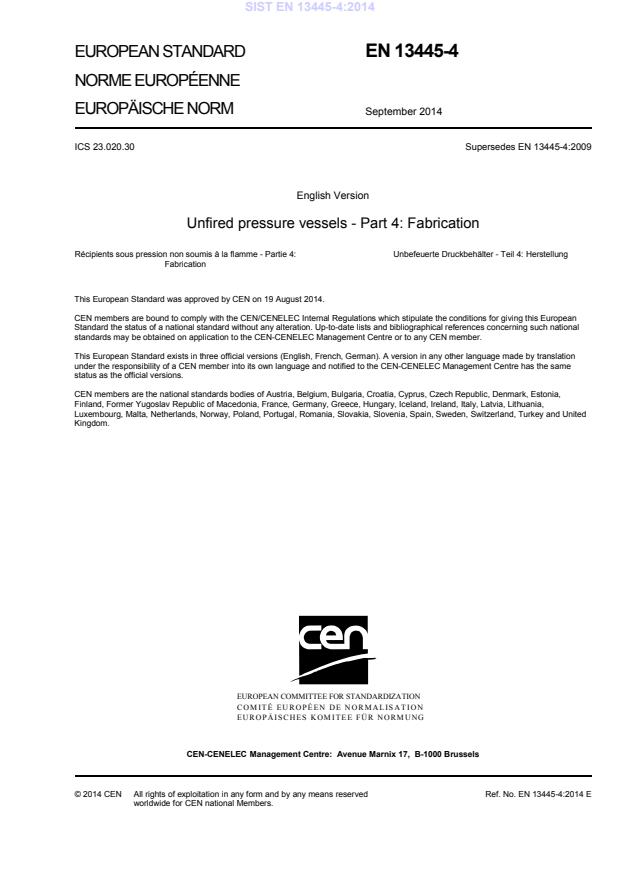
EUROPEAN STANDARD NORME EUROPÉENNE EUROPÄISCHE NORM
EN 13445-4
September 2014 ICS 23.020.30 Supersedes EN 13445-4:2009English Version
Unfired pressure vessels - Part 4: Fabrication
Récipients sous pression non soumis à la flamme - Partie 4: Fabrication
Unbefeuerte Druckbehälter - Teil 4: Herstellung This European Standard was approved by CEN on 19 August 2014.
CEN members are bound to comply with the CEN/CENELEC Internal Regulations which stipulate the conditions for giving this European Standard the status of a national standard without any alteration. Up-to-date lists and bibliographical references concerning such national standards may be obtained on application to the CEN-CENELEC Management Centre or to any CEN member.
This European Standard exists in three official versions (English, French, German). A version in any other language made by translation under the responsibility of a CEN member into its own language and notified to the CEN-CENELEC Management Centre has the same status as the official versions.
CEN members are the national standards bodies of Austria, Belgium, Bulgaria, Croatia, Cyprus, Czech Republic, Denmark, Estonia, Finland, Former Yugoslav Republic of Macedonia, France, Germany, Greece, Hungary, Iceland, Ireland, Italy, Latvia, Lithuania, Luxembourg, Malta, Netherlands, Norway, Poland, Portugal, Romania, Slovakia, Slovenia, Spain, Sweden, Switzerland, Turkey and United Kingdom.
EUROPEAN COMMITTEE FOR STANDARDIZATION
COMITÉ EUROPÉEN DE NORMALISATION EUROPÄISCHES KOMITEE FÜR NORMUNG
CEN-CENELEC Management Centre:
Avenue Marnix 17,
B-1000 Brussels © 2014 CEN All rights of exploitation in any form and by any means reserved worldwide for CEN national Members. Ref. No. EN 13445-4:2014 ESIST EN 13445-4:2014
Structural tolerances . 55 Annex B (informative)
Example of a sub-contractors form . 59 SIST EN 13445-4:2014
Specification and approval of expansion procedures and operators .60 C.1 General .60 C.1.1 Introduction .60 C.1.2 Responsibility .60 C.1.3 Specification of expansion procedures.60 C.1.4 Technical content of expansion procedure specification (EPS) .61 C.1.5 Expansion procedure qualification test (EPQT) .62 C.2 Examination and testing .62 C.2.1 General .62 C.2.2 Visual examination .62 C.2.3 Dimensional verification .62 C.2.4 Testing .63 C.3 Range of approval.63 C.3.1 General .63 C.3.2 Manufacturer .63 C.3.3 Material .63 C.3.4 Tube dimensions .63 C.3.5 Expansion factor .63 C.3.6 Joint design .64 C.3.7 Tool .64 C.3.8 PWHT .64 C.4 Expansion Procedure Approval Record (EPAR) .64 C.5 Expansion operator approval .64 C.5.1 General .64 C.5.2 Validity range of expansion operator qualification .65 C.5.3 Qualification tests .65 C.5.4 Examination and testing .65 C.5.5 Period of validity .65 C.5.6 Certification .66 Annex Y (informative)
History of EN 13445-4 .67 Y.1 Differences between EN 13445-4:2009 and EN 13445-4:2014 .67 Annex ZA (informative)
Relationship between this European Standard and the Essential Requirements of the EU Pressure Equipment Directive 97/23/EC .68 Bibliography .69
2 Normative references The following documents, in whole or in part, are normatively referenced in this document and are indispensable for its application. For dated references, only the edition cited applies. For undated references, the latest edition of the referenced document (including any amendments) applies. EN 287-1:20111), Qualification test of welders — Fusion welding — Part 1: Steels EN 10028-2:2009, Flat products made of steels for pressure purposes — Part 2: Non-alloy and alloy steels with specified elevated temperature properties EN 10028-3:2009, Flat products made of steels for pressure purposes — Part 3: Weldable fine grain steels, normalized EN 10028-4:2009, Flat products made of steels for pressure purposes — Part 4: Nickel alloy steels with specified low temperature properties EN 10216-1:2013, Seamless steel tubes for pressure purposes — Technical delivery conditions — Part 1: Non-alloy steel tubes with specified room temperature properties EN 10216-2:2013, Seamless steel tubes for pressure purposes — Technical delivery conditions — Part 2: Non-alloy and alloy steel tubes with specified elevated temperature properties EN 10216-3:2013, Seamless steel tubes for pressure purposes — Technical delivery conditions — Part 3: Alloy fine grain steel tubes EN 10216-4:2013, Seamless steel tubes for pressure purposes — Technical delivery conditions — Part 4: Non-alloy and alloy steel tubes with specified low temperature properties EN 10217-1:2002, EN 10217-1:2002/A1:2005, Welded steel tubes for pressure purposes — Technical delivery conditions — Part 1: Non-alloy steel tubes with specified room temperature properties EN 10217-2:2002, EN 10217-2:2002/A1:2005, Welded steel tubes for pressure purposes — Technical delivery conditions — Part 2: Electric welded non-alloy and alloy steel tubes with specified elevated temperature properties EN 10217-3:2002, EN 10217-3:2002/A1:2005, Welded steel tubes for pressure purposes — Technical delivery conditions — Part 3: Alloy fine grain steel tubes EN 10217-4:2002, EN 10217-4:2002/A1:2005, Welded steel tubes for pressure purposes — Technical delivery conditions — Part 4: Electric welded non-alloy and alloy steel tubes with specified low temperature properties
1) EN ISO 9606-1 has been published in 2013 replaces EN 287-1. CEN has decided to have a transition period for EN 287-1. As a consequence, EN 287-1 is valid until October 2015. SIST EN 13445-4:2014
EN 13445-2:2014, Unfired pressure vessels — Part 2: Materials EN 13445-3:2014, Unfired pressure vessels — Part 3: Design EN 13445-5:2014, Unfired pressure vessels — Part 5: Inspection and testing EN 14276-1:2006+A1:2011, Pressure equipment for refrigerating systems and heat pumps — Part 1: Vessels — General requirements EN ISO 3834-2:2005, Quality requirements for fusion welding of metallic materials — Part 2: Comprehensive quality requirements (ISO 3834-2:2005)
EN ISO 3834-3:2005, Quality requirements for fusion welding of metallic materials — Part 3: Standard quality requirements (ISO 3834-3:2005) EN ISO 4136:2012, Destructive tests on welds in metallic materials — Transverse tensile test (ISO 4136:2012) EN ISO 5173:2010, Destructive tests on welds in metallic materials — Bend tests (ISO 5173:2009) EN ISO 5178:2011, Destructive tests on welds in metallic materials — Longitudinal tensile test on weld metal in fusion welded joints (ISO 5178:2001) EN ISO 9015-1:2011, Destructive tests on welds in metallic materials — Hardness testing — Part 1: Hardness test on arc welded joints (ISO 9015-1:2001) EN ISO 9016:2012, Destructive tests on welds in metallic materials — Impact tests — Test specimen location, notch orientation and examination (ISO 9016:2012) EN ISO 13585:2012, Brazing — Qualification test of brazers and brazing operators (ISO 13585:2012) EN ISO 14732:2013, Welding personnel — Qualification testing of welding operators and weld setters for mechanized and automatic welding of metallic materials (ISO 14732:2013) EN ISO 15609-1:2004, Specification and qualification of welding procedures for metallic materials — Welding procedure specification — Part 1: Arc welding (ISO 15609-1:2004) SIST EN 13445-4:2014
c) the manufacturing equipment is adequate for fabrication; d) the staff is adequate for the assigned tasks; NOTE As far as welding co-ordination is concerned, the qualifications, tasks and responsibilities can be defined by the manufacturer in accordance with EN ISO 14731:2007 [1] in the job assignment. e) the quality requirements for welding defined in EN ISO 3834-3:2005 are met as a minimum. 3.2 Subcontracting The manufacturer may subcontract work, but shall ensure that the subcontractor carries out the work in accordance with the requirements of this European Standard. The manufacturer is responsible for the adequate definition of the subcontracted task and the need for any associated records. On all occasions that the subcontractor work includes a) welding; b) forming including associated heat treatment; c) post weld heat treatment; d) non-destructive testing of welds (see EN 13445-5:2014), the manufacturer shall obtain a subcontractor form (see Annex B). SIST EN 13445-4:2014
4 Materials 4.1 General Materials for pressure vessels and the grouping of materials for pressure vessels shall be in accordance with EN 13445-2:2014. The grouping applies regardless of product form, i.e. plate, forging, piping. 4.2 Material traceability 4.2.1 General The vessel manufacturer shall have and maintain an identification system for materials used in fabrication, so that all material subject to stress due to pressure and those welded thereto in the completed work can be traced to its origin. This includes the use of welding consumables. 4.2.2 Identification system 4.2.2.1 The vessel manufacturer's identification system shall assure that all materials to be used in the vessel have been subjected to and satisfactorily passed the following: a) examination of material before fabrication for the purpose of detecting, as far as possible, imperfections which would affect the safety of the work; b) check of material to determine that it has the required thickness; c) check of the material to assure that the materials are permitted by this European Standard, fully traceable to the correct material certification and as specified in the design documentation; d) check of the welding consumables to assure the correct markings and that correct conditions are maintained to prevent deterioration. 4.2.2.2 Material traceability to the original identification markings shall be by one or more of the following methods: SIST EN 13445-4:2014
a) Middle line alignment d1 at equal thickness e1 = e2b) Middle line alignment d1 at different thickness e1 e2Figure 5.2-1 — Middle line alignment d1 For longitudinal welds in cylinders, cones and rectangular/prismatic structures the middle lines of adjacent components (whether of equal or different thickness) shall be aligned within the tolerances specified in Table 5.2-1.
Table 5.2-1 — Offset of middle lines for longitudinal welds in cylinders, cones and rectangular/prismatic structures Dimensions in millimetresThinner part thickness e1 Maximum misalignment d1
e1
2 0,5
2 < e1
4 e1/4
4 < e1 10 1
10 < e1 30 e1/10
30 < e1 60 e1/30 + 2
60 < e1 4
For longitudinal welds in dished ends and welds in spherical components the middle lines of adjacent parts (whether of equal or different thickness) shall be aligned within the tolerances specified in Table 5.2-2.
Table 5.2-2 — Offset of middle lines for longitudinal welds in dished ends and in spherical components of adjacent parts Dimensions in millimetresThinner part thickness e1 Maximum misalignment d1
e1
2 0,5
2 < e1
4 e1/4
4 < e1
10 1
10 < e1
30 e1/10
30 < e1 120 e1/30 + 2
120 < e1 6
For circumferential welds the middle lines of adjacent parts (whether of equal or different thickness) shall be aligned within the tolerances specified in Table 5.2-3.
e1
30 e1/10 + 1
30 < e1 150 e1/30 + 3
150 < e1 8
5.3 Surface alignment 5.3.1 Surface misalignment between parts Where there is misalignment at the surface between parts of the same nominal thickness the transition across the weld shall be smooth and gradual with a slope of 1 in 4 over the width of the weld. If this taper cannot be accommodated within the weld width it is permissible to either: a) grind the higher plate surface, where this will not reduce the joint thickness at any point below the nominal specified plate thickness minus the plate thickness tolerance; b) build up the lower plate surface with added weld metal 5.3.2 Joining of parts of different thickness Where different thickness are being joined a taper shall be produced in accordance with EN 13445-3:2014 by either: a) taper the thicker plate in accordance with the design drawing and then applying the requirements above for the same nominal thickness parts; or b) obtain the required slope across the width of the welds, or by a combination of weld build up on the lower surface with added weld metal and thereafter obtain the required slope across the weld
width. 5.4 Tolerances for vessels subjected to internal pressure 5.4.1 External diameter For cylindrical and spherical pressure vessels the mean external diameter derived from the circumference shall not deviate by more than 1,5 % from the specified external diameter. For rectangular vessels and/or prismatic structures each external dimension shall not deviate by more than 1,5 % from the specified external dimension. 5.4.2 Out of roundness Out of roundness (O) shall be calculated in accordance with the following Equation (5.4-1): 100)(2[%]minmaxminmaxDDDDO (5.4-1) It shall not exceed the following values: a) 1,5 % for the ratio of e/D < 0,01; SIST EN 13445-4:2014
When irregularity in the profile occurs at the
...
Frequently Asked Questions
EN 13445-4:2014 is a standard published by the European Committee for Standardization (CEN). Its full title is "Unfired pressure vessels - Part 4: Fabrication". This standard covers: This document specifies requirements for the manufacture of unfired pressure vessels and their parts, made of steels, including their connections to non-pressure parts. It specifies requirements for material traceability, manufacturing tolerances, welding requirements, requirements for permanent joints other than welding, production tests, forming requirements, heat treatment, repairs and finishing operations.
This document specifies requirements for the manufacture of unfired pressure vessels and their parts, made of steels, including their connections to non-pressure parts. It specifies requirements for material traceability, manufacturing tolerances, welding requirements, requirements for permanent joints other than welding, production tests, forming requirements, heat treatment, repairs and finishing operations.
EN 13445-4:2014 is classified under the following ICS (International Classification for Standards) categories: 23.020.30 - Pressure vessels, gas cylinders. The ICS classification helps identify the subject area and facilitates finding related standards.
EN 13445-4:2014 has the following relationships with other standards: It is inter standard links to EN 13445-4:2009/A2:2014, EN 13445-4:2009/A1:2011, EN 13445-4:2009, EN 13445-4:2021, EN 13445-4:2014/A1:2016. Understanding these relationships helps ensure you are using the most current and applicable version of the standard.
EN 13445-4:2014 is associated with the following European legislation: EU Directives/Regulations: 2014/68/EU, 97/23/EC; Standardization Mandates: M/071. When a standard is cited in the Official Journal of the European Union, products manufactured in conformity with it benefit from a presumption of conformity with the essential requirements of the corresponding EU directive or regulation.
You can purchase EN 13445-4:2014 directly from iTeh Standards. The document is available in PDF format and is delivered instantly after payment. Add the standard to your cart and complete the secure checkout process. iTeh Standards is an authorized distributor of CEN standards.
문서 SIST EN 13445-4:2014은 비가열 압력용기의 제조에 관한 기준을 명확히 규명하고 있으며, 이는 주로 강철로 제작된 압력용기 및 그 부품에 대해 적용됩니다. 이 표준은 비가열 압력용기의 제작에 필요한 다양한 요구 사항을 포괄적으로 제시하고 있어, 제조업체들이 따를 수 있는 명확한 지침을 제공합니다. 표준의 주요 범위에는 물질 추적성, 제조 공차, 용접 요건, 용접 외 영구 접합 요건, 생산 시험, 형성 요구 사항, 열처리, 수리 및 마감 작업 등의 요구 사항이 포함되어 있습니다. 이러한 요소들은 비가열 압력용기의 안전성 및 품질을 보장하는 데 필수적입니다. SIST EN 13445-4:2014의 강점 중 하나는 제조 과정 전반에 걸쳐 요구되는 품질 관리를 체계적으로 규정하고 있다는 것입니다. 이는 제조업체가 각 단계에서 필요한 조치를 취할 수 있도록 하여 최종 제품의 신뢰성을 높입니다. 또한, 표준은 다양한 유형의 비가열 압력용기에 적용 가능한 유연성을 제공하므로, 다양한 산업 분야에서 사용될 수 있습니다. 이 표준의 적절성은 특히 비가열 압력용기가 사용되는 다양한 산업 분야에서 그 중요성이 강조됩니다. 화학 공업, 가스 및 석유 산업 등에서 비가열 압력용기의 안전한 사용은 매우 중요하며, 이 기준을 준수함으로써 제조업체는 산업 안전 규정을 충족할 수 있습니다. 따라서 SIST EN 13445-4:2014는 비가열 압력용기 제조에 있어 필수적인 기준으로 자리 잡고 있습니다.
The EN 13445-4:2014 standard provides a comprehensive framework for the fabrication of unfired pressure vessels, addressing the critical aspects necessary for ensuring safety and reliability in design and manufacturing. Its scope encompasses the entire manufacturing process, detailing requirements for materials, tolerances, and connections that contribute fundamentally to the integrity of pressure vessels. One of the strengths of this standard is its rigorous approach to material traceability, which is essential for maintaining quality control throughout the fabrication process. By specifying requirements for materials used in pressure vessels, it minimizes risks associated with inferior products and enhances the safety and durability of the final vessels. The inclusion of precise manufacturing tolerances is another significant advantage of EN 13445-4:2014. It ensures that parts are produced within acceptable limits, which is crucial for the proper assembly and functionality of pressure vessels. Welding requirements outlined in the standard ensure that joints meet high-quality standards, addressing one of the most critical aspects of pressure vessel integrity. Further, this standard covers alternative permanent joints, beyond welding, acknowledging the diverse methods available in modern fabrication. This inclusivity enhances its relevance in a variety of industrial contexts where different joining techniques might be predominant. Production tests, specified within the document, ensure that each step of the fabrication adheres to the required standards, providing an additional layer of safety validation. The detailed focus on forming requirements, heat treatment, repairs, and finishing operations also underscores the standard's thoroughness, ensuring that every stage of fabrication meets industry best practices. The EN 13445-4:2014 standard is particularly relevant in today's manufacturing landscape, where the demand for unfired pressure vessels spans various industries, including oil and gas, chemical processing, and power. By providing clear guidelines that enhance safety and operational efficiency, it plays a vital role in the responsible production of pressure vessels, fostering compliance and confidence in the sector.
Die Norm EN 13445-4:2014, die sich mit der Fertigung von unbefeuerten Druckbehältern befasst, weist einen klaren und strukturierten Anwendungsbereich auf. Sie definiert umfassende Anforderungen für die Herstellung von unbefeuerten Druckbehältern sowie deren Teile aus Stahl – einschließlich der Verbindungen zu drucklosen Komponenten. Dies betont die Relevanz der Norm für Hersteller und Ingenieure, die mit der Konstruktion und Fertigung von Druckbehältern befasst sind. Ein herausragendes Merkmal der Norm EN 13445-4:2014 ist die klare Regelung zur Materialrückverfolgbarkeit. Diese Anforderung sorgt dafür, dass alle verwendeten Materialien in der gesamten Herstellungsphase nachverfolgt werden können, was für die Qualitätssicherung und die Einhaltung von Sicherheitsstandards von größter Bedeutung ist. Die Festlegung von Fertigungstoleranzen trägt zudem zur Gewährleistung der Präzision und Qualität der Endprodukte bei. Die Norm enthält auch detaillierte Vorgaben zu den Schweißanforderungen und den Anforderungen für dauerhafte Verbindungen, die über das Schweißen hinausgehen. Diese Aspekte sind entscheidend für die Sicherheit und Integrität der Druckbehälter. Des Weiteren werden Produktionsprüfungen und spezifische Anforderungen an die Formgebung sowie die Wärmebehandlung behandelt, was die umfassende Natur der Norm unterstreicht. Ein weiterer bedeutender Punkt ist die Behandlung von Reparaturen und Nachbearbeitungsoperationen, die sicherstellt, dass alle Produkte auch nach eventuellen Instandhaltungen den geforderten Standards entsprechen. Dies ist besonders relevant in industriellen Anwendungen, wo die Zuverlässigkeit und Langlebigkeit von Druckbehältern von höchster Bedeutung sind. Insgesamt bietet die EN 13445-4:2014 eine entscheidende Grundlage für die Fertigung unbefeuerter Druckbehälter. Ihre umfassenden und spezifischen Anforderungen fördern nicht nur die Sicherheit und Qualität, sondern stellen auch sicher, dass die Herstellungsprozesse effizient und normkonform sind. Diese Norm bleibt in ihrer Relevanz unbestritten, insbesondere in einem Sektor, der zunehmend auf hohe Standards in der Produktion angewiesen ist.
SIST EN 13445-4:2014は、非加圧容器の製造に関する標準として、非常に重要な要素を網羅しています。この標準は、鋼で作られた非加圧容器およびその部品の製造に対する要求事項を明確に定義しており、非加圧部品との接続に関する要件も含まれています。 この文書の範囲において、材料のトレーサビリティや製造許容差、溶接要件、溶接以外の永久接合部に関する要求事項が規定されています。これらの要件は、製造プロセスの信頼性と安全性を確保するために必須であり、業界における標準化を推進する上での強みです。 また、生産試験、成形要件、熱処理、修理および仕上げ作業についても具体的な基準が設けられており、全体として非加圧容器の製造工程を包括的にカバーしています。これにより、製造業者は一貫した品質管理を行い、製品の安全性と信頼性を維持できる点が強調されます。 SIST EN 13445-4:2014は、現代の製造業において適切な技術的基準を提供しており、その関連性は非常に高いといえます。特に、鋼製の非加圧容器の設計と製造に携わる技術者にとって、この標準は業務に欠かせないガイドラインとなるでしょう。そのため、この標準の遵守は、企業の競争力を向上させ、法規制への適合性を確保するために重要です。
La norme EN 13445-4:2014, intitulée "Récipients à pression non soumis à la flamme - Partie 4 : Fabrication", présente une portée essentielle pour l'industrie des récipient à pression. Cette norme établit des exigences spécifiques pour la fabrication de récipients à pression non soumis à la flamme et de leurs composants, en mettant l'accent sur la qualité et la sécurité des matériaux en acier utilisés, ainsi que sur leurs connexions avec des parties non sous pression. Parmi les points forts de cette norme, on trouve son approche exhaustive concernant la traçabilité des matériaux, qui est cruciale pour garantir que les matériaux utilisés répondent aux spécifications nécessaires pour des applications à forte pression. Les tolérances de fabrication définies dans la norme assurent également une uniformité dans la production, permettant d'éviter les défauts potentiels qui pourraient compromettre la sécurité et le fonctionnement des récipients. Les exigences en matière de soudage et de joints permanents, autres que par soudage, sont clairement articulées dans la norme, ce qui renforce la qualité des assemblages et minimise les risques de défaillance. Les tests de production, ainsi que les exigences de mise en forme et de traitement thermique, garantissent que les produits finis répondent aux normes de performance requises. De plus, les dispositions concernant les réparations et les opérations de finition apportent une valeur ajoutée, permettant une maintenance efficace des composants sans compromettre leur intégrité. La pertinence de la norme EN 13445-4:2014 réside dans sa capacité à standardiser les processus de fabrication des récipient à pression non soumis à la flamme, ce qui est vital pour assurer la sécurité des utilisateurs et la conformité avec les réglementations. Son adoption par les fabricants de récipients à pression est donc non seulement recommandée, mais cruciale pour maintenir un haut niveau de qualité et de sécurité dans l'industrie.
Questions, Comments and Discussion
Ask us and Technical Secretary will try to provide an answer. You can facilitate discussion about the standard in here.
Loading comments...