


EN 15316-4-8:2017
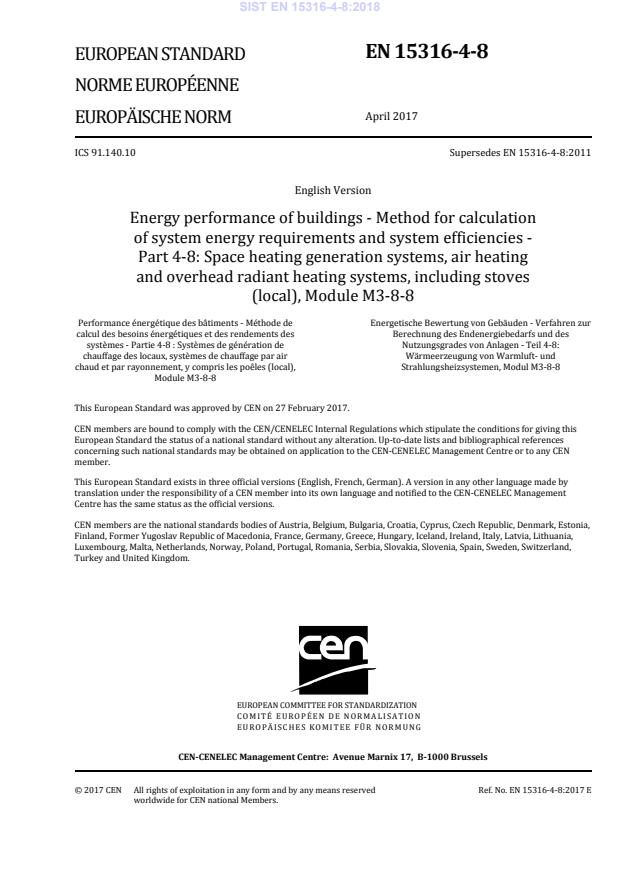
(Main)Energy performance of buildings - Method for calculation of system energy requirements and system efficiencies - Part 4-8: Space heating generation systems, air heating and overhead radiant heating systems, including stoves (local), Module M3-8-8
Energy performance of buildings - Method for calculation of system energy requirements and system efficiencies - Part 4-8: Space heating generation systems, air heating and overhead radiant heating systems, including stoves (local), Module M3-8-8
This European Standard is part of a series of standards on the method for calculation of system energy requirements and system efficiencies.
The scope of this specific part is to standardize the:
- required inputs;
- calculation method;
- resulting outputs,
for space heating generation by:
- air heating systems, including control;
- overhead radiant heating systems for non-domestic use, including control; and
- stoves and local heaters for residential use.
This standard does not apply to heating systems that utilize water as a heat transfer medium.
Other heat generation systems such as boilers, heat pumps and others are covered in other sub modules of M3-8.
Table 1 shows the relative position of this standard within the set of EPB standards in the context of the modular structure as set out in prEN ISO 52000-1.
NOTE 1 In prCEN ISO/TR 52000 2 the same table can be found, with, for each module, the numbers of the relevant EPB standards and accompanying technical reports that are published or in preparation.
NOTE 2 The modules represent EPB standards, although one EPB standard may cover more than one module and one module may be covered by more than one EPB standard, for instance a simplified and a detailed method respectively. See also Clause 2 and Tables A.1 and B.1.
Energetische Bewertung von Gebäuden — Verfahren zur Berechnung der Energieanforderungen und Nutzungsgrade der Anlagen — Teil 4-8: Wärmeerzeugung von Warmluft- und Strahlungsheizsystemen, einschließlich Öfen (lokal), Modul M3 8 8
Diese Europäische Norm ist Teil einer Normenreihe für Verfahren zur Berechnung der Energieanfor-derungen und Nutzungsgrade von Anlagen.
Der Anwendungsbereich des vorliegenden Teils dient zur Normung
— notwendiger Eingabedaten,
— des Berechnungsverfahrens,
— der sich ergebenden Ausgaben bzw. Ausgabedaten,
für die Wärmeerzeugung zur Raumheizung durch
— Warmluftsysteme, einschließlich deren Regelung,
— Strahlungsheizsysteme für gewerbliche Nutzung, einschließlich deren Regelung, und
— Öfen und Heizgeräte für den Einsatz in Wohngebäuden.
Diese Norm gilt nicht für Warmluftsysteme, die Wasser als Wärmeträger verwenden.
Andere Wärmeerzeugungssysteme, wie z. B. Kessel, Wärmepumpen und sonstige, werden in anderen Teilmodulen von M3 8 behandelt.
Tabelle 1 zeigt die relative Position dieser Norm innerhalb des EPB-Normenpakets im Kontext der in EN ISO 52000 1 dargelegten modularen Struktur.
ANMERKUNG 1 In CEN ISO/TR 52000 2 findet sich die gleiche Tabelle mit den Nummern (für jedes Modul) der jeweiligen EPB-Normen und den dazugehörigen technischen Berichten, die bereits veröffentlicht wurden oder sich in der Erstellung befinden.
ANMERKUNG 2 Die Module repräsentieren EPB-Normen, auch wenn eine EPB-Norm mehr als ein Modul abdecken kann und ein Modul von mehr als einer EPB-Norm abgedeckt werden kann, zum Beispiel jeweils ein vereinfachtes und ein detailliertes Verfahren. Siehe auch Abschnitt 2 und Tabellen A.1 und B.1
Performance énergétique des bâtiments - Méthode de calcul des besoins énergétiques et des rendements des systèmes - Partie 4-8 : Systèmes de génération de chauffage des locaux, systèmes de chauffage par air chaud et par rayonnement, y compris les poêles (local), Module M3-8-8
La présente Norme européenne fait partie d’une série de normes sur la méthode de calcul des besoins énergétiques et des rendements des systèmes.
L’objet de cette partie spécifique est de normaliser :
- les données d’entrée requises ;
- la méthode de calcul ;
- les données de sortie obtenues,
pour la génération du chauffage des locaux par :
- des systèmes de chauffage par air chaud, y compris leur régulation ;
- des systèmes de chauffage suspendus par rayonnement destinés à une utilisation non résidentielle, y compris leur régulation ; et
- des poêles et des appareils de chauffage locaux destinés à un usage résidentiel.
La présente norme ne s’applique pas aux systèmes de chauffage qui utilisent l’eau comme fluide caloporteur.
D’autres systèmes de génération de chaleur, tels que les chaudières ou les pompes à chaleur, sont traités dans d’autres sous-modules de M3-8.
Le Tableau 1 illustre la position relative de la présente norme au sein de la série de normes PEB dans le contexte de la structure modulaire telle que définie dans l'EN ISO 52000-1.
NOTE 1 Le même tableau figure dans le CEN ISO/TR 52000 2 avec, pour chaque module, le numéro de la norme PEB concernée et les rapports techniques d’accompagnement qui ont été publiés ou qui sont en préparation.
NOTE 2 Les modules représentent des normes PEB, même si une norme PEB peut couvrir plusieurs modules et un module peut être couvert par plusieurs normes PEB, par exemple une méthode simplifiée et une méthode détaillée. Voir également l’Article 2 et les Tableaux A.1 et B.1.
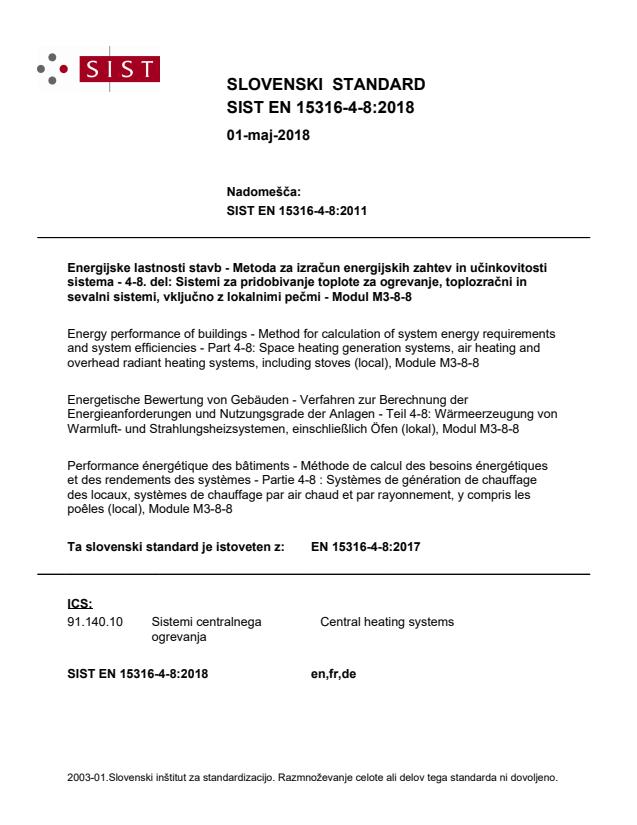
Energijske lastnosti stavb - Metoda za izračun energijskih zahtev in učinkovitosti sistema - 4-8. del: Sistemi za pridobivanje toplote za ogrevanje, toplozračni in sevalni sistemi, vključno z lokalnimi pečmi - Modul M3-8-8
Ta standard je del skupine standardov za metodo za izračun energijskih zahtev in učinkovitosti sistema.
Namen tega posameznega dela je standardizirati:
– zahtevane vhode;
– računsko metodo;
– dejanske izhode;
za proizvodnjo ogrevanja prostora:
– s sistemi za ogrevanja zraka, vključno z nadzorom;
– z nadzemnimi sistemi talnega ogrevanja za negospodinjsko rabo, vključno z nadzorom; in
– z grelnimi napravami.
Ta standard ne velja za sisteme ogrevanja, ki kot medij za prenos toplote uporabljajo vodo.
Drugi sistemi za proizvodnjo toplote, kot so kotli, toplotne črpalke in drugi so zajeti v drugih podmodulih dela M3 8.
General Information
Relations
Standards Content (Sample)
2003-01.Slovenski inštitut za standardizacijo. Razmnoževanje celote ali delov tega standarda ni dovoljeno.Energetische Bewertung von Gebäuden - Verfahren zur Berechnung der Energieanforderungen und Nutzungsgrade der Anlagen - Teil 4-8: Wärmeerzeugung von Warmluft- und Strahlungsheizsystemen, einschließlich Öfen (lokal), Modul M3-8-8Performance énergétique des bâtiments - Méthode de calcul des besoins énergétiques et des rendements des systèmes - Partie 4-8 : Systèmes de génération de chauffage des locaux, systèmes de chauffage par air chaud et par rayonnement, y compris les poêles (local), Module M3-8-8Energy performance of buildings - Method for calculation of system energy requirements and system efficiencies - Part 4-8: Space heating generation systems, air heating and overhead radiant heating systems, including stoves (local), Module M3-8-891.140.10Sistemi centralnega ogrevanjaCentral heating systemsICS:Ta slovenski standard je istoveten z:EN 15316-4-8:2017SIST EN 15316-4-8:2018en,fr,de01-maj-2018SIST EN 15316-4-8:2018SLOVENSKI
STANDARDSIST EN 15316-4-8:20111DGRPHãþD
EUROPEAN STANDARD NORME EUROPÉENNE EUROPÄISCHE NORM
EN 15316-4-8
April
t r s y ICS
{ sä s v rä s r Supersedes EN
s w u s xæ væ zã t r s sEnglish Version
Energy performance of buildings æ Method for calculation of system energy requirements and system efficiencies æ Part
væ zã Space heating generation systemsá air heating and overhead radiant heating systemsá including stoves Performance énergétique des bâtiments æ Méthode de calcul des besoins énergétiques et des rendements des systèmes æ Partie
væ z ã Systèmes de génération de chauffage des locauxá systèmes de chauffage par air Module M uæ zæ z
Energetische Bewertung von Gebäuden æ Verfahren zur Berechnung des Endenergiebedarfs und des Nutzungsgrades von Anlagen æ Teil
væ zã Wärmeerzeugung von Warmluftæ und Strahlungsheizsystemená Modul M uæ zæ z This European Standard was approved by CEN on
t y February
t r s yä
egulations which stipulate the conditions for giving this European Standard the status of a national standard without any alterationä Upætoædate lists and bibliographical references concerning such national standards may be obtained on application to the CENæCENELEC Management Centre or to any CEN memberä
translation under the responsibility of a CEN member into its own language and notified to the CENæCENELEC Management Centre has the same status as the official versionsä
CEN members are the national standards bodies of Austriaá Belgiumá Bulgariaá Croatiaá Cyprusá Czech Republicá Denmarká Estoniaá Finlandá Former Yugoslav Republic of Macedoniaá Franceá Germanyá Greeceá Hungaryá Icelandá Irelandá Italyá Latviaá Lithuaniaá Luxembourgá Maltaá Netherlandsá Norwayá Polandá Portugalá Romaniaá Serbiaá Slovakiaá Sloveniaá Spainá Swedená Switzerlandá Turkey and United Kingdomä
EUROPEAN COMMITTEE FOR STANDARDIZATION COMITÉ EUROPÉEN DE NORMALISATION EUROPÄISCHES KOMITEE FÜR NORMUNG
CEN-CENELEC Management Centre:
Avenue Marnix 17,
B-1000 Brussels
t r s y CEN All rights of exploitation in any form and by any means reserved worldwide for CEN national Membersä Refä Noä EN
s w u s xæ væ zã t r s y ESIST EN 15316-4-8:2018
European foreword . 4 Introduction . 5 1 Scope . 7 2 Normative references . 9 3 Terms and definitions . 9 4 Symbols and subscripts . 11 4.1 Symbols . 11 4.2 Subscripts . 12 5 Description of the methods . 12 5.1 Output of the method . 12 5.2 Alternative methods . 13 5.3 Connection with building needs and zoning . 13 5.4 Application data. 14 5.5 Using net and gross calorific values . 14 6 On/off heaters . 14 6.1 Output data . 14 6.2 Calculation intervals . 15 6.3 Input data . 16 6.4 Calculation procedure . 22 7 High-low and modulating heaters . 28 7.1 Output data . 28 7.2 Calculation intervals . 28 7.3 Input data . 28 7.4 Calculation procedure . 30 8 Stoves and local heaters . 37 8.1 General . 37 8.2 Stoves and local heaters without connection to a water based heating system. 37 8.3 Stoves and local heaters with a connection to a water based heating system . 38 9 Quality control . 40 9.1 On/off heaters, local heaters and stoves . 40 9.2 Modulating and high-low heaters, local heaters
and stoves . 41 9.3 Stoves with connection to a water system . 41 Annex A (normative)
Template for choices, input data and references. 42 A.1 Introduction . 42 A.2 References . 42 A.3 Product data . 43 A.4 System design data . 46 A.5 Method selection criteria . 47 SIST EN 15316-4-8:2018
Default choices, input data and references . 48 B.1 Introduction. 48 B.2 References . 48 B.3 Product data . 50 B.4 System design data . 55 B.5 Method selection criteria . 56 Annex C (informative)
Equivalence between the data specification according to draft Ecodesign regulation on solid fuel local heaters and the required product data
input for this module . 57 Bibliography . 60
Overarching Building (as such) Technical Building Systems SUbmodule Descriptions
Descriptions
Descriptions Heating Cooling Ventilation Humidification Dehumidification Domestic Hot water Lighting Building automation and control Electricity production sub1
M1
M2
M3 M4 M5 M6 M7 M8 M9 M10 M11 1 General
General
General 15316–1
15316–1
2 Common terms and definitions; symbols, units and subscripts
Building Energy Needs
Needs
12831–3
3 Applications
(Free) Indoor Conditions without Systems
Maximum Load and Power 12831–1
12831–3
4 Ways to Express Energy
Performance
Ways to Express Energy Performance
Ways to Express Energy Performance 15316–1
15316–1
5 Building categories and Building Boundaries
Heat Transfer by Transmission
Emission and control 15316–2 15316–2
6 Building Occupancy and Operating Conditions
Heat Transfer by Infiltration and Ventilation
Distribution and control 15316–3 15316–3
15316–3
7 Aggregation of Energy Services and Energy Carriers
Internal
Heat Gains
Storage and control 15316–5
15316–5 15316–4-3
8 Building zoning
Solar
Heat Gains
Generation
8–1
Combustion boilers 15316–4-1
15316–4-1
8–2
Heat pumps 15316–4-2 15316–4-2
15316–4-2
8–3
Thermal solar Photovoltaics 15316–4-3
15316–4-3
15316–4-3 8–4
On-site cogeneration 15316–4-4
15316–4-4
15316–4-4 8–5
District heating and cooling 15316–4-5 15316–4-5
15316–4-5 8–6
Direct electrical heater 15316–4-8
15316–4-8
8–7
Wind turbines
15316–4-10 8–8
Radiant heating, stoves 15316–4-8
9 Calculated Energy Performance
Building Dynamics (thermal mass)
Load dispatching and operating conditions
10 Measured
Energy
Performance
Measured Energy Performance
Measured Energy Performance 15378–3
15378–3
11 Inspection
Inspection
Inspection 15378–1
15378–1
12 Ways to Express Indoor Comfort
– BMS
13 External Environment Conditions
14 Economic Calculation 15459–1
a
The shaded modules are not applicable SIST EN 15316-4-8:2018
Heat loss factor %
Load factor, power factor - c Correlation parameter various k Factor, part of recoverable auxiliary energy, part of envelope losses - n Exponent
ÏÍ Temperature gradient K/m m' Mass flow rate
H Heigth m 4.2 Subscripts For the purposes of this document, the subscripts given in EN ISO 52000-1:2017, Clause 4 and Annex C and the specific subscripts listed in Table 3 apply. Table 3 — Subscripts air air gen generator rad radiant blw blower h height s gross (calorific value) br burner i net (calorific value) test test conditions ch chimney lrh local or radiant heater w heating system water cmb combustion mass mass, specific weight vent ventilation cond condensation mod modulating
corr corrected plt pilot flame
env envelope Pn at nominal load
exh exiting the building Pmax at maximum power
fuel fuel Pmin at minimum power
5 Description of the methods 5.1 Output of the method The following output data are calculated by this standard for each calculation interval: — maximum heat output during the calculation interval, QH;gen;out;max; — actual heat output during the calculation interval QH;gen;out. — fuel input to the heater or stove, EH;gen;in; — recoverable generation heat losses, QH;gen;ls;rbl; SIST EN 15316-4-8:2018
r to
» M3–1/2 M1–9/1 Recoverable heat losses QH;gen;ls;rbl kWh
r to
» M2–2/1 Total auxiliary energy WH;gen;aux kWh
r to
» M3–1/2 Maximum heat output during calculation interval QH;gen;out;max kWh
r to
» M3–1/2 Actual heat output during calculation interval QH;gen;out; kWh
r to
» M3–1/2 Fuel type BLR_FUEL List List M1–9/1 SIST EN 15316-4-8:2018
r to
» 6.3.1.2.2 NO Fuel flow rate at full power m'lrh;fuel;Pn QT/h a QT/h
r to
» 6.3.1.2.2 NO Heat losses to the flue with burner on at full load lrh;ch;ON % % 0 to 20 6.3.1.2.3 NO Correction factor for heat losses to the flue with burner on flrh;corr;ch;ON - - 0 to 1 6.3.1.2.4 NO Test temperature for heat losses to the flue with burner on lrh;air;test;ON °C °C 0 to 40 6.3.1.2.5 NO Load factor exponent nlrh;ch;ON - - 0 to 1 6.3.1.2.6 NO Auxiliary power of equipment related to the burner at full load lrh;aux;br;Pn W or kW kW
r to
» 6.3.1.2.7 NO Auxiliary power of equipment after the burner at full load lrh;aux;blw;Pn W or kW kW
r to
» 6.3.1.2.8 NO Auxiliary power at stand-by lrh;aux;sby W or kW kW
r to
» 6.3.1.2.9 NO Losses through the generator envelope lrh;env % % 0 to 40 6.3.1.2.10 NO Pilot flame losses lrh;pilot % % 0 to 10 6.3.1.2.11 NO Data for condensing heaters
Combustion efficiency of condensing heaters at full load lrh;cmb;Pn % % 90 to 110 6.3.1.2.12 NO a QT may be any suitable mass unit of fuel, like Sm3, kg, etc. it shall be consistent with the mass unit for calorific values. 6.3.1.2.2 lrh;cmb;Pn lrh,cmb,Pn shall be the value declared by the manufacturer. lrh;out;Pn lrh;Pn at full load, then the full load thermal input is calculated as ηΦΦ=lrh;out;Pnlrh;cmb;Pnlrh;Pn (4) If no manufacturer data are available, then the full load thermal input is calculated as: Φ=⋅lrh;cmb;Pnlrh;fuel;Pni;fuelmH (5) SIST EN 15316-4-8:2018
during stand-by shall be the value declared by the manufacturer. lrh,aux,sby shall be calculated according to the full load lrh,comb,Pn with the following equation: ⋅ΦΦ=lrh;aux;sbylrh;cmb;Pnlrh;aux;sby100k (9) where klrh,aux,blw is a default percentage value. Default values of klrh,aux,blw are given in Table B.12 according to the heater type. 6.3.1.2.10 Losses through the generator envelope lrh;env lrh;env is the heat loss from the appliance envelope when the appliance is in operation, expressed as a percentage of the thermal input lrh;cmb;Pn. Losses through the generator envelope lrh;env shall be the value declared by the manufacturer. If no data are avagen;env shall be calculated with: αΦ=−⋅lrh;cmb;Pnlrh;envlrh;1lrh;2log1000Wcc
(10) SIST EN 15316-4-8:2018
«10 to +10 Local NO Specific ventilation flow rate V'lrh,vent m3/kWh 5 to 20 EN 13410 NO Combustion air intake LRH_COMB_AIR n.a. List Local NO NOTE “local” means that the data are not coming from another module. 6.3.2.1.2 Auxiliary energy recovery factor klrh,aux;rh The default value of the recovered fraction of auxiliary energy klrh;aux;rh is given in Table B.18 according to the heater installation room. 6.3.2.1.3 Correction factor for envelope losses The recovery of envelope losses is taken into account as a reduction of losses expressed by the multiplying factor klrh;env applied to the envelope. The value of the correction factor of envelope losses klrh;env shall be within the interval from 0 (all the envelope losses are considered as recovered, e.g. when the heater is within the heated space) to 1 (no envelope losses are considered as recovered, e.g. when the heater is outside the heated space). Default values of the correction factor of envelope losses klrh;env are given in Table B.19 according to the heater installation room. 6.3.2.1.4 Induced ventilation losses data The following data are required for the calculation of induced ventilation losses when the heater discharges the flue gases in the heated space: Hlrh is the height of the installation room of the heater; dint;H is the vertical gradient of internal temperature in °C/m; lrh;rad is the difference between air and radiant temperature. Default values for dH lrh;rad are given in Table B.20. 6.3.2.2 Process control data There are no relevant process control data. 6.3.3 Operating conditions Required operating conditions data for this calculation procedure are listed in Table 7. SIST EN 15316-4-8:2018
r to
» M3–1/1 YES Calculation interval duration tci h 0 to 8760 M1–9/1 YES Total time of required heater operation tlrh;gen h 0 to 8760 M3–1/1 YES Average external temperature in the calculation interval ext °C
«50 to +50 M1–13/1 YES Indoor temperature of the room where the heater is located int °C
«50 to +50 M1–6/1 YES 6.3.4 Constants and physical data Table 8 — Constants and physical data Name Symbol Unit Origin Value Air / flue specific heat cp,air Wh/(m3·K) Local 0,34 Net calorific value of fuel Hi kWh/mass unit M1–10/1 Depends on fuel Gross calorific value of fuel Hs kWh/mass unit M1–10/1 Depends on fuel 6.4 Calculation procedure 6.4.1 Applicable calculation interval This procedure can be used with the following time-steps: — yearly; — monthly; — hourly; — bin. No dynamic effects are explicitly taken into account because there are no significant time constants. This procedure is suitable for dynamic simulations. 6.4.2 Time with burner ON an
...
Questions, Comments and Discussion
Ask us and Technical Secretary will try to provide an answer. You can facilitate discussion about the standard in here.
Loading comments...