

EN 14617-10:2012
(Main)Agglomerated stone - Test methods - Part 10: Determination of chemical resistance
- Abstract
This European Standard specifies a method for determining the chemical resistance and the resistance to stains of agglomerated stones (see EN 14618) with a polished surface after a prolonged contact with chemical materials.
NOTE It is to be remembered that agglomerated stones containing calcium carbonate aggregates are sensitive to any acid attack.
.
- Status
- Published
- Publication Date
- 10-Apr-2012
- Withdrawal Date
- 30-Oct-2012
- Technical Committee
- CEN/TC 246 - Natural stones
- Drafting Committee
- CEN/TC 246/WG 4 - Agglomerated stones (JWG 229/246)
- Current Stage
- 9092 - Decision on results of review/2YR ENQ - revise - Review Enquiry
- Start Date
- 25-May-2019
- Completion Date
- 07-Oct-2026

Overview
EN 14617-10:2012 is a European Standard developed by CEN focused on the chemical resistance testing of agglomerated stone. This standard specifies a standardized test method to evaluate the resistance of polished agglomerated stone surfaces to chemical attack and staining caused by prolonged contact with specific chemical reagents. The document highlights the sensitivity of agglomerated stones containing calcium carbonate aggregates to acid attack, emphasizing the importance of accurate and repeatable testing to ensure durability and surface integrity.
Key Topics
Chemical Resistance Testing
The standard provides a detailed procedure to assess the chemical resistance of agglomerated stones by exposing specimens to hydrochloric acid and sodium hydroxide solutions. The effect is measured by the loss of surface gloss or reflection, which indicates surface degradation.Glossmeter Measurement
A glossmeter is used to quantitatively measure the brightness or reflection degree of the stone surface before and after chemical exposure. Measurements are taken at specific angles (60° and 20°) to cover a broad range of surface gloss levels. This provides accurate data on how chemicals affect surface appearance.Specimen Preparation
Samples must be polished and cleaned before testing to remove finishes and other contaminants. They are prepared with a chemically resistant ring to contain the test solutions and kept under controlled conditions for specified exposure times.Stain Resistance Determination
Annex A outlines test methods for determining resistance to various staining agents. The method involves applying common staining substances, followed by rinsing and visual inspection to assess coloration changes or residual stains.Classification of Chemical Resistance
Based on gloss loss after acid and alkali exposure, materials receive resistance categories from C1 (lowest) to C4 (highest), providing a clear classification system for product evaluation.Test Reporting
The standard defines comprehensive test report requirements, including details of specimen preparation, chemical agents used, test conditions, measurement methods, and final results with measurement uncertainties.
Applications
Quality Control for Stone Manufacturers
EN 14617-10:2012 is crucial for manufacturers of agglomerated stone products to verify the chemical durability of polished surfaces. This ensures stones meet performance criteria for interior and exterior applications.Construction and Architecture
Architects and builders rely on test data from this standard when selecting agglomerated stone for flooring, cladding, countertops, and wall coverings, ensuring materials withstand exposure to cleaning agents, alkalis, and mild acids encountered during use.Material Certification and Compliance
Laboratories and testing agencies use the standard for certifying the durability and chemical resilience of agglomerated stone products in accordance with European regulations.Product Development and Innovation
Stone product developers utilize the test methods to assess new formulations and finishes aimed at enhancing chemical resistance and stain protection.
Related Standards
EN 14617-10:2012 is part of a broader series of standards dealing with agglomerated stone characterization and testing, including but not limited to:
- EN 14617-1: Determination of apparent density and water absorption
- EN 14617-2: Determination of flexural strength
- EN 14617-4: Determination of abrasion resistance
- EN 14617-5: Determination of freeze and thaw resistance
- EN 14617-6: Determination of thermal shock resistance
- EN 14617-9: Determination of impact resistance
- EN 14617-11: Determination of linear thermal expansion coefficient
- EN 14617-12: Determination of dimensional stability
- EN 14617-15: Determination of compressive strength
These interconnected standards collectively ensure comprehensive assessment of agglomerated stone materials' mechanical, physical, and chemical properties necessary for guaranteed performance in building and design.
Keywords: EN 14617-10:2012, chemical resistance, agglomerated stone, test methods, CEN standard, polished surface, stain resistance, glossmeter, hydrochloric acid test, sodium hydroxide test, calcium carbonate sensitivity, stone durability, building materials testing, European Standard, product certification
Relations
- Replaces
EN 14617-10:2005 - Agglomerated stone - Test methods - Part 10: Determination of chemical resistance - Effective Date
- 18-Apr-2012
- Referred By
EN 15564:2008 - Precast concrete products - Resin bound concrete - Requirements and test methods - Effective Date
- 28-Jan-2026
- Effective Date
- 28-Jan-2026
- Referred By
EN 15285:2008 - Agglomerated stone - Modular tiles for flooring and stairs (internal and external) - Effective Date
- 28-Jan-2026
- Referred By
EN 15388:2008 - Agglomerated stone - Slabs and cut-to-size products for vanity and kitchen tops - Effective Date
- 28-Jan-2026
- Referred By
EN 15388:2020 - Agglomerated stone - Slabs and cut-to-size products for vanity and kitchen tops - Effective Date
- 28-Jan-2026
Get Certified
Connect with accredited certification bodies for this standard

DIBt (Deutsches Institut für Bautechnik)
German Institute for Building Technology.
DIN CERTCO
DIN Group product certification.

Aboma Certification B.V.
Specialized in construction, metal, and transport sectors.
Sponsored listings
Frequently Asked Questions
EN 14617-10:2012 is a standard published by the European Committee for Standardization (CEN). Its full title is "Agglomerated stone - Test methods - Part 10: Determination of chemical resistance". This standard covers: This European Standard specifies a method for determining the chemical resistance and the resistance to stains of agglomerated stones (see EN 14618) with a polished surface after a prolonged contact with chemical materials. NOTE It is to be remembered that agglomerated stones containing calcium carbonate aggregates are sensitive to any acid attack. .
This European Standard specifies a method for determining the chemical resistance and the resistance to stains of agglomerated stones (see EN 14618) with a polished surface after a prolonged contact with chemical materials. NOTE It is to be remembered that agglomerated stones containing calcium carbonate aggregates are sensitive to any acid attack. .
EN 14617-10:2012 is classified under the following ICS (International Classification for Standards) categories: 91.100.15 - Mineral materials and products. The ICS classification helps identify the subject area and facilitates finding related standards.
EN 14617-10:2012 has the following relationships with other standards: It is inter standard links to EN 14617-10:2005, EN 15564:2008, EN 16954:2018, EN 15285:2008, EN 15388:2008, EN 15388:2020. Understanding these relationships helps ensure you are using the most current and applicable version of the standard.
EN 14617-10:2012 is available in PDF format for immediate download after purchase. The document can be added to your cart and obtained through the secure checkout process. Digital delivery ensures instant access to the complete standard document.
Standards Content (Sample)
2003-01.Slovenski inštitut za standardizacijo. Razmnoževanje celote ali delov tega standarda ni dovoljeno.Aglomeriran kamen - Preskusne metode - 10. del: Ugotavljanje kemijske odpornostiKünstlich hergestellter Stein - Prüfverfahren - Teil 10: Bestimmung der chemischen BeständigkeitPierre agglomérée - Méthodes d'essai - Partie 10: Détermination de la résistance chimiqueAgglomerated stone - Test methods - Part 10: Determination of chemical resistance91.100.15Mineralni materiali in izdelkiMineral materials and productsICS:Ta slovenski standard je istoveten z:EN 14617-10:2012SIST EN 14617-10:2012en,fr,de01-julij-2012SIST EN 14617-10:2012SLOVENSKI
STANDARDSIST EN 14617-10:20051DGRPHãþD
EUROPEAN STANDARD NORME EUROPÉENNE EUROPÄISCHE NORM
EN 14617-10
April 2012 ICS 91.100.15 Supersedes EN 14617-10:2005English Version
Agglomerated stone - Test methods - Part 10: Determination of chemical resistance
Pierre agglomérée - Méthodes d'essai - Partie 10: Détermination de la résistance chimique
Künstlich hergestellter Stein - Prüfverfahren - Teil 10: Bestimmung der chemischen Beständigkeit This European Standard was approved by CEN on 9 March 2012.
CEN members are bound to comply with the CEN/CENELEC Internal Regulations which stipulate the conditions for giving this European Standard the status of a national standard without any alteration. Up-to-date lists and bibliographical references concerning such national standards may be obtained on application to the CEN-CENELEC Management Centre or to any CEN member.
This European Standard exists in three official versions (English, French, German). A version in any other language made by translation under the responsibility of a CEN member into its own language and notified to the CEN-CENELEC Management Centre has the same status as the official versions.
CEN members are the national standards bodies of Austria, Belgium, Bulgaria, Croatia, Cyprus, Czech Republic, Denmark, Estonia, Finland, France, Germany, Greece, Hungary, Iceland, Ireland, Italy, Latvia, Lithuania, Luxembourg, Malta, Netherlands, Norway, Poland, Portugal, Romania, Slovakia, Slovenia, Spain, Sweden, Switzerland, Turkey and United Kingdom.
EUROPEAN COMMITTEE FOR STANDARDIZATION
COMITÉ EUROPÉEN DE NORMALISATION EUROPÄISCHES KOMITEE FÜR NORMUNG
Management Centre:
Avenue Marnix 17,
B-1000 Brussels © 2012 CEN All rights of exploitation in any form and by any means reserved worldwide for CEN national Members. Ref. No. EN 14617-10:2012: ESIST EN 14617-10:2012
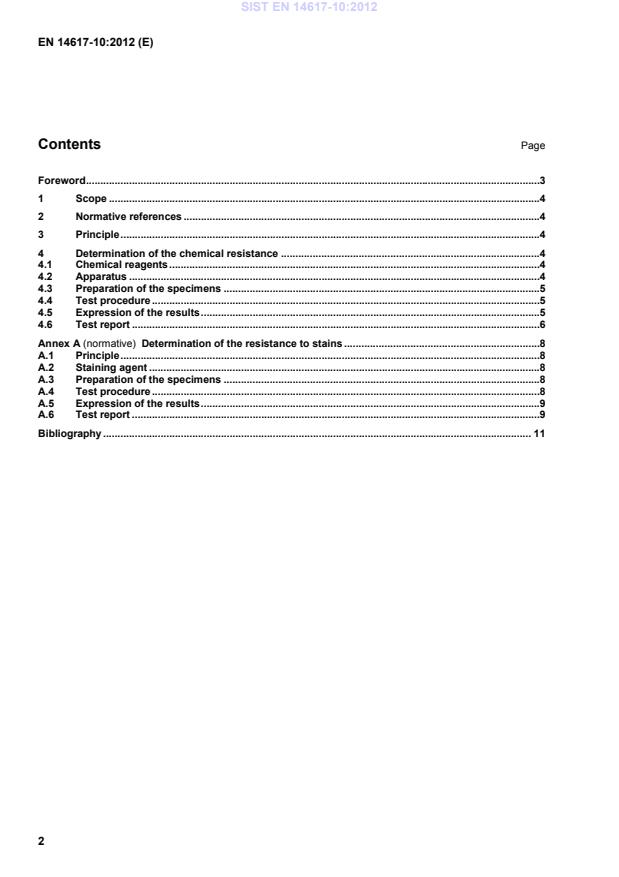
Determination of the resistance to stains .8A.1 Principle .8A.2 Staining agent .8A.3 Preparation of the specimens .8A.4 Test procedure .8A.5 Expression of the results .9A.6 Test report .9Bibliography . 11 SIST EN 14617-10:2012
EN 14617-5, Agglomerated stone — Test methods — Part 5: Determination of freeze and thaw resistance EN 14617-6, Agglomerated stone — Test methods — Part 6: Determination of thermal shock resistance EN 14617-8, Agglomerated stone — Test methods — Part 8: Determination of resistance to fixing (dowel hole) EN 14617-9, Agglomerated stone — Test methods — Part 9: Determination of impact resistance EN 14617-10, Agglomerated stone — Test methods — Part 10: Determination of chemical resistance EN 14617-11, Agglomerated stone — Test methods — Part 11: Determination of linear thermal expansion coefficient EN 14617-12, Agglomerated stone — Test methods — Part 12: Determination of dimensional stability EN 14617-13, Agglomerated stone — Test methods — Part 13: Determination of electrical resistivity EN 14617-15, Agglomerated stone — Test methods — Part 15: Determination of compressive strength EN 14617-16, Agglomerated stone — Test methods — Part 16: Determination of dimensions, geometric characteristics and surface quality of modular tiles According to the CEN/CENELEC Internal Regulations, the national standards organizations of the following countries are bound to implement this European Standard: Austria, Belgium, Bulgaria, Croatia, Cyprus, Czech Republic, Denmark, Estonia, Finland, France, Germany, Greece, Hungary, Iceland, Ireland, Italy, Latvia, Lithuania, Luxembourg, Malta, Netherlands, Norway, Poland, Portugal, Romania, Slovakia, Slovenia, Spain, Sweden, Switzerland, Turkey and the United Kingdom. SIST EN 14617-10:2012
...