

EN 18183:2026
(Main)Pumps - Specification for gland packings manufactured from yarns and ribbons
- Abstract
This document provides a method of describing the materials, impregnates and lubricants for various types of yarn and ribbon based packings intended for use as gland seals in mechanical equipment such as pumps, mixers, etc as a guide for packing manufacturers, pump OEM’s and end users. It does not include similar products intended for other duties such as thermal insulation.
Guidance is also given regarding dimensional and physical quality aspects of the packings and requirements for packaging and marking.
Tests are specified for the determination of lubricant content, size and mass.
NOTE 1 The information supplied by the purchaser at the time of enquiry and/or order is given in Annex B.
NOTE 2 All packings are free from introduced asbestos fibres in conformance with Annex XVII of REACH.
- Status
- Not Published
- Publication Date
- 27-Oct-2026
- Technical Committee
- CEN/TC 197 - Pumps
- Current Stage
- 6055 - CEN Ratification completed (DOR) - Publishing
- Start Date
- 14-Sep-2026
- Due Date
- 11-Dec-2025
- Completion Date
- 14-Sep-2026

EN 18183 is a CEN standard for yarn- and ribbon-based gland packings used as seals in mechanical equipment such as pumps and mixers. It specifies how to describe the packing materials, impregnants, lubricants, reinforcement and density, and it gives test methods and acceptance guidance for size, mass, lubricant content, packaging and marking.
What does EN 18183 specify?
EN 18183 covers gland packings manufactured from yarns and ribbons for sealing duties in pumps, mixers and similar equipment. It is also intended as a guide for packing manufacturers, pump OEMs and end users when they need to specify or identify a packing.
The standard is limited to these sealing packings and excludes similar products made for other duties such as thermal insulation. It also points purchasers to the information they need to provide when ordering, and it sets out the test methods used to check key properties.
Document structure
| Annex | What it covers |
|---|---|
| Annex A | Normative test methods for lubricant content, size, density, tensile strength and elongation at break, shrinkage, and creep resistance |
| Annex B | Normative information to be supplied by the purchaser |
Main clauses cover scope, normative references, terms and definitions, packing types and coding, construction, shape and cross-section, size, physical quality, packaging, marking, and quality of materials.
What are the key requirements of EN 18183?
EN 18183 is mainly a specification and identification standard. Its most important technical content is the coding system for packings, the construction and size rules, the visual quality checks, and the material-property tests.
Packing description and coding
Clause 4 requires each packing to be described by a unique code. The code identifies the yarn group and yarn type, the minimum yarn content, impregnant type and amount, lubricant type and amount, reinforcement type, density range, and whether the packing has an elastomeric core.
In practice, this means buyers and suppliers can specify the same packing in the same way, even when several materials are combined in one product. Clause 4.4 also allows an elastomeric core, and the code must then include the letter E.
Construction, form and size
Clause 5 requires packings, except expanded graphite and glass or ceramic types, to be made with the minimum number of tracks given for the nominal cross-section. Clauses 6 and 7 say that packings are normally supplied in length form, with a nominal square cross-section unless otherwise agreed, and they must stay within the cross-section tolerances in the size table.
That matters because fit in the stuffing box depends on both the construction and the finished size. Clause 7 ties the measurement method to Annex A, so the stated size is not just nominal - it is a measured property.
Physical quality, packaging and marking
Clause 8 requires a dense, firm but flexible packing with a regular surface, no obvious gaps or faults, uniform cross-section and no twisted or badly joined yarns. Clause 9 requires coiled delivery in sealed parcels protected from damage and dirt, and Clause 10 requires clear parcel marking with manufacturer identification, the standard number and packing code, size, length or weight, and month and year of manufacture.
This is important for traceability, storage and correct installation. Clause 10 also states that marking ESA PD 002 on or in relation to a product is the manufacturer’s declaration of conformity with this document.
Material quality and special material checks
Clause 11 sets yarn property checks for tensile strength, elongation at break and shrinkage, using the methods in Annex A. It also sets creep resistance requirements for packings and adds specific checks for PTFE packings and expanded graphite packings.
For PTFE-containing packings, the document also points to REACH restrictions for asbestos fibres and for added PFOA or PFOS residues. For expanded graphite packings, it requires additional composition and contamination checks using named ASTM methods.
What terms does EN 18183 define?
EN 18183 uses the glossary in the FSA/ESA Compression Packing Technical Manual, so its technical vocabulary follows that source.
- Gland packing - a sealing packing used in gland seals in equipment such as pumps and mixers.
- Packing code - the coded description that identifies the packing’s yarns, impregnant, lubricant, reinforcement, density and core condition.
- Impregnant - a material added into the packing, such as PTFE, mineral grease/oil, silicone grease/oil, graphite or mica.
- Lubricant - oil or grease in the packing, stated as a minimum percentage by weight.
- Reinforcement - an added material used to support the packing, such as glass, cotton, carbon, PTFE filament, stainless steel or Ni/Cr.
- PTFE - polytetrafluoroethylene, used in several packing types and treated carefully because heated PTFE can produce fumes.
Who uses EN 18183?
EN 18183 is used by packing manufacturers when they design, describe and test gland packings. It is also used by pump OEMs, maintenance teams, buyers and quality managers who need to specify the packing type, check delivery condition, and confirm that a product matches the agreed code.
The standard is relevant to industries that use pumps, mixers and similar mechanical equipment with gland seals. It is also useful for laboratory and quality-control staff who perform the tests in Annex A.
Which standards are used with EN 18183?
EN 18183 refers to ISO 18067 for shrinkage testing of packing yarns and to the FSA/ESA Compression Packing Technical Manual for terms and definitions.
It also uses or cites several other standards and methods in its annexes and bibliography, including EN ISO 527 or ASTM D2256 for tensile testing, EN ISO 4797, ISO 4793, BS 2071 and BS 572 for the lubricant-content test setup, and ASTM C561, ASTM D4239, ASTM D4327 and ASTM D5373 for expanded graphite checks.
What does the EN 18183 document contain?
EN 18183 contains coding tables for yarn groups, yarn types, impregnant and lubricant types, and reinforcement types. It also includes a construction table, a size-tolerance table, and property tables for yarn tensile strength, yarn shrinkage, creep resistance, PTFE weight loss, and expanded graphite limits.
Annex A gives step-by-step test methods for lubricant content, size, density, tensile strength and elongation at break, shrinkage, and creep resistance. Annex B lists the purchaser information needed to place an order.
Get Certified
Connect with accredited certification bodies for this standard

Institut za varilstvo d.o.o. (Welding Institute)
Slovenia's leading welding institute since 1952. ISO 3834, EN 1090, pressure equipment certification, NDT personnel, welder qualification. Only IIW Au
Sponsored listings
Frequently Asked Questions
EN 18183:2026 is a draft published by the European Committee for Standardization (CEN). Its full title is "Pumps - Specification for gland packings manufactured from yarns and ribbons". This standard covers: This document provides a method of describing the materials, impregnates and lubricants for various types of yarn and ribbon based packings intended for use as gland seals in mechanical equipment such as pumps, mixers, etc as a guide for packing manufacturers, pump OEM’s and end users. It does not include similar products intended for other duties such as thermal insulation. Guidance is also given regarding dimensional and physical quality aspects of the packings and requirements for packaging and marking. Tests are specified for the determination of lubricant content, size and mass. NOTE 1 The information supplied by the purchaser at the time of enquiry and/or order is given in Annex B. NOTE 2 All packings are free from introduced asbestos fibres in conformance with Annex XVII of REACH.
This document provides a method of describing the materials, impregnates and lubricants for various types of yarn and ribbon based packings intended for use as gland seals in mechanical equipment such as pumps, mixers, etc as a guide for packing manufacturers, pump OEM’s and end users. It does not include similar products intended for other duties such as thermal insulation. Guidance is also given regarding dimensional and physical quality aspects of the packings and requirements for packaging and marking. Tests are specified for the determination of lubricant content, size and mass. NOTE 1 The information supplied by the purchaser at the time of enquiry and/or order is given in Annex B. NOTE 2 All packings are free from introduced asbestos fibres in conformance with Annex XVII of REACH.
EN 18183:2026 is classified under the following ICS (International Classification for Standards) categories: 21.140 - Seals, glands; 23.080 - Pumps. The ICS classification helps identify the subject area and facilitates finding related standards.
EN 18183:2026 is available in PDF format for immediate download after purchase. The document can be added to your cart and obtained through the secure checkout process. Digital delivery ensures instant access to the complete standard document.
Standards Content (Sample)
SLOVENSKI STANDARD
oSIST prEN 18183:2025
01-junij-2025
Črpalke - Specifikacija za tesnila iz preje in trakov
Pumps - Specification for Gland Packings manufactured from Yarns and Ribbons
Pumpen - Spezifikation für Stopfbuchspackungen gefertigt aus Garnen und Bändern
Pompes - Spécifications pour les garnitures de presse-étoupe fabriquées en fil et ruban
Ta slovenski standard je istoveten z: prEN 18183
ICS:
21.140 Tesnilke, mašilke Seals, glands
23.080 Črpalke Pumps
oSIST prEN 18183:2025 en,fr,de
2003-01.Slovenski inštitut za standardizacijo. Razmnoževanje celote ali delov tega standarda ni dovoljeno.
oSIST prEN 18183:2025
oSIST prEN 18183:2025
DRAFT
EUROPEAN STANDARD
prEN 18183
NORME EUROPÉENNE
EUROPÄISCHE NORM
April 2025
ICS 23.080
English Version
Pumps - Specification for Gland Packings manufactured
from Yarns and Ribbons
Pompes - Spécifications pour les garnitures de presse- Pumpen - Spezifikation für Stopfbuchspackungen
étoupe fabriquées en fil et ruban gefertigt aus Garnen und Bändern
This draft European Standard is submitted to CEN members for enquiry. It has been drawn up by the Technical Committee
CEN/TC 197.
If this draft becomes a European Standard, CEN members are bound to comply with the CEN/CENELEC Internal Regulations
which stipulate the conditions for giving this European Standard the status of a national standard without any alteration.
This draft European Standard was established by CEN in three official versions (English, French, German). A version in any other
language made by translation under the responsibility of a CEN member into its own language and notified to the CEN-CENELEC
Management Centre has the same status as the official versions.
CEN members are the national standards bodies of Austria, Belgium, Bulgaria, Croatia, Cyprus, Czech Republic, Denmark, Estonia,
Finland, France, Germany, Greece, Hungary, Iceland, Ireland, Italy, Latvia, Lithuania, Luxembourg, Malta, Netherlands, Norway,
Poland, Portugal, Republic of North Macedonia, Romania, Serbia, Slovakia, Slovenia, Spain, Sweden, Switzerland, Türkiye and
United Kingdom.
Recipients of this draft are invited to submit, with their comments, notification of any relevant patent rights of which they are
aware and to provide supporting documentation.
Warning : This document is not a European Standard. It is distributed for review and comments. It is subject to change without
notice and shall not be referred to as a European Standard.
EUROPEAN COMMITTEE FOR STANDARDIZATION
COMITÉ EUROPÉEN DE NORMALISATION
EUROPÄISCHES KOMITEE FÜR NORMUNG
CEN-CENELEC Management Centre: Rue de la Science 23, B-1040 Brussels
© 2025 CEN All rights of exploitation in any form and by any means reserved Ref. No. prEN 18183:2025 E
worldwide for CEN national Members.
oSIST prEN 18183:2025
prEN 18183:2025 (E)
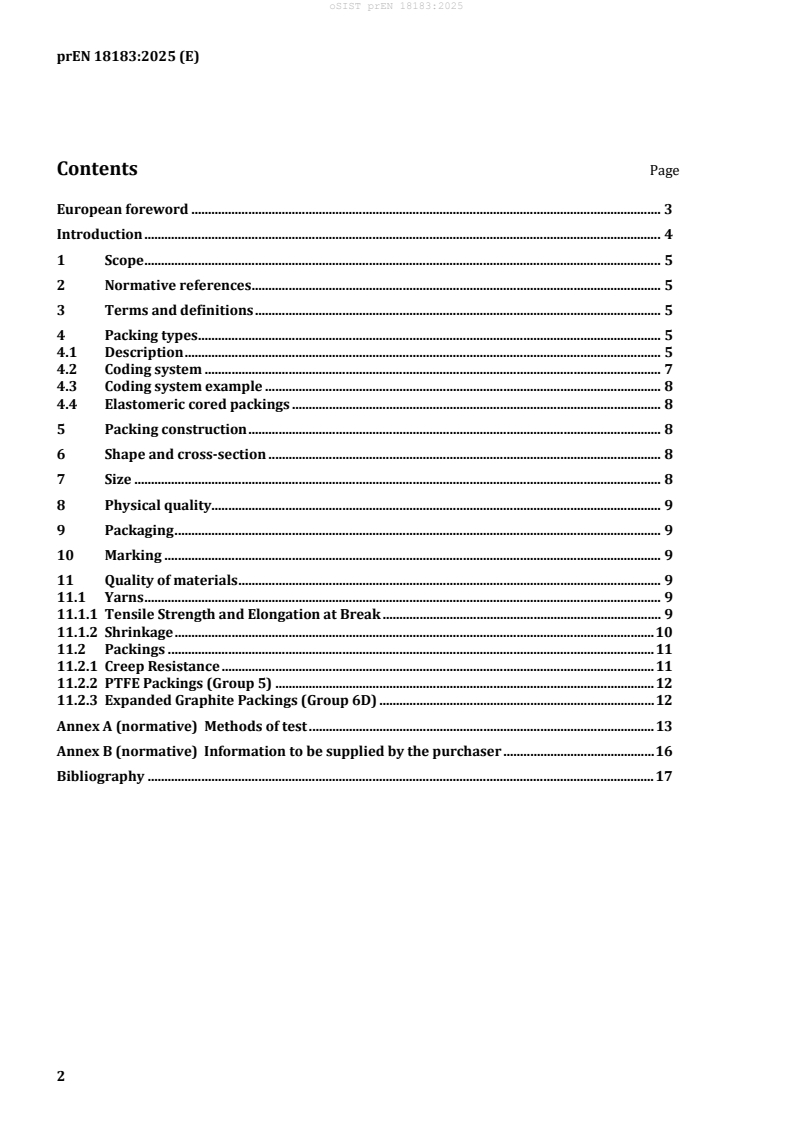
Contents Page
European foreword . 3
Introduction . 4
1 Scope . 5
2 Normative references . 5
3 Terms and definitions . 5
4 Packing types . 5
4.1 Description . 5
4.2 Coding system . 7
4.3 Coding system example . 8
4.4 Elastomeric cored packings . 8
5 Packing construction . 8
6 Shape and cross-section . 8
7 Size . 8
8 Physical quality. 9
9 Packaging . 9
10 Marking . 9
11 Quality of materials . 9
11.1 Yarns . 9
11.1.1 Tensile Strength and Elongation at Break . 9
11.1.2 Shrinkage . 10
11.2 Packings . 11
11.2.1 Creep Resistance . 11
11.2.2 PTFE Packings (Group 5) . 12
11.2.3 Expanded Graphite Packings (Group 6D) . 12
Annex A (normative) Methods of test . 13
Annex B (normative) Information to be supplied by the purchaser . 16
Bibliography . 17
oSIST prEN 18183:2025
prEN 18183:2025 (E)
European foreword
This document (prEN 18183:2025) has been prepared by Technical Committee CEN/TC 197 “Pumps”,
the secretariat of which is held by AFNOR.
This document is currently submitted to the CEN Enquiry.
oSIST prEN 18183:2025
prEN 18183:2025 (E)
Introduction
This document was originally drafted by a joint Technical Task Force of the Packings Division of the
European Sealing Association (ESA) and the Compression Packing Division of the Fluid Sealing
Association and is approved by both organisations as a suitable reference for the packing types described.
Certain of the packings contain polytetrafluoroethylene (PTFE) which, when heated to elevated
temperatures, can produce fumes which give unpleasant effects if inhaled. Care should be taken to avoid
contamination of tobacco products with PTFE.
oSIST prEN 18183:2025
prEN 18183:2025 (E)
1 Scope
This document provides a method of describing the materials, impregnates and lubricants for various
types of yarn and ribbon based packings intended for use as gland seals in mechanical equipment such
as pumps, mixers, etc. It does not include similar products intended for other duties such as thermal
insulation.
Guidance is also given regarding dimensional and physical quality aspects of the packings and
requirements for packaging and marking.
Tests are specified for the determination of lubricant content, size and mass.
NOTE 1 The information supplied by the purchaser at the time of enquiry and/or order is given in Annex B.
NOTE 2 All packings are free from introduced asbestos fibres in conformance with Annex XVII of REACH.
2 Normative references
The following documents are referred to in the text in such a way that some or all of their content
constitutes requirements of this document. For dated references, only the edition cited applies. For
undated references, the latest edition of the referenced document (including any amendments) applies.
ISO 18067, Textiles — Synthetic filament yarns — Determination of shrinkage in dry-hot air (after
treatment)
FSA/ESA, Publication ‘Compression Packings Technical Manual - 4th Edition
3 Terms and definitions
For the purposes of this document, the terms and definitions given in the Glossary of Terms in the
th
FSA/ESA Compression Packing Technical Manual 4 Edition, 2018, apply.
ISO and IEC maintain terminology databases for use in standardization at the following addresses:
— ISO Online browsing platform: available at https://www.iso.org/obp/
— IEC Electropedia: available at https://www.electropedia.org/
4 Packing types
4.1 Description
Each packing shall be described by a unique series of codes which define the following attributes:
1. The generic yarn Group or Groups,
2. The specific yarns within the Group,
3. The minimum weight of each yarn as a percentage of the total weight of the packing,
4. The minimum total weight of yarns as a percentage of the total weight of the packing,
5. The type of impregnation (where used),
6. The amount of impregnant percentage by weight,
7. The type of lubricating oil or grease (where used),
oSIST prEN 18183:2025
prEN 18183:2025 (E)
8. The amount of lubricant percentage by weight,
9. The type of reinforcement (where used),
10. The allowable density range in g/cm ,
11. Whether the packing has an elastomeric core.
Table 1 indicates the packing types.
Table 1 — Packing types
Group Yarn
Yarn group Yarn Type
number code
A Ramie
B Cotton
1 Natural C Flax
D Hemp
E Micaceous
2 Glass A Glass
3 Ceramic A Ceramic
A Para aramid
B Meta aramid
C Acrylic
D Polyimide
4 Synthetic
E Novoloid
Polyphenylene Sulfide
F
(PPS)
Polybenzimidazole
G
(PBI)
A PTFE Filament
B ePTFE
5 PFTE C ePTFE/Graphite
D ePTFE/Graphite/Oil
E ePTFE/Talc/Oil
A Preox. PAN
B Carbon
6 Carbonaceous
C Graphite
D Expanded graphite
oSIST prEN 18183:2025
prEN 18183:2025 (E)
Table 2 indicates the impregnant and lubricant types.
Table 2 — Impregnant and Lubricant Types
Impregnant or Lubricant Code
None X
PTFE P
Mineral grease/oil L
Silicone grease/oil S
Graphite G
Mica M
Table 3 indicates the reinforcement types.
Table 3 — Reinforcement Types
Impregnant or Lubricant Code
None Y
Glass Gl
Cotton Co
Carbon Ca
PTFE filament P
Stainless steel SS
Ni/Cr NC
4.2 Coding system
Each packing description shall consist of a sequence of codes separated by semi-colons as follows:
1. Yarn group, yarn code as shown in Table 1, (e.g. 5A),
2. Minimum total yarn content by weight %.
Where more than one yarn is present the details for each yarn should be followed by its percentage
by weight of the total packing and the details for each yarn shall be separated by a point sign
(e.g. 5C50.4A40),
3. Impregnant type as indicated in Table 2 and minimum % by weight (e.g. P10),
4. Lubricant type as indicated in Table 2 and minimum % by weight when determined by the method
specified in A.1 (e.g. S15),
5. Reinforcement type as indicated in Table 3 (e.g. Gl),
6. Density range of finished packing when determined by the method specified in A.3
(e.g. 1.6/1.9 g/cm ).
Where the yarn and/or lubricant content of the packing varies depending on the cross-section size, the
values quoted should be for the size for which these values are lowest.
oSIST prEN 18183:2025
prEN 18183:2025 (E)
4.3 Coding system example
A packing coded ‘5C50.4A40;P10;X;Y;1.6/1.9’ describes a packing manufactured from a combination of
50 % ePTFE/graphite and 40 % Para –Aramid yarns (i.e. a minimum total yarn content of 90 %)
impregnated with a minimum of 10 % PTFE impregnation and no additional lubricant or reinforcement
-1
having a finished density between 1.6 and 1.9 g.cm .
4.4 Elastomeric cored packings
Packings of any of the types can also be manufactured with an elastomeric core of circular, square or
rectangular cross-section.
The cross-sectional area of such cores shall not exceed 50% of the packing cross-sectional area.
Where the packing contains an elastomeric core the packing code shall be as specified in 4.2 with the
addition of the letter E (e.g. 5C;70;P10;X;Y;1.6/1.9;E).
5 Packing construction
All packing types except those in expanded graphite and glass or ceramic shall be manufactured using
the minimum number of tracks indicated in Table 4.
Table 4 — Construction
Nominal cross-section Minimum Number of Tracks
[mm]
From 3.0 up to and inc. 6.4 2
Above 6.4 up to and inc. 12.7 3
Above 12.7 4
6 Shape and cross-section
The packing shall be provided in length form unless requested as dye-formed or cut rings.
The packing shall have a nominal square cross-section unless otherwise specified.
7 Size
The cross-section size of the packing when determined in accordance with the procedure
...