

EN 17142:2018
(Main)Modular multilayer floor coverings - Elements with a wood powder based surface layer - Specifications, requirements and test methods
- Abstract
This document specifies characteristics, states requirements and gives test methods for modular multilayer floor coverings with an surface layer based on wood powder (as defined in 3.1).
It includes a classification system, based on EN ISO 10874, giving practical requirements for areas of use and levels of use, to indicate where powder based floor coverings will give satisfactory service and to encourage the consumer to make an informed choice. It also specifies requirements for marking and packaging.
Powder based floor coverings are considered for domestic and commercial levels of use.
- Status
- Published
- Publication Date
- 18-Dec-2018
- Withdrawal Date
- 29-Jun-2019
- Technical Committee
- CEN/TC 134 - Resilient and textile floor coverings
- Drafting Committee
- CEN/TC 134/WG 11 - Modular mechanical locked floor coverings (MMF)
- Current Stage
- 9093 - Decision to confirm - Review Enquiry
- Start Date
- 04-Jun-2024
- Completion Date
- 21-Oct-2026

Overview
EN 17142:2018 - Modular multilayer floor coverings - Elements with a wood powder based surface layer - Specifications, requirements and test methods (CEN) sets out the technical specifications, performance requirements and standardised test methods for modular multilayer floor coverings whose decorative surface layer is based on wood powder. The standard covers product definition, dimensional and physical tolerances, classification of use (based on EN ISO 10874), marking, packaging and reporting requirements for both domestic and commercial levels of use.
Key topics & technical requirements
- Product definition: modular multilayer floor coverings (planks/tiles) with a wood powder based surface layer (min. 20% w/w wood particles with aminoplastic resins).
- Dimensional tolerances (see Annex A–C): thickness tolerances (without underlay: average ±0.50 mm, max–min ≤0.50 mm; with pre-attached underlay: max–min ≤0.80 mm), length/width and squareness, straightness and flatness limits.
- Joint quality: allowable openings between elements (oaverage ≤ 0.15 mm; omax ≤ 0.20 mm) and height difference (haverage ≤ 0.10 mm; hmax ≤ 0.15 mm) - Annex B.
- Dimensional stability: limits for variation after changes in relative humidity (Δ average ≤ 0.9 mm) - Annex C.
- Surface and durability tests:
- Abrasion resistance and classification (AC1–AC6) - Annex E.
- Impact resistance (small and large ball tests with specified energies/distances) - Annex H.
- Light fastness, staining and surface soundness (references to EN 20105‑A02, EN ISO 4892‑2, EN 311).
- Static indentation residual limits (≤ 0.05 mm) per EN ISO 24343‑1.
- Functional tests: castor chair resistance (EN 425), furniture leg simulation (EN 424), locking strength and thickness swelling (ISO 24334, ISO 24336).
- Marking, packaging and test report: required identification, packaging specifications and standardized test reporting format.
Practical applications & users
- Manufacturers and product developers: to design, test and control quality of wood‑powder surface coverings and ensure consistent tolerances and durability.
- Test laboratories: to perform Annex A–H test methods and produce compliant test reports.
- Specifiers, architects and interior designers: to select appropriate classes (domestic/commercial; classes 21–34) for expected areas of use based on abrasion/impact classifications.
- Contractors and flooring installers: to verify product dimensional conformity, joint quality and suitability for site conditions.
- Retailers and consumers: classification and marking help inform purchase decisions for domestic vs commercial applications.
Related standards
Relevant referenced standards include EN ISO 10874 (classification), EN 311 (surface soundness), EN 318 (dimensional change with humidity), EN 425 (castor chair), EN 438‑2 (staining/chemical), EN ISO 24343‑1 (indentation), ISO 24334 and ISO 24336 (locking strength and thickness swelling).
Keywords: EN 17142:2018, modular multilayer floor coverings, wood powder based surface layer, specifications, test methods, abrasion resistance, impact resistance, dimensional stability, EN ISO 10874.
Relations
- Effective Date
- 10-Jun-2026
- Effective Date
- 10-Jun-2026
- Effective Date
- 09-Feb-2026
- Effective Date
- 09-Feb-2026
- Effective Date
- 09-Feb-2026
- Effective Date
- 28-Jan-2026
- Refers
EN 16354:2018 - Laminate floor coverings - Underlays - Specification, requirements and test methods - Effective Date
- 28-Jan-2026
- Effective Date
- 28-Jan-2026
- Effective Date
- 28-Jan-2026
- Effective Date
- 28-Jan-2026
- Effective Date
- 28-Jan-2026
- Effective Date
- 28-Jan-2026
- Effective Date
- 28-Jan-2026
- Effective Date
- 28-Jan-2026
- Effective Date
- 28-Jan-2026
Frequently Asked Questions
EN 17142:2018 is a standard published by the European Committee for Standardization (CEN). Its full title is "Modular multilayer floor coverings - Elements with a wood powder based surface layer - Specifications, requirements and test methods". This standard covers: This document specifies characteristics, states requirements and gives test methods for modular multilayer floor coverings with an surface layer based on wood powder (as defined in 3.1). It includes a classification system, based on EN ISO 10874, giving practical requirements for areas of use and levels of use, to indicate where powder based floor coverings will give satisfactory service and to encourage the consumer to make an informed choice. It also specifies requirements for marking and packaging. Powder based floor coverings are considered for domestic and commercial levels of use.
This document specifies characteristics, states requirements and gives test methods for modular multilayer floor coverings with an surface layer based on wood powder (as defined in 3.1). It includes a classification system, based on EN ISO 10874, giving practical requirements for areas of use and levels of use, to indicate where powder based floor coverings will give satisfactory service and to encourage the consumer to make an informed choice. It also specifies requirements for marking and packaging. Powder based floor coverings are considered for domestic and commercial levels of use.
EN 17142:2018 is classified under the following ICS (International Classification for Standards) categories: 97.150 - Floor coverings. The ICS classification helps identify the subject area and facilitates finding related standards.
EN 17142:2018 has the following relationships with other standards: It is inter standard links to ISO 6506-1:2014, ISO 24336:2005, ISO 48-7:2018, ISO 24334:2014, ISO 48-2:2018, EN ISO 10874:2012, EN 16354:2018, EN ISO 4892-2:2013, EN ISO 105-B02:2014, EN ISO 24343-1:2012, EN 14772:2021, EN 20105-A02:1994, EN 425:2002, EN 311:2002, EN ISO 16581:2019. Understanding these relationships helps ensure you are using the most current and applicable version of the standard.
EN 17142:2018 is available in PDF format for immediate download after purchase. The document can be added to your cart and obtained through the secure checkout process. Digital delivery ensures instant access to the complete standard document.
Standards Content (Sample)
2003-01.Slovenski inštitut za standardizacijo. Razmnoževanje celote ali delov tega standarda ni dovoljeno.Modularer mehrschichtiger Bodenbelag - Elemente mit einer auf Holzpulver basierenden Deckschicht - Spezifikationen, Anforderungen und PrüfverfahrenRevêtement de sol modulaire multicouche - Éléments dont la surface est à base de poudre de bois - Spécifications, exigences et méthodes d'essaiModular multilayer floor coverings - Elements with a wood powder based surface layer - Specifications, requirements and test methods97.150Talne oblogeFloor coveringsICS:Ta slovenski standard je istoveten z:EN 17142:2018SIST EN 17142:2019en,fr,de01-marec-2019SIST EN 17142:2019SLOVENSKI
STANDARD
EUROPEAN STANDARD NORME EUROPÉENNE EUROPÄISCHE NORM
EN 17142
December
t r s z ICS
{ yä s w r English Version
Modular multilayer floor coverings æ Elements with a wood powder based surface layer æ Specificationsá requirements and test methods Revêtements de sol modulaires multicouches æ Éléments comportant une couche de surface à base de poudre de bois æ Spécificationsá exigences et méthodes d 5essai
Modularer mehrschichtiger Bodenbelag æ Elemente mit einer auf Holzpulver basierenden Deckschicht æ Spezifikationená Anforderungen und Prüfverfahren This European Standard was approved by CEN on
x August
t r s zä
egulations which stipulate the conditions for giving this European Standard the status of a national standard without any alterationä Upætoædate lists and bibliographical references concerning such national standards may be obtained on application to the CENæCENELEC Management Centre or to any CEN memberä
translation under the responsibility of a CEN member into its own language and notified to the CENæCENELEC Management Centre has the same status as the official versionsä
CEN members are the national standards bodies of Austriaá Belgiumá Bulgariaá Croatiaá Cyprusá Czech Republicá Denmarká Estoniaá Finlandá Former Yugoslav Republic of Macedoniaá Franceá Germanyá Greeceá Hungaryá Icelandá Irelandá Italyá Latviaá Lithuaniaá Luxembourgá Maltaá Netherlandsá Norwayá Polandá Portugalá Romaniaá Serbiaá Slovakiaá Sloveniaá Spainá Swedená Switzerlandá Turkey and United Kingdomä
EUROPEAN COMMITTEE FOR STANDARDIZATION COMITÉ EUROPÉEN DE NORMALISATION EUROPÄISCHES KOMITEE FÜR NORMUNG
CEN-CENELEC Management Centre:
Rue de la Science 23,
B-1040 Brussels
t r s z CEN All rights of exploitation in any form and by any means reserved worldwide for CEN national Membersä Refä Noä EN
s y s v tã t r s z ESIST EN 17142:2019
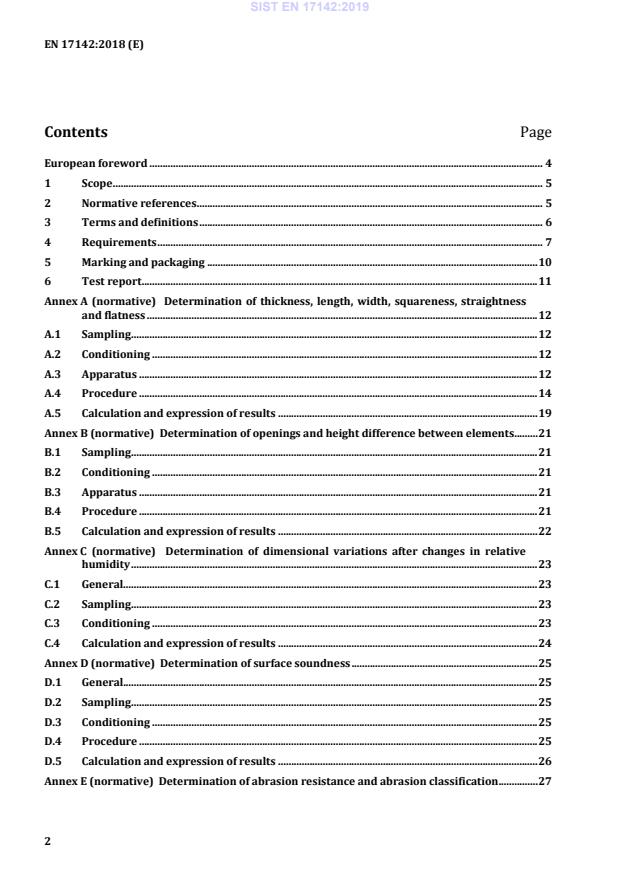
Determination of thickness, length, width, squareness, straightness and flatness . 12 A.1 Sampling . 12 A.2 Conditioning . 12 A.3 Apparatus . 12 A.4 Procedure . 14 A.5 Calculation and expression of results . 19 Annex B (normative)
Determination of openings and height difference between elements . 21 B.1 Sampling . 21 B.2 Conditioning . 21 B.3 Apparatus . 21 B.4 Procedure . 21 B.5 Calculation and expression of results . 22 Annex C (normative)
Determination of dimensional variations after changes in relative humidity . 23 C.1 General. 23 C.2 Sampling . 23 C.3 Conditioning . 23 C.4 Calculation and expression of results . 24 Annex D (normative)
Determination of surface soundness . 25 D.1 General. 25 D.2 Sampling . 25 D.3 Conditioning . 25 D.4 Procedure . 25 D.5 Calculation and expression of results . 26 Annex E (normative)
Determination of abrasion resistance and abrasion classification . 27 SIST EN 17142:2019
Calibration and maintenance of abrasion equipment . 34 F.1 General . 34 F.2 Apparatus . 34 F.3 Procedure . 34 Annex G (normative)
Measurement of shore A hardness . 37 Annex H (normative)
Determination of impact resistance and impact classification. 38 H.1 General . 38 H.2 Sampling . 38 H.3 Apparatus . 38 H.4 Procedure . 39 Bibliography . 42 SIST EN 17142:2019
IEC Electropedia: available at http://www.electropedia.org/
ISO Online browsing platform: available at http://www.iso.org/obp 3.1 modular multilayer floor covering floor covering, typically in a plank or tile format, having a multiple layer product structure: e.g. backer, substrate and surface layer Note 1 to entry: The planks/tiles have worked edges that allow the product to be joined together to form a larger integral unit. The product can vary in thickness, format, surface texture, gloss level and colour. 3.2 modular multilayer floor covering with wood powder based surface layer upper decorative layer consisting of one or more wood powder based layers which consists of a minimum 20% w/w of wood particles, together with aminoplastic, thermosetting resins (usually melamine), additives, pigments and any corundum and these components are dry mixed and scattered in layers on the substrate Note 1 to entry: By the simultaneous action of heat and pressure, these powder layers are either pressed as such or are directly pressed on a substrate (usually wood-based panels). The product is usually fitted with a backer (powder backer or impregnated papers), primarily used as a balancing material. In case of individually pressed layers, such layers can be fitted on substrates by, for example, a gluing operation. 3.3 substrate core material of the powder based floor covering Note 1 to entry: It is generally a particleboard, as defined in EN 309, or a Plywood board or an OSB board or a Medium Density Fibreboard (MDF) as defined in EN 316 or a so called High Density Fibreboard (HDF) which is a MDF-board with a density
· 800 kg/m3. 3.4 backer layer opposite to the surface layer used to balance and stabilise the product Note 1 to entry: The backer is generally made of wood powder or impregnated papers. 3.5 underlay layer placed between the powder based floor covering and the subfloor to impart specific properties Note 1 to entry: Some powder based floor covering products have the underlay pre-attached directly to the backer. SIST EN 17142:2019
Note 1 to entry: See Figure 1.
Key 1 surface layer 2 substrate 3 backer 4 underlay (optional) Figure 1— Powder based floor-covering element 4 Requirements 4.1 General requirements All powder based floor coverings shall conform to the general requirements given in Table 1, when tested by the methods specified therein. SIST EN 17142:2019
¶ 0,50 mm, relative to nominal value tmax. – tmin.
¶ 0,50 mm Annex A with pre-attached underlay taverage
¶ 0,50 mm, relative to nominal value t max. – t min.
¶ 0,80 mm Annex A Length of the surface layer, (l) For the nominal values given, no measured value shall exceed: l
¶ 1 500 mm:
¶ 0,5 mm l > 1 500 mm:
¶ 0,3 mm/m Annex A Width of the surface layer, (w) waverage
¶ 0,10 mm, relative to nominal value w max. - w min.
¶ 0,20 mm Annex A Length and width of squared elements,
(l = w) laverage
¶ 0,10 mm relative to nominal value average
¶ 0,10 mm, relative to nominal value lmax. – lmin.
¶ 0,20 mm wmax. – wmin.
¶ 0,20 mm Annex A Squareness of the element, (q) qmax.
¶ 0,20 mm Annex A Straightness of the surface layer, (s) smax.
¶ 0,30 mm/m Annex A Flatness of the element, (f) Maximum single values: fw, concave
¶ 0,15 %
fw, convex
¶ 0,20 % fl, concave
¶ 0,50 %
fl, convex
¶ 1,00 % Annex A Openings between elements, (o) oaverage
¶ 0,15 mm omax.
¶ 0,20 mm Annex B Height difference between elements, (h) h average
¶ 0,10 mm h max.
¶ 0,15 mm Annex B Dimensional variations after changes in relative humidity, () laverage
¶ 0,9 mm average
¶ 0,9 mm Annex C Light fastness Colour contrast between unexposed and exposed sample part
· 4 of grey scale according to EN 20105-A02 EN ISO 4892-2:2013 method B – cycle 2 or 5 (50 % rel. hum.) a b Static indentation residual indentation
¶ 0,05 mm EN ISO 24343-1 a Test until blue wool scale No. 6 according to EN ISO 105-B02 (= colour contrast 4 on the grey scale according to EN 20105-A02 between exposed and unexposed part of blue wool scale). b Allow sample (24 ± 1) h recovery time without light exposure at 23 °C and 50 % rel. humidity before taking final assessment. SIST EN 17142:2019
Levels of use
Domestic Commercial
Moderate General Heavy Moderate General Heavy Very Heavy
Class: 21 22 23 31 32 33 34 Test method Abrasion resistance AC1 AC2 AC3 AC4 AC5 AC6 Annex E Impact resistance Small ball Big ball
· 8 N
· 500 mm
· 12 N
· 750 mm
· 15 N
· 1 000 mm
· 20 N
· 1 600 mm Annex H Resistance to staining 4, (groups 1 and 2) 3, (group 3) 4, (groups 1, 2 and 3)
EN 438–2 Effect of a furniture leg _ No damage shall be visible, when tested with foot type 0 EN 424 Effect of a castor chair a _ 25 000 cycles, No damage a
EN 425:2002 b Thickness swelling
¶ 20 %
¶ 18 %
¶ 15 %
¶ 8 % ISO 24336 Locking strength - fl0,2
· 1 kN/m (length) fs0,2
· 2 kN/m (width)
fl0,2
· 3,5 kN/m (length) Fs0,2
· 3,5 kN/m (width) ISO 24334 Surface soundness
· 1,0 N/mm2
· 1,25 N/mm2
· 1,50 N/ mm2 Annex D a No visible damage on the surface of the assembled test area caused by detachment of layers, opening of joints, or crazing. Ignore any flattening or change in appearance, e.g. change in gloss. b Using soft castor wheels W PU (95 ± 5) Shore A except for class 34 wheels H PA (95 ± 5) Shore A.
1 The product “Selitflex 1,6 mm” made by Selit GmbH is an example of a suitable product available commercially. This information is given for the convenience of users of this document and does not constitute an endorsement by CEN of this product. Equivalent products may be used if they can be shown to lead to the same results. SIST EN 17142:2019
¶ 3 % EN 322 Appearance, surface defects Minor surface defects as defined in EN 438 are permitted EN 438–2 Micro-scratch resistance a Can be declared as micro-scratch resistance classes according to procedure A and/or B EN 16094 Dimensional stability w avg,
l avg:
¶ 0,15 % - 0,20 %
¶ Cavg b
¶ 0,25 % JL avg,
JS avg:
¶ 0,15 mm hL avg, hS avg:
¶ 0,15 mm ISO 24339
a Should not be tested on samples with texture deeper than 150
b Take the maximum of Cavg from wet climate (23 °C, 85 % rel. humidity) and the minimum of Cavg from dry climate (23 °C, 30 % rel. hum.) for the evaluation. 5 Marking and packaging 5.1 Marking NOTE For CE-Marking see EN 14041. Powder based floor coverings which comply with the requirements of this standard shall have the following information clearly marked by the manufacturer, either on their packaging, or on a label or information sheet included in the packaging: a) a reference to this document; b) manufacturer’s and/or supplier’s identification; c) product name; d) colour/pattern and batch number; e) level of use symbols appropriate to EN ISO 10874 and in accordance with Table 4; f) nominal dimensions of one floor-covering element in millimetres; if relevant: nominal thickness of pre-attached underlay, nominal thickness of products with pre-attached underlay e.g.
10 (8 + 2) mm; g) number of elements contained in a package; h) area contained in a package measured in square metre. SIST EN 17142:2019
General
Heavy
Very Heavy -
5.2 Packaging Powder based floor coverings shall be delivered in packages designed to protect the corners, edges and surfaces of the product, under normal conditions of transport and handling. Installation, cleaning and maintenance instructions shall be delivered together with the product. 6 Test report The test report shall include at least the following information: a) the name and address of the test laboratory; b) date and number of test report; c) a reference to this document; d) full description of the product tested; e) sampling information; f) test results; g) all deviations from this document. SIST EN 17142:2019
Determination of thickness, length, width, squareness, straightness and flatness A.1 Sampling Take five powder based floor-covering elements as test specimens. A.2 Conditioning Test specimens are measured in the received state. For type approval or verification purposes, the test specimens shall be stabilized to a constant mass in an atmosphere of (23 ± 2) °C and (50 ± 5) % relative humidity. Constant mass is considered to be reached when the results of two successive weighing operations, carried out at an interval of 24 h, do not differ by more than 0,1 % of the mass of the test specimens. A.3 Apparatus A.3.1 Micrometre, calliper gauge or any other equivalent tool, having flat and parallel circular measuring surfaces of at least 16 mm diameter and an operating force of (4 ± 1) N, with an accuracy of ± 0,05 mm, for thickness measurements. A.3.2 Calliper gauge or any other equivalent tools with an accuracy of ± 0,05 mm for width measurements, and ± 0,1 mm for length measurements. A.3.3 Square with arms of at least 300 mm and having a maximum angular deviation of 0,02 mm over 300 mm. A.3.4 Set of thickness gauges ranging from 0,05 mm to 0,10 mm in steps of 0,01 mm, and from 0,10 mm to 0,50 mm in steps of 0,05 mm. A.3.5 Steel ruler of length at least equal to the length of the test specimen, and having a maximum straightness deviation of 0,05 mm over 1 000 mm. A.3.6 Apparatus for measuring width flatness consisting of a dial gauge accurate to ± 0,01 mm with a rounded tip of radius
¶ 5,5 mm, installed centrally in relation to three rounded supports with radii
· 5 mm. The supports shall be adjustable along a T-shaped assembly of bars to provide the required gauge length. The measurement d shall not be less than the width w of the test specimen minus 10 mm. The tip of the gauge in contact with the face of the test specimen shall apply a force of (1,0 ± 0,5) N. The mass of the apparatus shall not affect the flatness of the test specimen beyond the limit of the accuracy of the gauge. See Figure A.1 for illustration. The instrument shall be set to zero against a suitable reference plate. SIST EN 17142:2019
Key 1 dial gauge 2 T-groove 3 adjustable bridge 4 adjustable support Figure A.1 — Instrument for measuring width flatness A.3.7 Apparatus for measuring the thickness of an element with pre-attached underlay as shown in Figure A.2. The pressure foot shall have a circular plane foot parallel to the baseplate with a diameter of 10 mm and applying force between 0,5 N and 2 N. SIST EN 17142:2019
Key 1 rigid frame 2 dial gauge 3 circular pressure foot 4 floor-covering element with pre-attached underlay (downward) 5 flat rigid base plate Figure A.2 — Instrument for measuring thickness of an element with pre-attached underlay A.4 Procedure A.4.1 Determination of thickness (t) of an element with or without pre-attached underlay Using the micrometre, calliper gauge or any other equivalent tool, measure the thickness t at a distance of 20 mm from the edges of the surface layer, at points located in each corner and in the middle of each long side (only four corner points if length < 600 mm) (see Figure A.3). SIST EN 17142:2019
Figure A.3 — Measuring points for determination of thickness (t) Take one powder based floor-covering element. Take from this element three test specimens measuring approximately 100 mm x 100 mm, two centred 10 mm in from the short edges and one exactly in the centre of the element (see Figure A.4). If the elements measure less than 100 mm, cut a square sample with the actual width of the element. Measure in the middle of each sample with an apparatus according to A.3.7 (see Figure A.2) and calculate the average of the three samples. Dimensions in millimetres
Figure A.4 — Sampling from one floor-covering element A.4.2 Determination of length (l) Using the appropriate calliper gauge or any other equivalent tool, measure the length l of the surface layer along two lines parallel to the axis of the test specimen, at a distance of 20 mm from the long sides (see Figure A.5). SIST EN 17142:2019
Figure A.5 — Measuring points for determination of length (l) A.4.3 Determination of width (w) Using the appropriate calliper gauge or any other equivalent tool, measure the width w, along two lines parallel to the sides of the surface layer, at a distance of 20 mm from the sides, and in the middle for elements with a length greater than 600 mm (see Figure A.6). Dimensions in millimetres
Figure A.6 — Measuring points for determination of width (w) A.4.4 Determination of dimensions of squared elements Using the appropriate calliper gauge or any other equivalent tool, measure the width w, and the length l along two lines parallel to the sides of the surface layer, at a distance of 20 mm from the sides (see Figure A.7). SIST EN 17142:2019
Figure A.7 — Measuring points for determination of width (w) and length (l) of squared elements A.4.5 Determination of squareness (q) Place one side of the square against one long side of the surface layer of the element. Using the thickness gauges, determine the maximum deviation from square qmax. at the small side. Repeat the procedure on the diagonally opposite corner (see Figure A.8).
Figure A.8 — Determination of squareness (q) A.4.6 Determination of straightness (s) Place the steel ruler against one long side of the surface layer. Using the thickness gauges, determine the maximum deviation smax. from the ruler. Measure only the concave or cupped side (see Figure A.9). SIST EN 17142:2019
Figure A.9 — Determination of straightness (s) A.4.7 Determination of width flatness (fw) Adjust the supports along the T-shaped assembly of bars according to the width of the test specimen to evaluate (see Figure A.10). Determine the maximum deviation fw for each element. The measurement d shall not be less than the width w of the test specimen minus 10 mm.
Figure A.10 — Determination of width flatness (fw) A.4.8 Determination of length flatness (fl) Place the test specimen against the steel ruler as shown in Figure A.11. Using the thickness gauges or the calliper gauge, determine the maximum deviation fl from the ruler for each element. The measured value shall be expressed as concave when the surface layer is facing towards the ruler and as convex when the surface layer is facing away from the ruler. SIST EN 17142:2019
Key 1 test specimen 2 steel ruler Figure A.11 — Determination of length flatness (fl) A.5 Calculation and expression of results A.5.1 Thickness (t) A.5.1.1 Thickness (average) Using all the measurements taken, calculate the mean value taverage, and also record the single maximum value t max. and the single minimum value t min. Calculate average = |tnominal — taverage| and tmax. - tmin. and express the results in millimetres to the nearest 0,05 mm. A.5.1.2 Thickness (td) Using all the measurements taken, calculate the mean value taverage and express the results in millimetres to the nearest 0,05 mm. A.5.2 Length (l) Record all measured values lmeasured. Calculate for all measured values
= |lnominal – lmeasured | and express the results in millimetres to the nearest 0,1 mm. If lnominal > 1 500 mm divide
by lnominal and express the results in millimetres to the nearest 0,1 mm/m. A.5.3 Width (w) Using all the measurements taken, calculate the mean value waverage, and also record the single maximum value wmax. and the single minimum value wmin. Calculate average = |wnominal – waverage | and wmax. – wmin. and express the results in millimetres to the nearest 0,05 mm. A.5.4 Squareness (q) Record all measured values q and take the largest value q max. of the deviation from square to the nearest 0,05 mm as the result. A.5.5 Straightness (s) Record all maximum deviations from the ruler and divide the largest value by the nominal length and express this value smax. as the result to the nearest 0,05 mm/m. SIST EN 17142:2019
...