

FprEN 3523
(Main)Aerospace series - Steel 15CrMoV6 (1.7334) - Air melted - Hardened and tempered - Bars for machining - De ≤ 100 mm - 1 080 MPa ≤ Rm ≤ 1 280 MPas
- Status
- Not Published
- Publication Date
- 17-Mar-2027
- Technical Committee
- ASD-STAN - Aerospace
- Drafting Committee
- ASD-STAN/D 4/S 3 - Steels & Heat Resisting Alloys
- Current Stage
- 4599 - Dispatch of FV draft to CMC - Finalization for Vote
- Start Date
- 07-Oct-2026
- Completion Date
- 07-Oct-2026

FprEN 3523 is a CEN draft European Standard for aerospace steel 15CrMoV6 (1.7334). It specifies the requirements for air melted, hardened and tempered bars for machining, with De ≤ 100 mm and 1 080 MPa ≤ Rm ≤ 1 280 MPa, for aerospace applications. Manufacturers, purchasers, and qualification teams use it to define the material condition, verify properties, and agree how the bars are inspected.
What does FprEN 3523 specify?
FprEN 3523 specifies one steel grade, one product form, and the acceptance requirements for aerospace use. It is focused on bars for machining, not on finished parts, and it ties the product to a defined size range and tensile strength range.
The document is organized into Clause 1 Scope, Clause 2 Normative references, Clause 3 Terms and definitions, and Clause 4 Requirements, followed by a bibliography. Clause 4 is the core of the standard because Table 1 carries the material limits, heat treatment, property values, and inspection references that a supplier or buyer must apply.
What are the key requirements of FprEN 3523?
Material identification and product form
FprEN 3523 applies to steel 15CrMoV6 (1.7334), air melted, in the form of bars for machining. It gives the ASD-STAN designation FE-PL1505. In practice, this means the material has to be ordered and supplied as this exact aerospace grade, not as a generic alloy steel bar.
Composition, heat treatment, and delivery condition
Table 1 sets the chemical composition limits for C, Si, Mn, P, S, Cr, Mo, V, and Fe. It also gives delivery condition codes A and U and links them to the heat treatment route, including quenching in water or oil and tempering, with air cooling in the specified condition. This matters because the final strength and hardenability depend on the exact heat treatment route.
A note in Table 1 says a stress relief tempering between quenching and tempering can be used at 350 °C minimum to reduce the risk of quench cracking. For production, that is a practical processing option to control cracking during heat treatment.
Mechanical properties and toughness
Table 1 sets the key acceptance values: proof stress, tensile strength, elongation, hardness, and impact strength. The tensile strength range is 1 080 MPa to 1 280 MPa, proof stress is at least 930 MPa, elongation is at least 10%, and the hardened-and-tempered hardness range is 321 HB to 380 HB. Impact strength is also specified at ambient temperature with notch direction T.
For a buyer or inspector, these values are the main evidence that the bar has the strength and toughness needed before machining and use in aerospace parts.
Hardening response and metallurgical quality
FprEN 3523 requires a hardenability check by the EN ISO 642 Jominy test, with minimum HRC values given at several distances. The standard also requires grain size G ≥ 5, inclusion content Category 1 according to EN 2951, external imperfections checked by visual testing (VT), and internal imperfections checked by ultrasonic testing (UT) to Class 3.
In practice, these requirements look beyond chemistry and strength. They control whether the steel hardens consistently and whether the bar is free from internal or surface defects that could affect machining or service performance.
Qualification and agreement between the parties
Table 1 points to EN 2043 for product qualification, and the qualification programme shall be agreed between manufacturer and purchaser. That means the supply agreement needs to cover how the material is qualified and what tests are used for acceptance.
What terms does FprEN 3523 use?
- W.nr - The document uses W.nr 1.7334 as the steel number for this grade.
- Rm - Tensile strength, used here as the main strength range for acceptance.
- R_p0.2 - Proof stress at 0.2% offset, used as a yield-type property in the table.
- KV - Impact strength, given with a minimum value and a defined notch direction.
- VT - Visual testing, used for checking external imperfections.
- UT - Ultrasonic testing, used for checking internal imperfections.
- Jominy test - The hardenability test referenced through EN ISO 642.
- FE-PL1505 - The ASD-STAN designation for this material.
Who uses FprEN 3523?
FprEN 3523 is used by aerospace material suppliers, steel mills, heat treatment shops, machining stock suppliers, buyers, and quality or inspection teams. It is relevant when specifying bar stock, qualifying a source, checking heat treatment results, and accepting deliveries for aerospace applications.
It also matters to testing laboratories and conformity teams because the standard points to specific methods for inclusion rating, hardenability, and non-destructive inspection. In practice, it helps them test the same material in the same way.
What changed in FprEN 3523 from the previous edition?
FprEN 3523 will supersede EN 3523:2024. The foreword states one significant technical change: Table 1, line 20, changes the notch direction for the impact test by replacing “L” for longitudinal with “T” for transverse.
Which standards are used with FprEN 3523?
- EN 2043 - Gives the general requirements for semi-finished product qualification, which FprEN 3523 uses for product qualification.
- EN 2951 - Gives the method for micrographic determination of non-metallic inclusions, used for the inclusion content requirement.
- EN 4700-002 - Provides the technical specification for bars and sections, which sits in the same aerospace wrought-products family.
- EN ISO 642 - Defines the Jominy end-quenching test used for hardenability.
- EN 4258 - The introduction cites this for the general organization of aerospace metallic material standards.
- EN 4500-005 - The introduction cites this for the drafting and presentation rules used for steel material standards.
What does the FprEN 3523 document contain?
The document is built around Table 1, which gathers the material designation, chemical composition, melting method, product form, dimensional limit, delivery condition, heat treatment, test conditions, and acceptance values. It also includes entries for hardenability, grain size, external imperfections, inclusion content, internal imperfections, marking inspection, dimensional inspection, and product qualification.
For practical use, this means the standard is not just a title and a grade name - it is a requirements sheet for selecting, qualifying, testing, and accepting aerospace bar stock. The bibliography then points readers to the framework and drafting standards that support this series.
Relations
- Effective Date
- 14-Jan-2026
Get Certified
Connect with accredited certification bodies for this standard

BUREAU VERITAS Certification Germany
Bureau Veritas certification in Germany.

Element Materials Technology
Materials testing and product certification.

AQMS Ltd.
AQMS provides ISO certification to SMEs across the UK.
Sponsored listings
Frequently Asked Questions
FprEN 3523 is a draft published by the European Committee for Standardization (CEN). Its full title is "Aerospace series - Steel 15CrMoV6 (1.7334) - Air melted - Hardened and tempered - Bars for machining - De ≤ 100 mm - 1 080 MPa ≤ Rm ≤ 1 280 MPas". This standard covers: Le présent document spécifie les exigences relatives à : Acier 15CrMoV6 (1.7334) Élaboré à l’air Trempé et revenu Barres pour usinage De ≤ 100 mm 1 080 MPa ≤ Rm ≤ 1 280 MPa pour les applications aérospatiales. W.nr : 1.7334. Désignation ASD-STAN : FE-PL1505.
Le présent document spécifie les exigences relatives à : Acier 15CrMoV6 (1.7334) Élaboré à l’air Trempé et revenu Barres pour usinage De ≤ 100 mm 1 080 MPa ≤ Rm ≤ 1 280 MPa pour les applications aérospatiales. W.nr : 1.7334. Désignation ASD-STAN : FE-PL1505.
FprEN 3523 is classified under the following ICS (International Classification for Standards) categories: 49.025.10 - Steels. The ICS classification helps identify the subject area and facilitates finding related standards.
FprEN 3523 has the following relationships with other standards: It is inter standard links to EN 3523:2024. Understanding these relationships helps ensure you are using the most current and applicable version of the standard.
FprEN 3523 is available in PDF format for immediate download after purchase. The document can be added to your cart and obtained through the secure checkout process. Digital delivery ensures instant access to the complete standard document.
Standards Content (Sample)
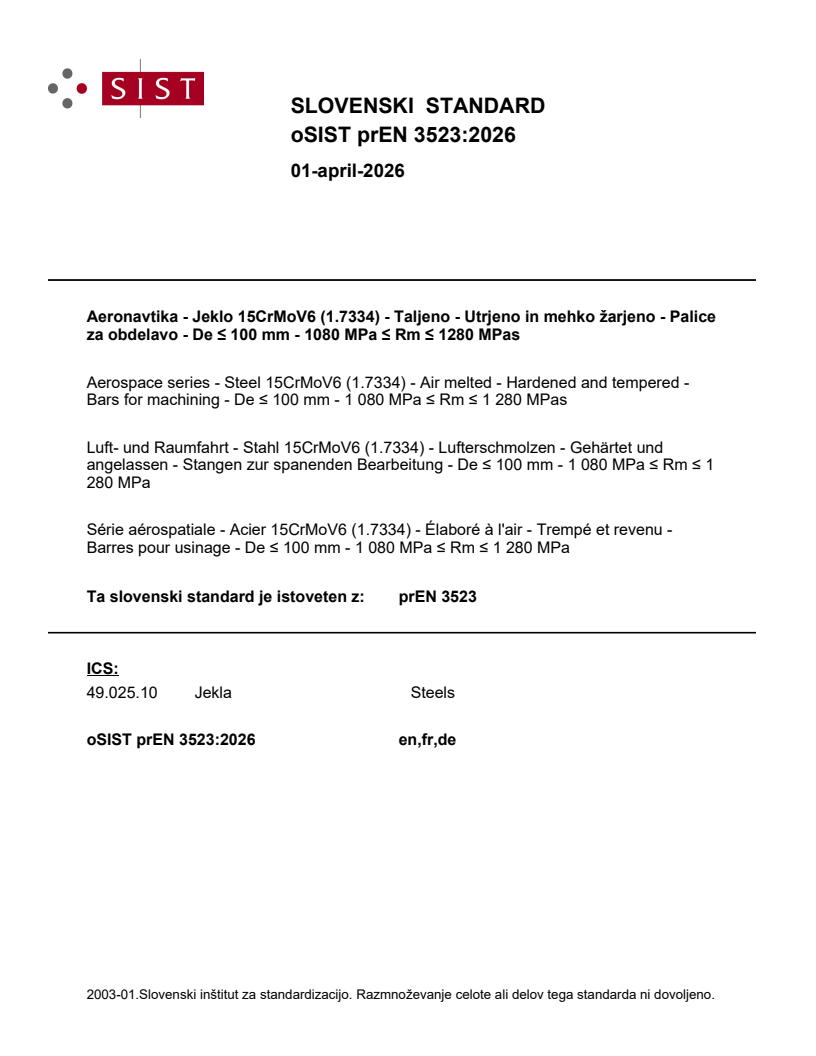
SLOVENSKI STANDARD
01-april-2026
Aeronavtika - Jeklo 15CrMoV6 (1.7334) - Taljeno - Utrjeno in mehko žarjeno - Palice
za obdelavo - De ≤ 100 mm - 1080 MPa ≤ Rm ≤ 1280 MPas
Aerospace series - Steel 15CrMoV6 (1.7334) - Air melted - Hardened and tempered -
Bars for machining - De ≤ 100 mm - 1 080 MPa ≤ Rm ≤ 1 280 MPas
Luft- und Raumfahrt - Stahl 15CrMoV6 (1.7334) - Lufterschmolzen - Gehärtet und
angelassen - Stangen zur spanenden Bearbeitung - De ≤ 100 mm - 1 080 MPa ≤ Rm ≤ 1
280 MPa
Série aérospatiale - Acier 15CrMoV6 (1.7334) - Élaboré à l'air - Trempé et revenu -
Barres pour usinage - De ≤ 100 mm - 1 080 MPa ≤ Rm ≤ 1 280 MPa
Ta slovenski standard je istoveten z: prEN 3523
ICS:
49.025.10 Jekla Steels
2003-01.Slovenski inštitut za standardizacijo. Razmnoževanje celote ali delov tega standarda ni dovoljeno.
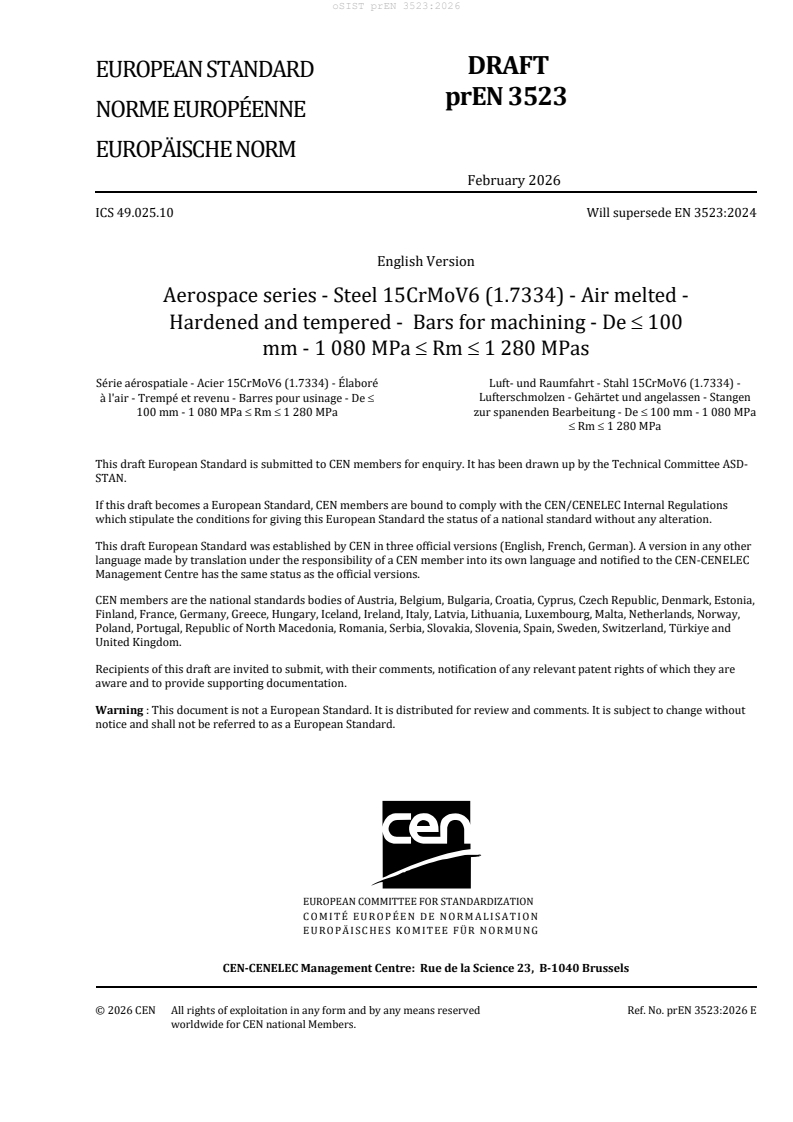
DRAFT
EUROPEAN STANDARD
prEN 3523
NORME EUROPÉENNE
EUROPÄISCHE NORM
February 2026
ICS 49.025.10 Will supersede EN 3523:2024
English Version
Aerospace series - Steel 15CrMoV6 (1.7334) - Air melted -
Hardened and tempered - Bars for machining - De 100
mm - 1 080 MPa Rm 1 280 MPas
Série aérospatiale - Acier 15CrMoV6 (1.7334) - Élaboré Luft- und Raumfahrt - Stahl 15CrMoV6 (1.7334) -
Lufterschmolzen - Gehärtet und angelassen - Stangen
à l'air - Trempé et revenu - Barres pour usinage - De
zur spanenden Bearbeitung - De 100 mm - 1 080 MPa
100 mm - 1 080 MPa Rm 1 280 MPa
Rm 1 280 MPa
This draft European Standard is submitted to CEN members for enquiry. It has been drawn up by the Technical Committee ASD-
STAN.
If this draft becomes a European Standard, CEN members are bound to comply with the CEN/CENELEC Internal Regulations
which stipulate the conditions for giving this European Standard the status of a national standard without any alteration.
This draft European Standard was established by CEN in three official versions (English, French, German). A version in any other
language made by translation under the responsibility of a CEN member into its own language and notified to the CEN-CENELEC
Management Centre has the same status as the official versions.
CEN members are the national standards bodies of Austria, Belgium, Bulgaria, Croatia, Cyprus, Czech Republic, Denmark, Estonia,
Finland, France, Germany, Greece, Hungary, Iceland, Ireland, Italy, Latvia, Lithuania, Luxembourg, Malta, Netherlands, Norway,
Poland, Portugal, Republic of North Macedonia, Romania, Serbia, Slovakia, Slovenia, Spain, Sweden, Switzerland, Türkiye and
United Kingdom.
Recipients of this draft are invited to submit, with their comments, notification of any relevant patent rights of which they are
aware and to provide supporting documentation.
Warning : This document is not a European Standard. It is distributed for review and comments. It is subject to change without
notice and shall not be referred to as a European Standard.
EUROPEAN COMMITTEE FOR STANDARDIZATION
COMITÉ EUROPÉEN DE NORMALISATION
EUROPÄISCHES KOMITEE FÜR NORMUNG
CEN-CENELEC Management Centre: Rue de la Science 23, B-1040 Brussels
© 2026 CEN All rights of exploitation in any form and by any means reserved Ref. No. prEN 3523:2026 E
worldwide for CEN national Members.
prEN 3523:2026 (E)
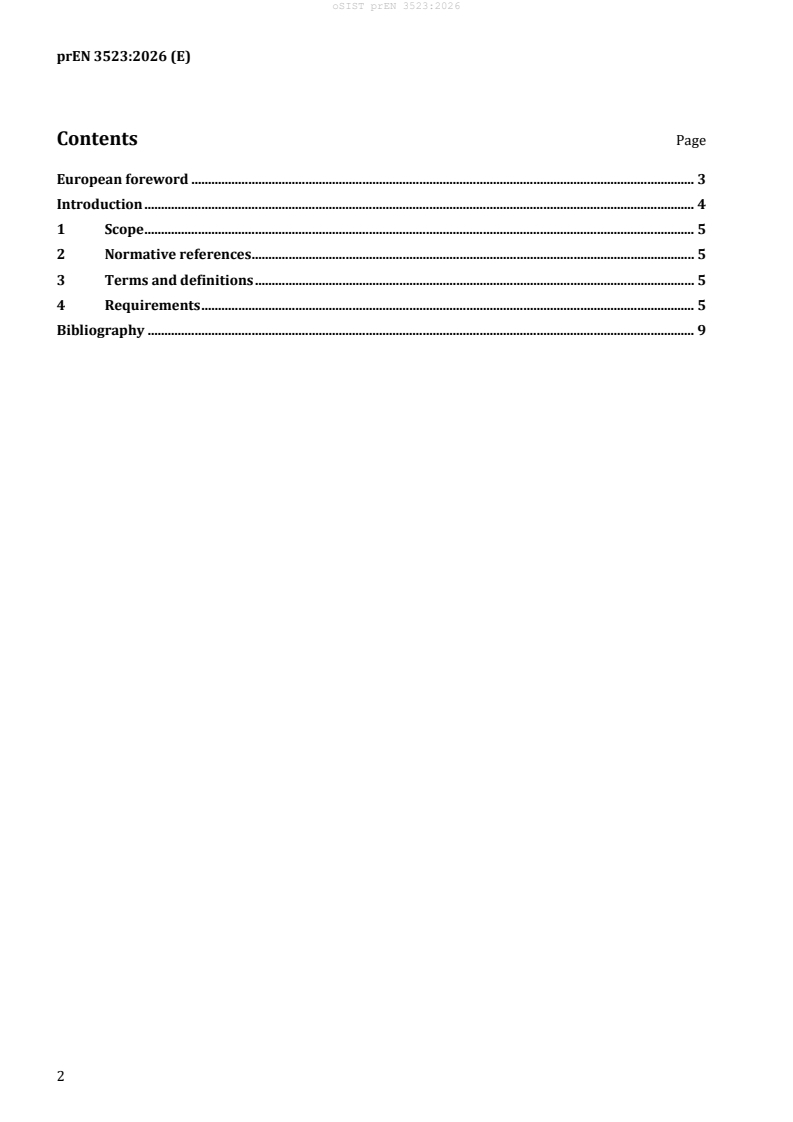
Contents Page
European foreword . 3
Introduction . 4
1 Scope . 5
2 Normative references . 5
3 Terms and definitions . 5
4 Requirements . 5
Bibliography . 9
prEN 3523:2026 (E)
European foreword
This document (prEN 3523:2026) has been prepared by ASD-STAN.
After enquiries and votes carried out in accordance with the rules of this Association, this document has
received the approval of the National Associations and the Official Services of the member countries of
ASD-STAN, prior to its presentation to CEN.
This document is currently submitted to the CEN Enquiry.
This document will supersede EN 3523:2024.
prEN 3523:2026 includes the following significant technical changes with respect to EN 3523:20
...