

EN ISO 11214:1996
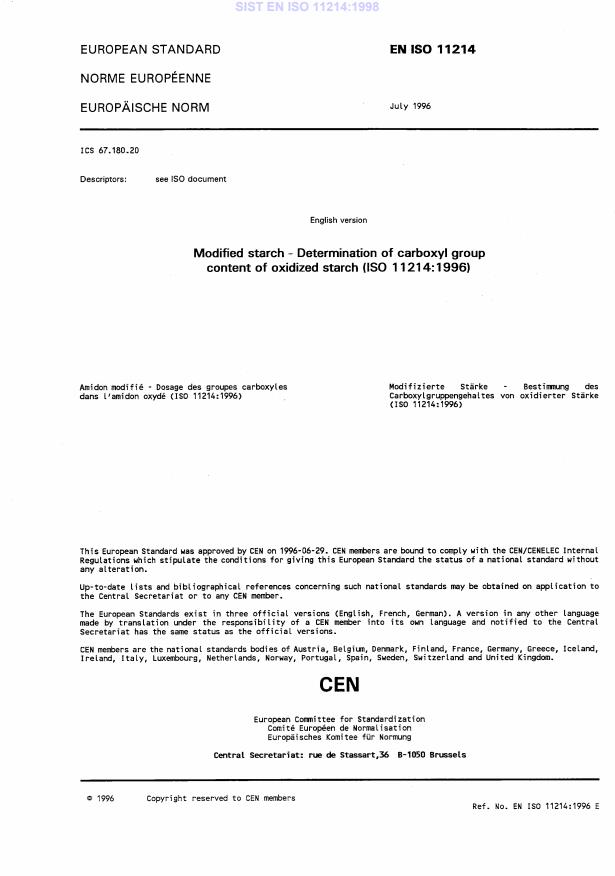
(Main)Modified starch - Determination of carboxyl group content of oxidized starch (ISO 11214:1996)
- Abstract
Migrated from Progress Sheet (TC Comment) (2000-07-10): According to a PC4 recommendation, CEN/BT agreed to launch a parallel voting ++ procedure on the draft international standard derived from the above ++ mentionned subject (Ref.nr. in ISO 11214).
- Status
- Published
- Publication Date
- 30-Jun-1996
- Withdrawal Date
- 30-Oct-1997
- Technical Committee
- CEN/SS C10 - Starch
- Drafting Committee
- CEN/SS C10 - Starch
- Current Stage
- 9093 - Decision to confirm - Review Enquiry
- Start Date
- 24-Jan-2001
- Completion Date
- 24-Jan-2001

Overview
EN ISO 11214:1996 - "Modified starch - Determination of carboxyl group content of oxidized starch" is an international standard developed by CEN and ISO/TC 93. This standard specifies a method for measuring the carboxyl group content in oxidized starch, an important property that affects the performance of modified starch in various industrial applications. The method applies to oxidized starch with carboxyl group contents up to 1% (m/m) and is widely recognized for ensuring the quality control and consistency of starch and starch-derived products.
Key Topics
- Scope and Applicability: The standard outlines procedures suitable for both laboratory and industrial environments, covering oxidized potato, maize, and wheat starch.
- Method Principle:
- Carboxyl groups within the oxidized starch are converted to their acid form using hydrochloric acid.
- Following removal of cations and excess acid, the sample is gelatinized and titrated with sodium hydroxide.
- Corrections are provided for specific starch types, such as those containing phosphorus groups.
- Analytical Requirements:
- Use of high-purity reagents, per ISO guidelines.
- Validation and calibration of laboratory apparatus for reliable results.
- Precision and Repeatability:
- Repeatability: Results within the same lab/operator should not differ by more than 6%.
- Reproducibility: Results across different labs/operators should not differ by more than 16%.
- Test Reporting:
- Reports must detail the standard reference, methods used, results, and relevant operational details.
Applications
The determination of carboxyl group content in oxidized starch is essential in several sectors:
- Food Industry: Accurate characterization of modified starches ensures product consistency, stability, and desired functional properties in processed foods and beverages.
- Paper and Packaging: In papermaking, the carboxyl content influences starch adhesion and film formation, impacting strength and surface quality.
- Textiles: Modified starch with specified carboxyl content is used as sizing and finishing agents, where precise properties are critical for fabric processing.
- Adhesives and Binders: Carboxyl group content directly affects binding strength and solubility profiles for adhesives and coatings derived from starch.
This standard supports manufacturers, quality control laboratories, and research institutions in verifying the specification and performance of oxidized starch across various end uses.
Related Standards
For comprehensive quality assurance and chemical analysis of starch and related products, the following international standards are referenced and widely used together with EN ISO 11214:1996:
- ISO 1666: Starch - Determination of moisture content (Oven-drying method)
- ISO 3696: Water for analytical laboratory use - Specification and test methods
- ISO 3946: Starches and derived products - Determination of total phosphorus content (Spectrophotometric method)
- ISO 5725-1 & ISO 5725-2: Accuracy (trueness and precision) of measurement methods and results
Utilizing these standards in tandem enables rigorous quality control, reproducible testing, and compliance with international best practices in the starch industry.
Keywords: EN ISO 11214:1996, oxidized starch, carboxyl group content, modified starch testing, starch quality control, starch analytical methods, international standards, food additives, papermaking, laboratory testing methods.
Relations
- Consolidated By
ISO 11214:1996 - Modified starch — Determination of carboxyl group content of oxidized starch - Effective Date
- 12-Feb-2026
Get Certified
Connect with accredited certification bodies for this standard

BSI Group
BSI (British Standards Institution) is the business standards company that helps organizations make excellence a habit.

Bureau Veritas
Bureau Veritas is a world leader in laboratory testing, inspection and certification services.

DNV
DNV is an independent assurance and risk management provider.
Sponsored listings
Frequently Asked Questions
EN ISO 11214:1996 is a standard published by the European Committee for Standardization (CEN). Its full title is "Modified starch - Determination of carboxyl group content of oxidized starch (ISO 11214:1996)". This standard covers: Migrated from Progress Sheet (TC Comment) (2000-07-10): According to a PC4 recommendation, CEN/BT agreed to launch a parallel voting ++ procedure on the draft international standard derived from the above ++ mentionned subject (Ref.nr. in ISO 11214).
Migrated from Progress Sheet (TC Comment) (2000-07-10): According to a PC4 recommendation, CEN/BT agreed to launch a parallel voting ++ procedure on the draft international standard derived from the above ++ mentionned subject (Ref.nr. in ISO 11214).
EN ISO 11214:1996 is classified under the following ICS (International Classification for Standards) categories: 67.180.20 - Starch and derived products. The ICS classification helps identify the subject area and facilitates finding related standards.
EN ISO 11214:1996 has the following relationships with other standards: It is inter standard links to ISO 11214:1996. Understanding these relationships helps ensure you are using the most current and applicable version of the standard.
EN ISO 11214:1996 is available in PDF format for immediate download after purchase. The document can be added to your cart and obtained through the secure checkout process. Digital delivery ensures instant access to the complete standard document.
Standards Content (Sample)
2003-01.Slovenski inštitut za standardizacijo. Razmnoževanje celote ali delov tega standarda ni dovoljeno.Amidon modifié - Dosage des groupes carboxyles dans l'amidon oxydé (ISO 11214:1996)Modified starch - Determination of carboxyl group content of oxidized starch (ISO 11214:1996)67.180.20Škrob in izdelki iz njegaStarch and derived productsICS:Ta slovenski standard je istoveten z:EN ISO 11214:1996SIST EN ISO 11214:1998en01-november-1998SIST EN ISO 11214:1998SLOVENSKI
STANDARD
INTERNATIONAL STANDARD IS0 11214 First edition 1996-07-01 Modified starch - Determination of carboxyl group content of oxidized starch Amidon modifi6 - Dosage des groupes carboxyles dans I’amidon oxyd6 Reference number IS0 11214:1996(E) SIST EN ISO 11214:1998
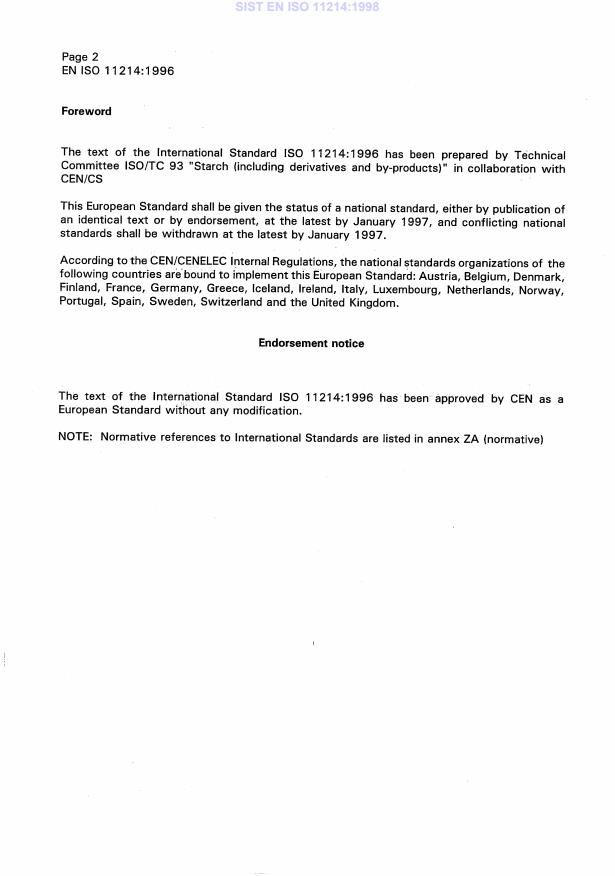
IS0 11214:1996(E) Foreword IS0 (the International Organization for Standardization) is a worldwide federation of national standards bodies (IS0 member bodies). The work of preparing International Standards is normally carried out through IS0 technical committees. Each member body interested in a subject for which a technical committee has been established has the right to be represented on that committee. International organizations, governmental and non-governmental, in liaison with ISO, also take part in the work. IS0 collaborates closely with the International Electrotechnical Commission (IEC) on all matters of electrotechnical standardization. Draft International Standards adopted by the technical committees are circulated to the member bodies for voting. Publication as an International Standard requires approval by at least 75 % of the member bodies casting a vote. International Standard IS0 11214 was prepared by Technical Committee lSO/TC 93, Starch (including derivatives and by-products). Annexes A and B of this International Standard are for information only. 0 IS0 1996 All rights reserved. Unless otherwise specified, no part of this publication may be reproduced or utilized in any form or by any means, electronic or mechanical, including photocopying and microfilm, without permission in writing from the publisher. International Organization for Standardization Case Postale 56 l CH-121 1 Geneve 20 l Swi tzerland Printed in Switzerland SIST EN ISO 11214:1998
INTERNATIONAL STANDARD 0 ISO ISO 11214:1996(E) Modified starch - Determination of carboxyl group content of oxidized starch 1 Scope This International Standard specifies a method for the determination of the carboxyl group content of oxidized starch. The method is suitable for determining carboxyl group contents up to 1 % (m/m). 2 Normative references The following standards contain provisions which, through reference in this text, constitute provisions of this International Standard. At the time of publi- cation, the editions indicated were valid. All standards are subject to revision, and parties to agreements based on this International Standard are encouraged to investigate the possibility of applying the most re- cent editions of the standards indicated below. Members of IEC and IS0 maintain registers of cur- rently valid International Standards. IS0 1666: --J), Starch - Determination of moisture content - Oven-drying method. I SO 3696: 1987, Water for analytical labora tory use - Specification and test methods. IS0 3946:1982, Starches and derived products - Determination of total phosphorus content - Spectrophotometric method. 3 Principle The carboxyl groups are converted into the acid form by adding a mineral acid to a homogenized test por- tion of the oxidized starch. The cations and the excess acid are eliminated by washing with water. The washed sample is gelatinized and titrated with sodium hydroxide standard solution. For oxidized potato starch, the result is corrected for the phosphate group content. 4 Reagents and materials Use only reagents of recognized analytical grade, un- less otherwise specified, and water complying with grade 2 in accordance with IS0 3696. The water used shall be free of carbon dioxide. 4.1 Hydrochloric acid, 0,l mol/l solution. 4.2 Sodium hydroxide, standard volumetric sol- ution, c(NaOH) = 0,l mol/l, free of carbon dioxide. 4.3 Phenolphthalein in ethanol, 1 g/l solution,- 90 % (VW). 4.4 Silver nitrate, 10 g/l solution. 5 Apparatus Usual laboratory apparatus and in particular the fol- lowing. 5.1 Beakers, of capacity 100 ml and 600 ml. 5.2 Magnetic stirrer. 1) To be published. (Revision of IS0 1666:1973) SIST EN ISO 11214:1998
IS0 11214:1996(E) 0 IS0 5.3 Vacuum filter, equipped with a fritted glass crucible of medium porosity, or a Buchner funnel, of diameter 55 mm, equipped with a small, round filter paper (medium filtration rate). 5.4 Boiling water bath. 5.5 Mechanical stirrer. 5.6 Blade mill. 5.7 Test sieve, of aperture size 800 pm. 6 Preparation of the test sample Pass the sample through the test sieve (5.7). If the sample does not pass through the sieve, grind it using the blade mill (5.6) so that it completely passes through the sieve. Homogenize the sample. NOTE 1 In the case of oxidized maize or wheat starch, it may be desirable to defat the sample by Soxhlet extraction with a mixture of propanol and water [3 + 1 (V/V)] in order to correct for the contribution of lipids to the carboxyl group content. 7 Procedure 7.1 Test portion Weigh, to the nearest 0,l mg, 5 g of the test sample into a 100 ml beaker (5.1). 7.2 Conversion of the carboxyl salts Add 25 ml of the hydrochloric acid solution (4. I) to the beaker and stir for 30 min on the magnetic stirrer (5.2). 7.3 Washing Filter the suspension under vacuum through a fritted glass crucible or Btichn
...