

EN 1751:2024
(Main)Ventilation for buildings - Air terminal devices - Aerodynamic testing of damper and valves
General Information
- Abstract
This document specifies methods for the testing and rating of dampers and valves used in air distribution systems with pressure differences up to 2 000 Pa.
The tests incorporated in this document will address:
- leakage past a closed damper or valve (for classification, see Annex C);
- casing leakage (for classification, see Annex C);
- flow rate/pressure requirement characteristics;
- torque: (see Annex A);
- thermal transmittance: (see Annex B).
The tests specified above are applicable to the following:
- measurement of leakage past a closed damper or valve;
- measurement of casing leakage;
- determination of flow rate and pressure requirements;
- measurement of torque characteristics (see Annex A);
- measurement of thermal transfer characteristics to determine insulation properties (see Annex B).
This document does not apply to the acoustic testing of dampers and valves.
NOTE Certain aspects of the dynamic performance of dampers and/or valves are dependent upon the air distribution system to which they are connected and are, therefore, difficult to measure in isolation. Such considerations have led to the omission of these aspects of the dynamic performance measurements from this document. Also, in common with other air distribution components, the results from tests carried out in accordance with this document might not be directly applicable if the damper or valve is situated in an area of non-uniform flow.
- Status
- Published
- Publication Date
- 21-May-2024
- Technical Committee
- CEN/TC 156 - Ventilation for buildings
- Drafting Committee
- CEN/TC 156/WG 4 - Air terminal devices
- Current Stage
- 6060 - Definitive text made available (DAV) - Publishing
- Start Date
- 22-May-2024
- Due Date
- 05-Mar-2024
- Completion Date
- 22-May-2024

Overview
EN 1751:2024 (CEN) - "Ventilation for buildings - Air terminal devices - Aerodynamic testing of damper and valves" - defines standardized methods to test and rate dampers and valves used in air distribution systems subjected to pressure differences up to 2 000 Pa. The standard covers measurement and classification of leakage (blade and casing), determination of flow‑rate vs. pressure characteristics, torque measurement, and thermal transmittance. It explicitly excludes acoustic testing and notes limitations when components are installed in non‑uniform flow conditions.
Key topics and technical requirements
- Scope and limits: Applies to dampers and valves in ventilation systems with pressure differences up to 2 000 Pa; acoustic testing and certain dynamic performance aspects are excluded.
- Leakage testing: Measurement of leakage past closed blades and casing leakage with classification schemes (see normative Annex C). Tests consider positive/negative pressure dependency and prescribe cycling procedures before measurement.
- Flow/pressure characterisation: Determination of flow rate and pressure requirements using ducted and chamber methods; instrumentation must conform to EN ISO 5167 series or equivalent.
- Instrumentation & accuracy:
- Flow meters: minimum permissible error of ±2.5% over the full range; leakage meter uncertainty specified for low ranges.
- Pressure measurement: calibrated manometers or equivalent with defined resolution and calibration uncertainty requirements.
- Temperature: instruments with resolution better than 0.5 K and calibration uncertainty ±0.25 K.
- Mechanical and thermal tests: Annex A (informative) addresses torque and structural tests; Annex B (informative) gives methods for thermal transmittance (insulation) testing.
- Classification & reporting: Annex C provides quantitative classification methods and formulae for closed‑blade and casing leakage; test report and calculation procedures are defined.
Applications and users
EN 1751:2024 is practical for:
- Manufacturers of dampers and valves - for product development, quality control and CE marking/market claims.
- Independent test laboratories - to perform repeatable aerodynamic, leakage, torque and thermal tests.
- HVAC consultants, building services engineers and specifiers - to compare products, size components and verify performance for compliance with ventilation system requirements.
- Building owners and procurement teams - for performance verification during acceptance testing.
- Researchers and R&D teams - to evaluate aerodynamic behaviour and insulation performance under standardized conditions.
Practical benefits include consistent product ratings, improved airtightness assessment, reliable selection for energy‑efficient ventilation systems, and defensible test data for procurement and regulatory compliance.
Related standards
Key normative references and related documents:
- EN 12792 (terminology and symbols)
- EN 16798‑3:2017 (ventilation performance requirements)
- EN ISO 5167‑1/2/3/4 (flow measurement)
- CEN/TS 17153 (air flow correction for ambient conditions)
Keywords: EN 1751:2024, damper testing, valve testing, aerodynamic testing, ventilation standards, leakage testing, flow rate, torque measurement, thermal transmittance, air terminal devices.
Relations
- Effective Date
- 18-Jan-2023
- Effective Date
- 28-Jan-2026
- Effective Date
- 28-Jan-2026
- Effective Date
- 28-Jan-2026
- Effective Date
- 28-Jan-2026
- Effective Date
- 28-Jan-2026
- Effective Date
- 28-Jan-2026
- Effective Date
- 28-Jan-2026
- Effective Date
- 28-Jan-2026
- Effective Date
- 28-Jan-2026
- Effective Date
- 28-Jan-2026
- Effective Date
- 28-Jan-2026
- Effective Date
- 28-Jan-2026
- Effective Date
- 28-Jan-2026
- Effective Date
- 28-Jan-2026
Get Certified
Connect with accredited certification bodies for this standard

DIBt (Deutsches Institut für Bautechnik)
German Institute for Building Technology.
DIN CERTCO
DIN Group product certification.

Aboma Certification B.V.
Specialized in construction, metal, and transport sectors.
Sponsored listings
Frequently Asked Questions
EN 1751:2024 is a standard published by the European Committee for Standardization (CEN). Its full title is "Ventilation for buildings - Air terminal devices - Aerodynamic testing of damper and valves". This standard covers: This document specifies methods for the testing and rating of dampers and valves used in air distribution systems with pressure differences up to 2 000 Pa. The tests incorporated in this document will address: - leakage past a closed damper or valve (for classification, see Annex C); - casing leakage (for classification, see Annex C); - flow rate/pressure requirement characteristics; - torque: (see Annex A); - thermal transmittance: (see Annex B). The tests specified above are applicable to the following: - measurement of leakage past a closed damper or valve; - measurement of casing leakage; - determination of flow rate and pressure requirements; - measurement of torque characteristics (see Annex A); - measurement of thermal transfer characteristics to determine insulation properties (see Annex B). This document does not apply to the acoustic testing of dampers and valves. NOTE Certain aspects of the dynamic performance of dampers and/or valves are dependent upon the air distribution system to which they are connected and are, therefore, difficult to measure in isolation. Such considerations have led to the omission of these aspects of the dynamic performance measurements from this document. Also, in common with other air distribution components, the results from tests carried out in accordance with this document might not be directly applicable if the damper or valve is situated in an area of non-uniform flow.
This document specifies methods for the testing and rating of dampers and valves used in air distribution systems with pressure differences up to 2 000 Pa. The tests incorporated in this document will address: - leakage past a closed damper or valve (for classification, see Annex C); - casing leakage (for classification, see Annex C); - flow rate/pressure requirement characteristics; - torque: (see Annex A); - thermal transmittance: (see Annex B). The tests specified above are applicable to the following: - measurement of leakage past a closed damper or valve; - measurement of casing leakage; - determination of flow rate and pressure requirements; - measurement of torque characteristics (see Annex A); - measurement of thermal transfer characteristics to determine insulation properties (see Annex B). This document does not apply to the acoustic testing of dampers and valves. NOTE Certain aspects of the dynamic performance of dampers and/or valves are dependent upon the air distribution system to which they are connected and are, therefore, difficult to measure in isolation. Such considerations have led to the omission of these aspects of the dynamic performance measurements from this document. Also, in common with other air distribution components, the results from tests carried out in accordance with this document might not be directly applicable if the damper or valve is situated in an area of non-uniform flow.
EN 1751:2024 is classified under the following ICS (International Classification for Standards) categories: 91.140.30 - Ventilation and air-conditioning systems. The ICS classification helps identify the subject area and facilitates finding related standards.
EN 1751:2024 has the following relationships with other standards: It is inter standard links to EN 1751:2014, EN ISO 5167-1:2022, EN 12792:2003, CEN/TS 17153:2018, EN 16798-3:2017, EN ISO 5167-4:2022, EN ISO 5167-2:2022, EN ISO 5167-3:2022, EN ISO 15138:2018, EN 13053:2019, EN 12101-8:2011, EN 13053:2006+A1:2011, EN ISO 15138:2007, EN 1366-10:2011+A1:2017, EN 15882-2:2022. Understanding these relationships helps ensure you are using the most current and applicable version of the standard.
EN 1751:2024 is available in PDF format for immediate download after purchase. The document can be added to your cart and obtained through the secure checkout process. Digital delivery ensures instant access to the complete standard document.
Standards Content (Sample)
SLOVENSKI STANDARD
01-julij-2024
Nadomešča:
SIST EN 1751:2014
Prezračevanje stavb - Naprave za vtok in odtok zraka - Aerodinamično
preskušanje dušilnikov in loput
Ventilation for buildings - Air terminal devices - Aerodynamic testing of damper and
valves
Lüftung von Gebäuden - Geräte des Luftverteilungssystems - Aerodynamische
Prüfungen von Drossel- und Absperrelementen
Ventilation des bâtiments - Bouches d'air - Essais aérodynamiques des registres et
clapets
Ta slovenski standard je istoveten z: EN 1751:2024
ICS:
91.140.30 Prezračevalni in klimatski Ventilation and air-
sistemi conditioning systems
2003-01.Slovenski inštitut za standardizacijo. Razmnoževanje celote ali delov tega standarda ni dovoljeno.
EN 1751
EUROPEAN STANDARD
NORME EUROPÉENNE
May 2024
EUROPÄISCHE NORM
ICS 91.140.30 Supersedes EN 1751:2014
English Version
Ventilation for buildings - Air terminal devices -
Aerodynamic testing of damper and valves
Ventilation des bâtiments - Bouches d'air - Essais Lüftung von Gebäuden - Geräte des
aérodynamiques des registres et clapets Luftverteilungssystems - Aerodynamische Prüfungen
von Drossel- und Absperrelementen
This European Standard was approved by CEN on 15 April 2024.
CEN members are bound to comply with the CEN/CENELEC Internal Regulations which stipulate the conditions for giving this
European Standard the status of a national standard without any alteration. Up-to-date lists and bibliographical references
concerning such national standards may be obtained on application to the CEN-CENELEC Management Centre or to any CEN
member.
This European Standard exists in three official versions (English, French, German). A version in any other language made by
translation under the responsibility of a CEN member into its own language and notified to the CEN-CENELEC Management
Centre has the same status as the official versions.
CEN members are the national standards bodies of Austria, Belgium, Bulgaria, Croatia, Cyprus, Czech Republic, Denmark, Estonia,
Finland, France, Germany, Greece, Hungary, Iceland, Ireland, Italy, Latvia, Lithuania, Luxembourg, Malta, Netherlands, Norway,
Poland, Portugal, Republic of North Macedonia, Romania, Serbia, Slovakia, Slovenia, Spain, Sweden, Switzerland, Türkiye and
United Kingdom.
EUROPEAN COMMITTEE FOR STANDARDIZATION
COMITÉ EUROPÉEN DE NORMALISATION
EUROPÄISCHES KOMITEE FÜR NORMUNG
CEN-CENELEC Management Centre: Rue de la Science 23, B-1040 Brussels
© 2024 CEN All rights of exploitation in any form and by any means reserved Ref. No. EN 1751:2024 E
worldwide for CEN national Members.
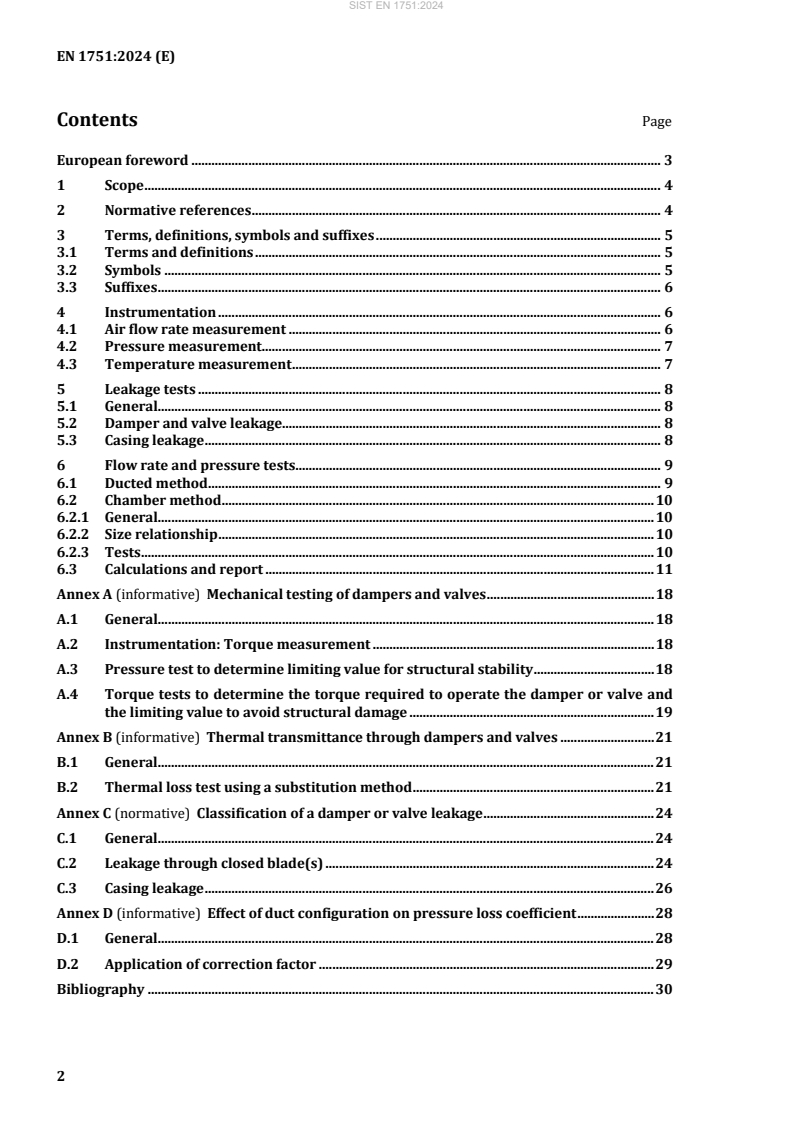
Contents Page
European foreword . 3
1 Scope . 4
2 Normative references . 4
3 Terms, definitions, symbols and suffixes . 5
3.1 Terms and definitions . 5
3.2 Symbols . 5
3.3 Suffixes . 6
4 Instrumentation . 6
4.1 Air flow rate measurement . 6
4.2 Pressure measurement. 7
4.3 Temperature measurement . 7
5 Leakage tests . 8
5.1 General. 8
5.2 Damper and valve leakage. 8
5.3 Casing leakage . 8
6 Flow rate and pressure tests. 9
6.1 Ducted method . 9
6.2 Chamber method . 10
6.2.1 General. 10
6.2.2 Size relationship . 10
6.2.3 Tests . 10
6.3 Calculations and report . 11
Annex A (informative) Mechanical testing of dampers and valves . 18
A.1 General. 18
A.2 Instrumentation: Torque measurement . 18
A.3 Pressure test to determine limiting value for structural stability . 18
A.4 Torque tests to determine the torque required to operate the damper or valve and
the limiting value to avoid structural damage . 19
Annex B (informative) Thermal transmittance through dampers and valves . 21
B.1 General. 21
B.2 Thermal loss test using a substitution method . 21
Annex C (normative) Classification of a damper or valve leakage . 24
C.1 General. 24
C.2 Leakage through closed blade(s) . 24
C.3 Casing leakage . 26
Annex D (informative) Effect of duct configuration on pressure loss coefficient . 28
D.1 General. 28
D.2 Application of correction factor . 29
Bibliography . 30
European foreword
This document (EN 1751:2024) has been prepared by Technical Committee CEN/TC 156 “Air terminal
devices”, the secretariat of which is held by BSI.
This European Standard shall be given the status of a national standard, either by publication of an
identical text or by endorsement, at the latest by November 2024, and conflicting national standards shall
be withdrawn at the latest by November 2024.
Attention is drawn to the possibility that some of the elements of this document may be the subject of
patent rights. CEN shall not be held responsible for identifying any or all such patent rights.
This document supersedes EN 1751:2014.
In comparison with the previous edition, EN 1751:2014, the following technical modifications have been
made:
— Annex C Classification of a damper or valve leakage;
• Closed blade leakage now has the addition of formulae for the calculation of classification levels
and an improved graph;
• Case leakage now has formulae for classification which are based on ductwork leakage classes
in EN 16798-3:2017, Table19 taking a reference case length of 1 m and also an improved graph.
Any feedback and questions on this document should be directed to the users’ national standards body.
A complete listing of these bodies can be found on the CEN website.
According to the CEN-CENELEC Internal Regulations, the national standards organisations of the
following countries are bound to implement this European Standard: Austria, Belgium, Bulgaria, Croatia,
Cyprus, Czech Republic, Denmark, Estonia, Finland, France, Germany, Greece, Hungary, Iceland, Ireland,
Italy, Latvia, Lithuania, Luxembourg, Malta, Netherlands, Norway, Poland, Portugal, Republic of North
Macedonia, Romania, Serbia, Slovakia, Slovenia, Spain, Sweden, Switzerland, Türkiye and the United
Kingdom.
1 Scope
This document specifies methods for the testing and rating of dampers and valves used in air distribution
systems with pressure differences up to 2 000 Pa.
The tests incorporated in this document will address:
— leakage past a closed damper or valve (for classification, see Annex C);
— casing leakage (for classification, see Annex C);
— flow rate/pressure requirement characteristics;
— torque: (see Annex A);
— thermal transmittance: (see Annex B).
The tests specified above are applicable to the following:
— measurement of leakage past a closed damper or valve;
— measurement of casing leakage;
— determination of flow rate and pressure requirements;
— measurement of torque characteristics (see Annex A);
— measurement of thermal transfer characteristics to determine insulation properties (see Annex B).
This document does not apply to the acoustic testing of dampers and valves.
NOTE Certain aspects of the dynamic performance of dampers and/or valves are dependent upon the air
distribution system to which they are connected and are, therefore, difficult to measure in isolation. Such
considerations have led to the omission of these aspects of the dynamic performance measurements from this
document. Also, in common with other air distribution components, the results from tests carried out in accordance
with this document might not be directly applicable if the damper or valve is situated in an area of non-uniform
flow.
2 Normative references
The following documents are referred to in the text in such a way that some or all of their content
constitutes requirements of this document. For dated references, only the edition cited applies. For
undated references, the latest edition of the referenced document (including any amendments) applies.
EN 12792, Ventilation for buildings — Symbols, terminology and graphical symbols
EN 16798-3:2017, Energy performance of buildings — Ventilation for buildings — Part 3: For non-
residential buildings — Performance requirements for ventilation and room-conditioning systems (Modules
M5-1, M5-4)
CEN/TS 17153, Ventilation for buildings — Correction of air flow rate according to ambient conditions
EN ISO 5167-1, Measurement of fluid flow by means of pressure differential devices inserted in circular
cross-section conduits running full — Part 1: General principles and requirements (ISO 5167-1)
EN ISO 5167-2, Measurement of fluid flow by means of pressure differential devices inserted in circular
cross-section conduits running full — Part 2: Orifice plates (ISO 5167-2)
EN ISO 5167-3, Measurement of fluid flow by means of pressure differential devices inserted in circular
cross-section conduits running full — Part 3: Nozzles and Venturi nozzles (ISO 5167-3)
EN ISO 5167-4, Measurement of fluid flow by means of pressure differential devices inserted in circular
cross-section conduits running full — Part 4: Venturi tubes (ISO 5167-4)
3 Terms, definitions, symbols and suffixes
3.1 Terms and definitions
For the purposes of this document, the terms and definitions given in EN 12792 apply.
ISO and IEC maintain terminology databases for use in standardization at the following addresses:
• ISO Online browsing platform: available at https://www.iso.org/obp
• IEC Electropedia: available at https://www.electropedia.org/
3.2 Symbols
The symbols used in this document are given in Table 1.
Table 1 — Symbols
Symbol Quantity Unit
A Internal cross-sectional area of duct m
C Coefficient of discharge -
D
D Equivalent diameter m
e
4 A
Circular ducts:
π
2ab
Square/Rectangular ducts:
ab+
p Absolute pressure Pa
p Atmospheric pressure Pa
a
p Velocity pressure 1/2 ρ v Pa
d
p Stagnation or absolute total pressure Pa
t
p Static gauge pressure (p - p ) Pa
s a
Δp Pressure difference across the damper or valve under test Pa
s
Δp Flow meter differential pressure Pa
Δp Conventional total pressure difference for an air density of Pa
t
−3
1,2 kg⋅m at the inlet to the damper or valve under test
−1
q Volume rate of air flow at the flow meter l⋅s
v
−1
q Leakage volume rate of air flow l⋅s
vL
−1 −2
q Closed blade air leakage factor, volume rate of air flow per unit l⋅s ⋅m
vLBA
duct cross-sectional area
Symbol Quantity Unit
−1 −2
q Case air leakage factor, volume rate of air flow per reference casing l⋅s ⋅m
vLCA
area (which is taken as a perimeter of the damper multiplied by an
equivalent length of 1 m)
−1
v Velocity m⋅s
S Position of damper setting %, α or m
T Torque Nm
−1 −2
U Thermal transmittance coefficient W⋅K ⋅m
θ Temperature °C or K as noted
in the text
−3
ρ Air density kg⋅m
ξ Pressure loss coefficient -
3.3 Suffixes
The following suffixes shall be used with the symbols given in Table 1.
1 is the inlet of the damper or valve under test;
2 is the outlet of the damper or valve under test;
u is the measuring point upstream of the flow meter;
n is the value at a selected point of the flow rate/static pressure curve.
4 Instrumentation
4.1 Air flow rate measurement
4.1.1 The air flow rate shall be measured using instruments in accordance with EN ISO 5167-1,
EN ISO 5167-2, EN ISO 5167-3 and EN ISO 5167-4, or other instruments which have equivalent
calibrated performance.
4.1.2 Air flow meters shall have a minimum permissible error of ±2,5 % over the whole range.
NOTE If necessary, flow meters can be calibrated in situ by means of the Pitot static tube traverse technique
described in ISO 3966.
4.1.3 Flow meters shall be checked at intervals as appropriate but not exceeding 12 months. This check
can take the form of one of the following:
— a dimensional check for all flow meters not requiring calibration;
— a calibration over their full range using the original method employed for the initial calibration of
meters calibrated in situ;
— a check against a flow meter which is compliant with flow meter specifications according to
EN ISO 5167-1, EN ISO 5167-2, EN ISO 5167-3 or EN ISO 5167-4 as appropriate.
4.1.4 Leakage air flow meters shall have a minimum indicated uncertainty according to the ranges in
Table 2.
Table 2 — Uncertainty of leakage air flow meters
Range Uncertainty of measurement
−1
l⋅s
−1
Up to and including 0,018 ±0,000 9 l⋅s
More than 0,018 ±5 %
NOTE Alternatively, other devices such as variable area flow rate meters or integrating air flow meters of the
positive displacement type can be used if calibrated in accordance with 4.1.3 c).
4.2 Pressure measurement
4.2.1 Pressure in the duct shall be measured by means of a liquid-filled calibrated manometer or any
other device conforming to 4.2.2.
4.2.2 The resolution shall not be greater than the characteristics listed for the accompanying range of
manometers, given in Table 3.
Table 3 — Resolution for the ranges of manometers
Range Resolution
Pa Pa
≤ 50 0,1
> 50 ≤ 250 1
> 250 ≤ 500 5,0
> 500 25,0
4.2.3 The measured value of differential pressure should be greater than 10 % of the range of the
measurement device used.
EXAMPLE With a micromanometer with a range from 0 to 1 000 Pa the minimum differential pressure to be
measured is 100 Pa.
4.2.4 The uncertainty of calibration standards shall be:
— for instruments with a measuring range up to 100 Pa, equal or better than ±0,5 Pa; and
— for instruments with a measuring range over 100 Pa, equal or better than ±0,5 % of reading.
4.3 Temperature measurement
Measurement of temperatures shall be conducted, for example, by means of mercury-in-glass
thermometers, resistance thermometers or thermo-couples. Instruments shall have a resolution better
than 0,5 K and be calibrated to an uncertainty of ±0,25 K.
5 Leakage tests
5.1 General
Damper leakage performance could vary depending on whether the damper is subjected to positive or
negative pressure. The manufacturer shall specify the pressure conditions for test.
5.2 Damper and valve leakage
5.2.1 Measurements of damper and/or valve leakage in the shut-off position shall be made under
conditions of actual operation with the damper or valve closed against the maximum recommended static
pressure conditions. Since small flow rates still exist during the closing of the damper and valve condition,
the method used to measure these small flow rates will introduce a high-pressure loss when the damper
or valve is open. This precludes a high-pressure difference in the inlet duct until the damper or valve
approaches the closed position.
As the valve is closed and the flow rate decreases, the inlet static pressure difference will increase to
approximately the recommended inlet pressure.
5.2.2 The damper or valve shall be cycled 10 times between the fully open and fully closed positions of
the actuator at the start of each test (before starting the fan of the air supply system) concluding with the
damper or valve in the fully closed position.
In all cases in the closed position, the damper drive is subject to a torque rating recommended by the
manufacturer.
5.2.3 The damper or valve under test shall be connected to a test installation similar to that shown in
Figure 1a) or Figure 1b). A suitable air supply shall be connected to the duct. In both cases, care shall be
taken to ensure that duct joints are sealed to manufacturer’s instructions.
5.2.4 The supply air pressure shall be increased to the maximum recommended inlet pressure
difference in accordance with the appropriate classification from Figure C.1 and Figure C.2. The damper
or valve is then modulated to the open position, without any additional adjustment of the supply air
system flow rate, and then returned to the closed position either manually or by the means provided by
the manufacturer. The supply air pressure shall be adjusted as the damper or valve nears closure, to
maintain the recommended inlet static gauge pressure difference within ±5 %. The above process is to
ensure that the closed condition is as representative as possible of typical operation with air flow present.
NOTE The air flow measuring device for leakage measurement might have to be disconnected in the above
process to avoid any potential damage to the device for measuring low air rates.
5.2.5 Report the damper or valve air leakage factor as a function of test pressure difference in the closed
position. Also include classification (see Annex C).
5.3 Casing leakage
5.3.1 The test installation shall be similar to that shown in Figure 2 a) or Figure 2 b). The damper or
valve casing outlet shall be sealed according to the instructions of the manufacturer. The damper or valve
shall be set to the open position.
5.3.2 The test of the casing shall be carried out by subjecting the casing to its maximum recommended
pressure in accordance with 5.2.4. The pressure shall be maintained for 60 s before the measurement of
leakage commences.
5.3.3 Report the test results as casing air leakage factor as a function of test pressure. Also include
classification (see Annex C).
6 Flow rate and pressure tests
6.1 Ducted method
6.1.1 This method applies for dampers or valves mounted within a duct.
6.1.2 The damper or valve under test shall be mounted in a system comprising of a fan, a means of
controlling air flow rate, a flow rate measuring system and test ducts (see Figure 3).
6.1.3 The test ducts shall have cross-sectional dimensions equal to the nominal size of the unit under
test or in accordance with the manufacturer's instructions. The upstream test duct shall be straight for a
minimum length of 5D . The downstream test duct shall be straight for a minimum length of 5D or 2 m,
e1 e2
whichever is the greatest.
from the connection
6.1.4 Flow straighteners shall be fitted in the upstream test duct at a position 3De1
to the damper or valve under test or, alternatively a straight duct shall be used without a flow
straightener.
6.1.5 The velocity profile near the upstream connection to the damper or valve under test shall be
uniform to 10 % of the mean value over the test duct cross-section, excluding the area within 15 mm of
the duct walls. Carry out a velocity survey at ten equally spaced intervals along a pair of mutually
perpendicular axis to confirm that the velocity profile is within these limits. Wire mesh screens located
no closer than 2,5D to the upstream connection to the damper or valve under test can, if necessary, be
e1
incorporated to achieve a suitably uniform velocity profile.
6.1.6 The upstream duct static gauge pressure (ps1) shall be measured by means of four static pressure
from the upstream connection to the damper or valve under test. For a rectangular duct,
tappings 1,5De1
these pressure taps shall be at the centre of each side and, for a circular duct, equally spaced around the
circumference. Connect the pressure taps to form a piez
...