

EN 16434:2014
(Main)Internal blinds - Protection from strangulation hazards - Requirements and test methods for safety devices
- Abstract
This European Standard specifies requirements and test methods for safety devices to be used for protection from strangulation in internal blinds as specified in EN 13120 and insect screens as specified in EN 13561.
These devices might be fitted to internal blinds and insect screens at the time of manufacture or for retrofitting.
This European Standard applies to any design of device including the following:
- tensioning devices;
- breakaway devices;
- accumulation devices;
- non tangling devices;
- inner cord stops.
Although at the time this standard has been published, no product standard exists for draperies, requirements and test methods specified in the present standard may be applied to safety devices used in such products.
For clarification purpose, the term "internal blinds" used in the present standard should mean "internal blinds and insect screens".
- Status
- Published
- Publication Date
- 18-Feb-2014
- Withdrawal Date
- 30-Aug-2014
- Technical Committee
- CEN/TC 33 - Doors, windows, shutters and building hardware
- Drafting Committee
- CEN/TC 33/WG 3 - Blinds and shutters
- Current Stage
- 9093 - Decision to confirm - Review Enquiry
- Start Date
- 05-Mar-2025
- Completion Date
- 07-Oct-2026
- Directive
- 2001/95/EC - General product safetyOJ Ref: C, C 359 OJ Date: 10-Oct-2014
Overview
EN 16434:2014 (CEN) specifies requirements and test methods for safety devices that protect against strangulation hazards associated with internal blinds and insect screens (as referenced in EN 13120 and EN 13561). The standard covers devices fitted at manufacture or retrofitted and applies to a wide range of designs, including tensioning, breakaway, accumulation, non‑tangling devices and inner cord stops. Where relevant, the standard’s methods may be applied to draperies.
Key topics and technical requirements
- Scope and applicability
- Applies to internal blinds and insect screens; safety devices may be part of the blind assembly or retrofitted.
- Device types covered
- Tensioning devices, breakaway devices, accumulation devices, non‑tangling devices, inner cord stops.
- Pre‑test conditioning
- UV ageing: 500 h exposure per EN ISO 4892-2 cycle 6 or EN ISO 4892-3 cycle 5.
- Mechanical endurance: representative blind or test rig subject to 5 000 cycles of extension/retraction (EN 14201 or equivalent).
- Temperature conditioning: low (5 °C ± 3 °C) and high (60 °C ± 3 °C) for minimum 4 h; subsequent tests begin at 23 °C ± 5 °C within 15 minutes.
- Representative test conditions
- Typical test environment: 23 °C ± 5 °C; sampling should be representative of production and repeated after design, material or supplier changes.
- Examples of explicit requirements
- Tensioning devices: distance between loop strands at exit < 50 mm; retaining device must not crack or fracture under a 60 N load; cord retention under 60 N in all directions.
- Breakaway devices: evaluated as assembled elements; engagement/disengagement repeated (20 cycles) to verify re‑engagement; breakaway tested at multiple loop positions.
- Installation, marking and information
- Standard requires information/instructions for installation, use and maintenance and includes factory production control (FPC) expectations.
Applications and who uses it
- Product designers and manufacturers of internal blinds, insect screens, and related accessories use EN 16434 to design compliant safety devices and specify component testing.
- Test laboratories and compliance bodies use the described methods to verify performance and durability.
- Installers, specifiers, architects and building safety officers reference the standard for safe product selection and installation guidance.
- Regulators and purchasers use EN 16434 to set procurement and regulatory requirements to reduce strangulation risk.
Related standards
- EN 13120 - Internal blinds: performance and safety (product standard)
- EN 13561 - External blinds: performance and safety
- EN 14201 - Mechanical endurance (repeated operations)
- EN ISO 4892‑2 / EN ISO 4892‑3 - Laboratory UV exposure methods
- EN 71‑1 - Safety of toys (referenced for small components testing)
Keywords: EN 16434:2014, internal blinds, strangulation hazards, safety devices, tensioning device, breakaway device, non‑tangling device, test methods, EN 13120.
Relations
- Effective Date
- 04-Feb-2026
- Refers
EN 12216:2018 - Shutters, external blinds, internal blinds - Terminology, glossary and definitions - Effective Date
- 28-Jan-2026
- Effective Date
- 28-Jan-2026
- Effective Date
- 28-Jan-2026
- Effective Date
- 28-Jan-2026
- Effective Date
- 28-Jan-2026
- Effective Date
- 28-Jan-2026
- Effective Date
- 28-Jan-2026
- Effective Date
- 28-Jan-2026
- Effective Date
- 28-Jan-2026
- Effective Date
- 28-Jan-2026
- Effective Date
- 28-Jan-2026
- Effective Date
- 28-Jan-2026
Get Certified
Connect with accredited certification bodies for this standard

DIBt (Deutsches Institut für Bautechnik)
German Institute for Building Technology.
DIN CERTCO
DIN Group product certification.

Aboma Certification B.V.
Specialized in construction, metal, and transport sectors.
Sponsored listings
Frequently Asked Questions
EN 16434:2014 is a standard published by the European Committee for Standardization (CEN). Its full title is "Internal blinds - Protection from strangulation hazards - Requirements and test methods for safety devices". This standard covers: This European Standard specifies requirements and test methods for safety devices to be used for protection from strangulation in internal blinds as specified in EN 13120 and insect screens as specified in EN 13561. These devices might be fitted to internal blinds and insect screens at the time of manufacture or for retrofitting. This European Standard applies to any design of device including the following: - tensioning devices; - breakaway devices; - accumulation devices; - non tangling devices; - inner cord stops. Although at the time this standard has been published, no product standard exists for draperies, requirements and test methods specified in the present standard may be applied to safety devices used in such products. For clarification purpose, the term "internal blinds" used in the present standard should mean "internal blinds and insect screens".
This European Standard specifies requirements and test methods for safety devices to be used for protection from strangulation in internal blinds as specified in EN 13120 and insect screens as specified in EN 13561. These devices might be fitted to internal blinds and insect screens at the time of manufacture or for retrofitting. This European Standard applies to any design of device including the following: - tensioning devices; - breakaway devices; - accumulation devices; - non tangling devices; - inner cord stops. Although at the time this standard has been published, no product standard exists for draperies, requirements and test methods specified in the present standard may be applied to safety devices used in such products. For clarification purpose, the term "internal blinds" used in the present standard should mean "internal blinds and insect screens".
EN 16434:2014 is classified under the following ICS (International Classification for Standards) categories: 91.060.50 - Doors and windows. The ICS classification helps identify the subject area and facilitates finding related standards.
EN 16434:2014 has the following relationships with other standards: It is inter standard links to EN 71-1:2026, EN 12216:2018, EN 14201:2004, EN ISO 4892-3:2024, EN 13120:2009+A1:2014, EN 71-1:2014+A1:2018, EN 13561:2015, EN ISO 4892-2:2013, EN ISO 14021:2001, EN ISO 14020:2023, CEN ISO/TS 14067:2014, EN ISO 14026:2018, CEN ISO/TS 14027:2018. Understanding these relationships helps ensure you are using the most current and applicable version of the standard.
EN 16434:2014 is associated with the following European legislation: EU Directives/Regulations: 2001/95/EC; Standardization Mandates: M/505. When a standard is cited in the Official Journal of the European Union, products manufactured in conformity with it benefit from a presumption of conformity with the essential requirements of the corresponding EU directive or regulation.
EN 16434:2014 is available in PDF format for immediate download after purchase. The document can be added to your cart and obtained through the secure checkout process. Digital delivery ensures instant access to the complete standard document.
Standards Content (Sample)
2003-01.Slovenski inštitut za standardizacijo. Razmnoževanje celote ali delov tega standarda ni dovoljeno.Innere Abschlüsse - Schutz vor Strangulationsgefahren - Anforderungen und Prüfverfahren für SicherheitseinrichtungenStores intérieurs - Protection contre les risques de strangulation - Exigences et Méthodes d’essai pour les dispositifs de sécuritéInternal blinds - Protection from strangulation hazards - Requirements and test methods for safety devices91.060.50Vrata in oknaDoors and windowsICS:Ta slovenski standard je istoveten z:EN 16434:2014SIST EN 16434:2014en,fr01-april-2014SIST EN 16434:2014SLOVENSKI
STANDARD
EUROPEAN STANDARD NORME EUROPÉENNE EUROPÄISCHE NORM
EN 16434
February 2014 ICS 91.060.50 English Version
Internal blinds - Protection from strangulation hazards - Requirements and test methods for safety devices
Stores intérieurs - Protection contre les risques de strangulation - Exigences et méthodes d'essai pour les dispositifs de sécurité
Innere Abschlüsse - Schutz vor Strangulationsgefahren - Anforderungen und Prüfverfahren für Sicherheitseinrichtungen This European Standard was approved by CEN on 26 October 2013.
CEN members are bound to comply with the CEN/CENELEC Internal Regulations which stipulate the conditions for giving this European Standard the status of a national standard without any alteration. Up-to-date lists and bibliographical references concerning such national standards may be obtained on application to the CEN-CENELEC Management Centre or to any CEN member.
This European Standard exists in three official versions (English, French, German). A version in any other language made by translation under the responsibility of a CEN member into its own language and notified to the CEN-CENELEC Management Centre has the same status as the official versions.
CEN members are the national standards bodies of Austria, Belgium, Bulgaria, Croatia, Cyprus, Czech Republic, Denmark, Estonia, Finland, Former Yugoslav Republic of Macedonia, France, Germany, Greece, Hungary, Iceland, Ireland, Italy, Latvia, Lithuania, Luxembourg, Malta, Netherlands, Norway, Poland, Portugal, Romania, Slovakia, Slovenia, Spain, Sweden, Switzerland, Turkey and United Kingdom.
EUROPEAN COMMITTEE FOR STANDARDIZATION
COMITÉ EUROPÉEN DE NORMALISATION EUROPÄISCHES KOMITEE FÜR NORMUNG
CEN-CENELEC Management Centre:
Avenue Marnix 17,
B-1000 Brussels © 2014 CEN All rights of exploitation in any form and by any means reserved worldwide for CEN national Members. Ref. No. EN 16434:2014 ESIST EN 16434:2014
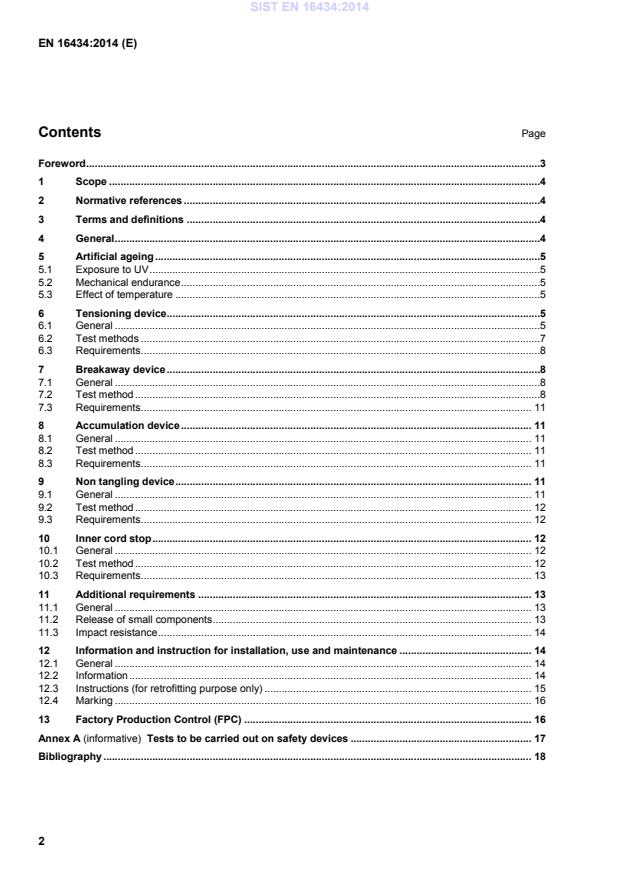
Tests to be carried out on safety devices . 17 Bibliography . 18
Scope This European Standard specifies requirements and test methods for safety devices to be used for protection from strangulation in internal blinds as specified in EN 13120 and insect screens as specified in EN 13561. These devices might be fitted to internal blinds and insect screens at the time of manufacture or for retrofitting. This European Standard applies to any design of device including the following: — tensioning devices; — breakaway devices; — accumulation devices; — non tangling devices; — inner cord stops. Although at the time this standard has been published, no product standard exists for draperies, requirements and test methods specified in the present standard may be applied to safety devices used in such products. For clarification purpose, the term “internal blinds” used in the present standard should mean “internal blinds and insect screens”. 2 Normative references The following documents, in whole or in part, are normatively referenced in this document and are indispensable for its application. For dated references, only the edition cited applies. For undated references, the latest edition of the referenced document (including any amendments) applies. EN 12216, Shutters, external blinds, internal blinds - Terminology, glossary and definitions EN 13120, Internal blinds - Performance requirements including safety EN 13561, External blinds - Performance requirements including safety EN 14201, Blinds and shutters - Resistance to repeated operations (mechanical endurance) - Methods of testing EN 71-1, Safety of toys - Part 1: Mechanical and physical properties EN ISO 4892-2, Plastics - Methods of exposure to laboratory light sources - Part 2: Xenon-arc lamps (ISO 4892-2) EN ISO 4892-3, Plastics - Methods of exposure to laboratory light sources - Part 3: Fluorescent UV lamps (ISO 4892-3) 3 Terms and definitions For the purposes of this document, the terms and definitions given in EN 12216, EN 13561 and EN 13120 apply. 4 General In the testing of safety devices, all related parts associated with the protection from strangulation shall be included. SIST EN 16434:2014
...