

EN 18213-2:2026
(Main)District heating and district cooling pipes - Bonded single and twin pipe systems for directly buried hot and cold water networks - Part 2: Qualification testing of PE-Welder
- Abstract
This document specifies the methods of examining the knowledge and skill set of the PE-welder required to carry out on-site weldable joint casing connections on thermally insulated rigid single and twin pipe systems for directly buried hot and cold water networks according to EN 13941-1 [7] and EN 13941-2 [8] also as for flexible pipe systems according to EN 15632-1 [10], EN 15632-2 [11], EN 15632-3 [12], EN 15632-4 [13], EN 17414-1 [17], EN 17414-2 [18], EN 17414-3 [19], EN 17878-1 [23], EN 17878-2 [24], EN 17878-3 [25] and CEN/TS 17889 [26].
The application of these specifications ensures that the examination is carried out according to a standardised examining procedure.
This document applies to the following processes:
- preparatory works for joint casing assembly;
- assembling and testing the elements for surveillance systems;
- assembling weldable joint casing system;
- executing hot gas welding and hot gas extrusion welding
- verifying joint tightness (leak-tightness testing);
- thermally insulating the joint casing (PUR foaming or half-shell);
- sealing fill & vent openings (weldable plugs);
- assessing overall installation quality of the completed welded joint casing assembly and on-site welded component (non-destructive);
Requirements for test institutes and supervisors are also specified.
NOTE Due to differences of the specific application methods and equipment from joint casing system suppliers, it might be advisable for the PE-welder to be certified for the particular weldable joint casing system.
- Status
- Not Published
- Publication Date
- 22-Dec-2026
- Technical Committee
- CEN/TC 107 - District heating and cooling systems
- Drafting Committee
- CEN/TC 107/WG 4 - Joints
- Current Stage
- 6055 - CEN Ratification completed (DOR) - Publishing
- Start Date
- 09-Nov-2026
- Due Date
- 26-Oct-2026
- Completion Date
- 26-Oct-2026


EN 18213-2:2026 is a CEN standard for qualification testing of PE-Welders working on district heating and district cooling pipe systems. It specifies how to examine the knowledge and practical skill set needed for on-site weldable joint casing connections in directly buried hot and cold water networks. The document is used to assess candidates, recognise test institutes and supervisors, and issue qualification records for this work.
What does EN 18213-2:2026 specify?
EN 18213-2:2026 defines the examination method for PE-Welders who install and assess weldable joint casing connections on thermally insulated single and twin pipe systems. The scope also ties the qualification to the listed rigid and flexible pipe system standards for directly buried hot and cold water networks, so the test method is aligned with the systems used in practice.
The document applies to these work steps:
- preparatory works for joint casing assembly
- assembling and testing the elements for surveillance systems
- assembling weldable joint casing systems
- executing hot gas welding and hot gas extrusion welding
- verifying joint tightness
- thermally insulating the joint casing
- sealing fill and vent openings with weldable plugs
- assessing the overall installation quality of the completed joint casing assembly and on-site welded component
The document is organised into clauses on qualification bodies, admission, theory and practical testing, evaluation, results, validity and renewal. It also includes five annexes.
| Annex | What it covers |
|---|---|
| Annex A | Qualification of PE-Welders, including training subjects and recommended background |
| Annex B | Checklist for welded joint casing systems and hot gas / hot gas extrusion welding |
| Annex C | Further test examples for hot gas extrusion welding |
| Annex D | Template PE-Welder qualification test certificate |
| Annex E | Template PE-Welder qualification identity card |
What are the key requirements of EN 18213-2:2026?
EN 18213-2:2026 is built around a supervised theoretical exam and a supervised practical exam. A candidate passes only when both parts are successful, and the practical work must meet the evaluation criteria in Clause 9. In practice, this means the standard does not just check knowledge of welding terms - it checks whether the welder can carry out the installation sequence correctly and document it.
Qualification bodies and supervision
Clause 4 requires the test institute to be a recognised centre with suitable equipment, testing facilities and premises. The institute is expected to demonstrate extensive practical and theoretical experience, and its recognition is valid for 5 years. Clause 4 also sets the supervisor profile: relevant technical education, 5 years of experience in joint casing installation and quality assessment, observations during PE-Welder examinations, and knowledge of PE-welding processes. This matters because the exam is meant to be credible and comparable between centres.
Admission to the test
Clause 5 limits entry to candidates whose training or previous work suggests they can pass. Typical routes are a plastics fabricator apprenticeship, at least one year as a joint casing installation assistant, or completion of a theoretical and practical preparation course. Candidates must also be trained in handling isocyanate. In practice, the standard expects the candidate to arrive with real job-site preparation, not with beginner-level knowledge.
Theoretical test
Clause 6.2 sets a 20-question multiple-choice exam, completed in no more than one hour and without teaching aids. The questions cover PPE, trench preparation, handling chemicals and flammable or corrosive substances, equipment and tools, installation conditions, surveillance systems, welding, tightness testing, PUR foam work, opening sealing, self-checking, and health and safety. For a buyer or employer, this shows that the qualification includes both technical and safety knowledge.
Practical test
Clause 6.3 requires the practical test to be supervised and carried out on an approved weldable joint casing system or on the defined test piece. The candidate is responsible for suitable tools and personal protective equipment, and equipment used in the test must be in good condition, functional and calibrated. The test also sets a time limit of 120 minutes per test piece. That means the candidate must work under realistic site conditions and complete the work within a controlled timeframe.
Test set-up and specimen handling
Clauses 8 and 9 specify how the test piece is identified, inspected and assessed. The supervisor verifies the candidate identity, checks materials and equipment, and may stop the exam if the work does not follow the manufacturer’s instructions. Clause 9 then sets visual and destructive checks, including measuring elements for surveillance systems, visual inspection of the joint casing, bend testing of samples, and testing of welded PE plugs. Results are recorded as conform or non-conform, so the outcome is tied to clear acceptance criteria rather than general judgement.
Passing, certificate and validity
Clause 10 states that the theoretical exam is passed at 80% correct answers or better, while the practical exam is passed when every section in Clause 9 meets its requirements. The qualification certificate and identity card must identify the PE-Welder and the qualified joint casing systems and welded PE-joint scope. Clause 12 gives the qualification a validity period of 3 years, subject to continuous work, no interruption longer than 6 months, no reason to doubt competence, and annual employer confirmation. Clause 13 allows renewal within 3 months before expiry so the new validity can start from the previous expiry date.
What terms does EN 18213-2:2026 define?
- PE-welder - the person whose knowledge and practical skill in PE welding and joint casing installation are being examined.
- Test Institute - the recognised centre that organises, supervises and issues the qualification documentation.
- Supervisor - the qualified person who oversees the exam, checks the candidate, and validates the result.
- Surveillance system - the monitoring system installed in the joint casing assembly and checked during the exam.
- PUR - polyurethane, used here in the PUR foam thermal insulation process for the joint casing cavity.
- Hot gas welding - a welding process examined in the practical test for specific joint and T-piece work.
- Hot gas extrusion welding - a related welding process examined for joint casing and T-piece applications.
Who uses EN 18213-2:2026?
EN 18213-2:2026 is used by PE-Welders, test institutes, supervisors, manufacturers, suppliers and organisations that train or certify installation staff. It is also relevant to employers and buyers who need evidence that the installer can carry out weldable joint casing connections on district heating and district cooling networks. In practice, it supports qualification, testing, certification and on-site acceptance of welded joint casing work.
Which standards are used with EN 18213-2:2026?
The document relies on several referenced standards and companion parts:
| Standard | What it contributes |
|---|---|
| EN 253 | Factory-made pipe assemblies used in the practical test arrangements |
| EN 448 | Factory-made fitting assemblies and visual requirements for welded PE work |
| EN 489-1 | Joint casing assemblies and thermal insulation for hot water networks |
| EN 14419 | Surveillance systems and related installation/testing checks |
| EN 17248 | Terms and definitions used throughout the document |
| EN 13941-1 | Design of thermal insulated bonded single and twin pipe systems |
| EN 13941-2 | Installation of thermal insulated bonded single and twin pipe systems |
| EN 15632-1 to EN 15632-4 | Flexible pipe system documents named in the scope |
| EN 17414-1 to EN 17414-3 | District cooling pipe system documents named in the scope |
| EN 17878-1 to EN 17878-3 | Flexible pipe system documents named in the scope |
| CEN/TS 17889 | Additional flexible pipe system document named in the scope |
What does the EN 18213-2:2026 document contain?
EN 18213-2:2026 contains the full examination structure for PE-Welder qualification: scope, references, terms, qualification of the test institute and supervisor, admission rules, theory test, practical test, assessment, certificates, validity and renewal. It also includes a training-oriented annex with knowledge areas such as PE casing, surveillance systems, PUR-foam systems, joint casing systems and joint installation.
The practical part is supported by figures that show the test-piece arrangements, including above-ground set-ups and specimen positions. The document also includes a checklist in Annex B, extra hot gas extrusion welding examples in Annex C, and certificate and identity card templates in Annexes D and E. These parts are used for exam setup, marking, evaluation and documentation.
Get Certified
Connect with accredited certification bodies for this standard

Institut za varilstvo d.o.o. (Welding Institute)
Slovenia's leading welding institute since 1952. ISO 3834, EN 1090, pressure equipment certification, NDT personnel, welder qualification. Only IIW Au
Sponsored listings
Frequently Asked Questions
EN 18213-2:2026 is a draft published by the European Committee for Standardization (CEN). Its full title is "District heating and district cooling pipes - Bonded single and twin pipe systems for directly buried hot and cold water networks - Part 2: Qualification testing of PE-Welder". This standard covers: This document specifies the methods of examining the knowledge and skill set of the PE-welder required to carry out on-site weldable joint casing connections on thermally insulated rigid single and twin pipe systems for directly buried hot and cold water networks according to EN 13941-1 [7] and EN 13941-2 [8] also as for flexible pipe systems according to EN 15632-1 [10], EN 15632-2 [11], EN 15632-3 [12], EN 15632-4 [13], EN 17414-1 [17], EN 17414-2 [18], EN 17414-3 [19], EN 17878-1 [23], EN 17878-2 [24], EN 17878-3 [25] and CEN/TS 17889 [26]. The application of these specifications ensures that the examination is carried out according to a standardised examining procedure. This document applies to the following processes: - preparatory works for joint casing assembly; - assembling and testing the elements for surveillance systems; - assembling weldable joint casing system; - executing hot gas welding and hot gas extrusion welding - verifying joint tightness (leak-tightness testing); - thermally insulating the joint casing (PUR foaming or half-shell); - sealing fill & vent openings (weldable plugs); - assessing overall installation quality of the completed welded joint casing assembly and on-site welded component (non-destructive); Requirements for test institutes and supervisors are also specified. NOTE Due to differences of the specific application methods and equipment from joint casing system suppliers, it might be advisable for the PE-welder to be certified for the particular weldable joint casing system.
This document specifies the methods of examining the knowledge and skill set of the PE-welder required to carry out on-site weldable joint casing connections on thermally insulated rigid single and twin pipe systems for directly buried hot and cold water networks according to EN 13941-1 [7] and EN 13941-2 [8] also as for flexible pipe systems according to EN 15632-1 [10], EN 15632-2 [11], EN 15632-3 [12], EN 15632-4 [13], EN 17414-1 [17], EN 17414-2 [18], EN 17414-3 [19], EN 17878-1 [23], EN 17878-2 [24], EN 17878-3 [25] and CEN/TS 17889 [26]. The application of these specifications ensures that the examination is carried out according to a standardised examining procedure. This document applies to the following processes: - preparatory works for joint casing assembly; - assembling and testing the elements for surveillance systems; - assembling weldable joint casing system; - executing hot gas welding and hot gas extrusion welding - verifying joint tightness (leak-tightness testing); - thermally insulating the joint casing (PUR foaming or half-shell); - sealing fill & vent openings (weldable plugs); - assessing overall installation quality of the completed welded joint casing assembly and on-site welded component (non-destructive); Requirements for test institutes and supervisors are also specified. NOTE Due to differences of the specific application methods and equipment from joint casing system suppliers, it might be advisable for the PE-welder to be certified for the particular weldable joint casing system.
EN 18213-2:2026 is classified under the following ICS (International Classification for Standards) categories: 23.040.07 - Pipelines and its parts for district heat; 23.040.99 - Other pipeline components. The ICS classification helps identify the subject area and facilitates finding related standards.
EN 18213-2:2026 is available in PDF format for immediate download after purchase. The document can be added to your cart and obtained through the secure checkout process. Digital delivery ensures instant access to the complete standard document.
Standards Content (Sample)
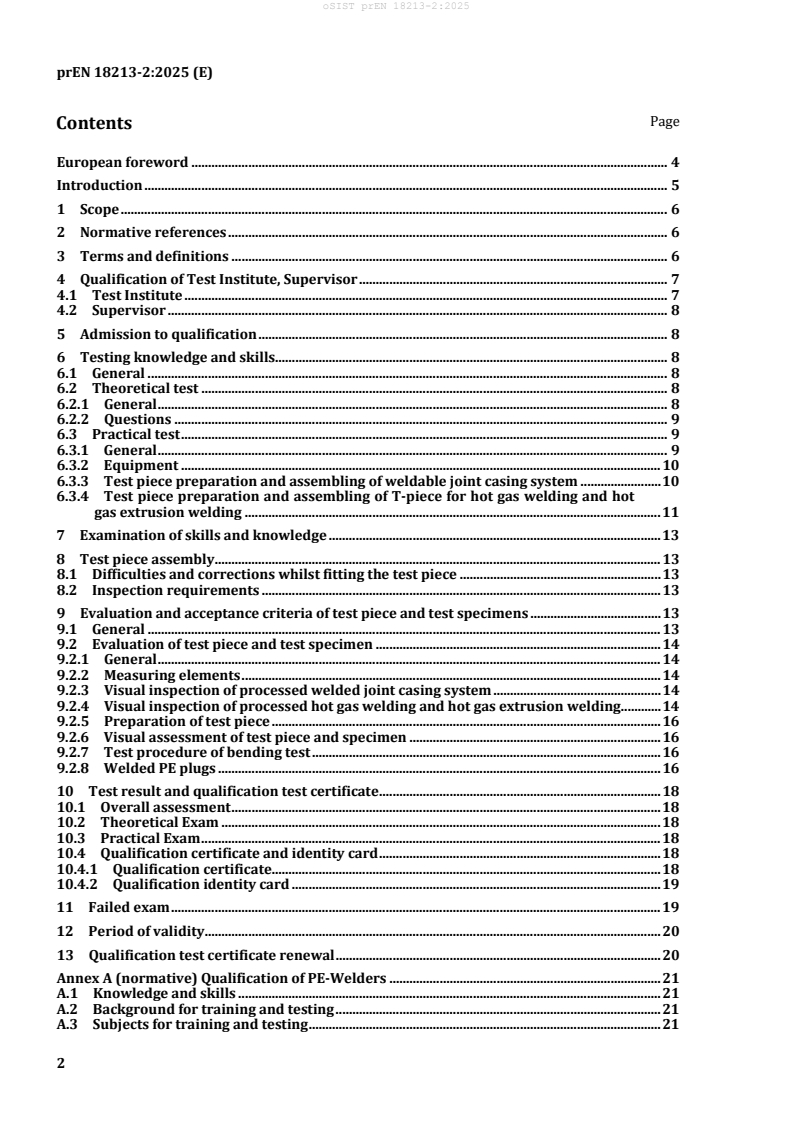
Contents
- Introduction
- 1 Scope
- 2 Normative references
- 3 Terms and definitions
- 4 Qualification of Test Institute, Supervisor
- 4.1 Test Institute
- 4.2 Supervisor
- 5 Admission to qualification
- 6 Testing knowledge and skills
- 6.1 General
- 6.2 Theoretical test
- 6.3 Practical test
- 1 Pipe assembly according to EN 253[19] with diameter casing (DC) 160 mm
- 2 Main pipe casing with cut-out [window] for branch-off pipe
- 3 Pipe assembly according to EN 253[19] with diameter casing (DC) 110 mm
- 4 Branch pipe casing
- 7 Ground level
- 8 Non-rotating pipe fixings
- 7 Examination of skills and knowledge
- 8 Test piece assembly
- 8.1 Difficulties and corrections whilst fitting the test piece
- 8.2 Inspection requirements
- 9 Evaluation and acceptance criteria of test piece and test specimens
- 9.1 General
- 9.2 Evaluation of test piece and test specimen
- 3 Test specimen position 3 from critical areas after the visual inspection
- 1 Fillet weld on nozzle; 1 per side Shape: parallel bar Visual inspection and fold
- 2 Section of the right- 1 per side w ≅ 20 mm Visual inspection
- 3 Longitudinal seam; 3 per side Shape: parallel bar Visual inspection and fold
- 1 Condition and identification of the PE material
- 2 Preparation of the weld seams
- 3 Weld filler material (type and condition, handling/cleanliness/pre-treatment)
- 4 Determination and selection of welding conditions, including actual value measurements
- 5 Equipment/workplace equipment (condition, settings, control measurements)
- 6 Device guidance (starting, finishing and interim interruptions of the welding process)
- 7 Control measurements and documentation
- 1 Formation of the weld bead Uniform shape around the entire perimeter
- 3 Plug is flush with the joint casing
- 4 Thermal damage Visible overheating or burning is not permitted
- 1 Casing
- 2 Joint Casing
- 3 Welded Plug
- 4 Cut-out of the test specimen from the test piece
- 5 Saw lines
- 6 Vice clamps
- 10 Test result and qualification test certificate
- 10.1 Overall assessment
- 10.2 Theoretical Exam
- 10.3 Practical Exam
- 4.1 Welded shrink joint casing (circumferential), single sealed
- 5.1 PE wrap around welded casing (circumferential and longitudinal), single sealed
- 10.4 Qualification certificate and identity card
- 11 Failed exam
- 12 Period of validity
- 13 Qualification test certificate renewal
- Annex A
- Annex B
- 9.2.8.1 Mechanically test the welded plugs according to clause X X X
- 9.2.8.2 After installation of the joint casing
- Annex C
- Annex D
- Annex E
- Bibliography
Introduction
The installation quality of the joint casing application and of measuring elements for surveillance systems also as welding of PE-casings is crucial for the service life and efficiency of district heating and cooling networks, built with factory-made thermally insulated pipe, fitting and valve assemblies. Damage caused by improper application leads to moisture ingress into the thermal insulation and to corrosion of the steel service pipe.
This document deals with the installation of weldable joint casing systems according to EN 489-1[1] as well as with hot gas welding and hot gas extrusion welding.
The PE-welder's ability to follow verbal or written instructions and to evidence his skills are important factors in ensuring the integrity of the joint casing connection. This document serves as the basis for the general recognition by test and certification bodies of the PE- welder's competency and qualification.
PE-welders can also take an examination according to prEN 18213-1[2] to demonstrate their ability to install sealable joint casing systems.
This document is an integral part of the standards for bonded pipe systems for district heating and cooling.
EN 13941- Other standards from CEN/TC 107 covering this subject: EN 253[3], EN 448[4], EN 489-1[1], 1[5], EN 13941-2[6], EN 14419[7], EN 15698-1[8], EN 15698-2[9], EN 17248[10], EN 17415-1[11], EN 17415-2[12], EN 17415-3[13], EN 17878-1[14], EN 17878-2[15], EN 17878-3[16] and prEN 18213-1[2] are listed in the bibliography.
oSIST prEN 18213-2:2025 prEN 18213-2:2025 (E)
1 Scope
This document specifies the methods of examining the knowledge and skill set of the PE-welder required to carry out on-site joint casing connections on thermally insulated single and twin pipe systems for directly buried hot and cold water networks according to EN 13941-1:2019[17] and EN 13941-2:2019[18].
The application of these specified methods specifications ensures that the examination is carried out according to a standardised examining procedure.
This document applies to the following processes:
- preparatory works for joint casing assembly; - assembling and testing the elements for surveillance systems; NOTE For special surveillance systems it can be important to have additional training. - preparatory works for joint casing system installation; - assembling weldable joint casing system; - executing hot gas welding and hot gas extrusion welding - verifying joint tightness (leakage testing); - thermally insulating the joint casing (PUR foaming or half-shell); - sealing fill & vent openings (weldable plugs); - assessing overall installation quality of the completed joint connection (non-destructive).
2 Normative references
The following documents are referred to in the text in such a way that some or all of their content constitutes requirements of this document. For dated references, only the edition cited applies. For undated references, the latest edition of the referenced document (including any amendments) applies. EN 253, District heating pipes - Bonded single pipe systems for directly buried hot water networks - Factory made pipe assembly of steel service pipe, polyurethane thermal insulation and a casing of polyethylene EN 448, District heating pipes - Bonded single pipe systems for directly buried hot water networks - Factory made fitting assemblies of steel service pipes, polyurethane thermal insulation and a casing of polyethylene EN 489-1, District heating pipes - Bonded single and twin pipe systems for buried hot water networks - Part 1: Joint casing assemblies and thermal insulation for hot water networks in accordance with EN 13941-1 EN 14419, District heating pipes - Bonded single and twin pipe systems for buried hot water networks - Surveillance systems EN 17248:2019, District heating and district cooling pipe systems - Terms and definitions
3 Terms and definitions
For the purposes of this document, the terms and definitions given in EN 17248:2019 apply. ISO and IEC maintain terminological databases for use in standardization at the following addresses:
- ISO Online browsing platform: available at http://www.iso.org/obp
oSIST prEN 18213-2:2025 prEN 18213-2:2025 (E) - IEC Electropedia: available at http://www.electropedia.org/
4 Qualification of Test Institute, Supervisor
4.1 Test Institute
The test institute is a recognized centre for the examination of PE-welders. NOTE The training of PE-welders can also take place at the test institute. Test institutes can be companies that:
- manufacture factory made district heating and district cooling pipe, fitting and valve assemblies ,
- distribute factory made district heating and district cooling pipe, fitting and valve assemblies,
- carry out joint installation work on factory made bonded and flexible pipe systems for district heating and district cooling, who have demonstrated extensive theoretical and practical experience in joint casing installation over a minimum period of 5 years.
or:
- institutions whose business activities include the education and examination of specialist staff, however with additional personnel requirements, in case extensive theoretical and practical expertise over a minimum period of 5 years cannot be demonstrated. Factual requirements for the test institute are suitable equipment engineering, testing technology and premises for knowledge and practical skills tests.
The application for recognition as testing institute shall be submitted in writing to the Euroheat & Power association (EHP), followed by an examination of the required specialist knowledge of the supervisors as well as by an inspection of the required spatial and factual infrastructure. A group of experts decides on the award or refusal of the certificate of recognition or raises deficiencies for rectification. The rules of procedure for the entire recognition process should be adhered to - process of the recognition procedure - duration of validity - recognition of additional supervisors - issuance, expiry or withdrawal of recognition - monitoring - review - extension of the period of validity - change of recognition - complaints procedure The recognition is valid for a period of 5 years. In order to maintain its recognition, the test institute shall ensure the necessary premises, technical equipment, further training and the availability of a recognized supervisor.
oSIST prEN 18213-2:2025 prEN 18213-2:2025 (E)
4.2 Supervisor
The qualification of a supervisor shall be:
- an engineer, bachelor, master, technician or state-recognized master craftsman respectively master chamber of industry and commerce in a relevant technical profession;
- proving extensive theoretical and practical experience over a minimum period of 5 years in joint casing installation as well as in the assessment of joint casing quality characteristics, in particular in the joint casing installation processes to be tested;
- having served at least 3 observations/internships during PE-welder examinations;
- knowledgeable and experienced in PE-welding processes.
Instead of the 5 years of practical experience, the necessary skills can be demonstrated through the following evidence:
- a valid test certificate according to this document, and , and
- a valid test certificate according to prEN 18213-1[2]
- at least 10 days observation/internship on joint casing installation construction sites.
5 Admission to qualification
Only applicants whose training and/or previous activities show that they are likely to pass the planned test may be admitted as a candidate.
As a rule, this is the case if one of the following is met:
- completed apprenticeship as plastics fabricator;
- at least one year experience as joint casing installation assistant, confirmed by employer’s declaration;
- completion of both a theoretical and practical training course in preparation for the PE-welder´s qualification test.
The applicant shall be trained in handling of isocyanate.
NOTE Further information can be found in the European REACH regulation. The content of the training course is defined in Annex A.
6 Testing knowledge and skills
6.1 General
The candidate shall demonstrate in qualification tests his theoretical knowledge according to 6.2 and practical skills according to 6.3.
6.2 Theoretical test
6.2.1 General
The candidate’s knowledge of the practical rules for skillful and safe working shall be evaluated in a theoretical test.
This part of the qualification test is carried out under the supervision of the supervisor.
oSIST prEN 18213-2:2025 prEN 18213-2:2025 (E) The candidate shall answer 20 multiple-choice questions. Filling in the questionnaire shall not exceed one hour and be continuous without access to teaching aids.
The questions shall cover the subjects in 6.2.2.
6.2.2 Questions
The questions shall be related to the following subjects, as appropriate:
- personal protective equipment (PPE) (observe the national requirements)
- preparation of pipe trench
- storage, transport and handling of chemicals and flammable/corrosive substances
- proper installation equipment and tools
- surrounding conditions for joint casing installation
- working and ambient conditions
- systems and products to be used
- preparatory works for joint casing installation
- assembly and test of surveillance systems
- preparation of welding areas
- installation of weldable joint casing systems
- execution of hot gas welding and hot gas extrusion welding (if a qualification is intended for)
- tightness testing of the joint casing prior to thermal insulation
- production of PUR foam sample
- thermal insulation of joint casing cavity
- sealing foam and vent openings
- self-assessment possibilities of welded joint casing assembly
- awareness of health and safety requirements.
6.3 Practical test
6.3.1 General
The practical test shall be carried out under the supervision of the supervisor on a weldable joint casing system approved in accordance with EN 489-1 and / or on a test piece according to 6.3.4. Assembling the test piece is to be carried out following the installation instructions. Prior to the practical test, the supervisor shall inform the candidates about the procedure of examining and rating the individual installation steps. During the practical test, the supervisor shall not provide any advice.
All materials and documents necessary for the practical test shall be available to the candidate. The PE-welder himself is responsible for the personal protective and suitable installation equipment.
oSIST prEN 18213-2:2025 prEN 18213-2:2025 (E) The PE-welder himself can decide whether to use his own tools and equipment (or those of his employer) or those of the test centre. Unless the PE-welder uses the tools and equipment of the test centre, separate proof shall be provided about its flawless condition, functionality and calibration. Depending on the qualification aimed for, the PE welder shall produce a separate test piece for joint casing systems 4.1 and 5.1 in accordance with EN 489-1 as well as for the hot gas welding and hot gas extrusion welding processes according to 6.3.4.
The practical test shall be conducted within 120 minutes per test piece. Subject areas of the practical test are:
- preparatory works for weldable joint casing assembly or T-piece according to 6.3.4;
- assembly of measuring elements and test of surveillance system;
- preparation of welding areas;
- handling of joint casing system;
- execution of hot gas welding and hot gas extrusion welding (if qualification is intended for);
- tightness test of joint casing, if applicable;
- handling of PUR foam
- closing of foam and vent openings, if applicable;
- visual inspection of assembled joint casing system / T-piece;
- documentation of joint casing system / T-piece installation.
6.3.2 Equipment
The equipment to be used in the practical test shall be in flawless condition, functional and calibrated. Equipment can be the one of the candidate or of the test institute.
6.3.3 Test piece preparation and assembling of weldable joint casing system
The test piece shall be positioned above ground level similarly to the situation on site. The height of the supports to be attached to the free ends of the steel service pipe shall be between 200 and 400 mm from the floor to the bottom edge of the steel service pipe, see Figure 1. The test piece shall be properly prepared for assembling of the joint casing system by the candidate.
Key A Non-rotating pipe fixings
oSIST prEN 18213-2:2025 prEN 18213-2:2025 (E) B Factory made pipe assembly according to EN 253 C Weldable joint casing system according to EN 489-1 D Distance between floor and bottom edge of the service pipe (200 mm to 400 mm) E Floor Figure 1 — Set-up of the test piece for the preparation and assembly of the joint casing system
6.3.4 Test piece preparation and assembling of T-piece for hot gas welding and hot gas
extrusion welding A T-piece is used as the test piece. It shall be positioned above ground level similarly to the situation on site. The height of the supports to be attached to the free ends of the steel service pipe shall be between 200 and 400 mm from the floor to the bottom edge of the steel service pipe, see Figure 2. Further possible examples for hot gas welding and hot gas extrusion welding are shown in Annex C. If a test piece other than shown in Figure 2 is used in the practical test, it shall be mentioned in the Certificate.
The test piece shall be properly prepared for assembling of the casing construction by the applicant.
oSIST prEN 18213-2:2025 prEN 18213-2:2025 (E)
Key
1 Pipe assembly according to EN 253[19] with diameter casing (DC) 160 mm
2 Main pipe casing with cut-out [window] for branch-off pipe
3 Pipe assembly according to EN 253[19] with diameter casing (DC) 110 mm
4 Branch pipe casing
oSIST prEN 18213-2:2025 prEN 18213-2:2025 (E) 5 Circumferential weld seams by root pass using the hot gas welding process with or without filler material and by cover pass using the hot gas extrusion welding process 6 Longitudinal seams as V-seam by root pass using the hot gas welding process with or without filler material and by cover pass using the hot gas extrusion welding process
7 Ground level
8 Non-rotating pipe fixings
Figure 2 — Arrangement and dimensions of the test piece (Dimensional data [mm] as circa dimensions)
7 Examination of skills and knowledge
The exam shall be supervised, rated and validated by the supervisor.
8 Test piece assembly
8.1 Difficulties and corrections whilst fitting the test piece
In the event of difficulties during the practical test for which the candidate is not responsible, the test piece on which assembling has been started may be replaced provided the supervisor’s prior consent. Errors made or occurring during the assembling may be repaired only after permission has been given by the supervisor.
8.2 Inspection requirements
Before assembling, the supervisor shall check the identity of the candidate as well as the suitability of the materials and equipment. The test piece shall be identified with the number or mark of the supervisor and of the candidate.
The supervisor shall - supervise the preparation and the assembling of the test piece. - terminate the qualification test if the assembling is not in compliance with the manufacturer’s instructions or the candidate does not have the skills required to obtain a satisfactory result. - visually check the test piece after completion by the candidate.
9 Evaluation and acceptance criteria of test piece and test specimens
9.1 General
The supervisor inspects the installation documentation and evaluates the test specimen made by the candidate.
The test has to be evaluated as follows:
- “c”: conform;
- “nc”: non-conform.
Storage or disposal of the test piece or test specimens shall be as instructed by the supervisor.
oSIST prEN 18213-2:2025 prEN 18213-2:2025 (E)
9.2 Evaluation of test piece and test specimen
9.2.1 General
Assembling of the test piece shall comply with the - installation instructions of the joint casing system used in the practical test - execution conditions of hot gas welding and hot gas extrusion welding. The supervisor shall visually evaluate the correct application by accompanying the assembly of the test piece by the candidate.
After completion of the test piece, visual inspection and destructive tests shall be performed under supervision.
The evaluation shall be recorded in accordance with Annex B.
Mechanical-technological tests in general shall be carried out after cooling down to 20 +/-10°C. Test piece or test specimens are stored or disposed of in accordance with the supervisor’s instructions.
...