


EN ISO 11295:2022
(Main)Plastics piping systems used for the rehabilitation of pipelines - Classification and overview of strategic, tactical and operational activities (ISO 11295:2022)
Plastics piping systems used for the rehabilitation of pipelines - Classification and overview of strategic, tactical and operational activities (ISO 11295:2022)
This document specifies the steps of the overall process of pipeline rehabilitation, comprising:
— information on strategic and tactical activities:
a) investigation and condition assessment of the existing pipeline;
b) pipeline rehabilitation planning.
— information on and requirements for operational activities:
c) project specification;
d) applications of techniques;
e) documentation of the design and application process.
Definitions and classification of families of renovation and trenchless replacement techniques are provided, and their respective features described. Areas of application covered include underground drainage and sewerage networks and underground water and gas supply networks.
The following aspects are not covered by the scope of this document:
— new construction provided as network extensions;
— calculation methods to determine, for each viable technique, the characteristics of lining or replacement pipe material needed to secure the desired performance of the rehabilitated pipeline;
— techniques providing non-structural pressure pipe liners;
— techniques for local repair.
It is the responsibility of the designer to choose and design the renovation or trenchless replacement pipeline system.
Kunststoff-Rohrleitungssysteme, die für die Sanierung verwendet werden - Klassifizierung und Überblick über strategische, taktische und operative Aktivitäten (ISO 11295:2022)
Dieses Dokument legt die Schritte des Gesamtprozesses der Rohrleitungssanierung fest, bestehend aus:
— Informationen zu strategischen und taktischen Aktivitäten:
a) Untersuchung und Zustandsbeurteilung der vorhandenen Rohrleitung;
b) Sanierungsplanung der Rohrleitung.
— Informationen zu und Anforderungen an operative Aktivitäten:
c) Maßnahmenplanung;
d) Einzusetzende Verfahren und Methoden;
e) Dokumentation des Planungs- und Anwendungsprozesses.
Definitionen und die Klassifizierung von Technikfamilien für die Sanierung und grabenlose Erneuerung sind enthalten, einschließlich einer Beschreibung ihrer jeweiligen Merkmale. Die behandelten Anwendungs¬bereiche beinhalten erdverlegte Entwässerungs- und Abwassernetze und erdverlegte Wasser- und Gas¬versorgungsnetze.
Die folgenden Aspekte sind durch den Anwendungsbereich dieses Dokuments nicht abgedeckt:
— Rohrleitungsneubauten zur Netzerweiterung;
— Berechnungsverfahren zur Bestimmung der Eigenschaften von Lining- oder Ersatzrohrwerkstoff für jedes praktikable Verfahren, die notwendig sind, um die gewünschte Leistungsfähigkeit der erneuerten Rohr¬leitung sicherzustellen;
— Verfahren der Bereitstellung von nicht statisch belastbaren Druckleitungs-Linern;
— Verfahren zur punktuellen Reparatur.
Es liegt in der Verantwortung des Planers, ein Rohrleitungssystem zur Renovierung oder grabenlosen Erneuerung auszuwählen und zu planen.
Systèmes de canalisation en plastique destinés à la réhabilitation des réseaux enterrés - Classification et vue d’ensemble des activités stratégiques, tactiques et opérationnelles (ISO 11295:2022)
Le présent document spécifie les étapes du processus global de réhabilitation des canalisations, comprenant:
— des informations sur les activités stratégiques et tactiques:
a) inspection et évaluation de l'état de la canalisation existante;
b) planification de la réhabilitation de la canalisation.
— informations sur les activités opérationnelles et leurs exigences:
c) spécification du projet;
d) application des techniques;
e) documentation du processus de conception et d'application.
Les définitions et la classification des familles de techniques de rénovation et de remplacement sans tranchée sont fournies, et leurs caractéristiques respectives décrites. Les domaines d'application couverts comprennent les réseaux les branchements et les collecteurs d'assainissement enterrés et les réseaux enterrés d'approvisionnement en eau et en gaz.
Les aspects suivants ne sont pas couverts par le domaine d'application du présent document:
— nouvelle construction prévue comme extension du réseau;
— méthodes de calcul permettant de déterminer, pour chaque technique viable, les caractéristiques du matériau du tubage ou de remplacement des canalisations nécessaires pour garantir la performance souhaitée de la canalisation réhabilitée;
— techniques permettant de fournir des revêtements non structuraux pour les tubes sous pression;
— techniques de réparation locale.
Il est de la responsabilité du concepteur de choisir et de concevoir le système de canalisation de rénovation ou de remplacement sans tranchée.
Cevni sistemi iz polimernih materialov za obnovo cevovodov - Razvrstitev in pregled strateških, taktičnih in operativnih dejavnosti (ISO 11295:2022)
Ta dokument določa korake celotnega postopka obnove cevovodov in zajema:
– informacije o strateških in taktičnih dejavnostih:
a) pregled in ocena stanja obstoječega cevovoda;
b) načrtovanje obnove cevovoda;
– informacije o operativnih dejavnostih in povezane zahteve:
c) specifikacija projekta;
d) uporaba tehnik;
e) dokumentacija postopka načrtovanja in uporabe.
Podane so definicije in klasifikacija družin tehnik za obnovo in zamenjavo brez izkopa
ter opisane so njihove ustrezne značilnosti. Področja uporabe zajemajo podzemna
omrežja za odvodnjavanje in kanalizacijo ter podzemna omrežja za oskrbo z vodo in s plinom.
Naslednji vidiki ne spadajo na področje uporabe tega dokumenta:
– nova gradnja v okviru razširitev omrežja;
– računske metode za določanje (za vsako izvedljivo tehniko) značilnosti oblog ali
nadomestnega materiala za cevi, ki je potreben za zagotovitev želene učinkovitosti obnovljenega cevovoda;
– tehnike, ki zagotavljajo nekonstrukcijske obloge cevi pod tlakom;
– tehnike za lokalna popravila.
Načrtovalec je odgovoren za izbiro in načrtovanje sistema za obnovo ali zamenjavo cevovodov
brez izkopa.
General Information
Relations
Overview
EN ISO 11295:2022 - "Plastics piping systems used for the rehabilitation of pipelines" - is a CEN-adopted international standard that defines the overall pipeline rehabilitation process for buried networks. It provides a classification and overview of strategic, tactical and operational activities for renovating or trenchlessly replacing pipelines using plastics piping systems. The standard applies to underground drainage and sewerage, and underground water and gas supply networks.
Key topics and requirements
- Pipeline rehabilitation process: Describes staged activities from strategic planning to operational execution.
- Strategic & tactical activities: Investigation and condition assessment of existing pipelines; rehabilitation planning and risk analysis.
- Operational activities: Project specification, technique application, construction/implementation and documentation.
- Performance criteria and investigations:
- Hydraulic, structural, environmental and operational requirements guide condition assessment and selection of techniques.
- Emphasis on condition assessment, investigation methods and risk control measures.
- Classification of techniques:
- Renovation (lining) families: continuous pipes, close-fit pipes, cured-in-place liners (CIPP), discrete pipe segments, adhesive-backed hoses, spirally-wound pipes, sprayed polymeric materials, and more.
- Trenchless replacement techniques: pipe bursting, pipe removal, horizontal directional drilling (HDD), impact moling, pipe jacking, etc.
- Selection and implementation:
- Criteria for choosing techniques based on system layout, hydraulic and structural performance, environmental impact and construction constraints.
- Guidance on preconstruction activities, materials conformity, inspection, handling, leak testing and acceptance control.
- Exclusions: Does not cover new network extensions, detailed calculation methods for liner material sizing, non-structural pressure liners, or local repair techniques. The designer remains responsible for system design and material selection.
Applications and practical value
- Useful for municipalities, utility owners, civil engineers, pipeline designers, rehabilitation contractors and consultants involved in sewer, water and gas network renewal.
- Helps asset managers develop consistent rehabilitation plans, select appropriate trenchless rehabilitation or lining technologies, and document project specifications and acceptance criteria.
- Supports decision-making for rehabilitation vs. replacement, ensuring hydraulic and structural requirements are met while minimizing excavation and environmental disruption.
Who should use this standard
- Pipeline designers and engineers, rehabilitation contractors, utility asset managers, infrastructure planners, and manufacturers of plastics piping and lining systems.
Related standards and context
- Prepared by ISO/TC 138 in collaboration with CEN/TC 155; EN ISO 11295:2022 supersedes earlier editions. For detailed material properties, design calculations and testing methods, users should consult complementary ISO and EN standards covering plastics pipes, fittings and test methods.

Standards Content (Sample)
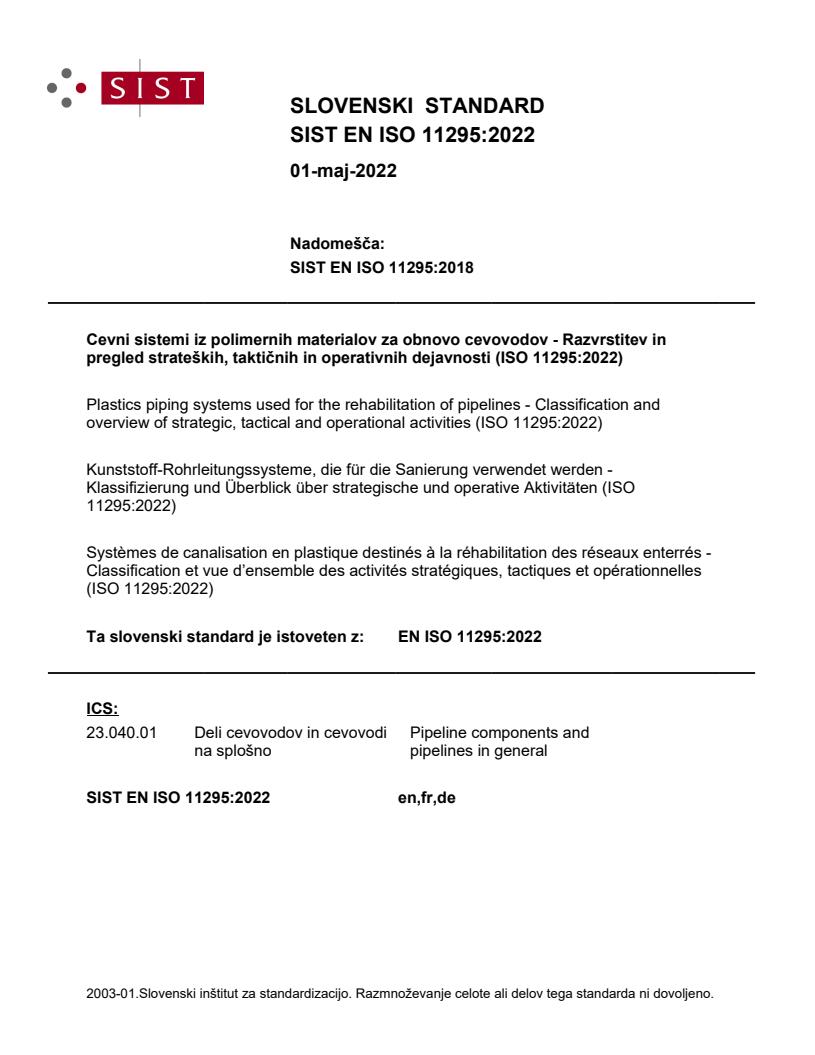
SLOVENSKI STANDARD
01-maj-2022
Nadomešča:
SIST EN ISO 11295:2018
Cevni sistemi iz polimernih materialov za obnovo cevovodov - Razvrstitev in
pregled strateških, taktičnih in operativnih dejavnosti (ISO 11295:2022)
Plastics piping systems used for the rehabilitation of pipelines - Classification and
overview of strategic, tactical and operational activities (ISO 11295:2022)
Kunststoff-Rohrleitungssysteme, die für die Sanierung verwendet werden -
Klassifizierung und Überblick über strategische und operative Aktivitäten (ISO
11295:2022)
Systèmes de canalisation en plastique destinés à la réhabilitation des réseaux enterrés -
Classification et vue d’ensemble des activités stratégiques, tactiques et opérationnelles
(ISO 11295:2022)
Ta slovenski standard je istoveten z: EN ISO 11295:2022
ICS:
23.040.01 Deli cevovodov in cevovodi Pipeline components and
na splošno pipelines in general
2003-01.Slovenski inštitut za standardizacijo. Razmnoževanje celote ali delov tega standarda ni dovoljeno.
EN ISO 11295
EUROPEAN STANDARD
NORME EUROPÉENNE
February 2022
EUROPÄISCHE NORM
ICS 23.040.01 Supersedes EN ISO 11295:2017
English Version
Plastics piping systems used for the rehabilitation of
pipelines - Classification and overview of strategic, tactical
and operational activities (ISO 11295:2022)
Systèmes de canalisation en plastique destinés à la Kunststoff-Rohrleitungssysteme, die für die Sanierung
réhabilitation des réseaux enterrés - Classification et verwendet werden - Klassifizierung und Überblick
vue d'ensemble des activités stratégiques, tactiques et über strategische und operative Aktivitäten (ISO
opérationnelles (ISO 11295:2022) 11295:2022)
This European Standard was approved by CEN on 26 December 2021.
CEN members are bound to comply with the CEN/CENELEC Internal Regulations which stipulate the conditions for giving this
European Standard the status of a national standard without any alteration. Up-to-date lists and bibliographical references
concerning such national standards may be obtained on application to the CEN-CENELEC Management Centre or to any CEN
member.
This European Standard exists in three official versions (English, French, German). A version in any other language made by
translation under the responsibility of a CEN member into its own language and notified to the CEN-CENELEC Management
Centre has the same status as the official versions.
CEN members are the national standards bodies of Austria, Belgium, Bulgaria, Croatia, Cyprus, Czech Republic, Denmark, Estonia,
Finland, France, Germany, Greece, Hungary, Iceland, Ireland, Italy, Latvia, Lithuania, Luxembourg, Malta, Netherlands, Norway,
Poland, Portugal, Republic of North Macedonia, Romania, Serbia, Slovakia, Slovenia, Spain, Sweden, Switzerland, Turkey and
United Kingdom.
EUROPEAN COMMITTEE FOR STANDARDIZATION
COMITÉ EUROPÉEN DE NORMALISATION
EUROPÄISCHES KOMITEE FÜR NORMUNG
CEN-CENELEC Management Centre: Rue de la Science 23, B-1040 Brussels
© 2022 CEN All rights of exploitation in any form and by any means reserved Ref. No. EN ISO 11295:2022 E
worldwide for CEN national Members.
Contents Page
European foreword . 3
European foreword
This document (EN ISO 11295:2022) has been prepared by Technical Committee ISO/TC 138 "Plastics
pipes, fittings and valves for the transport of fluids" in collaboration with Technical Committee CEN/TC
155 “Plastics piping systems and ducting systems” the secretariat of which is held by NEN.
This European Standard shall be given the status of a national standard, either by publication of an
identical text or by endorsement, at the latest by August 2022, and conflicting national standards shall
be withdrawn at the latest by August 2022.
Attention is drawn to the possibility that some of the elements of this document may be the subject of
patent rights. CEN shall not be held responsible for identifying any or all such patent rights.
This document supersedes EN ISO 11295:2017.
Any feedback and questions on this document should be directed to the users’ national standards
body/national committee. A complete listing of these bodies can be found on the CEN website.
According to the CEN-CENELEC Internal Regulations, the national standards organizations of the
following countries are bound to implement this European Standard: Austria, Belgium, Bulgaria,
Croatia, Cyprus, Czech Republic, Denmark, Estonia, Finland, France, Germany, Greece, Hungary, Iceland,
Ireland, Italy, Latvia, Lithuania, Luxembourg, Malta, Netherlands, Norway, Poland, Portugal, Republic of
North Macedonia, Romania, Serbia, Slovakia, Slovenia, Spain, Sweden, Switzerland, Turkey and the
United Kingdom.
Endorsement notice
The text of ISO 11295:2022 has been approved by CEN as EN ISO 11295:2022 without any modification.
INTERNATIONAL ISO
STANDARD 11295
Third edition
2022-01
Plastics piping systems used for
the rehabilitation of pipelines —
Classification and overview of
strategic, tactical and operational
activities
Systèmes de canalisation en plastique destinés à la réhabilitation
des réseaux enterrés — Classification et vue d’ensemble des activités
stratégiques, tactiques et opérationnelles
Reference number
ISO 11295:2022(E)
ISO 11295:2022(E)
© ISO 2022
All rights reserved. Unless otherwise specified, or required in the context of its implementation, no part of this publication may
be reproduced or utilized otherwise in any form or by any means, electronic or mechanical, including photocopying, or posting on
the internet or an intranet, without prior written permission. Permission can be requested from either ISO at the address below
or ISO’s member body in the country of the requester.
ISO copyright office
CP 401 • Ch. de Blandonnet 8
CH-1214 Vernier, Geneva
Phone: +41 22 749 01 11
Email: copyright@iso.org
Website: www.iso.org
Published in Switzerland
ii
ISO 11295:2022(E)
Contents Page
Foreword .v
Introduction . vi
1 Scope . 1
2 Normative references . 1
3 Terms and definitions . 1
3.1 General terms . 2
3.2 Terms related to techniques . 3
3.3 Terms related to services conditions . 5
4 Abbreviated terms . 5
5 Pipeline rehabilitation process .6
6 Investigation and condition assessment of the existing pipeline .6
6.1 Performance criteria . 6
6.1.1 General . 6
6.1.2 Hydraulic requirements . 8
6.1.3 Structural requirements . 8
6.1.4 Environmental requirement . 8
6.1.5 Operational requirements . 8
6.2 Investigation of performance . 9
6.2.1 General . 9
6.2.2 Hydraulic investigation . 10
6.2.3 Structural investigation . . 10
6.2.4 Environmental investigation . . 11
6.2.5 Operational investigation . 11
6.3 Condition assessment . 11
6.4 Risk analysis .12
6.5 Control measures . 12
7 Classification and characteristics of rehabilitation techniques .13
7.1 Overview . 13
7.2 Classification of renovation techniques . 14
7.2.1 General . 14
7.2.2 Lining with continuous pipes . 14
7.2.3 Lining with close-fit pipes . 16
7.2.4 Lining with cured-in-place pipes . 19
7.2.5 Lining with discrete pipes . 23
7.2.6 Lining with adhesive-backed hoses. 26
7.2.7 Lining with spirally-wound pipes .28
7.2.8 Lining with pipe segments . 31
7.2.9 Lining with a rigidly anchored plastics inner layer . 32
7.2.10 Lining with sprayed polymeric materials . .34
7.2.11 Lining with inserted hoses .36
7.3 Classification of trenchless replacement techniques . 37
7.3.1 General . 37
7.3.2 Pipe bursting.38
7.3.3 Pipe removal .40
7.3.4 Horizontal directional drilling (HDD) . 42
7.3.5 Impact moling . 45
7.3.6 Pipe jacking . 47
8 Selection of rehabilitation techniques .50
8.1 General .50
8.2 Pipeline system layout .50
8.3 Hydraulic performance . 51
iii
ISO 11295:2022(E)
8.4 Structural performance . 52
8.4.1 General . 52
8.4.2 Non-pressure pipes . 52
8.4.3 Pressure pipes .53
8.5 Environmental impact . 56
8.6 Construction constraints . 57
8.7 Project specification . 57
9 Implementation of rehabilitation techniques .58
9.1 Preconstruction activities . .58
9.2 Assessment of conformity of products . 59
9.3 Inspection, storage and handling of the materials on site . 59
9.4 Application of rehabilitation technique . 59
9.4.1 Preparatory work . 59
9.4.2 Construction.60
9.5 Acceptance control .60
9.5.1 General .60
9.5.2 Inspection .60
9.5.3 Leak tightness testing . 61
9.5.4 Sampling . 62
9.6 Completion of the work . 62
9.6.1 Finishing off the rehabilitation work . 62
9.6.2 Lateral reinstatement . 62
9.7 Documentation of the process . 62
Bibliography .64
iv
ISO 11295:2022(E)
Foreword
ISO (the International Organization for Standardization) is a worldwide federation of national standards
bodies (ISO member bodies). The work of preparing International Standards is normally carried out
through ISO technical committees. Each member body interested in a subject for which a technical
committee has been established has the right to be represented on that committee. International
organizations, governmental and non-governmental, in liaison with ISO, also take part in the work.
ISO collaborates closely with the International Electrotechnical Commission (IEC) on all matters of
electrotechnical standardization.
The procedures used to develop this document and those intended for its further maintenance are
described in the ISO/IEC Directives, Part 1. In particular, the different approval criteria needed for the
different types of ISO documents should be noted. This document was drafted in accordance with the
editorial rules of the ISO/IEC Directives, Part 2 (see www.iso.org/directives).
Attention is drawn to the possibility that some of the elements of this document may be the subject of
patent rights. ISO shall not be held responsible for identifying any or all such patent rights. Details of
any patent rights identified during the development of the document will be in the Introduction and/or
on the ISO list of patent declarations received (see www.iso.org/patents).
Any trade name used in this document is information given for the convenience of users and does not
constitute an endorsement.
For an explanation of the voluntary nature of standards, the meaning of ISO specific terms and
expressions related to conformity assessment, as well as information about ISO's adherence to
the World Trade Organization (WTO) principles in the Technical Barriers to Trade (TBT), see
www.iso.org/iso/foreword.html.
This document was prepared by ISO/TC 138 Plastics pipes, fittings and valves for the transport of fluids,
Subcommittee SC 8, Rehabilitation of pipeline systems, in collaboration with the European Committee for
Standardization (CEN) Technical Committee CEN/TC 155, Plastics piping systems and ducting systems, in
accordance with the Agreement on technical cooperation between ISO and CEN (Vienna Agreement).
This third edition cancels and replaces the second edition (ISO 11295:2017), which has been technically
revised.
The main changes compared to the previous edition are as follows:
— Title is renewed from “Classification and information on design and applications of plastics piping
systems used for renovation and replacement” to “Plastics piping systems used for the rehabilitation of
pipelines — Classification and overview of strategic, tactical and operational activities”;
— Clause 5 has been added, describing the whole process of pipeline rehabilitation with references to
the other clauses for further details;
— Clause 6 has been added, dealing with the strategic and tactical activities necessary to decide
whether to rehabilitate; parts of the content of the former Clause 8 are included in this new clause;
— Former Clauses 5, 6 and 7 have been combined into Clause 7 with largely unchanged content;
— Clause 8 has been added, outlining the further tactical and operational steps needed to specify the
rehabilitation project; parts of the content of the former Clauses 8 and 9 are included;
— Clause 9 still covers installation aspects but has been revised to include content on acceptance
control.
Any feedback or questions on this document should be directed to the user’s national standards body. A
complete listing of these bodies can be found at www.iso.org/members.html.
v
ISO 11295:2022(E)
Introduction
Pipeline systems are continuously required to satisfy physical, chemical, biochemical and biological
demands. These demands depend on planning, material, construction, type and period of use.
When pipeline systems become operational, they constitute a valuable asset to the network owner,
requiring adequate management, including monitoring the performance of the pipeline system. For
general guidelines and requirements on asset management, ISO 55000, ISO 55001 and ISO 55002 are
applicable.
For the specific case of pipelines for water supply and wastewater collection, detailed information on
the overall management of the networks is provided by ISO 24516-1 and ISO 24516-3.
In the case of loss of performance of a pipeline system, reactive measures initially focus on improving
regular maintenance procedures, including cleaning. In case of deterioration or other serious defects,
more stringent measures to rehabilitate the pipeline become necessary.
Rehabilitation is carried out when there is a need to restore or upgrade the performance of a
pipeline system. Rehabilitation can consist of repair, renovation or replacement. In recent years, the
rehabilitation of pipeline systems has become increasingly important and will continue to be so.
This document provides information on the design process when considering rehabilitation of an
existing pipeline, in order of sequence:
a) investigation and assessment of the deficiencies of current performance of the existing pipeline;
b) determination of viable options, based on performance criteria and process-related factors;
c) specification of the selected type of technique and the required pipe material;
d) the installation;
e) testing the performance.
The techniques used for the renovation and trenchless replacement of existing pipelines are classified
in technique families and the typical characteristics of each are described in general terms.
vi
INTERNATIONAL STANDARD ISO 11295:2022(E)
Plastics piping systems used for the rehabilitation of
pipelines — Classification and overview of strategic,
tactical and operational activities
1 Scope
This document specifies the steps of the overall process of pipeline rehabilitation, comprising:
— information on strategic and tactical activities:
a) investigation and condition assessment of the existing pipeline;
b) pipeline rehabilitation planning.
— information on and requirements for operational activities:
c) project specification;
d) applications of techniques;
e) documentation of the design and application process.
Definitions and classification of families of renovation and trenchless replacement techniques are
provided, and their respective features described. Areas of application covered include underground
drainage and sewerage networks and underground water and gas supply networks.
The following aspects are not covered by the scope of this document:
— new construction provided as network extensions;
— calculation methods to determine, for each viable technique, the characteristics of lining or
replacement pipe material needed to secure the desired performance of the rehabilitated pipeline;
— techniques providing non-structural pressure pipe liners;
— techniques for local repair.
It is the responsibility of the designer to choose and design the renovation or trenchless replacement
pipeline system.
2 Normative references
The following documents are referred to in the text in such a way that some or all of their content
constitutes requirements of this document. For dated references, only the edition cited applies. For
undated references, the latest edition of the referenced document (including any amendments) applies.
ISO 1043-1, Plastics — Symbols and abbreviated terms — Part 1: Basic polymers and their special
characteristics
3 Terms and definitions
For the purposes of this document, the terms and definitions given in ISO 1043-1 and the following
apply.
ISO 11295:2022(E)
ISO and IEC maintain terminology databases for use in standardization at the following addresses:
— ISO Online browsing platform: available at https:// www .iso .org/ obp
— IEC Electropedia: available at https:// www .electropedia .org/
3.1 General terms
3.1.1
assessment
process, or result of this process, comparing a specified subject matter to relevant references
3.1.2
design working life
assumed period for which a structure or part of it is to be used for its intended purpose with anticipated
repair (3.1.7) and maintenance (3.1.11) but without renovation (3.1.6) or replacement (3.1.8) being
necessary
3.1.3
hazard
condition of water, or biological, chemical, physical or radiological agent with the potential to cause
harm to public health
Note 1 to entry: Condition includes quantity.
[SOURCE: EN 15975-1:2011+A1: 2015, 2.6; modified]
3.1.4
pipeline system
interconnecting pipe network for the conveyance of fluids
[SOURCE: ISO 11298-1:2018, 3.1.1]
3.1.5
rehabilitation
measures for restoring or upgrading the performance of existing pipeline systems (3.1.4), including
renovation (3.1.6), repair (3.1.7) and replacement (3.1.8)
3.1.6
renovation
work incorporating all or part of the original fabric of the pipeline, by means of which its current
performance is improved
3.1.7
repair
rectification of local damage
3.1.8
replacement
construction of a new pipeline, on or off the line of an existing pipeline, where the function of the new
pipeline system (3.1.4) incorporates that of the old
3.1.9
network extension
new construction off the line of a pipeline or a network with the aim to expand the total capacity of the
network
3.1.10
trenchless replacement
replacement (3.1.8) without opening trenches other than small excavations to provide access for the
particular technique
ISO 11295:2022(E)
3.1.11
maintenance
routine work undertaken to ensure the continuing performance of a pipeline system (3.1.4)
3.1.12
independent pressure pipe liner
liner (3.2.3) capable on its own of resisting without failure all applicable internal loads throughout its
design life
3.1.13
interactive pressure pipe liner
liner (3.2.3) which relies on the existing pipeline for radial support in order to resist without failure all
applicable internal loads throughout its design life
3.1.14
fully structural renovation
use of an independent pressure pipe liner (3.1.12) which is capable of resisting all external loads
irrespective of the condition of the existing pipeline
3.1.15
semi-structural renovation
use of an interactive pressure pipe liner (3.1.13) which is capable of long-term hole and gap spanning at
operational pressure
3.1.16
non-structural renovation
use of an interactive pressure pipe liner (3.1.13) which is not capable of long-term hole and gap spanning
at operational pressure
3.1.17
flow diversion
temporary isolation of the section of pipeline to be rehabilitated by the use of a temporary bypass or
other means
3.2 Terms related to techniques
3.2.1
technique family
grouping of renovation (3.1.6) or trenchless replacement (3.1.10) techniques which are considered to
have common characteristics for standardization purposes
3.2.2
lining pipe
pipe inserted for renovation (3.1.6) purposes
3.2.3
liner
lining pipe (3.2.2) after installation
3.2.4
lining system
lining pipe (3.2.2) and all relevant fittings inserted into an existing pipeline for the purposes of
renovation (3.1.6)
3.2.5
lining with continuous pipes
lining with pipe made continuous prior to insertion, where the diameter of the lining pipe (3.2.2)
remains unchanged
ISO 11295:2022(E)
3.2.6
lining with close-fit pipes
lining with a continuous pipe for which the cross-section is reduced to facilitate installation and
reverted after installation to provide a close fit to the existing pipe
3.2.7
lining with cured-in-place pipes
lining with a flexible tube impregnated with a thermosetting resin, which produces a pipe after resin
cure
3.2.8
lining with discrete pipes
lining with short lengths of pipe which are jointed to form a continuous pipe one by one during insertion
3.2.9
lining with adhesive-backed hoses
lining with a reinforced hose which relies on an adhesive bond to the host pipe to provide resistance to
collapse
3.2.10
lining with spirally-wound pipes
lining with a profiled strip, spirally wound to form a continuous pipe after installation
3.2.11
lining with sprayed polymeric materials
lining with a sprayed two-part polymeric resin material that forms a continuous pipe after resin cure
3.2.12
lining with inserted hoses
lining with a reinforced hose which is either permanently shaped or re-rounded after installation by
the application of an internal pressure
3.2.13
lining with a rigidly anchored plastics inner layer
lining with a single rigid annulus of structural cementitious grout formed between a plastics layer and
the host pipe, where the plastics layer is permanently anchored in the grout
3.2.14
lining with pipe segments
lining with prefabricated segments bonded to the existing pipe, which either have longitudinal joints
and cover the whole of the pipe circumference, or cover only part of the circumference
3.2.15
pipe bursting
on-the-line replacement (3.1.8) method in which an existing pipe is broken by longitudinal splitting or
brittle fracture, using a mechanically applied force from within, where the pipe fragments are forced
into the surrounding ground and a new pipe of the same, smaller or larger diameter, is simultaneously
pulled in
3.2.16
pipe removal
on-the-line replacement (3.1.8) method, in which the existing pipe is removed by pipe eating (3.2.17) or
pipe extraction (3.2.18) and a new pipe is installed
3.2.17
pipe eating
type of pipe removal (3.2.16), where the existing pipe is progressively broken up and removed along
with an annulus of the ground immediately surrounding the existing pipe
ISO 11295:2022(E)
3.2.18
pipe extraction
type of pipe removal (3.2.16), where the existing pipe is extracted by pulling or pushing and replaced
with a new one, either simultaneously or as a separate step
3.2.19
horizontal directional drilling
off-the-line trenchless replacement (3.1.10) method in which a pilot bore is drilled using a steerable
drilling head connected to flexible rods and then the bore is enlarged by reamers up to the diameter
required for the pipe or pipes subsequently pulled/pushed into place
3.2.20
impact moling
off-the-line trenchless replacement (3.1.10) method in which pipes are pulled in behind a pneumatic
powered soil displacement hammer
3.2.21
pipe jacking
off-the-line trenchless replacement (3.1.10) method in which pipes are pushed through the ground, and
the soil inside removed either manually, mechanically or using a slurry system
3.2.22
auger boring
type of pipe jacking (3.2.21), where the bore is excavated by a rotating cutting head attached to an
auger which continuously removes the spoil, and the pipeline is pushed independently from the auger
3.2.23
microtunnelling
type of pipe jacking (3.2.21) where pipes are pushed behind a steerable, small scale tunnelling machine,
remotely controlled from the surface
3.2.24
grout system
cement-based grout including any fillers, reinforcement or other additives or admixtures, in specified
proportions
3.3 Terms related to services conditions
3.3.1
internal pressure resistance
ability to withstand internal fluid pressurization
3.3.2
allowable operating pressure
PFA
maximum hydrostatic pressure that a component is capable of withstanding continuously in service.
1)
Note 1 to entry: It is expressed in bars .
4 Abbreviated terms
For the purposes of this document, the abbreviated terms given in ISO 1043-1 and the following apply.
CCTV closed circuit television
DN nominal diameter
2 5 2
1) 1 bar =0,1 MPa = 0,1 N/mm = 10 N/m .
ISO 11295:2022(E)
HDD horizontal directional drilling
EP epoxy resin
GRP glass-reinforced thermosetting plastics
PE polyethylene
PFA allowable operating pressure
PP polypropylene
PRC polyester resin concrete
PUR polyurethane
PVC-U unplasticized poly(vinyl chloride)
RFC resin fibre composite
UP unsaturated polyester resin
VE vinyl ester resin
5 Pipeline rehabilitation process
The overall process of pipeline rehabilitation involves several sequential steps, for which this document
provides information and requirements as follows:
1) investigation of functional performance of the existing pipeline
2) condition assessment of performance against set requirements
Clause 6
3) measures to control risks / pipeline rehabilitation
4) pre-selection of suitable types of rehabilitation techniques } Clause 7
5) project specification
Clause 8
6) selection of technique / installer
7) application of rehabilitation technique
Clause 9
8) acceptance control
}
9) documentation of the rehabilitation process 9.7
A substantial part of this document (Clause 7) is dedicated to the classification of families of techniques
for pipeline rehabilitation, covering both renovation and trenchless replacement. Key features, including
typical product characteristics, areas of application and process related factors are described for each
technique family.
NOTE Guidance on the whole process of integrated management of drains and sewers is presented in EN 752.
6 Investigation and condition assessment of the existing pipeline
6.1 Performance criteria
6.1.1 General
For every pipeline system certain objectives apply, depending on their intended functionality.
ISO 11295:2022(E)
These are the basis for the performance requirements of a pipeline system. The pipeline system
objectives that impact on the performance requirements of the individual pipeline, shall be identified.
For drinking water distribution networks and wastewater collection networks, detailed guidance and
requirements are provided by ISO 24516-1 and ISO 24516-3 respectively. The items detailed below
specifically relate to the rehabilitation process of the pipeline systems in these networks, as well as in
gas supply networks.
Pipeline system objectives include at least the following:
— health and safety;
— environmental protection;
— sustainable operation.
Health and safety encompasses (depending on the function of the pipeline):
— provision of access to safe and good-quality drinking water;
— preventing spread of disease by safe disposal of wastewater;
— meeting user’s needs and expectations;
— minimizing occupational health and safety risks;
— maintaining pipeline system integrity.
Environmental protection includes:
— preventing pollution and minimizing generation of pollutants;
— minimizing energy consumption;
— avoiding nuisance in construction, operation and maintenance.
Sustainable operation includes:
— providing service over many years: economic, social, environmental;
— monitoring the quality of water (sampling, surveillance, maintenance);
— minimizing mains failures and leakages.
The objectives shall be transformed to performance requirements and the resulting design criteria
that ensure functionality of the pipeline system, such as: structural integrity, design working life, leak
tightness, prevention of pollution, sustainability and maintenance of flow.
Objectives can be split into the following categories:
— hydraulic requirements;
— structural requirements;
— environmental requirements;
— operational requirements.
NOTE 1 In ISO 24512 ‘performance requirements’ are recommended to be clearly specified in objective,
verifiable ‘Performance Indicators (PIs)’, allowing for a clear comparison with the targeted objectives.
NOTE 2 In EN 752, ‘performance requirements’ are for the status quo. When any predicted changes in time
are taken into account, they become ‘design criteria’.
ISO 11295:2022(E)
6.1.2 Hydraulic requirements
The following hydraulic requirements shall be considered:
a) sufficient capacity, allowing for foreseeable increases in flow over the design working life of the
pipeline system;
b) ensuring operation of the pipeline system to be safe and economically efficient;
c) leak tightness in accordance with national or local testing requirements;
d) in the case of water supply pipelines, national or local regulations can additionally require:
— safeguarding of water quality;
— sufficient pressure, flow rate and continuity of supply;
— prevention of back flow (via valves and wash outs);
— minimization of stagnation to avoid possible deterioration of water quality;
— requirements for firefighting (hydrants) to follow requirements of national legislation;
— prevention of contamination at pumping stations.
e) in the case of non-pressure drainage and sewerage networks,
— national or local regulations or the relevant authority can specify requirements for limitation
of surcharge or flooding.
6.1.3 Structural requirements
The following shall apply:
a) structural integrity over the design working life of the pipeline system;
The pipeline system shall be able to withstand the loads without defects which can:
— lead to risk of loss of structural integrity;
— impair the function of the pipeline system.
6.1.4 Environmental requirement
The following shall apply:
a) protection of groundwater;
b) sustainable use of products and potential re-use through recycling;
c) minimization of the use of energy over the design working life of the pipeline system;
d) prevention of odours and toxic, explosive and corrosive gases.
6.1.5 Operational requirements
The following shall apply:
a) trouble-free operation of the pipeline system, without interruptions of service;
b) minimization of the risk of failures: collapses (non-pressure pipelines) or bursts (pressure
pipelines);
c) maintenance to be carried out safely and without risks to the health of personnel;
ISO 11295:2022(E)
d) adequate access and working space;
e) prevention of noise and vibration;
f) not endangering adjacent structures and utility services.
6.2 Investigation of performance
6.2.1 General
Prior to the actual investigation, the following basic information about the existing pipeline shall be
collected:
a) location;
b) pipe material;
c) actual internal diameter or other non-circular section dimensions;
d) wall thickness (especially in the case of pressure pipelines where interactive lining is considered);
e) fluid transported;
f) accessibility and section lengths between access points;
g) frequency and location of any lateral connections, branches and/or valves;
h) depth of cover;
i) height of ground water table (both mean long-term and peak short-term);
j) flow quantity;
k) failure and repair records;
l) historical operating pressure regimes;
m) traffic or other surface loads;
n) proximity of adjacent buried services and structures.
NOTE 1 Some of this information can be ascertained from records and plans.
If available, the following additional information shall be acquired additionally:
— year of installation;
— pipe class (e.g. crushing strength, stiffness or pressure class);
— joint type;
— bedding and backfill of the original construction.
Methods for determining the condition of the existing pipeline affecting functional performance differ
in some respects for non-pressure and pressure applications and as a
...
Frequently Asked Questions
EN ISO 11295:2022 is a standard published by the European Committee for Standardization (CEN). Its full title is "Plastics piping systems used for the rehabilitation of pipelines - Classification and overview of strategic, tactical and operational activities (ISO 11295:2022)". This standard covers: This document specifies the steps of the overall process of pipeline rehabilitation, comprising: — information on strategic and tactical activities: a) investigation and condition assessment of the existing pipeline; b) pipeline rehabilitation planning. — information on and requirements for operational activities: c) project specification; d) applications of techniques; e) documentation of the design and application process. Definitions and classification of families of renovation and trenchless replacement techniques are provided, and their respective features described. Areas of application covered include underground drainage and sewerage networks and underground water and gas supply networks. The following aspects are not covered by the scope of this document: — new construction provided as network extensions; — calculation methods to determine, for each viable technique, the characteristics of lining or replacement pipe material needed to secure the desired performance of the rehabilitated pipeline; — techniques providing non-structural pressure pipe liners; — techniques for local repair. It is the responsibility of the designer to choose and design the renovation or trenchless replacement pipeline system.
This document specifies the steps of the overall process of pipeline rehabilitation, comprising: — information on strategic and tactical activities: a) investigation and condition assessment of the existing pipeline; b) pipeline rehabilitation planning. — information on and requirements for operational activities: c) project specification; d) applications of techniques; e) documentation of the design and application process. Definitions and classification of families of renovation and trenchless replacement techniques are provided, and their respective features described. Areas of application covered include underground drainage and sewerage networks and underground water and gas supply networks. The following aspects are not covered by the scope of this document: — new construction provided as network extensions; — calculation methods to determine, for each viable technique, the characteristics of lining or replacement pipe material needed to secure the desired performance of the rehabilitated pipeline; — techniques providing non-structural pressure pipe liners; — techniques for local repair. It is the responsibility of the designer to choose and design the renovation or trenchless replacement pipeline system.
EN ISO 11295:2022 is classified under the following ICS (International Classification for Standards) categories: 23.040.01 - Pipeline components and pipelines in general. The ICS classification helps identify the subject area and facilitates finding related standards.
EN ISO 11295:2022 has the following relationships with other standards: It is inter standard links to EN ISO 11295:2017, FprEN ISO 11295. Understanding these relationships helps ensure you are using the most current and applicable version of the standard.
You can purchase EN ISO 11295:2022 directly from iTeh Standards. The document is available in PDF format and is delivered instantly after payment. Add the standard to your cart and complete the secure checkout process. iTeh Standards is an authorized distributor of CEN standards.
Questions, Comments and Discussion
Ask us and Technical Secretary will try to provide an answer. You can facilitate discussion about the standard in here.
Loading comments...