

EN ISO 12759-4:2019/FprA1:2026
(Amendment)Fans - Efficiency classification for fans - Part 4: Driven fans at maximum operating speed - Amendment 1 (ISO 12759-4:2019/FDAmd1:2026)
- Status
- Not Published
- Publication Date
- 07-Mar-2027
- Technical Committee
- CEN/TC 156 - Ventilation for buildings
- Drafting Committee
- CEN/TC 156 - Ventilation for buildings
- Current Stage
- 4599 - Dispatch of FV draft to CMC - Finalization for Vote
- Start Date
- 30-Sep-2026
- Completion Date
- 30-Sep-2026
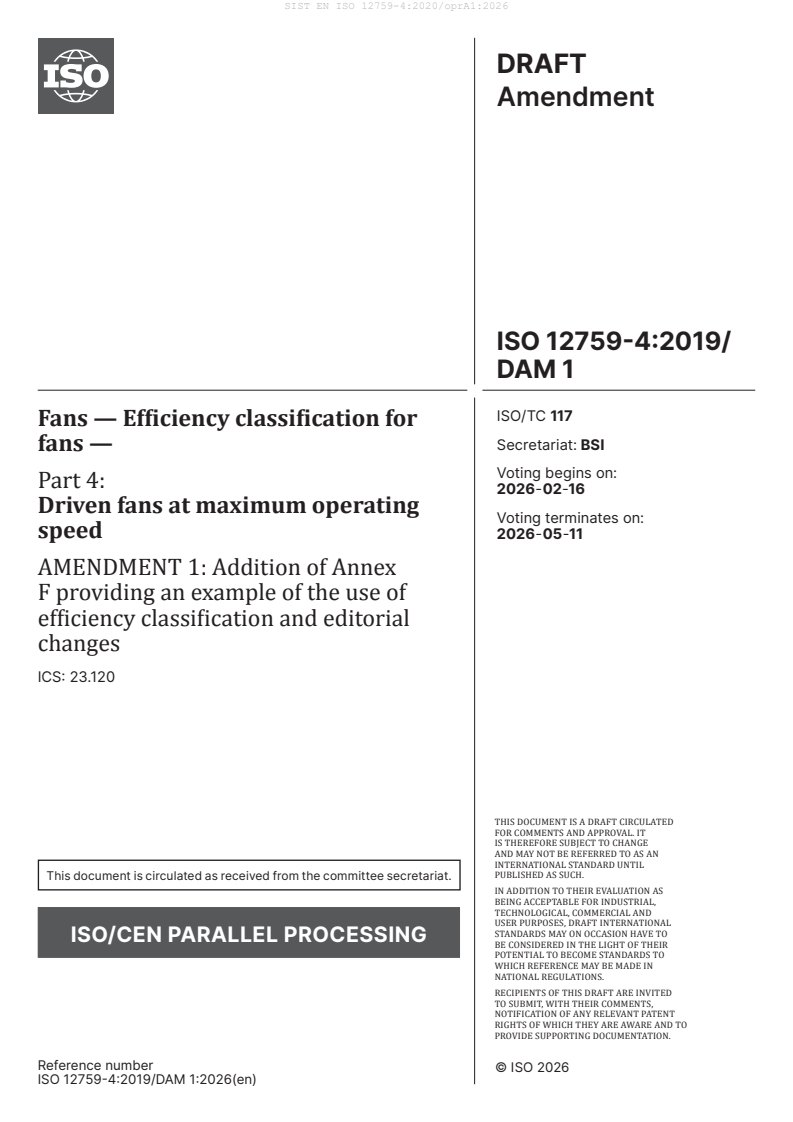

EN ISO 12759-4:2019/FprA1:2026 is a CEN/ISO amendment to the fan efficiency classification series. It updates the part for driven fans at maximum operating speed, adds an informative Annex F with an example of how efficiency classification can be used to set minimum efficiency limits (MELs), and makes editorial and definition changes to the base text.
What does EN ISO 12759-4:2019/FprA1:2026 specify?
EN ISO 12759-4:2019/FprA1:2026 amends the rules for classifying the efficiency of driven fans. The amended scope applies to all fan types driven by motors with an electrical input power of 0.125 kW and above, and it applies to the fan itself rather than the complete system in which the fan is installed.
The document is organized as an amendment to the existing part 4 text. In this amendment, the scope is replaced, several Clause 3 definitions are updated, Clause 5.2 is revised for installation categories, and a new informative Annex F is added before the bibliography.
| Annex | What it covers |
|---|---|
| F | An example of how the efficiency classification procedures can be used to set MELs, plus ecodesign-related information for fans driven by motors with electrical input power between 125 W and 500 kW |
What are the key requirements of EN ISO 12759-4:2019/FprA1:2026?
EN ISO 12759-4:2019/FprA1:2026 keeps the Part 4 focus on efficiency classification for driven fans and adds guidance that helps users apply the classification in practice. The most important points are the revised scope, the updated efficiency terms, the installation categories used for testing, and the new informative material in Annex F.
Scope and intended use
The amended scope says the document establishes a system for classifying fan efficiency for driven fans with motors at or above 0.125 kW electrical input power. It also states that the document is for the fan, not the full OEM product or ventilation system around it. In practice, that means users should classify the fan performance on its own and not confuse it with whole-system efficiency.
Relationship to MELs and the ISO 12759 series
The scope says EN ISO 12759-4, together with ISO 12759-3, ISO 12759-5 and ISO 12759-6, describes different procedures for classifying fan efficiency or applying a MEL. It also states that there is no method in this document for comparing the classifications and MELs. In practice, users need to pick the right procedure for the job rather than trying to translate one classification approach directly into another.
Updated definitions for efficiency calculations
Clause 3 revises the definition of conventional output power and updates the definitions used for efficiency with a variable speed drive. Clause 3.26 and Clause 3.28 tie the efficiency expressions to drive/control electrical input power and fan static air power. In practice, this matters because the measured or calculated input power must match the definition used by the classification method.
Installation categories for testing
Clause 5.2 updates the references for the four installation categories to ISO 5801:2017:
- category A installations
- category B installations
- category C installations
- category D installations
In practice, this tells users which test arrangement applies when they measure fan performance, so the classification is based on the correct installation type.
Annex F guidance on ecodesign use
Annex F is informative and adds an example showing how the document’s procedures can be used to set MELs. It also gives ecodesign-oriented information for fans driven by motors with electrical input power between 125 W and 500 kW, including correction factors for power conversion, part load and guard compensation. In practice, this is the part to consult when a fan must be checked against regulatory efficiency limits.
What terms does EN ISO 12759-4:2019/FprA1:2026 define?
Conventional output power - the output power term used in the classification calculations, based on the fan’s flow and static work or related fan-static quantities.
Drive/control electrical input power - the electrical input power used for the fan and motor combination when a variable speed drive is part of the system.
Fan static air power - the static air power term used in the variable-speed efficiency expression.
Variable speed drive - the drive/control arrangement that changes the operating speed and affects the efficiency calculation.
Minimum efficiency limit (MEL) - the lower efficiency limit that the document’s procedures can be used to set.
Protective guard - a fixed guard that can affect the efficiency correction in Annex F, depending on the guard opening size.
Who uses EN ISO 12759-4:2019/FprA1:2026?
EN ISO 12759-4:2019/FprA1:2026 is used by fan manufacturers, test laboratories, certification and conformity assessment bodies, and engineers who specify fans for HVAC and industrial ventilation. Buyers, quality managers and regulators use it to classify fan efficiency, assess MELs, and check whether a fan is being evaluated under the right installation category and power basis.
What changed in EN ISO 12759-4:2019/FprA1:2026 from the previous edition?
EN ISO 12759-4:2019/FprA1:2026 amends EN ISO 12759-4:2019 by:
- replacing the scope text
- revising Clause 3.17, 3.26 and 3.28
- updating the Clause 5.2 installation category references
- adding Annex F with an example of using efficiency classification to set MELs
- making editorial changes
Which standards are used with EN ISO 12759-4:2019/FprA1:2026?
- ISO 12759-3 - named as a companion part that provides one of the procedures for classifying fan efficiency or applying a MEL.
- ISO 12759-5 - named as a companion part used with this document for efficiency classification or MEL application.
- ISO 12759-6 - named as a companion part used with this document for efficiency classification or MEL application.
- ISO 5801:2017 - supplies the installation categories A, B, C and D used in Clause 5.2.
- ISO 13857:2019 - provides the definition of the guard opening dimension e used in Annex F.
What does the EN ISO 12759-4:2019/FprA1:2026 document contain?
EN ISO 12759-4:2019/FprA1:2026 contains the amended scope text, updated definitions in Clause 3, and revised installation category references in Clause 5.2. It also adds informative Annex F, which explains how the classification procedures can be used to set MELs and how correction factors are applied in ecodesign-oriented calculations.
Annex F includes equations for minimum efficiency limits, efficiency calculation adjustments, and guard compensation, plus a worked example context for fans such as axial, forward curved centrifugal, radial, mixed flow and centrifugal backward bladed fans, with and without housing. That makes the document useful both for testing and for checking regulatory efficiency limits.
Relations
- Consolidated By
ISO 12759-4:2019/FDAmd 1 - Fans — Efficiency classification for fans — Part 4: Driven fans at maximum operating speed — Amendment 1 - Effective Date
- 12-Feb-2026
- Effective Date
- 07-May-2025
Get Certified
Connect with accredited certification bodies for this standard

Institut za varilstvo d.o.o. (Welding Institute)
Slovenia's leading welding institute since 1952. ISO 3834, EN 1090, pressure equipment certification, NDT personnel, welder qualification. Only IIW Au
Sponsored listings
Frequently Asked Questions
EN ISO 12759-4:2019/FprA1:2026 is a draft published by the European Committee for Standardization (CEN). Its full title is "Fans - Efficiency classification for fans - Part 4: Driven fans at maximum operating speed - Amendment 1 (ISO 12759-4:2019/FDAmd1:2026)". This standard covers: Fans - Efficiency classification for fans - Part 4: Driven fans at maximum operating speed - Amendment 1 (ISO 12759-4:2019/FDAmd1:2026)
Fans - Efficiency classification for fans - Part 4: Driven fans at maximum operating speed - Amendment 1 (ISO 12759-4:2019/FDAmd1:2026)
EN ISO 12759-4:2019/FprA1:2026 is classified under the following ICS (International Classification for Standards) categories: 23.120 - Ventilators. Fans. Air-conditioners. The ICS classification helps identify the subject area and facilitates finding related standards.
EN ISO 12759-4:2019/FprA1:2026 has the following relationships with other standards: It is inter standard links to ISO 12759-4:2019/FDAmd 1, EN ISO 12759-4:2019. Understanding these relationships helps ensure you are using the most current and applicable version of the standard.
EN ISO 12759-4:2019/FprA1:2026 is available in PDF format for immediate download after purchase. The document can be added to your cart and obtained through the secure checkout process. Digital delivery ensures instant access to the complete standard document.
Standards Content (Sample)
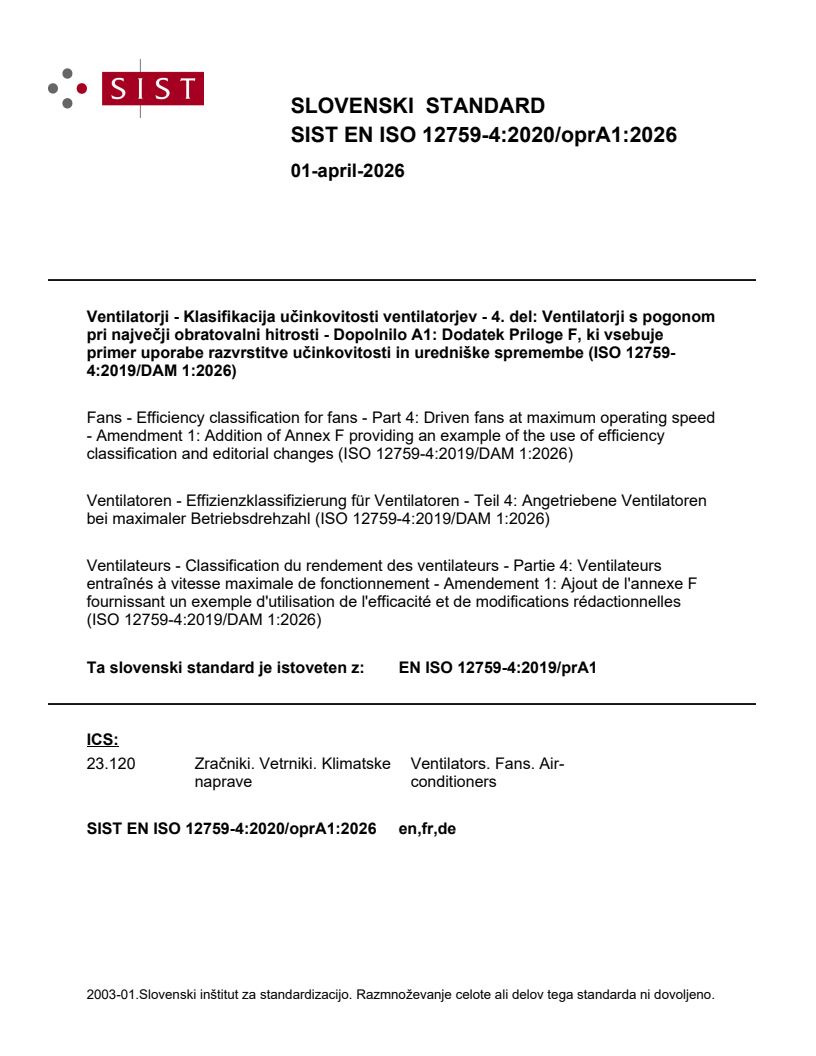
SLOVENSKI STANDARD
01-april-2026
Ventilatorji - Klasifikacija učinkovitosti ventilatorjev - 4. del: Ventilatorji s pogonom
pri največji obratovalni hitrosti - Dopolnilo A1: Dodatek Priloge F, ki vsebuje
primer uporabe razvrstitve učinkovitosti in uredniške spremembe (ISO 12759-
4:2019/DAM 1:2026)
Fans - Efficiency classification for fans - Part 4: Driven fans at maximum operating speed
- Amendment 1: Addition of Annex F providing an example of the use of efficiency
classification and editorial changes (ISO 12759-4:2019/DAM 1:2026)
Ventilatoren - Effizienzklassifizierung für Ventilatoren - Teil 4: Angetriebene Ventilatoren
bei maximaler Betriebsdrehzahl (ISO 12759-4:2019/DAM 1:2026)
Ventilateurs - Classification du rendement des ventilateurs - Partie 4: Ventilateurs
entraînés à vitesse maximale de fonctionnement - Amendement 1: Ajout de l'annexe F
fournissant un exemple d'utilisation de l'efficacité et de modifications rédactionnelles
(ISO 12759-4:2019/DAM 1:2026)
Ta slovenski standard je istoveten z: EN ISO 12759-4:2019/prA1
ICS:
23.120 Zračniki. Vetrniki. Klimatske Ventilators. Fans. Air-
naprave conditioners
2003-01.Slovenski inštitut za standardizacijo. Razmnoževanje celote ali delov tega standarda ni dovoljeno.
DRAFT
Amendment
ISO 12759-4:2019/
DAM 1
ISO/TC 117
Fans — Efficiency classification for
Secretariat: BSI
fans —
Voting begins on:
Part 4:
2026-02-16
Driven fans at maximum operating
Voting terminates on:
speed 2026-05-11
AMENDMENT 1: Addition of Annex
F providing an example of the use of
efficiency classification and editorial
changes
ICS: 23.120
THIS DOCUMENT IS A DRAFT CIRCULATED
FOR COMMENTS AND APPROVAL. IT
IS THEREFORE SUBJECT TO CHANGE
AND MAY NOT BE REFERRED TO AS AN
INTERNATIONAL STANDARD UNTIL
PUBLISHED AS SUCH.
This document is circulated as received from the committee secretariat.
IN ADDITION TO THEIR EVALUATION AS
BEING ACCEPTABLE FOR INDUSTRIAL,
TECHNOLOGICAL, COMMERCIAL AND
USER PURPOSES, DRAFT INTERNATIONAL
STANDARDS MAY ON OCCASION HAVE TO
ISO/CEN PARALLEL PROCESSING
BE CONSIDERED IN THE LIGHT OF THEIR
POTENTIAL TO BECOME STANDARDS TO
WHICH REFERENCE MAY BE MADE IN
NATIONAL REGULATIONS.
RECIPIENTS OF THIS DRAFT ARE INVITED
TO SUBMIT, WITH THEIR COMMENTS,
NOTIFICATION OF ANY RELEVANT PATENT
RIGHTS OF WHICH THEY ARE AWARE AND TO
PROVIDE SUPPORTING DOCUMENTATION.
Reference number
ISO 12759-4:2019/DAM 1:2026(en)
DRAFT
ISO 12759-4:2019/DAM 1:2026(en)
Amendment
ISO 12759-4:2019/
DAM 1
ISO/TC 117
Fans — Efficiency classification for
Secretariat: BSI
fans —
Voting begins on:
Part 4:
Driven fans at maximum operating
Voting terminates on:
speed
AMENDMENT 1: Addition of Annex
F providing an example of the use of
efficiency classification and editorial
changes
ICS: 23.120
THIS DOCUMENT IS A DRAFT CIRCULATED
FOR COMMENTS AND APPROVAL. IT
IS THEREFORE SUBJECT TO CHANGE
AND MAY NOT BE REFERRED TO AS AN
INTERNATIONAL STANDARD UNTIL
PUBLISHED AS SUCH.
This document is circulated as received from the committee secretariat.
IN ADDITION TO THEIR EVALUATION AS
BEING ACCEPTABLE FOR INDUSTRIAL,
© ISO 2026
TECHNOLOGICAL, COMMERCIAL AND
USER PURPOSES, DRAFT INTERNATIONAL
All rights reserved. Unless otherwise specified, or required in the context of its implementation, no part of this publication may
STANDARDS MAY ON OCCASION HAVE TO
ISO/CEN PARALLEL PROCESSING
be reproduced or utilized otherwise in any form or by any means, electronic or mechanical, including photocopying, or posting on
BE CONSIDERED IN THE LIGHT OF THEIR
the internet or an intranet, without prior written permission. Permission can be requested from either ISO at the address below
POTENTIAL TO BECOME STANDARDS TO
WHICH REFERENCE MAY BE MADE IN
or ISO’s member body in the country of the requester.
NATIONAL REGULATIONS.
ISO copyright office
RECIPIENTS OF THIS DRAFT ARE INVITED
CP 401 • Ch. de Blandonnet 8
TO SUBMIT, WITH THEIR COMMENTS,
CH-1214 Vernier, Geneva
NOTIFICATION OF ANY RELEVANT PATENT
Phone: +41 22 749 01 11
RIGHTS OF WHICH THEY ARE AWARE AND TO
PROVIDE SUPPORTING DOCUMENTATION.
Email: copyright@iso.org
Website: www.iso.org
Published in Switzerland Reference number
ISO 12759-4:2019/DAM 1:2026(en)
ii
ISO 12759-4:2019/DAM 1:2026(en)
Foreword
ISO (the International Organization for Standardization) is a worldwide federation of national standards
bodies (ISO member bodies). The work of preparing International Standards is normally carried out through
ISO technical committees. Each member body interested in a subject for which a technical committee
has been established has the right to be represented on that committee. International organizations,
governmental and non-governmental, in liaison with ISO, also take part in the work. ISO collaborates closely
with the International Electrotechnical Commission (IEC) on all matters of electrotechnical standardization.
The procedures used to develop this document and those intended for its further maintenance are described
in the ISO/IEC Directives, Part 1. In particular, the different approval criteria needed for the different types
of ISO documents should be noted. This document was drafted in accordance with the editorial rules of the
ISO/IEC Directives, Part 2 (see www.iso.org/directives).
ISO draws attention to the possibility that the implementation of this document may involve the use of (a)
patent(s). ISO takes no position concerning the evidence, validity or applicability of any claimed patent
rights in respect thereof. As of the date of publication of this document, ISO had not received notice of (a)
patent(s) which may be required to implement this document. However, implementers are cautioned that
this may not represent the latest information, which may be obtained from the patent database available at
www.iso.org/patents. ISO shall not be held responsible for identifying any or all such patent rights.
Any trade name used in this document is information given for the convenience of users and does not
constitute an endorsement.
For an explanation of the voluntary nature of standards, the meaning of ISO specific terms and expressions
related to conformity assessment, as well as information about ISO's adherence to the World Trade
Organization (WTO) principles in the Technical Barriers to Trade (TBT), see www.iso.org/iso/foreword.html.
This document was prepared by Technical Committee ISO/TC 117, Fans.
A list of all parts in the ISO 12759 series can be found on the ISO website.
Any feedback or questions on this document should be directed to the user’s national standards body. A
complete listing of these bodies can be found at www.iso.org/members.html.
...