

prEN 196-18
(Main)Methods of testing cement - Part 18: Determination of whiteness or colour of cement and clinker
- Abstract
This document describes a method for the determination of whiteness and the colour of common cements and clinkers.
This method can be used to determine the whiteness of white cements defined in the EN 197-1.
This document does not apply to colour measurements on cement-based formulated products or cement-based products.
The method is based on the measurement of the CIE XYZ trichromatic coordinates and describes the mathematical procedure for converting these coordinates into the CIE 1976 (L*a*b*) colour space.
NOTE Although the possible values of the L* parameter range from 0 to 100, this document applies to the range between 70 and 100 (photopic vision).
- Status
- Not Published
- Publication Date
- 24-May-2028
- Technical Committee
- CEN/TC 51 - Cement and building limes
- Drafting Committee
- CEN/TC 51/WG 15 - Revision of methods of testing cement
- Current Stage
- 4020 - Submission to enquiry - Enquiry
- Start Date
- 06-Aug-2026
- Due Date
- 11-Feb-2027
- Completion Date
- 06-Aug-2026

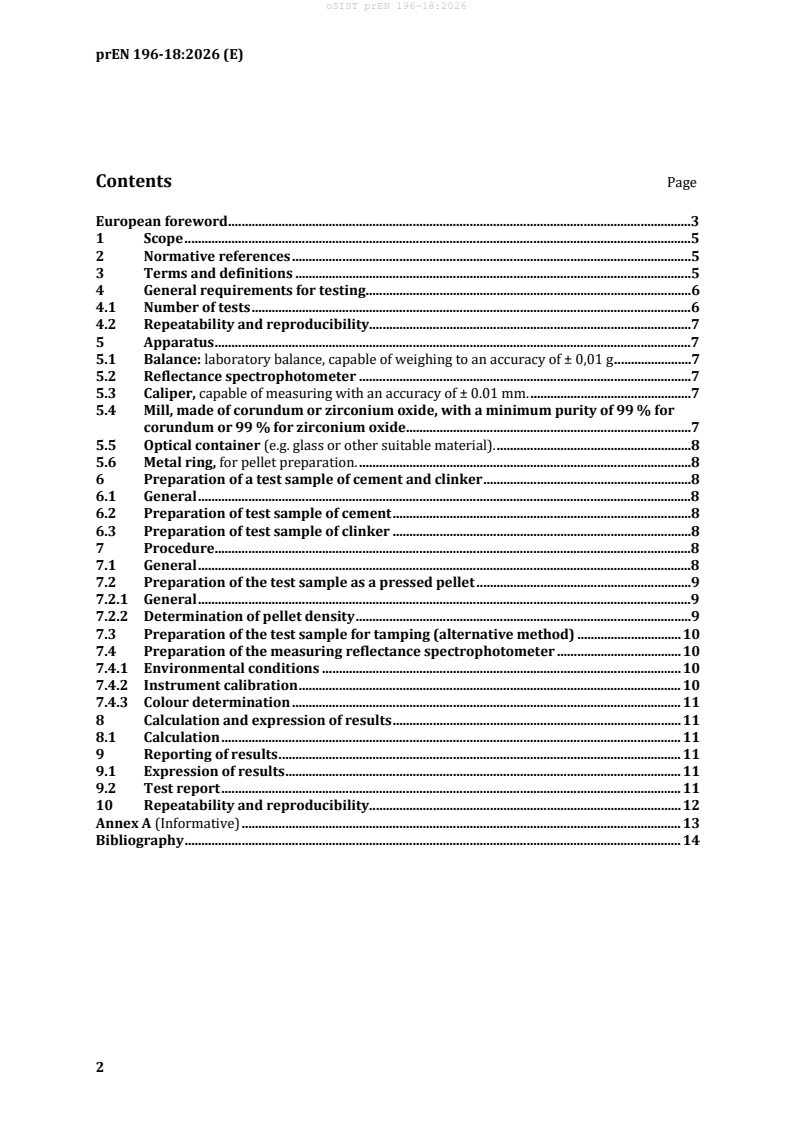
prEN 196-18 is a CEN draft European Standard in the Methods of testing cement series. It specifies a reference method for determining the whiteness and colour of common cements and clinkers by measuring Commission Internationale de l’Éclairage (CIE) XYZ trichromatic coordinates and converting them to CIE 1976 (Lab*) colour space. It is intended for laboratories, producers, and quality-control users working with cement and clinker, including white cements defined in EN 197-1.
What does prEN 196-18 specify?
prEN 196-18 specifies how to measure whiteness and colour for common cements and clinkers. It also states that the method can be used for white cements defined in EN 197-1, but not for cement-based formulated products or cement-based products.
The document is organised into clauses on scope, normative references, terms and definitions, general testing requirements, apparatus, sample preparation, procedure, calculation, reporting, and repeatability/reproducibility. Annex A is informative and gives the conversion from XYZ to Lab*.
What are the key requirements of prEN 196-18?
Test frequency and precision control
prEN 196-18 requires duplicate testing when colour is not part of a statistically controlled series, a single test as the minimum for a controlled series, and two tests in case of dispute. That matters because the document ties the number of measurements to how the results will be used and challenged.
The standard also defines repeatability and reproducibility as standard deviations. In practice, this tells the laboratory how to judge whether two results are close enough to accept.
Apparatus and measurement setup
prEN 196-18 requires a laboratory balance, a reflectance spectrophotometer, a caliper, a mill, an optical container, and a metal ring for pellet preparation. The spectrophotometer must cover 400 nm to 700 nm and be capable of expressing results in Lab* under specified illuminant and observer conditions.
This matters because colour results depend on the measuring geometry and the instrument setup. The document allows equivalent colour-measuring instruments only if their accuracy can be demonstrated.
Sample preparation
prEN 196-18 gives separate preparation routes for cement and clinker. Cement is reduced, mixed, and protected from moisture; clinker is ground to a specified Blaine fineness using EN 196-6 before testing.
The standard offers two measurement sample forms: a pressed pellet or a tamped layer in an optical container. In both cases, the measurement surface must be free of cracks or air voids, and the sample should be measured quickly after preparation.
Measurement and calibration
prEN 196-18 requires the spectrophotometer and the sample to be at the same laboratory temperature and protected from ambient light. The instrument must be switched on and calibrated before use, following the operating instructions.
The colour reading records XYZ values from the spectrophotometer. The method then converts those values to Lab*, which is the output used for reporting and comparison.
Calculation and reporting
prEN 196-18 requires the mean of three measurements to be reported, with X, Y, Z and L* rounded to one decimal place and a* and b* to two decimal places. If results differ by more than twice the repeatability standard deviation, the test must be repeated.
The test report must identify the sample, cite the document, state how the sample was prepared, give the mean XYZ and Lab* values, note any deviations, and include the test date. That gives users a traceable record of how the colour result was obtained.
What terms does prEN 196-18 define?
- CIE standard illuminant D65 - a daylight-like reference illuminant with a correlated colour temperature of about 6500 K.
- CIE 1931 colorimetric observer - the 2° observer used for colour perception in a small field of view.
- CIE 1976 (Lab*) colour space - the colour space used to express lightness and chromatic coordinates from XYZ values.
- Whiteness CIE 1976 - the CIE colourimetric attribute that expresses how close a material appears to ideal white under specified conditions.
Who uses prEN 196-18?
prEN 196-18 is used by cement producers, clinker producers, and testing laboratories that need a repeatable way to compare colour or whiteness. Quality managers use it to set and verify product appearance, and buyers use it when whiteness is part of acceptance or specification.
It is also relevant to anyone checking white cements, since the scope explicitly includes the white cements defined in EN 197-1.
Which standards are used with prEN 196-18?
| Standard | What it contributes |
|---|---|
| EN 196-6 | The fineness method used when clinker is ground to the required Blaine surface area. |
| EN 196-7 | Sampling and sample preparation for common cement and its constituents. |
| EN ISO/CIE 11664-4 | The definition of the CIE 1976 (Lab*) colour space used for reporting. |
| EN 197-1 | The definition of white cements mentioned in the scope. |
What does the prEN 196-18 document contain?
prEN 196-18 contains apparatus requirements, sample-preparation steps, a measurement procedure, calculation rules, reporting rules, and a precision statement. It also includes the repeatability and reproducibility table for L*, a*, b*, X, Y, and Z.
Annex A gives the formulas and reference white constants used to convert measured XYZ values into Lab* coordinates. The body of the document also describes instrument calibration, measurement conditions, and the two accepted sample-preparation formats.
Get Certified
Connect with accredited certification bodies for this standard

DIBt (Deutsches Institut für Bautechnik)
German Institute for Building Technology.
DIN CERTCO
DIN Group product certification.

Aboma Certification B.V.
Specialized in construction, metal, and transport sectors.
Sponsored listings
Frequently Asked Questions
prEN 196-18 is a draft published by the European Committee for Standardization (CEN). Its full title is "Methods of testing cement - Part 18: Determination of whiteness or colour of cement and clinker". This standard covers: This document describes a method for the determination of whiteness and the colour of common cements and clinkers. This method can be used to determine the whiteness of white cements defined in the EN 197-1. This document does not apply to colour measurements on cement-based formulated products or cement-based products. The method is based on the measurement of the CIE XYZ trichromatic coordinates and describes the mathematical procedure for converting these coordinates into the CIE 1976 (L*a*b*) colour space. NOTE Although the possible values of the L* parameter range from 0 to 100, this document applies to the range between 70 and 100 (photopic vision).
This document describes a method for the determination of whiteness and the colour of common cements and clinkers. This method can be used to determine the whiteness of white cements defined in the EN 197-1. This document does not apply to colour measurements on cement-based formulated products or cement-based products. The method is based on the measurement of the CIE XYZ trichromatic coordinates and describes the mathematical procedure for converting these coordinates into the CIE 1976 (L*a*b*) colour space. NOTE Although the possible values of the L* parameter range from 0 to 100, this document applies to the range between 70 and 100 (photopic vision).
prEN 196-18 is classified under the following ICS (International Classification for Standards) categories: 91.100.10 - Cement. Gypsum. Lime. Mortar. The ICS classification helps identify the subject area and facilitates finding related standards.
prEN 196-18 is available in PDF format for immediate download after purchase. The document can be added to your cart and obtained through the secure checkout process. Digital delivery ensures instant access to the complete standard document.
Standards Content (Sample)
SLOVENSKI STANDARD
01-oktober-2026
Metode preskušanja cementa - 18. del: Določanje beline ali barve cementa in
klinkerja
Methods of testing cement - Part 18: Determination of whiteness or colour of cement and
clinker
Prüfverfahren für Zement - Teil18: Bestimmung des Weißgrades oder der Farbe von
Zement und Klinker
Méthodes d'essais des ciments - Partie 18: Détermination de la blancheur ou de la
couleur du ciment et du clinker
Ta slovenski standard je istoveten z: prEN 196-18
ICS:
91.100.10 Cement. Mavec. Apno. Malta Cement. Gypsum. Lime.
Mortar
2003-01.Slovenski inštitut za standardizacijo. Razmnoževanje celote ali delov tega standarda ni dovoljeno.
DRAFT
EUROPEAN STANDARD
NORME EUROPÉENNE
EUROPÄISCHE NORM
August 2026
ICS 91.100.10
English Version
Methods of testing cement - Part 18: Determination of
whiteness or colour of cement and clinker
Méthodes d'essais des ciments - Partie 18: Prüfverfahren für Zement - Teil18: Bestimmung des
Détermination de la blancheur ou de la couleur du Weißgrades oder der Farbe von Zement und Klinker
ciment et du clinker
This draft European Standard is submitted to CEN members for enquiry. It has been drawn up by the Technical Committee
CEN/TC 51.
If this draft becomes a European Standard, CEN members are bound to comply with the CEN/CENELEC Internal Regulations
which stipulate the conditions for giving this European Standard the status of a national standard without any alteration.
This draft European Standard was established by CEN in three official versions (English, French, German). A version in any other
language made by translation under the responsibility of a CEN member into its own language and notified to the CEN-CENELEC
Management Centre has the same status as the official versions.
CEN members are the national standards bodies of Austria, Belgium, Bulgaria, Croatia, Cyprus, Czech Republic, Denmark, Estonia,
Finland, France, Germany, Greece, Hungary, Iceland, Ireland, Italy, Latvia, Lithuania, Luxembourg, Malta, Netherlands, Norway,
Poland, Portugal, Republic of North Macedonia, Romania, Serbia, Slovakia, Slovenia, Spain, Sweden, Switzerland, Türkiye and
United Kingdom.
Recipients of this draft are invited to submit, with their comments, notification of any relevant patent rights of which they are
aware and to provide supporting documentation.
Warning : This document is not a European Standard. It is distributed for review and comments. It is subject to change without
notice and shall not be referred to as a European Standard.
EUROPEAN COMMITTEE FOR STANDARDIZATION
COMITÉ EUROPÉEN DE NORMALISATION
EUROPÄISCHES KOMITEE FÜR NORMUNG
CEN-CENELEC Management Centre: Rue de la Science 23, B-1040 Brussels
© 2026 CEN All rights of exploitation in any form and by any means reserved Ref. No. prEN 196-18:2026 E
worldwide for CEN national Members.
Contents Page
European foreword .3
1 Scope .5
2 Normative references .5
3 Terms and definitions .5
4 General requirements for testing .6
4.1 Number of tests .6
4.2 Repeatability and reproducibility.7
5 Apparatus .7
5.1 Balance: laboratory balance, capable of weighing to an accuracy of ± 0,01 g .7
5.2 Reflectance spectrophotometer .7
5.3 Caliper, capable of measuring with an accuracy of ± 0.01 mm. .7
5.4 Mill, made of corundum or zirconium oxide, with a minimum purity of 99 % for
corundum or 99 % for zirconium oxide .7
5.5 Optical container (e.g. glass or other suitable material). .8
5.6 Metal ring, for pellet preparation. .8
6 Preparation of a test sample of cement and clinker .8
6.1 General .8
6.2 Preparation of test sample of cement .8
6.3 Preparation of test sample of clinker .8
7 Procedure .8
7.1 General .8
7.2 Preparation of the test sample as a pressed pellet .9
7.2.1 General .9
7.2.2 Determination of pellet density .9
7.3 Preparation of the test sample for tamping (alternative method) . 10
7.4 Preparation of the measuring reflectance spectrophotometer . 10
7.4.1 Environmental conditions . 10
7.4.2 Instrument calibration . 10
7.4.3 Colour determination . 11
8 Calculation and expression of results . 11
8.1 Calculation . 11
9 Reporting of results . 11
9.1 Expression of results . 11
9.2 Test report . 11
10 Repeatability and reproducibility. 12
Annex A (Informative) . 13
Bibliography . 14
European foreword
This document (prEN 196-18:2026) has been prepared by Technical Committee CEN/TC 51
“Cement and building limes”, the secretariat of which is held by NBN.
This document is currently submitted to the CEN Enquiry.
Introduction
This document specifies the reference method for the determination of cement and clinker colour.
1 Scope
This document describes a method for the determination of whiteness and the colour of common
cements and clinkers.
This method can be used to determine the whiteness of white cements defined in the EN 197-1.
This document does not apply to colour measurements on cement-based formulated products or
cement-based products.
The method is based on the measurement of the CIE XYZ trichromatic coordinates and describes
the mathematical procedure for converting these coordinates into the CIE 1976 (L*a*b*) colour
space.
NOTE Although the possible values of the L* parameter range from 0 to 100, this document applies to
the range between 70 and 100 (photopic vision).
2 Normative references
The following documents are referred to in the text in such a way that some or all their content
constitutes requirements of this document. For dated references, only the edition cited applies.
For undated references, the latest edition of the referenced document (including any
amendments) applies.
EN 196-6, Methods of testing cement — Part 6: Determination of fineness
EN 196-7, Methods of testing cement — Part 7: Methods for sampling and sample preparation of
common cement and its constituents
EN ISO/CIE 11664-4, Colorimetry – Part 4: CIE 1976 L*a*b* colour space
3 Terms and definitions
For the purposes of this document, the following terms and definitions apply.
ISO and IEC maintain terminology databases for use in standardization at the following
addresses:
— ISO Online browsing platform: available at https://www.iso.org/obp/
— IEC Electropedia: available at https://www.electropedia.org/
3.1
CIE standard illuminant D65
reference illuminant having a spectral power distribution within the visible range that
corresponds to average daylight, with a correlated colour temperature of approximately 6500 K
3.2
CIE 1931 colorimetric observer
colour perception for stimuli presented as an aperture on a dark background, corresponding to a
2° field of view (foveal vision)
3.3
CIE 1976 (L*a*b*) colour space
opponent-colour space with L* representing lightness, and a* and b* representing the chromatic
opponent dimensions, derived from the non-linear compression of the CIE XYZ tristimulus values
Figure 1 — CIE L*a*b* colour space
where:
L* = lightness coordinate, with values ranging from 0 (black) to 100 (white).
a* = red/green chromatic coordinate, where positive a* indicates redness and negative a*
indicates greenness. (see EN ISO/CIE 11664-4)
b* = yellow/blue chromatic coordinate, where positive b* indicates yellowness and negative
b* indicates blueness. (see EN ISO/CIE 11664-4)
3.4
whiteness CIE 1976
colorimetric attribute (L*a*b*), as defined by the CIE, expressing the perceived closeness of a
material to an ideal white under specified illumination and observation conditions
4 General requirements for testing
4.1 Number of tests
Determination of colour, where determination is not part of a series subject to statistical control,
shall be carried out in duplicate.
Where the determination is one of a series subject to statistical control, a single test shall be the
minimum required.
In the case of a dispute, the number of tests shall be two.
4.2 Repeatability and reproducibility
Repeatability - precision under repeatability conditions where independent test results are
obtained with the same method on identical test items (material) in the same laboratory by the
same operator using the same equipment within s
...