

EN 16781:2026
(Main)Textile child care articles - Safety requirements and test methods for children's sleep bags for use in a cot
- Abstract
This document specifies requirements for the safety of children's sleep bags which are used in the children's sleeping environment (i.e. not under supervision) and designed to provide sufficient warmth so as to remove the need for additional bedding when sleeping in a cot or similar product (e.g. crib/cradle) in which a child is contained. It is applicable to products for use by children up to the age of 24 months.
NOTE Requirements of this document are not relevant when sleep bags are used for children over the age of 24 months or when they have the ability to climb out of a cot or sleep in a bed.
This document does not apply to products
- designed for use during the care of premature children, or
- designed for children of low birthweight (i.e. lower than 2,5 kg - see B.1), or
- designed for medical settings or for children with special medical needs (see B.1), or
- for outdoor use or to products designed to keep a child warm in a pushchair (e.g. foot muff) (see B.1), or
- for use in a car restraint system for children (see B.1).
If a part of the children's sleep bag is designed to offer additional function (e.g. play function, swaddling functions), this part will, in addition to the following requirements, be subjected to safety requirements related to relevant standards (see B.1).
- Status
- Published
- Publication Date
- 01-Sep-2026
- Technical Committee
- CEN/TC 248 - Textiles and textile products
- Current Stage
- 6060 - Definitive text made available (DAV) - Publishing
- Start Date
- 02-Sep-2026
- Due Date
- 30-Apr-2025
- Completion Date
- 02-Sep-2026
- Directive
- 2001/95/EC - General product safety

EN 16781:2026 is a CEN European Standard for textile child care articles, specifically children's sleep bags for use in a cot. It specifies safety requirements, test methods, and user information for sleep bags used in the children's sleeping environment for children up to 24 months, with attention to hazards such as suffocation, entrapment, choking, overheating, flammability, and hygiene.
What does EN 16781:2026 specify?
EN 16781:2026 specifies the safety requirements for children's sleep bags used in a cot or similar enclosed sleeping product when the child is not under supervision. It also sets out the test methods and the marking, purchase information, and instructions for use that should accompany the product.
The standard is organized around a hazard-based approach. Its main clauses cover the scope, normative references, terms and definitions, general safety approach, requirements and test methods, and user information. The annexes provide design rationale, supplementary thermal and fastening guidance, an information summary, and the link to EU legislation.
| Annex | What it covers |
|---|---|
| Annex A | Inherently safe design |
| Annex B | Rationale for the requirements |
| Annex C | Supplementary information on thermal hazards |
| Annex D | Supplementary information on slide fastener positions |
| Annex E | Specific marking, purchase information, and user instruction |
| Annex ZA | Relationship with Regulation 2023/988/EC |
What are the key requirements of EN 16781:2026?
EN 16781:2026 focuses on keeping the sleep bag safe in normal night use. The most important requirements are about fit, openings, attachments, material hazards, thermal behaviour, flammability, and hygiene.
Suffocation and fit
Clause 5.1.1 sets dimensional requirements for the neck opening and sleep bag length according to child height. The sleep bag has to fit the intended child height range so that the head cannot slip inside and the bag does not create an unsafe opening. In practice, this means manufacturers must size and verify the product, not just label it by age.
Clause 5.1.1 also controls the fastening system at the neck and armholes. Buttons and metal press fasteners must remain closed under load, slide fasteners need a locking device and correct placement, and weighted sleep bags are not permitted. That matters because a loose opening or heavy added areas can increase the risk of the child sliding into the bag or being restricted.
Entrapment, choking, entanglement, edges, and ingestion
Clause 5.1.2 addresses entrapment hazards, while Clause 5.1.3 covers choking hazards from small parts, pockets, decorative items, and access to filling. Clause 5.1.4 deals with entanglement hazards from cords, drawstrings, labels, stitches, and threads, and Clause 5.1.5 covers hazardous edges and projections. Clause 5.1.6 prohibits magnetic components because they create ingestion hazards. For users and buyers, these clauses mean the product must stay free of loose parts, loops, sharp features, and accessible fillers during use and handling.
Chemical safety
Clause 5.2 addresses chemical hazards, including migration of certain substances, formaldehyde, pH, flame retardants, and colourants. The formaldehyde limit is given as 30 mg/kg, tested by the named chemical methods. In practice, this pushes suppliers to control fibre, fabric, trim, and finishing chemistry through the supply chain and to keep records of materials and treatments.
Thermal safety
Clause 5.3 sets requirements to reduce hyperthermia risk. Children's sleep bags shall not have a hood or other head covering, the front and back panels shall have homogenous thermal insulation, and the declared thermal resistance must be based on the specified test method. Annex B gives the rationale for the maximum thermal resistance, and Annex C explains how room temperature and sleepwear affect selection. For a manufacturer, this means the bag must be designed and labelled as a thermal system, not as a generic textile article.
Flammability and hygiene
Clause 5.4 requires raised outer fabrics to resist surface flash when tested, including after domestic washing and drying. Clause 5.5 requires the sleep bag to be washable, free from infestation and foreign materials, and properly controlled when feather and down or recycled materials are used. This matters because the product is meant for repeated night use, so cleanliness and cleaning durability are part of safety, not only appearance.
Information supplied with the product
Clause 6 requires conspicuous and legible marking, purchase information, and instructions for use. The product must carry the child height range, care instructions, a fire warning, and the thermal resistance declaration, with separate declarations for each multi-seasonal configuration. The purchase information and instructions also warn against use when the child's head can pass through the neck opening, when the child can climb out of the cot, or when the sleep bag is combined with a duvet or blanket.
What terms does EN 16781:2026 define?
EN 16781:2026 defines the product and hazard language used throughout the standard so the requirements can be applied consistently.
- Sleep bag - A full-length fabric bag with a neck opening and armholes, designed to contain a child; it is not treated as a garment.
- Cot - A child bed with a base and high sides intended to prevent the child from falling out.
- Inherently safe design - Design measures that eliminate hazards or reduce risk by changing the product design or operating characteristics.
- Cord - A chain, ribbon, string, or tape of textile or non-textile material, including elastic material.
- Drawstring - A cord that runs through a channel, loop, or eyelet to adjust an opening or fasten the sleep bag.
- Weighted sleep bag - A sleep bag with one or more areas that include additional functional weighting.
- Multi-seasonal configuration - A combination of sleep bag parts that can be used singly or together in different seasons.
Who uses EN 16781:2026?
EN 16781:2026 is used by manufacturers, product designers, test laboratories, and quality teams that develop or assess children's sleep bags. It is also relevant to importers, retailers, and buyers who need to check whether a product is intended for cot use and what information must accompany it.
Market surveillance authorities and conformity assessment teams use the standard to check design, test evidence, marking, and instructions. Textile suppliers use it to control fasteners, fillings, fabrics, finishes, and cleaning performance before a product is placed on the market.
What changed in EN 16781:2026 from the previous edition?
EN 16781:2026 supersedes EN 16781:2018. The foreword states these main changes:
- The standard has been restructured around hazards.
- The scope has been clarified.
- New and updated normative references have been added.
- New terms and definitions have been added.
- Requirements for slide fasteners, buttons, press fasteners, and weighted sleep bags have been clarified.
- Child height range and sleep bag length requirements have been added.
- The neck opening test method has been improved.
- Entrapment, choking, and entanglement requirements have been clarified.
- The back zone definition has been revised.
- Migration limits for certain substances have been updated.
- Thermal resistance requirements and the test method have been detailed.
- Thermal resistance declaration for multi-seasonal sleep bags has been added to the marking and information clauses.
- Warnings and information have been added.
- Annex A, Annex C, Annex E, and Annex ZA have been added or updated.
Which standards are used with EN 16781:2026?
EN 16781:2026 relies on several test and specification standards for materials, fasteners, chemicals, and user information.
- EN 71-3 - migration of certain elements.
- EN 1103 - burning behaviour of apparel fabrics, used for surface flash assessment of raised fabrics.
- EN 1162 and EN 1164 - feather and down test methods.
- EN 12935 - hygiene and cleanliness requirements for feather and down.
- EN 16711-2 - determination of metal content extracted by artificial perspiration.
- EN 16732 - specification for slide fasteners.
- CEN/TS 17394-1 to -4 - attachment security and test methods for buttons and other attached components.
- EN 17667 - thermal resistance test method for filled textile articles and similar items.
- EN ISO 6330 - domestic washing and drying procedures for test specimens.
- EN ISO 14184-1 and EN ISO 17226-1 - formaldehyde determination for textile materials and leather.
- EN ISO 3758 and ISO 7000 - care symbols and graphical symbols for marking and instructions.
- EN ISO 139, EN ISO 3071, EN ISO 4045, EN ISO 105-A01, EN ISO 105-A11, EN ISO 105-E01, and ISO 4915 - conditioning, pH, leather pH, colour fastness, and stitch terminology.
What does the EN 16781:2026 document contain?
EN 16781:2026 contains a table of size-related requirements for neck openings and sleep bag length, along with a measurement principle for checking the neck opening. It also contains hazard-to-design summary tables in Annex A and Annex B, which connect parts of the sleep bag to the risks they are meant to control.
The document includes supplementary thermal guidance in Annex C, including an example table that links room temperature, thermal resistance, and sleepwear choice. Annex D explains slide fastener position, and Annex E summarizes the required marking, purchase information, and instructions for use. Annex ZA maps the standard to the relevant EU product-safety requirements.
Relations
- Effective Date
- 28-Jan-2023
- Effective Date
- 23-Sep-2026
- Effective Date
- 23-Sep-2026
- Effective Date
- 23-Sep-2026
- Effective Date
- 23-Sep-2026
- Effective Date
- 23-Sep-2026
- Effective Date
- 23-Sep-2026
- Effective Date
- 23-Sep-2026
- Effective Date
- 23-Sep-2026
- Effective Date
- 23-Sep-2026
- Effective Date
- 23-Sep-2026
- Effective Date
- 23-Sep-2026
- Effective Date
- 23-Sep-2026
- Effective Date
- 23-Sep-2026
- Effective Date
- 23-Sep-2026
Frequently Asked Questions
EN 16781:2026 is a standard published by the European Committee for Standardization (CEN). Its full title is "Textile child care articles - Safety requirements and test methods for children's sleep bags for use in a cot". This standard covers: This document specifies requirements for the safety of children's sleep bags which are used in the children's sleeping environment (i.e. not under supervision) and designed to provide sufficient warmth so as to remove the need for additional bedding when sleeping in a cot or similar product (e.g. crib/cradle) in which a child is contained. It is applicable to products for use by children up to the age of 24 months. NOTE Requirements of this document are not relevant when sleep bags are used for children over the age of 24 months or when they have the ability to climb out of a cot or sleep in a bed. This document does not apply to products - designed for use during the care of premature children, or - designed for children of low birthweight (i.e. lower than 2,5 kg - see B.1), or - designed for medical settings or for children with special medical needs (see B.1), or - for outdoor use or to products designed to keep a child warm in a pushchair (e.g. foot muff) (see B.1), or - for use in a car restraint system for children (see B.1). If a part of the children's sleep bag is designed to offer additional function (e.g. play function, swaddling functions), this part will, in addition to the following requirements, be subjected to safety requirements related to relevant standards (see B.1).
This document specifies requirements for the safety of children's sleep bags which are used in the children's sleeping environment (i.e. not under supervision) and designed to provide sufficient warmth so as to remove the need for additional bedding when sleeping in a cot or similar product (e.g. crib/cradle) in which a child is contained. It is applicable to products for use by children up to the age of 24 months. NOTE Requirements of this document are not relevant when sleep bags are used for children over the age of 24 months or when they have the ability to climb out of a cot or sleep in a bed. This document does not apply to products - designed for use during the care of premature children, or - designed for children of low birthweight (i.e. lower than 2,5 kg - see B.1), or - designed for medical settings or for children with special medical needs (see B.1), or - for outdoor use or to products designed to keep a child warm in a pushchair (e.g. foot muff) (see B.1), or - for use in a car restraint system for children (see B.1). If a part of the children's sleep bag is designed to offer additional function (e.g. play function, swaddling functions), this part will, in addition to the following requirements, be subjected to safety requirements related to relevant standards (see B.1).
EN 16781:2026 is classified under the following ICS (International Classification for Standards) categories: 97.160 - Home textiles. Linen; 97.190 - Equipment for children. The ICS classification helps identify the subject area and facilitates finding related standards.
EN 16781:2026 has the following relationships with other standards: It is inter standard links to EN 16781:2018, EN 1162:1996, EN 17394-2:2020, EN ISO 17226-1:2021, EN 17667:2022, EN ISO 4045:2018, EN ISO 105-A01:2010, CEN/TS 17394-1:2021, EN 12935:2001, EN 16732:2025, EN ISO 14184-1:2011, EN ISO 6330:2021, EN ISO 105-A11:2012, CEN/TS 17394-3:2021, ISO 105-F10:1989/Amd 1:2009. Understanding these relationships helps ensure you are using the most current and applicable version of the standard.
EN 16781:2026 is associated with the following European legislation: EU Directives/Regulations: 2001/95/EC, 2023/988/EU; Standardization Mandates: M/497. When a standard is cited in the Official Journal of the European Union, products manufactured in conformity with it benefit from a presumption of conformity with the essential requirements of the corresponding EU directive or regulation.
EN 16781:2026 is available in PDF format for immediate download after purchase. The document can be added to your cart and obtained through the secure checkout process. Digital delivery ensures instant access to the complete standard document.
Standards Content (Sample)
SLOVENSKI STANDARD
01-oktober-2026
Nadomešča:
SIST EN 16781:2018
Tekstilni izdelki za otroke - Varnostne zahteve in preskusne metode za otroške
spalne vreče, ki se uporabljajo v posteljici
Textile child care articles - Safety requirements and test methods for children's sleep
bags for use in a cot
Textile Artikel für Säuglinge und Kleinkinder - Sicherheitstechnische Anforderungen und
Prüfverfahren für Kinderschlafsäcke zur Nutzung in einem Babybett
Articles textiles de puériculture - Exigences de sécurité et méthodes d’essai pour les
gigoteuses destinées à être utilisées dans un lit à nacelle
Ta slovenski standard je istoveten z: EN 16781:2026
ICS:
97.160 Tekstilije za dom. Perilo Home textiles. Linen
97.190 Otroška oprema Equipment for children
2003-01.Slovenski inštitut za standardizacijo. Razmnoževanje celote ali delov tega standarda ni dovoljeno.
EN 16781
EUROPEAN STANDARD
NORME EUROPÉENNE
September 2026
EUROPÄISCHE NORM
ICS 97.160 Supersedes EN 16781:2018
English Version
Textile child care articles - Safety requirements and test
methods for children's sleep bags for use in a cot
Articles textiles de puériculture - Exigences de sécurité Textile Artikel für Säuglinge und Kleinkinder -
et méthodes d'essai pour les gigoteuses destinées à Sicherheitstechnische Anforderungen und
être utilisées dans un lit à nacelle Prüfverfahren für Kinderschlafsäcke zur Nutzung in
einem Babybett
This European Standard was approved by CEN on 31 May 2026.
CEN members are bound to comply with the CEN/CENELEC Internal Regulations which stipulate the conditions for giving this
European Standard the status of a national standard without any alteration. Up-to-date lists and bibliographical references
concerning such national standards may be obtained on application to the CEN-CENELEC Management Centre or to any CEN
member.
This European Standard exists in three official versions (English, French, German). A version in any other language made by
translation under the responsibility of a CEN member into its own language and notified to the CEN-CENELEC Management
Centre has the same status as the official versions.
CEN members are the national standards bodies of Austria, Belgium, Bulgaria, Croatia, Cyprus, Czech Republic, Denmark, Estonia,
Finland, France, Germany, Greece, Hungary, Iceland, Ireland, Italy, Latvia, Lithuania, Luxembourg, Malta, Netherlands, Norway,
Poland, Portugal, Republic of North Macedonia, Romania, Serbia, Slovakia, Slovenia, Spain, Sweden, Switzerland, Türkiye and
United Kingdom.
EUROPEAN COMMITTEE FOR STANDARDIZATION
COMITÉ EUROPÉEN DE NORMALISATION
EUROPÄISCHES KOMITEE FÜR NORMUNG
CEN-CENELEC Management Centre: Rue de la Science 23, B-1040 Brussels
© 2026 CEN All rights of exploitation in any form and by any means reserved Ref. No. EN 16781:2026 E
worldwide for CEN national Members.
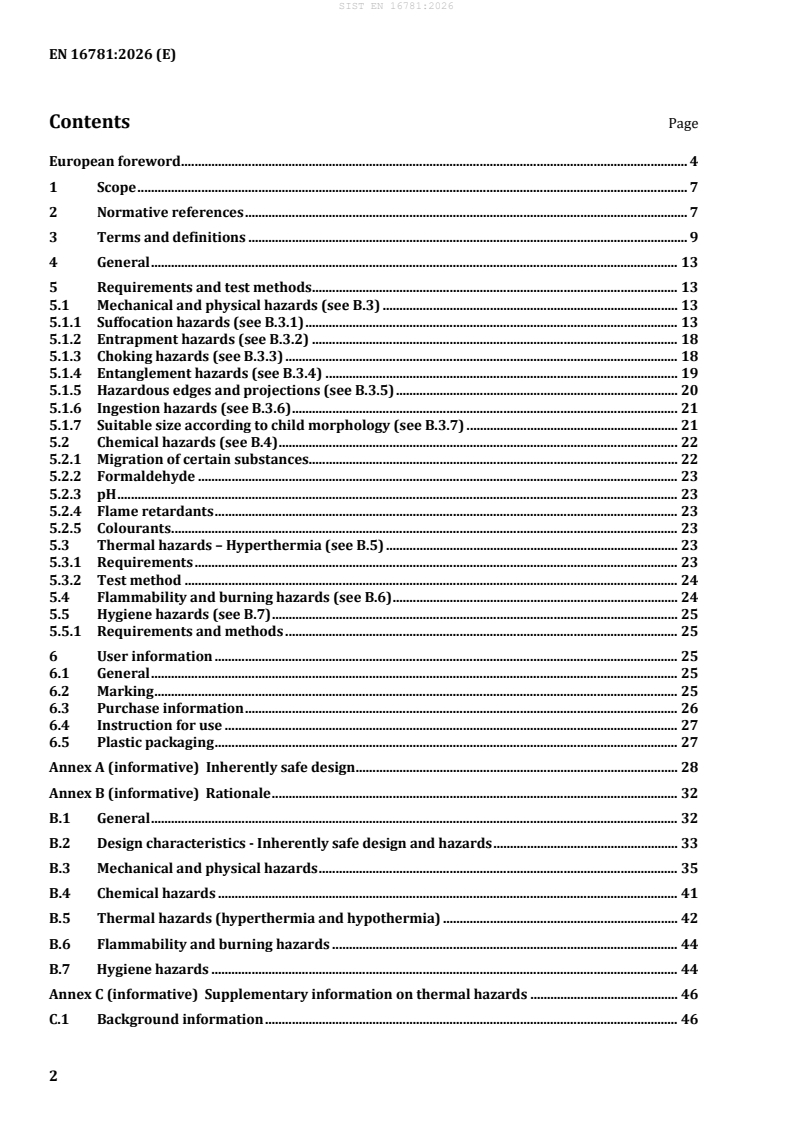
Contents Page
European foreword . 4
1 Scope . 7
2 Normative references . 7
3 Terms and definitions . 9
4 General . 13
5 Requirements and test methods . 13
5.1 Mechanical and physical hazards (see B.3) . 13
5.1.1 Suffocation hazards (see B.3.1) . 13
5.1.2 Entrapment hazards (see B.3.2) . 18
5.1.3 Choking hazards (see B.3.3) . 18
5.1.4 Entanglement hazards (see B.3.4) . 19
5.1.5 Hazardous edges and projections (see B.3.5) . 20
5.1.6 Ingestion hazards (see B.3.6) . 21
5.1.7 Suitable size according to child morphology (see B.3.7) . 21
5.2 Chemical hazards (see B.4) . 22
5.2.1 Migration of certain substances . 22
5.2.2 Formaldehyde . 23
5.2.3 pH . 23
5.2.4 Flame retardants . 23
5.2.5 Colourants . 23
5.3 Thermal hazards – Hyperthermia (see B.5) . 23
5.3.1 Requirements . 23
5.3.2 Test method . 24
5.4 Flammability and burning hazards (see B.6) . 24
5.5 Hygiene hazards (see B.7) . 25
5.5.1 Requirements and methods . 25
6 User information . 25
6.1 General . 25
6.2 Marking . 25
6.3 Purchase information . 26
6.4 Instruction for use . 27
6.5 Plastic packaging . 27
Annex A (informative) Inherently safe design . 28
Annex B (informative) Rationale . 32
B.1 General . 32
B.2 Design characteristics - Inherently safe design and hazards . 33
B.3 Mechanical and physical hazards . 35
B.4 Chemical hazards . 41
B.5 Thermal hazards (hyperthermia and hypothermia) . 42
B.6 Flammability and burning hazards . 44
B.7 Hygiene hazards . 44
Annex C (informative) Supplementary information on thermal hazards . 46
C.1 Background information . 46
C.2 Thermal resistance measurement . 46
C.3 Measurements with thermal manikins. 47
C.4 Rationale for guidance to the purchaser and/or user . 47
C.5 Relationship between thermal resistance and thickness or mass per unit area
(surface density) . 49
Annex D (informative) Supplementary information on slide fastener positions . 50
Annex E (informative) Specific marking, purchase information and user instruction . 51
Annex ZA (informative) Relationship between this European Standard and the
requirements of Regulation 2023/988/EC aimed to be covered . 52
Bibliography . 54
European foreword
This document (EN 16781:2026) has been prepared by Technical Committee CEN/TC 248 “Textiles and
textile products”, the secretariat of which is held by BSI.
This European Standard shall be given the status of a national standard, either by publication of an
identical text or by endorsement, at the latest by March 2027 and conflicting national standards shall be
withdrawn at the latest by March 2028.
Attention is drawn to the possibility that some of the elements of this document may be the subject of
patent rights. CEN shall not be held responsible for identifying any or all such patent rights.
This document supersedes EN 16781:2018.
The main technical changes compared to the previous edition are as follows:
— EN 16781:2026 has been restructured to be hazard-based;
— Clause 1, Scope has been clarified;
— Clause 2, additional normative references have been added to update to either specification
standards (EN 16732, CEN/TS 17394-1) or standardized test methods (EN 17394-2,
CEN/TS 17394-3, CEN/TS 17394-4, EN 17667);
— Clause 3, new terms and definitions have been added;
— 5.1.1, requirements related to slide fasteners, buttons and press fasteners have been clarified.
Requirement related to weighted sleep bags has been added;
— 5.1.1.1.7, a child height range has been added in the requirement table, as well as requirements for
sleep bag length;
— 5.1.1.2.1, the test method for the neck opening circumference has been improved to determine the
neck opening circumference at the relaxed state as it is when the sleep bag is used by taking into
consideration the mechanical behaviour of any sleep bag materials;
— 5.1.2, requirements related to entrapment hazards have been clarified regarding the textile and non-
textile materials;
— 5.1.3, requirements on attached components refer to CEN/TS 17394-1:2021 and test methods on
attached components refer to EN 17394-2, CEN/TS 17394-3 or CEN/TS 17394-4;
— 5.1.4, requirements related to entanglement hazards have been clarified;
— 5.1.5, the definition of the back zone has been revised and detailed;
— 5.1.7, requirements and test method on the sleep bag length have been added;
— 5.2, requirements on migration limits for certain substances have been updated;
— 5.3, requirements on thermal resistance have been detailed and the test method refers to EN 17667;
— 6.2, 6.3 and 6.4, declaration of the thermal resistance related to multi-seasonal sleep bags has been
added;
— 6.4, a warning and an information have been added;
— Annex A has been added to deal with inherently safe design;
— Annex B, some clarifications have been introduced. Rationale for sleep bag length has been added;
— Annex C, examples of the relationship between ambient room temperature of the sleep environment,
thermal resistance of the child sleep bag and choice of sleepwear have been added;
— Annex E, summary of specific marking, purchase information and user instruction has been updated;
— Annex ZA has been added for the correspondence of the requirements between this document and
the EU Regulation.
This document has been prepared under a standardization request addressed to CEN by the European
Commission. The Standing Committee of the EFTA States subsequently approves these requests for its
Member States.
For the relationship with EU Legislation, see informative Annex ZA, which is an integral part of this
document.
Following the publication and implementation of this document in CEN member countries, it has been
agreed by CEN TC 248 that there should be an 18-month transition period from the date of availability to
allow manufacturers to develop and produce children's sleep bags that conform to the standard. This
period is also to allow the supply chain, from manufacturer through to the consumer, to be cleared of
non-conforming children's sleep bags for use in a cot.
Any feedback and questions on this document should be directed to the users’ national standards body.
A complete listing of these bodies can be found on the CEN website.
According to the CEN-CENELEC Internal Regulations, the national standards organizations of the
following countries are bound to implement this European Standard: Austria, Belgium, Bulgaria, Croatia,
Cyprus, Czech Republic, Denmark, Estonia, Finland, France, Germany, Greece, Hungary, Iceland, Ireland,
Italy, Latvia, Lithuania, Luxembourg, Malta, Netherlands, Norway, Poland, Portugal, Republic of North
Macedonia, Romania, Serbia, Slovakia, Slovenia, Spain, Sweden, Switzerland, Türkiye and the United
Kingdom
Introduction
The European Commission Mandate M/497, followed by Product and Service safety in the Directorate-
General Health and Consumers, under the title “Standardisation mandate to CEN, CENELEC and ETSI on
the safety of child-care articles; Cluster 2- risks in the sleeping environment; Mattresses for cots, cot bumpers,
suspended beds for children, duvets for children, sleep bags for children”, issued on 2011-10-20 and
accepted by CEN BT on 2011-12-20, requested that CEN develop standards or specifications including
safety requirements and test methods, warnings and instructions to adult users in order to address the
possible hazard posed by these products.
The aim of this document is to minimize the main hazards posed by products in the sleep environment of
babies and young children.
For the development of this document, attention was paid to:
— the child’s stages of development (age, height, weight, ability, etc.). The safety of child-care articles,
in relation to the risks in the sleeping environment (articles such as mattresses for cots, cot bumpers,
suspended beds for children, duvets for children, sleep bags for children) was studied in relation to
children up to 3 years of age. In this document, the main hazards (suffocation and overheating) are
more common to children up to 24 months;
— the intended or foreseeable use of the product, bearing in mind a child’s behaviour. Such behaviour
exposes children to injury in ways that differ from those of adults, making children a particularly
vulnerable group in society;
— the hazard presented by the product in the circumstances under which the product and the child
come into contact with each other.
IMPORTANT — In order to comply with the essential safety requirements, this document is hazard
based. As this document only deals with a particular textile child-care article, i.e. children's sleep bags,
design characteristics have been specified only when necessary in order to introduce inherently safe
design. These characteristics have been specified in a manner which allows compliance to be checked by
interested parties, from designers to market surveillance authority officers.
1 Scope
This document specifies requirements for the safety of children's sleep bags which are used in the
children's sleeping environment (i.e. not under supervision) and designed to provide sufficient warmth
so as to remove the need for additional bedding when sleeping in a cot or similar product
(e.g. crib/cradle) in which a child is contained. It is applicable to products for use by children up to the
age of 24 months.
NOTE Requirements of this document are not relevant when sleep bags are used for children over the age of
24 months or when they have the ability to climb out of a cot or sleep in a bed.
This document does not apply to products
— designed for use during the care of premature children, or
— designed for children of low birthweight (i.e. lower than 2,5 kg – see B.1), or
— designed for medical settings or for children with special medical needs (see B.1), or
— for outdoor use or to products designed to keep a child warm in a pushchair (e.g. foot muff) (see B.1),
or
— for use in a car restraint system for children (see B.1).
If a part of the children's sleep bag is designed to offer additional function (e.g. play function, swaddling
functions), this part will, in addition to the following requirements, be subjected to safety requirements
related to relevant standards (see B.1).
2 Normative references
The following documents are referred to in the text in such a way that some or all of their content
constitutes requirements of this document. For dated references, only the edition cited applies. For
undated references, the latest edition of the referenced document (including any amendments) applies.
EN 71-3:2019+A2:2024, Safety of toys - Part 3: Migration of certain elements
EN 1103:2005, Textiles - Fabrics for apparel - Detailed procedure to determine the burning behaviour
EN 1162:1996, Feather and down - Test methods - Determination of the oxygen index number
EN 1164:1998, Feather and down - Test methods - Determination of the turbidity of an aqueous extract
EN 12935:2001, Feather and down - Hygiene and cleanliness requirements
EN 16711-2:2015, Textiles - Determination of metal content - Part 2: Determination of metals extracted by
acidic artificial perspiration solution
EN 16732:2025, Slide fasteners (zips) - Specification
CEN/TS 17394-1:2021, Textiles and textile products - Part 1: Safety of children’s clothing - Security of
attachment of attached components to infants’ clothing - Specification
EN 17394-2:2020, Textiles and textile products - Part 2: Safety of children’s clothing - Security of
attachment of buttons - Test method
CEN/TS 17394-3:2021, Textiles and textile products - Part 3: Safety of children’s clothing - Security of
attachment of metal mechanically applied press fasteners - Test method
CEN/TS 17394-4:2021, Textiles and textile products - Part 4: Safety of children’s clothing - Security of
attachment of components except buttons and metal mechanically applied press fasteners - Test method
EN 17667:2022, Test method - Determination of thermal resistance of filled textile articles and similar items
using small guarded hotplate apparatus
EN ISO 105-A01:2010, Textiles - Tests for colour fastness - Part A01: General principles of testing (ISO 105-
A01:2010)
EN ISO 105-A11:2012, Textiles - Tests for colour fastness - Part A11: Determination of colour fastness
grades by digital imaging techniques (ISO 105-A11:2012)
EN ISO 105-E01:2013, Textiles - Tests for colour fastness - Part E01: Colour fastness to water (ISO 105-
E01:2013)
EN ISO 139:2005, Textiles - Standard atmospheres for conditioning and testing (ISO 139:2005)
EN ISO 3071:2020, Textiles - Determination of pH of aqueous extract (ISO 3071:2020)
EN ISO 4045:2018, Leather - Chemical tests - Determination of pH and difference figure (ISO 4045:2018)
EN ISO 6330:2021, Textiles - Domestic washing and drying procedures for textile testing (ISO 6330:2021)
EN ISO 14184-1:2011, Textiles - Determination of formaldehyde - Part 1: Free and hydrolysed formaldehyde
(water extraction method) (ISO 14184-1:2011)
EN ISO 17226-1:2021, Leather - Chemical determination of formaldehyde content - Part 1: Method using
high-performance liquid chromatography (ISO 17226-1:2021)
ISO 105-F10:1989, Textiles - Tests for colour fastness - Part F10: Specification for adjacent fabric:
Multifibre
ISO 4915:1991, Textiles - Stitch types - Classification and terminology
ISO 7000:2019, Graphical symbols for use on equipment - Registered symbols
As impacted by EN ISO 139:2005/A1:2011.
As impacted by ISO 105-F10:1989/A1:2009.
3 Terms and definitions
For the purposes of this document, the following terms and definitions apply.
ISO and IEC maintain terminology databases for use in standardization at the following addresses:
— IEC Electropedia: available at https://www.electropedia.org/
— ISO Online browsing platform: available at https://www.iso.org/obp
3.1
sleep bag
bedding item consisting of a full-length fabric bag with neck opening and armholes and designed to
contain a child
Note 1 to entry: The sleep bag is not considered to be a garment.
Note 2 to entry: The sleep bag can be single or multi-layered, and with or without filling material.
Note 3 to entry: The sleep bag can be used in conjunction with sleepwear.
3.2
cot
bed for a child consisting of a base and enclosed by high sides to prevent the child from falling out
3.3
harm
injury or damage to the health of people
[SOURCE: ISO/IEC Guide 51:2014, 3.1, modified — “or damage to property or the environment” has been
deleted.]
3.4
hazard
potential source of harm (3.3)
[SOURCE: ISO/IEC Guide 51:2014, 3.2]
3.5
risk
combination of the probability of occurrence of harm (3.3) and the severity of that harm
[SOURCE: ISO/IEC Guide 51:2014, 3.9, modified — Note 1 to entry has been deleted.]
3.6
inherently safe design
measures taken to eliminate hazards (3.4) and/or to reduce risks (3.5) by changing the design or
operating characteristics of the product or system
[SOURCE: ISO/IEC Guide 51:2014, 3.5]
3.7
cord
chain, ribbon, string or tape of any textile or non-textile material, including elastic material
3.8
drawstring
cord (3.7) which passes through a channel, loop(s) or eyelet(s) or similar, to adjust the size of the opening,
or part of the sleep bag or to fasten the sleep bag itself
Note 1 to entry: This definition is inspired from EN 14682:2014, 2.5 [11].
3.9
asphyxiation
insufficient supply of air to the airways
Note 1 to entry: Insufficient supply of air could be caused, e.g. by closing off the flow of air as a result of choking
or suffocation or by entrapment in an unventilated, confined space.
[SOURCE: EN 71-1:2026, 3.4]
3.10
choking
closing off the flow of air as a result of internal asphyxiation (3.9)
Note 1 to entry: Choking can, for example, be caused by inhalation of an object, by an object becoming wedged in
the mouth or pharynx, or by an object becoming lodged over the entrance to the lower airways.
[SOURCE: EN 71-1:2026, 3.10]
3.11
suffocation
closing off the flow of air as a result of airway obstruction external to the mouth and nose
[SOURCE: EN 71-1:2026, 3.69]
3.12
monofilament sewing thread
continuous single filament of man-made fibre which can withstand the mechanical operation of sewing
3.13
burr
roughness, caused by not cleanly severing or finishing the material
[SOURCE: EN 71-1:2026, 3.7]
3.14
surface flash
rapid spread of flame over the surface of a material without ignition of its basic structure
Note 1 to entry: However, if the latter occurs simultaneously or sequentially with surface flash, it is not
considered as a part of surface flash.
[SOURCE: ISO 4880:1997, modified — The second note to entry has been deleted.]
3.15
label
piece of material displaying information and permanently attached to the textile product
3.16
hang tag
piece of material displaying information that is intended to be removed from the textile product before
first use
3.17
small part
component or piece of a component which when dropped, without compression, into the small parts
cylinder (Figure 1) in any orientation, fits entirely within the cylinder
Dimensions in millimetres
Figure 1 — Small parts cylinder
3.18
back zone
area on the back of the sleep bag, when laid down flat, starting at the side neck point and extending
downwards from the side neck point and finishing on both sides with a margin inwards from armholes
and sides
Note 1 to entry: See Figure 7.
3.19
child height
stature (3.19.1) or recumbent length (3.19.2) of a child
3.19.1
stature
vertical distance from the highest point of the head in the median line to the ground
Note 1 to entry: Identical to stature (body height) in ISO 7250-1.
Note 2 to entry: The term height is commonly used and covers both stature (3.19.1) and recumbent length
(3.19.2).
[SOURCE: EN ISO 8559-1:2020, 5.1.1]
3.19.2
recumbent length
horizontal distance from the vertical plate to which the soles touch to the crown of the head in the median
line
Note 1 to entry: The term ‘height’ is commonly used and covers both stature (3.19.1) and recumbent
length (3.19.2).
[SOURCE: EN ISO 8559-1:2020, 5.1.2]
3.20
press fastener
fastening device consisting of a male component and a female component that are attached to different
parts of a sleep bag and which are fastened by aligning the two components and pressing them together
Note 1 to entry: Press fasteners include poppers and snaps.
Note 2 to entry: These may be functional or decorative.
[SOURCE: CEN/TS 17394 3:2021, 3.1, modified — garment replaced with sleep bag.]
3.21
slide fastener (zip)
fastening device consisting of two flexible, interlocking stringers, with or without end stops, and one or
more sliders so arranged that by moving the slider along the stringers in one direction an opening is
formed, and by moving it in the other direction the opening is closed
[SOURCE: EN 16732:2025, 3.1]
3.22
locking device
device incorporated in the slider unit restricting its free movement along the slide fastener length in an
opening direction
Note 1 to entry: The locking device might operate either automatically on release of the puller or by manual
pressure on the puller.
[SOURCE: EN 16732:2025, 3.8]
3.23
weighted sleep bag
sleep bag in which one or more areas include additional functional weighting
3.24
traceability
ability to trace the history, application, location or source(s) of a material or product throughout the
supply chain
[SOURCE: ISO 22095:2020, 3.6.1]
3.25
multi-seasonal configuration
combination of sleep bag parts for use singly or in combination in different seasons
3.26
button
knob or disc which can be attached to a sleep bag by means of, for example, sewing thread
[SOURCE: EN 17394-2:2020, 3.3, modified — garment replaced with sleep bag.]
4 General
The requirements provided in this document are the characteristics for a sleep bag which are considered
to result in inherently safe design.
NOTE 1 Inherently safe design is provided in Annex A, and summarized in Table A.1.
NOTE 2 Rationales for the inclusion of some of the requirements given in this document are given in Annex B,
and summarized in Table B.1.
5 Requirements and test methods
5.1 Mechanical and physical hazards (see B.3)
5.1.1 Suffocation hazards (see B.3.1)
5.1.1.1 Requirements
5.1.1.1.1 There shall be no plastic print or coated fabrics having a continuous area which exceeds
100 mm by 100 mm. Areas of plastic print or coated fabric shall not exceed 10 % of the total area of the
sleep bag (Table A.1 and B.3.1.1).
5.1.1.1.2 Only buttons, metal press fasteners or slide fasteners shall be used for fastening the neck
opening and the armhole (Table A.1 and B.3.1.3, B.3.1.4).
5.1.1.1.3 Slide fasteners shall have a slider locking device in compliance with the requirements of
EN 16732:2025, Table 1 performance code B (Table A.1 and B.3.1.3).
5.1.1.1.4 Where a slide fastener is placed to fasten the neck opening, the slide fastener shall be an open-
end system and the combination of the box and the insert pin shall be placed at the neck opening. This
means that the top stops are not placed at the neck opening and that a slide fastener with only one slider
is used (Table A.1, B.3.1.3.1 and Annex D). See Figure 2.
Key
1 box
2 insert pin
3 top stop
Figure 2 — Open-end slide fastener
5.1.1.1.5 Where buttons or metal press fasteners are used for fastening the neck opening and the
armhole, the fastenings (button and its buttonhole, male and female parts of press fastener) shall remain
closed when tested according to 5.1.1.2.1, but with a mass applying a force (F) of (10 ± 1) N (see B.3.1.3).
5.1.1.1.6 Weighted sleep bags are not permitted (see B.3.1.6).
5.1.1.1.7 Neck openings
Neck openings, in relation to the child height range, shall comply with the requirements according
to Table 1, when measured in accordance with 5.1.1.2.1 (Table A.1, B.3.1.2, Table B.5, Table B.6 and
Table B.7).
Table 1 — Sleep bag's neck openings and length in relation to the child height
a, b
Child height range Neck opening Length of
circumference c
(cm) sleep bag
minimum maximum minimum
(cm) (cm) (cm)
45 to 55 26 30 60
50 to 65 28 32 70
65 to 80 30 39 85
80 to 95 31 41 100
a
If “age” is used as a sleep bag size designation, the relation between height and
approximate age can be found in Table B.2.
b
See examples in Table B.4, Table B.5, Table B.6 and Table B.7.
c
Sleep bag length: see 5.1.7.1.
The neck opening can be adjusted (variation on the neck opening circumferences) within the same child
height range claimed by the manufacturer so that the smallest neck opening dimension shall remain in
compliance with the minimum circumference requirement of Table 1 and the greatest neck opening
dimension shall remain in compliance with the maximum circumference requirement of Table 1. Sleep
bags designed for the smallest child height range (from 45 cm to 55 cm range of Table 1) shall not be
designed for higher child height range.
For any other child height ranges of Table 1, in case the child height range claimed by the manufacturer
is crossing more than one height range, the minimum circumference requirement of the neck opening
shall be the highest of the concerned child height ranges and the maximum circumference requirement
the smallest height range of the concerned child height ranges. The minimum length requirement of the
sleep bag shall be the greatest of the concerned child height ranges.
5.1.1.2 Test methods
5.1.1.2.1 Neck opening circumference
The apparatus shall consist of a fixed hook, a moveable hook, and a means of guiding the moveable hook
in a straight line (e.g. rigid rod, guide rails). Both hooks shall be L-shaped. The part of the hooks on which
the sample is mounted shall be no more than 3,0 mm in width or in diameter. The moving hook is
connected to a mass using an inelastic wire such that a force of (1,0 ± 0,2) N, measurement (l ) is taken,
1N
and then a force of (3,0 ± 0,2) N are applied to the neck opening either directly or via a pulley, and a
second measurement (l ) taken. The distance between the hooks shall be measured using a ruler or other
3N
measuring device graduated in divisions of not greater than 1 mm.
NOTE The use of a pulley permits the sleep bag to be placed and measured in a horizontal orientation but for
the force to be applied vertically using the deadweight principle. The use of a horizontal orientation permits the
sleep bag to be supported on a table without the need for additional means of support for the foot of the sleep bag
needed to avoid twisting and distortion during the measurement.
Fold the sleep bag along an axis between the centre-back and centre-front points taking care to align the
fastenings (see Figure 3). Apply the hooks to both the centre-front and centre-back points and apply the
force of 1 N to the neck opening. Measure the length of neck opening l to the nearest 1 mm. Apply the
1N
force of 3 N and measure the length of neck opening l to the nearest 1 mm.
3N
If a rigid component or inflexible opening is at the centre-front point, move the measurement point
slightly away from this rigid part (2 cm has been found suitable) and the same displacement of the centre-
back point.
The length of the neck opening, l , is calculated according to the following Formula (1).
0N
3×ll−
( )
1N 3N
l = (1)
0N
where
l is the length of the neck opening at 0 N, expressed in mm;
0N
l is the length of the neck opening at 1 N, expressed in mm;
1N
l is the length of the neck opening at 3 N, expressed in mm.
3N
The neck opening circumference is equal to twice the calculated length of the neck opening and is
calculated according to the following Formula (2) and rounded at the nearest 1 cm.
2× l
0N
N =
oc
(2)
where
N is the circumference of the neck opening, expressed in cm;
oc
l is the length of the neck opening at 0 N, expressed in mm.
0N
a) Example of measurement devices
b) Neck opening measurement c) Neck opening measurement
(example of sleep bag with press fasteners at shoulder) (example of sleep bag with seam
at shoulder)
Key
1 fixed hook
2 ruler
3 centre back
4 centre front
l length of the neck opening
F force applied
x point of contact between the sleep bag and the hook
______ alignment of hook and 0 on the ruler
Figure 3 — Principle of the neck opening measurement
5.1.2 Entrapment hazards (see B.3.2)
5.1.2.1 Requirements
5.1.2.1.1 Fabrics with open structures such as mesh or lace fabric, shall not be used (Table A.1 and
B.3.2.1).
5.1.2.1.2 If not covered in 5.1.2.1.1, there shall be no completely bounded openings in non-textile
materials (such as hole in a slider fastener puller, in an eyelet) between 5 mm and 12 mm, unless the
depth of penetration is less than 10 mm (see B.3.2.1), when tested in accordance with 5.1.2.2.
5.1.2.2 Test method
The test probes shall be made from plastic or other smooth, hard material, which can be mounted on a
force measuring device.
Determine whether the 5 mm test probe (Figure 4) with an applied force of up to 30 N, enters 10 mm or
more into any completely bounded circular openings in rigid materials, in any possible orientation.
Dimensions in millimetres
Key
R specific radius
Figure 4 — 5 mm test probes for openings in rigid materials
If the 5 mm test probe enters 10 mm or more, then the 12 mm test probe (Figure 5) shall also
enter 10 mm or more with an applied force of up to 5 N.
Dimensions in millimetres
Key
R specific radius
Figure 5 — 12 mm test probe for seams
5.1.3 Choking hazards (see B.3.3)
5.1.3.1 Requirements
5.1.3.1.1 Children's sleep bags shall not have any pockets (Table A.1 and B.3.3.1).
5.1.3.1.2 Slide fasteners shall meet at least the requirements of EN 16732:2025, Table 1, performance
code B, and shall also meet the requirements of EN 16732:2025, Table 2 (Table A.1).
5.1.3.1.3 Slide fasteners shall not have a removable slider (Table A.1 and B.3.3.2). The absence of a
removable slider may be confirmed by visual inspection.
5.1.3.1.4 Slide fasteners shall include a top stop (see B.3.3.2) and either a bottom stop or be secured in
a manner so that the slider cannot be removed from the chain. (Table A.1). The presence of the top stop
and the bottom stop may be confirmed by visual inspection.
5.1.3.1.5 Buttons shall not be attached by chain stitch (Table A.1 and B.3.3.2).
5.1.3.1.6 There shall be no pom-poms or tassels on children's sleep bags (Table A.1 and B.3.3.2).
5.1.3.1.7 There shall be no beads, sequins or diamantés on children's sleep bags (Table A.1
and B.3.3.2).
5.1.3.1.8 There shall be no glitter prints (e.g. plastic glue glitter or spread over glitter) on sleep bags.
5.1.3.1.9 Metal press fasteners with plastic top cover, two-part buttons (buttons made of more than
one piece), fabric-covered buttons or buttons made of wood or shells shall not be used (Table A.1
and B.3.3.3, B.3.3.4).
5.1.3.1.10 Seams shall have a seam allowance (distance between the fabric edge and sewing line) of no
less than 5 mm (Table A.1 and B.3.3.7).
5.1.3.1.11 Where filling materials are used, seams shall be sewn so as to meet the following conditions
(Table A.1 and B.3.3.7):
a) the seams shall have a minimum of 10 stitches per 3 cm; and,
b) the 12 mm probe shall not be inserted through any one opening in the seam when the seam is tested
as follows:
Use clamps with jaws to which discs with a diameter of 19 mm are affixed. Attach the clamps not less
than 30 mm apart and equidistant to the seam. Gradually apply a force of (70 ± 2) N between the two
clamps over a period of approximately 5 s. Maintain the force for 10 s. Apply the test to this seam
only once. Determine whether the front part of the 12 mm probe (see Figure 5) can be inserted
through any one opening in the seam, using a maximum force of 10 N.
NOTE Decorative stitches and quilting stitches are excluded from this requirement.
5.1.3.1.12 If not covered in 5.1.3.1.1 to 5.1.3.1.11,
Sleep bags shall contain attached components which comply with CEN/TS 17394-1:2021, when tested
according to EN 17394-2:2020, CEN/TS 17394-3:2021 or CEN/TS 17394-4:2021 as appropriate.
5.1.4 Entanglement hazards (see B.3.4)
5.1.4.1 Requirements
5.1.4.1.1 Chain stitches, as described in ISO 4915:1991, are not permitted (Table A.1 and B.3.4.2).
5.1.4.1.2 Monofilament sewing thread shall not be used (Table A.1 and B.3.4.2).
5.1.4.1.3 For surfaces of the article that can be in contact with the child, the maximum length of uncut
float threads or uncut stitches shall be 10 mm, and the maximum length for cut threads or cut stitches
shall be 10 mm (Table A.1 and B.3.4.2).
5.1.4.1.4 The ends of labels or the edge of raw edge fabric shall be secured to prevent unravelling
(Table A.1 and B.3.4.2). The security of the ends of the labels can be confirmed by carrying out a tactile
inspection.
5.1.4.1.5 Labels which are in the form of a loop (loop label) or inserted in a way that they can create a
loop when the sleep bag is used shall not be attached to the sleep bag. However, where these are attached
to the upper inside on the back panel, they are acceptable (Table A.1 and B.3.4.2).
5.1.4.1.6 There shall be no drawstrings attached to the children's sleep bags (Table A.1 and B.3.4.1).
5.1.4.1.7 There shall be no cords longer than 75 mm on children's sleep bags (Table A.1 and B.3.4.2).
5.1.4.1.8 Looped labels are only allowed when used in the inside back neck seam and shall have a
maximum circumference of 150 mm (Table A.1 and B.3.4.2.2).
5.1.4.1.9 A children's sleep bag shall not include any device designed to attach the children's sleep bag
to the cot or cot mattress.
5.1.5 Hazardous edges and projections (see B.3.5)
5.1.5.1 Requirements
5.1.5.1.1 Children's sleep bags shall not have any bulky seams or hard objects (e.g. press fasteners,
buttons and other fastenings) in the back zone (Table A.1 and B.3.5.1). The back zone is the area of the
back of the sleep bag, starting at the shoulder edge and extending towards 40 cm down from the side
neck point and finishing on both sides 5 cm inwards from armholes and side edges of the sleep bag (when
laid down flat on a table) – (Figure 6).
Figure 6 — Back zone
5.1.5.1.2 In order to avoid direct skin contact in wear, a fabric slide fastener guard shall cover the slide
fastener in the neck and under-arm area (Table A.1, B.3.5.2 and B.3.5.3).
In the neck area, the fabric slide fastener guard shall cover at least the pin and box.
In the under-arm area, the fabric slide fastener guard shall cover at least the pin and box, or, top stops.
5.1.5.1.3 Fabrics and filling materials shall not contain any hard, sharp or foreign objects (i.e. any
unintentional items such as needle, staple, nail, unattached press fastener, wood splinter) (Table A.1 and
B.3.5.3).
5.1.5.1.4 All components of the slide fasteners (for example, top stop, elements (teeth)) shall be free
from burrs and sharp edges (Table A.1, B.3.5.2 and B.3.5.3).
5.1.5.1.5 When positioning touch and close fasteners, the hook component shall face away from the
child’s body to reduce the possibility of skin abrasion (Table A.1 and B.3.5.2).
5.1.5.1.6 Pieces of touch and close fasteners shall be die cut with rounded corners to reduce the risk of
scratching (Table A.1 and B.3.5.2).
5.1.5.1.7 Heat-sealed or laser cut materials shall not have sharp edges (Table A.1 and B.3.5.2).
5.1.5.1.8 If not covered by 5.1.5.1.1. to 5.1.5.1.7, the component parts used on children's sleep bags
shall not have any sharp edges, sharp points or burrs (see B.3.5.2).
5.1.5.2 Test method
The presence of hard, sharp or foreign objects shall be confirmed by carrying out a visual and tactile
inspection.
NOTE Ferrous foreign objects such as broken needles can be detected using magnetic devices.
5.1.6 Ingestion hazards (see B.3.6)
Children's sleep bags shall not
...