

EN 15017:2019
(Main)Funeral Services - Requirements
- Abstract
This document sets out the requirements for the provision of funeral services with respect to education, transport, facilities, advisory services, and care of the deceased for both burial and cremation services.
This document is applicable to all funeral professionals, funeral homes, and funeral-related services at cemeteries and crematoria as well as any other person(s) providing funeral services of any kind.
This document does not apply to product-related technical requirements. Occupational health and safety requirements are not covered by this document.
- Status
- Published
- Publication Date
- 10-Sep-2019
- Withdrawal Date
- 30-Mar-2020
- Technical Committee
- CEN/TC 448 - Funeral services
- Drafting Committee
- CEN/TC 448 - Funeral services
- Current Stage
- 9060 - Closure of 2 Year Review Enquiry - Review Enquiry
- Start Date
- 04-Mar-2025
- Completion Date
- 04-Mar-2025


Overview
EN 15017:2019 - Funeral Services - Requirements is the CEN European standard that defines best-practice requirements for the provision of funeral services across burial and cremation. Published September 2019, it replaces the earlier 2005/2006 editions and applies to all funeral professionals, funeral homes, cemetery and crematorium services, repatriation/transport providers and any person or organisation offering funeral-related services. It covers advisory services, education and qualifications, transport of the deceased, facilities and care of the deceased, plus online and quality management aspects. Note: product-specific technical requirements and occupational health & safety are outside its scope.
Key Topics and Requirements
The standard organizes practical requirements and guidance into clear technical areas:
- Ethical values - principles guiding respectful and professional funeral service delivery.
- Education and qualifications - roles and responsibilities for funeral directors and funeral personnel, including minimum educational units and competency assessment.
- Advisory services - pre-funeral counselling, ceremony planning, obituaries, printed/electronic materials and post-funeral support.
- Funeral facilities - layout and requirements for preparation rooms, cooling/refrigeration, public areas and administrative spaces; equipment, vehicles and PPE.
- Transport of deceased persons - repatriation, long-distance and international transport, and movement of cremated remains.
- Care of the deceased - initial procedures, dressing, embalming/thanatopraxy, cosmetology, viewings, burial procedures, cremation and exhumation.
- Online services - requirements for online funeral brokers, online funeral companies, memorial pages, death announcements and e-commerce of funeral-related services.
- Quality management and complaints handling - monitoring, documentation and continual improvement.
- Privacy policy - data protection and client confidentiality requirements.
- Supporting annexes - skills and knowledge matrices for roles, “laissez-passer” documentation for transport, and guidance on cremation ethics.
Practical Applications & Users
EN 15017 is practical, non-prescriptive guidance used by:
- Funeral homes and directors to structure staff training, client advisory processes and facility design.
- Cemeteries and crematoria for defining operational procedures, public-area requirements and handling of ashes.
- Transport and repatriation services to align international transfer documentation and handling.
- Online funeral service providers for compliant service descriptions, pricing transparency and digital memorials.
- Regulators, auditors and consumer protection bodies as a benchmark for service quality and complaints handling.
Related Standards
While EN 15017 focuses on service requirements, organisations should align it with national regulations, data protection laws (privacy), and separate standards covering occupational health & safety and product-technical specifications.
Keywords: EN 15017, Funeral Services Requirements, funeral homes, funeral director education, crematoria, burial services, transport of deceased, funeral advisory services, quality management.
Relations
- Effective Date
- 18-Sep-2019
Get Certified
Connect with accredited certification bodies for this standard

Great Wall Tianjin Quality Assurance Center
Established 1993, first batch to receive national accreditation with IAF recognition.
Hong Kong Quality Assurance Agency (HKQAA)
Hong Kong's leading certification body.

Innovative Quality Certifications Pvt. Ltd. (IQCPL)
Known for integrity, providing ethical & impartial Assessment & Certification. CMMI Institute Partner.
Sponsored listings
Frequently Asked Questions
EN 15017:2019 is a standard published by the European Committee for Standardization (CEN). Its full title is "Funeral Services - Requirements". This standard covers: This document sets out the requirements for the provision of funeral services with respect to education, transport, facilities, advisory services, and care of the deceased for both burial and cremation services. This document is applicable to all funeral professionals, funeral homes, and funeral-related services at cemeteries and crematoria as well as any other person(s) providing funeral services of any kind. This document does not apply to product-related technical requirements. Occupational health and safety requirements are not covered by this document.
This document sets out the requirements for the provision of funeral services with respect to education, transport, facilities, advisory services, and care of the deceased for both burial and cremation services. This document is applicable to all funeral professionals, funeral homes, and funeral-related services at cemeteries and crematoria as well as any other person(s) providing funeral services of any kind. This document does not apply to product-related technical requirements. Occupational health and safety requirements are not covered by this document.
EN 15017:2019 is classified under the following ICS (International Classification for Standards) categories: 03.080.30 - Services for consumers. The ICS classification helps identify the subject area and facilitates finding related standards.
EN 15017:2019 has the following relationships with other standards: It is inter standard links to EN 15017:2005. Understanding these relationships helps ensure you are using the most current and applicable version of the standard.
EN 15017:2019 is available in PDF format for immediate download after purchase. The document can be added to your cart and obtained through the secure checkout process. Digital delivery ensures instant access to the complete standard document.
Standards Content (Sample)
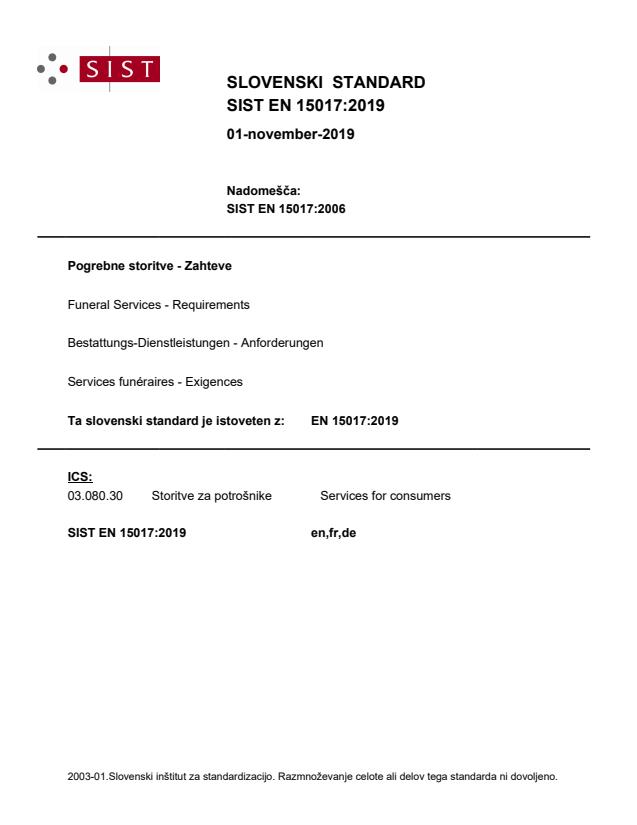
SLOVENSKI STANDARD
01-november-2019
Nadomešča:
SIST EN 15017:2006
Pogrebne storitve - Zahteve
Funeral Services - Requirements
Bestattungs-Dienstleistungen - Anforderungen
Services funéraires - Exigences
Ta slovenski standard je istoveten z: EN 15017:2019
ICS:
03.080.30 Storitve za potrošnike Services for consumers
2003-01.Slovenski inštitut za standardizacijo. Razmnoževanje celote ali delov tega standarda ni dovoljeno.
EN 15017
EUROPEAN STANDARD
NORME EUROPÉENNE
September 2019
EUROPÄISCHE NORM
ICS 03.080.30 Supersedes EN 15017:2005
English Version
Funeral Services - Requirements
Services funéraires - Exigences Bestattungs-Dienstleistungen - Anforderungen
This European Standard was approved by CEN on 28 July 2019.
CEN members are bound to comply with the CEN/CENELEC Internal Regulations which stipulate the conditions for giving this
European Standard the status of a national standard without any alteration. Up-to-date lists and bibliographical references
concerning such national standards may be obtained on application to the CEN-CENELEC Management Centre or to any CEN
member.
This European Standard exists in three official versions (English, French, German). A version in any other language made by
translation under the responsibility of a CEN member into its own language and notified to the CEN-CENELEC Management
Centre has the same status as the official versions.
CEN members are the national standards bodies of Austria, Belgium, Bulgaria, Croatia, Cyprus, Czech Republic, Denmark, Estonia,
Finland, France, Germany, Greece, Hungary, Iceland, Ireland, Italy, Latvia, Lithuania, Luxembourg, Malta, Netherlands, Norway,
Poland, Portugal, Republic of North Macedonia, Romania, Serbia, Slovakia, Slovenia, Spain, Sweden, Switzerland, Turkey and
United Kingdom.
EUROPEAN COMMITTEE FOR STANDARDIZATION
COMITÉ EUROPÉEN DE NORMALISATION
EUROPÄISCHES KOMITEE FÜR NORMUNG
CEN-CENELEC Management Centre: Rue de la Science 23, B-1040 Brussels
© 2019 CEN All rights of exploitation in any form and by any means reserved Ref. No. EN 15017:2019 E
worldwide for CEN national Members.
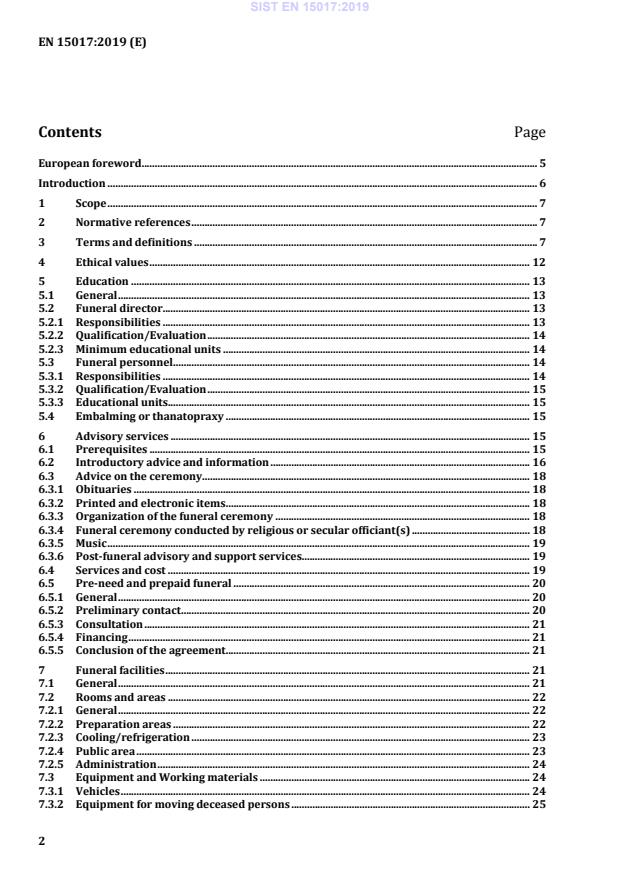
Contents Page
European foreword . 5
Introduction . 6
1 Scope . 7
2 Normative references . 7
3 Terms and definitions . 7
4 Ethical values . 12
5 Education . 13
5.1 General . 13
5.2 Funeral director. 13
5.2.1 Responsibilities . 13
5.2.2 Qualification/Evaluation . 14
5.2.3 Minimum educational units . 14
5.3 Funeral personnel . 14
5.3.1 Responsibilities . 14
5.3.2 Qualification/Evaluation . 15
5.3.3 Educational units . 15
5.4 Embalming or thanatopraxy . 15
6 Advisory services . 15
6.1 Prerequisites . 15
6.2 Introductory advice and information . 16
6.3 Advice on the ceremony . 18
6.3.1 Obituaries . 18
6.3.2 Printed and electronic items . 18
6.3.3 Organization of the funeral ceremony . 18
6.3.4 Funeral ceremony conducted by religious or secular officiant(s) . 18
6.3.5 Music . 19
6.3.6 Post-funeral advisory and support services. 19
6.4 Services and cost . 19
6.5 Pre-need and prepaid funeral . 20
6.5.1 General . 20
6.5.2 Preliminary contact . 20
6.5.3 Consultation . 21
6.5.4 Financing . 21
6.5.5 Conclusion of the agreement. 21
7 Funeral facilities . 21
7.1 General . 21
7.2 Rooms and areas . 22
7.2.1 General . 22
7.2.2 Preparation areas . 22
7.2.3 Cooling/refrigeration . 23
7.2.4 Public area . 23
7.2.5 Administration . 24
7.3 Equipment and Working materials . 24
7.3.1 Vehicles . 24
7.3.2 Equipment for moving deceased persons . 25
7.3.3 Support Material . 26
7.3.4 Adornment Material . 26
7.3.5 Funeral-related services at cemeteries . 26
7.4 Personal Protective Equipment (PPE) . 26
7.5 Waste management and environment . 27
8 Transport of deceased persons or human remains . 28
8.1 Repatriation, transfer and transport. 28
8.1.1 General . 28
8.1.2 Long-distance transport . 28
8.1.3 International transport of the deceased . 29
8.1.4 International transport of cremated remains . 29
8.2 Public authority removals . 29
9 Care of the deceased . 29
9.1 General . 29
9.2 Practical procedures . 30
9.2.1 Initial procedures . 30
9.2.2 Dressing of the deceased . 30
9.2.3 Embedding . 30
9.2.4 Embalming/Thanatopraxy . 31
9.2.5 Cosmetology . 31
9.2.6 Viewing . 31
9.3 Funeral ceremony. 32
9.4 Burial (excluding cremated remains) . 33
9.4.1 Existing burial plot . 33
9.4.2 New grave . 33
9.4.3 Grave dressing . 33
9.4.4 Burial at sea . 33
9.5 Cremation . 34
9.5.1 General . 34
9.5.2 Disposal of ashes . 34
9.6 Exhumation . 34
9.6.1 General . 34
9.6.2 Exhumation on behalf of authorities . 35
9.6.3 Exhumation performed on behalf of the relatives . 35
10 Online services . 35
10.1 General . 35
10.2 Online funeral broker . 35
10.3 Online Funeral Company . 35
10.3.1 General . 35
10.3.2 Price and product information . 35
10.3.3 Documentation to the client . 35
10.4 Online funeral services . 36
10.5 Online funeral-related services . 36
10.5.1 General . 36
10.5.2 Creating a memorial page . 36
10.5.3 Online death announcement . 36
10.5.4 Online donation . 36
11 Quality management . 36
11.1 General . 36
11.2 Quality assurance and complaints handling . 37
11.3 Monitoring system. 37
12 Privacy policy . 37
Annex A (informative) Skills and Knowledge of Funeral Director and Funeral Personnel . 38
A.1 General . 38
A.2 Funeral Director . 38
A.2.1 Knowledge (Theoretical training) . 38
A.2.2 Know to (execute/operationalize) . 38
A.2.3 Know to (relational/behavioural) . 39
A.3 Funeral Personnel . 40
A.3.1 Knowledge (Theoretical training) . 40
A.3.2 Know to (execute/operationalize) . 40
A.3.3 Know to (relational/behavioural) . 41
Annex B (informative) “Laissez-passer” of a deceased or cremated remains . 42
Annex C (informative) Cremation ethics of the International Cremation Federation (ICF) . 43
Annex D (informative) Minimum recommendations concerning the use of coffins, their
accessories and cremation urns . 45
D.1 Coffins and accessories . 45
D.2 Cremation urns . 45
Annex E (informative) Memorial page. 47
E.1 General . 47
E.2 Terms and conditions . 47
Annex F (informative) Code of Ethics of the European Federation of Funeral Services (EFFS) . 49
Annex G (informative) A-deviations . 50
Bibliography . 51
European foreword
This document (EN 15017:2019) has been prepared by Technical Committee CEN/TC 448 “Funeral
Services”, the secretariat of which is held by ASI.
This European Standard shall be given the status of a national standard, either by publication of an
identical text or by endorsement, at the latest by March 2020, and conflicting national standards shall be
withdrawn at the latest by March 2020.
Attention is drawn to the possibility that some of the elements of this document may be the subject of
patent rights. CEN shall not be held responsible for identifying any or all such patent rights.
This document supersedes EN 15017:2005.
This document is a comprehensive technical revision of EN 15017:2005.
The main modifications are:
— Requirements for the education of funeral personnel have been added.
— More detailed requirements on the provision of funeral facilities have been added, including
requirements for the provision of working equipment, transport vehicles and other working
materials.
— More detailed requirements on advisory services and on care of the deceased have been added.
— Clauses on online funeral services, quality management, ethical values and privacy policy have been
added.
According to the CEN-CENELEC Internal Regulations, the national standards organisations of the
following countries are bound to implement this European Standard: Austria, Belgium, Bulgaria, Croatia,
Cyprus, Czech Republic, Denmark, Estonia, Finland, France, Germany, Greece, Hungary, Iceland, Ireland,
Italy, Latvia, Lithuania, Luxembourg, Malta, Netherlands, Norway, Poland, Portugal, Republic of North
Macedonia, Romania, Serbia, Slovakia, Slovenia, Spain, Sweden, Switzerland, Turkey and the United
Kingdom.
Introduction
The revision of this document is based on the changing markets in the funeral sectors of Europe. It has
been prepared to provide a state of the art position to all persons and/or companies providing a service
in the funeral sector.
It is intended to provide more transparency in funeral-related services and facilities and the underlying
pricing principles for the consumer and contains improvements on the part of the service providers in
funeral-related services; hence providing higher standards and quality for the consumer and the client.
The main contents are education, transport, facilities, advisory services, online funeral services, and care
of the deceased for both burial and cremation services.
This document ensures quality in funeral services, including the highest respect for the deceased and
bereaved, while respecting the laws and regulations in force.
1 Scope
This document sets out the requirements for the provision of funeral services with respect to education,
transport, facilities, advisory services, and care of the deceased for both burial and cremation services.
This document is applicable to all funeral professionals, funeral homes, and funeral-related services at
cemeteries and crematoria as well as any other person(s) providing funeral services of any kind.
This document does not apply to product-related technical requirements. Occupational health and safety
requirements are not covered by this document.
2 Normative references
There are no normative references in this document.
3 Terms and definitions
For the purposes of this document, the following terms and definitions apply.
ISO and IEC maintain terminological databases for use in standardization at the following addresses:
— IEC Electropedia: available at http://www.electropedia.org/
— ISO Online browsing platform: available at http://www.iso.org/obp
3.1
ashes
cremated remains
remains of the deceased and/or human remains after being cremated including residual products of a
burnt coffin/casket
3.2
ashes container
container made of resistant material for holding the ashes resulting from the cremation of the deceased
and/or human remains
3.3
body bag
special bag made of resistant material designed to contain a human body, used for the storage and
transportation of the deceased and/or human remains in order to prevent contact with the body
3.4
body bag handles
handles made of resistant material, e.g. PVC or strengthened nylon, for ease of handling of body bags
3.5
burial
interment of the deceased and/or human remains
3.6
client
organization, person(s) or family of the deceased that receives a service
3.7
coffin
casket
box or other container in which the body of the deceased is placed for burial or cremation
3.8
coffin support
support for placing the coffin during the ceremony
3.9
columbarium
area where contained ashes can be stored in niches or walls
3.10
condolences book
book in which family and friends register a message of condolence
3.11
consultation
establishment of the wishes of the client, suggestions regarding products and services to be provided and
the cost to the client
3.12
consultation on the pre-arrangements of funerals
development/preparation of an individual proposal regarding the services for a future funeral, including
its financing
3.13
cortege
procession of people who are walking and/or driving to a funeral
3.14
cosmetic treatment
outer corrections, covering, and enhancement of the natural features of the deceased
3.15
cremation
entire procedure of incineration of the deceased and/or human remains
3.16
cremation services
any services pertaining to the cremation process
3.17
crematorium
building fitted with appliances for the sole purpose of cremating deceased and/or human remains,
including everything incidental or ancillary thereto and with a public area, which allows for a dignified
farewell ceremony
Note 1 to entry: The building is often equipped with a viewing room, and possibly with refrigeration facilities.
3.18
deceased
person(s) who has died
3.19
easel
placement support or stand
EXAMPLE For wreath or picture of the deceased.
3.20
embalming
thanatopraxy
process of temporary preservation of the deceased to forestall decomposition
3.21
embedding
placing of the deceased in a coffin/casket
3.22
exhumation
removal of human remains, in whatever state or form, from the place where they are buried
3.23
funeral home
funeral company
organization with facilities providing funeral services to the client
3.24
funeral director
qualified person ultimately responsible for carrying out funeral services him/herself or ensuring that
funeral personnel carry out funeral services
3.25
funeral facility
building with physical and technical infrastructure and devices, which are needed to fulfil the practical
funeral services
3.26
funeral personnel
persons working in funeral services, who are appropriately trained, skilled and fully qualified to fulfil the
general and specific requirements of the tasks concerned
3.27
grave
place for the burial in the ground, of the deceased and/or human remains, and may be marked by a
tombstone
3.28
hearse
specifically designed car or carriage used to transport from the place of death or funeral home to the
resting place; under normal circumstances only one deceased
3.29
hearse transport vehicle
specifically designed car or carriage and may carry more than one deceased or human remains in the
same vehicle, inside coffins
3.30
human remains
body of a deceased person, in whole or in parts, regardless of its stage of decomposition; including
cremated remains
Note 1 to entry: The definition does not specifically exclude foetuses or stillborn children
3.31
hygiene treatment and measures
treatment and measures suitable to counteract a potential health hazard for persons coming into contact
with the deceased
3.32
ID bracelet
tamper-resistant, robust bracelet that identifies the deceased
3.33
identification room
room where the deceased person's identity is checked and confirmed
3.34
initial care of the deceased
measures for short-term laying out at the place of death and preparation for collection
3.35
invoice
statement of own and third-party products and services with their prices, including value-added tax if
applicable, as well as the fees and additional costs to be paid, together with the terms of settlement
3.36
medical device
type of device to be found in the body of the deceased
EXAMPLE Pacemaker.
3.37
mortuary
morgue
specific place suited for temporary storage of the deceased
3.38
movement of the deceased
transport of a deceased person from one place to another prior to the funeral by means of any national
or international movement by road, rail, sea or air, excluding cremated remains, which is necessary
between the time of death and the time of final disposal
3.39
obituaries
drafting and/or publishing of death notices and condolence letters as well as other textual or electronic
publications
3.40
officiant
person who performs the funeral ceremony irrespective of religious or secular preference
3.41
online funeral broker
person(s) or organization with no own funeral facilities, who acts solely as an intermediary for selecting
a funeral home for the client and who receives a fee or commission for this service
3.42
online funeral company
person(s) or organization with no own funeral facilities providing full funeral services to the client solely
by hiring sub-contractors to carry out the services on the client’s behalf
3.43
online funeral services
funeral services provided by a person(s) or organization with or without their own funeral facilities using
online tools as complementary service for the client
EXAMPLE Contact forms, price comparisons, online shop for products.
3.44
online funeral-related services
person(s) or organization providing funeral-related services online
EXAMPLE Obituaries, printed materials, online memorials
3.45
period of peace
minimum length of time allowed before re-using any type of resting place
3.46
pre-arrangement of funerals
pre-need funeral
contract wherein a person defines and details all arrangements of his/her future funeral or the funeral of
a third person if authorized
Note 1 to entry: this may or may not include prepayment
3.47
preliminary information
information about the various types of funerals, the procedures involved and the financing of the funeral
3.48
quotation
statement of products, fees and services and their calculated prices, including value-added tax, if
applicable
3.49
preparation of the deceased
measures to prepare the deceased as required
Note 1 to entry: This service includes auxiliary services, such as washing, disinfecting, undressing and dressing.
Temporary hygienic treatment (thanatopractical treatment, embalming) or conservation measures are not
included.
3.50
preparation room
place especially equipped for the preparation and embedding of the deceased
3.51
qualified person
person who has the personal aptitude, has received a recognised form of training, and has acquired the
necessary vocational experience to carry out funeral services on a comprehensive basis
3.52
removal vehicle
modified vehicle that allows the transportation of several bodies in a separate coffin/casket/body bag/or
other suitable containment in separate sections within the vehicle that are cooled if appropriate
3.53
repatriation
transporting a deceased across country borders to the location of the resting place
3.54
scattering
distribution of cremated remains either manually or mechanically onto the ground on land or at
sea/water
3.55
tomb
vault or chamber for burial of the deceased and/or human remains different from grave
EXAMPLE Columbarium niche, mausoleum, crypt, vault, chapel, sepulchre, sepulture, burial chamber,
sarcophagus, catacomb, etc.
3.56
torch
lighting equipment placed next to the coffin
3.57
urn
container designed to hold the cremated remains of a deceased person
3.58
viewing room
room suitable for the bereaved to view the deceased
4 Ethical values
The provider of funeral services shall be guided by the following ethical principles:
a) ethical and professional relationship with the client;
b) sincere respect for all beliefs and customs of the client;
c) right of the person(s) making the funeral arrangements to choose the funeral director, decide
between burial or cremation and decide on all aspects of the funeral;
d) right of the families to be informed of the estimated total cost of the funeral before signature;
e) complete confidentiality ensured at all times, subject only to legal requirements;
f) honesty, loyalty and integrity of funeral personnel in the performance of their duties;
g) strict observance of all applicable laws, rules and regulations concerning the profession, both
national and international;
h) objective, honest and sensitive publications and advertising;
i) continuous effort to bring funeral professional knowledge to a higher level;
j) integrity with colleagues, national as well as international.
5 Education
5.1 General
All persons dealing with funeral services shall have adequate training and shall be suitable for the task.
Educational measures are divided into two sections: Funeral Director as outlined in 5.2 and Funeral
Personnel as outlined in 5.3.
The owner(s) or management shall ensure all personnel receive regular and continual training. All
funeral personnel shall have the skills and experience to deal with deceased persons and their relatives.
One member of staff shall have supervisory authority. All funeral personnel shall behave in a respectful
manner. All funeral personnel shall observe an appropriate dress code and shall show due respect for the
social, religious and cultural beliefs of the deceased and the client.
Training shall contain theoretical and practical education and shall lead to a diploma, or the training of
the personnel shall be approved by a recognized organization or person, e.g. national authority, chamber
or institute; certification company; auditor. To obtain this diploma all students shall be submitted to a
summative test. Training shall amount to a minimum of 100 hours for the funeral director and 50 hours
for funeral personnel and shall be completed within the first two years of holding the position. Afterwards
adequate continued education is a requirement in the amount of 20 hours within five years. Parts of the
training may be fulfilled as on the job training. Credits towards the hours required can be obtained by
holding an academic degree or through practical previous work experience in the funeral sector. Training
shall include:
a) legislation and jurisdiction;
b) economics and management including quality management;
c) sanitary science including hygienic treatment of deceased and hygienic measures for personnel and
material;
d) mourning psychology and advising;
e) funeral culture and rituals;
f) funeral, cremation and cemetery techniques; and
g) environmental protection, health and safety.
Training may be general and all-encompassing or divided into specialized training that focuses on single
aspects of the funeral business. It can be organized as a modular or as a dual system in school and
company. Detailed curricula can be found in Annex A.
5.2 Funeral director
5.2.1 Responsibilities
The funeral director shall be responsible for
a) price quotations, hiring relevant staff, arranging any necessary sub-contracts, and billing for
products and funeral services, depending on the customer requests;
b) preparing, organizing and performing funeral ceremonies;
c) meeting the legal standards for the operation of a funeral home;
d) supervising and coordinating staff;
e) carrying out service and customer support after-sales;
f) handling of the coffin and funeral props;
g) handling of the deceased.
5.2.2 Qualification/Evaluation
The Funeral Director training shall include the theoretical and practical components (summative test).
When completed a professional certificate or diploma will be given.
5.2.3 Minimum educational units
Table 1 — Minimum Educational Units Funeral Director
Educational Units Hours
1 Legislation and jurisdiction 16
2 Economics and management including quality
management
3 Sanitary science including hygienic treatment of deceased and hygienic
measures for personnel and material
4 Mourning psychology and advising 8
5 Funeral culture and rituals 20
6 Funeral, cremation and cemetery techniques 12
7 Environmental protection, health and safety 16
TOTAL 100
5.3 Funeral personnel
5.3.1 Responsibilities
Funeral personnel shall be able to carry out the preliminary and executive operations of the funeral
service in accordance with the legislation in force:
a) take care of the body from the moment it is at the disposal of relatives for the funeral until the final
destination;
b) carry out instructions from the funeral director and requests of relatives inside the funeral home, at
morgues and/or domicile;
c) carry out his/her activities in collaboration with other enterprise operators and act on guidance
provided by the funeral director.
5.3.2 Qualification/Evaluation
The training for funeral personnel should include the theoretical and practical components (summative
test). When approved a professional certificate or diploma will be given.
5.3.3 Educational units
Table 2 — Minimum Educational Units Funeral Personnel
Educational Units Hours
1 Legislation and jurisdiction 8
2 Economics and management including quality management
3 Sanitary science including hygienic treatment of deceased and
hygienic measures for personnel and material
4 Mourning psychology and advising 4
5 Funeral culture and rituals 8
6 Funeral, cremation and cemetery techniques 8
7 Environmental protection, health and safety 10
TOTAL 50
5.4 Embalming or thanatopraxy
Embalming or Thanatopraxy courses shall consist of study in theoretical and practical knowledge in
accordance with a nationally recognized syllabus. Students shall be required to pass a written
examination before attempting the practical examination. Practical experience shall include training in
all types of subjects including autopsied and non-autopsied cases. An independent board of examiners
shall provide the examination services and shall issue a diploma to all successful candidates.
Embalming/Thanatopraxy shall be performed exclusively by duly qualified persons.
NOTE A diploma is one that is approved by a national state authority or recognized national
funeral/embalming organization. In-house qualifications that have not been subject to totally independent
examination or assessment are not acceptable.
6 Advisory services
6.1 Prerequisites
In particular, it shall be confirmed in writing
a) that the client is authorized to make the funeral arrangements;
b) what the relationship of the client to the deceased is;
c) that the legal and medical formalities have been completed satisfactorily and that an appropriate
document that certified the death is available;
d) that on the medical certificate of death or other relevant document, e.g. the cause of death, has been
entered, and/or whether either contains an indication of a notifiable or known infectious/contagious
disease; and
e) that when necessary, special requirements and precautions have been taken regarding e.g. storing,
handling, embalming, encoffining, transportation, burial or cremation of the deceased.
6.2 Introductory advice and information
It shall be the responsibility of the funeral director to advise clients comprehensively, correctly and with
due consideration of the financial possibilities of the person seeking advice. The funeral director at all
times shall behave with tact and sympathy, bearing in mind the emotional situation of the client. The
funeral director shall present him/herself with an appropriate appearance and be articulate.
Advisory services, consultation and agreements over the organization of funerals shall be dealt with
exclusively in appropriate offices of the funeral company, or another place if explicitly asked by the client,
with the strict exclusion of locations inside public and private sanitarian structures, mortuaries and
identification rooms. Confidentiality shall be ensured at all times. Disturbances by third parties should be
avoided.
A preliminary consultation serves to define the wishes of the prospective client seeking advice. All legal
issues which arise in connection with the funeral shall be discussed, including:
a) type of funeral;
b) choice of ceremony (e.g. religious, civil);
c) person signing application for cremation, if required;
d) preliminary information on expected funeral costs;
e) scheduling the funeral;
f) acquisition of and right to the resting place, if required; and
g) information regarding the existence of the complaints procedure, with notice of the procedure in the
event of a dispute;
h) responsibility of payment;
i) formalities necessary for refund should overpayment occur.
The client shall be informed of all relevant possibilities for the arrangement of the funeral, including their
participation where appropriate, with consideration given to the religious persuasion or otherwise of the
deceased.
The client shall be made aware that several options for a funeral are available. These options may include
the various types of funeral as well as an indication of the various possibilities of disposal of the deceased
and/or human remains, including unmarked/anonymous burial, burial or scattering of ashes in/on the
ground or at sea and possibilities of burial abroad.
When consulting with the client(s), the funeral director shall establish and consider the wishes of the
deceased, if any, and those of the relatives or their representatives, regarding the details of the funeral.
The services offered by the funeral director for the type of funeral desired shall be suggested and
explained. Details and aspects of the funeral shall be discussed. These include e.g. references to the choice
of a religious or secular farewell ceremony, contact between the client and the clergy/officiant, agreement
on dates and confirmation of any transport needs.
The estimated costs and terms
...