

FprEN 1762
(Main)Rubber hoses and hose assemblies for liquefied petroleum gas, LPG (liquid or gaseous phase), and natural gas up to 25 bar (2,5 MPa) - Specification
- Abstract
This document specifies the requirements for rubber hoses and rubber hose assemblies used for the transfer of liquefied petroleum gas (LPG) in liquid or gaseous phase and natural gas with a maximum working pressure of 25 bar (2,5 MPa) and vacuum within the temperature range of −30 °C to +70 °C and, when designated -LT, −50 °C to +70 °C.
- Status
- Not Published
- Publication Date
- 20-Jan-2027
- Technical Committee
- CEN/TC 218 - Rubber and plastics hoses and hose assemblies
- Current Stage
- 5020 - Submission to Vote - Formal Approval
- Start Date
- 01-Oct-2026
- Due Date
- 15-Dec-2026
- Completion Date
- 01-Oct-2026



FprEN 1762 is a CEN draft European standard for rubber hoses and hose assemblies used with liquefied petroleum gas (LPG) and natural gas. It specifies construction, dimensions, physical and electrical performance, test methods, testing frequency, and marking for hoses up to 25 bar, for use in liquid or gaseous phase and in vacuum, within the stated temperature range.
What does FprEN 1762 specify?
FprEN 1762 specifies requirements for rubber hoses and rubber hose assemblies used to transfer LPG and natural gas at a maximum working pressure of 25 bar. It covers standard-temperature hoses and low-temperature versions designated -LT, and it sets out how these products are classified, built, tested, and marked.
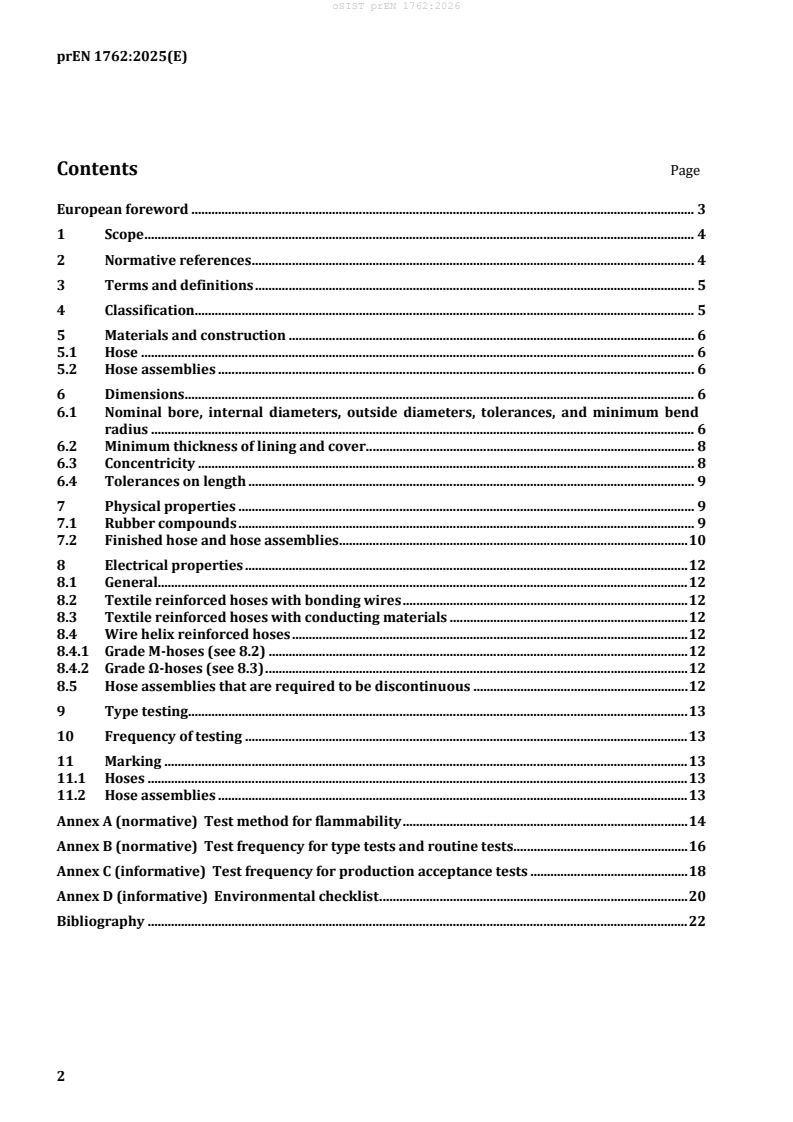
The document is organized into clauses 1 to 11 and four annexes.
| Annex | What it covers |
|---|---|
| Annex A | Normative flammability test method |
| Annex B | Normative test frequency for type tests and routine tests |
| Annex C | Informative test frequency for production acceptance tests |
| Annex D | Informative environmental checklist |
Clause 4 classifies hoses by use and electrical property. Clauses 5 and 6 cover materials, construction, and dimensional limits. Clauses 7 and 8 cover physical and electrical performance. Clauses 9 to 11 cover type testing, test frequency, and marking.
What are the key requirements of FprEN 1762?
Product types and grades
FprEN 1762 classifies hoses and hose assemblies into five types and three grades. The types are D, D-LT, SD, SD-LTS, and SD-LTR, and the grades are M, Ω, and Discontinuous.
This matters in practice because the hose type has to match the service condition, especially suction, delivery, and low-temperature use. The grade has to match the required static-electricity behavior and the way the hose is assembled and marked.
Materials and construction
FprEN 1762 requires a lining resistant to n-pentane, reinforcement using textile material or stainless steel wire, and a black or coloured synthetic-rubber cover resistant to abrasion and outdoor exposure. For SD, SD-LTS, and SD-LTR, an embedded stainless steel metallic helix is required, and type SD-LTR also uses an internal non-embedded stainless steel helical wire suitable for -50 °C.
The document also requires metallic fittings for hose assemblies, with the electrical properties achieved by the fitting arrangement. Chlorinated materials are not allowed in contact with stainless steel materials, which matters for durability and corrosion control.
Dimensions and tolerances
FprEN 1762 sets limits for nominal bore, internal diameter, outside diameter, minimum bend radius, lining and cover thickness, concentricity, and length tolerance. It gives separate dimensional tables for D and D-LT hoses and for SD, SD-LTS, and SD-LTR hoses.
For users, this means hose size and flexibility are controlled, so a hose can be specified and inspected against clear dimensional limits. The document also requires a minimum lining and cover thickness of 1.6 mm, concentricity limits for selected bore sizes, and a length tolerance of ± 1 %.
Physical performance of compounds and finished hoses
FprEN 1762 requires the rubber compounds used for lining and cover to meet tensile, elongation, abrasion, ageing, and liquid-resistance requirements. It also sets requirements for the finished hose and hose assembly, including proof pressure, burst pressure, adhesion, ozone resistance, low-temperature flexibility, deformation at minimum bend radius, and flammability.
In practice, this means manufacturers have to verify both the raw compound and the completed product. The compound tests check whether the rubber can survive LPG exposure, heat, and wear, while the finished-product tests check whether the hose remains sound under pressure, bending, cold conditions, and fire exposure.
Electrical properties
FprEN 1762 requires hoses and hose assemblies to satisfy one of the electrical-property arrangements defined in Clause 8. These include electrically bonded hoses using bonding wires, electrically conductive hoses using a conductive rubber layer, wire-helix reinforced hoses, and electrically discontinuous hose assemblies.
This matters because LPG and natural gas transfer can create static electricity risks. The document therefore ties the electrical design of the hose to a measured resistance limit and to the way the hose or assembly is marked.
Testing, frequency, and marking
FprEN 1762 requires type testing to demonstrate that a hose design and its materials comply with the standard, and type tests are repeated at least every five years or after changes in design, manufacture, or materials. Annex B sets the frequency for type tests and routine tests, and Annex C gives recommended production acceptance testing frequencies.
Marking is also mandatory. Each hose length has to be marked continuously with the manufacturer identification, document number, type, nominal bore, maximum working pressure, electrical grade symbol, and quarter and year of manufacture; hose assemblies also need assembler identification and assembly date when the fitting is not built in.
What terms does FprEN 1762 define?
Liquefied petroleum gas (LPG) - The gas handled by this standard, used here in liquid or gaseous phase.
Electrically bonded hose/hose assembly - A hose or hose assembly that uses a metallic wire connection to conduct static electricity.
Electrically conductive hose/hose assembly - A hose or hose assembly that conducts static electricity through a conductive rubber layer without a metallic wire.
Electrically discontinuous hose/hose assembly - A hose or hose assembly arranged so that only one end fitting, or neither end fitting, is electrically connected to the metallic reinforcement.
Nominal bore - The size designation used for the hose dimensions and tolerances in the dimensional tables.
Grade M - The electrical designation for a hose or hose assembly that is electrically bonded.
Grade Ω - The electrical designation for a hose or hose assembly that is electrically conductive using a conductive rubber layer.
Who uses FprEN 1762?
FprEN 1762 is used by hose manufacturers, hose assemblers, test laboratories, gas-distribution equipment suppliers, and buyers of LPG and natural gas transfer equipment. It is also used by quality managers who need to verify production testing, product marking, and batch release.
In practice, it supports selection and checking of hoses for LPG dispensing, gas handling, and other transfer applications where pressure, flexibility, low-temperature behavior, and static control matter. It is relevant to procurement teams that need to compare hose types and electrical grades, and to compliance teams that need a clear test and marking basis.
What changed in FprEN 1762 from the previous edition?
FprEN 1762 will supersede EN 1762:2018. The document states these significant technical changes compared with EN 1762:2018:
- extension of the lining material
- additional dimensions added in Tables 1 and 2
- revision of routine tests
- deletion of the requirement to include the year of publication of the document in the marking
- water added as a test fluid in Annex A
- editorial revision
Which standards are used with FprEN 1762?
FprEN 1762 refers to the following standards, which supply the test and vocabulary methods used throughout the document:
- EN ISO 1402 - hydrostatic testing for proof pressure, burst pressure, and related pressure-change checks
- EN ISO 4671 - measurement of hose dimensions and hose assembly lengths
- EN ISO 6179 - gravimetric measurement of volatile-liquid transmission, used for permeation-related assessment
- EN ISO 7233 - resistance to vacuum
- EN ISO 7326 - ozone resistance under static conditions
- EN ISO 8031 - electrical resistance and conductivity
- EN ISO 8033 - adhesion between components
- EN ISO 8330 - vocabulary for rubber hoses and hose assemblies
- EN ISO 10619-1 - flexibility and stiffness by bending at ambient temperature
- EN ISO 10619-2 - flexibility and stiffness by bending at sub-ambient temperatures
- ISO 37 - tensile stress-strain properties
- ISO 188 - accelerated ageing and heat resistance
- ISO 1817 - effect of liquids
- ISO 4649 - abrasion resistance using a rotating cylindrical drum device
What does the FprEN 1762 document contain?
FprEN 1762 contains tables for dimensions and tolerances, physical properties, test frequencies, and production acceptance guidance. It also contains procedures for pressure testing, vacuum testing, electrical testing, low-temperature flexibility, ozone resistance, adhesion, and flammability.
Annex A gives the flammability test setup and assessment rule, including the test arrangement shown in Figure A.1. Annex B and Annex C set out how often the different tests are carried out, which is important for design validation, routine manufacture, and batch control. Annex D provides an environmental checklist that points users to material selection, packaging, transport, and accident-risk considerations.
Relations
- Effective Date
- 08-Jan-2025
Get Certified
Connect with accredited certification bodies for this standard

Institut za varilstvo d.o.o. (Welding Institute)
Slovenia's leading welding institute since 1952. ISO 3834, EN 1090, pressure equipment certification, NDT personnel, welder qualification. Only IIW Au
Sponsored listings
Frequently Asked Questions
FprEN 1762 is a draft published by the European Committee for Standardization (CEN). Its full title is "Rubber hoses and hose assemblies for liquefied petroleum gas, LPG (liquid or gaseous phase), and natural gas up to 25 bar (2,5 MPa) - Specification". This standard covers: This document specifies the requirements for rubber hoses and rubber hose assemblies used for the transfer of liquefied petroleum gas (LPG) in liquid or gaseous phase and natural gas with a maximum working pressure of 25 bar (2,5 MPa) and vacuum within the temperature range of −30 °C to +70 °C and, when designated -LT, −50 °C to +70 °C.
This document specifies the requirements for rubber hoses and rubber hose assemblies used for the transfer of liquefied petroleum gas (LPG) in liquid or gaseous phase and natural gas with a maximum working pressure of 25 bar (2,5 MPa) and vacuum within the temperature range of −30 °C to +70 °C and, when designated -LT, −50 °C to +70 °C.
FprEN 1762 is classified under the following ICS (International Classification for Standards) categories: 23.040.70 - Hoses and hose assemblies. The ICS classification helps identify the subject area and facilitates finding related standards.
FprEN 1762 has the following relationships with other standards: It is inter standard links to EN 1762:2018. Understanding these relationships helps ensure you are using the most current and applicable version of the standard.
FprEN 1762 is available in PDF format for immediate download after purchase. The document can be added to your cart and obtained through the secure checkout process. Digital delivery ensures instant access to the complete standard document.
Standards Content (Sample)
SLOVENSKI STANDARD
oSIST prEN 1762:2026
01-januar-2026
Gumene cevi in cevni priključki za utekočinjeni naftni plin LPG (tekoča ali plinska
faza) in zemeljski plin do 25 barov (2,5 MPa) - Specifikacija
Rubber hoses and hose assemblies for liquefied petroleum gas, LPG (liquid or gaseous
phase), and natural gas up to 25 bar (2,5 MPa) - Specification
Gummischläuche und -schlauchleitungen für Flüssiggas LPG (flüssig oder gasförmig)
und Erdgas bis 25bar (2,5 MPa) - Spezifikation
Tuyaux et flexibles en caoutchouc pour le gaz de pétrole liquéfié GPL (en phase liquide
ou gazeuse) et le gaz naturel jusqu'à 25 bar (2,5 MPa) - Spécification
Ta slovenski standard je istoveten z: prEN 1762
ICS:
75.200 Oprema za skladiščenje Petroleum products and
nafte, naftnih proizvodov in natural gas handling
zemeljskega plina equipment
83.140.40 Gumene cevi Hoses
oSIST prEN 1762:2026 en,fr,de
2003-01.Slovenski inštitut za standardizacijo. Razmnoževanje celote ali delov tega standarda ni dovoljeno.
oSIST prEN 1762:2026
oSIST prEN 1762:2026
DRAFT
EUROPEAN STANDARD
prEN 1762
NORME EUROPÉENNE
EUROPÄISCHE NORM
November 2025
ICS 23.040.70 Will supersede EN 1762:2018
English Version
Rubber hoses and hose assemblies for liquefied petroleum
gas, LPG (liquid or gaseous phase), and natural gas up to
25 bar (2,5 MPa) - Specification
Tuyaux et flexibles en caoutchouc pour le gaz de Gummischläuche und -schlauchleitungen für Flüssiggas
pétrole liquéfié GPL (en phase liquide ou gazeuse) et le LPG (flüssig oder gasförmig) und Erdgas bis 25 bar (2,5
gaz naturel jusqu'à 25 bar (2,5 MPa) -Spécification MPa) - Spezifikation
This draft European Standard is submitted to CEN members for enquiry. It has been drawn up by the Technical Committee
CEN/TC 218.
If this draft becomes a European Standard, CEN members are bound to comply with the CEN/CENELEC Internal Regulations
which stipulate the conditions for giving this European Standard the status of a national standard without any alteration.
This draft European Standard was established by CEN in three official versions (English, French, German). A version in any other
language made by translation under the responsibility of a CEN member into its own language and notified to the CEN-CENELEC
Management Centre has the same status as the official versions.
CEN members are the national standards bodies of Austria, Belgium, Bulgaria, Croatia, Cyprus, Czech Republic, Denmark, Estonia,
Finland, France, Germany, Greece, Hungary, Iceland, Ireland, Italy, Latvia, Lithuania, Luxembourg, Malta, Netherlands, Norway,
Poland, Portugal, Republic of North Macedonia, Romania, Serbia, Slovakia, Slovenia, Spain, Sweden, Switzerland, Türkiye and
United Kingdom.
Recipients of this draft are invited to submit, with their comments, notification of any relevant patent rights of which they are
aware and to provide supporting documentation.
Warning : This document is not a European Standard. It is distributed for review and comments. It is subject to change without
notice and shall not be referred to as a European Standard.
EUROPEAN COMMITTEE FOR STANDARDIZATION
COMITÉ EUROPÉEN DE NORMALISATION
EUROPÄISCHES KOMITEE FÜR NORMUNG
CEN-CENELEC Management Centre: Rue de la Science 23, B-1040 Brussels
© 2025 CEN All rights of exploitation in any form and by any means reserved Ref. No. prEN 1762:2025 E
worldwide for CEN national Members.
oSIST prEN 1762:2026
prEN 1762:2025(E)
Contents Page
European foreword . 3
1 Scope . 4
2 Normative references . 4
3 Terms and definitions . 5
4 Classification. 5
5 Materials and construction . 6
5.1 Hose . 6
5.2 Hose assemblies . 6
6 Dimensions. 6
6.1 Nominal bore, internal diameters, outside diameters, tolerances, and minimum bend
radius . 6
6.2 Minimum thickness of lining and cover . 8
6.3 Concentricity . 8
6.4 Tolerances on length . 9
7 Physical properties . 9
7.1 Rubber compounds . 9
7.2 Finished hose and hose assemblies . 10
8 Electrical properties . 12
8.1 General. 12
8.2 Textile reinforced hoses with bonding wires . 12
8.3 Textile reinforced hoses with conducting materials . 12
8.4 Wire helix reinforced hoses . 12
8.4.1 Grade M-hoses (see 8.2) . 12
8.4.2 Grade Ω-hoses (see 8.3) . 12
8.5 Hose assemblies that are required to be discontinuous . 12
9 Type testing . 13
10 Frequency of testing . 13
11 Marking . 13
11.1 Hoses . 13
11.2 Hose assemblies . 13
Annex A (normative) Test method for flammability . 14
Annex B (normative) Test frequency for type tests and routine tests . 16
Annex C (informative) Test frequency for production acceptance tests . 18
Annex D (informative) Environmental checklist . 20
Bibliography . 22
oSIST prEN 1762:2026
prEN 1762:2025 (E)
European foreword
This document (prEN 1762:2025) has been prepared by Technical Committee CEN/TC 218
“Rubber and plastics hoses and hose assemblies”, the secretariat of which is held by BSI.
This document is currently submitted to the CEN Enquiry.
This document will supersede EN 1762:2018.
prEN 1762:2025 includes the following significant technical changes with respect to
EN 1762:2018:
a) extension of the material of the lining material
b) additional dimensions added in Table 1 and Table 2
c) revision of routine tests
d) in Clause 11, the requirement to include the year of publication of this document in the
marking has been deleted
e) water has been added as a test fluid in Annex A
f) the document has been editorially revised.
oSIST prEN 1762:2026
prEN 1762:2025(E)
1 Scope
This document specifies the requirements for rubber hoses and rubber hose assemblies used for
the transfer of liquefied petroleum gas (LPG) in liquid or gaseous phase and natural gas with a
maximum working pressure of 25 bar (2,5 MPa) and vacuum within the temperature range of
−30 °C to +70 °C and, when designated -LT, −50 °C to +70 °C.
2 Normative references
The following documents are referred to in the text in such a way that some or all of their content
constitutes requirements of this document. For dated references, only the edition cited applies.
For undated references, the latest edition of the referenced document (including any
amendments) applies.
EN ISO 1402, Rubber and plastics hoses and hose assemblies — Hydrostatic testing
EN ISO 4671, Rubber and plastics hoses and hose assemblies — Methods of measurement of the
dimensions of hoses and the lengths of hose assemblies
EN ISO 6179, Rubber, vulcanized or thermoplastic — Rubber sheets and rubber-coated fabrics —
Determination of transmission rate of volatile liquids (gravimetric technique)
EN ISO 7233, Rubber and plastics hoses and hose assemblies — Determination of resistance to
vacuum
EN ISO 7326, Rubber and plastics hoses — Assessment of ozone resistance under static conditions
EN ISO 8031, Rubber and plastics hoses and hose assemblies — Determination of electrical
resistance and conductivity
EN ISO 8033, Rubber and plastics hoses — Determination of adhesion between components
EN ISO 8330, Rubber and plastics hoses and hose assemblies — Vocabulary
EN ISO 10619-1, Rubber and plastics hoses and tubing — Measurement of flexibility and stiffness —
Part 1: Bending tests at ambient temperature
EN ISO 10619-2, Rubber and plastics hoses and tubing — Measurement of flexibility and stiffness —
Part 2: Bending tests at sub-ambient temperatures
ISO 37, Rubber, vulcanized or thermoplastic — Determination of tensile stress-strain properties
ISO 188, Rubber, vulcanized or thermoplastic — Accelerated ageing and heat resistance tests
ISO 1817, Rubber, vulcanized or thermoplastic — Determination of the effect of liquids
ISO 4649, Rubber, vulcanized or thermoplastic — Determination of abrasion resistance using a
rotating cylindrical drum device
oSIST prEN 1762:2026
prEN 1762:2025 (E)
3 Terms and definitions
For the purposes of this document, the terms and definitions given in EN ISO 8330 and the
following apply.
ISO and IEC maintain terminology databases for use in standardization at the following addresses:
— ISO Online browsing platform: available at https://www.iso.org/obp
— IEC Electropedia: available at https://www.electropedia.org/
3.1
electrically bonded hose/hose assembly
hose/hose assembly that uses a metallic wire connection to conduct static electricity
3.2
electrically conductive hose/hose assembly
hose/hose assembly that is capable of conducting static electrical charges, using a conductive
rubber layer, without the use of a metallic wire
3.3
electrically discontinuous hose/hose assembly
hose/hose assembly that incorporates a metallic wire connection to one end fittings of the
assembly only or is electrically insulated from both end-fittings
4 Classification
Hoses/hose assemblies for this application are classified into 5 types and 3 grades according to
their use, construction, and electrical properties. The maximum working pressure for all
hoses/hose assemblies is 25 bar.
The 5 types are as follows:
Type Application
D delivery hose
D-LT delivery hose, low temperature;
SD suction and delivery hose, helix reinforced
SD-LTS suction and delivery hose “smooth hose”, helix reinforced, low temperature
SD-LTR suction and delivery hose, rough bore (having an internal, non-embedded helical
wire of stainless steel), low temperature
Hoses for this application are divided into 3 grades according to their electrical properties:
Grade Electrical property
designation
M Electrically bonded
Ω Electrically conductive using a conductive rubber layer
Discontinuous Electrically discontinuous
oSIST prEN 1762:2026
prEN 1762:2025(E)
5 Materials and construction
5.1 Hose
The hose shall consist of the following:
— a lining resistant to n-pentane;
— a reinforcement of layers of woven, braided or spirally wound textile material or braided or
spirally wound stainless steel wire,
— an embedded stainless steel metallic helix reinforcement (types SD, SD-LTS and SD-LTR only);
— two or more low resistance electrical bonding wires (grade “M” only);
— an outer cover of black or coloured synthetic rubber, resistant to abrasion and outdoor
exposure; the cover may be pricked to allow gas permeation. If the cover is not pricked a
comparative measurement of permeation between the rubber materials of cover and lining
shall be carried out, see Table 3, item 6;
— an internal, non-embedded stainless steel helical wire, suitable for use at –50 °C (type SD-LTR
only).
5.2 Hose assemblies
Hose assemblies shall incorporate metallic fittings attached to the hose by the assembler or built
in by the manufacturer. In order to produce the required electrical properties, the fittings should
be attached in accordance with Clause 8.
Chlorinated materials shall not be used in contact with any stainless steel materials.
6 Dimensions
6.1 Nominal bore, internal diameters, outside diameters, tolerances, and minimum
bend radius
For hoses without built-in couplings, and when measured in accordance with method A of
EN ISO 4671, the internal diameter and outside diameter and their tolerances shall conform to
Table 1 or Table 2, depending on the type.
For hoses with built-in couplings, the outside diameters in Tables 1 and 2 do not apply.
When tested by the method described in EN ISO 10619-1, the value of the minimum bend radius
shall be as given in Table 1 or Table 2, depending on the type.
oSIST prEN 1762:2026
prEN 1762:2025 (E)
Table 1 — Dimensions and tolerances of hoses of types D and D-LT
Nominal bore Internal Tolerance Outside Tolerance Design min.
a
diameter diameter bend radius
mm mm mm mm mm
10 10 ±0,5 20,0 ±1,0 90
13 12,7 ±0,5 22,7 ±1,0 100
15 15 ±0,5 25 ±1,0 120
16 15,9 ±0,5 25,9 ±1,0 125
19 19 ±0,5 31 ±1,0 160
25 25 ±0,5 38 ±1,0 200
32 32 ±0,5 45 ±1,0 250
38 38 ±0,5 52 ±1,0 320
50 50 ±0,6 66 ±1,2 400
51 51 ±0,6 67 ±1,2 400
63 63 ±0,6 81 ±1,2 550
75 75 ±0,6 93 ±1,2 650
76 76 ±0,6 94 ±1,2 650
80 80 ±0,6 98 ±1,2 725
100 100 ±1,6 120 ±1,6 800
150 150 ±2,0 174 ±2,0 1200
b
200 200 ±2,0 226 or 232 ±3,0 1600
250 254 ±2,0 — — 2000
300 305 ±2,0 — — 2500
a
The design minimum bend radius is measured to the surface of the hose on the inside of the bend.
b
alternating outer diameter depending on the hose construction.
NOTE Other dimension and measurements possible in accordance with the customer.
oSIST prEN 1762:2026
prEN 1762:2025(E)
Table 2 — Dimensions and tolerances of hoses of types SD, SD-LTS and SD-LTR
Nominal bore Internal Tolerance Outside Tolerance Design min.
a
diameter diameter bend radius
mm mm
mm
mm mm
10 10 ±0,5 20,0 ±1,0 85
13 12,7 ±0,5 22,7 ±1,0 90
15 15 ±0,5 25 ±1,0 95
16 15,9 ±0,5 25,9 ±1,0 95
19 19 ±0,5 31 ±1,0 100
25 25 ±0,5 38 ±1,0 150
32 32
...