

EN 14066:2013
(Main)Natural stone test methods - Determination of resistance to ageing by thermal shock
- Abstract
This European Standard specifies a method to assess possible changes of natural stones under the effect of sudden changes in temperature (thermal shock).
- Status
- Published
- Publication Date
- 19-Mar-2013
- Withdrawal Date
- 29-Sep-2013
- Technical Committee
- CEN/TC 246 - Natural stones
- Drafting Committee
- CEN/TC 246/WG 2 - Test methods
- Current Stage
- 9093 - Decision to confirm - Review Enquiry
- Start Date
- 30-Sep-2025
- Completion Date
- 07-Oct-2026

Overview
EN 14066:2013 is a European Standard developed by the European Committee for Standardization (CEN) that specifies a precise test method to evaluate the resistance of natural stone to ageing caused by thermal shock. Thermal shock refers to the deterioration or changes that occur in natural stones due to sudden temperature variations, which are common in many environmental and industrial conditions. This standard sets out a comprehensive procedure to assess how natural stones withstand these rapid temperature changes, ensuring their durability and suitability for various applications.
Key Topics
Thermal Shock Test Method
The standard details a cycle which involves heating natural stone specimens to 70 ± 5 °C for approximately 18 hours, immediately followed by immersion in water at 20 ± 5 °C for 6 hours. This cycle simulates the effects of sudden temperature changes and is repeated typically 20 times.Specimen Preparation and Dimensions
Specimens must be sampled from a homogeneous batch with specific dimensional criteria relative to the stone grain size. Thickness ranges between 25 mm and 100 mm, with proportional length and width as defined by the standard to ensure consistent and relevant test results.Performance Evaluation Parameters
The standard requires measurement of:- Visual changes such as cracking, scaling, and exfoliation.
- Flexural strength differences before and after thermal shock cycles (measured according to EN 12372).
- Non-destructive testing including dynamic elastic modulus (EN 14146), ultrasound pulse velocity (EN 14579), and open porosity (EN 1936).
Data Analysis
Changes in stone properties are calculated as percentages to quantify deterioration:- Flexural strength change (∆F)
- Dynamic modulus of elasticity change (∆E)
- Ultrasound pulse velocity change (∆v)
- Open porosity change (∆ρ)
Reporting Requirements
Detailed test reports must include specimen identification, testing conditions, observed alterations, measured property changes, and any deviations from the standard procedure.
Applications
EN 14066:2013 is crucial for industries and professionals involved in:
Construction and Architecture
Ensuring that natural stone materials selected for facades, flooring, cladding, and monuments demonstrate adequate resistance to environmental thermal stresses, thereby extending their service life and appearance.Quality Control and Product Certification
Laboratories and manufacturers use this standard to assess natural stone batches for performance certification, aiding in compliance with client specifications and regulatory requirements.Research and Development
Enables material scientists to study the effects of thermal ageing on stone durability, assisting in the development of treatment processes or enhanced stone products with improved resistance to thermal shock.Maintenance and Conservation
Provides guidelines for evaluating historic stone materials before restoration or preservation initiatives, determining necessary protective measures.
Related Standards
EN 14066:2013 complements a suite of test methods for natural stones that address various durability and mechanical properties, including:
- EN 1936 – Determination of real density, apparent density, and total/open porosity
- EN 12372 – Flexural strength under concentrated load
- EN 14146 – Dynamic modulus of elasticity by resonance frequency
- EN 14579 – Sound speed propagation measurement
- EN 14147 – Resistance to ageing by salt mist
- EN 12371 – Frost resistance
- EN 12407 – Petrographic examination of natural stone
These interconnected standards offer a holistic approach to natural stone testing, enabling stakeholders to comprehensively assess material quality and suitability for diverse environmental conditions.
Implementing EN 14066:2013 ensures robust evaluation of natural stone resistance to thermal shock ageing, supporting the selection of durable materials for sustainable construction and preservation. This standard plays a vital role in quality assurance and material performance optimization within the natural stone industry.
Relations
- Replaces
EN 14066:2003 - Natural stone test methods - Determination of resistance to ageing by thermal shock - Effective Date
- 22-May-2010
- Effective Date
- 28-Jan-2026
- Effective Date
- 28-Jan-2026
- Effective Date
- 28-Jan-2026
- Effective Date
- 28-Jan-2026
- Effective Date
- 28-Jan-2026
- Effective Date
- 28-Jan-2026
- Effective Date
- 28-Jan-2026
- Effective Date
- 28-Jan-2026
- Effective Date
- 28-Jan-2026
- Effective Date
- 28-Jan-2026
- Effective Date
- 28-Jan-2026
- Effective Date
- 28-Jan-2026
- Effective Date
- 28-Jan-2026
- Effective Date
- 28-Jan-2026
Get Certified
Connect with accredited certification bodies for this standard

DIBt (Deutsches Institut für Bautechnik)
German Institute for Building Technology.
DIN CERTCO
DIN Group product certification.

Aboma Certification B.V.
Specialized in construction, metal, and transport sectors.
Sponsored listings
Frequently Asked Questions
EN 14066:2013 is a standard published by the European Committee for Standardization (CEN). Its full title is "Natural stone test methods - Determination of resistance to ageing by thermal shock". This standard covers: This European Standard specifies a method to assess possible changes of natural stones under the effect of sudden changes in temperature (thermal shock).
This European Standard specifies a method to assess possible changes of natural stones under the effect of sudden changes in temperature (thermal shock).
EN 14066:2013 is classified under the following ICS (International Classification for Standards) categories: 73.020 - Mining and quarrying; 91.100.15 - Mineral materials and products. The ICS classification helps identify the subject area and facilitates finding related standards.
EN 14066:2013 has the following relationships with other standards: It is inter standard links to EN 14066:2003, EN 1936:2006, EN 12670:2001, EN 14146:2004, EN 12372:2022, EN 14579:2004, EN 12058:2015, EN 12059:2008+A1:2011, CEN/TR 17024:2017, EN 12371:2010, EN 1469:2004, EN 12058:2004, EN 12057:2004, EN 12057:2015, EN 1469:2015. Understanding these relationships helps ensure you are using the most current and applicable version of the standard.
EN 14066:2013 is available in PDF format for immediate download after purchase. The document can be added to your cart and obtained through the secure checkout process. Digital delivery ensures instant access to the complete standard document.
Standards Content (Sample)
2003-01.Slovenski inštitut za standardizacijo. Razmnoževanje celote ali delov tega standarda ni dovoljeno.Preskušanje naravnega kamna - Ugotavljanje odpornosti proti staranju s temperaturnim šokomPrüfverfahren für Naturstein - Bestimmung des Widerstandes gegen Alterung durch WärmeschockMéthodes d'essai pour les pierres naturelles - Détermination de la résistance au vieillissement accéléré par choc thermiqueNatural stone test methods - Determination of resistance to ageing by thermal shock91.100.15Mineralni materiali in izdelkiMineral materials and productsICS:Ta slovenski standard je istoveten z:EN 14066:2013SIST EN 14066:2013en,fr,de01-junij-2013SIST EN 14066:2013SLOVENSKI
STANDARDSIST EN 14066:20031DGRPHãþD
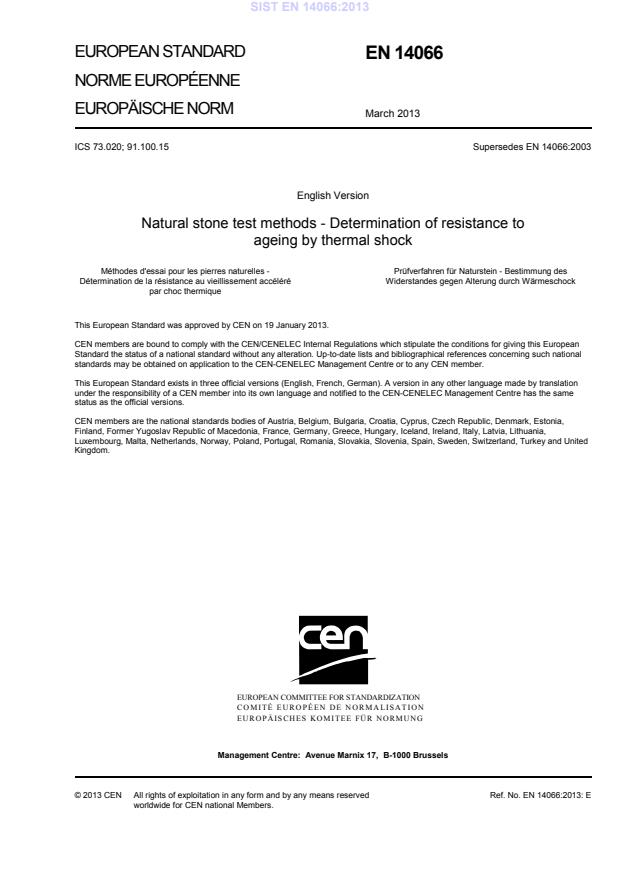
EUROPEAN STANDARD NORME EUROPÉENNE EUROPÄISCHE NORM
EN 14066
March 2013 ICS 73.020; 91.100.15 Supersedes EN 14066:2003English Version
Natural stone test methods - Determination of resistance to ageing by thermal shock
Méthodes d'essai pour les pierres naturelles - Détermination de la résistance au vieillissement accéléré par choc thermique
Prüfverfahren für Naturstein - Bestimmung des Widerstandes gegen Alterung durch Wärmeschock This European Standard was approved by CEN on 19 January 2013.
CEN members are bound to comply with the CEN/CENELEC Internal Regulations which stipulate the conditions for giving this European Standard the status of a national standard without any alteration. Up-to-date lists and bibliographical references concerning such national standards may be obtained on application to the CEN-CENELEC Management Centre or to any CEN member.
This European Standard exists in three official versions (English, French, German). A version in any other language made by translation under the responsibility of a CEN member into its own language and notified to the CEN-CENELEC Management Centre has the same status as the official versions.
CEN members are the national standards bodies of Austria, Belgium, Bulgaria, Croatia, Cyprus, Czech Republic, Denmark, Estonia, Finland, Former Yugoslav Republic of Macedonia, France, Germany, Greece, Hungary, Iceland, Ireland, Italy, Latvia, Lithuania, Luxembourg, Malta, Netherlands, Norway, Poland, Portugal, Romania, Slovakia, Slovenia, Spain, Sweden, Switzerland, Turkey and United Kingdom.
EUROPEAN COMMITTEE FOR STANDARDIZATION
COMITÉ EUROPÉEN DE NORMALISATION EUROPÄISCHES KOMITEE FÜR NORMUNG
Management Centre:
Avenue Marnix 17,
B-1000 Brussels © 2013 CEN All rights of exploitation in any form and by any means reserved worldwide for CEN national Members. Ref. No. EN 14066:2013: ESIST EN 14066:2013
EN 1936, Natural stone test methods – Determination of real density and apparent density, and of total and open porosity EN 12370, Natural stone test methods – Determination of resistance to salt crystallisation
EN 12371, Natural stone test methods – Determination of frost resistance
EN 12372, Natural stone test methods – Determination of flexural strength under concentrated load
EN 12407, Natural stone test methods – Petrographic examination
EN 13161, Natural stone test methods – Determination of flexural strength under constant moment
EN 13364, Natural stone test methods – Determination of the breaking load at dowel hole
EN 13373, Natural stone test methods – Determination of geometric characteristics on units EN 13755, Natural stone test methods – Determination of water absorption at atmospheric pressure
EN 14146, Natural stone test methods – Determination of the dynamic modulus of elasticity (by measuring the fundamental resonance frequency) EN 14147, Natural stone test methods – Determination of resistance to ageing by salt mist
EN 14158, Natural stone test methods – Determination of rupture energy
EN 14205, Natural stone test methods – Determination of Knoop hardness
EN 14231, Natural stone test methods – Determination of the slip resistance by means of the pendulum tester EN 14579, Natural stone test methods – Determination of sound speed propagation EN 14580, Natural stone test methods – Determination of static elastic modulus
EN 14581, Natural stone test methods – Determination of linear thermal expansion coefficient According to the CEN-CENELEC Internal Regulations, the national standards organizations of the following countries are bound to implement this European Standard: Austria, Belgium, Bulgaria, Croatia, Cyprus, Czech Republic, Denmark, Estonia, Finland, Former Yugoslav Republic of Macedonia, France, Germany, Greece, Hungary, Iceland,
...