


prEN IEC 62820-1-2:2025
(Main)Building intercom systems - Part 1-2: System requirements - Building intercom systems using the Internet protocol (IP)
General Information
- Abstract
- Status
- Not Published
- Publication Date
- 21-Sep-2026
- Technical Committee
- CLC/TC 79 - Alarm systems
- Drafting Committee
- IEC/TC 79 - IEC_TC_79
- Current Stage
- 4060 - Enquiry results established and sent to TC, SR, BTTF - Enquiry
- Start Date
- 23-May-2025
- Completion Date
- 23-May-2025

Overview
prEN IEC 62820-1-2:2025 - Building intercom systems - Part 1-2: System requirements - Building intercom systems using the internet protocol (IP) - specifies the technical composition, functional and performance requirements, and test methods for IP-based building intercom systems (BIS). It is a supplement to IEC 62820-1-1 (General) and applies to both residential and commercial buildings. Mixed IP/non‑IP systems are excluded (those are covered by IEC 62820-1-1).
Key topics and technical requirements
The standard organizes requirements into clear, testable areas:
- Functional requirements
- Basic and additional system functions for IP BIS
- Special modes for systems with subsystem management units (SMU)
- Performance requirements (audio & video)
- Audio: overall loudness rating (OLR), audio delay (one-way delay), echo return loss, and audio switching time
- Video: image resolution, frame rate, video delay, lip‑sync, and subjective image quality
- Network and information security
- Network access control
- Data integrity protection
- Test methods and verification
- Environmental and electrical test conditions
- Function tests and detailed procedures for audio and video metrics
- Network security test procedures (access control and data integrity)
- Annexes for subjective assessments (image quality and echo return loss)
- Documentation
- Required technical documentation to support compliance and testing
Normative references include IEC 62820-1-1 and ITU‑T P.501 (test signals), and the document includes diagrams, test signal descriptions and evaluation scoring forms.
Practical applications and who uses it
This standard is intended for organizations and professionals involved in the lifecycle of IP building intercom systems:
- Manufacturers - to design products that meet recognized system and performance expectations
- System integrators and installers - to specify, install and commission IP BIS with validated audio/video and network performance
- Testing laboratories and certification bodies - to develop test plans and verify conformance to IEC procedures
- Building owners, architects and security consultants - to write procurement specifications and ensure interoperability and security
- Product managers and R&D teams - to align product roadmaps with international requirements for quality and security
Related standards
- IEC 62820-1-1: System requirements - General (covers non-IP and mixed systems)
- ITU‑T P.501: Test signals for telephonometry
By providing structured performance metrics and test methods for IP intercoms, prEN IEC 62820-1-2:2025 helps ensure reliable audio/video quality, secure network operation, and consistent interoperability across residential and commercial building deployments.
Relations
- Effective Date
- 28-Jan-2022
Get Certified
Connect with accredited certification bodies for this standard

CIS Institut d.o.o.
Personal Protective Equipment (PPE) certification body. Notified Body NB-2890 for EU Regulation 2016/425 PPE.

Kiwa BDA Testing
Building and construction product certification.
Kmetijski inštitut Slovenije
Agricultural Institute of Slovenia. Soil testing, plant health, agricultural product analysis.
Sponsored listings
Frequently Asked Questions
prEN IEC 62820-1-2:2025 is a draft published by CLC. Its full title is "Building intercom systems - Part 1-2: System requirements - Building intercom systems using the Internet protocol (IP)". This standard covers: Building intercom systems - Part 1-2: System requirements - Building intercom systems using the Internet protocol (IP)
Building intercom systems - Part 1-2: System requirements - Building intercom systems using the Internet protocol (IP)
prEN IEC 62820-1-2:2025 is classified under the following ICS (International Classification for Standards) categories: 13.320 - Alarm and warning systems. The ICS classification helps identify the subject area and facilitates finding related standards.
prEN IEC 62820-1-2:2025 has the following relationships with other standards: It is inter standard links to EN 62820-1-2:2017. Understanding these relationships helps ensure you are using the most current and applicable version of the standard.
prEN IEC 62820-1-2:2025 is available in PDF format for immediate download after purchase. The document can be added to your cart and obtained through the secure checkout process. Digital delivery ensures instant access to the complete standard document.
Standards Content (Sample)
SLOVENSKI STANDARD
01-april-2025
Notranja komunikacija v stavbah - 1-2. del: Sistemske zahteve - Sistemi notranjih
komunikacij v stavbah z IP protokolom
Building intercom systems - Part 1-2: System requirements - Building intercom systems
using the internet protocol (IP)
Systèmes d'interphone de bâtiment - Partie 1-2: Exigences du système - Systèmes
d'interphone de bâtiment utilisant le protocole internet (IP)
Ta slovenski standard je istoveten z: prEN IEC 62820-1-2:2025
ICS:
35.240.67 Uporabniške rešitve IT v IT applications in building
gradbeništvu and construction industry
97.120 Avtomatske krmilne naprave Automatic controls for
za dom household use
2003-01.Slovenski inštitut za standardizacijo. Razmnoževanje celote ali delov tega standarda ni dovoljeno.
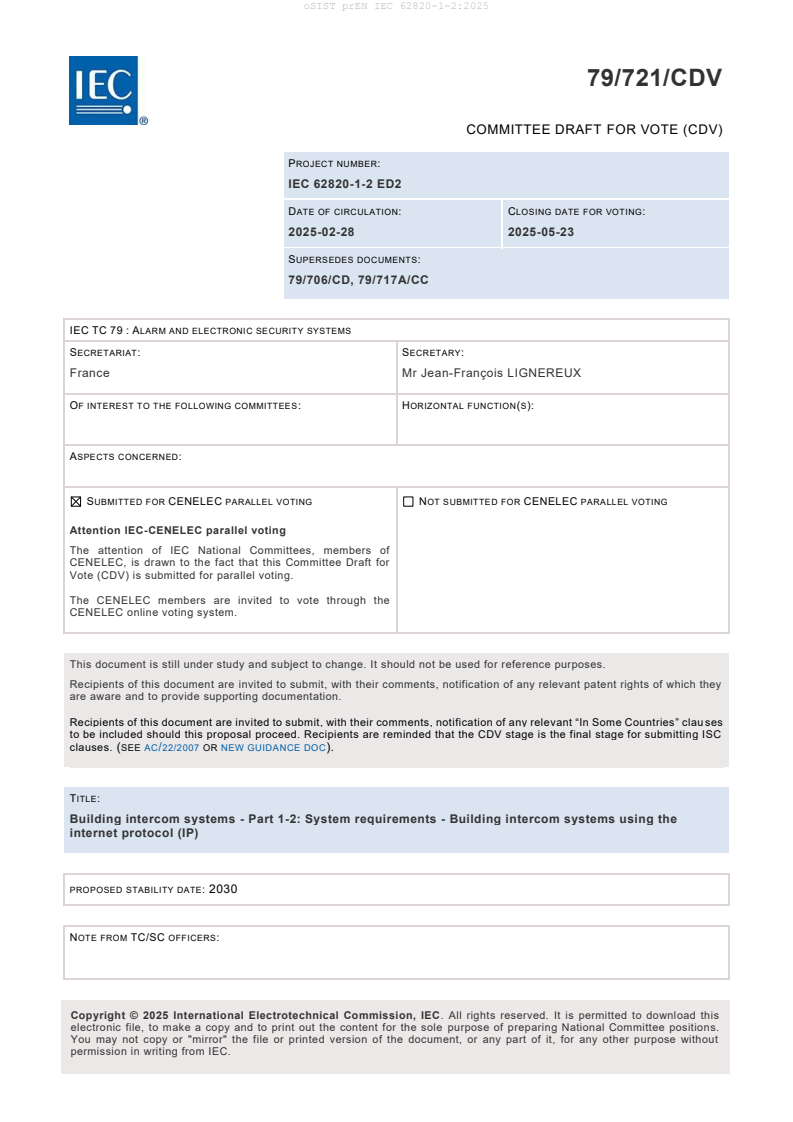
79/721/CDV
COMMITTEE DRAFT FOR VOTE (CDV)
PROJECT NUMBER:
IEC 62820-1-2 ED2
DATE OF CIRCULATION: CLOSING DATE FOR VOTING:
2025-02-28 2025-05-23
SUPERSEDES DOCUMENTS:
79/706/CD, 79/717A/CC
IEC TC 79 : ALARM AND ELECTRONIC SECURITY SYSTEMS
SECRETARIAT: SECRETARY:
France Mr Jean-François LIGNEREUX
OF INTEREST TO THE FOLLOWING COMMITTEES: HORIZONTAL FUNCTION(S):
ASPECTS CONCERNED:
SUBMITTED FOR CENELEC PARALLEL VOTING NOT SUBMITTED FOR CENELEC PARALLEL VOTING
Attention IEC-CENELEC parallel voting
The attention of IEC National Committees, members of
CENELEC, is drawn to the fact that this Committee Draft for
Vote (CDV) is submitted for parallel voting.
The CENELEC members are invited to vote through the
CENELEC online voting system.
This document is still under study and subject to change. It should not be used for reference purposes.
Recipients of this document are invited to submit, with their comments, notification of any relevant patent rights of which they
are aware and to provide supporting documentation.
Recipients of this document are invited to submit, with their comments, notification of any relevant “In Some Countries” clau ses
to be included should this proposal proceed. Recipients are reminded that the CDV stage is the final stage for submitting ISC
clauses. (SEE AC/22/2007 OR NEW GUIDANCE DOC).
TITLE:
Building intercom systems - Part 1-2: System requirements - Building intercom systems using the
internet protocol (IP)
PROPOSED STABILITY DATE: 2030
NOTE FROM TC/SC OFFICERS:
electronic file, to make a copy and to print out the content for the sole purpose of preparing National Committee positions.
You may not copy or "mirror" the file or printed version of the document, or any part of it, for any other purpose without
permission in writing from IEC.
79/721/CDV – 2 – IEC CDV 62820-1-2 ED2 © IEC 2025
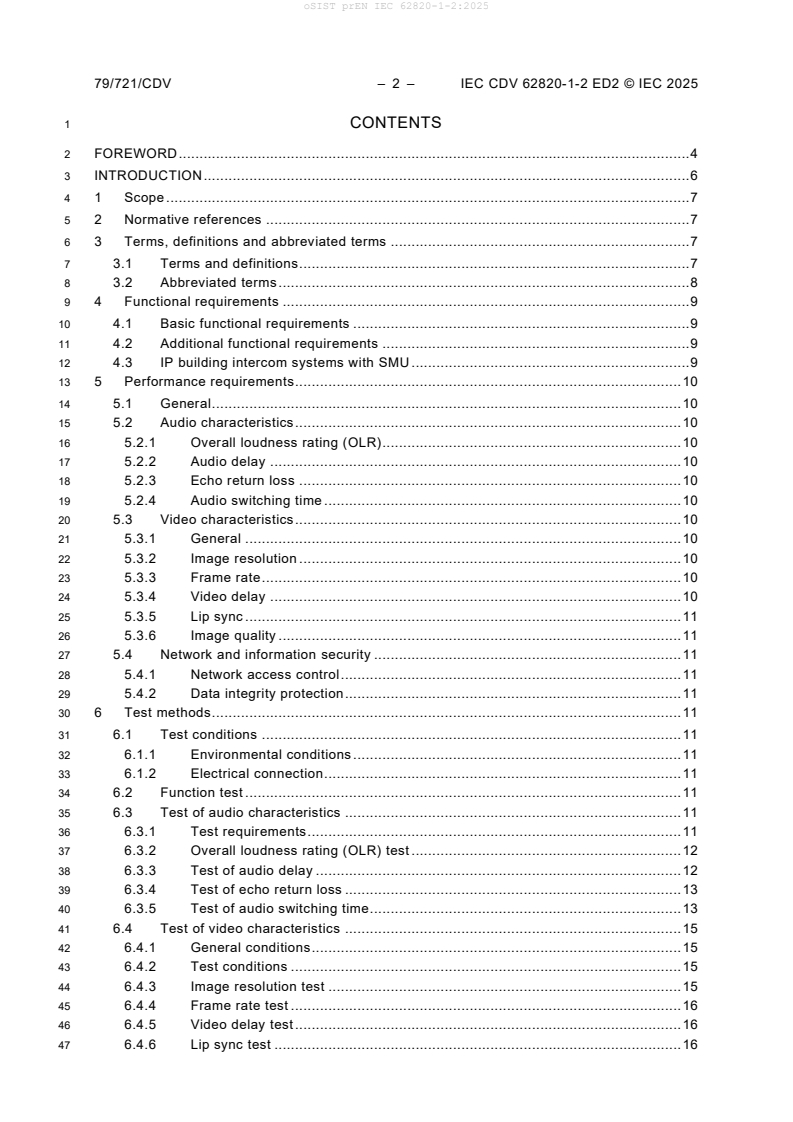
1 CONTENTS
2 FOREWORD . 4
3 INTRODUCTION . 6
4 1 Scope . 7
5 2 Normative references . 7
6 3 Terms, definitions and abbreviated terms . 7
7 3.1 Terms and definitions . 7
8 3.2 Abbreviated terms . 8
9 4 Functional requirements . 9
10 4.1 Basic functional requirements . 9
11 4.2 Additional functional requirements . 9
12 4.3 IP building intercom systems with SMU . 9
13 5 Performance requirements. 10
14 5.1 General . 10
15 5.2 Audio characteristics . 10
16 5.2.1 Overall loudness rating (OLR). 10
17 5.2.2 Audio delay . 10
18 5.2.3 Echo return loss . 10
19 5.2.4 Audio switching time . 10
20 5.3 Video characteristics . 10
21 5.3.1 General . 10
22 5.3.2 Image resolution . 10
23 5.3.3 Frame rate . 10
24 5.3.4 Video delay . 10
25 5.3.5 Lip sync . 11
26 5.3.6 Image quality . 11
27 5.4 Network and information security . 11
28 5.4.1 Network access control . 11
29 5.4.2 Data integrity protection . 11
30 6 Test methods . 11
31 6.1 Test conditions . 11
32 6.1.1 Environmental conditions . 11
33 6.1.2 Electrical connection . 11
34 6.2 Function test . 11
35 6.3 Test of audio characteristics . 11
36 6.3.1 Test requirements . 11
37 6.3.2 Overall loudness rating (OLR) test . 12
38 6.3.3 Test of audio delay . 12
39 6.3.4 Test of echo return loss . 13
40 6.3.5 Test of audio switching time. 13
41 6.4 Test of video characteristics . 15
42 6.4.1 General conditions . 15
43 6.4.2 Test conditions . 15
44 6.4.3 Image resolution test . 15
45 6.4.4 Frame rate test . 16
46 6.4.5 Video delay test . 16
47 6.4.6 Lip sync test . 16
IEC CDV 62820-1-2 ED2 © IEC 2025 – 3 – 79/721/CDV
48 6.4.7 Subjective image quality assessment . 17
49 6.5 Network security test . 17
50 6.5.1 Network test system . 17
51 6.5.2 Network access control test . 17
52 6.5.3 Data integrity protection test . 17
53 7 Documentation . 17
54 Annex A (normative) Subjective assessment of the IP BIS image quality . 18
55 A.1 Test setup . 18
56 A.2 Regulation for experimental actions . 18
57 A.2.1 Swing hands . 18
58 A.2.2 Show card . 18
59 A.3 Evaluation scoring . 19
60 Annex B (normative) Subjective assessment of echo return loss . 20
61 B.1 Test setup . 20
62 B.2 Evaluation scoring . 20
63 Bibliography . 21
65 Figure 1 – Test configuration of OLR, echo return loss, audio delay and audio
66 switching time diagram . 12
67 Figure 2 – Four groups of CSS signals . 13
68 Figure 3 – Test signal A . 14
69 Figure 4 – Test signal B . 14
70 Figure 5 – Audio switching time test process . 15
71 Figure 6 – Lip sync test signal . 16
72 Figure 7 – Test method diagram . 17
73 Figure A.1 – Test setup diagram . 18
75 Table A.1 – Image quality 5-point evaluation form . 19
76 Table B.1 – Subjective echo return loss evaluation form . 20
79/721/CDV – 4 – IEC CDV 62820-1-2 ED2 © IEC 2025
INTERNATIONAL ELECTROTECHNICAL COMMISSION
____________
BUILDING INTERCOM SYSTEMS
Part 1-2: System requirements –
Building intercom systems using the internet protocol (IP)
FOREWORD
1) The International Electrotechnical Commission (IEC) is a worldwide organization for standardization comprising
all national electrotechnical committees (IEC National Committees). The object of IEC is to promote international
co-operation on all questions concerning standardization in the electrical and electronic fields. To this end and
in addition to other activities, IEC publishes International Standards, Technical Specifications, Technical Reports,
Publicly Available Specifications (PAS) and Guides (hereafter referred to as “IEC Publication(s)”). Their
preparation is entrusted to technical committees; any IEC National Committee interested in the subject dealt with
may participate in this preparatory work. International, governmental and non-governmental organizations liaising
with the IEC also participate in this preparation. IEC collaborates closely with the International Organization for
Standardization (ISO) in accordance with conditions determined by agreement between the two organizations.
2) The formal decisions or agreements of IEC on technical matters express, as nearly as possible, an international
consensus of opinion on the relevant subjects since each technical committee has representation from all
interested IEC National Committees.
3) IEC Publications have the form of recommendations for international use and are accepted by IEC National
Committees in that sense. While all reasonable efforts are made to ensure that the technical content of IEC
Publications is accurate, IEC cannot be held responsible for the way in which they are used or for any
misinterpretation by any end user.
4) In order to promote international uniformity, IEC National Committees undertake to apply IEC Publications
transparently to the maximum extent possible in their national and regional publications. Any divergence between
any IEC Publication and the corresponding national or regional publication shall be clearly indicated in the latter.
5) IEC itself does not provide any attestation of conformity. Independent certification bodies provide conformity
assessment services and, in some areas, access to IEC marks of conformity. IEC is not responsible for any
services carried out by independent certification bodies.
6) All users should ensure that they have the latest edition of this publication.
7) No liability shall attach to IEC or its directors, employees, servants or agents including individual experts and
members of its technical committees and IEC National Committees for any personal injury, property damage or
other damage of any nature whatsoever, whether direct or indirect, or for costs (including legal fees) and
expenses arising out of the publication, use of, or reliance upon, this IEC Publication or any other IEC
Publications.
8) Attention is drawn to the Normative references cited in this publication. Use of the referenced publications is
indispensable for the correct application of this publication.
9) Attention is drawn to the possibility that some of the elements of this IEC Publication may be the subject of patent
rights. IEC shall not be held responsible for identifying any or all such patent rights.
International Standard IEC 62820-1-2 has been prepared by IEC technical committee 79: Alarm
and electronic security systems.
The text of this International Standard is based on the following documents:
FDIS Report on voting
Full information on the voting for the approval of this International Standard can be found in the
report on voting indicated in the above table.
This document has been drafted in accordance with the ISO/IEC Directives, Part 2.
A list of all parts in the IEC 62820 series, published under the general title Building intercom
systems, can be found on the IEC website.
IEC CDV 62820-1-2 ED2 © IEC 2025 – 5 – 79/721/CDV
The committee has decided that the contents of this document will remain unchanged until the
stability date indicated on the IEC website under "http://webstore.iec.ch" in the data related to
the specific document. At this date, the document will be
• reconfirmed,
• withdrawn,
• replaced by a revised edition, or
• amended.
Note from Secretariat: references to IEC 62820-1-1 are written with 202X as date. The letter
“X” will be replaced with the correct figure at publication stage.
79/721/CDV – 6 – IEC CDV 62820-1-2 ED2 © IEC 2025
1 INTRODUCTION
2 The IEC 62820 series of standards set out the technical requirements for the composition,
3 functions, performance, and test methods of building intercom systems for building entry and
4 application guidelines and consist of five parts:
5 Part 1-1: System requirements – General;
6 Part 1-2: System requirements – Building intercom systems using the internet protocol (IP);
7 Part 2: Requirements for advanced security building intercom systems;
8 Part 3-1: Application guidelines – General;
9 Part 3-2: Application guidelines – Advanced security building intercom systems.
IEC CDV 62820-1-2 ED2 © IEC 2025 – 7 – 79/721/CDV
12 BUILDING INTERCOM SYSTEMS
14 Part 1-2: System requirements –
15 Building intercom systems using the internet protocol (IP)
19 1 Scope
20 This part of IEC 62820 specifies the technical requirements for the composition, functions,
21 performance and test methods of building intercom systems using the internet protocol (IP),
22 and it is a supplement to IEC 62820-1-1.
23 This document is applicable to the IP building intercom systems for both residential and
24 commercial buildings.
25 NOTE A BIS that has a mixture of IP and non-IP connections is not covered by IEC 62820-1-2 but covered by
26 IEC 62820-1-1.
27 2 Normative references
28 The following documents are referred to in the text in such a way that some or all of their content
29 constitutes requirements of this document. For dated references, only the edition cited applies.
30 For undated references, the latest edition of the referenced document (including any
31 amendments) applies.
32 IEC 62820-1-1:202X, Building intercom systems – Part 1-1: System requirements – General
33 ITU-T P.501, Test signals for use in telephonometry
34 3 Terms, definitions and abbreviated terms
35 3.1 Terms and definitions
36 For the purposes of this document, the definitions given in IEC 62820-1-1 and the following
37 apply.
38 ISO and IEC maintain terminological databases for use in standardization at the following
39 addresses:
40 • IEC Electropedia: available at http://www.electropedia.org/
41 • ISO Online browsing platform: available at http://www.iso.org/obp
42 3.1.1
43 audio delay
44 audio latency
45 one way delay (OWD) time of the transmitted audio signal from the microphone of one intercom
46 unit through other components in the system to the loudspeaker of other intercom unit
47 3.1.2
48 audio switching time
49 time, from one transmission direction to the other measured from the removal of the signal in
50 the first direction until the level in the second direction reaches 3 dB below its final value
51 3.1.3
52 echo return loss
53 ability of the local intercom unit to avoid retransmitting the audio signal received from the far
54 intercom unit back again to it
79/721/CDV – 8 – IEC CDV 62820-1-2 ED2 © IEC 2025
55 3.1.4
56 intercom unit
57 device that is able to establish an audio connection or an audio and video connection between
58 each other (SMU, VCU and URU) and is specifically designed to be a component of a BIS
59 Note 1 to entry: Devices which can be connected to IP transmission network such as smartphones or tablets are
60 not considered as intercom units.
61 3.1.5
62 Internet Protocol
63 IP
64 network layer-3 protocol in the OSI model containing addressing and control information to
65 enable data packets to be routed in a network and primary network layer protocol in the TCP/IP
66 protocol suite according to IETF RFC 791 and IETF RFC 2460 and any subsequent evolution
67 3.1.6
68 IP transmission network
69 communication network used to achieve the relevant functions of IP BIS, such as data
70 transmission and control
71 3.1.7
72 lip sync
73 temporal relationship between transmitted audio signal and video signal
74 Note 1 to entry: Lip sync value is used to demonstrate the relationship between audio and video signal
75 synchronization.
76 3.1.8
77 single talk
78 type of non simultaneous 2 way speech in which two parties communicate by alternating speech
79 spurts without interrupting each other
80 3.1.9
81 double talk
82 type of non simultaneous 2 way speech in which two parties communicate by alternating speech
83 spurts in which both parties may interrupt each other
84 3.1.10
85 subjective image quality assessment
86 method where people, as observers, evaluate the image quality
87 Note 1 to entry: Test environment, observer and evaluation method shall comply with certain standards, in the same
88 way the methodology for the subjective assessment of the quality of the television pictures adopted ITU-R BT.500-
89 13-(01/2012).
90 3.1.11
91 video delay
92 one way delay (OWD) time of the transmitted video signal from the camera of one intercom unit
93 through other components to the display on the other intercom unit
94 3.2 Abbreviated terms
95 ACR absolute category rating
96 BIS building intercom system
97 CSS composite source signal
98 DCR degradation category rating
99 EUT equipment under test
100 FPS frames per second
101 IP Internet protocol
102 LED light-emitting diode
103 LIG LED image generator
104 LRGP loudness rating guard-ring position
IEC CDV 62820-1-2 ED2 © IEC 2025 – 9 – 79/721/CDV
105 MRP mouth reference point
106 OLR overall loudness rating
107 OSI open systems interconnection
108 OWD one way delay
109 PSG programmable signal generator
110 QoS quality of service
111 SMU security management unit
112 TVL television lines
113 URU user receiver unit
114 VCD video capture device
115 VCU visitor call unit
116 VRD video receiver device
117 4 Functional requirements
118 4.1 Basic functional requirements
119 Basic functional requirements of IP BIS shall comply with the requirements specified in
120 IEC 62820-1-1:202X, 4.1.
121 4.2 Additional functional requirements
122 In addition to the additional functional requirements specified in IEC 62820-1-1:202X, 4.2, an
123 IP building intercom system may comply with the following requirements:
124 a) Intercom unit to intercom unit speech
125 URU may be able to make addressing calls to other URU and conduct two-way speech.
126 b) Voice message function
127 IP building intercom system may allow the caller to leave voice messages from the VCU.
128 c) Intercom unit to intercom unit video and speech
129 URU may be able to conduct two-way video and audio communication with other URU.
130 d) Video and voice messages function
131 IP building intercom system may allow the caller to leave video and voice messages from
132 the VCU.
133 4.3 IP building intercom systems with SMU
134 In addition to the functional requirements specified in 4.1 and 4.2, IP building intercom systems
135 with SMU may comply with the following requirements:
136 a) Automatic detection of device status
137 The SMU may detect the status of other devices in the system.
138 b) Remote configuration and update
139 The SMU may remotely configure the operating mode of the devices and update the
140 firmware and software of the devices.
141 c) Image storing and replaying function
142 When the URU with video function is communicating with an SMU equipped with a camera,
143 it may be able to store and replay the images captured by the SMU.
79/721/CDV – 10 – IEC CDV 62820-1-2 ED2 © IEC 2025
144 5 Performance requirements
145 5.1 General
146 The performance requirements of IP BIS shall comply with the requirements specified in
147 IEC 62820-1-1:202X, Clause 5.
148 The following requirements shall be fulfilled when the intercom devices are linked in a local
149 network, wired or wireless. In case some devices are linked through a public network (i.e.
150 Internet), where it is not possible to guarantee QoS, the requirements
...