


FprEN IEC 60034-30-1:2025
(Main)Rotating electrical machines - Part 30-1: Efficiency classes of line operated AC motors (IE code)
Rotating electrical machines - Part 30-1: Efficiency classes of line operated AC motors (IE code)
IEC 60034-30-1:2025 specifies efficiency classes for single-speed electric motors that are rated in accordance with IEC 60034‑1 or IEC 60079‑0 and are rated for operation on a sinusoidal either 50 Hz or 60 Hz, or both voltage supply. The motors within this document: - have a rated power PN from 0,12 kW to 1 000 kW; - have a rated voltage UN from 50 V up to and including 1 000 V; - have 2, 4, 6 or 8 poles; - are capable of continuous operation at their rated power with a temperature rise within the specified insulation temperature class; NOTE 1 Most motors covered by this document are rated for duty type S1 (continuous duty). However, some motors that are rated for other duty cycles are still capable of continuous operation at their rated power, and these motors are also covered by this document. - are marked with any ambient temperature within the range of –30 °C to +60 °C; NOTE 2 The rated efficiency and efficiency classes are based on 25 °C ambient temperature in accordance with IEC 60034‑2‑1. NOTE 3 Motors exclusively rated for temperatures outside the range – 30 °C and +60 °C are considered to be of special construction and are consequently excluded from this document. NOTE 4 Smoke extraction motors with a temperature class of up to and including 400 °C are covered by this document. - are marked with an altitude up to 4 000 m above sea level. NOTE 5 The rated efficiency and efficiency class are based on a rating for altitudes up to 1 000 m above sea level. This document establishes a set of nominal efficiency values based on supply frequency, number of poles and motor output power. No distinction is made between motor technologies, supply voltage or motors with increased insulation designed specifically for converter operation even though not all motor technologies are capable of reaching the higher efficiency classes (see Table 1). This makes different motor technologies fully comparable with respect to their energy efficiency potential. The efficiency of power-drive systems is not covered by this document. Motor losses due to harmonic content of the supply voltage, losses in cables, filters and frequency-converters, are not covered. Motors with flanges, feet or shafts with mechanical dimensions different from IEC 60072‑1 are covered by this document. Geared motors are covered by this document including those incorporating non-standard shafts and flanges. This document does not apply to the following: - Single-speed motors with 10 or more poles or multi-speed motors. - Motors with mechanical commutators (such as DC motors). - Motors completely integrated into a machine (for example pump, fan and compressor) that cannot be practically tested separately from the machine even with provision of a temporary end-shield and drive-end bearing. This means the motor: a) shares common components (apart from connectors such as bolts) with the driven unit (for example, a shaft or housing) and b) is not designed in such a way as to enable the motor to be separated from the driven unit as an entire motor that can operate independently of the driven unit. That is, for a motor to be excluded from this document, the process of separation shall render the motor inoperative. - Totally enclosed air-over machines (TEAO, IC418), i.e. totally enclosed frame-surface cooled machines intended for exterior cooling by a ventilating means external to the machine. Efficiency testing of such motors can be performed with the fan removed and the cooling provided by an external blow
Drehende elektrische Maschinen - Teil 30-1: Wirkungsrad-Klassifizierung von netzgespeisten Drehstrommotoren (IE-Code)
Machines électriques tournantes - Partie 30-1: Classes de rendement pour les moteurs à courant alternatif alimentés par le réseau (code IE)
L'IEC 60034-30-1:2025 spécifie les classes de rendement pour les moteurs électriques à une seule vitesse qui sont classés conformément à l'IEC 60034‑1 ou à l'IEC 60079‑0. Ces moteurs sont assignés pour fonctionner soit avec une tension d'alimentation sinusoïdale de 50 Hz ou 60 Hz, soit avec ces deux valeurs de tension. Les moteurs traités dans le présent document: - ont une puissance assignée PN de 0,12 kW à 1 000 kW; - ont une tension assignée UN de 50 V jusqu'à 1 000 V inclus; - ont 2, 4, 6 ou 8 pôles; - peuvent fonctionner en continu à leur puissance assignée avec un échauffement ne dépassant pas la classe de température d'isolation spécifiée; NOTE 1 La plupart des moteurs couverts par le présent document sont assignés pour un type de régime S1 (régime continu). Toutefois, certains moteurs assignés pour d'autres cycles de service peuvent encore fonctionner en continu à leur puissance assignée et ces moteurs sont également couverts par le présent document. sont marqués pour toute température ambiante dans la gamme de –30 °C à +60 °C; NOTE 2 Le rendement assigné et les classes de rendement sont fondés sur une température ambiante de 25 °C, conformément à l'IEC 60034‑2‑1. NOTE 3 On considère que les moteurs exclusivement assignés pour des températures extérieures à la gamme de – 30 °C à +60 °C sont d'une construction particulière et ils sont en conséquence exclus du présent document. NOTE 4 Les moteurs pour extraction de fumée d'une classe de température allant jusqu'à 400 °C inclus sont couverts par le présent document. sont marqués pour une altitude allant jusqu'à 4 000 m au-dessus du niveau de la mer. NOTE 5 Le rendement assigné et la classe de rendement sont fondés sur des altitudes allant jusqu'à 1 000 m au-dessus du niveau de la mer. Le présent document définit un ensemble de valeurs nominales de rendement en se fondant sur la fréquence d'alimentation, le nombre de pôles et la puissance de sortie du moteur. Aucune distinction n'est établie entre les technologies de moteur, la tension d'alimentation ou les moteurs ayant une isolation renforcée, conçus en particulier pour le fonctionnement des convertisseurs, même si ces technologies de moteur peuvent ne pas être toutes en mesure d'atteindre les classes de rendement supérieures (voir le Tableau 1). Ceci permet de comparer entièrement des technologies de moteur différentes en fonction de leur potentiel de rendement énergétique. Le rendement des systèmes d'entraînement mécanique n'est pas couvert par le présent document. Les pertes dans les moteurs dues à la teneur en harmoniques de la tension d'alimentation, les pertes dans les câbles, les filtres et les convertisseurs de fréquence, ne sont pas couvertes. Les moteurs avec brides, à pattes ou avec arbres ayant des dimensions mécaniques différentes de celles fixées par l'IEC 60072‑1 sont couverts par le présent document. Les moteurs avec réducteur sont couverts par le présent document., ce qui inclut les moteurs comportant des arbres et des brides non normalisés. Le présent document ne s'applique pas aux éléments suivants: - les moteurs à une seule vitesse avec 10 pôles ou plus ou les moteurs à plusieurs vitesses; - les moteurs avec commutateurs mécaniques (tels que les moteurs à courant continu); - les moteurs complètement intégrés dans une machine (par exemple pompe, ventilateur, compresseur) qui ne peuvent pas faire l'objet d'essais séparé
Električni rotacijski stroji - 30-1. del: Razredi izkoristka enohitrostnih izmeničnih motorjev za diektni priklop (koda IE)
General Information
Relations
Standards Content (Sample)
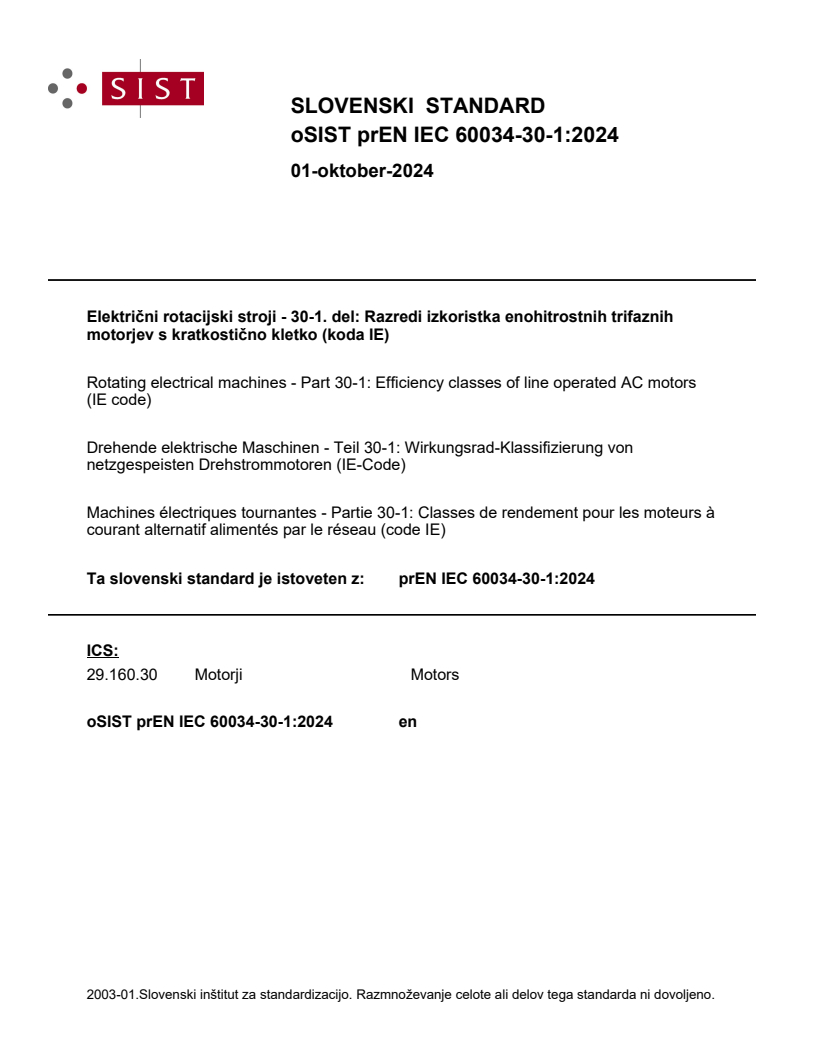
SLOVENSKI STANDARD
01-oktober-2024
Električni rotacijski stroji - 30-1. del: Razredi izkoristka enohitrostnih trifaznih
motorjev s kratkostično kletko (koda IE)
Rotating electrical machines - Part 30-1: Efficiency classes of line operated AC motors
(IE code)
Drehende elektrische Maschinen - Teil 30-1: Wirkungsrad-Klassifizierung von
netzgespeisten Drehstrommotoren (IE-Code)
Machines électriques tournantes - Partie 30-1: Classes de rendement pour les moteurs à
courant alternatif alimentés par le réseau (code IE)
Ta slovenski standard je istoveten z: prEN IEC 60034-30-1:2024
ICS:
29.160.30 Motorji Motors
2003-01.Slovenski inštitut za standardizacijo. Razmnoževanje celote ali delov tega standarda ni dovoljeno.
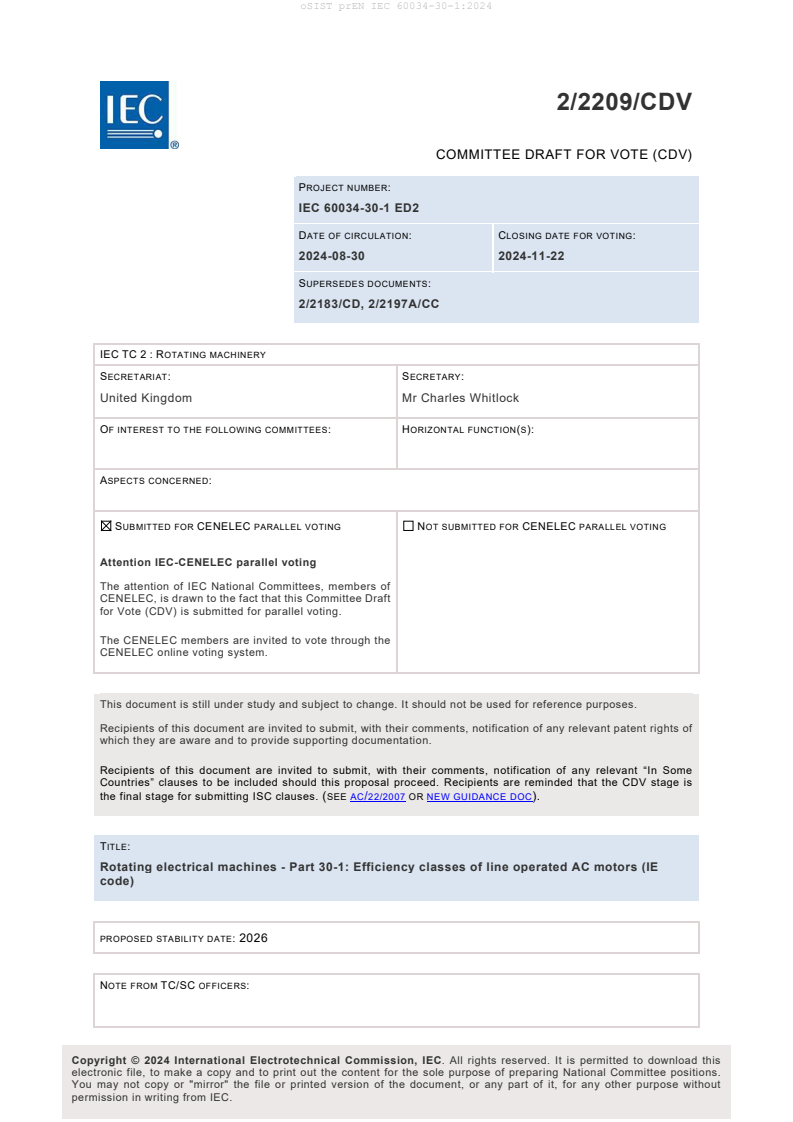
2/2209/CDV
COMMITTEE DRAFT FOR VOTE (CDV)
PROJECT NUMBER:
IEC 60034-30-1 ED2
DATE OF CIRCULATION: CLOSING DATE FOR VOTING:
2024-08-30 2024-11-22
SUPERSEDES DOCUMENTS:
2/2183/CD, 2/2197A/CC
TC 2 : ROTATING MACHINERY
IEC
SECRETARIAT: SECRETARY:
United Kingdom Mr Charles Whitlock
OF INTEREST TO THE FOLLOWING COMMITTEES: HORIZONTAL FUNCTION(S):
ASPECTS CONCERNED:
SUBMITTED FOR CENELEC PARALLEL VOTING NOT SUBMITTED FOR CENELEC PARALLEL VOTING
Attention IEC-CENELEC parallel voting
The attention of IEC National Committees, members of
CENELEC, is drawn to the fact that this Committee Draft
for Vote (CDV) is submitted for parallel voting.
The CENELEC members are invited to vote through the
CENELEC online voting system.
This document is still under study and subject to change. It should not be used for reference purposes.
Recipients of this document are invited to submit, with their comments, notification of any relevant patent rights of
which they are aware and to provide supporting documentation.
Recipients of this document are invited to submit, with their comments, notification of any relevant “In Some
Countries” clauses to be included should this proposal proceed. Recipients are reminded that the CDV stage is
the final stage for submitting ISC clauses. (SEE AC/22/2007 OR NEW GUIDANCE DOC).
TITLE:
Rotating electrical machines - Part 30-1: Efficiency classes of line operated AC motors (IE
code)
PROPOSED STABILITY DATE: 2026
NOTE FROM TC/SC OFFICERS:
electronic file, to make a copy and to print out the content for the sole purpose of preparing National Committee positions.
You may not copy or "mirror" the file or printed version of the document, or any part of it, for any other purpose without
permission in writing from IEC.
IEC CDV 60034-30-1 ED2 © IEC 2024 2 2/2209/CDV
1 CONTENTS
2 FOREWORD . 3
3 INTRODUCTION . 5
4 1 Scope . 7
5 2 Normative references . 8
6 3 Terms, definitions, and symbols . 9
7 3.1 Terms and definitions . 9
8 3.2 Symbols . 9
9 4 Fields of application . 10
10 5 Efficiency . 11
11 5.1 Determination . 11
12 5.1.1 General . 11
13 5.1.2 Rated voltages, rated frequencies, and rated power . 11
14 5.1.3 Auxiliary devices . 12
15 5.2 Rating . 12
16 5.3 Classification and marking . 12
17 5.3.1 General . 12
18 5.3.2 Efficiency classification . 13
19 5.3.3 Motors below IE1 efficiency . 13
20 5.3.4 Marking . 13
21 5.4 Nominal limits for efficiency classes IE1, IE2, IE3, IE4 and IE5 . 13
22 5.4.1 Nominal efficiency limits for IE1 . 14
23 5.4.2 Nominal efficiency limits for IE2 (see Tables 5 and 6) . 16
24 5.4.3 Nominal efficiency limits for IE3 (see Tables 7 and 8) . 18
25 5.4.4 Nominal efficiency limits for IE4 (see Tables 9 and 10) . 20
26 5.4.5 Nominal efficiency limits for IE5 (see Tables 11 and 12) . 22
27 5.4.6 Interpolation of nominal efficiency limits of intermediate rated
28 output powers for 50 Hz mains supply frequency . 23
29 5.4.7 Interpolation of nominal efficiency limits of intermediate rated
30 powers for 60 Hz mains supply frequency . 25
31 Annex A (informative) Nominal, rated (declared), minimum efficiency and tolerance . 26
32 Bibliography . 27
34 Table 1 – Common motor technologies and their energy efficiency potential . 10
35 Table 2 – IE efficiency classification . 13
36 Table 3 – Nominal efficiency limits (%) for 50 Hz IE1 . 14
37 Table 4 – Nominal efficiency limits (%) for 60 Hz IE1 . 15
38 Table 5 – Nominal efficiency limits (%) for 50 Hz IE2 . 16
39 Table 6 – Nominal efficiency limits (%) for 60 Hz IE2 . 17
40 Table 7 – Nominal efficiency limits (%) for 50 Hz IE3 . 18
41 Table 8 – Nominal efficiency limits (%) for 60 Hz IE3 . 19
42 Table 9 – Nominal efficiency limits (%) for 50 Hz IE4 . 20
43 Table 10 – Nominal efficiency limits (%) for 60 Hz IE4 . 21
44 Table 11 – Nominal efficiency limits (%) for 50 Hz IE5 . 22
45 Table 12 – Nominal efficiency limits (%) for 60 Hz IE5 . 23
46 Table 13 – Interpolation coefficients for 0,12 kW up to 0,55 kW . 23
47 Table 14 – Interpolation coefficients for 0,75 kW up to 200 kW . 25
IEC CDV 60034-30-1 ED2 © IEC 2024 3 2/2209/CDV
49 INTERNATIONAL ELECTROTECHNICAL COMMISSION
50 ____________
52 ROTATING ELECTRICAL MACHINES –
54 Part 30-1: Efficiency classes of line operated AC motors (IE code)
56 FOREWORD
57 1) The International Electrotechnical Commission (IEC) is a worldwide organization for standardization comprising
58 all national electrotechnical committees (IEC National Committees). The object of IEC is to promote international
59 co-operation on all questions concerning standardization in the electrical and electronic fields. To this end and
60 in addition to other activities, IEC publishes International Standards, Technical Specifications, Technical Reports,
61 Publicly Available Specifications (PAS) and Guides (hereafter referred to as “IEC Publication(s)”). Their
62 preparation is entrusted to technical committees; any IEC National Committee interested in the subject dealt with
63 may participate in this preparatory work. International, governmental and non-governmental organizations liaising
64 with the IEC also participate in this preparation. IEC collaborates closely with the International Organization for
65 Standardization (ISO) in accordance with conditions determined by agreement between the two organizations.
66 2) The formal decisions or agreements of IEC on technical matters express, as nearly as possible, an international
67 consensus of opinion on the relevant subjects since each technical committee has representation from all
68 interested IEC National Committees.
69 3) IEC Publications have the form of recommendations for international use and are accepted by IEC National
70 Committees in that sense. While all reasonable efforts are made to ensure that the technical content of IEC
71 Publications is accurate, IEC cannot be held responsible for the way in which they are used or for any
72 misinterpretation by any end user.
73 4) In order to promote international uniformity, IEC National Committees undertake to apply IEC Publications
74 transparently to the maximum extent possible in their national and regional publications. Any divergence between
75 any IEC Publication and the corresponding national or regional publication shall be clearly indicated in the latter.
76 5) IEC itself does not provide any attestation of conformity. Independent certification bodies provide conformity
77 assessment services and, in some areas, access to IEC marks of conformity. IEC is not responsible for any
78 services carried out by independent certification bodies.
79 6) All users should ensure that they have the latest edition of this publication.
80 7) No liability shall attach to IEC or its directors, employees, servants or agents including individual experts and
81 members of its technical committees and IEC National Committees for any personal injury, property damage or
82 other damage of any nature whatsoever, whether direct or indirect, or for costs (including legal fees) and
83 expenses arising out of the publication, use of, or reliance upon, this IEC Publication or any other IEC
84 Publications.
85 8) Attention is drawn to the Normative references cited in this publication. Use of the referenced publications is
86 indispensable for the correct application of this publication.
87 9) Attention is drawn to the possibility that some of the elements of this IEC Publication may be the subject of patent
88 rights. IEC shall not be held responsible for identifying any or all such patent rights.
89 International Standard IEC 60034-30-1 has been prepared by IEC Technical Committee 2:
90 Rotating machinery.
91 This second edition of IEC 60034-30-1 cancels and replaces the first edition of IEC 60034-30-
92 1 (2014).
93 The text of this standard is based on the following documents:
FDIS Report on voting
95 Full information on the voting for the approval of this standard can be found in the report on
96 voting indicated in the above table.
97 This publication has been drafted in accordance with the ISO/IEC Directives, Part 2.
98 NOTE A table of cross-references of all IEC TC 2 publications can be found on the IEC TC 2 dashboard on the IEC
99 website.
IEC CDV 60034-30-1 ED2 © IEC 2024 4 2/2209/CDV
100 The committee has decided that the contents of this publication will remain unchanged until the
101 stability date indicated on the IEC web site under "http://webstore.iec.ch" in the data related to
102 the specific publication. At this date, the publication will be
103 • reconfirmed,
104 • withdrawn,
105 • replaced by a revised edition, or
106 • amended.
IEC CDV 60034-30-1 ED2 © IEC 2024 5 2/2209/CDV
109 INTRODUCTION
110 This first part of the IEC standard series, 60034-30, provides for the global harmonization of
111 energy-efficiency classes of electric motors. It deals with all kinds of electric motors that are
112 rated for line operation (including starting at reduced voltage). This includes 50 Hz and/or 60
113 Hz single- and three-phase low voltage induction motors, regardless of their rated voltage, as
114 well as line-start synchronous motors.
115 The second part of this standard series (IEC 60034-30-2) is prepared for motors rated for
116 variable voltage and frequency supply.
117 This second edition of the first part introduces a new efficiency class, IE5. It should be noted
118 that IE class definition is generally independent of the output power – frame size assignment.
119 As standardized dimensions and outputs in the standard IEC 60072 is based on today’s
120 technology (up to IE4), it may be challenging to implement highest IE classes according to IEC
121 60072 standardized frame sizes.
122 Especially motors with lower output power ratings may need to be designed and manufactured
123 in one frame size bigger than frame size assigned in IEC 60072-1 to reach IE4 and IE5 efficiency
124 levels.
125 For a given power and frame size it is generally easier to achieve a higher motor efficiency
126 when the motor is designed for and operated directly on-line with a 60 Hz supply frequency
127 rather than on 50 Hz as explained in Note 1.
128 NOTE 1 As the utilization and size of motors are related to torque rather than power the theoretical power of single-
129 speed motors increases linearly with supply frequency (and hence with speed), i.e. by 20 % from 50 Hz to 60 Hz.
130 I R winding-losses are dominant especially in small and medium sized induction motors. They basically remain
131 constant at 50 Hz and 60 Hz as long as the torque is kept constant. Although windage, friction and iron losses
132 increase with frequency, they play a minor role especially in motors with a number of poles of four and higher.
133 Therefore, at 60 Hz, the losses increase less than the 20 % power increase when compared to 50 Hz and
134 consequently, the efficiency is improved.
135 In practice, both 60 Hz and 50 Hz power designations of single-speed motors usually conform to standard power
136 levels in accordance with IEC 60072-1. Therefore, an increased rating of motor power by 20 % is not always possible.
137 However, the general advantage of 60 Hz still applies when the motor design is optimized for the respective supply
138 frequency rather than just re-rated.
139 The difference in efficiency between 50 Hz and 60 Hz varies with the number of poles and the size of the motor. In
140 general, the 60 Hz efficiency of three-phase, cage-induction motors in the power range from 0,75 kW up to 375 kW
141 is between 2,5 percentage points to less than 0,5 percentage points greater when compared to the 50 Hz efficiency.
142 Only large 2-pole motors may experience a reduced efficiency at 60 Hz due to their high share of iron, windage and
143 friction losses.
144 It is not expected that all manufacturers will produce motors for all efficiency classes, nor all
145 ratings of a given class.
146 Users should dimension motors in their applications correctly based on the load profile,
147 operating hours in order to maximize energy savings considering most energy efficient solutions
148 in addition that all other requirements set by the application are covered. It may not be energy
149 efficient to select motors of a high efficiency class for intermittent or short time duty due to
150 increased inertia and start-up losses.
151 NOTE 2 The application guide IEC/TS 60034-31:2021 gives further information on useful applications of high-
152 efficient electric motors.
153 In order to achieve a significant market share it is essential for high-efficiency motors to meet
154 national/regional standards for assigned powers in relation to mechanical dimensions (such as
155 frame-size, flanges). Standard IEC 60072-1:2022 defines the relationship between mechanical
156 dimensions and rated output as well there are several national/regional frame assignment
157 standards (JIS C 4212, NBR 17094, NEMA MG13, SANS 1804 and others). As this standard
158 (IEC 60034-30-1) defines energy-efficiency classes independent of dimensional constraints it
159 may not be possible in all markets to produce motors with higher efficiency classes and maintain
160 the mechanical dimensions of the national/regional standards.
IEC CDV 60034-30-1 ED2 © IEC 2024 6 2/2209/CDV
162 Together with demands to create higher energy efficiency classes, components and equipment
163 also material efficiency should not be forgotten. Based on physics there will be a need to use
164 more materials like electric steel, copper, and aluminium to be able to design and manufacture
165 higher and higher efficient motors. Consequently, it may not be possible to design for example
166 IE5 class motors utilizing same frame sizes as IE4 class motors as well as motors will be heavier
167 requiring most probably redesigning the application.
169 IE codes are not limited only to motors and are used to classify other components such as
170 frequency converters (IEC 61800-9-2). The same standard defines also IES classes to
171 combinations of components (such as power drive systems).
172 However, it is anticipated that other components are rated with a comparable system: IE1
173 meaning low efficiency up to IE5 meaning the highest efficiency.
174 The efficiency levels in this standard for 50 Hz and 60 Hz are not always entirely consistent
175 across all numbers of poles and over the whole power range.
176 NOTE 3 The efficiency levels for 60 Hz motors were assigned for compatibility with U.S. and North American legal
177 requirements.
IEC CDV 60034-30-1 ED2 © IEC 2024 7 2/2209/CDV
179 ROTATING ELECTRICAL MACHINES –
181 Part 30-1: Efficiency classes of line operated AC motors (IE code)
185 1 Scope
186 This part of IEC 60034 specifies efficiency classes for single-speed electric motors that are
187 rated according to IEC 60034-1 or IEC 60079-0 and are rated for operation on a sinusoidal 50
188 Hz, 60 Hz and/or 50/60 Hz voltage supply and:
189 from 0,12 kW to 1 000 kW
• have a rated power P
N
190 • have a rated voltage U from 50 V up to and including 1 000 V
N
191 • have 2, 4, 6 or 8 poles
192 • are capable of continuous operation at their rated power with a temperature rise within the
193 specified insulation temperature class
194 NOTE 1 Most motors covered by this standard are rated for duty type S1 (continuous duty). However, some
195 motors that are rated for other duty cycles are still capable of continuous operation at their rated power and
196 these motors are also covered.
197 • are marked with any ambient temperature within the range of –20 °C to +60 °C
198 NOTE 2 The rated efficiency and efficiency classes are based on 25 °C ambient temperature according to
199 IEC 60034-2-1.
200 NOTE 3 Motors exclusively rated for temperatures outside the range – 20 °C and +60 °C are considered to be
201 of special construction and are consequently excluded from this standard.
202 NOTE 4 Smoke extraction motors with a temperature class of up to and including 400 °C are covered by this
203 standard.
204 • are marked with an altitude up to 4 000 m above sea level.
205 NOTE 5 The rated efficiency and efficiency class are based on a rating for altitudes up to 1 000 m above sea
206 level.
207 This standard establishes a set of nominal efficiency values based on supply frequency, number
208 of poles and motor output power. No distinction is made between motor technologies, supply
209 voltage or motors with increased insulation designed specifically for converter operation even
210 though these motor technologies may not all be capable of reaching the higher efficiency
211 classes (see Table 1). This makes different motor technologies fully comparable with respect
212 to their energy efficiency potential.
213 NOTE 6 Regulators should consider the above constraints when assigning national minimum energy-efficiency
214 performance standards (MEPS) with respect to any particular type of motor.
215 The efficiency of power-drive systems is not covered by this standard. Motor losses due to
216 harmonic content of the supply voltage, losses in cables, filters and frequency-converters, are
217 not covered.
218 Motors with flanges, feet and/or shafts with mechanical dimensions different from IEC 60072-1
219 are covered by this standard.
220 Geared motors are covered by this standard including those incorporating non-standard shafts
221 and flanges.
222 Excluded are:
223 • Single-speed motors with 10 or more poles or multi-speed motors.
224 • Motors with mechanical commutators (such as DC motors).
IEC CDV 60034-30-1 ED2 © IEC 2024 8 2/2209/CDV
225 • Motors completely integrated into a machine (for example pump, fan and compressor) that
226 cannot be practically tested separately from the machine even with provision of a temporary
227 end-shield and drive-end bearing. This means the motor shall: a) share common
228 components (apart from connectors such as bolts) with the driven unit (for example, a shaft
229 or housing) and b) not be designed in such a way as to enable the motor to be separated
230 from the driven unit as an entire motor that can operate independently of the driven unit.
231 That is, for a motor to be excluded from this standard, the process of separation shall render
232 the motor inoperative.
233 (TEAO, IC418) Totally enclosed air-over machines, i.e. totally enclosed frame-surface
234 cooled machines intended for exterior cooling by a ventilating means external to the
235 machine, are covered by this standard. Efficiency testing of such motors may be performed
236 with the fan removed and the cooling provided by an external blower with a similar airflow
237 rate as the original fan.
238 • Motors with integrated frequency-converters (compact drives) when the motor cannot be
239 tested separately from the converter. Energy efficiency classification of compact drives shall
240 be based on the complete product (PDS ie. Power Drive System) and is defined in IEC
241 61800-9-2.
242 NOTE 7 A motor is not excluded when the motor and frequency-converter can be separated, and the motor can
243 be tested independently of the converter.
244 • Brake motors when the brake is an integral part of the inner motor construction and can
245 neither be removed nor supplied by a separate power source during the testing of motor
246 efficiency.
247 NOTE 8 Brake motors with a brake coil that is integrated into the flange of the motor are covered as long as it
248 is possible to test motor efficiency without the losses of the brake (for example by dismantling the brake or by
249 energizing the brake coil from a separate power source).
250 When the manufacturer offers a motor of the same design with and without a brake the test
251 of motor efficiency may be done on a motor without the brake. The determined efficiency
252 may then be used as the rating of both motor and brake motor.
253 • Submersible motors specifically designed to operate wholly immersed in a liquid.
254 • Smoke extraction motors with a temperature class above 400 °C.
255 2 Normative references
256 The following documents, in whole or in part, are normatively referenced in this document and
257 are indispensable for its application. For dated references, only the edition cited applies. For
258 undated references, the latest edition of the referenced document (including any amendments)
259 applies.
260 IEC 60034-1, Rotating electrical machines – Part 1: Rating and performance
261 IEC 60034-2-1, Rotating electrical machines – Part 2-1: Standard methods for determining
262 losses and efficiency from tests (excluding machines for traction vehicles)
263 IEC 60034-2-3, Rotating electrical machines – Part 2-3: Specific test methods for determining
264 losses and efficiency of converter-fed AC induction motors
265 IEC 60034-6, Rotating electrical machines – Part 6: Methods of cooling (IC Code)
266 IEC/TS 60034-25, Rotating electrical machines – Part 25: Guidance for the design and
267 performance of a.c. motors specifically designed for converter supply
268 IEC 60038, IEC standard voltages
269 IEC 60079-0, Explosive atmospheres – Part 0: Equipment – General requirements
IEC CDV 60034-30-1 ED2 © IEC 2024 9 2/2209/CDV
270 3 Terms, definitions, and symbols
271 3.1 Terms and definitions
272 For the purposes of this document, the terms and definitions given in IEC 60034-1 and the
273 following apply.
274 3.1.1
275 single-speed motor
276 motor rated for 50 Hz and/or 60 Hz on-line operation
277 Note 1 to entry: Single-speed motors may be capable of frequency converter operation with variable speed.
278 3.1.2
279 multi-speed motor
280 motor rated for 50 Hz and/or 60 Hz on-line operation that has multiple windings or a switchable
281 winding to provide two or more different number of poles with different synchronous speeds
282 3.1.3
283 brake motor
284 motor equipped with an electro-mechanical brake unit operating directly on the motor shaft
285 without couplings
286 3.1.4
287 geared motor
288 motor equipped with an integral gearbox without couplings (i.e. the first gear wheel is fixed to
289 the motor shaft)
290 3.1.5
291 pump motor
292 motor directly attached to a pump without couplings (i.e. the impeller is fixed to the motor shaft)
293 3.1.6
294 average efficiency
295 average efficiency value for a motor population of the same design and rating
296 3.1.7
297 nominal efficiency
298 efficiency value required to meet a certain efficiency class according to the efficiency tables in
299 this standard
300 3.1.8
301 rated efficiency
302 efficiency value assigned by the manufacturer, equal to the nominal efficiency value or higher
303 3.2 Symbols
304 η is the nominal efficiency, %
n
305 η is the rated efficiency, %
N
306 f is the rated frequency, Hz
N
–1
307 n is the rated speed, min
N
308 P is the rated power, kW
N
309 T is the rated torque, Nm
N
310 U is the rated volta
...
Questions, Comments and Discussion
Ask us and Technical Secretary will try to provide an answer. You can facilitate discussion about the standard in here.