

EN 50290-2-1:2005
(Main)Communication cables - Part 2-1: Common design rules and construction
General Information
- Abstract
This European Standard harmonises the standardisation of symmetrical, coaxial and optical cables used for the infrastructure of communication, multimedia and control networks. Most of the cables covered by this European Standard are primarily intended to be used in IT networks. However, they can also be used for other applications with the exception of those which presume a direct connection to the mains electricity supply. EN 50290-2-1 gives the common rules for the design and construction of symmetrical, coaxial and optical cables used for the infrastructure of communication and control networks. It is to be used in conjunction with EN 50290-1-1 and is completed by generic, sectional, family and detail specifications, as appropriate, to describe in a detailed manner each type of cable with its specific characteristics.
- Status
- Published
- Publication Date
- 23-Feb-2005
- Withdrawal Date
- 30-Sep-2007
- Technical Committee
- CLC/TC 46X - Communication cables
- Drafting Committee
- IEC/TC 46 - IEC_TC_46
- Parallel Committee
- IEC/TC 46 - IEC_TC_46
- Current Stage
- 9093 - Decision to confirm - Review Enquiry
- Start Date
- 24-Sep-2025
- Completion Date
- 08-Sep-2026
- Directive
- 2006/95/EC - Directive 2006/95/EC of the European Parliament and of the Council of 12 December 2006 on the harmonisation of the laws of Member States relating to electrical equipment designed for use within certain voltage limits (codified version)OJ Ref: C 71/, C 71/17, C 348/03 OJ Date: 28-Nov-2013
2014/35/EU - Directive 2014/35/EU of the European Parliament and of the Council of 26 February 2014 on the harmonisation of the laws of the Member States relating to the making available on the market of electrical equipment designed for use within certain voltage limitsOJ Ref: C 249/03 OJ Date: 08-Jul-2016

Overview - EN 50290-2-1:2005 (Communication cables - Common design rules and construction)
EN 50290-2-1:2005 is a CENELEC European Standard that harmonises common design rules and construction requirements for communication cables - including symmetrical (balanced) cables, coaxial cables, and optical fibres - used in the infrastructure of communication, multimedia and control networks. The standard is primarily aimed at IT-network cabling but also applies to other communications uses, excluding applications that require a direct connection to the mains electricity supply. EN 50290-2-1 is intended to be used together with EN 50290-1-1 and completed by specific generic, sectional, family and detail specifications for individual cable types.
Key topics and technical requirements
- Materials: specified conductor, insulation and sheath materials; acceptable conductor types include solid or stranded annealed copper and copper-clad steel or copper-clad aluminium with defined electrical and mechanical performance requirements.
- Optical fibres: fibres must meet IEC 60793 series generic specifications.
- Screens and outer conductors: permitted forms include braids, tapes, metallised films, gas-tight tubes and combinations; braid construction and overlap are addressed.
- Cable make-up and construction: rules for core arrangement, taping, fillers, sheath types (solid, cellular, composite), messenger wires (aerial designs) and optional armour.
- Electrical characteristics: guidance and tables for characteristic impedance, capacitance, attenuation factors, DC resistance and current-carrying capability for coaxial and balanced cables.
- Mechanical and environmental properties: material ageing, temperature limits and strength/elongation requirements for conductor claddings and messenger wires.
- Marking and documentation: requirements for identification and information to be supplied in detail specifications.
- Reference to test methods: EN 50289 series for electrical, mechanical, transmission and environmental test methods.
Applications - who uses this standard
- Cable manufacturers and designers specifying construction, materials and performance limits for communication, coaxial and optical cables.
- System integrators, network engineers and procurement teams preparing technical specifications for IT, multimedia and control network infrastructure.
- Testing laboratories and conformity assessment bodies performing verification per EN 50289 test methods.
- Building services, telecom operators and installers selecting compliant cables for structured cabling projects.
Related standards
- EN 50290-1-1 (General), EN 50290-1-2 (Definitions)
- EN 50290-2-23 / -24 / -25 / -26 / -27 (material parts for insulation and sheathing)
- EN 50289 (Test methods)
- IEC 60793 (Optical fibres), IEC 60028 (Copper resistance)
Keywords: EN 50290-2-1:2005, communication cables, common design rules, coaxial cables, symmetrical cables, optical fibres, cable construction, CENELEC, cable materials.
Relations
- Effective Date
- 03-Feb-2026
- Effective Date
- 03-Feb-2026
- Effective Date
- 03-Feb-2026
- Effective Date
- 03-Feb-2026
- Effective Date
- 03-Feb-2026
- Effective Date
- 03-Feb-2026
- Effective Date
- 03-Feb-2026
- Effective Date
- 03-Feb-2026
Get Certified
Connect with accredited certification bodies for this standard

ANCE
Mexican certification and testing association.

Intertek Slovenia
Intertek testing, inspection, and certification services in Slovenia.

LNE (Laboratoire National de Métrologie et d'Essais)
French national laboratory for metrology and testing.
Sponsored listings
Frequently Asked Questions
EN 50290-2-1:2005 is a standard published by CLC. Its full title is "Communication cables - Part 2-1: Common design rules and construction". This standard covers: This European Standard harmonises the standardisation of symmetrical, coaxial and optical cables used for the infrastructure of communication, multimedia and control networks. Most of the cables covered by this European Standard are primarily intended to be used in IT networks. However, they can also be used for other applications with the exception of those which presume a direct connection to the mains electricity supply. EN 50290-2-1 gives the common rules for the design and construction of symmetrical, coaxial and optical cables used for the infrastructure of communication and control networks. It is to be used in conjunction with EN 50290-1-1 and is completed by generic, sectional, family and detail specifications, as appropriate, to describe in a detailed manner each type of cable with its specific characteristics.
This European Standard harmonises the standardisation of symmetrical, coaxial and optical cables used for the infrastructure of communication, multimedia and control networks. Most of the cables covered by this European Standard are primarily intended to be used in IT networks. However, they can also be used for other applications with the exception of those which presume a direct connection to the mains electricity supply. EN 50290-2-1 gives the common rules for the design and construction of symmetrical, coaxial and optical cables used for the infrastructure of communication and control networks. It is to be used in conjunction with EN 50290-1-1 and is completed by generic, sectional, family and detail specifications, as appropriate, to describe in a detailed manner each type of cable with its specific characteristics.
EN 50290-2-1:2005 is classified under the following ICS (International Classification for Standards) categories: 33.120.10 - Coaxial cables. Waveguides. The ICS classification helps identify the subject area and facilitates finding related standards.
EN 50290-2-1:2005 has the following relationships with other standards: It is inter standard links to EN 50117-11-2:2019, EN 50117-10-2:2019, EN 50290-4-1:2014, EN 50117-9-1:2019, EN 50117-9-2:2019, EN 50117-10-1:2019, EN 50117-11-1:2019, EN 50117-9-3:2019. Understanding these relationships helps ensure you are using the most current and applicable version of the standard.
EN 50290-2-1:2005 is associated with the following European legislation: EU Directives/Regulations: 2006/95/EC, 2014/35/EU, 2014/53/EU; Standardization Mandates: M/212. When a standard is cited in the Official Journal of the European Union, products manufactured in conformity with it benefit from a presumption of conformity with the essential requirements of the corresponding EU directive or regulation.
EN 50290-2-1:2005 is available in PDF format for immediate download after purchase. The document can be added to your cart and obtained through the secure checkout process. Digital delivery ensures instant access to the complete standard document.
Standards Content (Sample)
SLOVENSKI SIST EN 50290-2-1:2005
STANDARD
november 2005
Komunikacijski kabli – 2-1. del: Splošna pravila za načrtovanje in konstrukcijo
Communication cables - Part 2-1: Common design rules and construction
ICS 33.120.10 Referenčna številka
© Standard je založil in izdal Slovenski inštitut za standardizacijo. Razmnoževanje ali kopiranje celote ali delov tega dokumenta ni dovoljeno
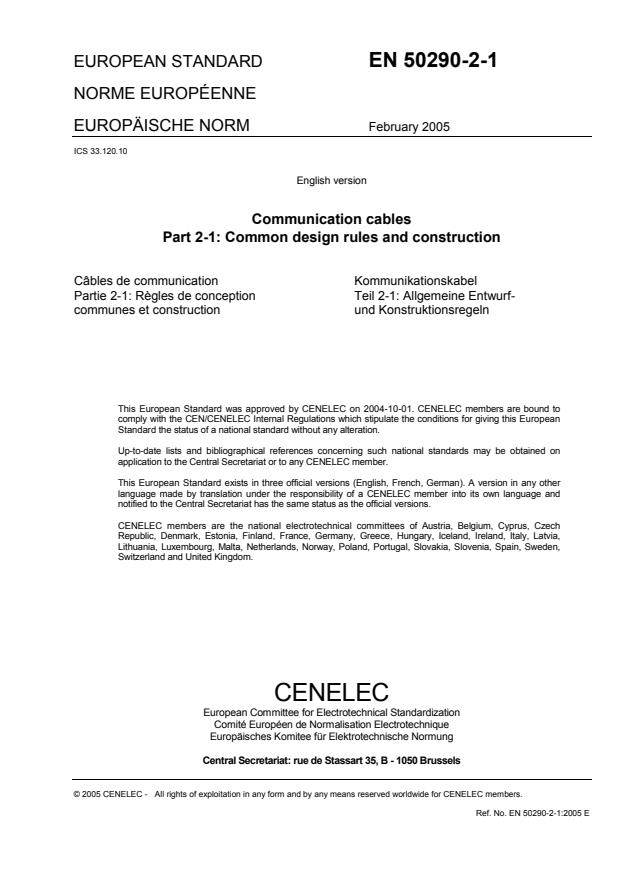
EUROPEAN STANDARD EN 50290-2-1
NORME EUROPÉENNE
EUROPÄISCHE NORM February 2005
ICS 33.120.10
English version
Communication cables
Part 2-1: Common design rules and construction
Câbles de communication Kommunikationskabel
Partie 2-1: Règles de conception Teil 2-1: Allgemeine Entwurf-
communes et construction und Konstruktionsregeln
This European Standard was approved by CENELEC on 2004-10-01. CENELEC members are bound to
comply with the CEN/CENELEC Internal Regulations which stipulate the conditions for giving this European
Standard the status of a national standard without any alteration.
Up-to-date lists and bibliographical references concerning such national standards may be obtained on
application to the Central Secretariat or to any CENELEC member.
This European Standard exists in three official versions (English, French, German). A version in any other
language made by translation under the responsibility of a CENELEC member into its own language and
notified to the Central Secretariat has the same status as the official versions.
CENELEC members are the national electrotechnical committees of Austria, Belgium, Cyprus, Czech
Republic, Denmark, Estonia, Finland, France, Germany, Greece, Hungary, Iceland, Ireland, Italy, Latvia,
Lithuania, Luxembourg, Malta, Netherlands, Norway, Poland, Portugal, Slovakia, Slovenia, Spain, Sweden,
Switzerland and United Kingdom.
CENELEC
European Committee for Electrotechnical Standardization
Comité Européen de Normalisation Electrotechnique
Europäisches Komitee für Elektrotechnische Normung
Central Secretariat: rue de Stassart 35, B - 1050 Brussels
© 2005 CENELEC - All rights of exploitation in any form and by any means reserved worldwide for CENELEC members.
Ref. No. EN 50290-2-1:2005 E
Foreword
This European Standard was prepared by the Technical Committee CENELEC TC 46X, Communication
cables.
The text of the draft was submitted to the formal vote and was approved by CENELEC as EN 50290-2-1 on
2004-10-01.
The following dates were fixed:
– latest date by which the EN has to be implemented
at national level by publication of an identical
national standard or by endorsement (dop) 2005-10-01
– latest date by which the national standards conflicting
with the EN have to be withdrawn (dow) 2007-10-01
This European Standard has been prepared under the European Mandate M/212 given to CENELEC by the
European Commission and the European Free Trade Association.
___________
- 3 - EN 50290-2-1:2005
Contents
Introduction .5
1 Scope.6
2 Normative references.6
3 Definitions.6
4 Common design rules.6
4.1 Materials.6
4.1.1 Conductor materials.6
4.1.2 Optical fibres.8
4.1.3 Taping / fillers.8
4.1.4 Insulating and sheathing materials.8
4.1.5 Messenger wires.8
4.1.6 Armour.9
4.2 Cable make-up.10
4.2.1 General design.10
4.2.2 Sheathing .10
4.2.3 Marking.10
5 Register of symbols used.11
6 Material constants.13
6.1 Table of material constants relating to dielectric and sheath and their values
for different materials .13
6.2 Tables of material constants relating to conductors.14
6.3 Construction constants.15
6.3.1 Table of construction constants relating to inner conductor.15
6.3.2 Table of construction constants relating to braided outer conductors and screens.15
6.4 Braid wire dimensions .15
6.5 Attenuation factors .16
6.6 Maximum permissible input power/ current carrying capacity.16
6.6.1 Coaxial cables.16
6.6.2 Balanced cables.18
7 Standard values of characteristic impedance and outer diameter of dielectric for
coaxial cables .18
7.1 Impedance of coaxial cables.18
7.2 Nominal diameters over dielectric of coaxial cables .18
8 Coaxial cable construction details .20
8.1 General.20
8.2 Inner conductor.20
8.3 Stranded inner conductor.20
8.4 Braided outer conductor.21
8.5 Medium between outer conductor and screen .21
8.6 Braided screen .21
8.7 Sheath.22
8.8 Attenuation.22
8.9 Nominal characteristic impedance z and capacitance c per unit length.23
o 2
9 Standard values of characteristic impedance and outer diameter of dielectric
for symmetrical cables.23
9.1 Impedance of symmetrical cables.23
10 Symmetrical cable construction details .24
10.1 Attenuation.25
11 Common characteristics.25
11.1 Weight calculation .25
12 Calculation of electrical properties.26
12.1 DC resistance of conductors and screen, per unit length.26
12.2 Permissible voltages.26
12.2.1 Test voltage, dielectric, u .26
t
12.2.2 Discharge test voltage, dielectric, u .27
d
12.2.3 Test voltage, sheath.27
- 5 - EN 50290-2-1:2005
Introduction
EN 50290-2-1 series gives directly or by reference all common requirements for communication
cables.
It is completed by generic, sectional, family and detail specifications, as appropriate, to describe in a
detailed manner each type of cables with its specific characteristics.
EN 50290, which is the basic reference standard for communication cables, consists of the following
parts:
– Part 1-1 General
– Part 1-2 Definitions
– Part 2-1 Common design rules and construction
– Part 2-1X Materials
– Part 3 Quality assessment
– Part 4-1 Environmental conditions and safety aspects
– Part 4-2 Guide for use
The test methods are described in the basic reference standard EN 50289, Communication cables -
Specifications for test methods, which consists of the following parts:
– Part 1-X Electrical test methods
– Part 2-X Transmission and optical test methods
– Part 3-X Mechanical test methods
– Part 4-X Environmental test methods
1 Scope
This European Standard harmonises the standardisation of symmetrical, coaxial and optical cables
used for the infrastructure of communication, multimedia and control networks. Most of the cables
covered by this European Standard are primarily intended to be used in IT networks. However, they
can also be used for other applications with the exception of those which presume a direct
connection to the mains electricity supply.
EN 50290-2-1 gives the common rules for the design and construction of symmetrical, coaxial and
optical cables used for the infrastructure of communication and control networks.
It is to be used in conjunction with EN 50290-1-1 and is completed by generic, sectional, family and
detail specifications, as appropriate, to describe in a detailed manner each type of cable with its
specific characteristics.
2 Normative references
The following referenced documents are indispensable for the application of this document. For
dated references, only the edition cited applies. For undated references, the latest edition of the
referenced document (including any amendments) applies.
EN 50290-1-2 Communication cables - Part 1-2: Definitions
EN 50290-2-23 Part 2-23: Materials - PE insulation
EN 50290-2-24 Part 2-24: Materials - PE sheathing
EN 50290-2-25 Part 2-25: Materials - Polypropylene insulation compounds
EN 50290-2-26 Part 2-26: Materials - Halogen free flame retardant insulation compounds
EN 50290-2-27 Part 2-27: Materials - Halogen free flame retardant thermoplastic sheathing
compounds
IEC 60304 Standard colours for insulation for low-frequency cables and wires
IEC 60028 International standard of resistance for copper
IEC 60793-1 Optical fibres - Part 1: Generic specification.
3 Definitions
For the purpose of this standard, the definitions given in EN 50290-1-2 apply.
4 Common design rules
4.1 Materials
4.1.1 Conductor materials
4.1.1.1 Wires and inner conductors
The construction and material of wires or inner conductor shall be specified in the relevant
specification.
- 7 - EN 50290-2-1:2005
The conductor shall be either solid or stranded annealed copper. The conductivity of the copper shall
be in accordance with IEC 60028.
Alternatively, the conductor shall consist of copper-clad steel. The layer of copper cladding shall be
continuous, and shall adhere to the steel; the cross-section shall be circular, such that the maximum
resistance of the clad conductor shall not exceed that given for copper conductor, in accordance with
IEC 60028, by more than a factor of 4,8, 3,5 and 2,8, respectively, for 21 % (minimum), 30 %, and
40 % nominal conductivity grade copper-clad steel. The percentage elongation at break, when tested
in accordance with test methods given in 9.7 shall be not less than 1 %. The minimum tensile
strength shall be 827 N/mm², 792 N/mm², 760 N/mm² for 21 %, 30 %, and 40 % grade, respectively.
Alternatively, the conductor shall consist of copper clad aluminium. The layer of copper cladding shall
be continuous, and shall adhere to the aluminium, the cross section shall be circular, such that the
maximum resistance of the clad conductor shall not exceed that given for copper conductor, in
accordance with IEC 60028, by more than a factor of 1.8. The percentage elongation at break, when
tested in accordance with test methods given in 9.6 shall not be less than 1 %.
Conductor joints made after the last drawing operation are not allowed.
The stranded conductor shall consist of wires circular in section and assembled, without insulation
between them, by concentric stranding or bunching.
The individual wires of the solid or stranded conductor may be plain or metal-coated.
4.1.1.2 Outer conductor or screen
The construction and material of the outer conductor and/or screen shall be specified in the detail
specification.
The outer conductor or screen may be
a) a single or double braid of plain or metal coated annealed copper wire. Joints in the braiding
wires shall be soldered, twisted or woven-in and there shall be no joint in the complete braid.
The braid shall be evenly applied. The braid angle and the filling factor shall be specified in the
detail specification,
b) a copper or aluminium tape formed round the core as a continuous and closed screen with a
sufficient overlap bonded or not bonded as specified in the detail specification,
c) a high permeability alloy tape, helically wound with overlap,
d) a gas-tight tube of copper or aluminium material (i.e. extruded, welded smooth or corrugated),
e) a layer of metal foil or metallised film applied with a sufficient overlap bonded or not bonded,
covered with a copper braid as in item a) above. When the metal foil or the film is in copper, the
braid shall be in copper. When the metal foil or the film is in aluminium, the braid shall be in
aluminium or tinned copper. The braid shall always be in contact with metal,
f) a screen as described in d) with two layers of bi-directional helically wound wires instead of
braid,
g) any combination of these.
4.1.2 Optical fibres
Optical fibres shall be uniform in quality and their characteristics shall meet the requirements of
IEC 60793-2-XX.
4.1.3 Taping / Fillers
Tapes and/or fillers may be used to achieve a circular cross section of the cable, and/or to prevent
moisture ingress and/or to achieve the required electrical, mechanical and environmental
performance. They usually consist of plastic, fibreglass, aromatic polyamide, or swellable material
depending upon the intended use.
The relevant specification shall give details of the taping and fillers to be used.
4.1.4 Insulating and sheathing materials
The insulation and outer sheath of the cable shall be of a suitable material as specified in the
relevant cable specification.
It may be solid, cellular, or composite (e.g. foam skin, plastic/metal composite).
Unless otherwise specified, plastic materials for sheath and insulation shall comply with the relevant
part of EN 50290-2-XX.
The insulation and sheath shall have appropriate mechanical characteristics before and after ageing
within the temperature limits to which it may be exposed to normal use.
4.1.5 Messenger wires
4.1.5.1 Design
This standard specifies requirements for aerial messenger wires.
Messenger wires shall consist of either a strand (wires twisted together with a uniform lay) or a single
wire. Messenger wire may consist of metallic or non-metallic materials.
In case of metallic material, the material used shall consist of either aluminium alloy or steel which
may be galvanised. Interstices between the stranded wires may be bituminised as an available
option.
Unless otherwise specified in the relevant detail specification, wires in the outer layer of strands shall
have a left-hand lay (S strand) and in case of strands with more than seven wires, the lay direction
shall alternate for each successive layer.
- 9 - EN 50290-2-1:2005
In the case of a Figure 8-shaped design as shown below, unless otherwise specified in the detail
specification, the height (a) and the thickness (b) of the web should be in accordance with Table 1.
Table 1
Web dimension in mm
(a) (b)
Min. Max. Min. Max.
3 5 2 4
Outer diameter of the cable
4.1.5.2 Information to be supplied
The following information shall be given in the relevant detail specification.
• strand and wire diameter mm;
• cross section mm²;
• nominal overall messenger diameter and tolerances mm;
• approximate mass kg/km;
• breaking load kN;
• effective modulus of elasticity kN/ mm²;
• coefficient of linear expansion 1/°C.
• wire material
4.1.6 Armour
Where additional tensile strength or protection from external damage is required, armouring shall be
provided.
Examples of armour include:
• steel tapes;
• steel wires;
• re-inforced glass fibre;
• corrugated steel;
• aramid yarns;
• and any combination of them.
The relevant cable specification shall give details of the armour construction and materials to be
used.
4.2 Cable make-up
4.2.1 General design
Communication cables shall be essentially round or flat. They can be formed as
• single element of pair/quad, coaxial or optical fibre cable,
• multi-element of pairs/quads, coaxial or optical fibre cable,
• a combination of two or more of these elements (hybrid cables).
Each of the elements shall comply with the relevant generic and sectional specifications.
The direction of lay may be right (Z) or left (S) hand and may be changed at intervals throughout the
length of the cable (SZ). The use of fillers is optional. Different conductors coaxial and optical fibre
elements may be insulated or sheathed with different materials.
Although any standardised conductor diameter, within the range given in the generic and sectional
specification, may be used, the acceptable dimension for the intended connector or termination
hardware shall be taken into account.
When optical fibre elements are assembled with other electrical conductors in a common layer, they
shall be cabled with the same direction and lay length as the electrical conductors.
Internal or external electromagnetic behaviour of the cable can require a common screen or
individual screens or a combination of them. The screens shall be described only in terms of their
electromagnetic performance (coupling attenuation/screening attenuation for frequency above
30 MHz and transfer impedance for frequency below 30 MHz).
To help the design of connectors and connecting terminations information about the design of
screens should be given in the relevant cable specification.
4.2.2 Sheathing
A cable sheath shall consist of a continuous outer covering consisting of a material complying with
the requirements specified in EN 50290-2-XX. The sheath shall be uniform and shall not have any
defects that are visible with normal or corrected vision without magnification.
The sheath shall be applied to fit closely to the cable core. In the case of screened cables, the
sheath shall not adhere to the screen except when it is intentionally bonded to it.
4.2.3 Marking
Marking may be required by local regulations (e.g. CE marking), systems specifications or by
agreement between customers and suppliers.
- 11 - EN 50290-2-1:2005
5 Register of symbols used
Symbol Designation Unit
α Total attenuation per unit length, 20 °C . dB/m
α Total attenuation per unit length, T ≠ 20 °C . dB/m
T
α Attenuation due to element x, 20 °C. dB/m
x
β Braid angle of element x. ° (degree)
x
γ Density of the material of element x . g/cm
x
δ Loss angle of the material of element x . rad
x
ε Relative dielectric permittivity of the material of element x . –
x
χ Conductivity of the material of element x, 20 °C. m/Ωmm
x
σ Thermal resistivity of the material of element x . K⋅m/W
x
B Braid coverage concerning element x. –
x
C Velocity of propagation in free space . m/s
o
C Capacitance of element x, per unit lengt
...