

EN IEC 60079-29-0:2026
(Main)Explosive atmospheres - Part 29-0: Gas detection equipment - General requirements and test methods
General Information
- Abstract
IEC 60079-29-0:2025 specifies general requirements, test methods and acceptance criteria that apply to flammable, oxygen and toxic gas detection equipment intended to detect gases and vapours and to provide an indication, alarm or other output function for personnel or property protection in industrial and commercial applications. This document applies to the following gas detection equipment: – Gas detection equipment Type "FL" intended for the detection of flammable gases: • Type FL-Group I, in mines susceptible to firedamp; • Type FL-Group II, in locations other than mines susceptible to firedamp; and • Type FL-OP, open path gas detection equipment for flammable gases. – Gas detection equipment Type "O2" intended for the detection of Oxygen: • Type O2-DE, detection of oxygen deficiency or oxygen enrichment; and • Type O2-IN, inertisation as measuring function for explosion protection. – Gas detection equipment Type "TX" intended for the detection of toxic gases: • Type TX-SM, detection in areas for safety monitoring applications and typically using alarm signalling; • Type TX-HM, occupational exposure measurement in the region of occupational exposure limit values; and • Type TX-OP, open path gas detection equipment for toxic gases. This document is not applicable to equipment: – used for medical applications; – used only in laboratories for analysis or measurement; – used only for process monitoring or control purposes (such as a gas analyser); – used in the domestic environment; – used in environmental air pollution monitoring; – used for flue gas analysis; – used for sampling systems external to the gas detection equipment; – with samplers and concentrators such as sorbents or paper tape having an irreversible indication; – consisting of a passive optical receiver without a dedicated optical source; – equipment within the scope of IEC 60335-2-40 and IEC 60335-2-89. This first edition of IEC 60079-29-0 cancels and replaces the second edition of 60079-29-1 published in 2016 and its Amendment 1:2020, and the first edition of IEC 60079-29-4 published in 2009. In addition, IEC 60079-29-0 Type TX-SM cancels and replaces Type SM of the first edition of IEC 62990-1.
- Status
- Published
- Publication Date
- 15-Jan-2026
- Current Stage
- 6060 - Document made available - Publishing
- Start Date
- 16-Jan-2026
- Due Date
- 01-Oct-2026
- Completion Date
- 16-Jan-2026

Overview
EN IEC 60079-29-0:2026 sets out the general requirements and test methods for gas detection equipment used to protect personnel and property from hazards related to explosive, toxic, and oxygen-deficient or -enriched atmospheres. Published by CLC and harmonized with IEC 60079-29-0:2025, this European standard provides a consolidated framework for the design, performance, and testing of gas detectors intended for industrial and commercial environments.
The standard applies to various types of gas detection equipment, including those for flammable, oxygen, or toxic gases. By aligning and updating previous editions, it ensures enhanced consistency and safety in the detection of hazardous gases and vapours in potentially explosive atmospheres. This edition supersedes earlier related documents and serves as a reference for manufacturers, users, and regulators in the industry.
Key Topics
- General Requirements: Defines essential design features and performance characteristics for gas detectors, such as indicating, alarming, and fault signalling functions.
- Test Methods: Includes standardized procedures for evaluating the reliability and functionality of gas detection equipment under controlled laboratory conditions, covering aspects like vibration, drop resistance, environmental influences, and response time.
- Classification: Outlines different equipment types:
- Type FL: Flammable gas detectors (for mines, general locations, and open path detection)
- Type O2: Oxygen detectors (for deficiency/enrichment and inertization)
- Type TX: Toxic gas detectors (for safety monitoring, occupational exposure, and open path detection)
- Scope Limitations: Explicitly excludes equipment designed for medical, domestic, laboratory analysis, process monitoring, flue gas, and environmental air pollution monitoring, as well as certain specialized sampling and analytical tools.
- Documentation and Marking: Stipulates requirements for clear instructions, device labeling, and safety-related documentation for end users.
Applications
The EN IEC 60079-29-0:2026 standard is applicable across a wide range of sectors that deal with hazardous atmosphere risks, including:
- Industrial Safety: Fixed and portable gas detectors provide early warning and automatic response in facilities such as chemical plants, refineries, power stations, and manufacturing sites.
- Mining Industry: Specialized equipment for mines susceptible to firedamp ensures robust protection against flammable gases.
- Commercial Facilities: Monitoring of confined spaces, storage areas, and maintenance zones to minimize health and explosion risks.
- Occupational Exposure Monitoring: Devices built to this standard can be used to assess workplace exposure to toxic gases and support compliance with occupational health regulations.
- Explosion Protection: Implementation of oxygen monitoring and inertisation systems in environments at risk of forming explosive atmospheres.
- Open Path Detection: Solutions enabling continuous monitoring over wide areas, enhancing safety coverage for large sites.
By adhering to the requirements and test methods specified, manufacturers improve the dependability and interoperability of gas detection systems, while end users gain increased confidence in safety-critical applications.
Related Standards
Standards related to EN IEC 60079-29-0:2026 support a comprehensive approach to equipment selection, installation, use, and maintenance:
- EN IEC 60079-29-2: Selection, installation, use, and maintenance of detectors for flammable gases and oxygen.
- EN IEC 62990-2: Gas detectors for toxic gases and vapours - selection, installation, use, and maintenance.
- EN IEC 60079-0: General requirements for equipment intended for use in explosive atmospheres.
- IEC 60529: Degrees of protection provided by enclosures (IP Code).
- EN IEC 61326-1: EMC requirements for measurement and control equipment.
- EN ISO/IEC 80079-20-1: Material characteristics for gas and vapour classification.
Compliance with this standard, alongside relevant referenced documents, is essential for organizations aiming to achieve and demonstrate high standards in gas detection system reliability, worker safety, and explosion risk management.
Relations
- Effective Date
- 30-Dec-2025
- Effective Date
- 30-Dec-2025
- Effective Date
- 30-Jul-2024
- Effective Date
- 30-Jul-2024
- Effective Date
- 30-Jul-2024
- Effective Date
- 30-Jul-2024
- Effective Date
- 15-Sep-2026
- Effective Date
- 10-Feb-2026
- Effective Date
- 09-Feb-2026
- Effective Date
- 03-Feb-2026
- Effective Date
- 03-Feb-2026
- Effective Date
- 03-Feb-2026
- Effective Date
- 03-Feb-2026
- Effective Date
- 03-Feb-2026
- Effective Date
- 03-Feb-2026
Get Certified
Connect with accredited certification bodies for this standard

IMQ S.p.A. (Certification)
Italian electrical product certification.

SLG Prüf- und Zertifizierungs GmbH
German testing and certification body.

UL Solutions
Global safety science company with testing, inspection and certification.
Sponsored listings
Frequently Asked Questions
EN IEC 60079-29-0:2026 is a standard published by CLC. Its full title is "Explosive atmospheres - Part 29-0: Gas detection equipment - General requirements and test methods". This standard covers: IEC 60079-29-0:2025 specifies general requirements, test methods and acceptance criteria that apply to flammable, oxygen and toxic gas detection equipment intended to detect gases and vapours and to provide an indication, alarm or other output function for personnel or property protection in industrial and commercial applications. This document applies to the following gas detection equipment: – Gas detection equipment Type "FL" intended for the detection of flammable gases: • Type FL-Group I, in mines susceptible to firedamp; • Type FL-Group II, in locations other than mines susceptible to firedamp; and • Type FL-OP, open path gas detection equipment for flammable gases. – Gas detection equipment Type "O2" intended for the detection of Oxygen: • Type O2-DE, detection of oxygen deficiency or oxygen enrichment; and • Type O2-IN, inertisation as measuring function for explosion protection. – Gas detection equipment Type "TX" intended for the detection of toxic gases: • Type TX-SM, detection in areas for safety monitoring applications and typically using alarm signalling; • Type TX-HM, occupational exposure measurement in the region of occupational exposure limit values; and • Type TX-OP, open path gas detection equipment for toxic gases. This document is not applicable to equipment: – used for medical applications; – used only in laboratories for analysis or measurement; – used only for process monitoring or control purposes (such as a gas analyser); – used in the domestic environment; – used in environmental air pollution monitoring; – used for flue gas analysis; – used for sampling systems external to the gas detection equipment; – with samplers and concentrators such as sorbents or paper tape having an irreversible indication; – consisting of a passive optical receiver without a dedicated optical source; – equipment within the scope of IEC 60335-2-40 and IEC 60335-2-89. This first edition of IEC 60079-29-0 cancels and replaces the second edition of 60079-29-1 published in 2016 and its Amendment 1:2020, and the first edition of IEC 60079-29-4 published in 2009. In addition, IEC 60079-29-0 Type TX-SM cancels and replaces Type SM of the first edition of IEC 62990-1.
IEC 60079-29-0:2025 specifies general requirements, test methods and acceptance criteria that apply to flammable, oxygen and toxic gas detection equipment intended to detect gases and vapours and to provide an indication, alarm or other output function for personnel or property protection in industrial and commercial applications. This document applies to the following gas detection equipment: – Gas detection equipment Type "FL" intended for the detection of flammable gases: • Type FL-Group I, in mines susceptible to firedamp; • Type FL-Group II, in locations other than mines susceptible to firedamp; and • Type FL-OP, open path gas detection equipment for flammable gases. – Gas detection equipment Type "O2" intended for the detection of Oxygen: • Type O2-DE, detection of oxygen deficiency or oxygen enrichment; and • Type O2-IN, inertisation as measuring function for explosion protection. – Gas detection equipment Type "TX" intended for the detection of toxic gases: • Type TX-SM, detection in areas for safety monitoring applications and typically using alarm signalling; • Type TX-HM, occupational exposure measurement in the region of occupational exposure limit values; and • Type TX-OP, open path gas detection equipment for toxic gases. This document is not applicable to equipment: – used for medical applications; – used only in laboratories for analysis or measurement; – used only for process monitoring or control purposes (such as a gas analyser); – used in the domestic environment; – used in environmental air pollution monitoring; – used for flue gas analysis; – used for sampling systems external to the gas detection equipment; – with samplers and concentrators such as sorbents or paper tape having an irreversible indication; – consisting of a passive optical receiver without a dedicated optical source; – equipment within the scope of IEC 60335-2-40 and IEC 60335-2-89. This first edition of IEC 60079-29-0 cancels and replaces the second edition of 60079-29-1 published in 2016 and its Amendment 1:2020, and the first edition of IEC 60079-29-4 published in 2009. In addition, IEC 60079-29-0 Type TX-SM cancels and replaces Type SM of the first edition of IEC 62990-1.
EN IEC 60079-29-0:2026 is classified under the following ICS (International Classification for Standards) categories: 29.260.20 - Electrical apparatus for explosive atmospheres. The ICS classification helps identify the subject area and facilitates finding related standards.
EN IEC 60079-29-0:2026 has the following relationships with other standards: It is inter standard links to EN 50104:2019, EN 50104:2019/A1:2023, EN 60079-29-4:2010, EN 60079-29-1:2016/A1:2022, EN 60079-29-1:2016, EN 60079-29-1:2016/A11:2022, EN IEC 61000-4-29:2026, IEC 62990-1:2019, EN ISO/IEC 80079-20-1:2019, EN 61000-4-29:2000, EN IEC 61326-1:2021, EN 60068-2-6:2008, EN IEC 62990-2:2021, EN IEC 60079-0:2018, EN 60079-29-2:2015. Understanding these relationships helps ensure you are using the most current and applicable version of the standard.
EN IEC 60079-29-0:2026 is available in PDF format for immediate download after purchase. The document can be added to your cart and obtained through the secure checkout process. Digital delivery ensures instant access to the complete standard document.
Standards Content (Sample)
SLOVENSKI STANDARD
01-maj-2026
Eksplozivne atmosfere - 29-0. del: Oprema za javljalnike plina - Splošne zahteve in
preskusne metode (IEC 60079-29-0:2025)
Explosive atmospheres - Part 29-0: Gas detection equipment -General requirements and
test methods (IEC 60079-29-0:2025)
Explosionsgefährdete Bereiche - Teil 29-0: Gaswarngeräte - Allgemeine Anforderungen
und Prüfverfahren und mögliche ergänzende Normenteile (IEC 60079-29-0:2025)
Atmosphères explosives - Partie 29-0: Détecteurs de gaz - Exigences générales et
méthodes d'essai (IEC 60079-29-0:2025)
Ta slovenski standard je istoveten z: EN IEC 60079-29-0:2026
ICS:
13.320 Alarmni in opozorilni sistemi Alarm and warning systems
29.260.20 Električni aparati za Electrical apparatus for
eksplozivna ozračja explosive atmospheres
2003-01.Slovenski inštitut za standardizacijo. Razmnoževanje celote ali delov tega standarda ni dovoljeno.
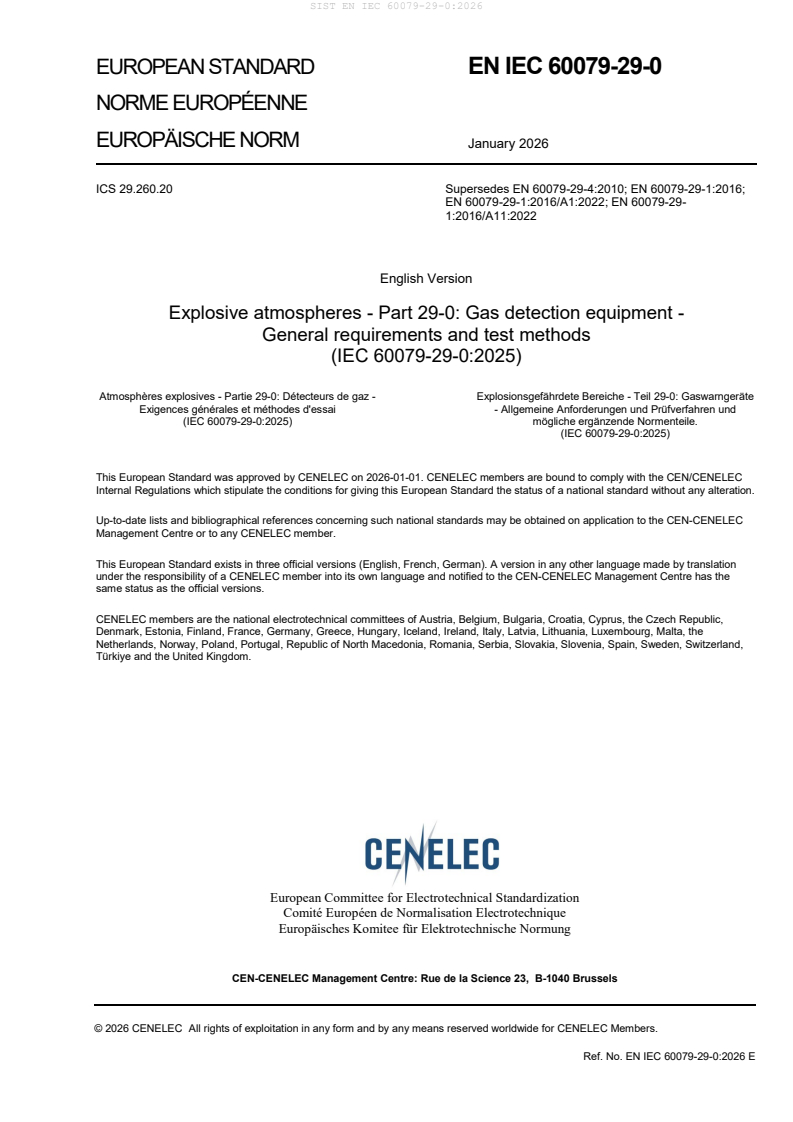
EUROPEAN STANDARD EN IEC 60079-29-0
NORME EUROPÉENNE
EUROPÄISCHE NORM January 2026
ICS 29.260.20 Supersedes EN 60079-29-4:2010; EN 60079-29-1:2016;
EN 60079-29-1:2016/A1:2022; EN 60079-29-
1:2016/A11:2022
English Version
Explosive atmospheres - Part 29-0: Gas detection equipment -
General requirements and test methods
(IEC 60079-29-0:2025)
Atmosphères explosives - Partie 29-0: Détecteurs de gaz - Explosionsgefährdete Bereiche - Teil 29-0: Gaswarngeräte
Exigences générales et méthodes d'essai - Allgemeine Anforderungen und Prüfverfahren und
(IEC 60079-29-0:2025) mögliche ergänzende Normenteile.
(IEC 60079-29-0:2025)
This European Standard was approved by CENELEC on 2026-01-01. CENELEC members are bound to comply with the CEN/CENELEC
Internal Regulations which stipulate the conditions for giving this European Standard the status of a national standard without any alteration.
Up-to-date lists and bibliographical references concerning such national standards may be obtained on application to the CEN-CENELEC
Management Centre or to any CENELEC member.
This European Standard exists in three official versions (English, French, German). A version in any other language made by translation
under the responsibility of a CENELEC member into its own language and notified to the CEN-CENELEC Management Centre has the
same status as the official versions.
CENELEC members are the national electrotechnical committees of Austria, Belgium, Bulgaria, Croatia, Cyprus, the Czech Republic,
Denmark, Estonia, Finland, France, Germany, Greece, Hungary, Iceland, Ireland, Italy, Latvia, Lithuania, Luxembourg, Malta, the
Netherlands, Norway, Poland, Portugal, Republic of North Macedonia, Romania, Serbia, Slovakia, Slovenia, Spain, Sweden, Switzerland,
Türkiye and the United Kingdom.
European Committee for Electrotechnical Standardization
Comité Européen de Normalisation Electrotechnique
Europäisches Komitee für Elektrotechnische Normung
CEN-CENELEC Management Centre: Rue de la Science 23, B-1040 Brussels
© 2026 CENELEC All rights of exploitation in any form and by any means reserved worldwide for CENELEC Members.
Ref. No. EN IEC 60079-29-0:2026 E
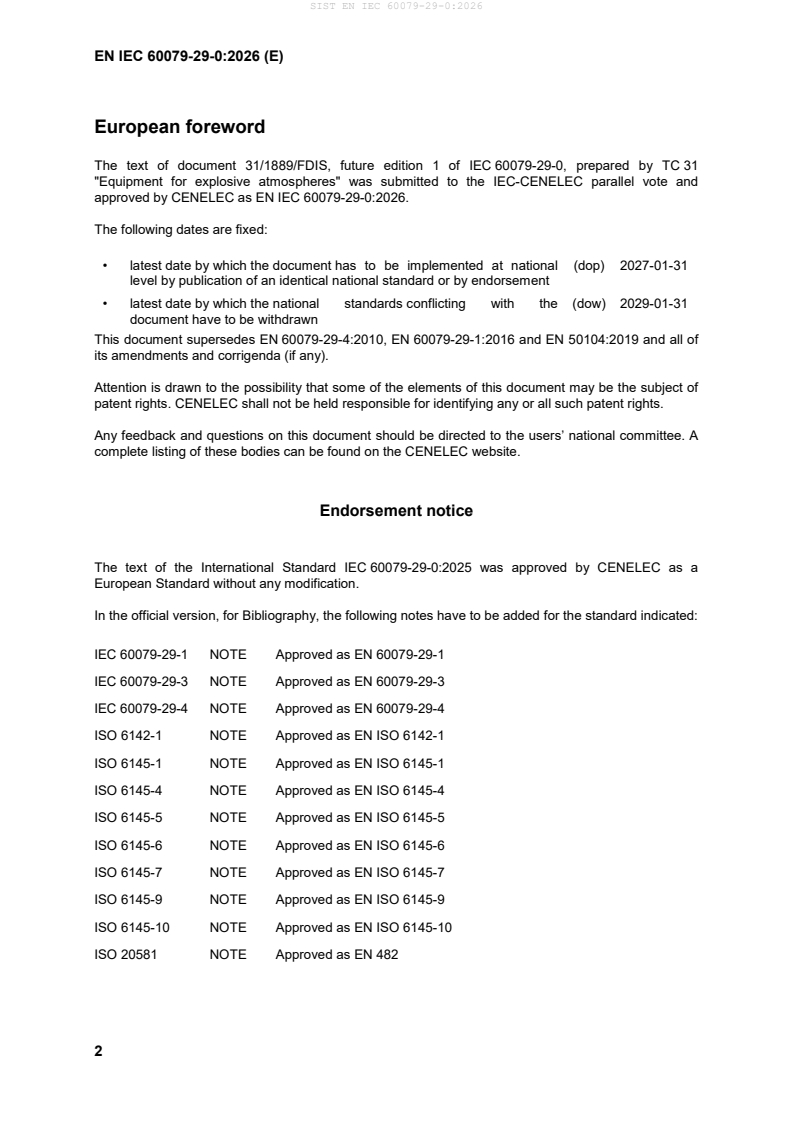
European foreword
The text of document 31/1889/FDIS, future edition 1 of IEC 60079-29-0, prepared by TC 31
"Equipment for explosive atmospheres" was submitted to the IEC-CENELEC parallel vote and
approved by CENELEC as EN IEC 60079-29-0:2026.
The following dates are fixed:
• latest date by which the document has to be implemented at national (dop) 2027-01-31
level by publication of an identical national standard or by endorsement
• latest date by which the national standards conflicting with the (dow) 2029-01-31
document have to be withdrawn
This document supersedes EN 60079-29-4:2010, EN 60079-29-1:2016 and EN 50104:2019 and all of
its amendments and corrigenda (if any).
Attention is drawn to the possibility that some of the elements of this document may be the subject of
patent rights. CENELEC shall not be held responsible for identifying any or all such patent rights.
Any feedback and questions on this document should be directed to the users’ national committee. A
complete listing of these bodies can be found on the CENELEC website.
Endorsement notice
The text of the International Standard IEC 60079-29-0:2025 was approved by CENELEC as a
European Standard without any modification.
In the official version, for Bibliography, the following notes have to be added for the standard indicated:
IEC 60079-29-1 NOTE Approved as EN 60079-29-1
IEC 60079-29-3 NOTE Approved as EN 60079-29-3
IEC 60079-29-4 NOTE Approved as EN 60079-29-4
ISO 6142-1 NOTE Approved as EN ISO 6142-1
ISO 6145-1 NOTE Approved as EN ISO 6145-1
ISO 6145-4 NOTE Approved as EN ISO 6145-4
ISO 6145-5 NOTE Approved as EN ISO 6145-5
ISO 6145-6 NOTE Approved as EN ISO 6145-6
ISO 6145-7 NOTE Approved as EN ISO 6145-7
ISO 6145-9 NOTE Approved as EN ISO 6145-9
ISO 6145-10 NOTE Approved as EN ISO 6145-10
ISO 20581 NOTE Approved as EN 482
Annex ZA
(normative)
Normative references to international publications
with their corresponding European publications
The following documents are referred to in the text in such a way that some or all of their content
constitutes requirements of this document. For dated references, only the edition cited applies. For
undated references, the latest edition of the referenced document (including any amendments)
applies.
NOTE 1 Where an International Publication has been modified by common modifications, indicated by (mod),
the relevant EN/HD applies.
NOTE 2 Up-to-date information on the latest versions of the European Standards listed in this annex is available
here: www.cencenelec.eu.
Publication Year Title EN/HD Year
IEC 60079-29-2 - Explosive atmospheres - Part 29-2: Gas EN 60079-29-2 -
detectors - Selection, installation, use and
maintenance of detectors for flammable
gases and oxygen
IEC 62990-2 - Workplace atmospheres - Part 2: Gas EN IEC 62990-2 -
detectors - Selection, installation, use and
maintenance of detectors for toxic gases
and vapours
IEC 60068-2-6 - Environmental testing - Part 2-6: Tests - EN 60068-2-6 -
Test Fc: Vibration (sinusoidal)
IEC 60079-0 - Explosive atmospheres - Part 0: EN IEC 60079-0 -
Equipment - General requirements
IEC 60529 - Degrees of protection provided by - -
enclosures (IP Code)
IEC 61000-4-29 - Electromagnetic compatibility (EMC) - Part EN 61000-4-29 -
4-29: Testing and measurement
techniques - Voltage dips, short
interruptions and voltage variations on d.c.
input power port immunity tests
IEC 61326-1 - Electrical equipment for measurement, EN IEC 61326-1 -
control and laboratory use - EMC
requirements - Part 1: General
requirements
IEC 62990-1 - Workplace atmospheres - Part 1: Gas - -
detectors - Performance requirements of
detectors for toxic gases
ISO/IEC 80079-20-1 - Explosive atmospheres - Part 20-1: EN ISO/IEC 80079- -
Material characteristics for gas and vapour 20-1
classification - Test methods and data
IEC 60079-29-0 ®
Edition 1.0 2025-11
INTERNATIONAL
STANDARD
Explosive atmospheres -
Part 29-0: Gas detection equipment - General requirements and test methods
ICS 29.260.20 ISBN 978-2-8327-0860-6
IEC 60079-29-0:2025-11(en)
IEC 60079-29-0:2025 © IEC 2025
CONTENTS
FOREWORD . 4
INTRODUCTION . 6
1 Scope . 7
2 Normative references . 8
3 Terms and definitions . 8
3.1 Gas properties . 8
3.2 Structure (or composition) of gas detection equipment . 9
3.3 Sensors . 11
3.4 Supply of gas to equipment. 11
3.5 Signals and alarms . 12
3.6 Times . 14
3.7 Type OP open path gas detection equipment and fixed point infrared
detectors . 15
4 General requirements. 16
4.1 Overview . 16
4.2 Design . 17
4.2.1 General. 17
4.2.2 Indicators and means of indication . 17
4.2.3 Alarm signal(s) . 19
4.2.4 Fault signals . 20
4.2.5 Special state indication . 20
4.2.6 Adjustments . 21
4.2.7 Battery-powered equipment . 21
4.2.8 Software-controlled equipment . 21
4.3 Marking . 22
4.4 Instructions . 23
5 Test methods . 26
5.1 General . 26
5.2 General requirements for tests . 26
5.2.1 Samples and sequence of tests . 26
5.2.2 Preparation of equipment before testing (all Types excluding FL-OP and
TX-OP) . 28
5.2.3 Preparation of equipment before testing (Types FL-OP and TX-OP) . 29
5.3 Normal conditions for test . 31
5.3.1 General. 31
5.3.2 Test gas(es) . 31
5.3.3 Flow rate for test gases . 33
5.3.4 Power supply . 33
5.3.5 Temperature . 33
5.3.6 Pressure . 33
5.3.7 Humidity . 33
5.3.8 Acclimation time . 34
5.3.9 Orientation . 34
5.3.10 Communications options . 34
5.4 Tests . 34
5.4.1 General. 34
5.4.2 Unpowered storage . 35
IEC 60079-29-0:2025 © IEC 2025
5.4.3 Vibration . 35
5.4.4 Drop test . 37
5.4.5 Calibration kit . 37
5.4.6 Linearity . 37
5.4.7 Alarm set-point(s) . 38
5.4.8 Stability . 39
5.4.9 Gas concentrations above the upper limit of indication . 40
5.4.10 Poisons and other gases . 41
5.4.11 Temperature . 43
5.4.12 Pressure (equipment with sensors only) . 44
5.4.13 Humidity of test gas . 44
5.4.14 Air velocity (diffusion equipment only) . 45
5.4.15 Flow rate (aspirated equipment only) . 45
5.4.16 Warm-up time . 46
5.4.17 Time of response . 46
5.4.18 Time of recovery . 47
5.4.19 Sampling probe . 47
5.4.20 Operation at or below the lower limit of measurement (Type O2-DE
only) . 47
5.4.21 Extended operation in test gas (Type TX only) . 47
5.4.22 Orientation . 48
5.4.23 Battery capacity for battery-powered equipment . 48
5.4.24 Power supply variations for externally powered equipment . 49
5.4.25 Electromagnetic immunity . 49
5.4.26 Fault signal tests . 51
5.4.27 Software controlled equipment . 53
5.4.28 Environmental protection . 53
5.4.29 Beam block fault (Type FL-OP and TX-OP except for topographic
reflection) . 54
5.4.30 Water vapour interference (Open path only) . 55
5.4.31 Alignment (Open path only except for topographic detectors) . 55
5.4.32 Partial obscuration (Open path only) . 56
5.4.33 Long range operation (Open path only) . 56
5.4.34 Direct solar radiation (Open path only) . 56
5.4.35 Signal intensity variation (Open path topographic reflection only) . 57
5.4.36 Scanning performance (Open path topographic reflection only) . 57
Annex A (normative) Acceptance criteria for Type FL . 58
A.1 Type FL-Group I . 58
A.2 Type FL-Group II . 60
A.3 Type FL-Group II hydrogen . 63
Annex B (normative) Acceptance criteria for Type O2 . 66
Annex C (normative) Acceptance criteria for Type TX . 69
Annex D (normative) Acceptance criteria for Type FL-OP and Type TX-OP . 71
Annex E (normative) Gas specific performance requirements . 73
Annex F (normative) Determination of time of response and time of recovery . 74
F.1 General . 74
F.2 Calculation of times of response and times of recovery . 74
F.3 Pressure, temperature and gas velocities . 75
F.4 Time of response and time of recovery methods for diffusion equipment. 75
IEC 60079-29-0:2025 © IEC 2025
F.4.1 Calibration mask method 1 . 75
F.4.2 Calibration mask method 2 . 76
F.4.3 Flow method . 77
F.4.4 Injection method . 78
F.5 Time of response and time of recovery methods for aspirated equipment . 78
F.5.1 Test rig . 78
F.5.2 Equipment without internal pump . 78
F.5.3 Equipment with internal pump . 79
F.6 Open path detection equipment (Types FL-OP and TX-OP) . 80
Annex G (informative) Transient considerations . 81
G.1 Underdamped time of response . 81
G.2 Underdamped time of recovery . 83
Annex H (informative) Open path gas detection equipment water vapour test
apparatus . 86
Bibliography . 87
Figure 1 – Relationship between indication range and measuring range . 13
Figure 2 – Warm-up time in clean air (typical) . 15
Figure 3 – Warm-up time in standard test gas (typical) . 15
Figure 4 – Example of functional components of gas detection equipment . 16
Figure 5 – Gas cell for calibration and speed of response test . 30
Figure F.1 – Test chamber for calibration mask method 1 . 76
Figure F.2 – Test arrangement for calibration mask method 2 . 77
Figure F.3 – Schematic example of test chamber for flow method . 78
Figure F.4 – Schematic example of test rig for use with aspirated equipment . 79
Figure G.1 – Monotonic characteristic of overdamped or critically damped time
response . 81
Figure G.2 – Underdamped time response . 83
Figure G.3 – Determination of time of recovery for the normal case, the deadband case
and the underdamped case . 85
Figure H.1 – Example of water vapour test apparatus . 86
Table 1 – Indicators . 17
Table 2 – Test samples and sequence of tests . 26
Table A.1 – Acceptance criteria for Type FL-Group I . 58
Table A.2 – Acceptance criteria for Type FL-Group II . 60
Table A.3 – Acceptance criteria for Type FL-Group II hydrogen . 63
Table B.1 – Acceptance criteria for Type O2 equipment (Type O2-DE & Type O2-IN) . 66
Table C.1 – Acceptance criteria for Type TX equipment (Type TX-SM & Type TX-HM) . 69
Table D.1 – Acceptance criteria for Type FL-OP & Type TX-OP . 71
Table E.1 – Gas specific performance requirements . 73
IEC 60079-29-0:2025 © IEC 2025
INTERNATIONAL ELECTROTECHNICAL COMMISSION
____________
Explosive atmospheres -
Part 29-0: Gas detection equipment -
General requirements and test methods
FOREWORD
1) The International Electrotechnical Commission (IEC) is a worldwide organization for standardization comprising
all national electrotechnical committees (IEC National Committees). The object of IEC is to promote international
co-operation on all questions concerning standardization in the electrical and electronic fields. To this end and
in addition to other activities, IEC publishes International Standards, Technical Specifications, Technical Reports,
Publicly Available Specifications (PAS) and Guides (hereafter referred to as “IEC Publication(s)”). Their
preparation is entrusted to technical committees; any IEC National Committee interested in the subject dealt with
may participate in this preparatory work. International, governmental and non-governmental organizations liaising
with the IEC also participate in this preparation. IEC collaborates closely with the International Organization for
Standardization (ISO) in accordance with conditions determined by agreement between the two organizations.
2) The formal decisions or agreements of IEC on technical matters express, as nearly as possible, an international
consensus of opinion on the relevant subjects since each technical committee has representation from all
interested IEC National Committees.
3) IEC Publications have the form of recommendations for international use and are accepted by IEC National
Committees in that sense. While all reasonable efforts are made to ensure that the technical content of IEC
Publications is accurate, IEC cannot be held responsible for the way in which they are used or for any
misinterpretation by any end user.
4) In order to promote international uniformity, IEC National Committees undertake to apply IEC Publications
transparently to the maximum extent possible in their national and regional publications. Any divergence between
any IEC Publication and the corresponding national or regional publication shall be clearly indicated in the latter.
5) IEC itself does not provide any attestation of conformity. Independent certification bodies provide conformity
assessment services and, in some areas, access to IEC marks of conformity. IEC is not responsible for any
services carried out by independent certification bodies.
6) All users should ensure that they have the latest edition of this publication.
7) No liability shall attach to IEC or its directors, employees, servants or agents including individual experts and
members of its technical committees and IEC National Committees for any personal injury, property damage or
other damage of any nature whatsoever, whether direct or indirect, or for costs (including legal fees) and
expenses arising out of the publication, use of, or reliance upon, this IEC Publication or any other IEC
Publications.
8) Attention is drawn to the Normative references cited in this publication. Use of the referenced publications is
indispensable for the correct application of this publication.
9) IEC draws attention to the possibility that the implementation of this document may involve the use of (a)
patent(s). IEC takes no position concerning the evidence, validity or applicability of any claimed patent rights in
respect thereof. As of the date of publication of this document, IEC had not received notice of (a) patent(s), which
may be required to implement this document. However, implementers are cautioned that this may not represent
the latest information, which may be obtained from the patent database available at https://patents.iec.ch. IEC
shall not be held responsible for identifying any or all such patent rights.
IEC 60079-29-0 has been prepared by the IEC technical committee 31: Equipment for explosive
atmospheres. It is an International Standard.
This first edition of IEC 60079-29-0 cancels and replaces the second edition of 60079-29-1
published in 2016 and its Amendment 1:2020, and the first edition of IEC 60079-29-4 published
in 2009. In addition, IEC 60079-29-0 Type TX-SM cancels and replaces Type SM of the first
edition of IEC 62990-1; however, Type TX-HM will remain within the standard.
IEC 60079-29-0:2025 © IEC 2025
The text of this International Standard is based on the following documents:
Draft Report on voting
31/1889/FDIS 31/1935/RVD
Full information on the voting for its approval can be found in the report on voting indicated in
the above table.
The language used for the development of this International Standard is English.
This document was drafted in accordance with ISO/IEC Directives, Part 2, and developed in
accordance with ISO/IEC Directives, Part 1 and ISO/IEC Directives, IEC Supplement, available
at www.iec.ch/members_experts/refdocs. The main document types developed by IEC are
described in greater detail at www.iec.ch/publications.
Users of this document are advised that interpretation sheets clarifying the interpretation of this
document can be published. Interpretation sheets are available from the IEC webstore and can
be found in the "history" tab of the page for each document.
A list of all parts in the IEC 60079-29 series, published under the general title Explosive
atmospheres, can be found on the IEC website.
The committee has decided that the contents of this document will remain unchanged until the
stability date indicated on the IEC website under webstore.iec.ch in the data related to the
specific document. At this date, the document will be
– reconfirmed,
– withdrawn, or
– revised.
IEC 60079-29-0:2025 © IEC 2025
INTRODUCTION
This part of IEC 60079-29 specifies general requirements, test methods and acceptance criteria
that apply to flammable, oxygen and toxic gas detection equipment intended to detect gases
and vapours and to provide an indication, alarm or other output function for personnel or
property protection in industrial and commercial applications. This part of IEC 60079-29 was
developed for the purpose of aligning requirements and test methods of gas detection
equipment within a single consolidated document for consistency.
Although a wide range of conditions can be encountered in practice, this document specifies
requirements to be fulfilled by gas detection equipment when tested under prescribed laboratory
conditions.
General and performance requirements for Type TX-HM gas detection equipment intended for
occupational exposure measurement in the region of Occupational Exposure Limit Values are
set out in IEC 62990-1.
Consideration needs to also be given to the following relevant international standards:
IEC 60079-29-2, Explosive atmospheres - Part 29-2: Gas detectors - Selection, installation, use
and maintenance of detectors for flammable gases and oxygen
IEC 62990-2, Workplace atmospheres - Part 2: Gas detectors - Selection, installation, use and
maintenance of detectors for toxic gases and vapours
IEC 60079-29-3, Explosive atmospheres - Part 29-3: Gas detectors - Guidance on functional
safety of fixed gas detection systems
IEC 60079-29-0:2025 © IEC 2025
1 Scope
This part of IEC 60079-29 specifies general requirements, test methods and acceptance criteria
that apply to flammable, oxygen and toxic gas detection equipment intended to detect gases
and vapours and to provide an indication, alarm or other output function for personnel or
property protection in industrial and commercial applications.
NOTE 1 The term gas detection equipment is often referred to as the term gas detector.
NOTE 2 The terms 'gas' and 'gases' used in this document are also intended to include 'vapour' and 'vapours'.
This document applies to the following gas detection equipment:
– Gas detection equipment Type "FL" intended for the detection of flammable gases:
• Type FL-Group I, in mines susceptible to firedamp;
• Type FL-Group II, in locations other than mines susceptible to firedamp; and
• Type FL-OP, open path gas detection equipment for flammable gases.
– Gas detection equipment Type "O2" intended for the detection of oxygen:
• Type O2-DE, detection of oxygen deficiency or oxygen enrichment; and
• Type O2-IN, inertisation as measuring function for explosion protection.
NOTE 3 Inertisation is an explosion protection technique where an explosive atmosphere is purged with inert gas.
– Gas detection equipment Type "TX" intended for the detection of toxic gases:
• Type TX-SM, detection in areas for safety monitoring applications and typically using
alarm signalling;
• Type TX-HM, occupational exposure measurement in the region of occupational
exposure limit values; and
NOTE 4 Type TX-HM gas detection equipment performance requirements reside in IEC 62990-1.
• Type TX-OP, open path gas detection equipment for toxic gases.
NOTE 5 This document addresses equipment giving a level of performance suitable for general purpose
applications. Specific applications might require particular tests or evaluations that are additional to and separate
from the compliance with this document.
NOTE 6 Although the focus of this document is gas detection equipment for use in 'explosive atmospheres', this
document can be applicable to detection in areas not formally classified as 'explosive atmospheres'.
NOTE 7 Refrigerant gas detection equipment used for life, health and safety area monitoring are within the scope
of this document or IEC 62990-1.
This document is not applicable to equipment:
– used for medical applications;
– used only in laboratories for analysis or measurement;
– used only for process monitoring or control purposes (such as a gas analyser);
– used in the domestic environment;
– used in environmental air pollution monitoring;
– used for flue gas analysis;
– used for sampling systems external to the gas detection equipment;
– with samplers and concentrators such as sorbents or paper tape having an irreversible
indication;
– consisting of a passive optical receiver without a dedicated optical source;
– equipment within the scope of IEC 60335-2-40 and IEC 60335-2-89.
IEC 60079-29-0:2025 © IEC 2025
2 Normative references
The following documents are referred to in the text in such a way that some or all of their content
constitutes requirements of this document. For dated references, only the edition cited applies.
For undated references, the latest edition of the referenced document (including any
amendments) applies.
IEC 60079-29-2, Explosive atmospheres - Part 29-2: Gas detectors - Selection, installation, use
and maintenance of detectors for flammable gases and oxygen
IEC 62990-2, Workplace atmospheres - Part 2: Gas detectors - Selection, installation, use and
maintenance of detectors for toxic gases and vapours
IEC 60068-2-6, Environmental testing - Part 2-6: Tests - Test Fc: Vibration (sinusoidal)
IEC 60079-0, Explosive atmospheres - Part 0: Equipment - General requirements
IEC 60529, Degrees of protection provided by enclosures (IP Code)
IEC 61000-4-29, Electromagnetic compatibility (EMC) - Part 4-29: Testing and measurement
techniques - Voltage dips, short interruptions and voltage variations on d.c. input power port
immunity tests
IEC 61326-1, Electrical equipment for measurement, control and laboratory use - EMC
requirements - Part 1: General requirements
IEC 62990-1, Workplace atmospheres - Part 1: Gas detectors - Performance requirements of
detectors for toxic gases
ISO/IEC 80079-20-1, Explosive atmospheres - Part 20-1: Material characteristics for gas and
vapour classification - Test methods and data
3 Terms and definitions
For the purposes of this document, the following terms and definitions apply.
ISO and IEC maintain terminology databases for use in standardization at the following
addresses:
– IEC Electropedia: available at https://www.electropedia.org/
– ISO Online browsing platform: available at https://www.iso.org/obp
3.1 Gas properties
3.1.1
ambient air
normal atmosphere surrounding the equipment
3.1.2
clean air
air that is free of gases or vapours to which the sensor is sensitive or which
influence the performance of the sensor
3.1.3
reference air
air with an oxygen volume fraction of (21 ± 0,4) %
IEC 60079-29-0:2025 © IEC 2025
3.1.4
zero test gas
gas, that is free of the gas(es) to be measured and interfering and
contaminating substances, the purpose of which is calibration/adjustment of the equipment zero
3.1.5
standard test gas
test gas with a composition specified to be used for all tests unless otherwise
stated
3.1.6
flammable gas
DEPRECATED: combustible gas
gas or vapour which, when mixed with air in a certain proportion, will form an
explosive atmosphere
Note 1 to entry: For the purposes of this part of IEC 60079-29, the term "flammable gas" includes flammable
vapours.
[SOURCE: IEC 60079-10-1:2020, 3.6.4, modified – "or vapour" dropped from term and Note to
entry added. Admitted and deprecated terms also added]
3.1.7
toxic gas
gas or vapour that can be harmful to human health and/or the performance of
persons due to its physical or physico-chemical properties
3.1.8
poison
substance that leads to temporary or permanent change of performance,
particularly loss of sensitivity of the sensing element
3.1.9
volume fraction
V/V
quotient of the volume of a specified component and the sum of the volumes of all components
of a gas mixture before mixing
Note 1 to entry: The volume fraction and volume concentration take the same value if, at the same state conditions,
the sum of the component volumes before mixing and the volume of the mixture are equal. However, because the
mixing of two or more gases at the same state conditions is usually accompanied by a slight contraction or, less
frequently, a slight expansion, this is not generally the case.
Note 2 to entry: All volumes are with respect to the pressure and the temperature of the gas mixture.
3.2 Structure (or composition) of gas detection equipment
3.2.1
alarm-only equipment
equipment with an alarm but not having an indication of measured value
3.2.2
aspirated equipment
equipment that samples the gas by drawing it to the gas sensor
Note 1 to entry: A hand operated or electric pump is often used to draw gas to the sensor.
3.2.3
automatically aspirated equipment
aspirated equipment with an integral pump or separate pump, which is
connected directly to the equipment
IEC 60079-29-0:2025 © IEC 2025
3.2.4
diffusion equipment
equipment in which the transfer of gas from the atmosphere to the sensor takes
place without aspirated flow
3.2.5
fixed equipment
equipment fastened to a support, or otherwise secured in a specific location when energized
[SOURCE: IEC 60079-0:2017, 3.31.2]
3.2.6
portable equipment
equipment intended to be carried by a person during its operation
Note 1 to entry: Portable equipment carried by a person during its operation is sometimes referred to as hand-held
equipment. This also includes equipment which is carried when the user is not interacting directly with it (for example,
carried on a belt holster or clipped to a person's clothing).
Note 2 to entry: Examples of portable equipment include mobile phones, remote controls for in-ear or on-ear audio
devices, hearing aids, flammable / toxic gas detectors, powered tools.
Note 3 to entry: Portable gas detection equipment, typically less than 1 kg, can be operated by only one hand.
Note 4 to entry: Larger equipment can be operated by the user while it is carried either by hand, by a shoulder strap
or carrying harness.
[SOURCE: IEC 60079-0:2017, 3.31.4, modified – modification of Notes 1 and 2 to entry,
addition of Notes 3 and 4 to entry]
3.2.7
transportable equipment
equipment not intended to be carried by a person during operation, nor intended for fixed
installation
[SOURCE: IEC 60079-0:2017, 3.31.5]
3.2.8
gas detection transmitter
fixed gas detection equipment that provides a conditioned electronic signal or output indication
to a generally accepted industry standard (such as 4 to 20 mA), intended to be utilized with
separate gas detection control units or signal processing data acquisition, central monitoring
and similar systems
3.2.9
gas detection control unit
equipment intended to provide display indication, alarm functions, output contacts or alarm
signal outputs or any combination when operated with integral or remote sensor(s)
3.2.10
separate gas detection control unit
equipment intended to provide display indication, alarm functions, output contacts or alarm
signal outputs or any combination when operated with gas detection transmitter(s)
3.2.11
equipment with integral sensor(s)
equipment that provides display indication, alarm functions, output contacts or
alarm signal outputs using a sensor which is within or directly assembled to the equipment
housing
IEC 60079-29-0:2025 © IEC 2025
3.2.12
accessory
component which can be fitted to the equipment for a special purpose and that
is referenced in the instructions
EXAMPLE External gas pump, sampling probe, hoses, collecting cone, weather protection device.
3.3 Sensors
3.3.1
sensing element
part of the sensor that is sensitive to the gas or vapour to be measured
3.3.2
measuring principle
principle that makes the sensing element or the sensor sensitive to the gas or
vapour to be measured
3.3.3
sensor
assembly in which the sensing element is housed and that may also contain
associated circuit components
3.3.4
integral sensor
sensor that is within or directly assembled to a gas detection control unit, gas
detection transmitter, or to transportable or portable equipment
3.3.5
remote sensor
sensor that is installed separately, but is connected to a gas detection control
unit, gas detection transmitter, or to transportable or portable equipment
3.4 Supply of gas to equipment
3.4.1
sample line
means by which the gas being sampled is conveyed to the sensor
Note 1 to entry: Accessories such as filters or water traps are often included in the sample line.
3.4.2
sampling probe
separate accessory sample line that is optionally attached to the equipment
3.4.3
adjustment
procedure carried out to minimize the deviation of the indication from the test
gas concentration
Note 1 to entry: When the equipment is adjusted to give an indication of zero in zero test gas, the procedure is
called 'zero adjustment'.
3.4.4
calibration
procedure that establishes the relationship between an indication and the
concentration of a test gas
IEC 60079-29-0:2025 © IEC 2025
3.4.5
calibration kit
means of presenting test gas to the equipment for the purpose of calibrating,
adjusting or verifying the operation of the equipment
Note 1 to entry: The calibration kit can be used for verifying the operation of the alarms if the concentration of the
test gas is beyond the alarm set-point.
Note 2 to entry: A mask for calibration and test is an example of a calibration kit.
3.4.6
mask for calibration and test
device that can be attached to the equipment to present a test gas to the
sensor in a reproducible manner
3.5 Signals and alarms
3.5.1
measured value
calculated concentration of gas or vapour that results from processing the
sensor signal
Note 1 to entry: The measured value can be further processed before indication (for example, filtering or averaging).
3.5.2
indication
representation of the measured value on an output or display
3.5.3
indication range
range of indications over which the equipment is capable of indicating
SEE: Figure 1
3.5.4
lower limit of indication
smallest indication within the indication range
SEE: Figure 1
3.5.5
upper limit of indication
largest indication within the indication range
SEE: Figure 1
3.5.6
measuring range
range of indications of gas concentration over which the accuracy of the
equipment lies within specified limits
SEE: Figure 1
IEC 60079-29-0:2025 © IEC 2025
3.5.7
lower limit of measurement
smallest measured value within the measuring range
Note 1 to entry: Lower limit of measuring range can be zero.
SEE: Figure 1
3.5.8
upper limit of measurement
largest measured value within the measuring range
SEE: Figure 1
Note 1 to entry: Indications below the lower limit of measurement or above the uppe
...