

EN IEC 60794-1-102:2026
(Main)Optical fibre cables - Part 1-102: Generic specification - Basic optical cable test procedures - Mechanical tests methods - Abrasion, method E2
- Status
- Not Published
- Publication Date
- 05-Nov-2026
- Technical Committee
- CLC/TC 86A - Optical fibres and optical fibre cables
- Current Stage
- 6055 - Ratification Completed (DOR) - Publishing
- Start Date
- 27-Oct-2026
- Completion Date
- 27-Oct-2026

EN IEC 60794-1-102:2026 is a CENELEC standard for optical fibre cables. It specifies the basic mechanical abrasion test method E2 for cable sheaths and cable markings, for use with telecommunication equipment and similar devices, including cables that combine optical fibres and electrical conductors. Engineers, cable manufacturers, test laboratories, and buyers use it to define and check abrasion resistance in a consistent way.
What does EN IEC 60794-1-102:2026 specify?
EN IEC 60794-1-102:2026 covers the abrasion test procedures for optical fibre cables and organizes them as a short test-method document. The main structure is Scope, Normative references, General requirements, and Method E2, with separate subsections for sheath abrasion and marking abrasion.
The document is focused on one mechanical property - abrasion - and splits the work into two cases:
- E2A for abrasion resistance of optical fibre cable sheaths
- E2B for abrasion resistance of cable markings, including text, graphic markers, and continuous coloured lines
Clause 1 limits the application to optical fibre cables used with telecommunication equipment and devices using similar techniques, and to hybrid cables with both optical fibres and electrical conductors. Clause 2 points readers to the general guidance in IEC 60794-1-2, which is needed to apply the test correctly.
What are the key requirements of EN IEC 60794-1-102:2026?
Sample preparation and test conditions
EN IEC 60794-1-102:2026 requires a sample long enough to carry out the test, with a typical length of 750 mm. The sample surface is to be cleaned gently with a soft wet towel and dried naturally before testing. In practice, this means the specimen should be prepared without damaging the sheath or markings before the abrasion test begins.
Unless otherwise specified, the test conditions follow the expanded test conditions defined in IEC 60794-1-2. That matters because the environmental state of the sample can affect abrasion performance.
E2A - sheath abrasion
EN IEC 60794-1-102:2026 defines an abrasion rig that moves an abrading edge parallel to the cable axis over a stroke of (40 ± 1) mm at (55 ± 5) cycles/min. The abrading edge is a steel needle with a diameter of 1.0 mm, unless the relevant specification says otherwise.
The sample is fixed to a supporting plate, loaded with 4 N, and tested four times, with the sample moved 100 mm between tests and rotated 90° in the same direction each time. The requirement is simple: there shall be no perforation of the sheath after testing. For users, this means the test is looking for actual penetration, not just surface wear.
E2B - marking abrasion
EN IEC 60794-1-102:2026 gives two ways to test cable markings. Method 1 uses the same apparatus as E2A, but the four tests are made on the markings. Method 2 uses white wool felt instead of a needle, with a 100 mm stroke at 6 to 12 cycles/min.
For Method 2, the felt is thoroughly impregnated with water and a normal force of 5 N is applied unless the relevant specification states otherwise. Four tests are made on four different markings. The pass condition is that all markings remain legible after testing. In practice, this checks whether printed identification stays readable after rubbing and handling.
What the relevant specification must state
EN IEC 60794-1-102:2026 requires the relevant specification to state test details such as the number of cycles, applied force if different from the stated value, needle diameter if different, stroke distance if different, and the method used for E2B. This is what allows product-specific adaptation without changing the core test method.
Reporting
EN IEC 60794-1-102:2026 requires the report to identify the sample, method used, number of cycles, force, stroke distance, needle diameter for E2A and E2B Method 1, the result, and any deviations from the procedure. That gives traceability for quality control, qualification, and dispute resolution.
What changed in EN IEC 60794-1-102:2026 from the previous edition?
EN IEC 60794-1-102:2026 is the first edition of IEC 60794-1-102 and replaces Method E2 from IEC 60794-1-21:2015. The foreword states that the mechanical tests previously contained in IEC 60794-1-21:2015+AMD1:2020 are now individually numbered in the IEC 60794-1-1xx series, with each test method treated as a separate document rather than part of a compendium.
Which standards are used with EN IEC 60794-1-102:2026?
- IEC 60794-1-2 - provides the general guidance, general requirements, definitions, and cross-reference details needed to apply this test method correctly.
What does the EN IEC 60794-1-102:2026 document contain?
EN IEC 60794-1-102:2026 contains a test method description, apparatus descriptions, procedures, pass/fail requirements, and reporting items for abrasion testing. It also includes two typical test-set-up figures: one for E2A and E2B Method 1, and one for E2B Method 2.
The document is practical rather than broad: it is aimed at setting up the test, running the abrasion cycles, and recording the result. It is useful for product specification, laboratory testing, and conformity assessment of optical fibre cable sheaths and markings.
Relations
- Effective Date
- 09-Sep-2025
- Effective Date
- 09-Sep-2025
- Effective Date
- 20-Oct-2026
Get Certified
Connect with accredited certification bodies for this standard

ANCE
Mexican certification and testing association.

Intertek Slovenia
Intertek testing, inspection, and certification services in Slovenia.

LNE (Laboratoire National de Métrologie et d'Essais)
French national laboratory for metrology and testing.
Sponsored listings
Frequently Asked Questions
EN IEC 60794-1-102:2026 is a draft published by CLC. Its full title is "Optical fibre cables - Part 1-102: Generic specification - Basic optical cable test procedures - Mechanical tests methods - Abrasion, method E2". This standard covers: Optical fibre cables - Part 1-102: Generic specification - Basic optical cable test procedures - Mechanical tests methods - Abrasion, method E2
Optical fibre cables - Part 1-102: Generic specification - Basic optical cable test procedures - Mechanical tests methods - Abrasion, method E2
EN IEC 60794-1-102:2026 is classified under the following ICS (International Classification for Standards) categories: 33.180.10 - Fibres and cables. The ICS classification helps identify the subject area and facilitates finding related standards.
EN IEC 60794-1-102:2026 has the following relationships with other standards: It is inter standard links to EN 60794-1-21:2015, EN 60794-1-21:2015/A1:2020, EN IEC 60794-1-2:2021. Understanding these relationships helps ensure you are using the most current and applicable version of the standard.
EN IEC 60794-1-102:2026 is available in PDF format for immediate download after purchase. The document can be added to your cart and obtained through the secure checkout process. Digital delivery ensures instant access to the complete standard document.
Standards Content (Sample)
SLOVENSKI STANDARD
oSIST prEN IEC 60794-1-102:2025
01-marec-2025
Optični kabli - 1-102. del: Splošna specifikacija - Osnovni preskusni postopki za
optične kable - Mehanske preskusne metode - Odpornost, metoda e2
Optical fibre cables - Part 1-102: Generic specification - Basic optical cable test
procedures - Mechanical tests methods - Abrasion, method e2
Câbles à fibres optiques - Partie 1-102: Spécification générique - Procédures
fondamentales d’essais des câbles optiques - Méthodes d’essais mécaniques -
Abrasion, méthode e2
Ta slovenski standard je istoveten z: prEN IEC 60794-1-102:2025
ICS:
33.180.10 (Optična) vlakna in kabli Fibres and cables
oSIST prEN IEC 60794-1-102:2025 en
2003-01.Slovenski inštitut za standardizacijo. Razmnoževanje celote ali delov tega standarda ni dovoljeno.
oSIST prEN IEC 60794-1-102:2025
oSIST prEN IEC 60794-1-102:2025
86A/2518/CDV
COMMITTEE DRAFT FOR VOTE (CDV)
PROJECT NUMBER:
IEC 60794-1-102 ED1
DATE OF CIRCULATION: CLOSING DATE FOR VOTING:
2025-01-17 2025-04-11
SUPERSEDES DOCUMENTS:
86A/2479/CD, 86A/2516/CC
IEC SC 86A : FIBRES AND CABLES
SECRETARIAT: SECRETARY:
France Mr Laurent Gasca
OF INTEREST TO THE FOLLOWING COMMITTEES: HORIZONTAL FUNCTION(S):
ASPECTS CONCERNED:
SUBMITTED FOR CENELEC PARALLEL VOTING NOT SUBMITTED FOR CENELEC PARALLEL VOTING
Attention IEC-CENELEC parallel voting
The attention of IEC National Committees, members of
CENELEC, is drawn to the fact that this Committee Draft
for Vote (CDV) is submitted for parallel voting.
The CENELEC members are invited to vote through the
CENELEC online voting system.
This document is still under study and subject to change. It should not be used for reference purposes.
Recipients of this document are invited to submit, with their comments, notification of any relevant patent rights of which
they are aware and to provide supporting documentation.
Recipients of this document are invited to submit, with their comments, notification of any relevant “In Some Countries”
clauses to be included should this proposal proceed. Recipients are reminded that the CDV stage is the final stage for
submitting ISC clauses. (SEE AC/22/2007 OR NEW GUIDANCE DOC).
TITLE:
Optical fibre cables - Part 1-102: Generic specification - Basic optical cable test procedures -
Mechanical tests methods – Abrasion, Method E2
PROPOSED STABILITY DATE: 2028
NOTE FROM TC/SC OFFICERS:
electronic file, to make a copy and to print out the content for the sole purpose of preparing National Committee positions.
You may not copy or "mirror" the file or printed version of the document, or any part of it, for any other purpose without
permission in writing from IEC.
oSIST prEN IEC 60794-1-102:2025
IEC CDV 60794-1-102/Ed1 © IEC 2025 – 2 – 86A/2518/CDV
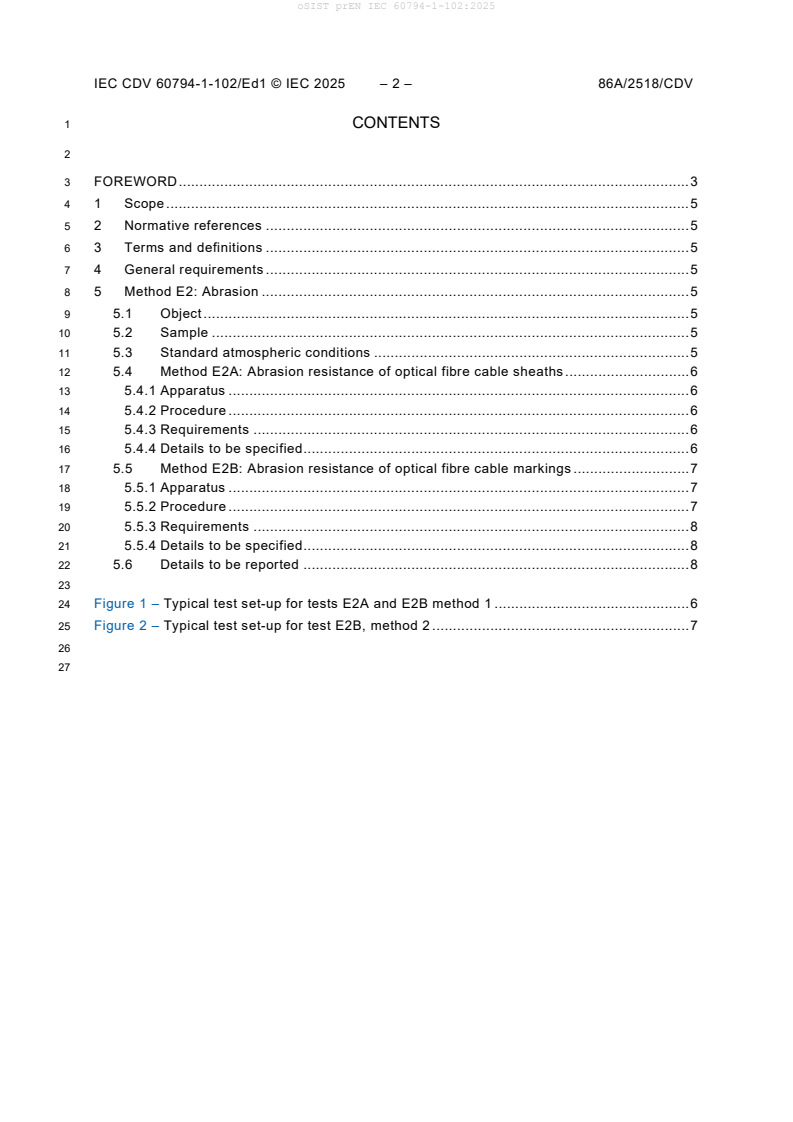
1 CONTENTS
3 FOREWORD . 3
4 1 Scope . 5
5 2 Normative references . 5
6 3 Terms and definitions . 5
7 4 General requirements . 5
8 5 Method E2: Abrasion . 5
9 5.1 Object . 5
10 5.2 Sample . 5
11 5.3 Standard atmospheric conditions . 5
12 5.4 Method E2A: Abrasion resistance of optical fibre cable sheaths . 6
13 5.4.1 Apparatus . 6
14 5.4.2 Procedure . 6
15 5.4.3 Requirements . 6
16 5.4.4 Details to be specified . 6
17 5.5 Method E2B: Abrasion resistance of optical fibre cable markings . 7
18 5.5.1 Apparatus . 7
19 5.5.2 Procedure . 7
20 5.5.3 Requirements . 8
21 5.5.4 Details to be specified . 8
22 5.6 Details to be reported . 8
24 Figure 1 – Typical test set-up for tests E2A and E2B method 1 . 6
25 Figure 2 – Typical test set-up for test E2B, method 2 . 7
oSIST prEN IEC 60794-1-102:2025
IEC CDV 60794-1-102/Ed1 © IEC 2025 – 3 – 86A/2518/CDV
28 INTERNATIONAL ELECTROTECHNICAL COMMISSION
29 ____________
31 OPTICAL FIBRE CABLES –
33 Part 1-102: Generic specification – Basic optical cable test procedures –
34 Mechanical test methods – Abrasion, Method E2
36 FOREWORD
37 1) The International Electrotechnical Commission (IEC) is a worldwide organization for standardization comprising
38 all national electrotechnical committees (IEC National Committees). The object of IEC is to promote international
39 co-operation on all questions concerning standardization in the electrical and electronic fields. To this end and
40 in addition to other activities, IEC publishes International Standards, Technical Specifications, Technical Reports,
41 Publicly Available Specifications (PAS) and Guides (hereafter referred to as “IEC Publication(s)”). Their
42 preparation is entrusted to technical committees; any IEC National Committee interested in the subject dealt with
43 may participate in this preparatory work. International, governmental and non-governmental organizations liaising
44 with the IEC also participate in this preparation. IEC collaborates closely with the International Organization for
45 Standardization (ISO) in accordance with conditions determined by agreement between the two organizations.
46 2) The formal decisions or agreements of IEC on technical matters express, as nearly as possible, an international
47 consensus of opinion on the relevant subjects since each technical committee has representation from all
48 interested IEC National Committees.
49 3) IEC Publications have the form of recommendations for international use and are accepted by IEC National
50 Committees in that sense. While all reasonable efforts are made to ensure that the technical content of IEC
51 Publications is accurate, IEC cannot be held responsible for the way in which they are used or for any
52 misinterpretation by any end user.
53 4) In order to promote international uniformity, IEC National Committees undertake to apply IEC Publications
54 transparently to the maximum extent possible in their national and regional publications. Any divergence between
55 any IEC Publication and the corresponding national or regional publication shall be clearly indicated in the latter.
56 5) IEC itself does not provide any attestation of conformity. Independent certification bodies provide conformity
57 assessment services and, in some areas, access to IEC marks of conformity. IEC is not responsible for any
58 services carried out by independent certification bodies.
59 6) All users should ensure that they have the latest edition of this publication.
60 7) No liability shall attach to IEC or its directors, employees, servants or agents including individual experts and
61 members of its technical committees and IEC National Committees for any personal injury, property damage or
62 other damage of any nature whatsoever, whether direct or indirect, or for costs (including legal fees) and
63 expenses arising out of the publication, use of, or reliance upon, this IEC Publication or any other IEC
64 Publications.
65 8) Attention is drawn to the Normative references cited in this publication. Use of the referenced publications is
66 indispensable for the correct application of this publication.
67 9) Attention is drawn to the possibility that some of the elements of this IEC Publication may be the subject of pat
...