

EN IEC 60794-1-117:2026
(Main)Optical fibre cables - Part 1-117: Generic specification - Basic optical cable test procedures - Mechanical test methods - Bending stiffness, method E17
- Abstract
This part of IEC 60794 defines the test procedures used to establish uniform requirements for bending stiffness performance. It applies to optical fibre cables for use with telecommunication equipment and devices employing similar techniques, and to cables having a combination of both optical fibres and electrical conductors.
NOTE Throughout the document, the wording "optical cable" can also include optical fibre units, microduct fibre units, etc.
- Status
- Published
- Publication Date
- 02-Jul-2026
- Technical Committee
- CLC/TC 86A - Optical fibres and optical fibre cables
- Current Stage
- 6060 - Document made available - Publishing
- Start Date
- 03-Jul-2026
- Due Date
- 06-Mar-2026
- Completion Date
- 03-Jul-2026
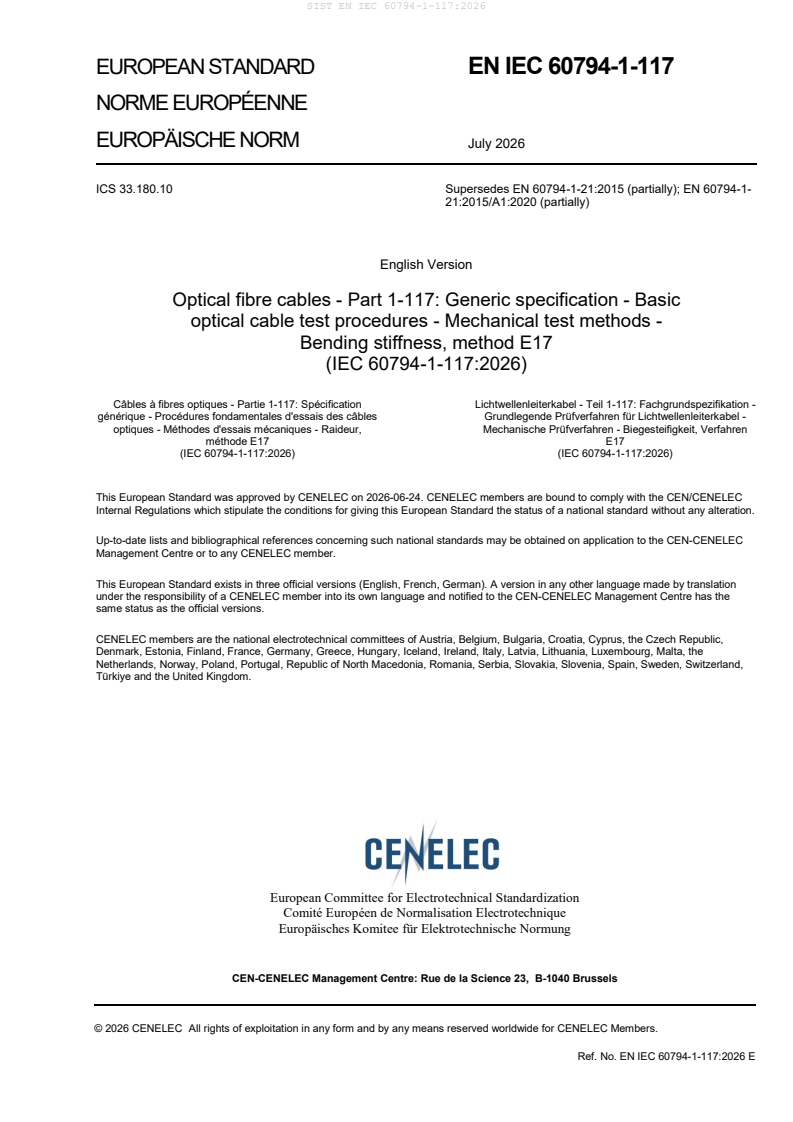
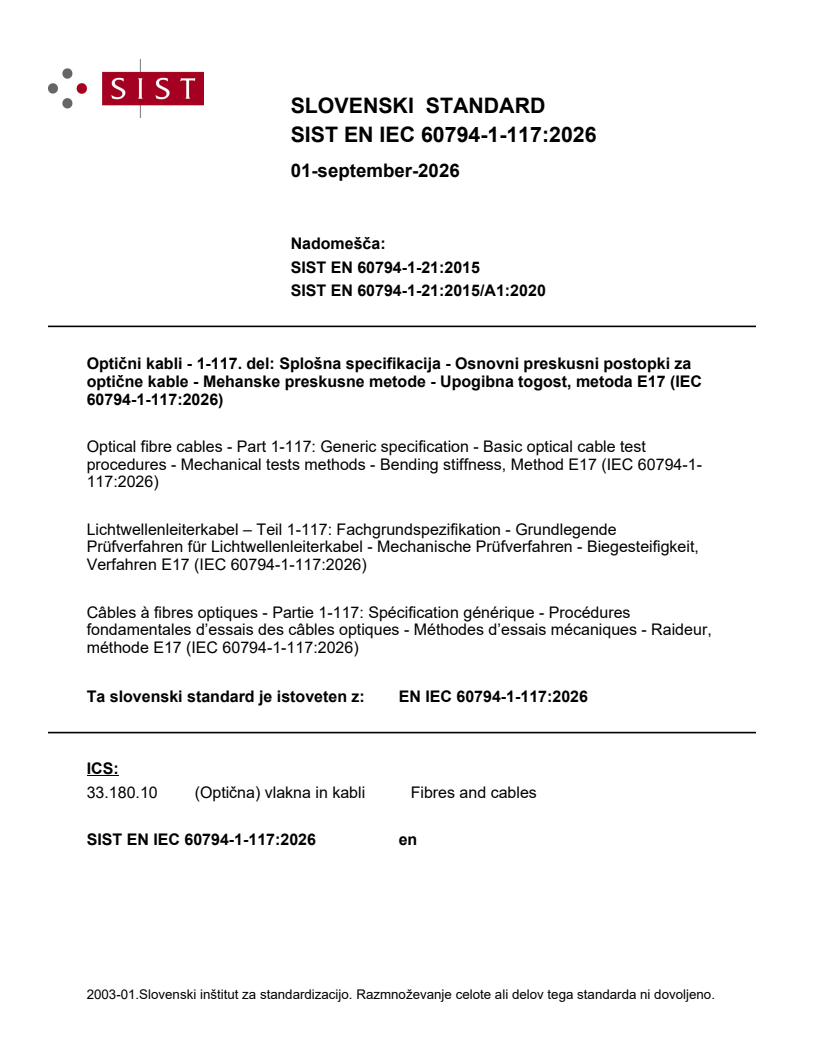

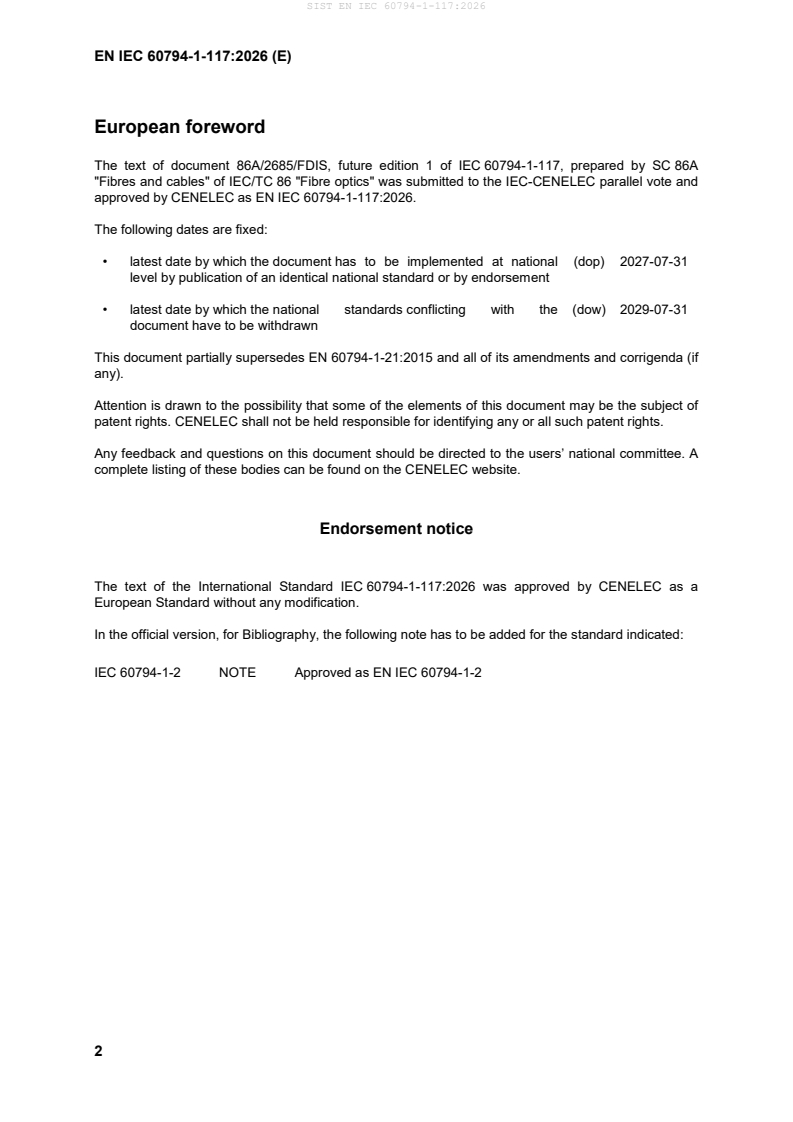
EN IEC 60794-1-117:2026 is a CENELEC European Standard for optical fibre cables. It specifies mechanical test methods for measuring bending stiffness, using Method E17 in three variants - E17A, E17B and E17C - for people who specify, test, or report optical fibre cable performance.
What does EN IEC 60794-1-117:2026 specify?
EN IEC 60794-1-117:2026 defines test procedures for establishing uniform requirements for bending stiffness performance in optical fibre cables. It applies to cables used with telecommunication equipment and devices using similar techniques, and to cables that combine optical fibres and electrical conductors.
The document is organized into clauses 1 to 8, covering scope, normative references, terms and definitions, general requirements, the purpose of the test, and the three procedures E17A, E17B and E17C. Annex ZA gives the normative references to international publications and their European equivalents.
| Annex | What it covers |
|---|---|
| ZA | Normative references to international publications and the corresponding European publications |
What are the key requirements of EN IEC 60794-1-117:2026?
EN IEC 60794-1-117:2026 is a test method standard, not a product specification. The key requirement is that the measured cable stiffness shall meet the values set in the relevant family and detail specification.
- Clause 4 points users to IEC 60794-1-2 for general requirements and definitions. In practice, the test has to be run and interpreted within the wider IEC guidance for optical cable test methods.
- Clause 5 states that the purpose is to measure bending stiffness and notes that the result is used to judge installation behaviour and everyday ruggedness. It also warns that results from different bending tests are not necessarily equivalent, so values from one method should not be compared directly with another.
- Clause 5 identifies three methods. E17A and E17B are suitable for large cables, E17B is also suitable for smaller cables including lightly armoured and indoor cables, and E17C is suitable for small cables such as reinforced single-fibre cables. This helps the reader choose the method that matches the cable construction.
- Clause 6, Method E17A, measures force and displacement on a short sample supported at two points. The standard notes that loading may need to be incremental so that a change from elastic to inelastic behaviour can be seen, which matters when a cable bends differently under real installation loads.
- Clause 7, Method E17B, uses a cantilever arrangement with the sample clamped at one end and loaded at the other. The clamp and span must be chosen so internal movement of cable elements does not affect the result, which is important for small or flexible constructions.
- Clause 8, Method E17C, bends the sample into a U-bend using a defined jaw separation based on cable diameter and a separation factor. The force is recorded after the specified duration, so the test reflects the cable’s resistance at the chosen bend condition.
- Clauses 6.5, 7.5 and 8.5 say the family and detail specification has to state the cable type and the method settings such as support distance, span, force, sample length, number of samples, loading rate, separation factor and duration. In practice, the test setup is completed by the product specification, not by this standard alone.
- Clauses 6.6, 7.6 and 8.6 require the report to repeat those specified details, add the measured cable stiffness, and record any deviations. That makes the result traceable for audits, supplier qualification and product comparison.
The standard also cautions that these tests can show significant sample-to-sample variation because of apparatus details and the interaction of cable components in bending. That means the method is best used carefully, with conservative stiffness requirements.
What terms does EN IEC 60794-1-117:2026 define?
EN IEC 60794-1-117:2026 uses the terms and definitions from IEC 60794-1-1. The following terms are central to the test procedures:
- bending stiffness - the cable property measured by these tests, describing resistance to bending.
- elastic stiffness - the slope of the linear part of the force-displacement curve, used when the cable changes from elastic to inelastic behaviour.
- family and detail specification - the product-specific document that sets the test settings and acceptance requirements for the chosen method.
- separation factor (s) - the multiplier used in Method E17C to set the final jaw separation from cable diameter.
- cable span (L) - the distance used in Method E17B between the clamp and the loading point.
- load cell - the force sensor used in Method E17C to measure the force during buckling bend.
Who uses EN IEC 60794-1-117:2026?
EN IEC 60794-1-117:2026 is used by cable manufacturers, test laboratories, quality managers, and specification writers working with optical fibre cables. It is also relevant to buyers and technical teams who need to compare bending stiffness requirements for telecommunication, indoor, jumper, duct, conduit, trunking, floor, or blown-cable applications. The standard supports product development, routine testing, and preparation of test reports.
What changed in EN IEC 60794-1-117:2026 from the previous edition?
EN IEC 60794-1-117:2026 replaces Method E17 of IEC 60794-1-21:2015 and moves it into the IEC 60794-1-1xx series as a separate document. The technical revision adds explicit reporting details in 6.6, 7.6 and 8.6 for the three methods.
Which standards are used with EN IEC 60794-1-117:2026?
EN IEC 60794-1-117:2026 cites IEC 60794-1-1 as the source for general terms and definitions. It also relies on IEC 60794-1-2 as the general guidance and cross-reference document for optical cable test methods, and Annex ZA maps IEC 60794-1-1 to EN IEC 60794-1-1.
What does the EN IEC 60794-1-117:2026 document contain?
The document contains three complete test methods, each with sample, apparatus, procedure, requirements, details to be specified, and details to be reported. It includes figures for the E17A, E17B and E17C test set-ups, plus an example force-displacement curve for interpreting behaviour in bending. The bibliography points readers to related IEC guidance, including IEC 60794-1-2.
Relations
- Effective Date
- 09-Sep-2025
- Effective Date
- 09-Sep-2025
- Effective Date
- 16-Jun-2026
- Effective Date
- 07-Jul-2026
- Effective Date
- 07-Jul-2026
- Effective Date
- 07-Jul-2026
Get Certified
Connect with accredited certification bodies for this standard

ANCE
Mexican certification and testing association.

Intertek Slovenia
Intertek testing, inspection, and certification services in Slovenia.

LNE (Laboratoire National de Métrologie et d'Essais)
French national laboratory for metrology and testing.
Sponsored listings
Frequently Asked Questions
EN IEC 60794-1-117:2026 is a standard published by CLC. Its full title is "Optical fibre cables - Part 1-117: Generic specification - Basic optical cable test procedures - Mechanical test methods - Bending stiffness, method E17". This standard covers: This part of IEC 60794 defines the test procedures used to establish uniform requirements for bending stiffness performance. It applies to optical fibre cables for use with telecommunication equipment and devices employing similar techniques, and to cables having a combination of both optical fibres and electrical conductors. NOTE Throughout the document, the wording "optical cable" can also include optical fibre units, microduct fibre units, etc.
This part of IEC 60794 defines the test procedures used to establish uniform requirements for bending stiffness performance. It applies to optical fibre cables for use with telecommunication equipment and devices employing similar techniques, and to cables having a combination of both optical fibres and electrical conductors. NOTE Throughout the document, the wording "optical cable" can also include optical fibre units, microduct fibre units, etc.
EN IEC 60794-1-117:2026 is classified under the following ICS (International Classification for Standards) categories: 33.180.10 - Fibres and cables. The ICS classification helps identify the subject area and facilitates finding related standards.
EN IEC 60794-1-117:2026 has the following relationships with other standards: It is inter standard links to EN 60794-1-21:2015, EN 60794-1-21:2015/A1:2020, EN IEC 60794-1-1:2023, EN IEC 62148-1:2018, EN 3745-505:2018, CLC/TS 50621:2016. Understanding these relationships helps ensure you are using the most current and applicable version of the standard.
EN IEC 60794-1-117:2026 is available in PDF format for immediate download after purchase. The document can be added to your cart and obtained through the secure checkout process. Digital delivery ensures instant access to the complete standard document.
Standards Content (Sample)
SLOVENSKI STANDARD
01-september-2026
Nadomešča:
SIST EN 60794-1-21:2015
SIST EN 60794-1-21:2015/A1:2020
Optični kabli - 1-117. del: Splošna specifikacija - Osnovni preskusni postopki za
optične kable - Mehanske preskusne metode - Upogibna togost, metoda E17 (IEC
60794-1-117:2026)
Optical fibre cables - Part 1-117: Generic specification - Basic optical cable test
procedures - Mechanical tests methods - Bending stiffness, Method E17 (IEC 60794-1-
117:2026)
Lichtwellenleiterkabel – Teil 1-117: Fachgrundspezifikation - Grundlegende
Prüfverfahren für Lichtwellenleiterkabel - Mechanische Prüfverfahren - Biegesteifigkeit,
Verfahren E17 (IEC 60794-1-117:2026)
Câbles à fibres optiques - Partie 1-117: Spécification générique - Procédures
fondamentales d’essais des câbles optiques - Méthodes d’essais mécaniques - Raideur,
méthode E17 (IEC 60794-1-117:2026)
Ta slovenski standard je istoveten z: EN IEC 60794-1-117:2026
ICS:
33.180.10 (Optična) vlakna in kabli Fibres and cables
2003-01.Slovenski inštitut za standardizacijo. Razmnoževanje celote ali delov tega standarda ni dovoljeno.
EUROPEAN STANDARD EN IEC 60794-1-117
NORME EUROPÉENNE
EUROPÄISCHE NORM July 2026
ICS 33.180.10 Supersedes EN 60794-1-21:2015 (partially); EN 60794-1-
21:2015/A1:2020 (partially)
English Version
Optical fibre cables - Part 1-117: Generic specification - Basic
optical cable test procedures - Mechanical test methods -
Bending stiffness, method E17
(IEC 60794-1-117:2026)
Câbles à fibres optiques - Partie 1-117: Spécification Lichtwellenleiterkabel - Teil 1-117: Fachgrundspezifikation -
générique - Procédures fondamentales d'essais des câbles Grundlegende Prüfverfahren für Lichtwellenleiterkabel -
optiques - Méthodes d'essais mécaniques - Raideur, Mechanische Prüfverfahren - Biegesteifigkeit, Verfahren
méthode E17 E17
(IEC 60794-1-117:2026) (IEC 60794-1-117:2026)
This European Standard was approved by CENELEC on 2026-06-24. CENELEC members are bound to comply with the CEN/CENELEC
Internal Regulations which stipulate the conditions for giving this European Standard the status of a national standard without any alteration.
Up-to-date lists and bibliographical references concerning such national standards may be obtained on application to the CEN-CENELEC
Management Centre or to any CENELEC member.
This European Standard exists in three official versions (English, French, German). A version in any other language made by translation
under the responsibility of a CENELEC member into its own language and notified to the CEN-CENELEC Management Centre has the
same status as the official versions.
CENELEC members are the national electrotechnical committees of Austria, Belgium, Bulgaria, Croatia, Cyprus, the Czech Republic,
Denmark, Estonia, Finland, France, Germany, Greece, Hungary, Iceland, Ireland, Italy, Latvia, Lithuania, Luxembourg, Malta, the
Netherlands, Norway, Poland, Portugal, Republic of North Macedonia, Romania, Serbia, Slovakia, Slovenia, Spain, Sweden, Switzerland,
Türkiye and the United Kingdom.
European Committee for Electrotechnical Standardization
Comité Européen de Normalisation Electrotechnique
Europäisches Komitee für Elektrotechnische Normung
CEN-CENELEC Management Centre: Rue de la Science 23, B-1040 Brussels
© 2026 CENELEC All rights of exploitation in any form and by any means reserved worldwide for CENELEC Members.
Ref. No. EN IEC 60794-1-117:2026 E
European foreword
The text of document 86A/2685/FDIS, future edition 1 of IEC 60794-1-117, prepared by SC 86A
"Fibres and cables" of IEC/TC 86 "Fibre optics" was submitted to the IEC-CENELEC parallel vote and
approved by CENELEC as EN IEC 60794-1-117:2026.
The following dates are fixed:
• latest date by which the document has to be implemented at national (dop) 2027-07-31
level by publication of an identical national standard or by endorsement
• latest date by which the national standards conflicting with the (dow) 2029-07-31
document have to be withdrawn
This document partially supersedes EN 60794-1-21:2015 and all of its amendments and corrigenda (if
any).
Attention is drawn to the possibility that some of the elements of this document may be the subject of
patent rights. CENELEC shall not be held responsible for identifying any or all such patent rights.
Any feedback and questions on this document should be directed to the users’ national committee. A
complete listing of these bodies can be found on the CENELEC website.
Endorsement notice
The text of the International Standard IEC 60794-1-117:2026 was approved by CENELEC as a
European Standard without any modification.
In the official version, for Bibliography, the following note has to be added for the standard indicated:
IEC 60794-1-2 NOTE Approved as EN IEC 60794-1-2
Annex ZA
(normative)
Normative references to international publications
with their corresponding European publications
The following documents are referred to in the text in such a way that some or all of their content
constitutes requirements of this document. For dated references, only the edition cited applies. For
undated references, the latest edition of the referenced document (including any amendments)
applies.
NOTE 1 Where an International Publication has been modified by common modifications, indicated by (mod),
the relevant EN/HD applies.
NOTE 2 Up-to-date information on the latest versions of the European Standards listed in this annex is available
here: www.cencenelec.eu.
Publication Year Title EN/HD Year
IEC 60794-1-1 - Optical fibre cables - Part 1-1: Generic EN IEC 60794-1-1 -
specification - General
IEC 60794-1-117 ®
Edition 1.0 2026-05
INTERNATIONAL
STANDARD
Optical fibre cables -
Part 1-117: Generic specification - Basic optical cable test procedures -
Mechanical tests methods - Bending stiffness, method E17
ICS 33.180.10 ISBN 978-2-8327-1249-8
IEC 60794-1-117:2026-05(en)
IEC 60794-1-117:2026 © IEC 2026
CONTENTS
FOREWORD . 2
INTRODUCTION . 4
1 Scope . 5
2 Normative references . 5
3 Terms and definitions . 5
4 General requirements. 5
5 Object . 5
6 Method E17A: Three-point bend . 6
6.1 Sample . 6
6.2 Apparatus . 6
6.3 Procedure . 6
6.4 Requirement . 7
6.5 Details to be specified . 7
6.6 Details to be reported . 7
7 Method E17B: Cantilever bend . 7
7.1 Sample . 7
7.2 Apparatus . 7
7.3 Procedure . 8
7.4 Requirements . 8
7.5 Details to be specified . 8
7.6 Details to be reported . 8
8 Method E17C: Buckling bend . 8
8.1 Sample . 8
8.2 Apparatus . 8
8.3 Procedure . 9
8.4 Requirements . 9
8.5 Details to be specified . 9
8.6 Details to be reported . 9
Bibliography . 12
Figure 1 – Method E17A – Test set-up . 10
Figure 2 – Example of results of applied force and displacement . 10
Figure 3 – Method E17B – Test set-up . 10
Figure 4 – Method E17C – Test set-up. 11
IEC 60794-1-117:2026 © IEC 2026
INTERNATIONAL ELECTROTECHNICAL COMMISSION
____________
Optical fibre cables -
Part 1-117: Generic specification - Basic optical cable test procedures -
Mechanical test methods - Bending stiffness, method E17
FOREWORD
1) The International Electrotechnical Commission (IEC) is a worldwide organization for standardization comprising
all national electrotechnical committees (IEC National Committees). The object of IEC is to promote international
co-operation on all questions concerning standardization in the electrical and electronic fields. To this end and
in addition to other activities, IEC publishes International Standards, Technical Specifications, Technical Reports,
Publicly Available Specifications (PAS) and Guides (hereafter referred to as "IEC Publication(s)"). Their
preparation is entrusted to technical committees; any IEC National Committee interested in the subject dealt with
may participate in this preparatory work. International, governmental and non-governmental organizations liaising
with the IEC also participate in this preparation. IEC collaborates closely with the International Organization for
Standardization (ISO) in accordance with conditions determined by agreement between the two organizations.
2) The formal decisions or agreements of IEC on technical matters express, as nearly as possible, an international
consensus of opinion on the relevant subjects since each technical committee has representation from all
interested IEC National Committees.
3) IEC Publications have the form of recommendations for international use and are accepted by IEC National
Committees in that sense. While all reasonable efforts are made to ensure that the technical content of IEC
Publications is accurate, IEC cannot be held responsible for the way in which they are used or for any
misinterpretation by any end user.
4) In order to promote international uniformity, IEC National Committees undertake to apply IEC Publications
transparently to the maximum extent possible in their national and regional publications. Any divergence between
any IEC Publication and the corresponding national or regional publication shall be clearly indicated in the latter.
5) IEC itself does not provide any attestation of conformity. Independent certification bodies provide conformity
assessment services and, in some areas, access to IEC marks of conformity. IEC is not responsible for any
services carried out by independent certification bodies.
6) All users should ensure that they have the latest edition of this publication.
7) No liability shall attach to IEC or its directors, employees, servants or agents including individual experts and
members of its technical committees and IEC National Committees for any personal injury, property damage or
other damage of any nature whatsoever, whether direct or indirect, or for costs (including legal fees) and
expenses arising out of the publication, use of, or reliance upon, this IEC Publication or any other IEC
Publications.
8) Attention is drawn to the Normative references cited in this publication. Use of the referenced publications is
indispensable for the correct application of this publication.
9) IEC draws attention to the possibility that the
...