

prEN IEC 60034-30-2:2026
(Main)Rotating electrical machines - Part 30-2: Efficiency classes of variable speed AC motors (IE-code)
- Status
- Not Published
- Publication Date
- 10-Oct-2027
- Technical Committee
- CLC/TC 2 - Rotating machinery
- Current Stage
- 4060 - Enquiry results established and sent to TC, SR, BTTF - Enquiry
- Start Date
- 24-Jul-2026
- Completion Date
- 24-Jul-2026

Overview
prEN IEC 60034-30-2:2026 specifies international efficiency classes (IE-codes) for rotating electrical machines, focusing on variable speed AC motors used with electronic frequency converters. Published by the International Electrotechnical Commission (IEC) and governed by CENELEC (CLC), this standard brings global harmonization to energy efficiency classifications for converter duty AC motors not covered in IEC 60034-30-1. It provides a clear framework for evaluating and comparing the energy efficiency of variable speed motors across diverse industrial applications.
Key Topics
Scope and Coverage
- Applies to variable speed rotating AC motors designed exclusively for operation with frequency converters
- Covers motors with rated power from 0.12 kW up to 1000 kW and rated voltages from 50 V to 1000 V
- Includes both asynchronous and synchronous motor types
- Excludes line-operated motors, servo motors, switched reluctance machines, fully integrated (untestable) motors, and specific submersible/smoke extraction motors
Efficiency Classification (IE-Code)
- Defines seven efficiency classes: IE1 to IE7
- Efficiency limits are set based on reference values for power and speed ranges
- Adjustments are made for harmonic losses introduced by frequency converter operation
- Clear marking of IE-class required on motor nameplates to ensure transparency in the marketplace
Testing and Marking
- Efficiency determined as prescribed in IEC 60034-2-3 for converter-fed motors
- Marking must indicate the IE-class and note "converter duty" for clarity
- Detailed information on test conditions and auxiliary devices handling included
Harmonization and Comparability
- Aligned with related standards such as IEC 61800-9-2 for variable speed drives (VSDs) and power drive systems (PDS)
- Facilitates effective comparison between different motor technologies by standardizing the efficiency metrics
Applications
The standard is essential for:
- Motor Manufacturers: Provides a harmonized framework for the design, testing, and labeling of variable speed AC motors intended for converter duty, enabling compliance with both European and international market requirements.
- Industrial Operators and OEMs: Assists in the selection of energy-efficient motors suited for variable speed drive systems, such as those used in conveyors, pumps, compressors, and HVAC applications.
- Specifiers and Consultants: Enables accurate specification of motor efficiency in procurement, supporting energy saving initiatives and regulatory conformity.
- Regulators: Offers a standardized approach to enforce energy efficiency requirements for AC motors in industrial and commercial sectors.
Implementing motors classified under this standard supports energy savings, operational cost reduction, and environmentally sustainable practices. It ensures that motors chosen for variable speed applications meet stringent efficiency benchmarks, promoting lifecycle efficiency of industrial electric drive systems.
Related Standards
Motor and drive system stakeholders should consider the following related standards for comprehensive compliance and integration:
- IEC 60034-30-1: Efficiency classes for line-operated AC motors (IE-Code)
- IEC 60034-2-3: Specific test methods for determining losses and efficiency of converter-fed AC motors
- IEC 60034-1: General requirements for rotating electrical machines
- IEC 61800-9-2: Ecodesign for motor systems - Energy efficiency determination and classification of power drive systems (PDS) and complete drive modules (CDM)
- IEC 60079-0: Equipment for explosive atmospheres (relevant for motors used in hazardous environments)
By referencing prEN IEC 60034-30-2:2026, organizations reinforce their commitment to international best practices in motor energy efficiency, support seamless trade in global markets, and drive progress towards a low-carbon future.
Keywords: prEN IEC 60034-30-2, variable speed AC motors, efficiency classes, IE-code, converter duty, energy-efficient motors, IEC 60034, rotating electrical machines, industrial motors, frequency converter, VSD, PDS, CENELEC, international standards.
For further details and official requirements, refer to the published standard and associated normative references.
Relations
- Effective Date
- 17-Mar-2026
Get Certified
Connect with accredited certification bodies for this standard

IMQ S.p.A. (Certification)
Italian electrical product certification.

SLG Prüf- und Zertifizierungs GmbH
German testing and certification body.

UL Solutions
Global safety science company with testing, inspection and certification.
Sponsored listings
Frequently Asked Questions
prEN IEC 60034-30-2:2026 is a draft published by CLC. Its full title is "Rotating electrical machines - Part 30-2: Efficiency classes of variable speed AC motors (IE-code)". This standard covers: Rotating electrical machines - Part 30-2: Efficiency classes of variable speed AC motors (IE-code)
Rotating electrical machines - Part 30-2: Efficiency classes of variable speed AC motors (IE-code)
prEN IEC 60034-30-2:2026 is classified under the following ICS (International Classification for Standards) categories: 29.160.01 - Rotating machinery in general. The ICS classification helps identify the subject area and facilitates finding related standards.
prEN IEC 60034-30-2:2026 has the following relationships with other standards: It is inter standard links to CLC IEC/TS 60034-30-2:2021. Understanding these relationships helps ensure you are using the most current and applicable version of the standard.
prEN IEC 60034-30-2:2026 is available in PDF format for immediate download after purchase. The document can be added to your cart and obtained through the secure checkout process. Digital delivery ensures instant access to the complete standard document.
Standards Content (Sample)
SLOVENSKI STANDARD
01-junij-2026
Vrteči električni stroji - Del 30-2: Razredi učinkovitosti izmeničnih motorjev s
spremenljivo hitrostjo (IE-koda)
Rotating electrical machines - Part 30-2: Efficiency classes of variable speed AC motors
(IE-code)
Ta slovenski standard je istoveten z: prEN IEC 60034-30-2:2026
ICS:
29.160.30 Motorji Motors
2003-01.Slovenski inštitut za standardizacijo. Razmnoževanje celote ali delov tega standarda ni dovoljeno.
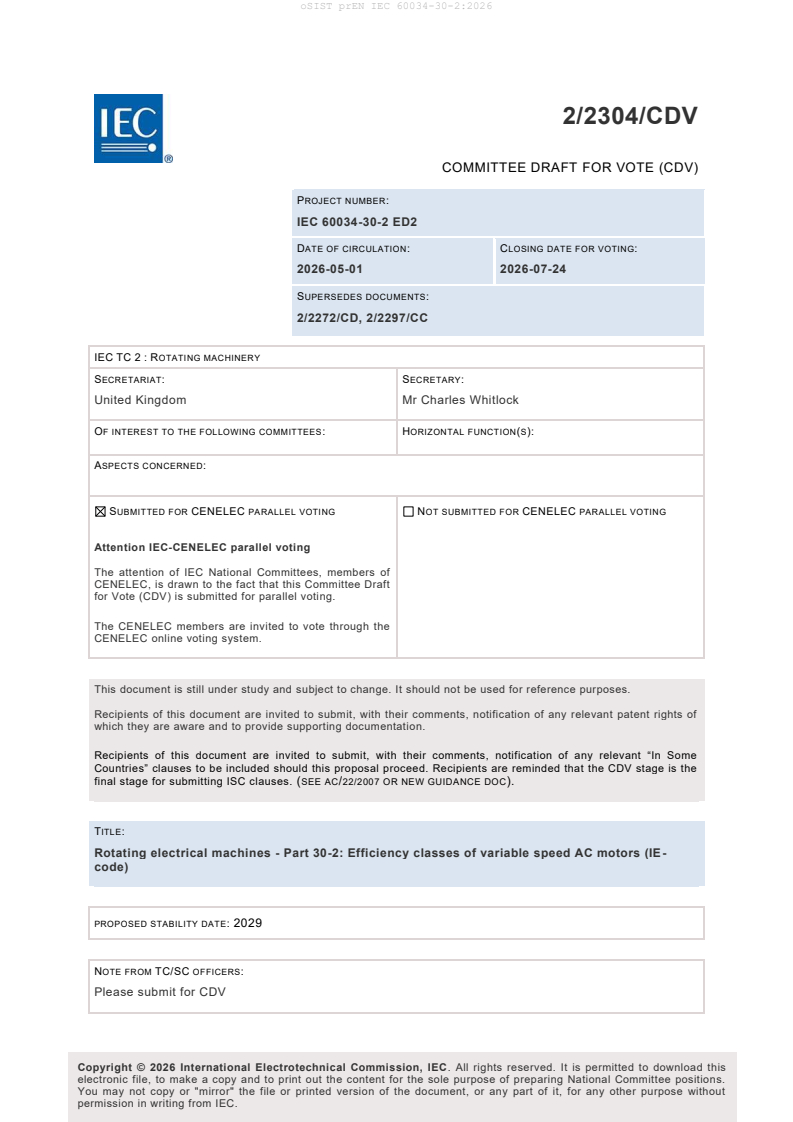
2/2304/CDV
COMMITTEE DRAFT FOR VOTE (CDV)
PROJECT NUMBER:
IEC 60034-30-2 ED2
DATE OF CIRCULATION: CLOSING DATE FOR VOTING:
2026-05-01 2026-07-24
SUPERSEDES DOCUMENTS:
2/2272/CD, 2/2297/CC
IEC TC 2 : ROTATING MACHINERY
SECRETARIAT: SECRETARY:
United Kingdom Mr Charles Whitlock
OF INTEREST TO THE FOLLOWING COMMITTEES: HORIZONTAL FUNCTION(S):
ASPECTS CONCERNED:
SUBMITTED FOR CENELEC PARALLEL VOTING NOT SUBMITTED FOR CENELEC PARALLEL VOTING
Attention IEC-CENELEC parallel voting
The attention of IEC National Committees, members of
CENELEC, is drawn to the fact that this Committee Draft
for Vote (CDV) is submitted for parallel voting.
The CENELEC members are invited to vote through the
CENELEC online voting system.
This document is still under study and subject to change. It should not be used for reference purposes.
Recipients of this document are invited to submit, with their comments, notification of any relevant patent rights of
which they are aware and to provide supporting documentation.
Recipients of this document are invited to submit, with their comments, notification of any relevant “In Some
Countries” clauses to be included should this proposal proceed. Recipients are reminded that the CDV stage is the
final stage for submitting ISC clauses. (SEE AC/22/2007 OR NEW GUIDANCE DOC).
TITLE:
Rotating electrical machines - Part 30-2: Efficiency classes of variable speed AC motors (IE-
code)
PROPOSED STABILITY DATE: 2029
NOTE FROM TC/SC OFFICERS:
Please submit for CDV
electronic file, to make a copy and to print out the content for the sole purpose of preparing National Committee positions.
You may not copy or "mirror" the file or printed version of the document, or any part of it, for any other purpose without
permission in writing from IEC.
IEC CDV 60034-30-2 © IEC 2026
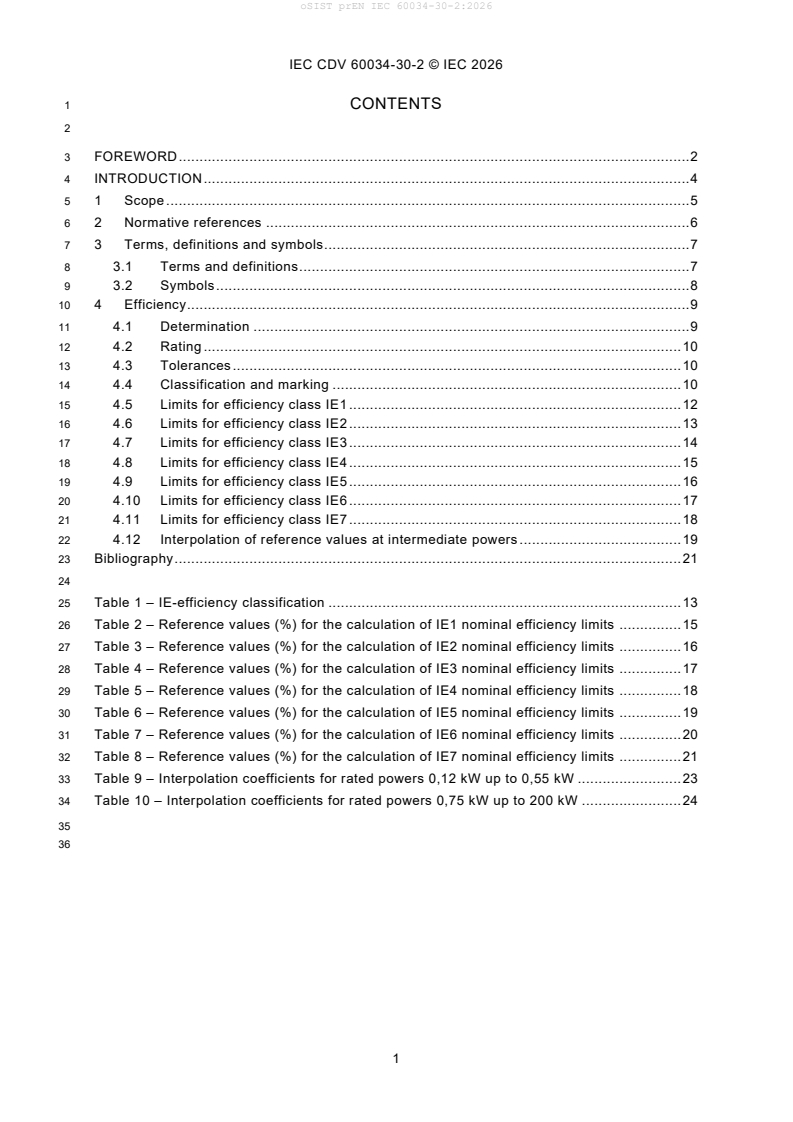
1 CONTENTS
3 FOREWORD . 2
4 INTRODUCTION . 4
5 1 Scope . 5
6 2 Normative references . 6
7 3 Terms, definitions and symbols. 7
8 3.1 Terms and definitions . 7
9 3.2 Symbols . 8
10 4 Efficiency . 9
11 4.1 Determination . 9
12 4.2 Rating . 10
13 4.3 Tolerances . 10
14 4.4 Classification and marking . 10
15 4.5 Limits for efficiency class IE1 . 12
16 4.6 Limits for efficiency class IE2 . 13
17 4.7 Limits for efficiency class IE3 . 14
18 4.8 Limits for efficiency class IE4 . 15
19 4.9 Limits for efficiency class IE5 . 16
20 4.10 Limits for efficiency class IE6 . 17
21 4.11 Limits for efficiency class IE7 . 18
22 4.12 Interpolation of reference values at intermediate powers . 19
23 Bibliography . 21
25 Table 1 – IE-efficiency classification . 13
26 Table 2 – Reference values (%) for the calculation of IE1 nominal efficiency limits . 15
27 Table 3 – Reference values (%) for the calculation of IE2 nominal efficiency limits . 16
28 Table 4 – Reference values (%) for the calculation of IE3 nominal efficiency limits . 17
29 Table 5 – Reference values (%) for the calculation of IE4 nominal efficiency limits . 18
30 Table 6 – Reference values (%) for the calculation of IE5 nominal efficiency limits . 19
31 Table 7 – Reference values (%) for the calculation of IE6 nominal efficiency limits . 20
32 Table 8 – Reference values (%) for the calculation of IE7 nominal efficiency limits . 21
33 Table 9 – Interpolation coefficients for rated powers 0,12 kW up to 0,55 kW . 23
34 Table 10 – Interpolation coefficients for rated powers 0,75 kW up to 200 kW . 24
IEC CDV 60034-30-2 © IEC 2026
37 INTERNATIONAL ELECTROTECHNICAL COMMISSION
38 ____________
40 ROTATING ELECTRICAL MACHINES –
42 Part 30-2: Efficiency classes of variable speed AC motors (IE-code)
44 FOREWORD
45 1) The International Electrotechnical Commission (IEC) is a worldwide organization for standardization comprising
46 all national electrotechnical committees (IEC National Committees). The object of IEC is to promote
47 international co-operation on all questions concerning standardization in the electrical and electronic fields. To
48 this end and in addition to other activities, IEC publishes International Standards, Technical Specifications,
49 Technical Reports, Publicly Available Specifications (PAS) and Guides (hereafter referred to as “IEC
50 Publication(s)”). Their preparation is entrusted to technical committees; any IEC National Committee interested
51 in the subject dealt with may participate in this preparatory work. International, governmental and non -
52 governmental organizations liaising with the IEC also participate in this preparation. IEC collaborates closely
53 with the International Organization for Standardization (ISO) in accordance with conditions determined by
54 agreement between the two organizations.
55 2) The formal decisions or agreements of IEC on technical matters express, as nearly as possible, an international
56 consensus on the relevant subjects since each technical committee has representation from all interested IEC
57 National Committees.
58 3) IEC Publications have the form of recommendations for international use and are accepted by IEC National
59 Committees in that sense. While all reasonable efforts are made to ensure that the technical content of IEC
60 Publications is accurate, IEC cannot be held responsible for the way in which they are used or for any
61 misinterpretation by any end user.
62 4) In order to promote international uniformity, IEC National Committees undertake to apply IEC Publications
63 transparently to the maximum extent possible in their national and regional publications. Any divergence
64 between any IEC Publication and the corresponding national or regional publication shall be clearly indicated in
65 the latter.
66 5) IEC itself does not provide any attestation of conformity. Independent certification bodies provide conformity
67 assessment services and, in some areas, access to IEC marks of conformity. IEC is not responsible for any
68 services carried out by independent certification bodies.
69 6) All users should ensure that they have the latest edition of this publication.
70 7) No liability shall attach to IEC or its directors, employees, servants or agents including individual experts and
71 members of its technical committees and IEC National Committees for any personal injury, property damage or
72 other damage of any nature whatsoever, whether direct or indirect, or for costs (including legal fees) and
73 expenses arising out of the publication, use of, or reliance upon, this IEC Publication or any other IEC
74 Publications.
75 8) Attention is drawn to the Normative references cited in this publication. Use of the referenced publications is
76 indispensable for the correct application of this publication.
77 9) Attention is drawn to the possibility that some of the elements of this IEC Publication may be the subject of
78 patent rights. IEC shall not be held responsible for identifying any or all such patent rights.
79 The main task of IEC technical committees is to prepare International Standards. In
80 exceptional circumstances, a technical committee may propose the publication of a technical
81 specification when
82 • the required support cannot be obtained for the publication of an International Standard,
83 despite repeated efforts, or
84 • the subject is still under technical development or where, for any other reason, there is the
85 future but no immediate possibility of an agreement on an International Standard.
86 International Standard IEC 60034-30-2 has been prepared by IEC Technical Committee 2:
87 Rotating machinery.
88 This first edition of the standard IEC 60034-30-2 cancels and replaces the first edition of
89 IEC TS 60034-30-2 (2016). Full information on the voting for the approval of this standard can
90 be found in the report on voting indicated above table.
91 This publication has been drafted in accordance with the ISO/IEC Directives, Part 2.
IEC CDV 60034-30-2 © IEC 2026
92 The text of this standard is based on the following documents:
Enquiry draft Report on voting
2/XX/DTS 2/XX/RVC
94 Full information on the voting for the approval of this standard can be found in the report on
95 voting indicated in the above table.
96 NOTE A table of cross-references of all IEC TC 2 publications can be found on the IEC TC 2 dashboard on the
97 IEC website.
98 The committee has decided that the contents of this document will remain unchanged until the
99 stability date indicated on the IEC website under "http://webstore.iec.ch" in the data related to
100 the specific document. At this date, the document will be
101 • reconfirmed,
102 • withdrawn,
103 • replaced by a revised edition, or
104 • amended.
106 The National Committees are requested to note that for this document the stability date
107 is 20xx
108 THIS TEXT IS INCLUDED FOR THE INFORMATION OF THE NATIONAL COMMITTEES AND WILL BE
109 DELETED AT THE PUBLICATION STAGE.
IEC CDV 60034-30-2 © IEC 2026
112 INTRODUCTION
113 This second part of the IEC 60034-30 standard series, IEC 60034-30-2, replaces the technical
114 specification and provides energy-efficiency classes of variable speed electric motors for
115 global harmonization. It deals with low-voltage electric AC motors that are rated for variable
116 speed operation. An electronic frequency converter provides variable voltage and variable
117 frequency.
118 This standard defines energy efficiency classification of converter duty AC motors rated for
119 variable voltage and frequency, namely converter duty machines and either asynchronous or
120 synchronous motors not covered in IEC 60034-30-1. It is harmonized with the standard
121 IEC 61800-9-2 where IE-classifications of frequency converters (variable speed drive VSD or
122 complete drive modules = CDM) and IES-classifications of power drive systems (PDS) are
123 defined. To clearly distinguish energy efficiency classes between this document and
124 IEC 60034-30-1, the converter duty motors according to this document will be marked with the
125 term “converter duty” on the rating plate (as required by IEC 60034-1 Ed.15).
126 An efficient motor alone does not necessarily result in an efficient PDS. Users should select
127 the efficiency class in accordance with a given application depending on the actual load /
128 speed operating points and related operating time.
129 It may not be energy efficient to select very high efficiency continuous duty, S1, motors for
130 intermittent or short time duty or part load applications. The use of the Extended Product
131 Approach (EPA) as described in the IEC 61800-9 series of standards will help applicative
132 sectors for specification of energy efficiency performance of power-driven equipment and
133 parts.
134 It is not expected that all manufacturers will produce motors for all efficiency classes nor all
135 ratings of a given class.
IEC CDV 60034-30-2 © IEC 2026
137 ROTATING ELECTRICAL MACHINES –
139 Part 30-2: Efficiency classes of variable speed AC motors (IE-code)
143 1 Scope
144 This part of IEC 60034 specifies efficiency classes for electrical, variable speed rotating
145 motors that are rated according to IEC 60034-1 for converter duty operation only. The
146 document only applies to machines that:
147 • are not covered in IEC 60034-30-1;
148 • have a rated power P from 0,12 kW up to and including 1 000 kW;
N
149 • have a rated voltage U from 50 V up to and including 1000 V;
N
–1 –1
150 • have a rated speed n from 600 min up to 6 000 min regardless of the number of
N
151 magnetic poles;
152 • are designed for cooling methods IC4A1A0 (IC410), IC4A1A1 (IC411), IC4A1A6 (IC416),
153 or IC4A1A8 (IC418) according to IEC 60034-6;
154 • are capable of continuous operation at their rated operating point (torque/power, speed)
155 with a temperature rise within the specified insulation temperature class;
156 NOTE 1 Most motors covered by this document are rated as duty type S1 (continuous duty). However, some
157 motors that are rated for other duty cycles like S9 and S10 are still capable of continuous operation at their rated
158 power and these motors are also covered.
159 • are rated for any ambient temperature within the range of –30°C to + 60°C;
160 NOTE 2 Motors rated for temperatures outside the range – 30°C and + 60°C are considered to be of special
161 construction and consequently excluded from this document.
162 NOTE 3 Smoke extraction motors with a temperature class of up to and including 400 °C are covered by this
163 document.
164 • are rated at an operating altitude up to 4 000 m above sea level.
165 NOTE 4 The rated efficiency and efficiency class are based on a rating for altitudes up to 1 000 m above sea
166 level. If not possible to refer to this altitude, the rated efficiency and class are based on the design altitude .
167 The classification only covers machines designed for operation with sinusoidal fundamental
168 current that are not designed to be operated direct-on-line (grid), for example permanent
169 magnet synchronous machines with and without additional reluctance torque, sinusoidal
170 reluctance synchronous machines and synchronous machines with DC field windings. This
171 also includes induction machines that are designed exclusively for converter duty operation.
172 The procedures to determine losses at speed and load point are given in IEC 60034-2-3. They
173 apply to all converter operated motors.
174 No distinction is made between motor technologies, supply voltage or motors with increased
175 insulation even though these motor technologies may not all be capable of reachin g the
176 higher efficiency classes. This makes different motor technologies fully comparable with
177 respect to their energy efficiency capabilities.
178 Covered in this document are also:
179 • Motors with flanges, feet and/or shafts with mechanical dimensions different from
180 IEC 60072-1.
181 • Geared motors including those incorporating non-standard shafts and flanges. However, ,
182 efficiency testing shall be performed on the motor itself without the gear unit.
IEC CDV 60034-30-2 © IEC 2026
183 • Motors specifically built for operation in explosive environments according to IEC 60079-0.
184 Such motors may not be able to reach higher efficiency classes (due to safety
185 requirements and possible design constraints of explosion proof motors such as increased
186 airgaps, reduced starting current, enhanced sealing).
187 • Brake motors with a brake coil that is integrated into the flange of the motor are covered if
188 it is possible to test motor efficiency without the losses of the brake (for example by
189 dismantling the brake, removing the brake or by energizing the brake coil from a separate
190 power source).
191 NOTE 5 Some motors used in horizontal, inclined and vertical transport of goods and people are specifically
192 designed for this purpose. They are often integrated into a machine and are not brought to the market as individual
193 products. These motors are excluded
194 Excluded from this document are:
195 • Switched reluctance synchronous machines.
196 • Servo motors
197 Motors that are designed for servo applications, i.e. applications where frequent overload
198 or field-weakening operations or frequent speed or torque changes occur or no thermal
199 steady state operation (thermal equilibrium) is reached.
200 • Motors with mechanical commutators.
201 • Motors completely integrated with the driven machine (for example pumps, fans and
202 compressors) that cannot be practically tested separately from the machine even with
203 provision of a temporary end-shield and drive-end bearing.
204 • Brake motors when the brake is an integral part of the inner motor construction and can
205 neither be removed nor supplied by a separate power source during the testing of motor
206 efficiency.
207 • Submersible motors specifically designed to operate wholly immersed in a liquid;
208 • Smoke extraction motors with a temperature class above 400°C;
209 • Motors that are just soft-started with a frequency-converter and then operated on
210 sinusoidal mains supply are rated according to IEC 60034-30-1;
211 • Motors with integrated frequency converters (compact drives) when the motor cannot be
212 tested separately from the converter. Energy efficiency classification of compact drives is
213 based on the complete product (PDS, ie. Power Drive System) and is defined in
214 IEC 61800-9-2.
215 NOTE 6 This document covers industrial motors which mostly run continuously at or near rated load, and whose
216 speed is not changing often or rapidly. Such motors include those which drive compressors and conveyor belts, for
217 example.
218 To achieve high efficiency at full load, magnetic flux densities within those motors must be modest, often requiring
219 larger sizes and higher inertia rotors compared with standard efficiency machines.
220 Motors excluded from this document may be evaluated as a power drive system (PDS)
221 according to IEC 61800-9-2.
222 2 Normative references
223 The following documents are referred to in the text in such a way that some or all of their
224 content constitutes requirements of this document. For dated references, only the edition
225 cited applies. For undated references, the latest edition of the referenced document (including
226 any amendments) applies.
227 IEC 60034-1, Rotating electrical machines – Part 1: Rating and performance
228 IEC 60034-2-3, Rotating electrical machines – Part 2-3: Specific test methods for determining
229 losses and efficiency of converter-fed AC motors
IEC CDV 60034-30-2 © IEC 2026
230 IEC 60034-30-1, Rotating electrical machines – Part 30-1: Efficiency classes of line operated
231 AC motors (IE code)
232 IEC 61800-9-2, Adjustable speed electrical power drive systems (PDS) – Part 9-2: Ecodesign
233 for motor systems – Energy efficiency determination and classification
234 3 Terms, definitions and symbols
235 3.1 Terms and definitions
236 For the purposes of this document, the terms and definitions given in IEC 60034-1 and the
237 following apply.
238 ISO and IEC maintain terminological databases for use in standardization at the following
239 addresses:
240 • IEC Electropedia: available at http://www.electropedia.org/
241 • ISO Online browsing platform: available at http://www.iso.org/obp
242 3.1.1 converter duty motor
243 electrical machine designed specifically for operation with a power electronic frequency
244 converter and with a temperature rise within the specified insulation thermal class or thermal
245 class
246 NOTE Such motors have no IEC Design or NEMA Design letter.
247 3.1.2
248 brake motor
249 motor equipped with an electro-mechanical brake unit installed directly on the motor shaft
250 without couplings
251 3.1.3
252 geared motor
253 motor equipped with an integral gearbox without couplings (i.e. the first gear whe el is fixed to
254 the motor shaft)
255 3.1.4
256 nominal efficiency
257 efficiency value required to meet a certain efficiency class
258 Note 1 to entry: Nominal efficiency is calculated from the reference values reduced by the additional harmonic
259 losses (see rHL factor). The reference values are defined in the efficiency tables or derived by the interpolation
260 formula.
261 3.1.5
262 rated efficiency
263 efficiency value assigned by the manufacturer to the motor when operating on a converter at
264 rated speed and rated power
265 3.1.6
266 reference efficiency
267 reference value of efficiency given in Tables 2 to 8 and in 4.12
268 3.1.7
269 rated speed
270 speed assigned by the manufacturer for a specified operating condition of a motor
IEC CDV 60034-30-2 © IEC 2026
271 3.1.8
272 maximum speed
273 maximum operating speed designated by the manufacturer
274 3.1.9
275 rated power
276 continuous output power at rated speed assigned by the manufacturer and defined on the
277 name plate of the motor
278 3.1.10
279 rated torque
280 continuous output torque at rated speed assigned by the manufacturer and defined by rated
281 speed and rated power
282 3.1.11
283 constant magnetic-flux speed-range
284 base speed-range
285 speed-range between standstill and rated speed in which the motor can be operated with a
286 magnetic flux similar to rated operation (base speed-range); in this speed-range the motor
287 can deliver rated output torque
288 3.1.12
289 field-weakening speed-range
290 speed-range above rated speed up to a maximum speed in which the motor is operated with
291 reduced magnetic-flux (field-weakening speed-range); in this speed-range the motor can
292 deliver rated output power
293 3.1.13
294 additional harmonic losses
295 additional harmonic losses produced in the motor by the non-sinusoidal voltage and current
296 waveform
...