

EN IEC 60318-7:2022
(Main)Electroacoustics - Simulators of human head and ear - Part 7: Head and torso simulator for the measurement of sound sources close to the ear
General Information
- Abstract
This part of IEC 60318 describes a head and torso simulator, or manikin, intended for the measurement of sound sources placed close to the ear in the frequency range from 100 Hz to 16 000 Hz. The manikin described in this part of IEC 60318 is intended for airborne acoustic measurements only. It is not suitable for measurements which depend upon vibration transmission paths such as bone conduction, or for measurements requiring the simulation of bone or tissue. This document specifies the manikin in terms of both its geometrical dimensions and its acoustical properties. For conformance with this document, a manikin shall be compliant with both sets of specifications.
- Status
- Published
- Publication Date
- 04-Aug-2022
- Technical Committee
- CLC/SR 29 - Electroacoustics
- Drafting Committee
- IEC/TC 29 - IEC_TC_29
- Current Stage
- 6060 - Document made available - Publishing
- Start Date
- 05-Aug-2022
- Completion Date
- 05-Aug-2022
Buy Documents

EN IEC 60318-7:2023 - POZOR: Potrebno posredovati še manjkajoči del SIST standarda (IEC). Ob nakupu se obrnite na prodaja@sist.si. ATTENTION: The missing part of the SIST (IEC) standard must be provided. When purchasing, please contact prodaja@sist.si.
Overview
EN IEC 60318-7:2022 (published by CLC/CENELEC) is part of the IEC 60318 series on electroacoustics. It defines a head and torso simulator (HATS) or manikin intended for the measurement of sound sources placed close to the ear. The standard covers airborne acoustic measurements in the frequency range 100 Hz to 16 000 Hz and specifies the manikin in terms of both geometrical dimensions and acoustical properties. For conformance, a manikin must meet both sets of requirements.
Key topics and requirements
- Scope and use: Designed specifically for near-ear, airborne acoustic measurements; not suitable for vibration-dependent measurements such as bone conduction or simulations that require bone/tissue modeling.
- Frequency range: Standardized measurement capabilities specified from 100 Hz to 16 kHz.
- Geometrical specifications: Defined head and torso dimensions to ensure repeatable positioning and acoustic coupling of devices near the ear.
- Acoustical properties: Target acoustic responses and tolerances for ears and pinnae, ensuring consistent measurement transfer functions across laboratories and products.
- Conformance: Compliance requires meeting both geometry and acoustics criteria; test methods and reference conditions are described or referenced to enable verification.
- Airborne-only focus: Emphasizes acoustic measurements in air and excludes pathways relying on mechanical vibration or tissue conduction.
Applications and users
EN IEC 60318-7 is used wherever accurate, repeatable measurement of near-ear sound sources is required:
- Headphone, earphone, and in-ear monitor manufacturers - product performance testing and R&D.
- Headset and communication device developers - microphone and transducer placement evaluation.
- Acoustic test labs and certification bodies - standardized measurement for compliance, comparison, and reporting.
- Hearing protection and consumer audio testing - evaluation of exposure and response for ear-coupled devices.
- Researchers in psychoacoustics and audio engineering - controlled, repeatable near-ear acoustic measurements.
Related standards
EN IEC 60318-7 aligns with and references other electroacoustic and measurement standards, including:
- IEC 60318 series (other simulator parts, e.g., part 4 occluded-ear simulator)
- IEC 60118-8, IEC 60268-7, IEC 61094-4 and ISO 11904-2, ISO 4869-1 (harmonized or related measurement methods and instrumentation)
Keywords: EN IEC 60318-7, head and torso simulator, HATS, manikin, near-ear acoustic measurement, airborne acoustic measurements, electroacoustics, conformance, 100 Hz–16 kHz.
Relations
- Effective Date
- 10-Feb-2026
- Effective Date
- 09-Feb-2026
- Effective Date
- 03-Feb-2026
- Effective Date
- 03-Feb-2026
- Effective Date
- 03-Feb-2026
- Effective Date
- 25-Feb-2026
- Effective Date
- 03-Feb-2026
- Effective Date
- 03-Feb-2026
- Effective Date
- 03-Feb-2026
- Effective Date
- 03-Feb-2026
Buy Documents
EN IEC 60318-7:2023 - POZOR: Potrebno posredovati še manjkajoči del SIST standarda (IEC). Ob nakupu se obrnite na prodaja@sist.si. ATTENTION: The missing part of the SIST (IEC) standard must be provided. When purchasing, please contact prodaja@sist.si.
Get Certified
Connect with accredited certification bodies for this standard

BSMI (Bureau of Standards, Metrology and Inspection)
Taiwan's standards and inspection authority.
Sponsored listings
Frequently Asked Questions
EN IEC 60318-7:2022 is a standard published by CLC. Its full title is "Electroacoustics - Simulators of human head and ear - Part 7: Head and torso simulator for the measurement of sound sources close to the ear". This standard covers: This part of IEC 60318 describes a head and torso simulator, or manikin, intended for the measurement of sound sources placed close to the ear in the frequency range from 100 Hz to 16 000 Hz. The manikin described in this part of IEC 60318 is intended for airborne acoustic measurements only. It is not suitable for measurements which depend upon vibration transmission paths such as bone conduction, or for measurements requiring the simulation of bone or tissue. This document specifies the manikin in terms of both its geometrical dimensions and its acoustical properties. For conformance with this document, a manikin shall be compliant with both sets of specifications.
This part of IEC 60318 describes a head and torso simulator, or manikin, intended for the measurement of sound sources placed close to the ear in the frequency range from 100 Hz to 16 000 Hz. The manikin described in this part of IEC 60318 is intended for airborne acoustic measurements only. It is not suitable for measurements which depend upon vibration transmission paths such as bone conduction, or for measurements requiring the simulation of bone or tissue. This document specifies the manikin in terms of both its geometrical dimensions and its acoustical properties. For conformance with this document, a manikin shall be compliant with both sets of specifications.
EN IEC 60318-7:2022 is classified under the following ICS (International Classification for Standards) categories: 17.140.50 - Electroacoustics. The ICS classification helps identify the subject area and facilitates finding related standards.
EN IEC 60318-7:2022 has the following relationships with other standards: It is inter standard links to ISO 3:1973, EN ISO 11064-3:1999, EN 61260-1:2014, EN 60318-4:2010, EN 60118-8:2005, EN 71-1:2026, EN IEC 63296-2:2024, EN IEC 63296-3:2025, EN IEC 60268-7:2025, EN IEC 60268-24:2024. Understanding these relationships helps ensure you are using the most current and applicable version of the standard.
EN IEC 60318-7:2022 is available in PDF format for immediate download after purchase. The document can be added to your cart and obtained through the secure checkout process. Digital delivery ensures instant access to the complete standard document.
Standards Content (Sample)
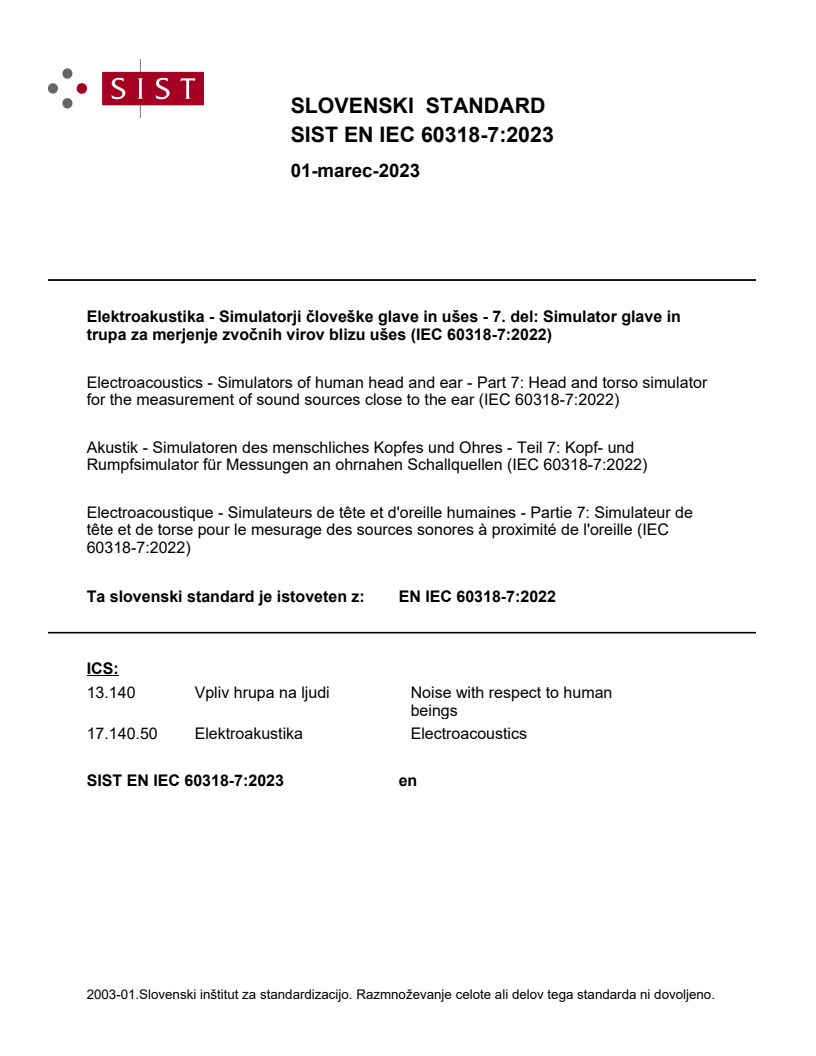
SLOVENSKI STANDARD
01-marec-2023
Elektroakustika - Simulatorji človeške glave in ušes - 7. del: Simulator glave in
trupa za merjenje zvočnih virov blizu ušes (IEC 60318-7:2022)
Electroacoustics - Simulators of human head and ear - Part 7: Head and torso simulator
for the measurement of sound sources close to the ear (IEC 60318-7:2022)
Akustik - Simulatoren des menschliches Kopfes und Ohres - Teil 7: Kopf- und
Rumpfsimulator für Messungen an ohrnahen Schallquellen (IEC 60318-7:2022)
Electroacoustique - Simulateurs de tête et d'oreille humaines - Partie 7: Simulateur de
tête et de torse pour le mesurage des sources sonores à proximité de l'oreille (IEC
60318-7:2022)
Ta slovenski standard je istoveten z: EN IEC 60318-7:2022
ICS:
13.140 Vpliv hrupa na ljudi Noise with respect to human
beings
17.140.50 Elektroakustika Electroacoustics
2003-01.Slovenski inštitut za standardizacijo. Razmnoževanje celote ali delov tega standarda ni dovoljeno.
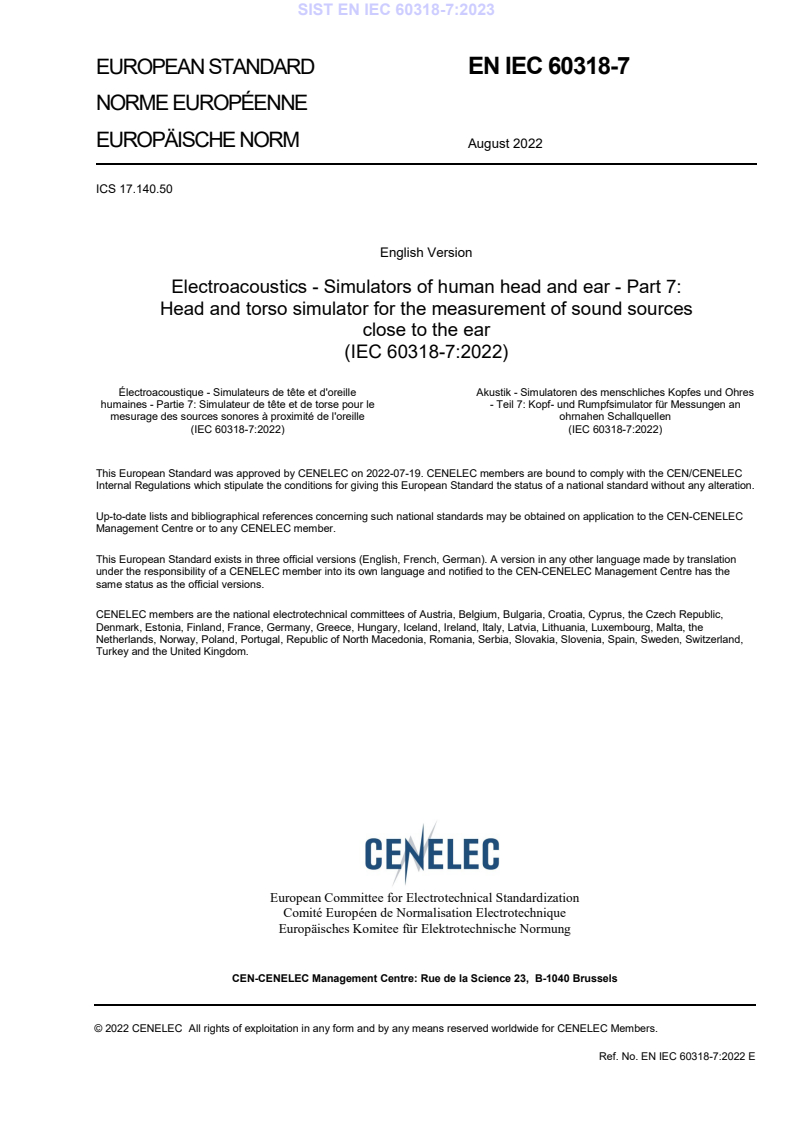
EUROPEAN STANDARD EN IEC 60318-7
NORME EUROPÉENNE
EUROPÄISCHE NORM August 2022
ICS 17.140.50
English Version
Electroacoustics - Simulators of human head and ear - Part 7:
Head and torso simulator for the measurement of sound sources
close to the ear
(IEC 60318-7:2022)
Électroacoustique - Simulateurs de tête et d'oreille Akustik - Simulatoren des menschliches Kopfes und Ohres
humaines - Partie 7: Simulateur de tête et de torse pour le - Teil 7: Kopf- und Rumpfsimulator für Messungen an
mesurage des sources sonores à proximité de l'oreille ohrnahen Schallquellen
(IEC 60318-7:2022) (IEC 60318-7:2022)
This European Standard was approved by CENELEC on 2022-07-19. CENELEC members are bound to comply with the CEN/CENELEC
Internal Regulations which stipulate the conditions for giving this European Standard the status of a national standard without any alteration.
Up-to-date lists and bibliographical references concerning such national standards may be obtained on application to the CEN-CENELEC
Management Centre or to any CENELEC member.
This European Standard exists in three official versions (English, French, German). A version in any other language made by translation
under the responsibility of a CENELEC member into its own language and notified to the CEN-CENELEC Management Centre has the
same status as the official versions.
CENELEC members are the national electrotechnical committees of Austria, Belgium, Bulgaria, Croatia, Cyprus, the Czech Republic,
Denmark, Estonia, Finland, France, Germany, Greece, Hungary, Iceland, Ireland, Italy, Latvia, Lithuania, Luxembourg, Malta, the
Netherlands, Norway, Poland, Portugal, Republic of North Macedonia, Romania, Serbia, Slovakia, Slovenia, Spain, Sweden, Switzerland,
Turkey and the United Kingdom.
European Committee for Electrotechnical Standardization
Comité Européen de Normalisation Electrotechnique
Europäisches Komitee für Elektrotechnische Normung
C
...