


IEC 61466-1:2016
(Main)Composite string insulator units for overhead lines with a nominal voltage greater than 1 000 V - Part 1: Standard strength and end fittings
Composite string insulator units for overhead lines with a nominal voltage greater than 1 000 V - Part 1: Standard strength and end fittings
IEC 61466-1:2016 is applicable to composite string insulator units for a.c. overhead lines with a nominal voltage greater than 1 000 V and a frequency not greater than 100 Hz. It also applies to insulators of similar design used in substations or on electric traction lines. This standard applies to string insulator units of composite type with ball, socket, tongue, clevis, Y-clevis or eye couplings, or a combination thereof. The object of this standard is to prescribe specified values for the mechanical characteristics of the composite string insulator units and define the main dimensions of the couplings to be used on the composite string insulator units in order to permit the assembly of insulators or fittings supplied by different manufacturers and to allow, whenever practical, interchangeability with existing installations. It also defines a standard designation system for composite string insulator units. This edition includes the following significant technical changes with respect to the previous edition:
a) Addition of strength classes reflecting UHV practice;
b) Inclusion of Corrigendum 1:2008 for Y fitting hole dimensions.
Éléments de chaîne d'isolateurs composites pour lignes aériennes de tension nominale supérieure à 1 000 V - Partie 1: Classes mécaniques et armatures d'extrémité normalisées
L'IEC 61466-1:2016 s'applique aux éléments de chaîne d'isolateurs composites pour les lignes aériennes de tension nominale supérieure à 1 000 V à courant alternatif de fréquence inférieure ou égale à 100 Hz. Elle s'applique également aux isolateurs de conception identique utilisés dans les postes de transformation ou sur des lignes de traction électrique. Cette norme s'applique à des éléments de chaîne d'isolateurs composites équipés d'assemblages à rotule, logement de rotule, chape, tenon, chape en Y ou oeillet, ou à une combinaison de ces types d assemblages. Cette norme a pour objet de stipuler les valeurs spécifiées des caractéristiques mécaniques des éléments de chaîne d'isolateurs composites et de définir les dimensions principales de leurs extrémités afin de permettre l'assemblage d'isolateurs et d'armatures provenant de différents fabricants et, lorsque cela est possible, d'autoriser leur interchangeabilité sur des installations existantes. Elle définit également un système normalisé de désignation des éléments de chaîne d'isolateurs composites. Cette édition inclut les modifications techniques majeures suivantes par rapport à l'édition précédente:
a) Ajout des classes mécaniques reflétant l'usage UHV;
b) Inclusion du Corrigendum 1:2008 pour la dimension des trous des armatures en Y.
General Information
- Status
- Published
- Publication Date
- 17-May-2016
- Technical Committee
- TC 36 - Insulators
- Drafting Committee
- MT 18 - TC 36/MT 18
- Current Stage
- PPUB - Publication issued
- Start Date
- 18-May-2016
- Completion Date
- 15-Jul-2016
Relations
- Effective Date
- 05-Sep-2023
- Effective Date
- 05-Sep-2023
Overview
IEC 61466-1:2016 is an international standard established by the International Electrotechnical Commission (IEC) that defines requirements for composite string insulator units used in overhead power lines with nominal voltages exceeding 1,000 V. This standard specifically applies to alternating current (a.c.) overhead lines operating at frequencies not greater than 100 Hz. Additionally, it covers insulators of similar design employed in substations and electric traction lines.
The document sets out the mechanical characteristics, standard strength classes, and main dimensions of end fittings (couplings) for composite string insulator units. It aims to ensure compatibility and interchangeability of insulator units and fittings from different manufacturers to facilitate easier assembly and maintenance in power transmission systems.
Key Updates in 2016 Edition
- Introduction of strength classes suitable for ultra-high voltage (UHV) applications.
- Inclusion of corrigendum for Y fitting hole dimensions to enhance fitting accuracy.
Key Topics
Scope and Application
- Applicable to composite string insulator units with nominal voltage >1,000 V and frequency ≤100 Hz.
- Covers various coupling types including ball, socket, tongue, clevis, Y-clevis, and eye couplings, or combinations thereof.
- Relevant for overhead transmission lines, substations, and electric traction systems.
Mechanical Characteristics
- Specifies standard strength classes to classify insulators based on mechanical load capabilities.
- Defines dimensional parameters to standardize couplings ensuring reliable assembly and structural integrity.
- Aims at mechanical interchangeability between different manufacturers’ components.
Coupling Dimensions and Gauges
- Detailed descriptions of coupling types with exact dimensions for ball and socket couplings, clevis and tongue couplings, Y-clevis, and eye couplings.
- Provision of GO and NOT GO gauges for quality inspection and verification of coupling dimensions.
- Emphasis on dimensional standards supports manufacturing consistency and field compatibility.
Standardized Designation System
- Defines a systematic coding for composite string insulator units to facilitate identification and specification across industries.
- The designation incorporates strength class, coupling type, and size, improving procurement and technical communication.
Applications
IEC 61466-1:2016 is vital for the design, manufacturing, testing, and deployment of composite string insulators used in:
High-voltage overhead power lines operating above 1,000 V.
Ultra-high voltage (UHV) transmission systems requiring enhanced mechanical performance.
Substations where robust insulator units ensure electrical isolation and mechanical support.
Railway and electric traction infrastructure, where insulators withstand dynamic mechanical loads.
Power utilities, manufacturers, and engineers utilize this standard to:
- Select composite insulator units that meet prescribed mechanical strength.
- Ensure reliable interchangeability of fittings and couplings between different suppliers.
- Facilitate maintenance and upgrades with standardized end fittings.
- Improve safety and longevity of overhead line installations.
Related Standards
- IEC 61109: Provides general definitions and test methods for composite insulators used in high voltage applications.
- Other parts in the IEC 61466 series cover additional technical details related to composite insulator units beyond Part 1’s focus on strength and fittings.
- IEC standards for insulator design and testing collectively ensure international uniformity and quality in electrical insulation for power transmission.
By adhering to IEC 61466-1:2016, stakeholders in power transmission systems can achieve enhanced reliability, safety, and interoperability of composite string insulator units, crucial for modern electric grid infrastructure operating at high nominal voltages. This standard supports consistent fabrication and deployment practices, thereby enabling efficient maintenance and system expansion globally.
Frequently Asked Questions
IEC 61466-1:2016 is a standard published by the International Electrotechnical Commission (IEC). Its full title is "Composite string insulator units for overhead lines with a nominal voltage greater than 1 000 V - Part 1: Standard strength and end fittings". This standard covers: IEC 61466-1:2016 is applicable to composite string insulator units for a.c. overhead lines with a nominal voltage greater than 1 000 V and a frequency not greater than 100 Hz. It also applies to insulators of similar design used in substations or on electric traction lines. This standard applies to string insulator units of composite type with ball, socket, tongue, clevis, Y-clevis or eye couplings, or a combination thereof. The object of this standard is to prescribe specified values for the mechanical characteristics of the composite string insulator units and define the main dimensions of the couplings to be used on the composite string insulator units in order to permit the assembly of insulators or fittings supplied by different manufacturers and to allow, whenever practical, interchangeability with existing installations. It also defines a standard designation system for composite string insulator units. This edition includes the following significant technical changes with respect to the previous edition: a) Addition of strength classes reflecting UHV practice; b) Inclusion of Corrigendum 1:2008 for Y fitting hole dimensions.
IEC 61466-1:2016 is applicable to composite string insulator units for a.c. overhead lines with a nominal voltage greater than 1 000 V and a frequency not greater than 100 Hz. It also applies to insulators of similar design used in substations or on electric traction lines. This standard applies to string insulator units of composite type with ball, socket, tongue, clevis, Y-clevis or eye couplings, or a combination thereof. The object of this standard is to prescribe specified values for the mechanical characteristics of the composite string insulator units and define the main dimensions of the couplings to be used on the composite string insulator units in order to permit the assembly of insulators or fittings supplied by different manufacturers and to allow, whenever practical, interchangeability with existing installations. It also defines a standard designation system for composite string insulator units. This edition includes the following significant technical changes with respect to the previous edition: a) Addition of strength classes reflecting UHV practice; b) Inclusion of Corrigendum 1:2008 for Y fitting hole dimensions.
IEC 61466-1:2016 is classified under the following ICS (International Classification for Standards) categories: 29.080.10 - Insulators; 29.240.20 - Power transmission and distribution lines. The ICS classification helps identify the subject area and facilitates finding related standards.
IEC 61466-1:2016 has the following relationships with other standards: It is inter standard links to IEC 61466-1:1997, IEC 61466-1:1997/COR1:2007. Understanding these relationships helps ensure you are using the most current and applicable version of the standard.
You can purchase IEC 61466-1:2016 directly from iTeh Standards. The document is available in PDF format and is delivered instantly after payment. Add the standard to your cart and complete the secure checkout process. iTeh Standards is an authorized distributor of IEC standards.
Standards Content (Sample)
IEC 61466-1 ®
Edition 2.0 2016-05
INTERNATIONAL
STANDARD
NORME
INTERNATIONALE
Composite string insulator units for overhead lines with a nominal voltage
greater than 1 000 V –
Part 1: Standard strength classes and end fittings
Éléments de chaîne d’isolateurs composites pour lignes aériennes de tension
nominale supérieure à 1 000 V –
Partie 1: Classes mécaniques et armatures d’extrémité normalisées
All rights reserved. Unless otherwise specified, no part of this publication may be reproduced or utilized in any form
or by any means, electronic or mechanical, including photocopying and microfilm, without permission in writing from
either IEC or IEC's member National Committee in the country of the requester. If you have any questions about IEC
copyright or have an enquiry about obtaining additional rights to this publication, please contact the address below or
your local IEC member National Committee for further information.
Droits de reproduction réservés. Sauf indication contraire, aucune partie de cette publication ne peut être reproduite
ni utilisée sous quelque forme que ce soit et par aucun procédé, électronique ou mécanique, y compris la photocopie
et les microfilms, sans l'accord écrit de l'IEC ou du Comité national de l'IEC du pays du demandeur. Si vous avez des
questions sur le copyright de l'IEC ou si vous désirez obtenir des droits supplémentaires sur cette publication, utilisez
les coordonnées ci-après ou contactez le Comité national de l'IEC de votre pays de résidence.
IEC Central Office Tel.: +41 22 919 02 11
3, rue de Varembé Fax: +41 22 919 03 00
CH-1211 Geneva 20 info@iec.ch
Switzerland www.iec.ch
About the IEC
The International Electrotechnical Commission (IEC) is the leading global organization that prepares and publishes
International Standards for all electrical, electronic and related technologies.
About IEC publications
The technical content of IEC publications is kept under constant review by the IEC. Please make sure that you have the
latest edition, a corrigenda or an amendment might have been published.
IEC Catalogue - webstore.iec.ch/catalogue Electropedia - www.electropedia.org
The stand-alone application for consulting the entire The world's leading online dictionary of electronic and
bibliographical information on IEC International Standards, electrical terms containing 20 000 terms and definitions in
Technical Specifications, Technical Reports and other English and French, with equivalent terms in 15 additional
documents. Available for PC, Mac OS, Android Tablets and languages. Also known as the International Electrotechnical
iPad. Vocabulary (IEV) online.
IEC publications search - www.iec.ch/searchpub IEC Glossary - std.iec.ch/glossary
The advanced search enables to find IEC publications by a 65 000 electrotechnical terminology entries in English and
variety of criteria (reference number, text, technical French extracted from the Terms and Definitions clause of
committee,…). It also gives information on projects, replaced IEC publications issued since 2002. Some entries have been
and withdrawn publications. collected from earlier publications of IEC TC 37, 77, 86 and
CISPR.
IEC Just Published - webstore.iec.ch/justpublished
Stay up to date on all new IEC publications. Just Published IEC Customer Service Centre - webstore.iec.ch/csc
details all new publications released. Available online and If you wish to give us your feedback on this publication or
also once a month by email. need further assistance, please contact the Customer Service
Centre: csc@iec.ch.
A propos de l'IEC
La Commission Electrotechnique Internationale (IEC) est la première organisation mondiale qui élabore et publie des
Normes internationales pour tout ce qui a trait à l'électricité, à l'électronique et aux technologies apparentées.
A propos des publications IEC
Le contenu technique des publications IEC est constamment revu. Veuillez vous assurer que vous possédez l’édition la
plus récente, un corrigendum ou amendement peut avoir été publié.
Catalogue IEC - webstore.iec.ch/catalogue Electropedia - www.electropedia.org
Application autonome pour consulter tous les renseignements
Le premier dictionnaire en ligne de termes électroniques et
bibliographiques sur les Normes internationales,
électriques. Il contient 20 000 termes et définitions en anglais
Spécifications techniques, Rapports techniques et autres
et en français, ainsi que les termes équivalents dans 15
documents de l'IEC. Disponible pour PC, Mac OS, tablettes
langues additionnelles. Egalement appelé Vocabulaire
Android et iPad.
Electrotechnique International (IEV) en ligne.
Recherche de publications IEC - www.iec.ch/searchpub
Glossaire IEC - std.iec.ch/glossary
La recherche avancée permet de trouver des publications IEC 65 000 entrées terminologiques électrotechniques, en anglais
en utilisant différents critères (numéro de référence, texte, et en français, extraites des articles Termes et Définitions des
comité d’études,…). Elle donne aussi des informations sur les publications IEC parues depuis 2002. Plus certaines entrées
projets et les publications remplacées ou retirées. antérieures extraites des publications des CE 37, 77, 86 et
CISPR de l'IEC.
IEC Just Published - webstore.iec.ch/justpublished
Service Clients - webstore.iec.ch/csc
Restez informé sur les nouvelles publications IEC. Just
Published détaille les nouvelles publications parues. Si vous désirez nous donner des commentaires sur cette
Disponible en ligne et aussi une fois par mois par email. publication ou si vous avez des questions contactez-nous:
csc@iec.ch.
IEC 61466-1 ®
Edition 2.0 2016-05
INTERNATIONAL
STANDARD
NORME
INTERNATIONALE
Composite string insulator units for overhead lines with a nominal voltage
greater than 1 000 V –
Part 1: Standard strength classes and end fittings
Éléments de chaîne d’isolateurs composites pour lignes aériennes de tension
nominale supérieure à 1 000 V –
Partie 1: Classes mécaniques et armatures d’extrémité normalisées
INTERNATIONAL
ELECTROTECHNICAL
COMMISSION
COMMISSION
ELECTROTECHNIQUE
INTERNATIONALE
ICS 29.080.10; 29.240.20 ISBN 978-2-8322-3419-8
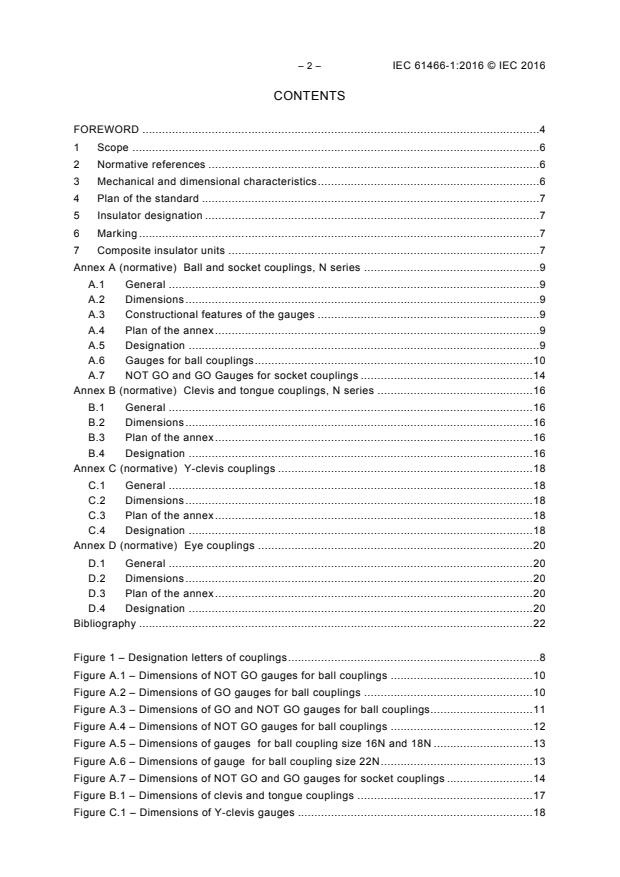
– 2 – IEC 61466-1:2016 © IEC 2016
CONTENTS
FOREWORD .4
1 Scope .6
2 Normative references .6
3 Mechanical and dimensional characteristics .6
4 Plan of the standard .7
5 Insulator designation .7
6 Marking .7
7 Composite insulator units .7
Annex A (normative) Ball and socket couplings, N series .9
A.1 General .9
A.2 Dimensions .9
A.3 Constructional features of the gauges .9
A.4 Plan of the annex .9
A.5 Designation .9
A.6 Gauges for ball couplings . 10
A.7 NOT GO and GO Gauges for socket couplings . 14
Annex B (normative) Clevis and tongue couplings, N series . 16
B.1 General . 16
B.2 Dimensions . 16
B.3 Plan of the annex . 16
B.4 Designation . 16
Annex C (normative) Y-clevis couplings . 18
C.1 General . 18
C.2 Dimensions . 18
C.3 Plan of the annex . 18
C.4 Designation . 18
Annex D (normative) Eye couplings . 20
D.1 General . 20
D.2 Dimensions . 20
D.3 Plan of the annex . 20
D.4 Designation . 20
Bibliography . 22
Figure 1 – Designation letters of couplings .8
Figure A.1 – Dimensions of NOT GO gauges for ball couplings . 10
Figure A.2 – Dimensions of GO gauges for ball couplings . 10
Figure A.3 – Dimensions of GO and NOT GO gauges for ball couplings . 11
Figure A.4 – Dimensions of NOT GO gauges for ball couplings . 12
Figure A.5 – Dimensions of gauges for ball coupling size 16N and 18N . 13
Figure A.6 – Dimensions of gauge for ball coupling size 22N . 13
Figure A.7 – Dimensions of NOT GO and GO gauges for socket couplings . 14
Figure B.1 – Dimensions of clevis and tongue couplings . 17
Figure C.1 – Dimensions of Y-clevis gauges . 18
Figure C.2 – Dimensions of Y-clevis couplings and gauges . 19
Figure D.1 – Dimensions of eye couplings . 21
Table 1 – Insulator designation .8
Table A.1 – Dimensions of NOT GO gauges for ball couplings . 10
Table A.2 – Dimensions of GO gauges for ball couplings . 11
Table A.3 – Dimensions of GO and NOT GO gauges for ball couplings . 11
Table A.4 – Dimensions of NOT GO gauges for ball couplings . 12
Table A.5 – Dimensions of gauges for ball couplings . 13
Table A.6 – Dimensions of NOT GO and GO gauges for socket couplings . 15
Table B.1 – Dimensions of clevis and tongue couplings . 17
Table C.1 – Dimensions of Y-clevis couplings . 19
Table D.1 – Dimensions of eye couplings . 21
– 4 – IEC 61466-1:2016 © IEC 2016
INTERNATIONAL ELECTROTECHNICAL COMMISSION
____________
COMPOSITE STRING INSULATOR UNITS FOR OVERHEAD LINES
WITH A NOMINAL VOLTAGE GREATER THAN 1 000 V –
Part 1: Standard strength classes and end fittings
FOREWORD
1) The International Electrotechnical Commission (IEC) is a worldwide organization for standardization comprising
all national electrotechnical committees (IEC National Committees). The object of IEC is to promote
international co-operation on all questions concerning standardization in the electrical and electronic fields. To
this end and in addition to other activities, IEC publishes International Standards, Technical Specifications,
Technical Reports, Publicly Available Specifications (PAS) and Guides (hereafter referred to as “IEC
Publication(s)”). Their preparation is entrusted to technical committees; any IEC National Committee interested
in the subject dealt with may participate in this preparatory work. International, governmental and non-
governmental organizations liaising with the IEC also participate in this preparation. IEC collaborates closely
with the International Organization for Standardization (ISO) in accordance with conditions determined by
agreement between the two organizations.
2) The formal decisions or agreements of IEC on technical matters express, as nearly as possible, an
international consensus of opinion on the relevant subjects since each technical committee has representation
from all interested IEC National Committees.
3) IEC Publications have the form of recommendations for international use and are accepted by IEC National
Committees in that sense. While all reasonable efforts are made to ensure that the technical content of IEC
Publications is accurate, IEC cannot be held responsible for the way in which they are used or for any
misinterpretation by any end user.
4) In order to promote international uniformity, IEC National Committees undertake to apply IEC Publications
transparently to the maximum extent possible in their national and regional publications. Any divergence
between any IEC Publication and the corresponding national or regional publication shall be clearly indicated in
the latter.
5) IEC itself does not provide any attestation of conformity. Independent certification bodies provide conformity
assessment services and, in some areas, access to IEC marks of conformity. IEC is not responsible for any
services carried out by independent certification bodies.
6) All users should ensure that they have the latest edition of this publication.
7) No liability shall attach to IEC or its directors, employees, servants or agents including individual experts and
members of its technical committees and IEC National Committees for any personal injury, property damage or
other damage of any nature whatsoever, whether direct or indirect, or for costs (including legal fees) and
expenses arising out of the publication, use of, or reliance upon, this IEC Publication or any other IEC
Publications.
8) Attention is drawn to the Normative references cited in this publication. Use of the referenced publications is
indispensable for the correct application of this publication.
9) Attention is drawn to the possibility that some of the elements of this IEC Publication may be the subject of
patent rights. IEC shall not be held responsible for identifying any or all such patent rights.
International Standard IEC 61466-1 has been prepared by IEC technical committee 36:
Insulators.
This second edition cancels and replaces the first edition published in 1997. This edition
constitutes a technical revision.
This edition includes the following significant technical changes with respect to the previous
edition:
a) Addition of strength classes reflecting UHV practice;
b) Inclusion of Corrigendum 1:2008 for Y fitting hole dimensions.
The text of this standard is based on the following documents:
FDIS Report on voting
36/378/FDIS 36/381/RVD
Full information on the voting for the approval of this standard can be found in the report on
voting indicated in the above table.
This publication has been drafted in accordance with the ISO/IEC Directives, Part 2.
A list of all parts in the IEC 61466 series, published under the general title Composite string
insulator units for overhead lines with a nominal voltage greater than 1 000 V, can be found
on the IEC website.
The committee has decided that the contents of this publication will remain unchanged until
the stability date indicated on the IEC website under "http://webstore.iec.ch" in the data
related to the specific publication. At this date, the publication will be
• reconfirmed,
• withdrawn,
• replaced by a revised edition, or
• amended.
– 6 – IEC 61466-1:2016 © IEC 2016
COMPOSITE STRING INSULATOR UNITS FOR OVERHEAD LINES
WITH A NOMINAL VOLTAGE GREATER THAN 1 000 V –
Part 1: Standard strength classes and end fittings
1 Scope
This part of IEC 61466 is applicable to composite string insulator units for a.c. overhead lines
with a nominal voltage greater than 1 000 V and a frequency not greater than 100 Hz.
It also applies to insulators of similar design used in substations or on electric traction lines.
This standard applies to string insulator units of composite type with ball, socket, tongue,
clevis, Y-clevis or eye couplings, or a combination thereof.
The object of this standard is to prescribe specified values for the mechanical characteristics
of the composite string insulator units and define the main dimensions of the couplings to be
used on the composite string insulator units in order to permit the assembly of insulators or
fittings supplied by different manufacturers and to allow, whenever practical,
interchangeability with existing installations.
It also defines a standard designation system for composite string insulator units.
NOTE 1 General definitions and methods of testing are given in IEC 61109.
NOTE 2 Only the dimensions necessary for assembly of the couplings are dealt with in this International
Standard. Properties of material and working loads are not specified. The coordination of dimensions of the end-
fittings with the strength classes is specified in Clause 7.
2 Normative references
The following documents, in whole or in part, are normatively referenced in this document
and are indispensable for its application. For dated references, only the edition cited applies.
For undated references, the latest edition of the referenced document (including any
amendments) applies.
IEC 60120:1984, Dimensions of ball and socket couplings of string insulator units
IEC 60471:1977, Dimensions of clevis and tongue couplings of string insulator units
3 Mechanical and dimensional characteristics
Composite string insulator units are standardized by the following specified characteristics:
– specified mechanical load (SML);
– standard couplings.
All dimensions are expressed in millimetres.
The dimensions apply to the finished product after any surface treatment.
4 Plan of the standard
This standard includes eleven standard SML classes designated for use together with 10
different series of couplings as follows.
– Two different standard series of ball couplings, one according to IEC 60120 and one,
type N, as shown in Annex A of this standard.
– Two different standard series of socket couplings, one according to IEC 60120 and one,
type N, as shown in Annex A of this standard.
– Two different standard series of tongue couplings, one, type L, according to IEC 60471
and one, type N, as shown in Annex B of this standard.
– Two different standard series of clevis couplings, one, type L, according to IEC 60471,
and one, type N, as shown in Annex B of this standard
– One standard series of Y clevis couplings, as shown in Annex C of this standard.
– One standard series of eye couplings as shown in Annex D of this standard.
5 Insulator designation
Insulators are designated in Table 1 by letter CS followed by a number indicating the
specified mechanical load (SML) in kilonewtons. The letter B, S, T, C, Y or E or a
combination thereof which follows specifies a ball, socket, tongue, clevis, Y-clevis or eye
coupling, see Figure 1. The following figures specify the size of the coupling. When a
combination of couplings are used, the first letter shall always express the coupling on the
upper end of the insulator. The upper end of the insulator is defined in relation to the slope of
the sheds. In the case of symmetrical profile of the sheds any order of the letters is
acceptable.
As examples, possible designations could be:
CS 120 S/B16 indicates a composite insulator having a SML equal to 120 kN, a socket
coupling according to IEC 60120, size 16, at the upper end and a ball coupling according to
IEC 60120, size 16, at the other end.
CS 120 C/T19N indicates a composite insulator having a SML equal to 120 kN, a clevis
coupling according to Annex B, size 19N, at the upper end and a tongue coupling according
to Annex B, size 19N, at the other end.
Fittings of the same series conforming to different standards (e.g. IEC 60120 and Annex A of
this part of IEC 61466) should be avoided on the same insulator.
6 Marking
Each insulator shall be clearly and indelibly marked with the name or trademark of the
manufacturer, the year of manufacture, the specified mechanical load (SML) and a means
permitting identification of each of the component parts.
7 Composite insulator units
The values of the specified mechanical loads (SML) for composite string insulators together
with corresponding coupling sizes are given in Table 1.
The designation letters of the different designs of couplings which may be used in any
combination are shown in Figure 1.
– 8 – IEC 61466-1:2016 © IEC 2016
B S T C Y E
Upper end
B S T C Y E
IEC
Figure 1 – Designation letters of couplings
Table 1 – Insulator designation
Designation Specified Ball and socket Clevis and tongue Y-clevis Eye
mechanical
IEC 60120 Annex A IEC 60471 Annex B Annex C Annex D
load
size size size size size size
(SML)
CS 40 40 11 – – – – –
CS 70 70 16 16N 13L 16N 16 (19) 17 (24)
CS 100 100 16 16N 16L 16N (19N) 19 24
CS 120 120 16 18N 16L 16N (19N) 19 24
CS 160 160 20 22N 19L 19N (22N) 22 25
CS 210 210 20 22N (19L) 22L 22N 22 25
CS 300 300 24 – (22L) 25L – – –
CS 400 400 28 – 28L – – –
CS 420 420 28 – 28L – – –
CS 530 530 32 – 32L – – –
CS 550 550 32 – 32L – – –
CS 600 600 – – 36L – – –
NOTE 1 Non-preferred coupling sizes in brackets.
NOTE 2 Coupling size 36L is not defined in IEC 60471.
Annex A
(normative)
Ball and socket couplings, N series
A.1 General
This annex applies to the couplings of composite string insulator units.
This annex defines the dimensions of a standardized series of ball and socket couplings,
which permit the replacement of existing insulator sets in accordance with North American
practice, and permits the assembly of composite insulator units and fittings supplied by
different manufacturers.
A.2 Dimensions
The dimensions for the ball and socket couplings are expressed by dimensions for the GO
and NOT GO gauges (see Figures A.1 to A.7).
All dimensions indicated in Tables A.1 to A.6 are given in millimetres and refer to the finished
product after surface treatment such as, for instance, hot dip galvanizing.
The outside dimensions of the socket have not been fixed, since they depend on the
mechanical characteristics of the material used. Only the dimensions necessary for assembly
of the couplings are dealt with in this standard.
In general, the ball is made of forged steel and the socket is made of malleable or ductile
cast iron or forged steel. However, other materials may be used if they have mechanical
characteristics corresponding to those given in Table 1 of this part of IEC 61466.
NOTE Dimensions are converted from inches.
A.3 Constructional features of the gauges
The choice of material, the hardness, the surface finish, the surface treatment and the
method of manufacture are liable to vary from one country to another. Therefore, the
following recommendations are given only for general guidance:
– the material shall be non-shrinking, oil-hardening steel;
– the Rockwell hardness number shall be 62 to 63 HRC in order to reduce deformation and
wear;
– the surface roughness shall be less than 4 µm;
– hard chromium plating can, in certain cases, increase resistance to wear.
A.4 Plan of the annex
This annex includes three standard sizes of ball and socket couplings, followed by the letter
N, which reflect the North American practice.
A.5 Designation
The ball and socket couplings are designated by the shank diameter, expressed in
millimetres, of the ball coupling, followed by the letter N.
– 10 – IEC 61466-1:2016 © IEC 2016
A.6 Gauges for ball couplings
d
r
d
IEC
Figure A.1 – Dimensions of NOT GO gauges for ball couplings
Table A.1 – Dimensions of NOT GO gauges for ball couplings
Designated size of Gauge contour Dimensions according to figure A.1
ball couplings
d d h r
1 2 1 1
Min. 15,748 – – –
16N Nom. 15,748 20,638 14,288 1,588
Max. 15,753 – – –
Min. 17,399 – – –
18N Nom. 17,399 20,638 14,288 1,588
Max. 17,404 – – –
Min. 21,565 28,448 – 1,473
22N Nom. 21,590 28,575 19,050 1,600
Max. 21,615 28,702 – 1,727
d
r
r
r
r
α
r
d
IEC
Figure A.2 – Dimensions of GO gauges for ball couplings
h
h
h
Table A.2 – Dimensions of GO gauges for ball couplings
Designated Gauge Dimensions according to figure A.2
size of ball contour
d d h h r r r r r α
couplings 3 4 2 3 2 3 4 5 6 1
Min. 18,867 33,325 14,122 30,607 23,241 6,223 2,997 3,048 1,905 –
16N Nom. 18,872 33,376 14,224 30,607 23,368 6,350 3,124 3,175 2,032 11,5
Max. 18,872 33,376 14,224 30,734 23,368 6,477 3,124 3,175 2,159 –
Min. 18,867 33,325 14,122 30,607 23,241 6,223 2,997 3,048 1,905 –
18N Nom. 18,872 33,376 14,224 30,607 23,368 6,350 3,124 3,175 2,032 11,5
Max. 18,872 33,376 14,224 30,734 23,368 6,477 3,124 3,175 2,159 –
Min. 23,647 43,078 18,440 36,525 32,055 3,963 5,004 – 1,905 –
22N Nom. 23,673 43,104 18,491 36,576 32,106 4,089 5,055 3,962 2,032 9,5
Max. 23,698 43,129 18,542 36,627 32,156 4,216 5,105 – 2,159 –
d
r
r
r
d
IEC
Figure A.3 – Dimensions of GO and NOT GO gauges for ball couplings
Table A.3 – Dimensions of GO and NOT GO gauges for ball couplings
Designated Gauge Dimensions according to figure A.3
size of ball contour
d d r r h h
couplings
5 6 7 8 4 5
Min. 31,598 33,350 – – – –
16N Nom. 31,598 33,376 1,588 0,397 12,700 6,350
Max. 31,623 33,376 – – – –
Min. 31,598 33,350 – – – –
18N Nom. 31,598 33,376 1,588 0,397 12,700 6,350
Max. 31,623 33,376 – – – –
Min. 40,843 43,104 – – – –
22N Nom. 40,869 43,129 0,397 0,397 12,700 6,350
Max. 40,894 43,155 – – – –
h
h h
5 5
– 12 – IEC 61466-1:2016 © IEC 2016
d
r
r
r
r
α
r
k
d
IEC
Figure A.4 – Dimensions of NOT GO gauges for ball couplings
Table A.4 – Dimensions of NOT GO gauges for ball couplings
Designated Gauge Dimensions according to figure A.4
size of ball contour
d d h h r r r r r k α
couplings 7 8 6 7 9 10 11 12 13 2
Min. 18,923 – 12,573 25,781 23,368 3,175 – – 1,905 – –
16N Nom. 18,923 38,100 12,573 25,908 23,368 3,302 4,366 3,175 2,032 6,350 11
Max. 18,928 – 12,675 26,035 23,495 3,429 – – 2,159 – –
Min. 18,923 – 12,573 25,781 23,368 3,175 – – 1,905 – –
18N Nom. 18,923 38,100 12,573 25,908 23,368 3,302 4,366 3,175 2,032 6,350 11
Max. 18,928 – 12,675 26,035 23,495 3,429 – – 2,159 – –
Min. 23,698 47,498 16,713 36,195 32,055 3,175 4,648 – 1,905 – –
22N Nom. 23,724 47,625 16,764 36,322 32,106 3,302 4,775 4,064 2,032 6,350 9,5
Max. 23,749 47,752 16,815 36,449 32,156 3,429 4,902 – 2,159 – –
h
h
M
R R
M
M
M
M
IEC IEC
Figure A.5 – Dimensions of gauges Figure A.6 – Dimensions of gauge
for ball coupling size 16N and 18N for ball coupling size 22N
Table A.5 – Dimensions of gauges for ball couplings
Designated Gauge Dimensions according to figures A.5, A.6
size of ball contour
M M M M M M R
couplings 1 2 3 4 5 6
16N Nom. 110 111 98 49 24 – –
18N Nom. 110 113 98 49 24 – –
22N Nom. 140 70 127 64 32 15 90
NOTE The thickness of each gauge is 12,7 mm.
M
M
M
M M
4 5
M
– 14 – IEC 61466-1:2016 © IEC 2016
A.7 NOT GO and GO Gauges for socket couplings
D
NOT GO
D
M
M
M
R
R
R
α
α α
3 4
D
M
D
D
R
R
R
3 R
α
D
GO
IEC
Figure A.7 – Dimensions of NOT GO and GO gauges for socket couplings
H
H
H H
3 2
H H H
8 5 7
H
Table A.6 – Dimensions of NOT GO and GO gauges for socket couplings
Dimensions according to figure A.7
D D D H H H R R R R α D D H H H H H M M M R R R α α α
1 2 3 1 2 3 1 2 3 4 1 4 5 4 5 6 7 8 1 2 3 5 6 7 2 3 4
Min. 19,177 33,401 – 14,249 30,556 – 9,525 23,393 3,277 – – 35,662 20,803 15,824 – – – – 26,797 33,350 16,993 9,500 24,511 3,835 – – –
16N Nom. 19,177 33,401 34,138 14,249 30,607 9,144 9,525 23,393 3,277 3,175 11 35,712 20,828 15,875 12,700 9,906 8,763 19,447 26,848 33,401 17,018 9,627 24,638 3,937 11 30 45
Max. 19,202 33,452 – 14,300 30,607 – 9,652 23,520 3,378 – – 35,712 20,828 15,875 – – – – 26,848 33,401 17,018 9,627 24,638 3,937 – – –
Min. 19,177 33,401 – 14,249 30,556 – 9,525 23,393 3,277 – – 35,662 20,803 15,824 – – – – 26,797 33,350 16,993 9,500 24,511 3,835 – – –
18N Nom. 19,177 33,401 34,138 14,249 30,607 9,144 9,525 23,393 3,277 3,175 11 35,712 20,828 15,875 12,700 9,906 8,763 19,447 26,848 33,401 17,018 9,627 24,638 3,937 11 30 45
Max. 19,202 33,452 – 14,300 30,607 – 9,652 23,520 3,378 – – 35,712 20,828 15,875 – – – – 26,848 33,401 17,018 9,627 24,638 3,937 – – –
Min. 24,613 43,155 50,673 18,593 36,449 – 6,299 32,156 5,105 – – 46,660 26,899 – 17,729 – – – 34,671 43,155 22,225 6,350 34,036 5,867 – – –
22N Nom. 24,638 43,180 50,800 18,618 36,474 13,589 6,350 32,207 5,131 4,064 9,5 46,685 26,924 20,726 17,780 – 13,360 28,575 34,696 43,180 22,352 6,401 34,087 5,918 9,5 – 45
Max. 24,663 43,205 50,927 18,644 36,500 – 6,401 32,258 5,156 – – 46,711 26,949 – 17,831 – – – 34,722 43,205 22,479 6,452 34,138 5,969 – – –
Designated size of
socket couplings
Gauge contour
– 16 – IEC 61466-1:2016 © IEC 2016
Annex B
(normative)
Clevis and tongue couplings, N series
B.1 General
This annex applies to the couplings of composite string insulator units.
This annex defines the dimensions of a series of clevis and tongue couplings, which permit
articulation perpendicular to the coupling pin axis to avoid bending forces in the insulator,
and permits the assembly of composite insulator units and fittings supplied by different
manufacturers.
B.2 Dimensions
All dimensions indicated in Table B.1 are given in millimetres, and refer to the finished
articles after surface treatment such as, for instance, hot dip galvanizing.
The outside dimensions of the clevis have not been fixed, since they depend on the
mechanical characteristics of the material used. Therefore the length of the coupling pin is
not fixed and, unless otherwise agreed, the coupling pin shall be delivered together with the
clevis. A locking device, such as a nut or a split pin, shall be placed to hold the pin in its
place. Only the dimensions necessary for assembly of the couplings are dealt with in this
standard.
In general, the clevis is made of malleable or ductile cast iron or forged steel and the tongue
of forged steel. However, other materials may be used if they have mechanical
characteristics corresponding to those given in Table 1.
NOTE The dimensions of this series of couplings are based on those of the IEC 60471 C series, except that they
allow articulation perpendicular to the coupling pin.
B.3 Plan of the annex
This annex includes three standard sizes of clevis and tongue couplings which reflect the
North American practice.
B.4 Designation
The clevis and tongue couplings are designated by the diameter, expressed in millimetres, of
the coupling pin which connects the clevis and the tongue, followed by the letter N.
B
A
N
A
d
Section A-A
IEC
Figure B.1 – Dimensions of clevis and tongue couplings
Table B.1 – Dimensions of clevis and tongue couplings
Designation 16N 19N 22N
Dimensions Min. Nom. Max. Min. Nom. Max. Min. Nom. Max.
mm
Coupling pin diameter d 15,5 16 16,3 18,6 19 19,4 21,8 22 22,6
Hole of clevis and tongue d 16,7 17,5 18,3 19,8 20,6 21,4 23 23,8 24,5
Tongue thickness N – – 14,3 – – 20,6 – – 23,8
Clevis opening B 17,5 – – 22,2 – – 25,4 – –
Tongue M – – 14,3 – – 14,3 – – 15,9
Clevis F 32,9 – – 36,2 – – 40,9 – –
Clevis H – – 16,5 – – 21 – – 23
Tongue L 48 – – 56 – – 63 – –
L
d
M
H
F
– 18 – IEC 61466-1:2016 © IEC 2016
Annex C
(normative)
Y-clevis couplings
C.1 General
This annex applies to the couplings of composite string insulator units.
This annex defines the dimensions of a series of Y-clevis couplings, which permit articulation
perpendicular and longitudinal to the coupling pin axis, to avoid bending forces in the
insulator, and permits the assembly of composite insulator units and fittings supplied by
different manufacturers.
C.2 Dimensions
All dimensions indicated in Table C.1 are given in millimetres, and refer to the finished
articles after surface treatment such as, for instance, hot dip galvanizing.
The outside dimensions of the clevis have not been fixed, since they depend on the
mechanical characteristics of the material used. Therefore, the length of the coupling pin is
not fixed and, unless otherwise agreed, the coupling pin shall be delivered together with the
clevis. A locking device, such as a nut or a split pin, shall be placed to hold the pin in its
place. Only the dimensions necessary for assembly of the couplings are dealt with in this part
of IEC 61466.
In general, the clevis is made of malleable or ductile cast iron or forged steel. However, other
materials may be used if they have mechanical characteristics corresponding to those given
in Table 1.
C.3 Plan of the annex
This annex includes three standard sizes of Y-clevis couplings which reflect the North
American practice.
C.4 Designation
The Y-clevis couplings are designated by diameter, expressed in millimetres, of the coupling
pin which connects the clevis to the equipment to which it shall be fitted, as shown in
Figure C.1.
B
r =
r
L
B
IEC
Figure C.1 – Dimensions of Y-clevis gauges
F
The gauge shall pass as indicated in Figure C.2.
+2
45° 0
H
d
d
IEC
Figure C.2 – Dimensions of Y-clevis couplings and gauges
Table C.1 – Dimensions of Y-clevis couplings
Designation 16 19 22
Dimensions Min. Nom. Max. Min. Nom. Max. Min. Nom. Max.
mm
Coupling pin diameter d 15,5 16 16,3 18,6 19 19,4 21,8 22 22,6
a
Hole of clevis d 18,5 19 19,3 22,5 23 23,5 26,5 27 27,5
Clevis H – – 16,5 – – 21 – – 23
Gauge width B 15,9 16 16,1 20,9 21 21,1 23,9 24 24,1
Gauge height F 29,8 30 30,2 31,8 32 32,2 39,8 40 40,2
Gauge length L 45 – – 45 – – 55 – –
a
In order to allow satisfactory insertion of the coupling pin through the holes in the clevis arms these holes
may be elongated rather than round. In this case the dimension d shall be taken as the width of the holes.
– 20 – IEC 61466-1:2016 © IEC 2016
Annex D
(normative)
Eye couplings
D.1 General
This annex applies to the couplings of composite string insulator units.
This annex defines the dimensions of a series of eye couplings, which permit articulation
perpendicular and longitudinal to the coupling, to avoid bending forces in the insulator, and to
permit the assembly of composite insulator units and fittings supplied by different
manufacturers.
D.2 Dimensions
All dimensions indicated in Table D.1 are given in millimetres, and refer to the finished
articles after surface treatment such as, for instance, hot dip galvanizing.
The dimensions of the eye have only been fixed for such dimensions that are important for
the connecting parts since all other dimensions depend on the mechanical characteristics of
the material used.
In general, the eye is made of forged steel. However, other materials may be used if they
have mechanical characteristics corresponding to those given in Table 1 of this standard.
D.3 Plan of the annex
This annex includes three standard sizes of eye couplings which reflect the North American
practice.
D.4 Designation
The eye couplings are designated by the inside width, expressed in millimetres, of the
coupling eye, as shown in Figure D.1.
A
D
IEC
Figure D.1 – Dimensions of eye couplings
Table D.1 – Dimensions of eye couplings
Designation 17 24 25
Dimensions Min. Max. Min. Max. Min. Max.
mm
Width of eye A 17 – 24 – 25 –
Length of eye B 30 – 48 – 50 –
Shank C – 15 – 19 – 24
Shoulder D – 15 – 19 – 24
Head E – 18 – 19 – 26
C
B E
– 22 – IEC 61466-1:2016 © IEC 2016
Bibliography
[1] IEC 61109:2008, Insulators for overhead lines – Composite suspension and tension
insulators for a.c. systems with a nominal voltage greater than 1 000 V – Definitions,
test methods and acceptance criteria
___________
– 24 – IEC 61466-1:2016 © IEC 2016
SOMMAIRE
AVANT-PROPOS . 26
1 Domaine d'application . 28
2 Références normatives . 28
3 Caractéristiques mécaniques et dimensionnelles . 28
4 Plan de la norme . 29
5 Désignation des isolateurs . 29
6 Marquage . 29
7 Modèles d’éléments de chaîne d’isolateurs composites . 30
Annexe A (normative) Assemblages à rotule, série N . 32
A.1 Généralités . 32
A.2 Dimensions . 32
A.3 Exécution des calibres de contrôle . 32
A.4 Plan de l’annexe . 32
A.5 Désignation . 33
A.6 Calibres de contrôle pour les tiges à rotule . 33
A.7 Calibres de contrôle pour les logements de rotules . 38
Annexe B (normative) Assemblages à chape et tenon, série N . 40
B.1 Généralités . 40
B.2 Dimensions . 40
B.3 Plan de l’annexe . 40
B.4 Désignation . 40
Annexe C (normative) Assemblages à chape en Y . 42
C.1 Généralités . 42
C.2 Dimensions . 42
C.3 Plan de l’annexe . 42
C.4 Désignation . 42
Annexe D (normative) Assemblages à œillet . 44
D.1 Généralités . 44
D.2 Dimensions . 44
D.3 Plan de l’annexe . 44
D.4 Désignation . 44
Bibliographie . 46
Figure 1 – Désignation des assemblages . 30
Figure A.1 – Dimensions des calibres NE PASSE PAS pour les tiges à rotule . 33
Figure A.2 – Dimensions des calibres PASSE pour les tiges à rotule . 34
Figure A.3 – Dimensions des calibres PASSE – NE PASSE PAS pour les tiges à rotule . 35
Figure A.4 – Dimensions des calibres NE PASSE PAS pour les tiges à rotule . 36
Figure A.5 – Dimensions des calibres pour les tiges à rotule de type 16N
...
記事のタイトル:IEC 61466-1:2016 - 道路線の名称電圧が1,000 V以上の交流用空中線に適用される合成弦状絶縁子ユニット - 第1部:標準強度およびエンドフィッティング 記事の内容:IEC 61466-1:2016は、名称電圧が1,000 V以上および周波数が100 Hzを超えない交流用空中線に使用される合成弦状絶縁子ユニットに適用されます。また、変電所や電気牽引線で使用される同様のデザインの絶縁子にも適用されます。この規格は、ボール、ソケット、タン、クレビス、Y-クレビスまたはアイのカップリング、またはその組み合わせを持つ合成弦型絶縁子ユニットに対して、機械的特性の指定値とカップリングの主要な寸法を定義することを目的としています。これにより、異なるメーカーから供給される絶縁子やフィッティングの組み立てを可能にし、できる限り既存の設備との交換性を実現します。また、合成弦状絶縁子ユニットのための標準指定システムも定義しています。最新版では、次の重要な技術的変更が含まれています: a) UHVの実践を反映した強度クラスの追加 b) Yフィッティングの穴の寸法に関する訂正 1:2008の追加
IEC 61466-1:2016 is a standard that applies to composite string insulator units used in overhead lines with a voltage greater than 1,000 V and a frequency not exceeding 100 Hz. It also applies to similar insulators used in substations or electric traction lines. The standard specifies mechanical characteristics and dimensions of couplings, allowing for compatibility between different manufacturers and interchangeability with existing installations. The latest edition includes updates such as the addition of strength classes for ultra-high voltage practice and the inclusion of Corrigendum 1:2008 for Y fitting hole dimensions.
아티클 제목: IEC 61466-1:2016 - 유격 전압이 1,000 V 이상인 공중선용 합성섬유로 구성된 단열체 유닛 - 제1부: 표준 강도 및 연결기 아티클 내용: IEC 61466-1:2016은 유격 전압이 1,000 V 이상이고 주파수가 100 Hz를 초과하지 않는 교류 공중선용 합성섬유로 구성된 단열체 유닛에 적용됩니다. 또한, 이 표준은 변전소나 전기적인 구동선에서 사용되는 유사한 디자인의 단열체에도 적용됩니다. 이 표준은 볼, 소켓, 통, 클레비스, Y-클레비스 또는 아이 연결기, 또는 이들의 조합을 갖는 합성섬유 단열체 유닛에 적용됩니다. 이 표준의 목적은 합성섬유 단열체 유닛의 기계적 특성에 대한 지정된 값과 연결기의 주요 치수를 정의하여, 다른 제조업체에서 공급되는 단열체나 연결부품의 조립을 허용하고, 가능한 경우 기존 설치물과 교환 가능성을 허용하기 위함입니다. 또한, 합성섬유 단열체 유닛에 대해 표준 명칭 시스템을 정의합니다. 최신 판에서는 다음과 같은 중요한 기술적 변경 사항이 포함됩니다: a) UHV 실무를 반영한 강도 등급 추가 b) Y 연결구의 구멍 치수에 대한 Corrigendum 1:2008 포함
Questions, Comments and Discussion
Ask us and Technical Secretary will try to provide an answer. You can facilitate discussion about the standard in here.
Loading comments...