

IEC PAS 61980-5:2024
(Main)Electric vehicle wireless power transfer (WPT) systems - Part 5: Interoperability and safety of dynamic wireless power transfer (D-WPT) for electric vehicles
General Information
- Abstract
IEC PAS 61980-5:2024 applies to the off-board supply equipment for dynamic wireless power transfer via magnetic field (MF-D-WPT) to electric road vehicles in motion for purposes of supplying electric energy to the RESS (rechargeable energy storage system) and/or other on-board electrical systems.
The system operates at standard supply voltage ratings per IEC 60038 up to 1 000 V AC and up to 1 500 V DC from the supply network. The power transfer takes place primarily while the electric vehicle (EV) is in motion, but can continue to take place under certain conditions while the vehicle is not in motion.
Off-board supply equipment fulfilling the requirements in this document are intended to operate with EV devices fulfilling the requirements of ISO 5474-4 and ISO 5474-6.
The aspects covered in this document includes
– the characteristics and operating conditions,
– specific power transfer requirements for the off-board side of magnetic field dynamic wireless power transfer systems for electric road vehicles, and
– the general requirement of electrical safety and EMC for MF-D-WPT.
- Status
- Published
- Publication Date
- 11-Dec-2024
- Technical Committee
- TC 69 - Electrical power/energy transfer systems for electrically propelled road vehicles and industrial trucks
- Drafting Committee
- WG 7 - TC 69/WG 7
- Current Stage
- PPUB - Publication issued
- Start Date
- 12-Dec-2024
- Completion Date
- 29-Nov-2024
Buy Documents

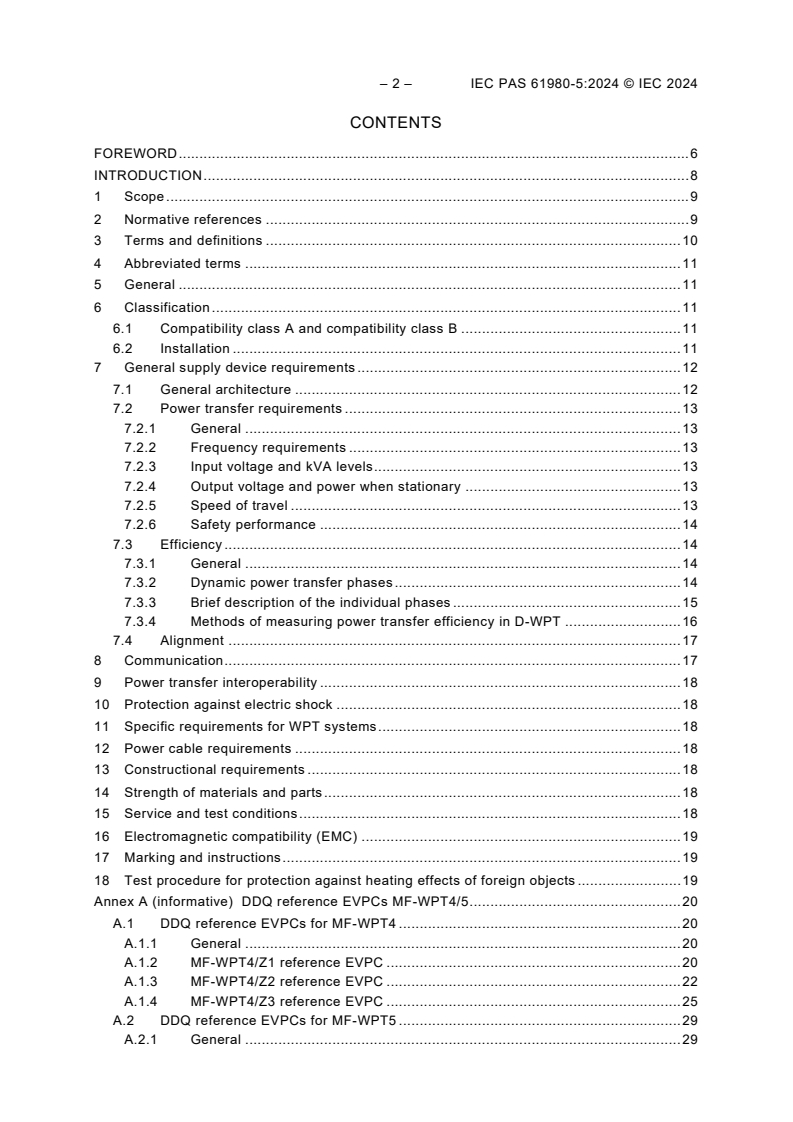
IEC PAS 61980-5:2024 - Electric vehicle wireless power transfer (WPT) systems - Part 5: Interoperability and safety of dynamic wireless power transfer (D-WPT) for electric vehicles Released:12/12/2024
Overview - IEC PAS 61980-5:2024 (D-WPT for EVs)
IEC PAS 61980-5:2024 defines interoperability and safety requirements for dynamic wireless power transfer (D-WPT) systems that deliver energy to electric road vehicles via magnetic field (MF‑D‑WPT) while vehicles are in motion. The document applies to off‑board supply equipment designed to charge the RESS (rechargeable energy storage system) and/or other on‑board electrical systems, operating at supply voltage ratings per IEC 60038 (up to 1 000 V AC and up to 1 500 V DC). It is intended for systems interoperable with EV devices meeting ISO 5474‑4 and ISO 5474‑6.
Key topics and technical requirements
- System scope and classification
- Compatibility classes and installation types for MF‑D‑WPT.
- General supply device requirements
- Architecture of off‑board equipment and required power transfer behavior.
- Input voltage and kVA levels, and output power (including conditions when stationary).
- Power transfer characteristics
- Requirements for dynamic power transfer phases, alignment, and how speed of travel affects transfer.
- Methods for measuring efficiency in D‑WPT (dynamic measurement procedures are specified).
- Frequency and EMC
- Frequency requirements and electromagnetic compatibility (EMC) provisions to limit interference and ensure reliable operation.
- Safety and protection
- Electrical safety, protection against electric shock, heating effects of foreign objects, constructional strength, and marking/instructions.
- Communication and interoperability
- Requirements for control/communication between off‑board supply and vehicle for secure, interoperable charging.
- Test, service and installation
- Procedures and test conditions; annexes provide reference EV power and coil configurations for verification.
- Informative annexes
- Annexes A–D include reference EVPCs, multi‑phase and transversal coil topologies, magnetic field distributions, and mechanical/electrical schematics useful for testing and design.
Practical applications and users
IEC PAS 61980‑5 is practical for:
- EV infrastructure designers and roadway integrators implementing dynamic wireless charging lanes.
- EV manufacturers and power electronics suppliers ensuring interoperability with off‑board D‑WPT systems.
- Utilities and transport authorities planning large‑scale electric road infrastructure.
- Test laboratories and certification bodies validating safety, EMC, and performance of MF‑D‑WPT installations.
- Regulators, city planners, and system integrators evaluating standards compliance for public deployments.
Related standards
- IEC 60038 (standard supply voltage ratings)
- ISO 5474‑4 and ISO 5474‑6 (vehicle-side device compatibility)
- Other parts of IEC 61980 series (WPT system family)
Keywords: IEC PAS 61980‑5:2024, dynamic wireless power transfer, D‑WPT, MF‑D‑WPT, electric vehicle wireless charging, interoperability, electrical safety, EMC, off‑board supply equipment, RESS.
Buy Documents
IEC PAS 61980-5:2024 - Electric vehicle wireless power transfer (WPT) systems - Part 5: Interoperability and safety of dynamic wireless power transfer (D-WPT) for electric vehicles Released:12/12/2024
Get Certified
Connect with accredited certification bodies for this standard

TÜV Rheinland
TÜV Rheinland is a leading international provider of technical services.

TÜV SÜD
TÜV SÜD is a trusted partner of choice for safety, security and sustainability solutions.

DEKRA Certification Inc.
DEKRA US certification services.
Sponsored listings
Frequently Asked Questions
IEC PAS 61980-5:2024 is a technical specification published by the International Electrotechnical Commission (IEC). Its full title is "Electric vehicle wireless power transfer (WPT) systems - Part 5: Interoperability and safety of dynamic wireless power transfer (D-WPT) for electric vehicles". This standard covers: IEC PAS 61980-5:2024 applies to the off-board supply equipment for dynamic wireless power transfer via magnetic field (MF-D-WPT) to electric road vehicles in motion for purposes of supplying electric energy to the RESS (rechargeable energy storage system) and/or other on-board electrical systems. The system operates at standard supply voltage ratings per IEC 60038 up to 1 000 V AC and up to 1 500 V DC from the supply network. The power transfer takes place primarily while the electric vehicle (EV) is in motion, but can continue to take place under certain conditions while the vehicle is not in motion. Off-board supply equipment fulfilling the requirements in this document are intended to operate with EV devices fulfilling the requirements of ISO 5474-4 and ISO 5474-6. The aspects covered in this document includes – the characteristics and operating conditions, – specific power transfer requirements for the off-board side of magnetic field dynamic wireless power transfer systems for electric road vehicles, and – the general requirement of electrical safety and EMC for MF-D-WPT.
IEC PAS 61980-5:2024 applies to the off-board supply equipment for dynamic wireless power transfer via magnetic field (MF-D-WPT) to electric road vehicles in motion for purposes of supplying electric energy to the RESS (rechargeable energy storage system) and/or other on-board electrical systems. The system operates at standard supply voltage ratings per IEC 60038 up to 1 000 V AC and up to 1 500 V DC from the supply network. The power transfer takes place primarily while the electric vehicle (EV) is in motion, but can continue to take place under certain conditions while the vehicle is not in motion. Off-board supply equipment fulfilling the requirements in this document are intended to operate with EV devices fulfilling the requirements of ISO 5474-4 and ISO 5474-6. The aspects covered in this document includes – the characteristics and operating conditions, – specific power transfer requirements for the off-board side of magnetic field dynamic wireless power transfer systems for electric road vehicles, and – the general requirement of electrical safety and EMC for MF-D-WPT.
IEC PAS 61980-5:2024 is classified under the following ICS (International Classification for Standards) categories: 43.120 - Electric road vehicles. The ICS classification helps identify the subject area and facilitates finding related standards.
IEC PAS 61980-5:2024 is available in PDF format for immediate download after purchase. The document can be added to your cart and obtained through the secure checkout process. Digital delivery ensures instant access to the complete standard document.
Standards Content (Sample)
IEC PAS 61980-5 ®
Edition 1.0 2024-12
PUBLICLY AVAILABLE
SPECIFICATION
colour
inside
Electric vehicle wireless power transfer (WPT) systems –
Part 5: Interoperability and safety of dynamic wireless power transfer (D-WPT)
for electric vehicles
All rights reserved. Unless otherwise specified, no part of this publication may be reproduced or utilized in any form
or by any means, electronic or mechanical, including photocopying and microfilm, without permission in writing from
either IEC or IEC's member National Committee in the country of the requester. If you have any questions about IEC
copyright or have an enquiry about obtaining additional rights to this publication, please contact the address below or
your local IEC member National Committee for further information.
IEC Secretariat Tel.: +41 22 919 02 11
3, rue de Varembé info@iec.ch
CH-1211 Geneva 20 www.iec.ch
Switzerland
About the IEC
The International Electrotechnical Commission (IEC) is the leading global organization that prepares and publishes
International Standards for all electrical, electronic and related technologies.
About IEC publications
The technical content of IEC publications is kept under constant review by the IEC. Please make sure that you have the
latest edition, a corrigendum or an amendment might have been published.
IEC publications search - webstore.iec.ch/advsearchform IEC Products & Services Portal - products.iec.ch
The advanced search enables to find IEC publications by a Discover our powerful search engine and read freely all the
variety of criteria (reference number, text, technical publications previews, graphical symbols and the glossary.
committee, …). It also gives information on projects, replaced With a subscription you will always have access to up to date
and withdrawn publications. content tailored to your needs.
IEC Just Published - webstore.iec.ch/justpublished
Electropedia - www.electropedia.org
Stay up to date on all new IEC publications. Just Published
The world's leading online dictionary on electrotechnology,
details all new publications released. Available online and once
containing more than 22 500 terminological entries in English
a month by email.
and French, with equivalent terms in 25 additional languages.
Also known as the International Electrotechnical Vocabulary
IEC Customer Service Centre - webstore.iec.ch/csc
(IEV) online.
If you wish to give us your feedback on this publication or need
further assistance, please contact the Customer Service
Centre: sales@iec.ch.
IEC PAS 61980-5 ®
Edition 1.0 2024-12
PUBLICLY AVAILABLE
SPECIFICATION
colour
inside
Electric vehicle wireless power transfer (WPT) systems –
Part 5: Interoperability and safety of dynamic wireless power transfer (D-WPT)
for electric vehicles
INTERNATIONAL
ELECTROTECHNICAL
COMMISSION
ICS 43.120 ISBN 978-2-8327- 0058-7
– 2 – IEC PAS 61980-5:2024 © IEC 2024
CONTENTS
FOREWORD . 6
INTRODUCTION . 8
1 Scope . 9
2 Normative references . 9
3 Terms and definitions . 10
4 Abbreviated terms . 11
5 General . 11
6 Classification . 11
6.1 Compatibility class A and compatibility class B . 11
6.2 Installation . 11
7 General supply device requirements . 12
7.1 General architecture . 12
7.2 Power transfer requirements . 13
7.2.1 General . 13
7.2.2 Frequency requirements . 13
7.2.3 Input voltage and kVA levels . 13
7.2.4 Output voltage and power when stationary . 13
7.2.5 Speed of travel . 13
7.2.6 Safety performance . 14
7.3 Efficiency . 14
7.3.1 General . 14
7.3.2 Dynamic power transfer phases . 14
7.3.3 Brief description of the individual phases . 15
7.3.4 Methods of measuring power transfer efficiency in D-WPT . 16
7.4 Alignment . 17
8 Communication . 17
9 Power transfer interoperability . 18
10 Protection against electric shock . 18
11 Specific requirements for WPT systems . 18
12 Power cable requirements . 18
13 Constructional requirements . 18
14 Strength of materials and parts . 18
15 Service and test conditions . 18
16 Electromagnetic compatibility (EMC) . 19
17 Marking and instructions . 19
18 Test procedure for protection against heating effects of foreign objects . 19
Annex A (informative) DDQ reference EVPCs MF-WPT4/5 . 20
A.1 DDQ reference EVPCs for MF-WPT4 . 20
A.1.1 General . 20
A.1.2 MF-WPT4/Z1 reference EVPC . 20
A.1.3 MF-WPT4/Z2 reference EVPC . 22
A.1.4 MF-WPT4/Z3 reference EVPC . 25
A.2 DDQ reference EVPCs for MF-WPT5 . 29
A.2.1 General . 29
A.2.2 MF-WPT5/Z1 reference EVPC . 29
A.2.3 MF-WPT5/Z2 reference EVPC . 31
A.2.4 MF-WPT5/Z3 reference EVPC . 34
Annex B (informative) Multi-phase coil reference EVPCs for MF-WPT4/5 . 38
B.1 Multi-phase coil reference EVPCs for MF-WPT4 . 38
B.1.1 General . 38
B.1.2 MF-WPT4/Z1 reference EVPC . 38
B.1.3 MF-WPT4/Z2 reference EVPC . 40
B.1.4 MF-WPT4/Z3 reference EVPC . 42
B.2 Multi-phase coil reference EVPCs for MF-WPT5 . 44
B.2.1 General . 44
B.2.2 MF-WPT5/Z1 reference EVPC . 45
B.2.3 MF-WPT5/Z2 reference EVPC . 47
B.2.4 MF-WPT5/Z3 reference EVPC . 50
Annex C (informative) Multi-phase coil topology for DWPT power transfer . 53
C.1 System description of the power transfer system . 53
C.2 Primary device . 54
C.2.1 Primary coil segment . 54
C.2.2 Reference primary device . 55
C.2.3 Magnetic characteristics of product primary device . 55
C.3 Secondary device . 56
C.3.1 Compatible secondary device for primary device . 56
C.3.2 Reference secondary device . 56
C.3.3 Electric characteristics of reference secondary device . 57
Annex D (informative) Transversal coil topology for DWPT power transfer . 59
D.1 System description of the power transfer system . 59
D.2 Primary device . 60
D.2.1 Primary coil segment . 60
D.2.2 Reference primary device . 60
D.2.3 Magnetic characteristics of product primary device . 61
D.3 Secondary device . 62
D.3.1 Compatible secondary device for primary device . 62
D.3.2 Reference secondary device . 62
D.3.3 Electric characteristics of reference secondary device . 63
Bibliography . 65
Figure 1 – Embedded mounting . 11
Figure 2 – Example of MF-D-WPT system . 12
Figure 3 – Definition of phases for each road segment in D-WPT . 15
Figure 4 – Measuring the efficiency in D-WPT . 17
Figure A.1 – General layout of the MF-WPT4/Z1 reference secondary device . 20
Figure A.2 – Mechanical dimensions of the MF-WPT4/Z1 reference secondary device . 21
Figure A.3 – Schematic of the EV power electronics for the MF-WPT4 reference EVPC . 22
Figure A.4 – General layout of the MF-WPT4/Z2 reference secondary device . 23
Figure A.5 – Mechanical dimensions of the MF-WPT4/Z2 reference secondary device . 24
Figure A.6 – Schematic of the EV power electronics for the MF-WPT4 reference EVPC . 25
Figure A.7 – General layout of the MF-WPT4/Z3 reference secondary device . 26
– 4 – IEC PAS 61980-5:2024 © IEC 2024
Figure A.8 – Mechanical dimensions of the MF-WPT4/Z3 reference secondary device . 27
Figure A.9 – Schematic of the EV power electronics for the MF-WPT4 reference EVPC . 28
Figure A.10 – General layout of the MF-WPT5/Z1 reference secondary device . 29
Figure A.11 – Mechanical dimensions of the MF-WPT4/Z1 reference secondary device . 30
Figure A.12 – Schematic of the EV power electronics for the MF-WPT5 reference
EVPC . 31
Figure A.13 – General layout of the MF-WPT5/Z2 reference secondary device . 32
Figure A.14 – Mechanical dimensions of the MF-WPT5/Z2 reference secondary device . 33
Figure A.15 – Schematic of the EV power electronics for the MF-WPT4 reference
EVPC . 34
Figure A.16 – General layout of the MF-WPT5/Z3 reference secondary device . 35
Figure A.17 – Mechanical dimensions of the MF-WPT5/Z3 reference secondary device . 36
Figure A.18 – Schematic of the EV power electronics for the MF-WPT5 reference
EVPC . 37
Figure B.1 – General layout of the MF-WPT4/Z1 reference secondary device . 38
Figure B.2 – Mechanical dimensions of the MF-WPT4/Z1 reference secondary device . 39
Figure B.3 – Schematic of the EV power electronics for the MF-WPT4/Z1 reference
EVPC . 40
Figure B.4 – General layout of the MF-WPT4/Z2 reference secondary device . 41
Figure B.5 – Mechanical dimensions of the MF-WPT4/Z2 reference secondary device . 41
Figure B.6 – Schematic of the EV power electronics for the MF-WPT4/Z2 reference
EVPC . 42
Figure B.7 – General layout of the MF-WPT4/Z3 reference secondary device . 43
Figure B.8 – Mechanical dimensions of the MF-WPT4/Z3 reference secondary device . 43
Figure B.9 – Schematic of the EV power electronics for the MF-WPT4/Z3 reference
EVPC . 44
Figure B.10 – General layout of the MF-WPT5/Z1 reference secondary device . 45
Figure B.11 – Mechanical dimensions of the MF-WPT5/Z1 reference secondary device . 46
Figure B.12 – Schematic of the EV power electronics for the MF-WPT5/Z1 reference
EVPC . 47
Figure B.13 – General layout of the MF-WPT5/Z2 reference secondary device . 48
Figure B.14 – Mechanical dimensions of the MF-WPT5/Z2 reference secondary device . 48
Figure B.15 – Schematic of the EV power electronics for the MF-WPT5/Z2 reference
EVPC . 49
Figure B.16 – General layout of the MF-WPT5/Z3 reference secondary device . 50
Figure B.17 – Mechanical dimensions of the MF-WPT5/Z3 reference secondary device . 51
Figure B.18 – Schematic of the EV power electronics for the MF-WPT5/Z3 reference
EVPC . 52
Figure C.1 – Mechanical arrangement of multi-phase coil topology DWPT power
transfer . 53
Figure C.2 – Magnetic field distribution of reference primary coil device . 54
Figure C.3 – Mechanical dimensions of reference primary device . 55
Figure C.4 – Mechanical dimensions of the reference secondary multi-phase device . 57
Figure D.1 – Mechanical arrangement of transversal coil topology . 59
Figure D.2 – Magnetic field distribution of reference primary coil device A . 60
Figure D.3 – Mechanical dimensions of reference primary device . 61
Figure D.4 – Mechanical dimensions of the reference secondary device . 63
Table A.1 – Values of circuit elements for Figure A.3 . 22
Table A.2 – Coupling factors and coil current MF-WPT4/Z1 . 22
Table A.3 – Values of circuit elements for Figure A.6 . 25
Table A.4 – Coupling factors and coil current MF-WPT4/Z2 . 25
Table A.5 – Values of circuit elements for Figure A.9 . 28
Table A.6 – Coupling factors and coil current MF-WPT4/Z3 . 28
Table A.7 – Values of circuit elements for Figure A.12 . 31
Table A.8 – Coupling factors and coil current MF-WPT5/Z1 . 31
Table A.9 – Values of circuit elements for Figure A.15 . 34
Table A.10 – Coupling factors and coil current MF-WPT5/Z2 . 34
Table A.11 – Values of circuit elements for Figure A.18 . 37
Table A.12 – Coupling factors and coil current MF-WPT5/Z3 . 37
Table B.1 – Values of circuit elements . 40
Table B.2 – Secondary coil inductance and coupling factor . 40
Table B.3 – Values of circuit elements . 42
Table B.4 – Secondary coil inductance and coupling factor . 42
Table B.5 – Values of circuit elements . 44
Table B.6 – Secondary coil inductance and coupling factor . 44
Table B.7 – Values of circuit elements . 47
Table B.8 – Secondary coil inductance and coupling factor . 47
Table B.9 – Values of circuit elements . 49
Table B.10 – Secondary coil inductance and coupling factor . 49
Table B.11 – Values of circuit elements . 52
Table B.12 – Secondary coil inductance and coupling factor . 52
Table C.1 – Mechanical dimensions and electrical parameters of a reference primary
device . 55
Table C.2 – Fundamental mutual inductanceM_(0,R) values [µH] with gauge devices . 56
Table C.3 – Mechanical dimensions and electrical parameters of a reference
secondary device . 57
Table C.4 – Electrical values and parameters . 58
Table D.1 – Mechanical dimensions and electrical parameters of a reference primary
device . 61
Table D.2 – Fundamental mutual inductance M_(0, R) values ([µH]) with gauge devices . 62
Table D.3 – Mechanical dimensions and electrical parameters of the reference
secondary device . 63
Table D.4 – Electrical values and parameters . 64
– 6 – IEC PAS 61980-5:2024 © IEC 2024
INTERNATIONAL ELECTROTECHNICAL COMMISSION
____________
ELECTRIC VEHICLE WIRELESS POWER TRANSFER (WPT) SYSTEMS –
Part 5: Interoperability and safety of dynamic wireless power transfer
(D-WPT) for electric vehicles
FOREWORD
1) The International Electrotechnical Commission (IEC) is a worldwide organization for standardization comprising
all national electrotechnical committees (IEC National Committees). The object of IEC is to promote international
co-operation on all questions concerning standardization in the electrical and electronic fields. To this end and
in addition to other activities, IEC publishes International Standards, Technical Specifications, Technical Reports,
Publicly Available Specifications (PAS) and Guides (hereafter referred to as "IEC Publication(s)"). Their
preparation is entrusted to technical committees; any IEC National Committee interested in the subject dealt with
may participate in this preparatory work. International, governmental and non-governmental organizations liaising
with the IEC also participate in this preparation. IEC collaborates closely with the International Organization for
Standardization (ISO) in accordance with conditions determined by agreement between the two organizations.
2) The formal decisions or agreements of IEC on technical matters express, as nearly as possible, an international
consensus of opinion on the relevant subjects since each technical committee has representation from all
interested IEC National Committees.
3) IEC Publications have the form of recommendations for international use and are accepted by IEC National
Committees in that sense. While all reasonable efforts are made to ensure that the technical content of IEC
Publications is accurate, IEC cannot be held responsible for the way in which they are used or for any
misinterpretation by any end user.
4) In order to promote international uniformity, IEC National Committees undertake to apply IEC Publications
transparently to the maximum extent possible in their national and regional publications. Any divergence between
any IEC Publication and the corresponding national or regional publication shall be clearly indicated in the latter.
5) IEC itself does not provide any attestation of conformity. Independent certification bodies provide conformity
assessment services and, in some areas, access to IEC marks of conformity. IEC is not responsible for any
services carried out by independent certification bodies.
6) All users should ensure that they have the latest edition of this publication.
7) No liability shall attach to IEC or its directors, employees, servants or agents including individual experts and
members of its technical committees and IEC National Committees for any personal injury, property damage or
other damage of any nature whatsoever, whether direct or indirect, or for costs (including legal fees) and
expenses arising out of the publication, use of, or reliance upon, this IEC Publication or any other IEC
Publications.
8) Attention is drawn to the Normative references cited in this publication. Use of the referenced publications is
indispensable for the correct application of this publication.
9) IEC draws attention to the possibility that the implementation of this document may involve the use of (a)
patent(s). IEC takes no position concerning the evidence, validity or applicability of any claimed patent rights in
respect thereof. As of the date of publication of this document, IEC had not received notice of (a) patent(s), which
may be required to implement this document. However, implementers are cautioned that this may not represent
the latest information, which may be obtained from the patent database available at https://patents.iec.ch. IEC
shall not be held responsible for identifying any or all such patent rights.
IEC PAS 61980-5 has been prepared by IEC technical committee 69: Electrical power/energy
transfer systems for electrically propelled road vehicles and industrial trucks. It is a Publicly
Available Specification.
The text of this Publicly Available Specification is based on the following documents:
Draft Report on voting
69/975/DPAS 69/1011/RVDPAS
Full information on the voting for its approval can be found in the report on voting indicated in
the above table.
The language used for the development of this Publicly Available Specification is English.
This document was drafted in accordance with ISO/IEC Directives, Part 2, and developed in
accordance with ISO/IEC Directives, Part 1 and ISO/IEC Directives, IEC Supplement, available
at www.iec.ch/members_experts/refdocs. The main document types developed by IEC are
described in greater detail at www.iec.ch/publications.
This document is to be read in conjunction with IEC 61980-1:2020.
The clauses of the particular requirements in this document supplement or modify the
corresponding clauses in IEC 61980-1:2020. Where the text indicates an "addition" to or a
"replacement" of the relevant requirement, test specification or explanation of
IEC 61980-1:2020, these changes are made to the relevant text of IEC 61980-1:2020, which
then becomes part of the standard. Where no change is necessary, the words
"Clause/Subclause xx of IEC 61980-1:2020 is applicable" are used. Additional items to those
of IEC 61980-1:2020 are numbered starting 101. Annexes are lettered from A onwards.
A list of all parts in the IEC 61980 series, published under the general title Electric vehicle
wireless power transfer (WPT) systems, can be found on the IEC website.
The committee has decided that the contents of this document will remain unchanged until the
stability date indicated on the IEC website under webstore.iec.ch in the data related to the
specific document. At this date, the document will be
• reconfirmed,
• withdrawn, or
• revised.
NOTE In accordance with ISO/IEC Directives, Part 1, IEC PASs are automatically withdrawn after 4 years.
IMPORTANT – The "colour inside" logo on the cover page of this document indicates
that it contains colours which are considered to be useful for the correct understanding
of its contents. Users should therefore print this document using a colour printer.
– 8 – IEC PAS 61980-5:2024 © IEC 2024
INTRODUCTION
The IEC 61980 series is published in separate parts according to the following structure:
– IEC 61980-1 covers general requirements for electric road vehicle (EV) wireless power
transfer (WPT) systems including general background and definitions (e.g. efficiency,
electrical safety, EMC, EMF);
– IEC 61980-2 applies to magnetic field wireless power transfer (MF-WPT) for electric road
vehicles and covers specific requirements for system activities and communication between
the electric road vehicle side and the off-board side, including general background and
definitions;
– IEC 61980-3 covers specific power transfer requirements for the off-board side of magnetic
field wireless power transfer systems for electric road vehicles (e.g. efficiency, electrical
safety, EMC, EMF);
– IEC PAS 61980-4 covers specific power transfer requirements for the off-board side of
magnetic field high power wireless power transfer (H-WPT) systems for electric road
vehicles (e.g. efficiency, electrical safety, EMC, EMF).
– IEC 61980-5 covers specific power transfer requirements for the off-board side of magnetic
field dynamic wireless power transfer (MF-D-WPT) systems for electric road vehicles (e.g.
efficiency, electrical safety, EMC, EMF). This document is IEC 61980-5 and is under
development as a PAS.
– IEC 61980-6 applies to magnetic field dynamic wireless power transfer for electric road
vehicles (EV) and covers specific requirements for system activities and communication
between the electric road vehicle side and the off-board side, including general background
and definitions.
Requirements for the on-board side of MF-WPT and MF-D-WPT for electric road vehicles are
covered in ISO PAS 5474-6 .
This document is being published as a PAS for information about how dynamic charging
systems can work, as evidenced by demonstration systems described in Annex A to Annex D.
___________
Under preparation. Stage at the time of publication: IEC CD PAS 61980-4:2024.
Under development.
Under preparation. Stage at the time of publication: ISO CD PAS 5474-6:2023.
ELECTRIC VEHICLE WIRELESS POWER TRANSFER (WPT) SYSTEMS –
Part 5: Interoperability and safety of dynamic wireless power transfer
(D-WPT) for electric vehicles
1 Scope
This part of IEC 61980 applies to the off-board supply equipment for dynamic wireless power
transfer via magnetic field (MF-D-WPT) to electric road vehicles in motion for purposes of
supplying electric energy to the RESS (rechargeable energy storage system) and/or other on-
board electrical systems.
The system operates at standard supply voltage ratings per IEC 60038 up to 1 000 V AC and
up to 1 500 V DC from the supply network. The power transfer takes place primarily while the
electric vehicle (EV) is in motion, but can continue to take place under certain conditions while
the vehicle is not in motion.
Off-board supply equipment fulfilling the requirements in this document are intended to operate
with EV devices fulfilling the requirements of ISO 5474-4 and ISO 5474-6.
The aspects covered in this document includes
– the characteristics and operating conditions,
– specific power transfer requirements for the off-board side of magnetic field dynamic
wireless power transfer systems for electric road vehicles, and
– the general requirement of electrical safety and EMC for MF-D-WPT.
Examples of D-WPT systems are described in the informative Annex A to Annex D.
2 Normative references
The following documents are referred to in the text in such a way that some or all of their content
constitutes requirements of this document. For dated references, only the edition cited applies.
For undated references, the latest edition of the referenced document (including any
amendments) applies.
IEC 60038, IEC standard voltages
IEC 61980-1, Electric vehicle wireless power transfer (WPT) systems – Part 1: General
requirements
IEC 61980-3, Electric vehicle wireless power transfer (WPT) systems – Part 3: Specific
requirements for magnetic field wireless power transfer systems
ITU-R Recommendation SM.2110.1:2019, Guidance on frequency ranges for operation of non-
beam wireless power transmission for electric vehicles
___________
Under preparation. Stage at the time of publication: ISO DIS 5474-4:2024.
– 10 – IEC PAS 61980-5:2024 © IEC 2024
3 Terms and definitions
For the purposes of this document, he terms and definitions given in IEC 61980-1, IEC 61980-3
and the following terms and definitions apply, except as follows.
ISO and IEC maintain terminology databases for use in standardization at the following
addresses:
• IEC Electropedia: available at https://www.electropedia.org/
• ISO Online browsing platform: available at https://www.iso.org/obp
Additional terms and definitions:
3.101
dynamic wireless power transfer
D-WPT
WPT while vehicle is in motion
3.102
embedded depth
Z
RS
distance between the road surface and the top of housing in the primary device
3.103
embedded mounting
mounting of a primary device in such a manner that the top covering of the primary device is
buried (embedded) in the pavement.
3.104
inverter
power electronic device or circuitry that changes direct current (DC) to alternating current (AC)
Note 1 to entry: Inverter is a part of a power electronics.
3.105
magnetic gap
vertical (z-direction) distance between the coil of the primary device and the coil of the
secondary device
3.106
standby state
state where power transfer is stopped and power electronics is not ready to transfer power for
a short period, but communication stays up
3.107
segment
unit of coil(s) and core(s) controlled independently in the primary device
Note 1 to entry: Depending on the system structure, a switch for energization, supply device P2PS controller and
supply power electronics might be part of a segment. See Figure 2.
3.108
segment switching
turn on/off function that energizes the primary coil(s) of the segment
3.109
steady state
state of a system at which quasi-constant power is transferred
4 Abbreviated terms
IEC 61980-1:2020, Clause 4, does not apply.
5 General
IEC 61980-1:2020, Clause 5, applies, except as follows.
Replacement of the first paragraph :
The supply device (see Figure 2) shall be rated for one or a range of standard nominal voltages
and frequencies as listed in IEC 60038.
6 Classification
Replacement:
6.1 Compatibility class A and compatibility class B
The supply device is classified according to the compatibility class:
– compatibility class A supply device;
– compatibility class B supply device.
6.2 Installation
For dynamic wireless power transfer, the primary device shall be embedded per Figure 1. Z
RS
gives the distance under road surface between the road surface and the top of the housing in
the primary device as shown in Figure 1.
b
a
Key
a primary device
b secondary device
1 top of road surface
2 secondary device ground clearance (Z)
3 embedded depth (Z )
RS
Figure 1 – Embedded mounting
The magnetic gap is the vertical (z-direction) distance between the coil of the primary device
and the coil of the secondary device.
– 12 – IEC PAS 61980-5:2024 © IEC 2024
7 General supply device requirements
IEC 61980-1:2020, Clause 7, applies except as follows:
7.1 General architecture
Replacement:
Figure 2 shows an example for the structure of the components referred to in this document.
17a 27a
14 c 24a
b
16 15a 25a
b
13a 23a
100 12a 18a 11a 21a 22a 200a
15b
18b
11b
15c
18c 11c
15d
11d
18d
17b
15e
13b
12b 18e 11e
Key Name Key Name
1 MF-D-WPT system
11 primary device 21 secondary device
12 supply power electronics 22 EV power electronics
13 supply power circuit 23 EV power circuit (EVPC)
14 dynamic WPT SECC (D-SECC) 24 dynamic WPT EVCC (D-EVCC)
15 supply device P2PS controller 25 EV device P2PS controller
16 D-WPT management unit (DWMM)
17 supply device 27 EV device
18 switch 200 RESS / motor
100 supply network b uni/bi-directional wireless signalling
a wireless power flow c cellular/cloud/Wi-Fi with mobility support
18x+15x+11x segment
Figure 2 – Example of MF-D-WPT system
In dynamic wireless power transfer (D-WPT) system for electric vehicles, primary infrastructure
is divided into several segments. Only small number of segments will be turned on at specific
time for dynamic wireless power transfer while electric vehicle passes by those segments. In
order to support this segment switching operation, wireless communication support with low
latency and P2PS signalling can be used.
7.2 Power transfer requirements
Additional subclauses:
7.2.1 General
Unless otherwise stated in any of the subsequent clauses of this document, requirements apply
to supply devices and their component parts.
7.2.2 Frequency requirements
For both compatibility class A supply devices and compatibility class B supply devices, the
supply device shall utilize magnetic resonance to perform power transfer within the fundamental
frequency range of 79 kHz to 90 kHz in accordance with ITU-R Recommendation
SM.2110.1:2019, Table 1.
7.2.3 Input voltage and kVA levels
For both compatibility class A and compatibility class B supply devices, the manufacturer shall
specify the input voltage range of operation and the rated input kVA.
7.2.4 Output voltage and power when stationary
7.2.4.1 Compatibility class A device
For a compatibility class A supply device, the reference EVPC shall provide an output which
covers the reference EVPC output range at the rated output power when stationary.
7.2.4.2 Compatibility class B device
For a compatibility class B supply device, the specific class B EVPC specified by the
manufacturer shall provide an output which covers the reference EVPC output range at the
rated output power when stationary.
7.2.5 Speed of travel
7.2.5.1 Compatibility class A device
A compatibility class A supply device shall be able to transfer power to all reference EVPCs
over the specified output voltage range, power and efficiency when mounted on a test vehicle
traveling at a maximum speed up to 120 kph. The required parameters (voltage, power,
efficiency) are part of the reference EVPC specification.
7.2.5.2 Compatibility class B device
A compatibility class B supply device shall be able to transfer power to the EVPCs specified by
the manufacturer over the specified output voltage range, power and efficiency when mounted
on a test vehicle traveling at a maximum speed specified by manufacturer. The required
parameters (voltage, power, efficiency) are part of the EVPC specification.
– 14 – IEC PAS 61980-5:2024 © IEC 2024
7.2.6 Safety performance
In the event of an emergency shutdown condition, the supply device shall immediately reduce
primary device coil current to zero and turn off all high voltages in order to make the system
safe.
7.3 Efficiency
Additional subclauses:
7.3.1 General
The power transfer efficiency in case of D-WPT is the ratio of the sum of the output power (i.e.
energy) in the EVPC divided by the sum of the input power (i.e. energy) in the SPC for each
segment from the phase "inverter rise" to the phase "inverter fall".
Measured efficiency values according to 7.3.3 are representative values for evaluating products,
but they do not correspond to actual efficiency values.
NOTE 1 Measurement of the power transfer efficiency and determination of conformance with the eventual
requirements in this document will be made by a test vehicle receiving energy while in motion over a test track with
the candidate supply device(s) installed and reference EVPCs installed on the test vehicle. In order to develop
confidence that the supply device being developed will meet the performance requirements, there are preliminary
steps which can give theoretical results that can indicate likelihood of conformance. These are specified in 7.3.2 and
7.3.3.
NOTE 2 The static measurement on the efficiency of D-WPT with dynamic parameters includes speed information,
which is an important difference between static and dynamic WPT. Although it is possible the D-WPT efficiency
measurement does not exactly match reality, efficiency can be expressed in a normalized equation. The D-WPT
efficiency measurement method includes factors such as segment length, vehicle speed, and waiting time to derive
efficiency that is close to reality.
7.3.2 Dynamic power transfer phases
The phases described in 7.3.2 are relevant for the determination of the electrical efficiency of
D-WPT systems. These phases apply while a vehicle is driving over a road D-WPT segment,
having requested wireless power from that segment. The requirement for power transfer
efficiency in under consideration.
Key
P quiescent power required to maintain the coil current required in a single primary coil segment in
quiescent_prepowe
order to begin power transfer once the secondary coil becomes coupled with the primary coil
segment
quiescent power required to be ready for power ramp up in detecting the secondary coil at the
P
quiescent_standby
DWPT system segment
Figure 3 – Definition of phases for each road segment in D-WPT
7.3.3 Brief description of the individual phases
7.3.3.1 Phase "inverter rise"
Phase required to ramp up the high frequency inverter that provides current to the primary coil
to a ready state just prior to power transfer to a secondary coil
Inverter rise is the phase from P to P . At the light load condition,
quiescent_standby quiescent_prepower
the rated current is supplied to the primary coil. The rated current is maintained before the
inverter fall.
7.3.3.2 Phase "pre-power"
Phase "pre-power" is the period that the high frequency primary inverter remains in a ready
state after the inverter rise time and before power transfer to a secondary coil begins.
7.3.3.3 Phase "power transfer ramp-up"
Phase "power transfer ramp-up" is the period required for the secondary to ramp up from zero
power to its peak or steady-state received power level when coupling to a single segment.
7.3.3.4 Phase "power transfer ramp-down"
Phase "power transfer ramp-down" is the period required for the secondary to ramp down from
its peak or steady-state power level to zero power when decoupling from a single segment.
7.3.3.5 Phase "inverter fall"
Phase required for the high frequency primary inverter to ramp down the current to the primary
coil to be in a standby state. Inverter rise is the phase from P to
quiescent_sta
...