

IEC 60774-5:2004
(Main)Helical-scan video tape cassette system using 12,65 mm (0,5 in) magnetic tape on type VHS - Part 5: D-VHS
General Information
- Abstract
IEC 60774-5:2004 applies to the MPEG TS (Transport Stream) packet recording for helical-scan video tape cassette system using 12,65 mm magnetic tape on type VHS. This standard specifies the cassettes, the tape, the track configuration, the data structure, the recording method and the MPEG TS format for D-VHS. This bilingual version (2012-08) corresponds to the monolingual English version, published in 2004-04.
- Status
- Published
- Publication Date
- 06-Apr-2004
- Technical Committee
- TC 100 - Audio, video and multimedia systems and equipment
- Drafting Committee
- PT 60774-5 - TC 100/PT 60774-5
- Current Stage
- PPUB - Publication issued
- Start Date
- 07-Apr-2004
- Completion Date
- 15-Apr-2004
Buy Documents

IEC 60774-5:2004 - Helical-scan video tape cassette system using 12,65 mm (0,5 in) magnetic tape on type VHS - Part 5: D-VHS Released:4/7/2004
IEC 60774-5:2004 - Helical-scan video tape cassette system using 12,65 mm (0,5 in) magnetic tape on type VHS - Part 5: D-VHS Released:4/7/2004
Overview
IEC 60774-5:2004 specifies requirements for the D-VHS (Digital VHS) helical-scan video tape cassette system, utilizing 12.65 mm (0.5 in) magnetic tape on VHS cassettes. Managed by the International Electrotechnical Commission (IEC), this standard addresses MPEG Transport Stream (TS) packet recording, essential for digital video and audio storage. It defines essential elements such as tape cassettes, track configuration, data structure, and recording methods, ensuring compatibility for modern recording, playback, and archival of digital content using D-VHS technology.
D-VHS leverages the established VHS platform for storing digital video directly via MPEG TS packets. This supports seamless integration with digital broadcasting standards and offers multiple recording modes to adapt to various data-rate requirements.
Key Topics
Cassette and Tape Specifications
Guidance on physical and magnetic requirements for 12.65 mm VHS cassettes is provided, ensuring reliable media interchange and performance.Track Configuration
The standard outlines the track structure, including configuration and dimensions for various D-VHS recording modes such as Standard (STD), High Speed (HS), and four types of Low Speed (LS).Data Structure and MPEG TS Recording
IEC 60774-5:2004 defines the arrangement of data on tape, focusing on how MPEG2 TS (Transport Stream) packets are formatted for robust digital video recording and trick-play operations.Recording Modes
Multiple modes address differing content and storage requirements:- STD (Standard): For typical digital broadcasting
- HS (High Speed): For fast data rates and versatility
- LS (Low Speed): Four options to optimize for extended recording
Pack Format
Sets standards for recording ancillary and metadata packs, in addition to main MPEG TS payloads, ensuring comprehensive data handling.Compatibility
D-VHS maintains backward compatibility with VHS design principles while incorporating digital recording standards for enhanced utility.
Applications
IEC 60774-5:2004 is valuable across various domains where robust digital video storage and playback are required:
Digital Video Archiving
Used by broadcasters and archival organizations for long-term storage of high-quality digital content, ensuring lossless retrieval and reliable playback.Broadcast System Integration
Enables compatibility with digital broadcast standards, leveraging MPEG2 TS packet recording for easy capture and transfer in professional environments.Consumer Video Recording
Facilitates direct digital TV recording and time-shifting by consumers, supporting both pre-recorded and home-recorded content in a widely supported tape format.Migration from Analog to Digital
Offers a standardized path from conventional analog VHS to digital video storage, preserving investments in existing hardware while upgrading content quality.
Related Standards
For comprehensive implementation, IEC 60774-5:2004 references and aligns with several international standards, including:
- IEC 60774-1: Helical-scan VHS and compact VHS cassette system
- IEC 60774-3: S-VHS enhancements
- ISO/IEC 13818-1/2/3/7/9: MPEG2, Audio, and Advanced Audio Coding for video and audio coding
- ISO 639-2, ISO 3166-1: Language and country codes for metadata support
- Industry Specifications: ATSC, DVB, ARIB, EIA for digital television broadcasting
Adherence to these related standards ensures that D-VHS systems provide interoperability, reliability, and high performance across professional and consumer applications.
By following IEC 60774-5:2004, engineers, manufacturers, and broadcasters ensure that D-VHS systems meet international expectations for digital video tape recording, facilitating the transition to digital media while maximizing compatibility and operational efficiency.
Buy Documents
IEC 60774-5:2004 - Helical-scan video tape cassette system using 12,65 mm (0,5 in) magnetic tape on type VHS - Part 5: D-VHS Released:4/7/2004
IEC 60774-5:2004 - Helical-scan video tape cassette system using 12,65 mm (0,5 in) magnetic tape on type VHS - Part 5: D-VHS Released:4/7/2004
Get Certified
Connect with accredited certification bodies for this standard

ANCE
Mexican certification and testing association.

Intertek Slovenia
Intertek testing, inspection, and certification services in Slovenia.

LNE (Laboratoire National de Métrologie et d'Essais)
French national laboratory for metrology and testing.
Sponsored listings
Frequently Asked Questions
IEC 60774-5:2004 is a standard published by the International Electrotechnical Commission (IEC). Its full title is "Helical-scan video tape cassette system using 12,65 mm (0,5 in) magnetic tape on type VHS - Part 5: D-VHS". This standard covers: IEC 60774-5:2004 applies to the MPEG TS (Transport Stream) packet recording for helical-scan video tape cassette system using 12,65 mm magnetic tape on type VHS. This standard specifies the cassettes, the tape, the track configuration, the data structure, the recording method and the MPEG TS format for D-VHS. This bilingual version (2012-08) corresponds to the monolingual English version, published in 2004-04.
IEC 60774-5:2004 applies to the MPEG TS (Transport Stream) packet recording for helical-scan video tape cassette system using 12,65 mm magnetic tape on type VHS. This standard specifies the cassettes, the tape, the track configuration, the data structure, the recording method and the MPEG TS format for D-VHS. This bilingual version (2012-08) corresponds to the monolingual English version, published in 2004-04.
IEC 60774-5:2004 is classified under the following ICS (International Classification for Standards) categories: 33.160.40 - Video systems. The ICS classification helps identify the subject area and facilitates finding related standards.
IEC 60774-5:2004 is available in PDF format for immediate download after purchase. The document can be added to your cart and obtained through the secure checkout process. Digital delivery ensures instant access to the complete standard document.
Standards Content (Sample)
INTERNATIONAL IEC
STANDARD 60774-5
First edition
2004-04
Helical-scan video tape cassette system
using 12,65 mm (0,5 in) magnetic tape
on type VHS –
Part 5:
D-VHS
Reference number
Publication numbering
As from 1 January 1997 all IEC publications are issued with a designation in the
60000 series. For example, IEC 34-1 is now referred to as IEC 60034-1.
Consolidated editions
The IEC is now publishing consolidated versions of its publications. For example,
edition numbers 1.0, 1.1 and 1.2 refer, respectively, to the base publication, the
base publication incorporating amendment 1 and the base publication incorporating
amendments 1 and 2.
Further information on IEC publications
The technical content of IEC publications is kept under constant review by the IEC,
thus ensuring that the content reflects current technology. Information relating to
this publication, including its validity, is available in the IEC Catalogue of
publications (see below) in addition to new editions, amendments and corrigenda.
Information on the subjects under consideration and work in progress undertaken
by the technical committee which has prepared this publication, as well as the list
of publications issued, is also available from the following:
• IEC Web Site (www.iec.ch)
• Catalogue of IEC publications
The on-line catalogue on the IEC web site (www.iec.ch/searchpub) enables you to
search by a variety of criteria including text searches, technical committees
and date of publication. On-line information is also available on recently issued
publications, withdrawn and replaced publications, as well as corrigenda.
• IEC Just Published
This summary of recently issued publications (www.iec.ch/online_news/ justpub)
is also available by email. Please contact the Customer Service Centre (see
below) for further information.
• Customer Service Centre
If you have any questions regarding this publication or need further assistance,
please contact the Customer Service Centre:
Email: custserv@iec.ch
Tel: +41 22 919 02 11
Fax: +41 22 919 03 00
INTERNATIONAL IEC
STANDARD 60774-5
First edition
2004-04
Helical-scan video tape cassette system
using 12,65 mm (0,5 in) magnetic tape
on type VHS –
Part 5:
D-VHS
IEC 2004 Copyright - all rights reserved
No part of this publication may be reproduced or utilized in any form or by any means, electronic or
mechanical, including photocopying and microfilm, without permission in writing from the publisher.
International Electrotechnical Commission, 3, rue de Varembé, PO Box 131, CH-1211 Geneva 20, Switzerland
Telephone: +41 22 919 02 11 Telefax: +41 22 919 03 00 E-mail: inmail@iec.ch Web: www.iec.ch
PRICE CODE
Commission Electrotechnique Internationale XG
International Electrotechnical Commission
МеждународнаяЭлектротехническаяКомиссия
For price, see current catalogue
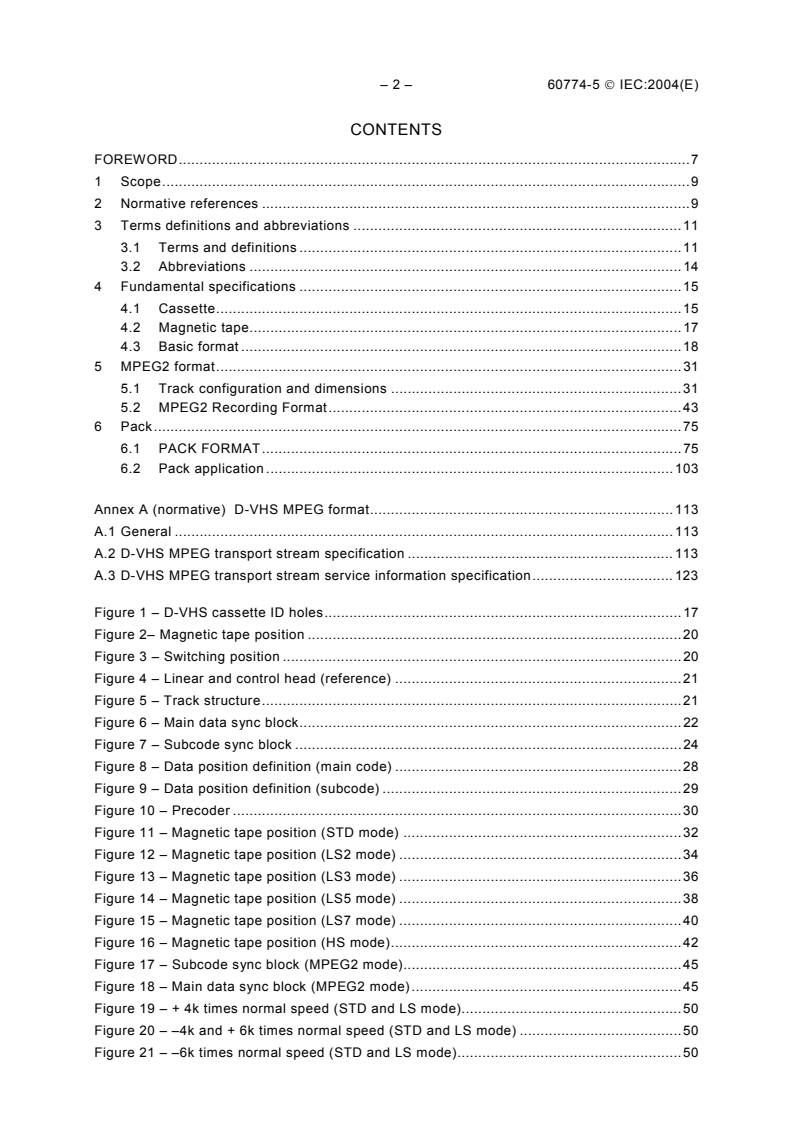
– 2 – 60774-5 IEC:2004(E)
CONTENTS
FOREWORD.7
1 Scope.9
2 Normative references.9
3 Terms definitions and abbreviations .11
3.1 Terms and definitions .11
3.2 Abbreviations.14
4 Fundamental specifications.15
4.1 Cassette.15
4.2 Magnetic tape.17
4.3 Basic format.18
5 MPEG2 format.31
5.1 Track configuration and dimensions .31
5.2 MPEG2 Recording Format.43
6 Pack.75
6.1 PACK FORMAT.75
6.2 Pack application.103
Annex A (normative) D-VHS MPEG format.113
A.1 General .113
A.2 D-VHS MPEG transport stream specification .113
A.3 D-VHS MPEG transport stream service information specification.123
Figure 1 – D-VHS cassette ID holes.17
Figure 2– Magnetic tape position .20
Figure 3 – Switching position .20
Figure 4 – Linear and control head (reference) .21
Figure 5 – Track structure.21
Figure 6 – Main data sync block.22
Figure 7 – Subcode sync block .24
Figure 8 – Data position definition (main code) .28
Figure 9 – Data position definition (subcode) .29
Figure 10 – Precoder .30
Figure 11 – Magnetic tape position (STD mode) .32
Figure 12 – Magnetic tape position (LS2 mode) .34
Figure 13 – Magnetic tape position (LS3 mode) .36
Figure 14 – Magnetic tape position (LS5 mode) .38
Figure 15 – Magnetic tape position (LS7 mode) .40
Figure 16 – Magnetic tape position (HS mode).42
Figure 17 – Subcode sync block (MPEG2 mode).45
Figure 18 – Main data sync block (MPEG2 mode).45
Figure 19 – + 4k times normal speed (STD and LS mode).50
Figure 20 – –4k and + 6k times normal speed (STD and LS mode) .50
Figure 21 – –6k times normal speed (STD and LS mode).50
60774-5 IEC:2004(E) – 3 –
Figure 22 – +12k times normal speed (STD and LS mode).50
Figure 23 – –12k times normal speed (STD and LS mode).51
Figure 24 – –12k times normal speed (STD and LS mode).51
Figure 25 – + 3 times normal speed (HS mode) .51
Figure 26 – – 3 times normal speed (HS mode) .51
Figure 27 – + 6 times normal speed (HS mode) .51
Figure 28 – – 6 times normal speed (HS mode) .52
Figure 29 – +12 and –12 times normal speed (HS mode).52
Figure 30 – Basic units (STD and LS mode).52
Figure 31 – Basic units (HS mode).53
Figure 32 – Macro areas (STD and LS mode) .53
Figure 33 – Macro areas (HS mode) .54
Figure 34 – Macro units (STD and LS mode) .54
Figure 35 – Macro units (HS mode) .55
Figure 36 – ECC structure (main data area).65
Figure 37 – Data position definition.65
Figure 38 – ECC Structure (trick play) .67
Figure 39 – MPEG2 TS recording (normal play) .68
Figure 40 – Packet Header (STD and LS mode/normal play).69
Figure 41 – Packet Header (HS mode/normal play).69
Figure 42 – Time stamp for MPEG2 TS recording (STD and LS mode/ Normal play) .70
Figure 43 – Time stamp for MPEG2 TS recording (HS mode/normal play).70
Figure 44 – MPEG2 TS recording (trick play) .72
Figure 45 – Packet header (trick play) .73
Figure 46 – Time stamp for MPEG2 TS recording (trick play) .74
Figure 47 – TS recording position .74
Figure 48 – C0: No information .75
Figure 49 – C1: Cassette ID.76
Figure 50 – C2: Absolute time code .77
Figure 51 – C3: Optional time code.79
Figure 52 – C4: Total time .80
Figure 53 – C5: Rec date .81
Figure 54 – C6: Rec time .82
Figure 55 – C7: Source.83
Figure 56 – C8: Text header .84
Figure 57 – C9: Text data .85
Figure 58 – C10: Transparent .86
Figure 59 – C11, C 12: ISRC .87
Figure 60 – C13: Marker .88
Figure 61 – Data detail of Marker.89
Figure 62 – C14: TOC of start point .90
Figure 63 – C15: TOC of program information.91
Figure 64 – C16: Trick play information.92
– 4 – 60774-5 IEC:2004(E)
Figure 65 – P1: Program information .94
Figure 66 – P2: Program total time .95
Figure 67 – P3: Program time code.96
Figure 68 – I1: Index total time .97
Figure 69 – I2: Index time code.98
Figure 70 – E1: G_ECM Pack .99
Figure 71 – E2: L_ECM Pack .100
Figure 72 – E3: A_ECM Pack.101
Figure 73 – E4: R_ECM Pack .102
Figure 74 – An example of different time code on a track.104
Figure 75 – An example of a text recording.105
Figure 76 – An example of same text data pack recording .105
Figure 77 – An example of a text group recording .106
Figure 78 – Additional Information of TOC .106
Figure 79 – TOC without TOC Start and End Pack.107
Figure 80 – TOC with TOC start and end pack .107
Figure 81 – An example of a TOC of previous programs in program n.108
Figure 82 – An example of TOC of each program.108
Figure 83 – An example of the TOC of all programs.108
Figure 84 – An example of indication of multi-channel recording .109
Figure 85 – An example of Information in multi-channel recording .109
Figure A.1 – Kanji characters set structure .152
Figure A.2 – Additional character set structure.153
Figure A.3 – Conversion routes between MJD and UTC.156
Table 1 – Track configuration and dimensions .19
Table 2 – Configuration of ID (maindata sync block) .22
Table 3 – Symbol definition of ID parity (maindata sync block).23
Table 4 – Configuration of ID (subcode sync block) .24
Table 5 – Absolute track number support flag .25
Table 6 – Tag .25
Table 7 – Symbol definition of ID parity (subcode sync block) .26
Table 8 – Format ID .27
Table 9 – Application ID.27
Table 10 – Signal allocation.31
Table 11 – Track configuration and dimensions (STD mode).31
Table 12 – Track configuration and dimensions (LS2 mode) .33
Table 13 – Track configuration and dimensions (LS3 mode) .35
Table 14 – Track configuration and dimensions (LS5 mode) .37
Table 15 – Track configuration and dimensions (LS7 mode) .39
Table 16 – Track configuration and dimensions (HS mode).41
Table 17 – Definition of k .43
Table 18 – ECC block size.43
60774-5 IEC:2004(E) – 5 –
Table 19 – ECC block number per track.43
Table 20 – Program mode.43
Table 21 – Scanner rotation speed .43
Table 22 – 1,001 flag .43
Table 23 – Outer interleave .44
Table 24 – Recording mode .44
Table 25 – Application ID.44
Table 26 – Configuration of Main header .46
Table 27 – Format ID .46
Table 28 – Application ID.47
Table 29 – Application detail.47
Table 30 – Time compression ratio .47
Table 31 – Region management flag.48
Table 32 – CGMS .48
Table 33 – Data type .48
Table 34 – Data detail.49
Table 35 – Configuration of Pack .49
Table 36 – Repeating factor (STD and LS mode) .53
Table 37 – Repeating factor (HS mode) .54
Table 38 – Macro area (STD and LS mode) .56
Table 39 – Macro area (HS mode) .57
Table 40 – Ideal points (STD and LS mode).57
Table 41 – Ideal points (HS mode).58
Table 42 – Ideal points of macro area (STD mode: k=1) .59
Table 43 – Ideal points of macro area (LS2 mode: k=2) .60
Table 44 – Ideal points of macro area (LS3 mode: k=3) .61
Table 45 – Ideal points of macro area (LS5 mode: k=5) .62
Table 46 – Ideal points of macro area (LS7 mode: k=7) .63
Table 47 – Ideal points of macro area (HS mode) .64
Table 48 – Sync block count (normal play).68
Table 49 – Sync block count (dummy data).69
Table 50 – Data detail (normal play) .69
Table 51 – Sync block count (STD and LS mode/ trick play) .72
Table 52 – Sync block count (HS mode/ trick play) .72
Table 53 – Data detail (trick play) .73
Table 54 – Direction of trick play.73
Table 55 – Time code in the interlace scan system (STD mode) .110
Table 56 – Time code in the progressive scan system (STD mode).111
Table 57 – Time Code in progressive scan system (STD mode).112
Table A.1 – MPEG2(MP@ML) Parameters constraints for NTSC .115
Table A.2 – MPEG2(MP@ML) Parameters constraints for PAL/SECAM .115
Table A.3 – MPEG1 Parameters constraints for NTSC .115
Table A.4 – MPEG1 Parameters constraints for PAL/SECAM.115
– 6 – 60774-5 IEC:2004(E)
Table A.5 – Permitted values for display_horizontal_size and pan scan vector .116
Table A.6 – MPEG2(MP@HL/MP@H14L) Parameters constraints for NTSC .116
Table A.7 – MPEG2(MP@HL/MP@H14L) Parameters constraints for PAL/SECAM.117
Table A.8 – Picture user data structure of closed caption.119
Table A.9 – Constraints of parameters in chunk .121
Table A.10 – Constraints of display conditions.122
Table A.11 – Possible locations of the descriptor .123
Table A.12 – PAT table.124
Table A.13 – PMT table .126
Table A.14 – Registration_descriptor (descriptor_tag = 0x05) .128
Table A.15 – DTCP_descriptor (descriptor_tag = 0x88 ).129
Table A.16 – DTCP_CCI .129
Table A.17 – Image_Constraint_Token .130
Table A.18 – APS .130
Table A.19 – Stream_identifier_descriptor (descriptor_tag = 0x52) .130
Table A.20 – component_tag constraints .131
Table A.21 – ISO_639_language_descriptor (descriptor_tag = 0x0A).131
Table A.22 – Audio type values.131
Table A.23 – SIT table ( PID = 0x001F table_id = 0x7F) .132
Table A.24 – Partial_transport_stream_descriptor (descriptor_tag = 0x63).134
Table A.25 – Parental_rating_descriptor (descriptor_tag = 0x55) .134
Table A.26 – Rating .135
Table A.27 – Component_descriptor (descriptor_tag = 0x50) .135
Table A.28 – Stream_content and component_type .136
Table A.29 – Short_event_descriptor (descriptor_tag = 0x4D).138
Table A.30 – Extended_event_descriptor (descriptor_tag = 0x4E) .139
Table A.31 – Multilingual_service_name_descriptor (descriptor_tag = 0x5D) .140
Table A.32 – Content_descriptor (descriptor_tag = 0x54).141
Table A.33 – Content_nibble level 1 and 2 assignments .142
Table A.34 – PartialTS_time_descriptor (descriptor_tag = 0xC3) .145
Table A.35 – Caption_service_descriptor (descriptor_tag = 0x86).146
Table A.36 – DIT table ( PID = 0x001E table_id = 0x7E ) .147
Table A.37 – Text characters set .149
Table A.38 – Control character .150
Table A.39 – Invocation .150
Table A.40 – Designation.150
Table A.41 – Final character .151
Table A.42 – Initial designation and invocation .151
Table A.43 – Additional graphic characters set .154
Table A.44 – Symbols.156
Table A.45 – Example.157
60774-5 IEC:2004(E) – 7 –
INTERNATIONAL ELECTROTECHNICAL COMMISSION
____________
HELICAL-SCAN VIDEO TAPE CASSETTE SYSTEM
USING 12,65 mm (0,5 in) MAGNETIC TAPE ON TYPE VHS –
Part 5: D-VHS
FOREWORD
1) The International Electrotechnical Commission (IEC) is a worldwide organization for standardization comprising
all national electrotechnical committees (IEC National Committees). The object of IEC is to promote
international co-operation on all questions concerning standardization in the electrical and electronic fields. To
this end and in addition to other activities, IEC publishes International Standards, Technical Specifications,
Technical Reports, Publicly Available Specifications (PAS) and Guides (hereafter referred to as “IEC
Publication(s)”). Their preparation is entrusted to technical committees; any IEC National Committee interested
in the subject dealt with may participate in this preparatory work. International, governmental and non-
governmental organizations liaising with the IEC also participate in this preparation. IEC collaborates closely
with the International Organization for Standardization (ISO) in accordance with conditions determined by
agreement between the two organizations.
2) The formal decisions or agreements of IEC on technical matters express, as nearly as possible, an international
consensus of opinion on the relevant subjects since each technical committee has representation from all
interested IEC National Committees.
3) IEC Publications have the form of recommendations for international use and are accepted by IEC National
Committees in that sense. While all reasonable efforts are made to ensure that the technical content of IEC
Publications is accurate, IEC cannot be held responsible for the way in which they are used or for any
misinterpretation by any end user.
4) In order to promote international uniformity, IEC National Committees undertake to apply IEC Publications
transparently to the maximum extent possible in their national and regional publications. Any divergence
between any IEC Publication and the corresponding national or regional publication shall be clearly indicated in
the latter.
5) IEC provides no marking procedure to indicate its approval and cannot be rendered responsible for any
equipment declared to be in conformity with an IEC Publication.
6) All users should ensure that they have the latest edition of this publication.
7) No liability shall attach to IEC or its directors, employees, servants or agents including individual experts and
members of its technical committees and IEC National Committees for any personal injury, property damage or
other damage of any nature whatsoever, whether direct or indirect, or for costs (including legal fees) and
expenses arising out of the publication, use of, or reliance upon, this IEC Publication or any other IEC
Publications.
8) Attention is drawn to the Normative references cited in this publication. Use of the referenced publications is
indispensable for the correct application of this publication.
The IEC draws attention to the fact that it is claimed that compliance with this document may
involve the use of patents.
The IEC takes no position concerning the evidence, validity and scope of this patent right.
The holder of this patent right has assured the IEC that he/she is willing to negotiate licences
under reasonable and non-discriminatory terms and conditions with applicants throughout the
world. In this respect, the statement of the holder of this patent right is registered with IEC.
Information may be obtained from:
Patent Center, Legal & Intellectual Property Dept., Victor Company of Japan, Limited
3-12, Moriya-cho, Kanagawa-ku, Yokohama 221-8528, Japan
Attention is drawn to the possibility that some of the elements of this document may be the
subject of patent rights other than those identified above. The IEC shall not be held
responsible for identifying any or all such patent rights.
– 8 – 60774-5 IEC:2004(E)
International Standard IEC 60774-5 has been prepared by IEC technical committee 100:
Audio, video and multimedia systems and equipment.
The text of this standard is based on the following documents:
CDV Report on voting
100/664/CDV 100/748/RVC
Full information on the voting for the approval of this standard can be found in the report on
voting indicated in the above table.
This publication has been drafted in accordance with the ISO/IEC Directives, Part 2.
IEC 60774 consists of several parts under the general title Helical-scan video tape cassette
system using 12,65 mm (0,5 in) magnetic tape on type VHS:
Part 1: VHS and compact VHS video cassette system
Part 2: FM audio recording
Part 3: S-VHS
Part 4: S-VHS video cassette system - ET mode
Part 5: D-VHS
The committee has decided that the contents of this publication will remain unchanged until
2007. At this date, the publication will be
• reconfirmed;
• withdrawn;
• replaced by a revised edition, or
• amended.
A bilingual version of this standard may be issued at a later date.
60774-5 IEC:2004(E) – 9 –
HELICAL-SCAN VIDEO TAPE CASSETTE SYSTEM
USING 12,65 mm (0,5 in) MAGNETIC TAPE ON TYPE VHS –
Part 5: D-VHS
1 Scope
This part of IEC 60774 applies to the MPEG TS (Transport Stream) packet recording for
helical-scan video tape cassette system using 12,65 mm magnetic tape on type VHS.
This standard specifies the cassettes, the tape, the track configuration, the data structure, the
recording method and the MPEG TS format for D-VHS.
D-VHS is formatted on the basis of the VHS system, aiming for digital data recording. D-VHS
basic format, which is commonly used in various types of data recording application, is
specified.
D-VHS records the MPEG TS packets directly compatible with digital broadcast systems.
D-VHS has three recording modes according to the data-rate: STD (Standard), HS (High
Speed) and LS (Low Speed/four types), to accommodate various digital broadcasts and needs.
MPEG2 recording format for D-VHS including trick play is specified.
The pack format is specified for recording ancillary data, except the MPEG TS packets.
D-VHS MPEG format (ID: MTRM) is specified. D-VHS MPEG format is used for pre-recorded
software tape for D-VHS, and self-encoding of analog video and audio signal (for example
conventional TV) to MPEG TS packet.
2 Normative references
The following referenced documents are indispensable for the application of this document.
For dated references, only the edition cited applies. For undated references, the latest edition
of the referenced document (including any amendments) applies.
IEC 60774-1:1994, Helical-scan video tape cassette system using 12,65 mm (0,5 in) magnetic
tape on type VHS – Part 1: VHS and compact VHS video cassette system
IEC 60774-3:1993, Helical-scan video tape cassette system using 12,65 mm (0,5 in) magnetic
tape on type VHS – Part 3: S-VHS
ISO/IEC 11172-3:1993, Information technology – Coding of moving pictures and associated
audio for digital storage media at up to about 1,5 Mbit/s – Part 3: Audio
ISO/IEC 13818-1, Information technology – Generic coding of moving pictures and associated
audio information – Part 1: Systems
ISO/IEC 13818-2, Information technology – Generic coding of moving pictures and associated
audio information – Part 2: Video
ISO/IEC 13818-3:1998, Information technology – Generic coding of moving pictures and
associated audio information– Part 3: Audio
– 10 – 60774-5 IEC:2004(E)
ISO/IEC 13818-7:1998, Information technology – Generic coding of moving pictures and
associated audio information – Part 7: Advanced Audio Coding (AAC)
ISO 639-2:1998, Codes for the representation of names of languages – Part 2: Alpha-3 code
ISO 2015:1976, Numbering of weeks
ISO 3166-1:1997, Codes for the representation of names of countries and their subdivisions –
Part 1: Country codes
ISO 3901:2001, Information and documentation – International Standard Recording Code
(ISRC)
ISO 8859-1:1997, Information technology – 8-bit single-byte coded graphic character sets -
Part 1: Latin alphabet No. 1
ISO 13818-9:1996, Information technology – Generic coding of moving pictures and
associated audio information – Part 9: Extension for real-time interface for system decoders
ARIB STD-B5:1996, Ver 1.0, Data multiplex broadcasting system for the conventional
television using the vertical blanking interval
ARIB STD-B10:2004, Ver 3.8, Service Information for Digital Broadcasting System
ARIB STD-B24:2004, Ver 4, Data coding system and transmission specification for digital
broadcasting
ARIB TR-B15:2004, Ver 2.9, Operational guidelines for digital satellite broadcasting services
using broadcasting satellites
ATSC A/52B:2001, Digital audio Compression (AC-3)
ATSC.A/53B:2001, ATSC Digital Television Standard
ATSC A/70:2000, Conditional Access System for Terrestrial Broadcast
EIA 708 B:1999, Digital Television (DTV) closed captioning
EN 300 468:1998, V1.3.1, Digital Video Broadcasting (DVB) - Specification for Service
Information (SI) in DVB systems
ETR 211:1997, Digital Video Broadcasting (DVB); Guidelines on implementation and usage of
Service Information (SI)
ETS 300 743:1997, Digital Video Broadcasting (DVB) - Subtitling systems
JIS X 208:1997, 7-bit and 8-bit double byte coded KANJI sets for information interchange
PNG (Portable Network Graphic) Specification Ver1.0, W3C Rec.Oct.1996, available at
SMPTE 302M:2002, Television – Mapping of AES3 Data into MPEG-2 Transport Stream
60774-5 IEC:2004(E) – 11 –
3 Terms, definitions and abbreviations
3.1 Terms and definitions
For the purposes of this part of IEC 60774-5, the following terms and definitions apply.
3.1.1
absolute track number
22-bit code recorded in the ID area of the Subcode sync block. The absolute track number is
counted up every track and indicates the tape absolute position
3.1.2
absolute track number support flag
SF
2-bit code recorded in the ID area of the subcode sync block. SF indicates the condition of
absolute track number
3.1.3
application detail
in the case of MPEG2 mode or CTP STD mode 1, the application detail is recorded in the
main header. Application detail indicates the contents of main data
3.1.4
application ID
the application ID is recorded in the format ID. The application ID provides the definitions of
subcode data area and main data area
3.1.5
code word
code word in ECC
3.1.6
data-AUX
in the case of MPEG2 transport stream recording or CTP stream recording, data-AUX is the
next 1 byte after the main header. 6 data-AUX from 6 subsequent sync blocks constitute the
pack data
3.1.7
data detail
the data detail is recorded in the sync block information area. The contents of Data detail
depend on the contents of data type
3.1.8
data type
DT
the data type is recorded in the sync block information area in the main header. The data type
indicates the contents of the sync block data
3.1.9
ECC block size
indicates the size of data which constitute the product codes of main code
3.1.10
ECC block number per track
number of ECC blocks per track
– 12 – 60774-5 IEC:2004(E)
3.1.11
format ID
block of ID data in the subcode sync block or main header which contains ECC block size,
ECC block number per track, program mode, scanner rotation speed, recording
3.1.12
format information area
first 4 bits of the main header. The format information area contains format ID, application
details, application information, etc.
3.1.13
group of pictures
GOP
layer defined in MPEG
3.1.14
ID parity
IDP
error detecting code for ID
3.1.15
index flag
indicates the start point of the index
3.1.16
inter block gap
IBG
edit gap between two data areas
3.1.17
local time stamp generator
in the case of MPEG2 mode or CTP STD mode 1, the local time stamp generator is the drum
reference generator in recording and playback. Local time stamp generator provides the value
of the time stamp to be recorded
3.1.18
main data sync block
sync block in main code area. One main data sync block is 112 bytes
3.1.19
main header
in the case of MPEG2 mode or CTP STD mode, the main header is the first 2 bytes of the
main data area in each main data sync block and it consists of format information area and
sync block information area
3.1.20
marker flag
indicates the remarkable data area
3.1.21
outer interleave
number of tracks which constitute one interleave block for the outer error correcting codes
3.1.22
pack data
contains ancillary data as specified in the pack data format
60774-5 IEC:2004(E) – 13 –
3.1.23
packet header
4-byte information area associated with the transport packet. The packet header is recorded
in front of each transport packet
3.1.24
pack header
first byte of pack data
3.1.25
precoder
device for the first process of interleaved NRZI
3.1.26
program mode
indicates the structure of the main code area
3.1.27
sequence number
the sequence number is recorded in the ID area of the main data sync block. The sequence
number indicates the number of interleave sequences
3.1.28
skip flag
indicates the skip start point
3.1.29
start flag
indicates the start point of the program
3.1.30
subcode sync block
sync block in the subcode area. One subcode sync block is 28 bytes
3.1.31
sync block
SB
indicates the main data sync block or the subcode sync block or a 112 byte (896 bits) data
length
3.1.32
sync block count
SBC
the sync block count is recorded in the sync block information area. Sync block count
indicates the relation between D-VHS and the transport packet
3.1.33
sync block information area
12-bit data area in the main header. The sync block information area consists of data type,
sync block count and data detail
3.1.34
sync block number
the sync block number is recorded in the ID area of the main data sync block and the subcode
sync block. The sync block number indicates the position of the sync block
– 14 – 60774-5 IEC:2004(E)
3.1.35
time stamp
input time of the transport packet. The time stamp is recorded in packer header as the
sampled value of the local time stamp generator
3.1.36
track pair number
the track pair number is recorded in the ID area of the main data sync block. The track pair
number represents interleave sequence
3.2 Abbreviations
AAC Advanced Audio Coding
ATSC Advanced Television Systems Committee
ARIB Association of Radio Industries and Businesses
bslbf bit string, left bit first
C/N Carrier to Noise ratio
CGMS Copy Generation Management System
CRC Cyclic Redundancy Check Code
CTP Compact Transport Packet (different format from MPEG2 TS packet)
DIT Discontinuity Information Table
DTS Digital Theater System
DVB Digital Video Broadcasting
ES Elementary Stream
ETR ETSI Technical Report
ETS European Telecommunication Standard
ETSI European Telecommunication Standards Institute
IEC International Electrotechnical Commission
I-picture Intra-coded Frame or Field
IRD Integrated Receiver-Decoder
ISO International Organisation for Standardisation
ITU International Telecommunication Union
HDTV High Definition Television
HL High Level
MJD Modified Julian Date
ML Main Level
MP Main Profile
MPEG Moving Pictures Expert Group
MTRM MPEG Transport stream for Recording Media
NIT Network Information Table
NRZI Non-Return to Zero Inverse
PAT Program Association Table
PCR Program Clock Reference
PES Packetized Elementary Stream
PID Packet Identifier
PLTE Palette
PMT Program Map Table
60774-5 IEC:2004(E) – 15 –
PNG Potable Network Graphics
PSI Program Specific Information
rpchof remainder polynomial coefficients, highest order first
RS code Reed-Solom
...
IEC 60774-5 ®
Edition 1.0 2004-04
INTERNATIONAL
STANDARD
NORME
INTERNATIONALE
Helical-scan video tape cassette system using 12,65 mm (0,5 in) magnetic tape
on type VHS –
Part 5: D-VHS
Système de magnétoscope à cassette à balayage hélicoïdal utilisant la bande
magnétique de 12,65 mm (0,5 in) de format VHS –
Partie 5: D-VHS
All rights reserved. Unless otherwise specified, no part of this publication may be reproduced or utilized in any form
or by any means, electronic or mechanical, including photocopying and microfilm, without permission in writing from
either IEC or IEC's member National Committee in the country of the requester.
If you have any questions about IEC copyright or have an enquiry about obtaining additional rights to this publication,
please contact the address below or your local IEC member National Committee for further information.
Droits de reproduction réservés. Sauf indication contraire, aucune partie de cette publication ne peut être reproduite ni
utilisée sous quelque forme que ce soit et par aucun procédé, électronique ou mécanique, y compris la photocopie et les
microfilms, sans l'accord écrit de la CEI ou du Comité national de la CEI du pays du demandeur.
Si vous avez des questions sur le copyright de la CEI ou si vous désirez obtenir des droits supplémentaires sur cette
publication, utilisez les coordonnées ci-après ou contactez le Comité national de la CEI de votre pays de résidence.
IEC Central Office Tel.: +41 22 919 02 11
3, rue de Varembé Fax: +41 22 919 03 00
CH-1211 Geneva 20 info@iec.ch
Switzerland www.iec.ch
About the IEC
The International Electrotechnical Commission (IEC) is the leading global organization that prepares and publishes
International Standards for all electrical, electronic and related technologies.
About IEC publications
The technical content of IEC publications is kept under constant review by the IEC. Please make sure that you have the
latest edition, a corrigenda or an amendment might have been published.
Useful links:
IEC publications search - www.iec.ch/searchpub Electropedia - www.electropedia.org
The advanced search enables you to find IEC publications The world's leading online dictionary of electronic and
by a variety of criteria (reference number, text, technical electrical terms containing more than 30 000 terms and
committee,…). definitions in English and French, with equivalent terms in
It also gives information on projects, replaced and additional languages. Also known as the International
withdrawn publications. Electrotechnical Vocabulary (IEV) on-line.
IEC Just Published - webstore.iec.ch/justpublished Customer Service Centre - webstore.iec.ch/csc
Stay up to date on all new IEC publications. Just Published If you wish to give us your feedback on this publication
details all new publications released. Available on-line and or need further assistance, please contact the
also once a month by email. Customer Service Centre: csc@iec.ch.
A propos de la CEI
La Commission Electrotechnique Internationale (CEI) est la première organisation mondiale qui élabore et publie des
Normes internationales pour tout ce qui a trait à l'électricité, à l'électronique et aux technologies apparentées.
A propos des publications CEI
Le contenu technique des publications de la CEI est constamment revu. Veuillez vous assurer que vous possédez
l’édition la plus récente, un corrigendum ou amendement peut avoir été publié.
Liens utiles:
Recherche de publications CEI - www.iec.ch/searchpub Electropedia - www.electropedia.org
La recherche avancée vous permet de trouver des Le premier dictionnaire en ligne au monde de termes
publications CEI en utilisant différents critères (numéro de électroniques et électriques. Il contient plus de 30 000
référence, texte, comité d’études,…). termes et définitions en anglais et en français, ainsi que
Elle donne aussi des informations sur les projets et les les termes équivalents dans les langues additionnelles.
publications remplacées ou retirées. Egalement appelé Vocabulaire Electrotechnique
International (VEI) en ligne.
Just Published CEI - webstore.iec.ch/justpublished
Service Clients - webstore.iec.ch/csc
Restez informé sur les nouvelles publications de la CEI.
Just Published détaille les nouvelles publications parues. Si vous désirez nous donner des commentaires sur
Disponible en ligne et aussi une fois par mois par email. cette publication ou si vous avez des questions
contactez-nous: csc@iec.ch.
IEC 60774-5 ®
Edition 1.0 2004-04
INTERNATIONAL
STANDARD
NORME
INTERNATIONALE
Helical-scan video tape cassette system using 12,65 mm (0,5 in) magnetic tape
on type VHS –
Part 5: D-VHS
Système de magnétoscope à cassette à balayage hélicoïdal utilisant la bande
magnétique de 12,65 mm (0,5 in) de format VHS –
Partie 5: D-VHS
INTERNATIONAL
ELECTROTECHNICAL
COMMISSION
COMMISSION
ELECTROTECHNIQUE
PRICE CODE
INTERNATIONALE
CODE PRIX XG
ICS 33.160.40 ISBN 978-2-83220-247-0
– 2 – 60774-5 IEC:2004
CONTENTS
FOREWORD . 8
1 Scope . 10
2 Normative references . 10
3 Terms, definitions and abbreviations . 12
3.1 Terms and definitions . 12
3.2 Abbreviations . 15
4 Fundamental specifications . 16
4.1 Cassette . 16
4.2 Magnetic tape. 18
4.3 Basic format . 19
5 MPEG2 format . 32
5.1 Track configuration and dimensions . 32
5.2 MPEG2 recording format . 44
6 Pack . 76
6.1 Pack format . 76
6.2 Pack application . 104
Annex A (normative) D-VHS MPEG format . 114
A.1 General . 114
A.2 D-VHS MPEG transport stream specification . 114
A.3 D-VHS MPEG transport stream service information specification . 124
Bibliography . 159
Figure 1 – D-VHS cassette ID holes . 18
Figure 2 – Magnetic tape position . 21
Figure 3 – Switching position . 21
Figure 4 – Linear and control head (reference) . 22
Figure 5 – Track structure . 22
Figure 6 – Main data sync block . 23
Figure 7 – Subcode sync block . 25
Figure 8 – Data position definition (main code) . 29
Figure 9 – Data position definition (subcode) . 30
Figure 10 – Precoder . 31
Figure 11 – Magnetic tape position (STD mode) . 33
Figure 12 – Magnetic tape position (LS2 mode) . 35
Figure 13 – Magnetic tape position (LS3 mode) . 37
Figure 14 – Magnetic tape position (LS5 mode) . 39
Figure 15 – Magnetic tape position (LS7 mode) . 41
Figure 16 – Magnetic tape position (HS mode) . 43
Figure 17 – Subcode sync block (MPEG2 mode). 46
Figure 18 – Main data sync block (MPEG2 mode) . 46
60774-5 IEC:2004 – 3 –
Figure 19 – + 4k times normal speed (STD and LS mode). 51
Figure 20 – –4k and + 6k times normal speed (STD and LS mode) . 51
Figure 21 – –6k times normal speed (STD and LS mode) . 51
Figure 22 – +12k times normal speed (STD and LS mode) . 51
Figure 23 – –12k times normal speed (STD and LS mode) . 52
Figure 24 – –12k times normal speed (STD and LS mode) . 52
Figure 25 – + 3 times normal speed (HS mode) . 52
Figure 26 – – 3 times normal speed (HS mode) . 52
Figure 27 – + 6 times normal speed (HS mode) . 52
Figure 28 – – 6 times normal speed (HS mode) . 53
Figure 29 – +12 and –12 times normal speed (HS mode) . 53
Figure 30 – Basic units (STD and LS mode). 53
Figure 31 – Basic units (HS mode) . 54
Figure 32 – Macro areas (STD and LS mode) . 54
Figure 33 – Macro areas (HS mode) . 55
Figure 34 – Macro units (STD and LS mode) . 55
Figure 35 – Macro units (HS mode) . 56
Figure 36 – ECC structure (main data area) . 66
Figure 37 – Data position definition . 66
Figure 38 – ECC Structure (trick play) . 68
Figure 39 – MPEG2 TS recording (normal play) . 69
Figure 40 – Packet Header (STD and LS mode/normal play) . 70
Figure 41 – Packet Header (HS mode/normal play) . 70
Figure 42 – Time stamp for MPEG2 TS recording (STD and LS mode/ Normal play) . 71
Figure 43 – Time stamp for MPEG2 TS recording (HS mode/normal play). 71
Figure 44 – MPEG2 TS recording (trick play) . 73
Figure 45 – Packet header (trick play) . 74
Figure 46 – Time stamp for MPEG2 TS recording (trick play) . 75
Figure 47 – TS recording position . 75
Figure 48 – C0: No information . 76
Figure 49 – C1: Cassette ID . 77
Figure 50 – C2: Absolute time code . 78
Figure 51 – C3: Optional time code . 80
Figure 52 – C4: Total time . 81
Figure 53 – C5: Rec date . 82
Figure 54 – C6: Rec time . 83
Figure 55 – C7: Source . 84
Figure 56 – C8: Text header . 85
Figure 57 – C9: Text data . 86
Figure 58 – C10: Transparent . 87
Figure 59 – C11, C 12: ISRC . 88
Figure 60 – C13: Marker . 89
Figure 61 – Data detail of Marker . 90
– 4 – 60774-5 IEC:2004
Figure 62 – C14: TOC of start point . 91
Figure 63 – C15: TOC of program information . 92
Figure 64 – C16: Trick play information . 93
Figure 65 – P1: Program information . 95
Figure 66 – P2: Program total time . 96
Figure 67 – P3: Program time code . 97
Figure 68 – I1: Index total time . 98
Figure 69 – I2: Index time code . 99
Figure 70 – E1: G_ECM Pack . 100
Figure 71 – E2: L_ECM Pack . 101
Figure 72 – E3: A_ECM Pack . 102
Figure 73 – E4: R_ECM Pack . 103
Figure 74 – An example of different time code on a track . 105
Figure 75 – An example of a text recording . 106
Figure 76 – An example of same text data pack recording . 106
Figure 77 – An example of a text group recording . 107
Figure 78 – Additional Information of TOC . 107
Figure 79 – TOC without TOC Start and End Pack . 108
Figure 80 – TOC with TOC start and end pack . 108
Figure 81 – An example of a TOC of previous programs in program n . 109
Figure 82 – An example of TOC of each program. 109
Figure 83 – An example of the TOC of all programs . 109
Figure 84 – An example of indication of multi-channel recording . 110
Figure 85 – An example of Information in multi-channel recording . 110
Figure A.1 – Kanji characters set structure . 153
Figure A.2 – Additional character set structure . 154
Figure A.3 – Conversion routes between MJD and UTC . 157
Table 1 – Track configuration and dimensions . 20
............................................................. 23
Table 2 – Configuration of ID (maindata sync block)
Table 3 – Symbol definition of ID parity (maindata sync block) . 24
Table 4 – Configuration of ID (subcode sync block) . 25
Table 5 – Absolute track number support flag . 26
Table 6 – Tag . 26
Table 7 – Symbol definition of ID parity (subcode sync block) . 27
Table 8 – Format ID . 28
Table 9 – Application ID . 28
Table 10 – Signal allocation . 32
Table 11 – Track configuration and dimensions (STD mode) . 32
Table 12 – Track configuration and dimensions (LS2 mode) . 34
Table 13 – Track configuration and dimensions (LS3 mode) . 36
Table 14 – Track configuration and dimensions (LS5 mode) . 38
Table 15 – Track configuration and dimensions (LS7 mode) . 40
60774-5 IEC:2004 – 5 –
Table 16 – Track configuration and dimensions (HS mode) . 42
Table 17 – Definition of k . 44
Table 18 – ECC block size . 44
Table 19 – ECC block number per track . 44
Table 20 – Program mode . 44
Table 21 – Scanner rotation speed . 44
Table 22 – 1,001 flag . 44
Table 23 – Outer interleave . 45
Table 24 – Recording mode . 45
Table 25 – Application ID . 45
Table 26 – Configuration of Main header . 47
Table 27 – Format ID . 47
Table 28 – Application ID . 48
Table 29 – Application detail . 48
Table 30 – Time compression ratio . 48
Table 31 – Region management flag . 49
Table 32 – CGMS . 49
Table 33 – Data type . 49
Table 34 – Data detail . 50
Table 35 – Configuration of Pack . 50
Table 36 – Repeating factor (STD and LS mode) . 54
Table 37 – Repeating factor (HS mode) . 55
Table 38 – Macro area (STD and LS mode) . 57
Table 39 – Macro area (HS mode) . 58
Table 40 – Ideal points (STD and LS mode) . 58
Table 41 – Ideal points (HS mode) . 59
Table 42 – Ideal points of macro area (STD mode: k=1) . 60
Table 43 – Ideal points of macro area (LS2 mode: k=2) . 61
Table 44 – Ideal points of macro area (LS3 mode: k=3) . 62
Table 45 – Ideal points of macro area (LS5 mode: k=5) . 63
Table 46 – Ideal points of macro area (LS7 mode: k=7) . 64
Table 47 – Ideal points of macro area (HS mode) . 65
Table 48 – Sync block count (normal play) . 69
Table 49 – Sync block count (dummy data) . 70
Table 50 – Data detail (normal play) . 70
Table 51 – Sync block count (STD and LS mode/ trick play) . 73
Table 52 – Sync block count (HS mode/ trick play) . 73
Table 53 – Data detail (trick play) . 74
Table 54 – Direction of trick play . 74
Table 55 – Time code in the interlace scan system (STD mode) . 111
Table 56 – Time code in the progressive scan system (STD mode) . 112
Table 57 – Time Code in progressive scan system (STD mode) . 113
Table A.1 – MPEG2(MP@ML) Parameters constraints for NTSC . 116
– 6 – 60774-5 IEC:2004
Table A.2 – MPEG2(MP@ML) Parameters constraints for PAL/SECAM . 116
Table A.3 – MPEG1 Parameters constraints for NTSC . 116
Table A.4 – MPEG1 Parameters constraints for PAL/SECAM . 116
Table A.5 – Permitted values for display_horizontal_size and pan scan vector . 117
Table A.6 – MPEG2(MP@HL/MP@H14L) Parameters constraints for NTSC . 117
Table A.7 – MPEG2(MP@HL/MP@H14L) Parameters constraints for PAL/SECAM . 118
Table A.8 – Picture user data structure of closed caption . 120
Table A.9 – Constraints of parameters in chunk . 122
Table A.10 – Constraints of display conditions . 123
Table A.11 – Possible locations of the descriptor . 124
Table A.12 – PAT table . 125
Table A.13 – PMT table . 127
Table A.14 – Registration_descriptor (descriptor_tag = 0x05) . 129
Table A.15 – DTCP_descriptor (descriptor_tag = 0x88 ). 130
Table A.16 – DTCP_CCI . 130
Table A.17 – Image_Constraint_Token . 131
Table A.18 – APS . 131
Table A.19 – Stream_identifier_descriptor (descriptor_tag = 0x52) . 131
Table A.20 – component_tag constraints . 132
Table A.21 – ISO_639_language_descriptor (descriptor_tag = 0x0A) . 132
Table A.22 – Audio type values . 132
Table A.23 – SIT table ( PID = 0x001F table_id = 0x7F) . 133
Table A.24 – Partial_transport_stream_descriptor (descriptor_tag = 0x63) . 135
Table A.25 – Parental_rating_descriptor (descriptor_tag = 0x55) . 135
Table A.26 – Rating . 136
Table A.27 – Component_descriptor (descriptor_tag = 0x50) . 136
Table A.28 – Stream_content and component_type . 137
Table A.29 – Short_event_descriptor (descriptor_tag = 0x4D) . 139
Table A.30 – Extended_event_descriptor (descriptor_tag = 0x4E) . 140
Table A.31 – Multilingual_service_name_descriptor (descriptor_tag = 0x5D) . 141
Table A.32 – Content_descriptor (descriptor_tag = 0x54) . 142
Table A.33 – Content_nibble level 1 and 2 assignments . 143
Table A.34 – PartialTS_time_descriptor (descriptor_tag = 0xC3) . 146
Table A.35 – Caption_service_descriptor (descriptor_tag = 0x86) . 147
Table A.36 – DIT table ( PID = 0x001E table_id = 0x7E ) . 148
Table A.37 – Text characters set . 150
Table A.38 – Control character . 151
Table A.39 – Invocation . 151
Table A.40 – Designation . 151
Table A.41 – Final character . 152
Table A.42 – Initial designation and invocation . 152
Table A.43 – Additional graphic characters set . 155
Table A.44 – Symbols . 157
60774-5 IEC:2004 – 7 –
Table A.45 – Example . 158
– 8 – 60774-5 IEC:2004
INTERNATIONAL ELECTROTECHNICAL COMMISSION
____________
HELICAL-SCAN VIDEO TAPE CASSETTE SYSTEM
USING 12,65 mm (0,5 in) MAGNETIC TAPE ON TYPE VHS –
Part 5: D-VHS
FOREWORD
1) The International Electrotechnical Commission (IEC) is a worldwide organization for standardization comprising
all national electrotechnical committees (IEC National Committees). The object of IEC is to promote
international co-operation on all questions concerning standardization in the electrical and electronic fields. To
this end and in addition to other activities, IEC publishes International Standards, Technical Specifications,
Technical Reports, Publicly Available Specifications (PAS) and Guides (hereafter referred to as “IEC
Publication(s)”). Their preparation is entrusted to technical committees; any IEC National Committee interested
in the subject dealt with may participate in this preparatory work. International, governmental and non-
governmental organizations liaising with the IEC also participate in this preparation. IEC collaborates closely
with the International Organization for Standardization (ISO) in accordance with conditions determined by
agreement between the two organizations.
2) The formal decisions or agreements of IEC on technical matters express, as nearly as possible, an international
consensus of opinion on the relevant subjects since each technical committee has representation from all
interested IEC National Committees.
3) IEC Publications have the form of recommendations for international use and are accepted by IEC National
Committees in that sense. While all reasonable efforts are made to ensure that the technical content of IEC
Publications is accurate, IEC cannot be held responsible for the way in which they are used or for any
misinterpretation by any end user.
4) In order to promote international uniformity, IEC National Committees undertake to apply IEC Publications
transparently to the maximum extent possible in their national and regional publications. Any divergence
between any IEC Publication and the corresponding national or regional publication shall be clearly indicated in
the latter.
5) IEC provides no marking procedure to indicate its approval and cannot be rendered responsible for any
equipment declared to be in conformity with an IEC Publication.
6) All users should ensure that they have the latest edition of this publication.
7) No liability shall attach to IEC or its directors, employees, servants or agents including individual experts and
members of its technical committees and IEC National Committees for any personal injury, property damage or
other damage of any nature whatsoever, whether direct or indirect, or for costs (including legal fees) and
expenses arising out of the publication, use of, or reliance upon, this IEC Publication or any other IEC
Publications.
8) Attention is drawn to the Normative references cited in this publication. Use of the referenced publications is
indispensable for the correct application of this publication.
The IEC draws attention to the fact that it is claimed that compliance with this document may
involve the use of patents.
The IEC takes no position concerning the evidence, validity and scope of this patent right.
The holder of this patent right has assured the IEC that he/she is willing to negotiate licences
under reasonable and non-discriminatory terms and conditions with applicants throughout the
world. In this respect, the statement of the holder of this patent right is registered with IEC.
Information may be obtained from:
Patent Center, Legal & Intellectual Property Dept., Victor Company of Japan, Limited
3-12, Moriya-cho, Kanagawa-ku, Yokohama 221-8528, Japan
Attention is drawn to the possibility that some of the elements of this document may be the
subject of patent rights other than those identified above. The IEC shall not be held
responsible for identifying any or all such patent rights.
60774-5 IEC:2004 – 9 –
International Standard IEC 60774-5 has been prepared by IEC technical committee 100:
Audio, video and multimedia systems and equipment.
This bilingual version (2012-08) corresponds to the monolingual English version, published in
2004-04.
The text of this standard is based on the following documents:
CDV Report on voting
100/664/CDV 100/748/RVC
Full information on the voting for the approval of this standard can be found in the report on
voting indicated in the above table.
The French version of this standard has not been voted upon.
This publication has been drafted in accordance with the ISO/IEC Directives, Part 2.
IEC 60774 consists of several parts under the general title Helical-scan video tape cassette
system using 12,65 mm (0,5 in) magnetic tape on type VHS:
Part 1: VHS and compact VHS video cassette system
Part 2: FM audio recording
Part 3: S-VHS
Part 4: S-VHS video cassette system - ET mode
Part 5: D-VHS
The committee has decided that the contents of this publication will remain unchanged until
2007. At this date, the publication will be
• reconfirmed;
• withdrawn;
• replaced by a revised edition, or
• amended.
– 10 – 60774-5 IEC:2004
HELICAL-SCAN VIDEO TAPE CASSETTE SYSTEM
USING 12,65 mm (0,5 in) MAGNETIC TAPE ON TYPE VHS –
Part 5: D-VHS
1 Scope
This part of IEC 60774 applies to the MPEG TS (Transport Stream) packet recording for
helical-scan video tape cassette system using 12,65 mm magnetic tape on type VHS.
This standard specifies the cassettes, the tape, the track configuration, the data structure, the
recording method and the MPEG TS format for D-VHS.
D-VHS is formatted on the basis of the VHS system, aiming for digital data recording. D-VHS
basic format, which is commonly used in various types of data recording application, is
specified.
D-VHS records the MPEG TS packets directly compatible with digital broadcast systems.
D-VHS has three recording modes according to the data-rate: STD (Standard), HS (High
Speed) and LS (Low Speed/four types), to accommodate various digital broadcasts and needs.
MPEG2 recording format for D-VHS including trick play is specified.
The pack format is specified for recording ancillary data, except the MPEG TS packets.
D-VHS MPEG format (ID: MTRM) is specified. D-VHS MPEG format is used for pre-recorded
software tape for D-VHS, and self-encoding of analog video and audio signal (for example
conventional TV) to MPEG TS packet.
2 Normative references
The following referenced documents are indispensable for the application of this document.
For dated references, only the edition cited applies. For undated references, the latest edition
of the referenced document (including any amendments) applies.
IEC 60774-1:1994, Helical-scan video tape cassette system using 12,65 mm (0,5 in) magnetic
tape on type VHS – Part 1: VHS and compact VHS video cassette system
IEC 60774-3:1993, Helical-scan video tape cassette system using 12,65 mm (0,5 in) magnetic
tape on type VHS – Part 3: S-VHS
ISO/IEC 11172-3:1993, Information technology – Coding of moving pictures and associated
audio for digital storage media at up to about 1,5 Mbit/s – Part 3: Audio
ISO/IEC 13818-1, Information technology – Generic coding of moving pictures and associated
audio information – Part 1: Systems
ISO/IEC 13818-2, Information technology – Generic coding of moving pictures and associated
audio information – Part 2: Video
ISO/IEC 13818-3:1998, Information technology – Generic coding of moving pictures and
associated audio information– Part 3: Audio
60774-5 IEC:2004 – 11 –
ISO/IEC 13818-7:1998, Information technology – Generic coding of moving pictures and
associated audio information – Part 7: Advanced Audio Coding (AAC)
ISO 639-2:1998, Codes for the representation of names of languages – Part 2: Alpha-3 code
ISO 2015:1976, Numbering of weeks
ISO 3166-1:1997, Codes for the representation of names of countries and their subdivisions –
Part 1: Country codes
ISO 3901:2001, Information and documentation – International Standard Recording Code
(ISRC)
ISO 8859-1:1997, Information technology – 8-bit single-byte coded graphic character sets -
Part 1: Latin alphabet No. 1
ISO 13818-9:1996, Information technology – Generic coding of moving pictures and
associated audio information – Part 9: Extension for real-time interface for system decoders
ARIB STD-B5:1996, Ver 1.0, Data multiplex broadcasting system for the conventional
television using the vertical blanking interval
ARIB STD-B10:2004, Ver 3.8, Service Information for Digital Broadcasting System
ARIB STD-B24:2004, Ver 4, Data coding system and transmission specification for digital
broadcasting
ARIB TR-B15:2004, Ver 2.9, Operational guidelines for digital satellite broadcasting services
using broadcasting satellites
ATSC A/52B:2001, Digital audio Compression (AC-3)
ATSC.A/53B:2001, ATSC Digital Television Standard
ATSC A/70:2000, Conditional Access System for Terrestrial Broadcast
EIA 708 B:1999, Digital Television (DTV) closed captioning
EN 300 468:1998, V1.3.1, Digital Video Broadcasting (DVB) - Specification for Service
Information (SI) in DVB systems
ETR 211:1997, Digital Video Broadcasting (DVB); Guidelines on implementation and usage of
Service Information (SI)
ETS 300 743:1997, Digital Video Broadcasting (DVB) - Subtitling systems
JIS X 208:1997, 7-bit and 8-bit double byte coded KANJI sets for information interchange
PNG (Portable Network Graphic) Specification Ver1.0, W3C Rec.Oct.1996, available at
SMPTE 302M:2002, Television – Mapping of AES3 Data into MPEG-2 Transport Stream
– 12 – 60774-5 IEC:2004
3 Terms, definitions and abbreviations
3.1 Terms and definitions
For the purposes of this part of IEC 60774-5, the following terms and definitions apply.
3.1.1
absolute track number
22-bit code recorded in the ID area of the Subcode sync block. The absolute track number is
counted up every track and indicates the tape absolute position
3.1.2
absolute track number support flag
SF
2-bit code recorded in the ID area of the subcode sync block. SF indicates the condition of
absolute track number
3.1.3
application detail
in the case of MPEG2 mode or CTP STD mode 1, the application detail is recorded in the
main header. Application detail indicates the contents of main data
3.1.4
application ID
the application ID is recorded in the format ID. The application ID provides the definitions of
subcode data area and main data area
3.1.5
code word
code word in ECC
3.1.6
data-AUX
in the case of MPEG2 transport stream recording or CTP stream recording, data-AUX is the
next 1 byte after the main header. 6 data-AUX from 6 subsequent sync blocks constitute the
pack data
3.1.7
data detail
the data detail is recorded in the sync block information area. The contents of Data detail
depend on the contents of data type
3.1.8
data type
DT
the data type is recorded in the sync block information area in the main header. The data type
indicates the contents of the sync block data
3.1.9
ECC block size
indicates the size of data which constitute the product codes of main code
3.1.10
ECC block number per track
number of ECC blocks per track
60774-5 IEC:2004 – 13 –
3.1.11
format ID
block of ID data in the subcode sync block or main header which contains ECC block size,
ECC block number per track, program mode, scanner rotation speed, recording
3.1.12
format information area
first 4 bits of the main header. The format information area contains format ID, application
details, application information, etc.
3.1.13
group of pictures
GOP
layer defined in MPEG
3.1.14
ID parity
IDP
error detecting code for ID
3.1.15
index flag
indicates the start point of the index
3.1.16
inter block gap
IBG
edit gap between two data areas
3.1.17
local time stamp generator
in the case of MPEG2 mode or CTP STD mode 1, the local time stamp generator is the drum
reference generator in recording and playback. Local time stamp generator provides the value
of the time stamp to be recorded
3.1.18
main data sync block
sync block in main code area. One main data sync block is 112 bytes
3.1.19
main header
in the case of MPEG2 mode or CTP STD mode, the main header is the first 2 bytes of the
main data area in each main data sync block and it consists of format information area and
sync block information area
3.1.20
marker flag
indicates the remarkable data area
3.1.21
outer interleave
number of tracks which constitute one interleave block for the outer error correcting codes
3.1.22
pack data
contains ancillary data as specified in the pack data format
...