


IEC 60856:1986/AMD2:1997
(Amendment)Amendment 2 - Pre-recorded optical reflective videodisk system 'Laser vision' 50Hz/625 lines - PAL
Amendment 2 - Pre-recorded optical reflective videodisk system 'Laser vision' 50Hz/625 lines - PAL
Amendement 2 - Système de vidéodisque optique réfléchissant préenregistré 'Laservision' 50 Hz/625 lignes - PAL
General Information
- Status
- Published
- Publication Date
- 29-May-1997
- Technical Committee
- TC 100 - Audio, video and multimedia systems and equipment
- Drafting Committee
- WG 1 - TC 100/WG 1
- Current Stage
- PPUB - Publication issued
- Start Date
- 30-May-1997
- Completion Date
- 30-Apr-1997
Overview
IEC 60856:1986/AMD2:1997 is Amendment 2 to the international standard IEC 60856, issued by the International Electrotechnical Commission (IEC). This amendment focuses on the pre-recorded optical reflective videodisk system known as "Laser Vision," specifically for 50 Hz/625 lines PAL video systems. It addresses updated mechanical, optical, temperature, humidity, video, and audio parameters to enhance the functionality and interoperability of videodisk systems. The amendment is essential for manufacturers and developers working with optical videodisk technology ensuring compliance with global standards in the audio-video industry.
Key Updates and Topics
Mechanical Parameters
- Disk thickness requirements are precisely defined (min. 1.1 mm, max. 1.4 mm for single disks).
- Label specifications cover size, position, and thickness to ensure proper disk handling and operation.
- Clamping area thickness requirements are established for both single and double-sided disks, critical for drive compatibility.
- Maximum radial angle of the disk surface is limited to ±1° to maintain accurate optical reading.
Optical Requirements
- Birefringence of transparent disks is capped at 40°, ensuring optical clarity and signal integrity.
- Numerical aperture of the readout laser beam lens standardized at NA = 0.40 ± 0.01 to optimize playback quality.
Environmental Conditions
- Disks must withstand temperature ranges from 5 °C to 45 °C and humidity levels from 5% to 90% for four consecutive days without performance degradation.
Video Signal Specifications
- Vertical Interval Test Signals (VITS) incorporated as per ITU-R Recommendation 473-5 to facilitate quality control and troubleshooting.
- Specific video lines are reserved for address and data signals, subtitles, and future applications while maintaining compatibility with PAL video standards.
Digital Audio Signal Implementation
- Detailed introduction of digital audio signal modulation in the Laser Vision system as an optional enhancement, referencing IEC 60908 for the EFM signal structure.
- Signal processing includes low-pass and high-pass filtering, pre-emphasis, and symmetrical double-edge pulse width modulation to ensure high fidelity audio encoding.
- Block Error Rate (BLER) standards specified to guarantee error control in digital audio data transmission.
- Sample frequency standardized relative to the PAL line frequency, ensuring audio-video synchronization.
- Compensation techniques recommended to offset audio decoding delay for seamless playback.
Sub-code and Command Signaling
- Specific modifications to sub-code modes ensure compatibility with compact disc standards for control and display commands within the video disc environment.
- Directory structure and table of contents (TOC) formatting align with IEC 60908-2 requirements to facilitate multimedia integration.
Applications
This amendment serves practical value for:
- Optical disc manufacturers refining product specifications to comply with up-to-date international mechanical and optical requirements for PAL Laser Vision discs.
- Video system designers and engineers integrating advanced digital audio capabilities alongside analog video on pre-recorded discs, improving media versatility.
- Quality control and testing labs applying the standardized vertical interval test signals and environmental resilience criteria to ensure product durability and performance.
- Multimedia content producers who rely on precise addressing, subtitling, and data embedding within the video stream for enhanced user experiences.
- Playback equipment developers ensuring device compatibility with amended specifications to deliver optimal reading and decoding of both video and digital audio signals.
Related Standards
- IEC 60908 – Digital audio tape and compact disc systems, complementary reference for audio signal implementation and modulation.
- ITU-R Recommendation 473-5 – Guidance on vertical interval test signals relevant for video quality assessments incorporated into this amendment.
- IEC 60856 (original and previous amendments) – Base standard for pre-recorded optical reflective videodisk systems, important for full technical understanding.
By aligning videodisk products with IEC 60856:1986/AMD2:1997 standards, manufacturers and developers ensure global interoperability, enhanced audio-visual quality, and robust mechanical and environmental performance in Laser Vision PAL systems. This amendment facilitates continued innovation and consistency in the optical media industry.
Get Certified
Connect with accredited certification bodies for this standard

ANCE
Mexican certification and testing association.

Intertek Slovenia
Intertek testing, inspection, and certification services in Slovenia.

LNE (Laboratoire National de Métrologie et d'Essais)
French national laboratory for metrology and testing.
Sponsored listings
Frequently Asked Questions
IEC 60856:1986/AMD2:1997 is a standard published by the International Electrotechnical Commission (IEC). Its full title is "Amendment 2 - Pre-recorded optical reflective videodisk system 'Laser vision' 50Hz/625 lines - PAL". This standard covers: Amendment 2 - Pre-recorded optical reflective videodisk system 'Laser vision' 50Hz/625 lines - PAL
Amendment 2 - Pre-recorded optical reflective videodisk system 'Laser vision' 50Hz/625 lines - PAL
IEC 60856:1986/AMD2:1997 is classified under the following ICS (International Classification for Standards) categories: 33.160.40 - Video systems. The ICS classification helps identify the subject area and facilitates finding related standards.
IEC 60856:1986/AMD2:1997 is available in PDF format for immediate download after purchase. The document can be added to your cart and obtained through the secure checkout process. Digital delivery ensures instant access to the complete standard document.
Standards Content (Sample)
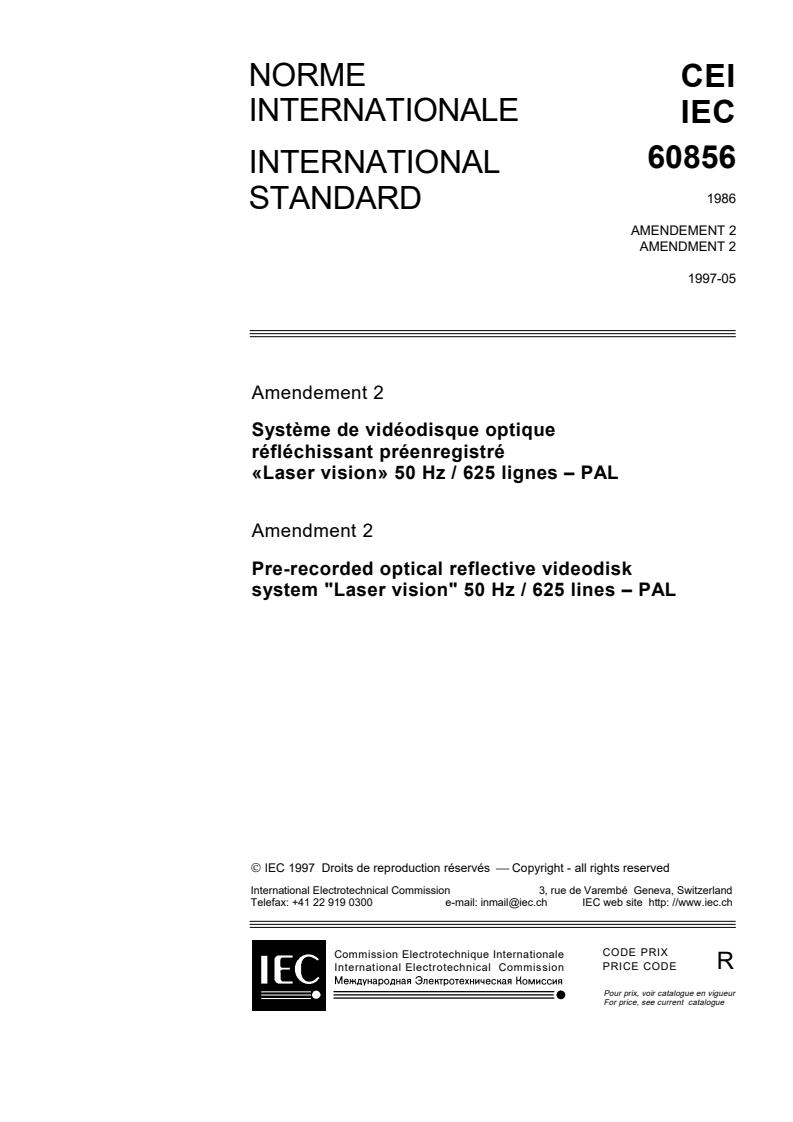
NORME
CEI
INTERNATIONALE
IEC
INTERNATIONAL
STANDARD
AMENDEMENT 2
AMENDMENT 2
1997-05
Amendement 2
Système de vidéodisque optique
réfléchissant préenregistré
«Laser vision» 50 Hz / 625 lignes – PAL
Amendment 2
Pre-recorded optical reflective videodisk
system "Laser vision" 50 Hz / 625 lines – PAL
IEC 1997 Droits de reproduction réservés Copyright - all rights reserved
International Electrotechnical Commission 3, rue de Varembé Geneva, Switzerland
Telefax: +41 22 919 0300 e-mail: inmail@iec.ch IEC web site http: //www.iec.ch
CODE PRIX
Commission Electrotechnique Internationale
PRICE CODE R
International Electrotechnical Commission
Pour prix, voir catalogue en vigueur
For price, see current catalogue
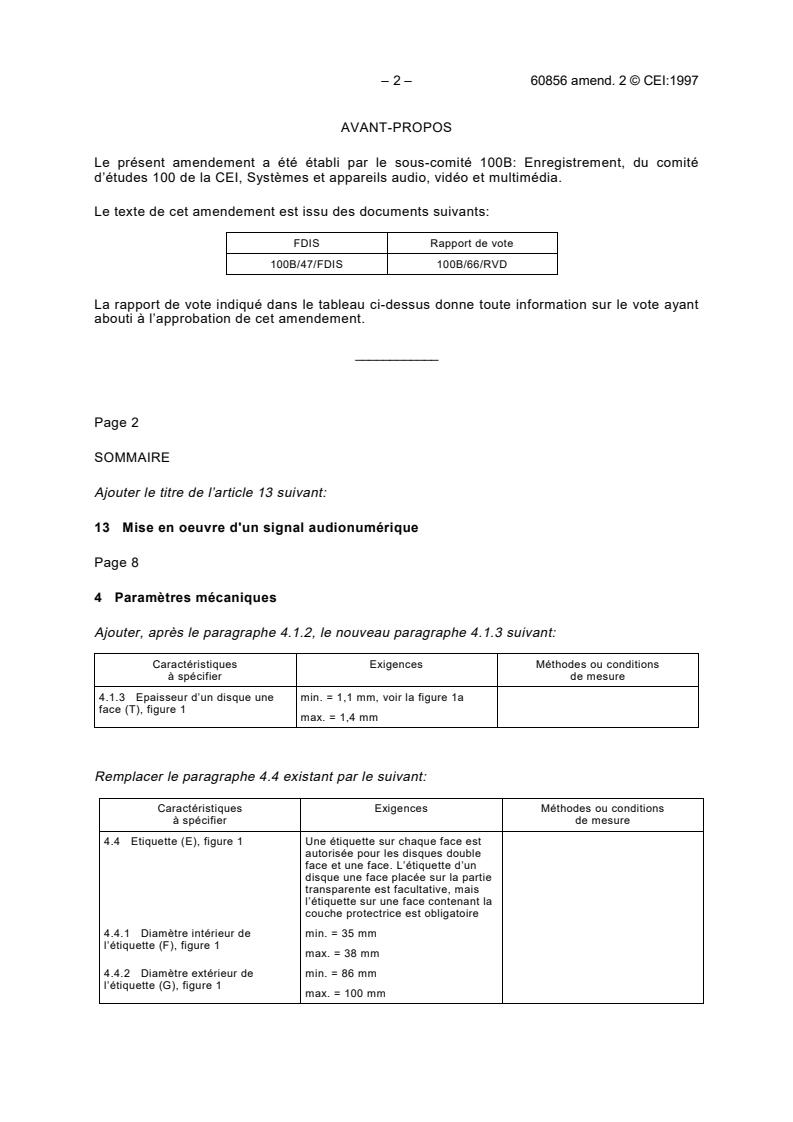
– 2 – 60856 amend. 2 © CEI:1997
AVANT-PROPOS
Le présent amendement a été établi par le sous-comité 100B: Enregistrement, du comité
d’études 100 de la CEI, Systèmes et appareils audio, vidéo et multimédia.
Le texte de cet amendement est issu des documents suivants:
FDIS Rapport de vote
100B/47/FDIS 100B/66/RVD
La rapport de vote indiqué dans le tableau ci-dessus donne toute information sur le vote ayant
abouti à l’approbation de cet amendement.
____________
Page 2
SOMMAIRE
Ajouter le titre de l’article 13 suivant:
13 Mise en oeuvre d'un signal audionumérique
Page 8
4 Paramètres mécaniques
Ajouter, après le paragraphe 4.1.2, le nouveau paragraphe 4.1.3 suivant:
Caractéristiques Exigences Méthodes ou conditions
à spécifier de mesure
4.1.3 Epaisseur d’un disque une min. = 1,1 mm, voir la figure 1a
face (T), figure 1
max. = 1,4 mm
Remplacer le paragraphe 4.4 existant par le suivant:
Caractéristiques Exigences Méthodes ou conditions
à spécifier de mesure
4.4 Etiquette (E), figure 1 Une étiquette sur chaque face est
autorisée pour les disques double
face et une face. L’étiquette d’un
disque une face placée sur la partie
transparente est facultative, mais
l’étiquette sur une face contenant la
couche protectrice est obligatoire
4.4.1 Diamètre intérieur de min. = 35 mm
l’étiquette (F), figure 1
max. = 38 mm
4.4.2 Diamètre extérieur de min. = 86 mm
l’étiquette (G), figure 1
max. = 100 mm
60856 Amend. 2 © IEC:1997 – 3 –
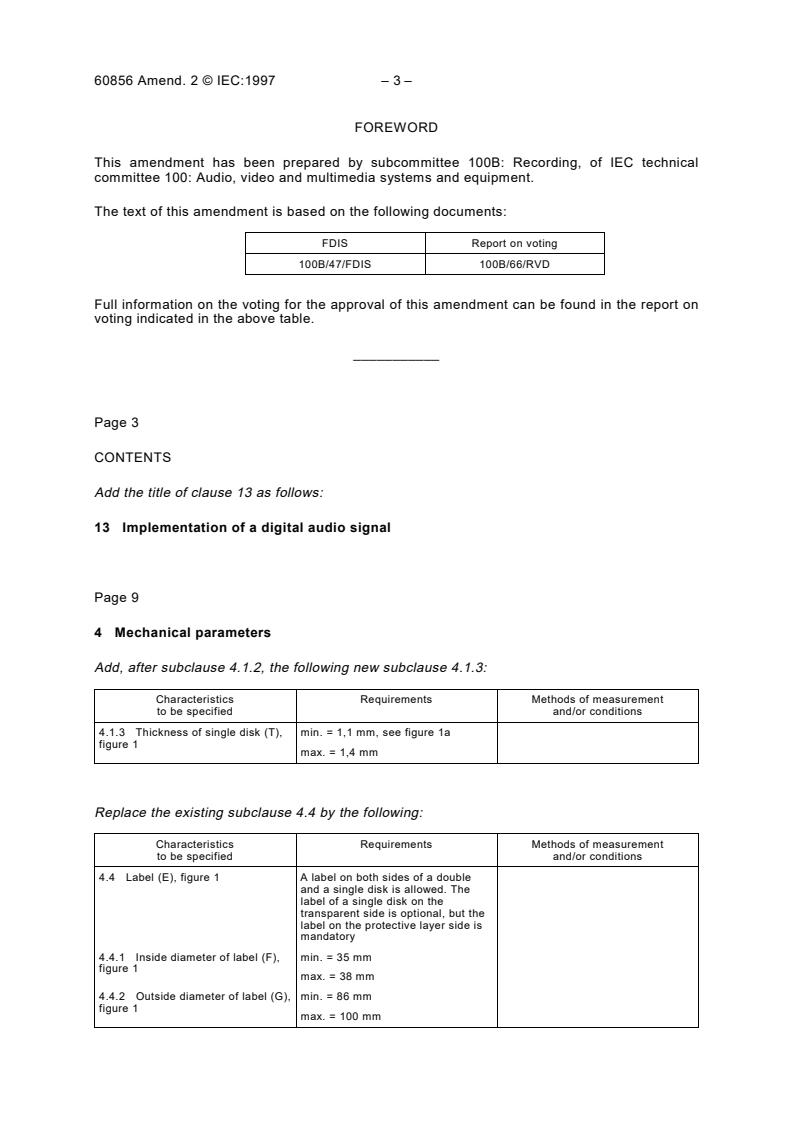
FOREWORD
This amendment has been prepared by subcommittee 100B: Recording, of IEC technical
committee 100: Audio, video and multimedia systems and equipment.
The text of this amendment is based on the following documents:
FDIS Report on voting
100B/47/FDIS 100B/66/RVD
Full information on the voting for the approval of this amendment can be found in the report on
voting indicated in the above table.
___________
Page 3
CONTENTS
Add the title of clause 13 as follows:
13 Implementation of a digital audio signal
Page 9
4 Mechanical parameters
Add, after subclause 4.1.2, the following new subclause 4.1.3:
Characteristics Requirements Methods of measurement
to be specified and/or conditions
4.1.3 Thickness of single disk (T), min. = 1,1 mm, see figure 1a
figure 1
max. = 1,4 mm
Replace the existing subclause 4.4 by the following:
Characteristics Requirements Methods of measurement
to be specified and/or conditions
4.4 Label (E), figure 1 A label on both sides of a double
and a single disk is allowed. The
label of a single disk on the
transparent side is optional, but the
label on the protective layer side is
mandatory
4.4.1 Inside diameter of label (F), min. = 35 mm
figure 1
max. = 38 mm
4.4.2 Outside diameter of label (G), min. = 86 mm
figure 1
max. = 100 mm
– 4 – 60856 amend. 2 © CEI:1997
Caractéristiques Exigences Méthodes ou conditions
à spécifier de mesure
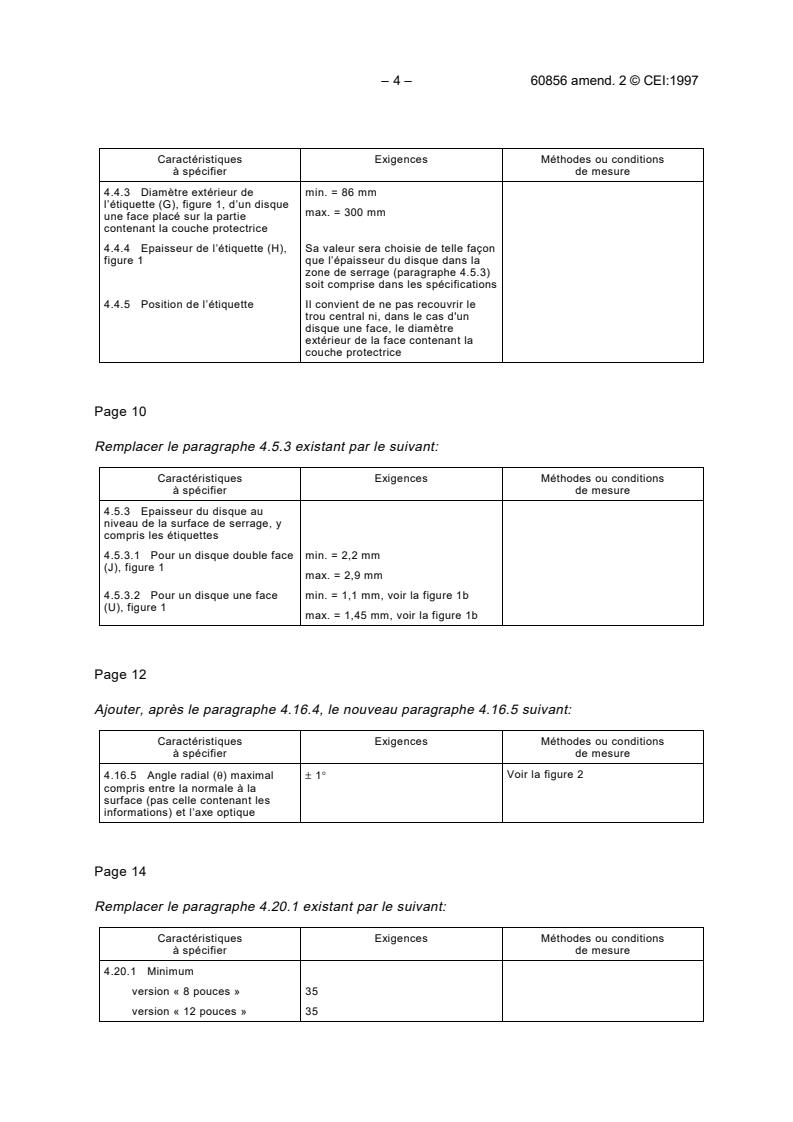
4.4.3 Diamètre extérieur de min. = 86 mm
l’étiquette (G), figure 1, d’un disque
max. = 300 mm
une face placé sur la partie
contenant la couche protectrice
4.4.4 Epaisseur de l’étiquette (H), Sa valeur sera choisie de telle façon
figure 1 que l’épaisseur du disque dans la
zone de serrage (paragraphe 4.5.3)
soit comprise dans les spécifications
4.4.5 Position de l’étiquette Il convient de ne pas recouvrir le
trou central ni, dans le cas d'un
disque une face, le diamètre
extérieur de la face contenant la
couche protectrice
Page 10
Remplacer le paragraphe 4.5.3 existant par le suivant:
Caractéristiques Exigences Méthodes ou conditions
à spécifier de mesure
4.5.3 Epaisseur du disque au
niveau de la surface de serrage, y
compris les étiquettes
4.5.3.1 Pour un disque double face min. = 2,2 mm
(J), figure 1
max. = 2,9 mm
4.5.3.2 Pour un disque une face min. = 1,1 mm, voir la figure 1b
(U), figure 1
max. = 1,45 mm, voir la figure 1b
Page 12
Ajouter, après le paragraphe 4.16.4, le nouveau paragraphe 4.16.5 suivant:
Caractéristiques Exigences Méthodes ou conditions
à spécifier de mesure
Voir la figure 2
4.16.5 Angle radial (θ) maximal ± 1°
compris entre la normale à la
surface (pas celle contenant les
informations) et l’axe optique
Page 14
Remplacer le paragraphe 4.20.1 existant par le suivant:
Caractéristiques Exigences Méthodes ou conditions
à spécifier de mesure
4.20.1 Minimum
version « 8 pouces » 35
version « 12 pouces » 35
60856 Amend. 2 © IEC:1997 – 5 –
Characteristics Requirements Methods of measurement
to be specified and/or conditions
4.4.3 Outside diameter of the label min. = 86 mm
(G), figure 1 of a single disk on the
max. = 300 mm
protective layer side
4.4.4 Thickness of label (H), So that thickness of disk in clamping
figure 1 area (subclause 4.5.3) is within
specification
4.4.5 Position of label Should not overlap either centre
hole or, in case of a single disk, the
outer diameter of the protective
layer side
Page 11
Replace the existing subclause 4.5.3 by the following:
Characteristics Requirements Methods of measurement
to be specified and/or conditions
4.5.3 Thickness of disk in clamping
area including labels
4.5.3.1 For double disk (J), figure 1 min. = 2,2 mm
max. = 2,9 mm
4.5.3.2 For single disk (U), min. = 1,1 mm, see figure 1b
figure 1
max. = 1,45 mm, see figure 1b
Page 13
Add, after subclause 4.16.4, the following new subclause 4.16.5:
Characteristics Requirements Methods of measurement
to be specified and/or conditions
See figure 2
4.16.5 Maximum radial angle (θ) ± 1°
between the normal on the surface
(not infoside) and the optical axis
Page 15
Replace the existing subclause 4.20.1 by the following:
Characteristics Requirements Methods of measurement
to be specified and/or conditions
4.20.1 Minimum
8 in version 35
12 in version 35
– 6 – 60856 amend. 2 © CEI:1997
Remplacer le paragraphe 4.21.1 existant par le suivant:
Caractéristiques Exigences Méthodes ou conditions
à spécifier de mesure
4.21.1 Minimum
version « 8 pouces » 0,18
version « 12 pouces » 0,18
5 Exigences optiques
Remplacer le paragraphe 5.2 existant par le suivant:
Caractéristiques Exigences Méthodes ou conditions
à spécifier de mesure
5.2 Biréfringence des disques 40 max.
°
transparents (double passage)
Page 16
6 Exigences de température et d’humidité
Remplacer le texte de la deuxième colonne par le nouveau texte suivant:
Exigences
Doit satisfaire à toutes les
exigences à la suite d'une
exposition à une température
allant de 5 °C à 45 °C à une
humidité relative comprise dans la
plage de 5 % à 90 % pendant une
période de quatre jours
Page 18
9 Paramètres vidéo
Remplacer les paragraphes 9.1.3 et 9.1.4 existants par les suivants:
9.1.3 Signaux d'essais de l’intervalle vertical
Des signaux d'essais de l’intervalle vertical conformes à la Recommandation UIT-R 473-5,
annexe I (voir figures 7 à 10) peuvent être insérés dans les lignes 19, 13 ou 20, 332 et 326 ou
333. Les lignes 22 et 335 doivent être supprimées avant l'enregistrement optique afin de
pouvoir mesurer le bruit du disque.
9.1.4 Signaux d'adresse
Dans le signal vidéo, les lignes 6 à 18 et 319 à 331 sont réservées pour l'adresse ou les
signaux de données. Pour la spécification du signal, voir l'article 10. Les lignes qui ne sont pas
spécifiées ont un contenu vidéo fixé au niveau de suppression et sont réservées à des
applications futures. Les lignes 20, 21 et 333, 334 peuvent contenir des signaux de données en
sous-titres; dans ce cas, il n’y a pas de signaux d'essais de l'intervalle vertical sur les lignes 20
et 333 (voir 9.1.3).
Si une capacité supplémentaire est nécessaire pour des signaux de données en sous-titre, les
lignes 14, 15, 327 et 328 peuvent être utilisées.
60856 Amend. 2 © IEC:1997 – 7 –
Replace the existing subclause 4.21.1 by the following:
Characteristics Requirements Methods of measurement
to be specified and/or conditions
4.21.1 Minimum
8 in version 0,18
12 in version 0,18
5 Optical requirements
Replace the existing subclause 5.2 by the following:
Characteristics Requirements Methods of measurement
to be specified and/or conditions
5.2 Birefringence of transparent 40 max.
°
disk (double pass)
Page 17
6 Temperature and humidity requirements
Replace the text in the second column by the following new text:
Requirements
Must satisfy all requirements
following exposure to any
temperature within the range of
5 °C to 45 °C at any relative
humidity within the range of 5 %
to 90 % held constant for a period
of four days
Page 19
9 Video parameters
Replace the existing subclauses 9.1.3 and 9.1.4 by the following:
9.1.3 Vertical interval test signals (VITS)
Vertical interval test signals according to ITU-R Recommendation 473-5, annex I (see figures 7
to 10) may be inserted in the lines 19, 13 or 20, 332 and 326 or 333. The lines 22 and 335 shall
be blanked before optical recording, to enable disk noise measurements to be made.
9.1.4 Address signals
In the video signal, lines 6 through 18 and 319 through 331 are reserved for address or data
signals. For signal specification, see clause 10. The lines that are not specified have a video
content set at blanking level and are reserved for future applications. Lines 20, 21 and 333,
334 may contain subtitle data signals; in that case there are no VITS (see 9.1.3) on lines 20
and 333.
When additional capacity is needed for subtitle data signals, lines 14, 15, 327 and 328 may be
used.
– 8 – 60856 amend. 2 © CEI:1997
Page 26
10.1.10 Numéro d’image CLV
Remplacer le texte du paragraphe 10.1.10 par le nouveau texte suivant:
Sur le disque CLV, le numéro d'image CLV identifie chaque image vidéo et peut également
être utilisé pour détecter les points d’arrêt.
Code: 8 X1 E X3 X4 X5.
X1 = A à F et X3 = 0 à 9.
X1 et X3 indiquent les secondes du temps de fonctionnement avec les heures et les minutes
du code temporel de programme.
X4 et X5 sont les numéros d’image pendant 1 s, ainsi:
X4 = 0 à 2 et X5 = 0 à 9.
Le numéro d'image CLV doit être inséré à la ligne 16 ou à la ligne 329 selon la trame qui est la
première trame de l'image.
Le début du code temporel de programme est zéro heure et zéro minute, et celui du numéro
d'image CLV est zéro seconde et zéro image au commencement du programme actif.
11.1.2
Ouverture numérique
Remplacer le texte du paragraphe 11.1.2 par le nouveau texte suivant:
L'ouverture numérique des lentilles du faisceau de lecture est:
NA = 0,40 ± 0,01.
Page 28
12 Paramètres opérationnels
Ajouter, après l’article 12, le nouvel article 13 suivant:
13 Mise en oeuvre d'un signal audionumérique
Le présent article spécifie la mise en oeuvre d'un signal audionumérique comme complément
facultatif dans le système laser vision (LV). Voir les sections trois et quatre de la CEI 60908.
13.1 Modulation du signal
13.1.1 Généralités
Conformément à la CEI 60908 et avant d'être modulé, le signal EFM est corrigé dans un filtre
passe-bas dont la réponse en fréquences est détaillée en 13.1.2, un filtre passe-haut avec une
réponse telle que celle donnée à la figure 25 et doit être préaccentué (voir figure 25). Le signal
numérique est un train d'impulsions symétriques à deux fronts modulé en largeur. Ce signal est
ajouté à la porteuse principale et enregistré sur le disque (voir figure 23).
60856 Amend. 2 © IEC:1997 – 9 –
Page 27
10.1.10 CLV picture number
Replace the text of subclause 10.1.10 by the following new text:
On the CLV disk the CLV picture number identifies each video frame and can also be used to
detect hang-ups.
Code: 8 X1 E X3 X4 X5
X1 = A to F and X3 = 0 to 9.
X1 and X3 indicate the seconds of the run time together with the hours and minutes of the
programme time code.
X4 and X5 are the picture numbers within 1 s, thus:
X4 = 0 to 2 and X5 = 0 to 9.
The CLV picture number shall be inserted into line 16 or 329 depending on which field is the
first field of the picture.
The start of the programme time code is zero hour and zero minute, and that of CLV picture
number is zero second and zero picture at the beginning of the active programme.
11.1.2 Numerical aperture
Replace the text of subclause 11.1.2 by the following new text:
The numerical aperture of the lens of the readout beam is:
NA = 0,40 ± 0,01.
Page 29
12 Operational parameters
Add, after clause 12, the following new clause 13:
13 Implementation of a digital audio signal
This clause specifies the implementation of a digital audio signal as an optional addition to the
laser vision system (LV). See sections three and four of IEC 60908.
13.1
Signal modulation
13.1.1 General
The EFM signal, as defined in IEC 60908, prior to modulation, is filtered by a low-pass filter
with a frequency response as detailed in 13.1.2, a high-pass filter with a response as shown in
figure 25, and shall have a pre-emphasis as detailed in figure 25. The digital signal is a
symmetrical double edge pulse width modulated onto the main carrier and recorded on the disk
as shown in figure 23.
– 10 – 60856 amend. 2 © CEI:1997
13.1.2 Filtre passe-bas (voir la figure 24)
a) La réponse en fréquences doit être la suivante:
1) jusqu’à 1,6 MHz ±0,5 dB (réf. 0,5 MHz)
2) 1,75 MHz (–3 ± 0,5) dB
3) 2 MHz (–26 ± 2) dB
4) >2,3 MHz < –50 dB
b) Le temps de propagation de groupe doit être le suivant:
1) <0,5 MHz (0 ± 20) ns (réf. 0,5 MHz)
2) 0,8 MHz (–50 ± 20) ns
3) 1 MHz (–100 ± 50) ns
4) 1,2 MHz (–180 ± 50) ns
5) 1,4 MHz (–350 ± 75) ns
NOTE – Ce temps de propagation est une prédistorsion pour le filtre passe-bas du lecteur de disque.
13.1.3 Préaccentuation
Le signal EFM avant la modulation doit être préaccentué conformément à la figure 25.
13.1.4 Filtre passe-haut
Le signal EFM avant la modulation doit être corrigé dans un filtre passe-haut conformément à
la figure 25.
13.1.5 Modulation du signal corrigé EFM
Le signal filtré EFM doit être un train d'impulsions symétriques à deux fronts modulé en largeur
et ajouté à la porteuse principale. Dans le spectre de fréquences enregistrées, le niveau de ce
signal modulé EFM doit être de –27 dB ± 1 dB par rapport à celui de la porteuse principale non
modulée, s'il n'y a pas de signal audio pendant le silence numérique (voir figure 26).
13.1.6 Taux d'erreur sur les blocs (BLER)
13.1.6.1 Définitions
Voir 11.1.1 de la section trois de la CEI 60908.
13.1.6.2 Spécifications pour les erreurs aléatoires
Le taux d'erreur sur les blocs dont la valeur moyenne est calculée sur un intervalle quelconque
–2 –2
de 10 s doit être ≤ 8 × 10 , avec une recommandation pour ≤ 3 × 10 .
13.1.6.3 Spécifications des erreurs en paquets
Voir l'amendement 1 de la CEI 60908, paragraphe 11.1.3.
13.2 Fréquence d’échantillonnage
La fréquence d’échantillonnage audio doit être:
FF=× (44,1 kHz nominal)
S
H
F est la fréquence ligne correspondant au signal vidéo (50 Hz/625 lignes système PAL).
H
60856 Amend. 2 © IEC:1997 – 11 –
13.1.2 Low-pass filter (see figure 24)
a) The frequency response shall be as follows:
1) up to 1,6 MHz ±0,5 dB (ref. 0,5 MHz)
2) 1,75 MHz (–3 ± 0,5) dB
3) 2 MHz (–26 ± 2) dB
4) >2,3 MHz < –50 dB
b) The group delay shall be as follows:
1) <0,5 MHz (0 ± 20) ns (ref. 0,5 MHz)
2) 0,8 MHz (–50 ± 20) ns
3) 1 MHz (–100 ± 50) ns
4) 1,2 MHz (–180 ± 50) ns
5) 1,4 MHz (–350 ± 75) ns
NOTE – This group delay is a predistortion for the low-pass filter of the player.
13.1.3 Pre-emphasis
The EFM signal prior to modulation shall have a pre-emphasis according to figure 25.
13.1.4 High-pass filter
The EFM signal prior to modulation shall be filtered by a high-pass filter according to figure 25.
13.1.5 Modulation of the filtered EFM signal
The filtered EFM signal shall be a symmetrical double edge pulse width modulated on the main
carrier.
The level of this modulated EFM signal in the recorded frequency spectrum shall be –27 dB
± 1 dB with respect to the unmodulated main carrier when no audio signal in present during
digital silence (see figure 26).
13.1.6 Block error rate (BLER)
13.1.6.1 Definitions
See 11.1.1, section three of IEC 60908.
13.1.6.2 Specification of random errors
–2 –2
BLER averaged over any 10 s shall be ≤ 8 x 10 with a recommendation of ≤ 3 x 10 .
13.1.6.3 Specification of burst errors
See amendment 1 of IEC 60908, subclause 11.1.3.
13.2 Sample frequency
The audio sample frequency shall be:
FF=× (44,1 kHz nominal)
S
H
F is the line frequency corresponding to the video signal (50 Hz/625 Iines – PAL system).
H
– 12 – 60856 amend. 2 © CEI:1997
13.3 Compensation du temps de retard
Comme le décodeur audionumérique retarde le signal audio de 15,3 ms, il est recommandé
d'avancer les signaux audio, modulés à l'intérieur du signal EFM, par rapport au signal vidéo
correspondant.
13.4 Sous-porteuses audio-analogiques
Les sous-porteuses audio-analogiques ne doivent pas être enregistrées (code de statut 0010,
voir annexe C).
...
Questions, Comments and Discussion
Ask us and Technical Secretary will try to provide an answer. You can facilitate discussion about the standard in here.
Loading comments...