


IEC 61076-1:2006
(Main)Connectors for electronic equipment - Product requirements - Part 1: Generic specification
Connectors for electronic equipment - Product requirements - Part 1: Generic specification
Establishes uniform specifications and technical information for connectors. Is applicable to a family of connectors for use in electronic and electrical equipment; does not cover connectors designed for use at radio frequencies.
Connecteurs pour équipements électroniques - Exigences de produit - Partie 1: Spécification générique
Etablit des spécifications et des caractéristiques techniques uniformes pour les connecteurs. Est applicable à une famille de connecteurs destinés à être utilisés dans des équipements électriques et électroniques; ne couvre pas les connecteurs conçus pour être utilisés aux fréquences radioélectriques.
General Information
- Status
- Published
- Publication Date
- 26-Apr-2006
- Technical Committee
- SC 48B - Electrical connectors
- Current Stage
- PPUB - Publication issued
- Start Date
- 27-Apr-2006
- Completion Date
- 15-Apr-2006
Relations
- Effective Date
- 05-Sep-2023
- Effective Date
- 05-Sep-2023
- Effective Date
- 05-Sep-2023
Overview
IEC 61076-1:2006, titled "Connectors for electronic equipment - Product requirements - Part 1: Generic specification," is an international standard developed by the International Electrotechnical Commission (IEC) focusing on uniform specifications for electronic connectors. This standard applies broadly to families of connectors used in electronic and electrical equipment but explicitly excludes those intended for radio frequency use. It provides a generic framework for product requirements, ensuring compatibility, reliability, and performance in electronic connector design.
This standard is regularly updated to align with technological advances and industry best practices, with the latest consolidated edition including amendments up to 2019. The document aims to harmonize connector specifications to facilitate international cooperation, streamline manufacturing quality, and support interoperability in electronic equipment.
Key Topics
Scope and Applicability
IEC 61076-1 establishes uniform technical information and general requirements for connectors that do not operate at radio frequencies. It sets a foundation for connector families in electronic and electrical systems.Product Specification Structure
The standard separates the documentation into two main parts:- Product requirements (covering general and detailed specifications, dimensions, performance characteristics, and test schedules).
- Quality assessment requirements (addressing capability approval, technology approval, and qualification).
Performance Characteristics
Requirements cover key factors such as:- Operating environment conditions (temperature, humidity, and climatic categories).
- Electrical properties including current-carrying capacity and insulation.
- Mechanical properties like durability, mating cycles, and mechanical strength.
- Compatibility and interchangeability criteria to ensure connectors from different manufacturers or batches are functional together.
Testing and Quality Assessment
The standard introduces modern quality control concepts such as:- Capability Approval (CA) for connector families demonstrating production consistency.
- Technology Approval (TA) covering processes used in connector manufacturing.
- Qualification Approval (QA) ensuring connectors meet specified environmental and mechanical performance levels.
Marking and Identification
IEC 61076-1 specifies requirements for clear connector markings, including product codes and package labeling to enhance traceability and correct application.Dimensional and Engineering Drawings
Provides guidelines on technical drawings, dimensional data, and gauge usage to guarantee dimensional conformity among connector components.
Applications
IEC 61076-1 is essential for manufacturers, designers, and quality engineers working with electronic connectors in a broad range of industries:
- Electronic Equipment Manufacturing: Ensures connectors used in computers, industrial electronics, consumer electronics, and automation devices meet standardized criteria.
- Electrical Systems Design: Facilitates implementation of robust connectors in power supplies, control panels, and electrical devices.
- Quality Assurance Processes: Supports systematic inspection and certification to maintain manufacturing consistency and product reliability over time.
- Supply Chain and Interoperability: Assists in selecting and verifying connector components compatible across suppliers and applications, improving operational efficiency.
- Product Development: Guides early-stage connector design and development with clear performance and testing benchmarks.
Related Standards
IEC 61076-1 works in conjunction with other IEC and ISO standards related to connector design and testing, including:
- IEC 62197-1 – Connectors for electronic equipment; often used together for detailed connector specifications.
- IEC 60512 Series – Connectors for electronic equipment – Tests and measurements.
- IEC 60068 Series – Environmental testing standards relevant to climatic categories defined in IEC 61076-1.
- ISO/IEC Directives Part 2 – Framework for the preparation of international standards, influencing the structure of IEC 61076-1.
- Additional IEC TC 48 Subcommittee 48B Specifications – Detail specifications for families of connectors expanding on the generic requirements.
By adhering to IEC 61076-1:2006 standards, stakeholders can enhance interoperability, ensure high-quality, and maintain reliable connector performance across global electronic equipment markets. The standard’s emphasis on product requirements and modern quality assessment processes provides a consistent foundation for manufacturing and applying electronic connectors worldwide.
IEC 61076-1:2006 - Connectors for electronic equipment - Product requirements - Part 1: Generic specification

IEC 61076-1:2006+AMD1:2019 CSV - Connectors for electronic equipment - Product requirements - Part 1: Generic specification Released:1/11/2019 Isbn:9782832264249
Frequently Asked Questions
IEC 61076-1:2006 is a standard published by the International Electrotechnical Commission (IEC). Its full title is "Connectors for electronic equipment - Product requirements - Part 1: Generic specification". This standard covers: Establishes uniform specifications and technical information for connectors. Is applicable to a family of connectors for use in electronic and electrical equipment; does not cover connectors designed for use at radio frequencies.
Establishes uniform specifications and technical information for connectors. Is applicable to a family of connectors for use in electronic and electrical equipment; does not cover connectors designed for use at radio frequencies.
IEC 61076-1:2006 is classified under the following ICS (International Classification for Standards) categories: 31.220.10 - Plug-and-socket devices. Connectors. The ICS classification helps identify the subject area and facilitates finding related standards.
IEC 61076-1:2006 has the following relationships with other standards: It is inter standard links to IEC 61076-1:2006/AMD1:2019, IEC 61076-1:1995, IEC 61076-1:1995/AMD2:2001. Understanding these relationships helps ensure you are using the most current and applicable version of the standard.
IEC 61076-1:2006 is available in PDF format for immediate download after purchase. The document can be added to your cart and obtained through the secure checkout process. Digital delivery ensures instant access to the complete standard document.
Standards Content (Sample)
NORME CEI
INTERNATIONALE
IEC
61076-1
INTERNATIONAL
Deuxième édition
STANDARD
Second edition
2006-04
Connecteurs pour équipements électroniques –
Exigences de produit –
Partie 1:
Spécification générique
Connectors for electronic equipment –
Product requirements –
Part 1:
Generic specification
Numéro de référence
Reference number
CEI/IEC 61076-1:2006
Numérotation des publications Publication numbering
Depuis le 1er janvier 1997, les publications de la CEI As from 1 January 1997 all IEC publications are
sont numérotées à partir de 60000. Ainsi, la CEI 34-1 issued with a designation in the 60000 series. For
devient la CEI 60034-1. example, IEC 34-1 is now referred to as IEC 60034-1.
Editions consolidées Consolidated editions
Les versions consolidées de certaines publications de la The IEC is now publishing consolidated versions of its
CEI incorporant les amendements sont disponibles. Par publications. For example, edition numbers 1.0, 1.1
exemple, les numéros d’édition 1.0, 1.1 et 1.2 indiquent and 1.2 refer, respectively, to the base publication,
respectivement la publication de base, la publication de the base publication incorporating amendment 1 and
base incorporant l’amendement 1, et la publication de the base publication incorporating amendments 1
base incorporant les amendements 1 et 2. and 2.
Informations supplémentaires Further information on IEC publications
sur les publications de la CEI
Le contenu technique des publications de la CEI est The technical content of IEC publications is kept
constamment revu par la CEI afin qu'il reflète l'état under constant review by the IEC, thus ensuring that
actuel de la technique. Des renseignements relatifs à the content reflects current technology. Information
cette publication, y compris sa validité, sont dispo- relating to this publication, including its validity, is
nibles dans le Catalogue des publications de la CEI available in the IEC Catalogue of publications
(voir ci-dessous) en plus des nouvelles éditions, (see below) in addition to new editions, amendments
amendements et corrigenda. Des informations sur les and corrigenda. Information on the subjects under
sujets à l’étude et l’avancement des travaux entrepris consideration and work in progress undertaken by the
par le comité d’études qui a élaboré cette publication, technical committee which has prepared this
ainsi que la liste des publications parues, sont publication, as well as the list of publications issued,
également disponibles par l’intermédiaire de: is also available from the following:
• Site web de la CEI (www.iec.ch) • IEC Web Site (www.iec.ch)
• Catalogue des publications de la CEI • Catalogue of IEC publications
Le catalogue en ligne sur le site web de la CEI The on-line catalogue on the IEC web site
(www.iec.ch/searchpub) vous permet de faire des (www.iec.ch/searchpub) enables you to search by a
recherches en utilisant de nombreux critères, variety of criteria including text searches,
comprenant des recherches textuelles, par comité technical committees and date of publication. On-
d’études ou date de publication. Des informations en line information is also available on recently
ligne sont également disponibles sur les nouvelles issued publications, withdrawn and replaced
publications, les publications remplacées ou retirées, publications, as well as corrigenda.
ainsi que sur les corrigenda.
• IEC Just Published • IEC Just Published
Ce résumé des dernières publications parues This summary of recently issued publications
(www.iec.ch/online_news/justpub) est aussi dispo- (www.iec.ch/online_news/justpub) is also available
nible par courrier électronique. Veuillez prendre by email. Please contact the Customer Service
contact avec le Service client (voir ci-dessous) Centre (see below) for further information.
pour plus d’informations.
• Service clients • Customer Service Centre
Si vous avez des questions au sujet de cette If you have any questions regarding this
publication ou avez besoin de renseignements publication or need further assistance, please
supplémentaires, prenez contact avec le Service contact the Customer Service Centre:
clients:
Email: custserv@iec.ch Email: custserv@iec.ch
Tél: +41 22 919 02 11 Tel: +41 22 919 02 11
Fax: +41 22 919 03 00 Fax: +41 22 919 03 00
.
NORME CEI
INTERNATIONALE
IEC
61076-1
INTERNATIONAL
Deuxième édition
STANDARD
Second edition
2006-04
Connecteurs pour équipements électroniques –
Exigences de produit –
Partie 1:
Spécification générique
Connectors for electronic equipment –
Product requirements –
Part 1:
Generic specification
IEC 2006 Droits de reproduction réservés Copyright - all rights reserved
Aucune partie de cette publication ne peut être reproduite ni No part of this publication may be reproduced or utilized in any
utilisée sous quelque forme que ce soit et par aucun procédé, form or by any means, electronic or mechanical, including
électronique ou mécanique, y compris la photocopie et les photocopying and microfilm, without permission in writing from
microfilms, sans l'accord écrit de l'éditeur. the publisher.
International Electrotechnical Commission, 3, rue de Varembé, PO Box 131, CH-1211 Geneva 20, Switzerland
Telephone: +41 22 919 02 11 Telefax: +41 22 919 03 00 E-mail: inmail@iec.ch Web: www.iec.ch
CODE PRIX
S
PRICE CODE
Commission Electrotechnique Internationale
International Electrotechnical Commission
МеждународнаяЭлектротехническаяКомиссия
Pour prix, voir catalogue en vigueur
For price, see current catalogue
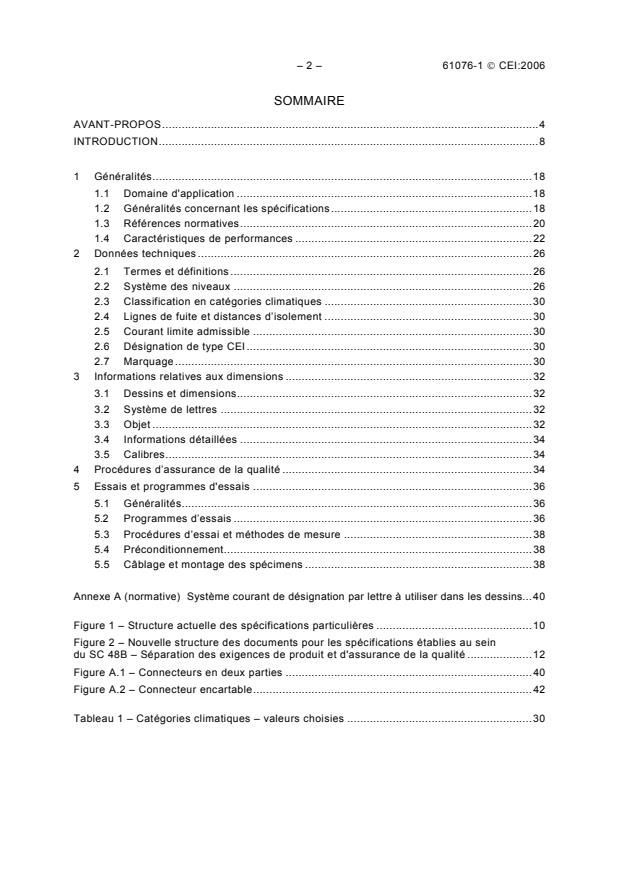
– 2 – 61076-1 CEI:2006
SOMMAIRE
AVANT-PROPOS.4
INTRODUCTION.8
1 Généralités.18
1.1 Domaine d'application .18
1.2 Généralités concernant les spécifications.18
1.3 Références normatives.20
1.4 Caractéristiques de performances .22
2 Données techniques .26
2.1 Termes et définitions .26
2.2 Système des niveaux .26
2.3 Classification en catégories climatiques .30
2.4 Lignes de fuite et distances d’isolement .30
2.5 Courant limite admissible .30
2.6 Désignation de type CEI.30
2.7 Marquage.30
3 Informations relatives aux dimensions .32
3.1 Dessins et dimensions.32
3.2 Système de lettres .32
3.3 Objet .32
3.4 Informations détaillées .34
3.5 Calibres.34
4 Procédures d’assurance de la qualité .34
5 Essais et programmes d'essais .36
5.1 Généralités.36
5.2 Programmes d’essais .36
5.3 Procédures d’essai et méthodes de mesure .38
5.4 Préconditionnement.38
5.5 Câblage et montage des spécimens .38
Annexe A (normative) Système courant de désignation par lettre à utiliser dans les dessins.40
Figure 1 – Structure actuelle des spécifications particulières .10
Figure 2 – Nouvelle structure des documents pour les spécifications établies au sein
du SC 48B – Séparation des exigences de produit et d'assurance de la qualité .12
Figure A.1 – Connecteurs en deux parties .40
Figure A.2 – Connecteur encartable.42
Tableau 1 – Catégories climatiques – valeurs choisies .30
61076-1 IEC:2006 – 3 –
CONTENTS
FOREWORD.5
INTRODUCTION.9
1 General .19
1.1 Scope.19
1.2 General considerations relating to specifications .19
1.3 Normative references .21
1.4 Performance characteristics .23
2 Technical information .27
2.1 Terms and definitions .27
2.2 System of levels .27
2.3 Classification into climatic categories .31
2.4 Clearance and creepage distances.31
2.5 Current-carrying capacity .31
2.6 IEC type designation .31
2.7 Marking .31
3 Dimensional information .33
3.1 Drawings and dimensions.33
3.2 System of lettering .33
3.3 Purpose .33
3.4 Detailed information .35
3.5 Gauges .35
4 Quality assessment procedures.35
5 Tests and test schedules .37
5.1 General aspects .37
5.2 Test schedules .37
5.3 Test procedures and measuring methods .39
5.4 Preconditioning .39
5.5 Wiring and mounting of specimens .39
Annex A (normative) Common lettering system to be used in drawings .41
Figure 1 – Actual detail specification structure .11
Figure 2 – New documentation structure for specifications drafted in SC 48B –
Separation of product and quality assessment requirements.13
Figure A.1 – Two part connectors .41
Figure A.2 – Edge-socket connector .43
Table 1 – Climatic categories – selected values.31
– 4 – 61076-1 CEI:2006
COMMISSION ÉLECTROTECHNIQUE INTERNATIONALE
___________
CONNECTEURS POUR ÉQUIPEMENTS ÉLECTRONIQUES –
EXIGENCES DE PRODUIT –
Partie 1: Spécification générique
AVANT-PROPOS
1) La Commission Electrotechnique Internationale (CEI) est une organisation mondiale de normalisation
composée de l'ensemble des comités électrotechniques nationaux (Comités nationaux de la CEI). La CEI a
pour objet de favoriser la coopération internationale pour toutes les questions de normalisation dans les
domaines de l'électricité et de l'électronique. A cet effet, la CEI – entre autres activités – publie des Normes
internationales, des Spécifications techniques, des Rapports techniques, des Spécifications accessibles au
public (PAS) et des Guides (ci-après dénommés "Publication(s) de la CEI"). Leur élaboration est confiée à des
comités d'études, aux travaux desquels tout Comité national intéressé par le sujet traité peut participer. Les
organisations internationales, gouvernementales et non gouvernementales, en liaison avec la CEI, participent
également aux travaux. La CEI collabore étroitement avec l'Organisation Internationale de Normalisation (ISO),
selon des conditions fixées par accord entre les deux organisations.
2) Les décisions ou accords officiels de la CEI concernant les questions techniques représentent, dans la mesure
du possible, un accord international sur les sujets étudiés, étant donné que les Comités nationaux de la CEI
intéressés sont représentés dans chaque comité d’études.
3) Les Publications de la CEI se présentent sous la forme de recommandations internationales et sont agréées
comme telles par les Comités nationaux de la CEI. Tous les efforts raisonnables sont entrepris afin que la CEI
s'assure de l'exactitude du contenu technique de ses publications; la CEI ne peut pas être tenue responsable
de l'éventuelle mauvaise utilisation ou interprétation qui en est faite par un quelconque utilisateur final.
4) Dans le but d'encourager l'uniformité internationale, les Comités nationaux de la CEI s'engagent, dans toute la
mesure possible, à appliquer de façon transparente les Publications de la CEI dans leurs publications
nationales et régionales. Toutes divergences entre toutes Publications de la CEI et toutes publications
nationales ou régionales correspondantes doivent être indiquées en termes clairs dans ces dernières.
5) La CEI n’a prévu aucune procédure de marquage valant indication d’approbation et n'engage pas sa
responsabilité pour les équipements déclarés conformes à une de ses Publications.
6) Tous les utilisateurs doivent s'assurer qu'ils sont en possession de la dernière édition de cette publication.
7) Aucune responsabilité ne doit être imputée à la CEI, à ses administrateurs, employés, auxiliaires ou
mandataires, y compris ses experts particuliers et les membres de ses comités d'études et des Comités
nationaux de la CEI, pour tout préjudice causé en cas de dommages corporels et matériels, ou de tout autre
dommage de quelque nature que ce soit, directe ou indirecte, ou pour supporter les coûts (y compris les frais
de justice) et les dépenses découlant de la publication ou de l'utilisation de cette Publication de la CEI ou de
toute autre Publication de la CEI, ou au crédit qui lui est accordé.
8) L'attention est attirée sur les références normatives citées dans cette publication. L'utilisation de publications
référencées est obligatoire pour une application correcte de la présente publication.
9) L’attention est attirée sur le fait que certains des éléments de la présente Publication de la CEI peuvent faire
l’objet de droits de propriété intellectuelle ou de droits analogues. La CEI ne saurait être tenue pour
responsable de ne pas avoir identifié de tels droits de propriété et de ne pas avoir signalé leur existence.
La Norme internationale CEI 61076-1 a été établie par le sous-comité 48B: Connecteurs, du
Comité d'Etudes 48 de la CEI: Composants électromécaniques et structures mécaniques pour
équipements électroniques.
Cette deuxième édition annule et remplace la première édition parue en 1995, son amende-
ment 1 (1996) et son amendement 2 (2001) dont elle constitue une révision technique. Les
modifications par rapport à l’édition précédente sont décrites dans l’introduction.
La présente norme doit être utilisée conjointement avec la CEI 62197-1:2006.
61076-1 IEC:2006 – 5 –
INTERNATIONAL ELECTROTECHNICAL COMMISSION
___________
CONNECTORS FOR ELECTRONIC EQUIPMENT –
PRODUCT REQUIREMENTS –
Part 1: Generic specification
FOREWORD
1) The International Electrotechnical Commission (IEC) is a worldwide organization for standardization comprising
all national electrotechnical committees (IEC National Committees). The object of IEC is to promote
international co-operation on all questions concerning standardization in the electrical and electronic fields. To
this end and in addition to other activities, IEC publishes International Standards, Technical Specifications,
Technical Reports, Publicly Available Specifications (PAS) and Guides (hereafter referred to as “IEC
Publication(s)”). Their preparation is entrusted to technical committees; any IEC National Committee interested
in the subject dealt with may participate in this preparatory work. International, governmental and non-
governmental organizations liaising with the IEC also participate in this preparation. IEC collaborates closely
with the International Organization for Standardization (ISO) in accordance with conditions determined by
agreement between the two organizations.
2) The formal decisions or agreements of IEC on technical matters express, as nearly as possible, an international
consensus of opinion on the relevant subjects since each technical committee has representation from all
interested IEC National Committees.
3) IEC Publications have the form of recommendations for international use and are accepted by IEC National
Committees in that sense. While all reasonable efforts are made to ensure that the technical content of IEC
Publications is accurate, IEC cannot be held responsible for the way in which they are used or for any
misinterpretation by any end user.
4) In order to promote international uniformity, IEC National Committees undertake to apply IEC Publications
transparently to the maximum extent possible in their national and regional publications. Any divergence
between any IEC Publication and the corresponding national or regional publication shall be clearly indicated in
the latter.
5) IEC provides no marking procedure to indicate its approval and cannot be rendered responsible for any
equipment declared to be in conformity with an IEC Publication.
6) All users should ensure that they have the latest edition of this publication.
7) No liability shall attach to IEC or its directors, employees, servants or agents including individual experts and
members of its technical committees and IEC National Committees for any personal injury, property damage or
other damage of any nature whatsoever, whether direct or indirect, or for costs (including legal fees) and
expenses arising out of the publication, use of, or reliance upon, this IEC Publication or any other IEC
Publications.
8) Attention is drawn to the Normative references cited in this publication. Use of the referenced publications is
indispensable for the correct application of this publication.
9) Attention is drawn to the possibility that some of the elements of this IEC Publication may be the subject of
patent rights. IEC shall not be held responsible for identifying any or all such patent rights.
International Standard IEC 61076-1 has been prepared by subcommittee 48B: Connectors, of
IEC technical committee 48: Electromechanical components and mechanical structures for
electronic equipment.
This second edition cancels and replaces the first edition issued in 1995, its amendment 1
(1996) and its amendment 2 (2001) and constitutes a technical revision. Modifications with
respect to the previous edition are described in the introduction.
This standard is to be used in conjunction with IEC 62197-1:2006.
– 6 – 61076-1 CEI:2006
Le texte de cette norme est issu des documents suivants:
FDIS Rapport de vote
48B/1621/FDIS 48B/1671/RVD
Le rapport de vote indiqué dans le tableau ci-dessus donne toute information sur le vote ayant
abouti à l'approbation de cette norme.
Cette publication a été rédigée selon les Directives ISO/CEI, Partie 2.
Le comité a décidé que le contenu de cette publication ne sera pas modifié avant la date de
maintenance indiquée sur le site web de la CEI sous «http://webstore.iec.ch» dans les
données relatives à la publication recherchée. A cette date, la publication sera
• reconduite;
• supprimée;
• remplacée par une édition révisée, ou
• amendée.
61076-1 IEC:2006 – 7 –
The text of this standard is based on the following documents:
FDIS Report on voting
48B/1621/FDIS 48B/1671/RVD
Full information on the voting for the approval of this standard can be found in the report on
voting indicated in the above table.
This publication has been drafted in accordance with the ISO/IEC Directives, Part 2.
The committee has decided that the contents of this publication will remain unchanged until
the maintenance result date indicated on the IEC web site under "http://webstore.iec.ch" in
the data related to the specific publication. At this date, the publication will be
• reconfirmed;
• withdrawn;
• replaced by a revised edition, or
• amended.
– 8 – 61076-1 CEI:2006
INTRODUCTION
Ces travaux sont destinés à mettre à jour les procédures d'assurance de la qualité des
spécifications pour connecteurs afin de prendre en compte les processus industriels
correspondant à l'état de l'art actuel.
A l'heure actuelle, toutes les spécifications particulières pour connecteurs du ressort du sous-
comité 48B de la CEI sont construites comme indiqué à la Figure 1 avec 5 chapitres
principaux.
Les procédures dépassées les plus importantes sont celles qui concernent les essais lot par
lot avec différents niveaux de contrôle et un niveau d'acceptation de la qualité et les essais
périodiques avec un nombre autorisé de défauts.
Il a été considéré comme nécessaire d'introduire l'agrément de savoir-faire et l'agrément de
technologie avec les paramètres de conception de base de la maîtrise statistique des
processus comme système de retour d'informations pour avoir un contrôle continu de la
qualité au cours des différentes étapes de la fabrication.
Il est également apparu approprié de diviser l'actuelle structure des documents en deux
structures séparées de documents qui, dans l'utilisation au quotidien des spécifications,
satisfont la plupart des utilisateurs, voir la Figure 2.
Le système de documents sera divisé en deux parties:
• Des exigences de produit
• Des exigences d'assurance de la qualité
La structure concernant la spécification de produit contient les exigences de caractéristiques,
de dimensions, de performances et les programmes d'essais.
La structure concernant les spécifications d'assurance de la qualité contient les exigences
pour obtenir l'homologation (QA) pour un niveau de performance donné (par catégorie
d'environnement), l'agrément de savoir-faire (CA) par famille de connecteurs ou l'agrément de
technologie (TA) qui comprend toutes les technologies entrant dans la production des
connecteurs.
L'agrément de savoir-faire ou l'agrément de technologie combiné aux paramètres de maîtrise
statistique des processus sont destinés à remplacer les essais lot par lot et périodiques.
Pour homologuer complètement un produit, l'utilisateur doit choisir une combinaison des deux
structures en gardant à l'esprit que, dans la maîtrise statistique des processus, les
caractéristiques clés doivent faire l'objet d'un accord entre le fabricant et l'utilisateur.
Une spécification générique de produit avec la structure à 4 niveaux comprend une
spécification générique, une spécification intermédiaire, une spécification particulière cadre et
une spécification particulière.
On peut en conclure que deux spécifications génériques sont diffusées, une pour les aspects
de produit et l'autre pour les aspects de qualité.
Les spécifications intermédiaires seront présentées au niveau du produit par famille de
connecteurs par exemple connecteurs pour cartes imprimées, connecteurs circulaires,
connecteurs rectangulaires, etc.
61076-1 IEC:2006 – 9 –
INTRODUCTION
The objective of this work is to update the quality assessment procedures of the connector
specifications to the current state of the art industrial procedures.
At the time of publication, all the connector detail specifications dealt with by subcommittee
48B of the International Electrotechnical Commission were built as described in Figure 1 with
5 major chapters.
The most significant out of date procedures relate to the lot-by-lot tests with different
inspection levels and acceptance quality level and to the periodic tests with permitted number
of defectives.
It was felt necessary to introduce the capability and the technology approval together with the
basic design parameters of statistical process control as a feed back system to have a
continuous control of the quality during the various steps of manufacture.
It was also felt appropriate to split the current documentation structure into two separate
structures of documents which, in the day to day use of specifications, satisfy most users, see
Figure 2.
The documentation system will be split into two parts:
• Product requirements
• Quality assessment requirements
The structure for the Product Specification contains characteristics, dimensions, performance
requirements and test schedules.
The structure for the quality assessment specification contains the requirements to obtain
Qualification Approval (QA) for a given performance level (per environment category),
Capability Approval (CA) per family of connectors or Technology Approval (TA) comprising all
relevant technologies for connector production.
Capability Approval or Technology Approval combined with statistical process control
parameters are intended to replace lot-by-lot and periodic tests.
To fully certify a product, a combination of the two structures will have to be selected by the
user, keeping in mind that in the statistical process control, key characteristics shall be
agreed between manufacturer and user.
A generic product specification with a 4 level structure consists of a generic, a sectional, a
blank detail and a detail specification.
From this, it can be concluded that two generic specifications are being circulated, one
document for the product aspects and a second one for the quality aspects.
The sectional specifications will be presented at the product level per family of connectors, for
example printed board connectors, circular connectors, rectangular connectors, etc.
– 10 – 61076-1 CEI:2006
Au niveau de l'assurance de la qualité, l'Annexe B de la CEI 62197-1 traite de l'homologation
en B.2, de l'agrément de savoir-faire en B.3 et de l'agrément de technologie en B.4.
Dimensions
d’interface
Programme d’essais
(= exigences de
performance) avec
différents niveaux de
performance (PL)
Programme d’essai
d’homologation
avec différents
niveaux de
performance
Essais lot par lot
avec différents
niveaux
d’assurance
Essais périodiques
avec différents
niveaux d’assurance
avec nombre de
défauts autorisé
IEC 481/06
Figure 1 – Structure actuelle des spécifications particulières
61076-1 IEC:2006 – 11 –
At the quality assessment level, Annex B of IEC 62197-1 deals with qualification approval in
B.2, capability approval in B.3 and technology approval in B.4.
Interface
dimensions
Test schedule
(= performance
requirements) with
different performance
levels (PL)
Qualification approval
test schedule
with different
performance levels
Lot-by-lot tests
with different
assessment levels
Periodic tests
with different
assessment level
with permitted no.
of defectives
IEC 481/06
Figure 1 – Actual detail specification structure
– 12 – 61076-1 CEI:2006
Spécification Spécification Spécification
particulière de produit particulière de produit particulière de produit
CEI 61076-2-1xx CEI 61076-3-1xx CEI 61076-4-1xx
CEI 61076-2-1xy CEI 61076-3-1xy CEI 61076-4-1xy
Spécification Spécification Spécification
particulière cadre particulière cadre particulière cadre
CEI 61076-2-001 CEI 61076-3-001 CEI 61076-4-001
Spécification intermédiaire Spécification intermédiaire Spécification intermédiaire de produit
de produit connecteurs de produit connecteurs connecteurs
circulaires rec tangulaires pour cartes imprimées
CEI 61076-2 CEI 61076-3 CEI 61076-4
Connecteurs pour équipements électroniques –
Spécification générique de produit – CEI 61076-1
Définitions et exigences pour:
• les caractéristiques
• les dimensions
Exigences
• les exigences de performance
produit
• programmes d'essai
Exigences
Connecteurs pour équipements électroniques –
d'assurance
Exigences d' assurance de la qualité –
de la qualité
Spécification générique de qualité – CEI 62197-1
Définitions et exigences pour:
• l'homologation
• l'agrément de savoir-faire avec Contrôle Statistique de Processus (SPC)
• l'agrément de technologie avec Contrôle Statistique de Processus (SPC)
Annexe B : Procédures d'assurance de la qualité
Article B.2 : Homologation
Article B.3 : Agrément de savoir faire
Article B.4 : Agrément de technologie
Spécification Spécification Spécification
particuliére cadre particulière cadre particulière cadre
Connecteurs circulaires Connecteurs rectangulaires pour connecteurs pour CI
CEI 62197-2-001 CEI 62197-3-001 CEI 62197-4-001
Spécification Spécification Spécification
particulière qualité particulière qualité particulière qualité
CEI 62197-2-1xx CEI 62197-3-1xx CEI 62197-4-1xx
CEI 62197-2-1xy CEI 62197-3-1xy CEI 62197-4-1xy
IEC 482/06
NOTE Les spécifications particulières et particulières cadres pour un même connecteur auront des références de
publication dont les terminaisons seront identiques dans les séries 61076 et 62197; par exemple les CEI 61076-4-
100 et 62197-4-100 seront associées au même connecteur.
Figure 2 – Nouvelle structure des documents pour les spécifications établies au sein du
SC 48B – Séparation des exigences de produit et d'assurance de la qualité
61076-1 IEC:2006 – 13 –
Detail product Detail product Detail product
specification specification specification
IEC 61076-2-1xx IEC 61076-3-1xx IEC 61076-4-1xx
IEC 61076-2-1xy IEC 61076-3-1xy IEC 61076-4-1xy
Blank detail Blank detail Blank detail
specification specification specification
IEC 61076-2-001 IEC 61076-3-001 IEC 61076-4-001
Sectional product S ectional product Sectional product
specification specification specification
circular connectors rectangular connectors printed board connectors
IEC 61076-2 IEC 61076-3 IEC 61076-4
Connectors for electronic equipment –
Generic product specification – IEC 61076-1
Definitions and requirements for:
• characteristics
• dimensions
Product
• performance requirements
requirements
• test schedules
Quality
Connectors for electronic equipment –
assessment
Quality assessment requirements –
requirements
Generic quality specification – IEC 62197-1
Definitions and requirements for:
• qualification approval
• capability approval with St atistical Process Control (SPC)
• technology approval with St atistical Process Control (SPC)
Annex B : Quality assessment procedures
Clause B.2 : Qualification approval
Clause B.3 : Capability approval
Clause B.4 : Technology approval
Blank detail Blank detail Blank detail
specification specification specification
Circular connectors Rectangular connectors Printer bord connectors
IEC 62197-2-001 IEC 62197-3-001 IEC 62197-4-001
Detail quality Detail quality Detail quality
specification specification specification
IEC 62197-2-1xx IEC 62197-3-1xx IEC 62197-4-1xx
IEC 62197-2-1xy IEC 62197-3-1xy IEC 62197-4-1xy
IEC 482/06
NOTE Detail and blank detail specifications for the same connector will have publication numbers with identical
terminations in the 61076 and 62197 series; for instance IEC 61076-4-100 and IEC 62197-4-100 are associated
with the same connector.
Figure 2 – New documentation structure for specifications drafted in SC 48B –
Separation of product and quality assessment requirements
– 14 – 61076-1 CEI:2006
éme
L'objectif de cette 2 Edition est de réviser et de mettre à jour les spécifications de
connecteurs définissant les produits et les exigences d'assurance de qualité.
Actuellement toutes les spécifications particulières de connecteurs prises en compte par le
Sous Comité 48B de la Commission Electrotechnique Internationale sont préparées tel que
décrit dans la figure 1 avec 5 chapitres principaux.
Les procédures obsolètes les plus significatives concernent les essais lot par lot ayant
différents niveaux d'exigences et niveaux d'assurance de la qualité ainsi que les essais
périodiques avec les niveaux de défauts tolérés.
Pour mettre à jour ce document afin de prendre en compte des règles plus récentes, il a été
nécessaire d'introduire les procédures d'agrément de savoir faire et de technologie incluant
les paramètres de base de conception de la maîtrise statistique des procédés afin d'avoir un
contrôle continu de la qualité pendant les différentes étapes de fabrication.
Il a également été estimé approprié de séparer la documentation en deux parties qui au cours
de l'utilisation au jour le jour des spécifications, conviennent au plus grand nombre
d'utilisateurs, comme indiqué dans la figure 2.
Ceci permet à l'utilisateur d'acquérir des produits certifiés ou non. Il est évident qu'il est
nécessaire à l'industrie d'avoir des informations séparées sur les dimensions, les exigences
de performance et les paramètres de conception de base.
Les deux documents séparés concernent:
– Les exigences de produit
– Les exigences d'assurance de la qualité
La spécification de produit contient les caractéristiques, les dimensions, les exigences de
performance, et les programmes d'essais. Le document correspondant est:
CEI 61076-1 Ed. 2
Connecteurs pour équipements électroniques – Exigences de produit
Partie 1: Spécification générique.
La spécification d'assurance de qualité contient les exigences nécessaires à l'obtention de
l'agrément d'homologation (QA) pour un niveau de qualité donné (par catégorie
d'environnement), l'Agrément de Savoir Faire (CA) par famille de connecteurs ou l' Agrément
de Technologie (TA) comprenant toutes les technologies de référence pour la production de
connecteurs.
L'agrément de savoir faire ou l'agrément de technologie combinés avec les paramètres de
maîtrise statistique de procédé sont destinés à remplacer les essais lot par lot et les essais
périodiques. Le document correspondant est:
CEI 62197-1
Connecteurs pour équipements électroniques – Exigences d'assurance de la qualité –
Partie 1: Spécification générique.
Pour spécifier un produit totalement certifié, une combinaison des spécifications issues des
deux structures doit être requise.
La structure de document à 4 niveaux adoptée par le SC 48B consiste en des spécifications
Générique, puis Intermédiaire, puis Particulière Cadre puis Particulière.
61076-1 IEC:2006 – 15 –
nd
The objective of this 2 Edition is to review and update the actual connector specifications
containing product and quality assessment requirements.
Today, all the connector detail specifications dealt with by Subcommittee 48B of the
International Electrotechnical Commission are prepared as described in figure 1 with 5 major
chapters.
The most significant out of date procedures relate to the lot-by-lot tests with different
inspection levels and acceptance quality level and to the periodic tests with permitted number
of defectives.
To update the document to reflect modern practices it was necessary to introduce the
capability and the technology approval together with the basic design parameters of statistical
process control as a feed back system to have a continuous quality control during various
steps of manufacture.
It was also felt appropriate to split the current documentation into two separate structures of
documents which, in the day-to-day use of specifications, satisfy most users, see illustration
in Figure 2.
This offers the user the option to acquire products with and without certification. It is obvious
that the industry needs to get separate information on dimensions, performance requirements
and basic design parameters.
The two separate documents are:
▪ Product requirements
▪ Quality assessment requirements
The Product Specification contains characteristics, dimensions, performance requirements
and test schedules. The relevant document is:
IEC 61076-1 (Ed. 2)
Connectors for electronic equipment – Product requirements –
Part 1: Generic Specification.
The Quality Assessment Specification contains the requirements to obtain Qualification
Approval (QA) for a given performance level (per environment category), Capability Approval
(CA) per family of connectors or Technology Approval (TA) comprising all relevant
technologies for connector production.
Capability Approval or Technology Approval combined with statistical process control
parameters are intending to replace lot-by-lot and periodic tests. The relevant document is:
IEC 62197-1
Connectors for electronic equipment – Quality assessment requirements –
Part 1: Generic Specification
To specify a fully certified product, a combination of specifications from both structures shall
be required.
The 4 level document structure adopted by SC48B consists of a Generic, a Sectional, a Blank
Detail and Detail Specifications.
– 16 – 61076-1 CEI:2006
Pour maintenir cette structure à 4 niveaux, deux Spécifications Génériques ont été diffusées,
la première concernant les aspects produit, et la seconde pour les aspects qualité.
Les Spécifications Intermédiaires seront présentées au niveau produit par famille de
connecteurs par exemple les connecteurs pour cartes imprimées, les connecteurs circulaires,
les connecteurs rectangulaires, etc. Pour les Niveaux d'Assurance Qualité l'Annexe B de la
CEI 62197-1 concerne l'Agrément d'Homologation B.2, l'Agrément de Savoir Faire B.3 et
L'Agrément de Technologie B.4.
61076-1 IEC:2006 – 17 –
To maintain this 4 level structure, two Generic Specifications are being circulated, one
document for the product aspects and a second one for the quality aspects.
The Sectional Specifications will be presented at the product level per family of connectors
e.g. printed board connectors, circular connectors, rectangular connectors, etc.
At the quality assessment level Annex B of IEC 62197-1 is dealing with Qualification Approval
B.2, Capability Approval B.3 and Technology Approval B.4.
– 18 – 61076-1 CEI:2006
CONNECTEURS POUR ÉQUIPEMENTS ÉLECTRONIQUES –
EXIGENCES DE PRODUIT –
Partie 1: Spécification générique
1 Généralités
1.1 Domaine d'application
La présente partie de la CEI 61076 établit des spécifications et des caractéristiques
techniques uniformes pour les connecteurs.
La présente partie de la CEI 61076 est applicable à une famille de connecteurs destinés à
être utilisés dans des équipements électriques et électroniques; elle ne couvre pas les
connecteurs conçus pour être utilisés aux fréquences radioélectriques.
1.2 Généralités concernant les spécifications
La présente partie de la CEI 61076 contient ou cite en référence, les termes, les définitions,
les symboles, les programmes d'essai et les informations concernant les connecteurs.
Elle doit être utilisée conjointement avec le guide CEI 109 qui présente comme nécessaire la
réduction de l'impact d'un produit sur son environnement naturel tout au long de son cycle
de vie.
Il est entendu que certains matériaux autorisés par la présente spécification et dans les
processus de fabrication et d'assemblage peuvent avoir un impact négatif sur l'environ-
nement. Au fur et à mesure que les avancées technologiques aboutissent à des alternatives
acceptables à ces matériaux, ceux-ci doivent être éliminés de la présente spécification. Il
convient que les processus de fabrication inappropriés soient remplacés par une conception
du produit qui offre une maintenabilité et un démontage aisés.
En cas de divergence entre la présente partie de la CEI 61076 et la spécification
intermédiaire de produit, ce sont les exigences de la spécification intermédiaire qui prévalent.
1.2.1 Spécifications intermédiaires de produit
Tous les détails appropriés pour une sous-famille de connecteurs donnée sont fournis dans la
spécification intermédiaire de produit applicable: par exemple, connecteurs pour cartes
imprimées, connecteurs circulaires, connecteurs rectangulaires et autres dispositifs de
connexion.
Elle doit contenir une sélection de toutes les méthodes et séquences d'essais, des niveaux de
sévérité et des valeurs préférentielles concernant les dimensions et les caractéristiques
applicables à la sous-famille concernée.
Son contenu doit être dérivé de la CEI 61076-1.
En cas de divergence entre une spécification intermédiaire de produit et la sp
...
IEC 61076-1 ®
Edition 2.1 2019-01
CONSOLIDATED VERSION
INTERNATIONAL
STANDARD
NORME
INTERNATIONALE
colour
inside
Connectors for electronic equipment – Product requirements –
Part 1: Generic specification
Connecteurs pour équipements électroniques – Exigences de produit –
Partie 1: Spécification générique
All rights reserved. Unless otherwise specified, no part of this publication may be reproduced or utilized in any form
or by any means, electronic or mechanical, including photocopying and microfilm, without permission in writing from
either IEC or IEC's member National Committee in the country of the requester. If you have any questions about IEC
copyright or have an enquiry about obtaining additional rights to this publication, please contact the address below or
your local IEC member National Committee for further information.
Droits de reproduction réservés. Sauf indication contraire, aucune partie de cette publication ne peut être reproduite
ni utilisée sous quelque forme que ce soit et par aucun procédé, électronique ou mécanique, y compris la photocopie
et les microfilms, sans l'accord écrit de l'IEC ou du Comité national de l'IEC du pays du demandeur. Si vous avez des
questions sur le copyright de l'IEC ou si vous désirez obtenir des droits supplémentaires sur cette publication, utilisez
les coordonnées ci-après ou contactez le Comité national de l'IEC de votre pays de résidence.
IEC Central Office Tel.: +41 22 919 02 11
3, rue de Varembé info@iec.ch
CH-1211 Geneva 20 www.iec.ch
Switzerland
About the IEC
The International Electrotechnical Commission (IEC) is the leading global organization that prepares and publishes
International Standards for all electrical, electronic and related technologies.
About IEC publications
The technical content of IEC publications is kept under constant review by the IEC. Please make sure that you have the
latest edition, a corrigendum or an amendment might have been published.
IEC publications search - webstore.iec.ch/advsearchform Electropedia - www.electropedia.org
The advanced search enables to find IEC publications by a The world's leading online dictionary on electrotechnology,
variety of criteria (reference number, text, technical containing more than 22 000 terminological entries in English
committee,…). It also gives information on projects, replaced and French, with equivalent terms in 16 additional languages.
and withdrawn publications. Also known as the International Electrotechnical Vocabulary
(IEV) online.
IEC Just Published - webstore.iec.ch/justpublished
Stay up to date on all new IEC publications. Just Published IEC Glossary - std.iec.ch/glossary
details all new publications released. Available online and 67 000 electrotechnical terminology entries in English and
once a month by email. French extracted from the Terms and Definitions clause of
IEC publications issued since 2002. Some entries have been
IEC Customer Service Centre - webstore.iec.ch/csc collected from earlier publications of IEC TC 37, 77, 86 and
If you wish to give us your feedback on this publication or CISPR.
need further assistance, please contact the Customer Service
Centre: sales@iec.ch.
A propos de l'IEC
La Commission Electrotechnique Internationale (IEC) est la première organisation mondiale qui élabore et publie des
Normes internationales pour tout ce qui a trait à l'électricité, à l'électronique et aux technologies apparentées.
A propos des publications IEC
Le contenu technique des publications IEC est constamment revu. Veuillez vous assurer que vous possédez l’édition la
plus récente, un corrigendum ou amendement peut avoir été publié.
Recherche de publications IEC - Electropedia - www.electropedia.org
webstore.iec.ch/advsearchform Le premier dictionnaire d'électrotechnologie en ligne au
La recherche avancée permet de trouver des publications IEC monde, avec plus de 22 000 articles terminologiques en
en utilisant différents critères (numéro de référence, texte, anglais et en français, ainsi que les termes équivalents dans
comité d’études,…). Elle donne aussi des informations sur les 16 langues additionnelles. Egalement appelé Vocabulaire
projets et les publications remplacées ou retirées. Electrotechnique International (IEV) en ligne.
IEC Just Published - webstore.iec.ch/justpublished Glossaire IEC - std.iec.ch/glossary
Restez informé sur les nouvelles publications IEC. Just 67 000 entrées terminologiques électrotechniques, en anglais
Published détaille les nouvelles publications parues. et en français, extraites des articles Termes et Définitions des
Disponible en ligne et une fois par mois par email. publications IEC parues depuis 2002. Plus certaines entrées
antérieures extraites des publications des CE 37, 77, 86 et
Service Clients - webstore.iec.ch/csc CISPR de l'IEC.
Si vous désirez nous donner des commentaires sur cette
publication ou si vous avez des questions contactez-nous:
sales@iec.ch.
IEC 61076-1 ®
Edition 2.1 2019-01
CONSOLIDATED VERSION
INTERNATIONAL
STANDARD
NORME
INTERNATIONALE
colour
inside
Connectors for electronic equipment – Product requirements –
Part 1: Generic specification
Connecteurs pour équipements électroniques – Exigences de produit –
Partie 1: Spécification générique
INTERNATIONAL
ELECTROTECHNICAL
COMMISSION
COMMISSION
ELECTROTECHNIQUE
INTERNATIONALE
ICS 31.220.10 ISBN 978-2-8322-6424-9
IEC 61076-1 ®
Edition 2.1 2019-01
CONSOLIDATED VERSION
REDLINE VERSION
VERSION REDLINE
colour
inside
Connectors for electronic equipment – Product requirements –
Part 1: Generic specification
Connecteurs pour équipements électroniques – Exigences de produit –
Partie 1: Spécification générique
– 2 – IEC 61076-1:2006+AMD1:2019 CSV
IEC 2019
CONTENTS
FOREWORD . 4
INTRODUCTION . 6
1 General . 11
1.1 Scope . 11
1.2 General considerations relating to specifications . 11
1.2.1 Sectional product specifications. 11
1.2.2 Blank detail product specification . 12
1.2.3 Detail product specifications . 12
1.3 Normative references . 12
1.4 Performance characteristics . 13
1.4.1 General . 13
1.4.2 Operating environment . 14
1.4.3 Electrical characteristics . 14
1.4.4 Mechanical characteristics . 14
1.4.5 Compatibility. 14
2 Technical information . 15
2.1 Terms and definitions . 15
2.2 System of levels . 17
2.2.1 General . 17
2.2.2 Performance levels . 17
2.2.3 Compatibility levels. 17
2.3 Classification into climatic categories . 18
2.4 Clearance and creepage distances . 18
2.5 Current-carrying capacity . 18
2.6 IEC type designation . 18
2.7 Marking . 19
2.7.1 On the connector . 19
2.7.2 On the package . 19
3 Dimensional information . 19
3.1 Drawings and dimensions . 19
3.2 System of lettering . 19
3.3 Purpose . 19
3.4 Detailed information . 20
3.5 Gauges . 20
4 Quality assessment procedures . 20
5 Tests and test schedules . 21
5.1 General aspects . 21
5.2 Test schedules . 21
5.3 Test procedures and measuring methods . 22
5.4 Preconditioning . 22
5.5 Wiring and mounting of specimens . 22
Annex A (normative) Common lettering system to be used in drawings . 23
Annex B (normative) Levels of compatibility . 25
Bibliography . 29
IEC 2019
Figure 1 – Actual detail specification structure . 7
Figure 2 – New documentation structure for specifications drafted in SC 48B –
Separation of product and quality assessment requirements . 8
Figure A.1 – Two part connectors . 23
Figure A.2 – Edge-socket connector . 24
Table 1 – Climatic categories – selected values . 18
b) c) b)
Table B.1 – Levels of compatibility and required parameters . 26
– 4 – IEC 61076-1:2006+AMD1:2019 CSV
IEC 2019
INTERNATIONAL ELECTROTECHNICAL COMMISSION
___________
CONNECTORS FOR ELECTRONIC EQUIPMENT –
PRODUCT REQUIREMENTS –
Part 1: Generic specification
FOREWORD
1) The International Electrotechnical Commission (IEC) is a worldwide organization for standardization comprising
all national electrotechnical committees (IEC National Committees). The object of IEC is to promote
international co-operation on all questions concerning standardization in the electrical and electronic fields. To
this end and in addition to other activities, IEC publishes International Standards, Technical Specifications,
Technical Reports, Publicly Available Specifications (PAS) and Guides (hereafter referred to as “IEC
Publication(s)”). Their preparation is entrusted to technical committees; any IEC National Committee interested
in the subject dealt with may participate in this preparatory work. International, governmental and non-
governmental organizations liaising with the IEC also participate in this preparation. IEC collaborates closely
with the International Organization for Standardization (ISO) in accordance with conditions determined by
agreement between the two organizations.
2) The formal decisions or agreements of IEC on technical matters express, as nearly as possible, an international
consensus of opinion on the relevant subjects since each technical committee has representation from all
interested IEC National Committees.
3) IEC Publications have the form of recommendations for international use and are accepted by IEC National
Committees in that sense. While all reasonable efforts are made to ensure that the technical content of IEC
Publications is accurate, IEC cannot be held responsible for the way in which they are used or for any
misinterpretation by any end user.
4) In order to promote international uniformity, IEC National Committees undertake to apply IEC Publications
transparently to the maximum extent possible in their national and regional publications. Any divergence
between any IEC Publication and the corresponding national or regional publication shall be clearly indicated in
the latter.
5) IEC itself does not provide any attestation of conformity. Independent certification bodies provide conformity
assessment services and, in some areas, access to IEC marks of conformity. IEC is not responsible for any
services carried out by independent certification bodies.
6) All users should ensure that they have the latest edition of this publication.
7) No liability shall attach to IEC or its directors, employees, servants or agents including individual experts and
members of its technical committees and IEC National Committees for any personal injury, property damage or
other damage of any nature whatsoever, whether direct or indirect, or for costs (including legal fees) and
expenses arising out of the publication, use of, or reliance upon, this IEC Publication or any other IEC
Publications.
8) Attention is drawn to the Normative references cited in this publication. Use of the referenced publications is
indispensable for the correct application of this publication.
9) Attention is drawn to the possibility that some of the elements of this IEC Publication may be the subject of
patent rights. IEC shall not be held responsible for identifying any or all such patent rights.
This consolidated version of the official IEC Standard and its amendment has been prepared
for user convenience.
IEC 61076-1 edition 2.1 contains the second edition (2006-04) [documents 48B/1621/FDIS and
48B/1671/RVD] and its amendment 1 (2019-01) [documents 48B/2678/FDIS and 48B/2691/RVD].
In this Redline version, a vertical line in the margin shows where the technical content is
modified by amendment 1. Additions are in green text, deletions are in strikethrough red text.
A separate Final version with all changes accepted is available in this publication.
IEC 2019
International Standard IEC 61076-1 has been prepared by subcommittee 48B: Connectors, of
IEC technical committee 48: Electromechanical components and mechanical structures for
electronic equipment.
This second edition constitutes a technical revision. Modifications with respect to the previous
edition are described in the introduction.
This standard is to be used in conjunction with IEC 62197-1:2006.
This publication has been drafted in accordance with the ISO/IEC Directives, Part 2.
The committee has decided that the contents of the base publication and its amendment will
remain unchanged until the stability date indicated on the IEC web site under
"http://webstore.iec.ch" in the data related to the specific publication. At this date, the
publication will be
• reconfirmed,
• withdrawn,
• replaced by a revised edition, or
• amended.
IMPORTANT – The 'colour inside' logo on the cover page of this publication indicates
that it contains colours which are considered to be useful for the correct
understanding of its contents. Users should therefore print this document using a
colour printer.
– 6 – IEC 61076-1:2006+AMD1:2019 CSV
IEC 2019
INTRODUCTION
The objective of this work is to update the quality assessment procedures of the connector
specifications to the current state of the art industrial procedures.
At the time of publication, all the connector detail specifications dealt with by subcommittee
48B of the International Electrotechnical Commission were built as described in Figure 1 with
5 major chapters.
The most significant out of date procedures relate to the lot-by-lot tests with different
inspection levels and acceptance quality level and to the periodic tests with permitted number
of defectives.
It was felt necessary to introduce the capability and the technology approval together with the
basic design parameters of statistical process control as a feed back system to have a
continuous control of the quality during the various steps of manufacture.
It was also felt appropriate to split the current documentation structure into two separate
structures of documents which, in the day to day use of specifications, satisfy most users, see
Figure 2.
The documentation system will be split into two parts:
• Product requirements
• Quality assessment requirements
The structure for the Product Specification contains characteristics, dimensions, performance
requirements and test schedules.
The structure for the quality assessment specification contains the requirements to obtain
Qualification Approval (QA) for a given performance level (per environment category),
Capability Approval (CA) per family of connectors or Technology Approval (TA) comprising all
relevant technologies for connector production.
Capability Approval or Technology Approval combined with statistical process control
parameters are intended to replace lot-by-lot and periodic tests.
To fully certify a product, a combination of the two structures will have to be selected by the
user, keeping in mind that in the statistical process control, key characteristics shall be
agreed between manufacturer and user.
A generic product specification with a 4 level structure consists of a generic, a sectional, a
blank detail and a detail specification.
From this, it can be concluded that two generic specifications are being circulated, one
document for the product aspects and a second one for the quality aspects.
The sectional specifications will be presented at the product level per family of connectors, for
example printed board connectors, circular connectors, rectangular connectors, etc.
IEC 2019
At the quality assessment level, Annex B of IEC 62197-1 deals with qualification approval in
B.2, capability approval in B.3 and technology approval in B.4.
Interface
dimensions
Test schedule
(= performance
requirements) with
different performance
levels (PL)
Qualification approval
test schedule
with different
performance levels
Lot-by-lot tests
with different
assessment levels
Periodic tests
with different
assessment level
with permitted no.
of defectives
IEC 481/06
Figure 1 – Actual detail specification structure
– 8 – IEC 61076-1:2006+AMD1:2019 CSV
IEC 2019
Detail product Detail product Detail product
specification specification specification
IEC 61076-2-1xx IEC 61076-3-1xx IEC 61076-4-1xx
IEC 61076-2-1xy IEC 61076-3-1xy IEC 61076-4-1xy
Blank detail Blank detail Blank detail
specification specification specification
IEC 61076-2-001 IEC 61076-3-001 IEC 61076-4-001
Sectional product S ectional product Sectional product
specification specification specification
circular connectors rectangular connectors printed board connectors
IEC 61076-2 IEC 61076-3 IEC 61076-4
Connectors for electronic equipment –
Generic product specification – IEC 61076-1
Definitions and requirements for:
• characteristics
• dimensions
Product
• performance requirements
requirements
• test schedules
Quality
Connectors for electronic equipment –
assessment
Quality assessment requirements –
requirements
Generic quality specification – IEC 62197-1
Definitions and requirements for:
• qualification approval
• capability approval with St atistical Process Control (SPC)
• technology approval with Statistical Process Control (SPC)
Annex B : Quality assessment procedures
Clause B.2 : Qualification appr oval
Clause B.3 : Capability approval
Clause B.4 : Technology approval
Blank detail Blank detail Blank detail
specification specification specification
Circular connectors Rectangular connectors Printer bord connectors
IEC 62197-2-001 IEC 62197-3-001 IEC 62197-4-001
Detail quality Detail quality Detail quality
specification specification specification
IEC 62197-2-1xx IEC 62197-3-1xx IEC 62197-4-1xx
IEC 62197-2-1xy IEC 62197-3-1xy IEC 62197-4-1xy
IEC 482/06
NOTE Detail and blank detail specifications for the same connector will have publication numbers with identical
terminations in the 61076 and 62197 series; for instance IEC 61076-4-100 and IEC 62197-4-100 are associated
with the same connector.
Figure 2 – New documentation structure for specifications drafted in SC 48B –
Separation of product and quality assessment requirements
IEC 2019
nd
The objective of this 2 Edition is to review and update the actual connector specifications
containing product and quality assessment requirements.
Today, all the connector detail specifications dealt with by Subcommittee 48B of the
International Electrotechnical Commission are prepared as described in figure 1 with 5 major
chapters.
The most significant out of date procedures relate to the lot-by-lot tests with different
inspection levels and acceptance quality level and to the periodic tests with permitted number
of defectives.
To update the document to reflect modern practices it was necessary to introduce the
capability and the technology approval together with the basic design parameters of statistical
process control as a feed back system to have a continuous quality control during various
steps of manufacture.
It was also felt appropriate to split the current documentation into two separate structures of
documents which, in the day-to-day use of specifications, satisfy most users, see illustration
in Figure 2.
This offers the user the option to acquire products with and without certification. It is obvious
that the industry needs to get separate information on dimensions, performance requirements
and basic design parameters.
The two separate documents are:
▪ Product requirements
▪ Quality assessment requirements
The Product Specification contains characteristics, dimensions, performance requirements
and test schedules. The relevant document is:
IEC 61076-1 (Ed. 2)
Connectors for electronic equipment – Product requirements –
Part 1: Generic Specification.
The Quality Assessment Specification contains the requirements to obtain Qualification
Approval (QA) for a given performance level (per environment category), Capability Approval
(CA) per family of connectors or Technology Approval (TA) comprising all relevant
technologies for connector production.
Capability Approval or Technology Approval combined with statistical process control
parameters are intending to replace lot-by-lot and periodic tests. The relevant document is:
IEC 62197-1
Connectors for electronic equipment – Quality assessment requirements –
Part 1: Generic Specification
To specify a fully certified product, a combination of specifications from both structures shall
be required.
The 4 level document structure adopted by SC48B consists of a Generic, a Sectional, a Blank
Detail and Detail Specifications.
To maintain this 4 level structure, two Generic Specifications are being circulated, one
document for the product aspects and a second one for the quality aspects.
– 10 – IEC 61076-1:2006+AMD1:2019 CSV
IEC 2019
The Sectional Specifications will be presented at the product level per family of connectors
e.g. printed board connectors, circular connectors, rectangular connectors, etc.
At the quality assessment level Annex B of IEC 62197-1 is dealing with Qualification Approval
B.2, Capability Approval B.3 and Technology Approval B.4.
IEC 2019
CONNECTORS FOR ELECTRONIC EQUIPMENT –
PRODUCT REQUIREMENTS –
Part 1: Generic specification
1 General
1.1 Scope
This part of IEC 61076 establishes uniform specifications and technical information for
connectors.
This part of IEC 61076 is applicable to a family of connectors for use in electronic and
electrical equipment; connectors designed for use at radio frequencies are not covered.
1.2 General considerations relating to specifications
This part of IEC 61076 contains, or gives reference to, the terms, definitions, symbols, test
schedules and information relating to connectors.
It shall be used in conjunction with IEC Guide 109 that advocates the need to minimise the
impact of a product on the natural environment throughout the product life cycle.
It is understood that some materials permitted by this specification and in manufacturing and
assembly processes may have a negative environmental impact. As technological advantages
lead to acceptable alternatives for these materials, they shall be eliminated from this
specification. Inappropriate manufacturing processes should be replaced by a product design
that features easy maintainability and disassembly.
In the event of conflict between this part of IEC 61076 and the sectional product specification,
the requirements of the sectional product specification prevail.
1.2.1 Sectional product specifications
All details appropriate to a particular subfamily of connectors are contained in the relevant
sectional product specification, for example printed board, circular, rectangular connectors
and other connecting devices.
It shall contain a choice of all test methods and sequences, severities and preferred values
for dimensions and characteristics, which could be applicable to that subfamily.
The contents shall be derived from IEC 61076-1.
In the event of conflict between a Sectional Product Specification and the Detail Product
Specification, the requirements of the Detail Product Specification shall prevail.
– 12 – IEC 61076-1:2006+AMD1:2019 CSV
IEC 2019
nd
The following 2 editions of sectional product specifications are under consideration:
IEC 61076-2: Circular connectors;
IEC 61076-3: Rectangular connectors;
IEC 61076-4: Printed board connectors;
IEC 61076-5: In-line socket devices;
IEC 61076-6: Loose-part contacts;
IEC 61076-7: Accessories.
1.2.2 Blank detail product specification
Guidance to prepare the appropriate detail product specifications shall be given in a blank
detail specification, prescribing the layout to be adopted and the information to be given, thus
ensuring a uniform presentation.
Its contents shall be derived from IEC 61076-1 or sectional product specification and shall list
a selection of the technical criteria necessary and sufficient to verify the design parameters of
the subject connector subfamily.
Blank detail product specifications encompass the following parts:
IEC 61076-2-001: Circular connectors;
IEC 61076-3-001: Rectangular connectors;
IEC 61076-4-001: Printed board connectors;
IEC 61076-5-001: In-line socket devices;
IEC 61076-6-001: Loose-part contacts;
IEC 61076-7-001: Accessories.
1.2.3 Detail product specifications
Detail Product Specifications shall give directly, or by making reference to other normative
documents, all information necessary to describe a given connector or range of connectors
completely.
Their contents shall be derived from IEC 61076-1 or sectional product specification and shall
list a selection of the technical criteria necessary and sufficient to verify the design
parameters of the subject connector type, and shall be considered complete and sufficient for
control purposes.
1.3 Normative references
The following referenced documents are indispensable for the application of this document.
For dated references, only the edition cited applies. For undated references, the latest edition
of the referenced document (including any amendments) applies.
IEC 60050(581):1978, International Electrotechnical Vocabulary (IEV) – Chapter 581:
Electromechanical components for electronic equipment
IEC 60068-1:1988, Environmental testing – Part 1: General and guidance
IEC 60512 (all parts), Connectors for electronic equipment – Tests and measurements
IEC 2019
IEC 60664-1:1992, Insulation coordination for equipment within low-voltage systems – Part 1:
Principles, requirements and tests
Amendment 1 (2000)
Amendment 2 (2002)
IEC 62197-1:2006, Connectors for electronic equipment – Quality assessment requirements –
Part 1: Generic specification
IEC 62225:2001, Guidance on terms for connectors and mechanical structures in electronic
equipment
IEC Guide 109:2003, Environmental aspects – Inclusion in electrotechnical product standards
ISO 129-1:2004, Technical drawings – Indication of dimensions and tolerances – Part 1:
General principles
ISO 286-1:1988, ISO system of limits and fits – Part 1: Bases of tolerances, deviations and
fits
ISO 286-2:1988, ISO system of limits and fits – Part 2: Tables of standard tolerance grades
and limit deviations for holes and shafts
ISO 1000:1992, SI units and recommendations for use of their multiples and of certain other
units
ISO 1101:2004, Technical drawings – Geometrical tolerancing – Tolerancing of form,
orientation,location and run-out – Generalities, definitions, symbols, indications on drawings
ISO 1302:2002, Geometrical Product Specifications (GPS) – Indication of surface texture in
technical product documentation
1.4 Performance characteristics
1.4.1 General
Performance characteristics reflect the environmental and mechanical stresses to which a
connector is designed and also features such as long-term stability of electrical
characteristics. It is based on:
– the environmental conditions.
They also permit the following additions to be stated which may result in different
performance level (a variation in one or more of these factors will result in a different
performance level):
– electrical characteristics;
– mechanical characteristics;
– compatibility.
Further characteristics specified in addition to those that are mandatory:
– test schedule;
– severities of test conditions;
– end-of-test conditions;
– different (closer) tolerances on characteristics;
– different severities for environmental testing.
For information on performance levels, see 2.2.2.
– 14 – IEC 61076-1:2006+AMD1:2019 CSV
IEC 2019
1.4.2 Operating environment
This covers definition and values for the following parameters:
– temperature and temperature ranges;
– humidity and damp heat, steady state;
– low air pressure;
– fluid immersion and resistance;
– corrosion by industrial atmosphere (concentration of polluting gasses or salt spray
endurance).
1.4.3 Electrical characteristics
This covers definition and values of the following parameters:
– clearance and creepage distances;
– voltage proof;
– current-carrying capacity;
– contact resistance;
– insulation resistance;
– transmission characteristics.
1.4.4 Mechanical characteristics
This covers definition and values of the following parameters:
– mechanical operation;
– engaging and separating forces;
– functionality of contact retaining systems;
– capability for keying and/or polarisation;
– axial static load;
– mechanical shock and vibration.
1.4.5 Compatibility
Compatibility comprises specification of intermountability, intermateability and/or interchange-
ability as detailed in 2.2.3 to guarantee compliance with requirements of mated connector
pairs, of which the individual connectors are supplied by different sources.
Compatibility comprises specification of intermountability, intermateability and/or
interchangeability, as well as of interoperability and backward compatibility, where applicable,
as detailed in 2.2.3 and in Annex B (normative) to guarantee compliance with requirements of
mated connector pairs, of which the individual connectors are supplied by different sources.
Examples of such parameters are:
– contact design;
– shape and dimension of mechanical interface;
– material specifications;
– retention information of loose-part or removable contacts;
– locking device;
– mounting information.
IEC 2019
NOTE Additional compatibility requirements may be defined in the product detail specification to fulfil compliance
with automatic mounting, assembling and solder/solderless termination tools.
2 Technical information
2.1 Terms and definitions
For the purposes of this document, the terms and definitions given in IEC 60050(581) and
IEC 62225, as well as the following, apply.
2.1.1
family
connector
2.1.2
subfamily
group of connectors recognizable by their basic shape or intended application i.e.
– circular connectors;
– rectangular connectors;
– printed board connectors;
– in-line sockets devices.
2.1.3
type
connectors within a particular sub-family, such as edge-socket connectors for printed boards
or two-part connectors for printed boards
2.1.4
style
particular connector within a type
2.1.5
variant
variations within a type and style, or within a group of related connectors
EXAMPLES:
Family: connectors.
Subfamily: connectors for printed boards.
Type: two-part connector for printed boards.
Style: a particular configuration, for example flange mounting.
Variant: number of contacts, polarisation, termination, etc.
NOTE For the following definitions, reference is made to IEC 60664-1:
– Clearance;
– Creepage distance;
– Rated voltage;
– Working voltage.
2.1.6
interoperability
interoperability of different IEC 61076-1 connectors and of IEC 61076-1 connectors with
connectors of other families (e.g. IEC 60603-7 series) is ensured by compliance with the
specified interface dimensions, when they have the same number of contacts, the same
electrical wiring-related dimensions and when the lowest electrical, mechanical and climatic
performance (performance level) among the two connectors is suitable for the intended
application
– 16 – IEC 61076-1:2006+AMD1:2019 CSV
IEC 2019
SEE: Clause B.5.
2.1.7
number of contacts
number of contacts (or ways) that a connector owns, including the protective and/or functional
earth contact(s), if any
Note 1 to entry: A connector for removable contacts is characterized by its number of contact positions (seats): its
number of contacts (ways) may be lower than the number of contact positions (seats).
Note 2 to entry: The same number of contacts does not grants the same electrical interface: the geometry of said
contacts may be different while their number is the same.
2.1.8
overall dimensions
dimensions providing the overall space occupied by a connector
Note 1 to entry: Two connectors of the same gender may have the same overall dimensions but different
mounting dimensions and/or different interface dimensions
2.1.9
interface dimensions
set of dimensions required to fully describe the connector’s mating interface, belonging to
both the connector insert and to the relevant electric contacts
Note 1 to entry: Interface dimensions enable the proper functioning of a mated set of connectors according to the
relevant product detail specification or manufacturer’s detail specification.
Note 2 to entry: Two connectors with same interface dimensions have the same number of contact seats (or
positions), whereas they may not show the same number of contacts (ways).
2.1.10
mounting dimensions
dimensions enabling the mounting of a connector
Note 1 to entry: Examples of mounting dimensions are panel cutout size, size and interaxes of fixing holes or
threads.
Note 2 to entry: The geometry of the mounting interface of Printed Circuit Board connectors to the PCB belongs
to the mounting dimensions: two Printed Circuit Board connectors of the same gender with the same mounting
dimensions share the same pattern and pitch of their contacts.
Note 3 to entry: Two connectors not of the Printed Circuit Board type of the same gender with the same mounting
dimensions may have different interface dimensions.
Note 4 to entry: Two connectors of the same gender with the same mounting dimensions may have different
overall dimensions.
2.1.11
electrical wiring-related dimensions
dimensions related to the wiring of the connector, i.e. to its number and type of contacts
(ways)
Note 1 to entry: Two connectors of the same gender with the same electrical wiring-related dimensions have the
same number of contacts (ways) or contact positions (seats), the same dimensions of these contacts or contact
positions, the same overall dimensions, the same interface dimensions, and if they are Printed Circuit Board
connectors, the same mounting dimensions.
2.1.12
electrical, mechanical and climatic performances
levels of electrical, mechanical and climatic performance assigned to a connector in the
relevant product detail specification or manufacturer’s detail specification, therein verified
through dedicated groups of tests
Note 1 to entry: The electrical performance includes signal integrity.
IEC 2019
2.2 System of levels
2.2.1 General
The term level is used in the following different meanings and should clearly be distinguished.
All details of the levels and their combinations shall be specified in the detail specification.
A detail product specification may contain more than one performance level and compatibility
level.
2.2.2 Performance levels
The term performance level reflects the grouping of the environmental and mechanical
stresses at which a component is tested, and also such features as long-term stability of
electrical characteristics. These levels are numbered, where the lowest number (1) usually
indicates the highest performance.
2.2.3 Compatibility levels
2.2.3.1 General
As a function of the standardisation degree, 4 levels characterize the compatibility of
connectors from different sources. These levels are defined in 2.2.3.2 to 2.2.3.5 and shall,
when appropriate, be indicated in the detail product specification of connectors.
NOTE If connectors of different compatibility levels are mated, the lower level prevails.
2.2.3.2 Level 1 – Intermountable
This level standardizes only overall dimensions and mounting dimensions on printed board or
panel cut-out and cable termination assembly. Connectors from different sources are not
necessarily intermateable.
Information required in a detail specification in order to satisfy to this level is:
For printed board connectors:
– printed board layout;
– board distances and orientation (parallel or perpendicular);
– panel cut-out and location, if applicable.
For free cable connector, cable termination assembly characteristics shall be specified.
2.2.3.3 Level 2 – Intermateable
This level standardizes only dimensions of electrical and mechanical interfaces.
Electrical, mechanical and climatic performances of connectors from different sources, when
mated, are not fully guaranteed.
2.2.3.4 Level 3 – Intermateable and intermountable
This level standardizes mounting dimensions, electrical and mechanical interface and overall
dimensions.
Electrical, mechanical and climatic performances of connectors, from different sources, when
mated, are not fully guaranteed.
– 18 – IEC 61076-1:2006+AMD1:2019 CSV
IEC 2019
2.2.3.5 Level 4 – Interchangeable
This level standardizes all the elements guaranteeing compliance of the electrical, mechanical
and climatic performances of mated connector when individual connectors halves are from
different sources.
NOTE The complexity of demonstrating interchangeability at level 4 may be substantial and therefore should be
evaluated prior to the level being specified.
2.3 Classification into climatic categories
Connectors are classified into climatic categories in accordance with the general rules given
in IEC 60068-1.
Preferred temperature ranges and severities of the damp heat, steady state tests have been
selected, see Table 1. Any combination of these elements may be used, and should be written
in the format: for example 10/070/04, in the applicable sectional and detail product
specifications.
Table 1 – Climatic categories – selected values
Lower temperature Upper temperature Damp heat, steady state
°C °C Days
–10 70 4
–25 85 10
–40 100 21
–55 125 56
–65 155
2.4 Clearance and creepage distances
Permissible working or rated voltages depend on the application and on the applicable or
specified safety requirements.
Therefore, clearance and creepage distances as well as proof voltages under specified air
pressure shall be specified in the detail product specification.
Guidance is provided in IEC 60664-1.
2.5 Current-carrying capacity
For each connector, the current-carrying capacity shall be specified in the detail product
specification, preferably by the de-rating curve determined in accordance with test 5b of
IEC 60512.
2.6 IEC type designation
Connectors to which this specification applies shall be designated as specified in the relevant
sectional product specification.
IEC 2019
2.7 Marking
2.7.1 On the connector
Each connector shall have the identification of the contact positions marked upon it as
indicated in the det
...
Questions, Comments and Discussion
Ask us and Technical Secretary will try to provide an answer. You can facilitate discussion about the standard in here.
Loading comments...