


IEC 62788-2-1:2023
(Main)Measurement procedures for materials used in photovoltaic modules - Part 2-1: Polymeric materials - Frontsheet and backsheet - Safety requirements
Measurement procedures for materials used in photovoltaic modules - Part 2-1: Polymeric materials - Frontsheet and backsheet - Safety requirements
IEC 62788-2-1:2023 specifies the safety requirements for flexible polymeric front- and backsheet constructions, which are intended for use as relied-upon insulation in photovoltaic (PV) modules. The specifications in this document define the specific requirements of polymeric front- or backsheet constructions on the component level and cover mechanical, electrical, visual and thermal characterization in an unexposed state and/or after ageing.
This document covers class II and class 0 modules, as defined in IEC 61730-1. Class III modules are out of scope. This document provides the requirements for qualification of front- and backsheets to be used in module safety qualification according to IEC 61730-1. Test method descriptions are provided in IEC TS 62788-2, along with additional characterization methods useful for performance or quality assurance.
Procédures de mesure des matériaux utilisés dans les modules photovoltaïques - Partie 2-1: Matériaux polymères - Face avant et face arrière - Exigences de sécurité
IEC 62788-2-1:2023 spécifie les exigences de sécurité pour les constructions souples de faces avant et de faces arrière polymères, prévues pour être utilisées comme isolation attendue dans les modules photovoltaïques (PV). Les spécifications du présent document définissent les exigences spécifiques des constructions des faces avant ou arrière polymères au niveau des composants et couvrent la caractérisation mécanique, électrique, visuelle et thermique des faces avant et arrière à l'état non exposé et/ou après vieillissement.
Le présent document couvre les modules de classe II et de classe 0 définis dans l'IEC 61730‑1. Les modules de classe III sont hors du domaine d'application.
Le présent document fournit les exigences de qualification des faces avant et arrière à utiliser pour la qualification pour la sûreté de fonctionnement du module conformément à l'IEC 61730‑1. Les descriptions des méthodes d'essai sont données dans l'IEC TS 62788-2, ainsi que des méthodes de caractérisation supplémentaires utiles pour assurer les performances ou la qualité.
General Information
- Status
- Published
- Publication Date
- 24-Aug-2023
- Technical Committee
- TC 82 - Solar photovoltaic energy systems
- Drafting Committee
- WG 2 - TC 82/WG 2
- Current Stage
- PPUB - Publication issued
- Start Date
- 25-Aug-2023
- Completion Date
- 26-May-2023
Overview
IEC 62788-2-1:2023 is an international standard developed by the International Electrotechnical Commission (IEC) that specifies safety requirements for flexible polymeric frontsheet and backsheet materials used in photovoltaic (PV) modules. This part of the IEC 62788 series focuses exclusively on polymeric materials intended to serve as relied-upon insulation components in PV modules. The standard addresses the component-level specifications and ensures comprehensive mechanical, electrical, visual, and thermal characterization of frontsheet and backsheet materials both in their unexposed state and after ageing.
This standard applies to class II and class 0 PV modules as defined by IEC 61730-1, excluding class III modules. It is crucial for manufacturers, quality assurance teams, and certification bodies involved in PV module safety qualification. The document also references additional test methods found in IEC TS 62788-2, aiding in performance evaluation and quality assurance.
Key Topics
- Scope and Application: Specifies safety requirements for polymeric frontsheet and backsheet used in PV modules, emphasizing insulation properties to ensure module safety according to IEC 61730-1.
- Material Characterization: Covers evaluation of mechanical strength, electrical insulation, thermal endurance, and visual inspection in unaged and aged states.
- Insulation Coordination: Defines breakdown voltage requirements for complete sheets and individual layers, as well as creepage distance and distance through insulation requirements.
- Testing Procedures: Details test methods for tensile properties, breakdown voltage, thermal endurance, and accelerated ageing such as damp heat and UV exposure.
- Design and Ratings: Includes guidance on single-layer and multilayer constructions, model and variant designations.
- Evaluation and Reporting: Establishes formats for evaluation reports, visual inspections, and documentation for materials variants across color and thickness changes.
- Quality Assurance: Aids manufacturers in meeting strict qualification needs for frontsheet and backsheet materials to enhance module reliability and safety.
Applications
IEC 62788-2-1:2023 is essential for multiple stakeholders in the photovoltaic industry:
- PV Module Manufacturers: Ensures front and backsheet materials meet safety and performance standards, aiding in the reliable production of class 0 and class II PV modules.
- Material Suppliers: Provides clear requirements for polymeric materials to be used as frontsheet or backsheet, supporting product development and certification.
- Testing Laboratories: Supplies standardized measurement procedures to verify mechanical, electrical, and thermal properties of polymer components.
- Certifiers and Regulators: Facilitates compliance assessment during module safety qualification consistent with IEC 61730-1.
- Quality Control Teams: Enables robust characterization and accelerated ageing assessments to predict long-term durability and product lifecycle performance.
By following the standard, stakeholders can ensure photovoltaic modules feature safe and reliable polymeric insulation, critical for long-term operation and electrical safety.
Related Standards
- IEC 61730-1: Safety Qualification of PV Modules – Part 1: Requirements for Design Qualification and Type Approval, defining safety classes and module safety criteria.
- IEC TS 62788-2: Provides complementary test methods for additional characterization including performance and quality assurance of PV module materials.
- IEC 62788 Series: Comprehensive measurement procedures for materials used in photovoltaic modules encompassing different material types and aspects.
Summary
IEC 62788-2-1:2023 delivers authoritative guidance and safety requirements for polymeric frontsheet and backsheet materials utilized in photovoltaic modules. This standard enhances module safety by defining rigorous test methods and acceptance criteria for electrical insulation, mechanical durability, and thermal endurance. It supports manufacturers, suppliers, and certification bodies in ensuring compliance with global PV module safety standards and promoting the reliability and sustainability of solar energy systems worldwide.
Buy Documents
IEC 62788-2-1:2023 - Measurement procedures for materials used in photovoltaic modules - Part 2-1: Polymeric materials - Frontsheet and backsheet - Safety requirements Released:8/25/2023
Get Certified
Connect with accredited certification bodies for this standard

DNV
DNV is an independent assurance and risk management provider.

Lloyd's Register
Lloyd's Register is a global professional services organisation specialising in engineering and technology.
DNV Energy Systems
Energy and renewable energy certification.
Sponsored listings
Frequently Asked Questions
IEC 62788-2-1:2023 is a standard published by the International Electrotechnical Commission (IEC). Its full title is "Measurement procedures for materials used in photovoltaic modules - Part 2-1: Polymeric materials - Frontsheet and backsheet - Safety requirements". This standard covers: IEC 62788-2-1:2023 specifies the safety requirements for flexible polymeric front- and backsheet constructions, which are intended for use as relied-upon insulation in photovoltaic (PV) modules. The specifications in this document define the specific requirements of polymeric front- or backsheet constructions on the component level and cover mechanical, electrical, visual and thermal characterization in an unexposed state and/or after ageing. This document covers class II and class 0 modules, as defined in IEC 61730-1. Class III modules are out of scope. This document provides the requirements for qualification of front- and backsheets to be used in module safety qualification according to IEC 61730-1. Test method descriptions are provided in IEC TS 62788-2, along with additional characterization methods useful for performance or quality assurance.
IEC 62788-2-1:2023 specifies the safety requirements for flexible polymeric front- and backsheet constructions, which are intended for use as relied-upon insulation in photovoltaic (PV) modules. The specifications in this document define the specific requirements of polymeric front- or backsheet constructions on the component level and cover mechanical, electrical, visual and thermal characterization in an unexposed state and/or after ageing. This document covers class II and class 0 modules, as defined in IEC 61730-1. Class III modules are out of scope. This document provides the requirements for qualification of front- and backsheets to be used in module safety qualification according to IEC 61730-1. Test method descriptions are provided in IEC TS 62788-2, along with additional characterization methods useful for performance or quality assurance.
IEC 62788-2-1:2023 is classified under the following ICS (International Classification for Standards) categories: 27.160 - Solar energy engineering. The ICS classification helps identify the subject area and facilitates finding related standards.
IEC 62788-2-1:2023 is available in PDF format for immediate download after purchase. The document can be added to your cart and obtained through the secure checkout process. Digital delivery ensures instant access to the complete standard document.
Standards Content (Sample)
IEC 62788-2-1 ®
Edition 1.0 2023-08
INTERNATIONAL
STANDARD
NORME
INTERNATIONALE
colour
inside
Measurement procedures for materials used in photovoltaic modules –
Part 2-1: Polymeric materials – Frontsheet and backsheet – Safety requirements
Procédures de mesure des matériaux utilisés dans les modules photovoltaïques –
Partie 2-1: Matériaux polymères – Face avant et face arrière – Exigences de
sécurité
All rights reserved. Unless otherwise specified, no part of this publication may be reproduced or utilized in any form
or by any means, electronic or mechanical, including photocopying and microfilm, without permission in writing from
either IEC or IEC's member National Committee in the country of the requester. If you have any questions about IEC
copyright or have an enquiry about obtaining additional rights to this publication, please contact the address below or
your local IEC member National Committee for further information.
Droits de reproduction réservés. Sauf indication contraire, aucune partie de cette publication ne peut être reproduite ni
utilisée sous quelque forme que ce soit et par aucun procédé, électronique ou mécanique, y compris la photocopie et
les microfilms, sans l'accord écrit de l'IEC ou du Comité national de l'IEC du pays du demandeur. Si vous avez des
questions sur le copyright de l'IEC ou si vous désirez obtenir des droits supplémentaires sur cette publication, utilisez
les coordonnées ci-après ou contactez le Comité national de l'IEC de votre pays de résidence.
IEC Secretariat Tel.: +41 22 919 02 11
3, rue de Varembé info@iec.ch
CH-1211 Geneva 20 www.iec.ch
Switzerland
About the IEC
The International Electrotechnical Commission (IEC) is the leading global organization that prepares and publishes
International Standards for all electrical, electronic and related technologies.
About IEC publications
The technical content of IEC publications is kept under constant review by the IEC. Please make sure that you have the
latest edition, a corrigendum or an amendment might have been published.
IEC publications search - webstore.iec.ch/advsearchform IEC Products & Services Portal - products.iec.ch
The advanced search enables to find IEC publications by a Discover our powerful search engine and read freely all the
variety of criteria (reference number, text, technical publications previews. With a subscription you will always have
committee, …). It also gives information on projects, replaced access to up to date content tailored to your needs.
and withdrawn publications.
Electropedia - www.electropedia.org
IEC Just Published - webstore.iec.ch/justpublished
The world's leading online dictionary on electrotechnology,
Stay up to date on all new IEC publications. Just Published
containing more than 22 300 terminological entries in English
details all new publications released. Available online and once
and French, with equivalent terms in 19 additional languages.
a month by email.
Also known as the International Electrotechnical Vocabulary
(IEV) online.
IEC Customer Service Centre - webstore.iec.ch/csc
If you wish to give us your feedback on this publication or need
further assistance, please contact the Customer Service
Centre: sales@iec.ch.
A propos de l'IEC
La Commission Electrotechnique Internationale (IEC) est la première organisation mondiale qui élabore et publie des
Normes internationales pour tout ce qui a trait à l'électricité, à l'électronique et aux technologies apparentées.
A propos des publications IEC
Le contenu technique des publications IEC est constamment revu. Veuillez vous assurer que vous possédez l’édition la
plus récente, un corrigendum ou amendement peut avoir été publié.
Recherche de publications IEC - IEC Products & Services Portal - products.iec.ch
webstore.iec.ch/advsearchform Découvrez notre puissant moteur de recherche et consultez
La recherche avancée permet de trouver des publications IEC gratuitement tous les aperçus des publications. Avec un
en utilisant différents critères (numéro de référence, texte, abonnement, vous aurez toujours accès à un contenu à jour
comité d’études, …). Elle donne aussi des informations sur les adapté à vos besoins.
projets et les publications remplacées ou retirées.
Electropedia - www.electropedia.org
IEC Just Published - webstore.iec.ch/justpublished
Le premier dictionnaire d'électrotechnologie en ligne au monde,
Restez informé sur les nouvelles publications IEC. Just
avec plus de 22 300 articles terminologiques en anglais et en
Published détaille les nouvelles publications parues.
français, ainsi que les termes équivalents dans 19 langues
Disponible en ligne et une fois par mois par email.
additionnelles. Egalement appelé Vocabulaire
Electrotechnique International (IEV) en ligne.
Service Clients - webstore.iec.ch/csc
Si vous désirez nous donner des commentaires sur cette
publication ou si vous avez des questions contactez-nous:
sales@iec.ch.
IEC 62788-2-1 ®
Edition 1.0 2023-08
INTERNATIONAL
STANDARD
NORME
INTERNATIONALE
colour
inside
Measurement procedures for materials used in photovoltaic modules –
Part 2-1: Polymeric materials – Frontsheet and backsheet – Safety requirements
Procédures de mesure des matériaux utilisés dans les modules photovoltaïques –
Partie 2-1: Matériaux polymères – Face avant et face arrière – Exigences de
sécurité
INTERNATIONAL
ELECTROTECHNICAL
COMMISSION
COMMISSION
ELECTROTECHNIQUE
INTERNATIONALE
ICS 27.160 ISBN 978-2-8322-6887-2
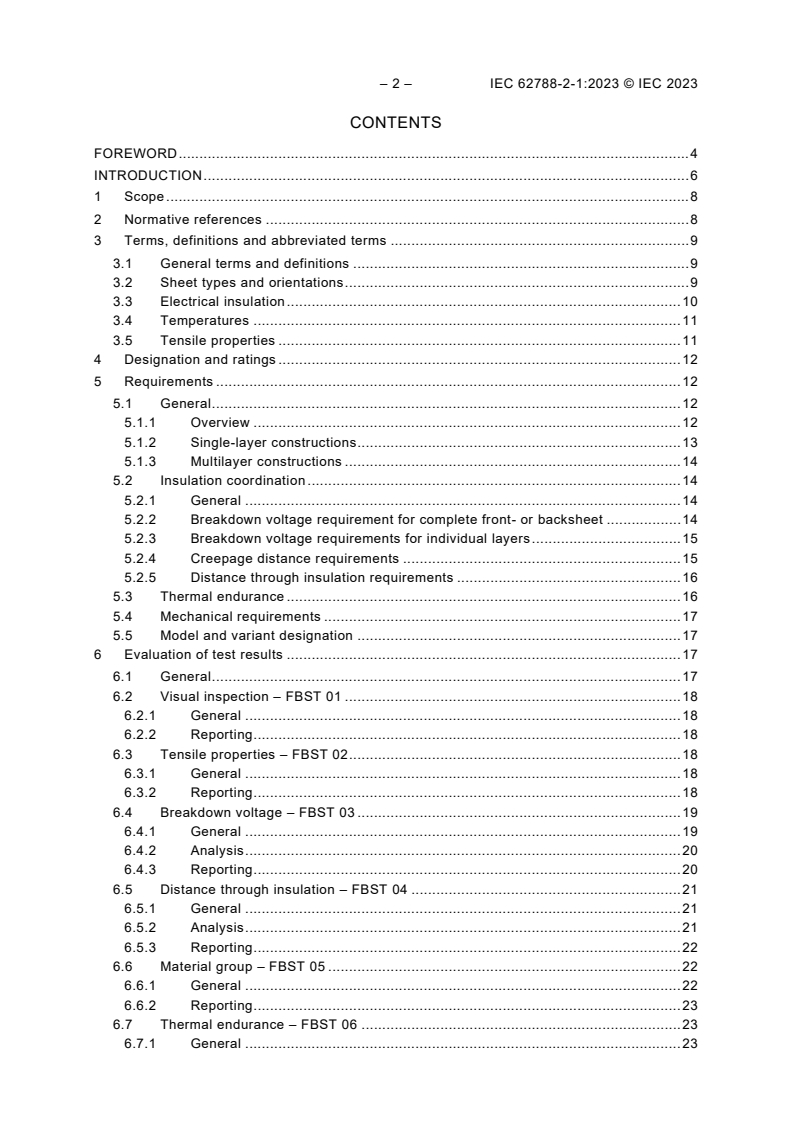
– 2 – IEC 62788-2-1:2023 © IEC 2023
CONTENTS
FOREWORD . 4
INTRODUCTION . 6
1 Scope . 8
2 Normative references . 8
3 Terms, definitions and abbreviated terms . 9
3.1 General terms and definitions . 9
3.2 Sheet types and orientations . 9
3.3 Electrical insulation . 10
3.4 Temperatures . 11
3.5 Tensile properties . 11
4 Designation and ratings . 12
5 Requirements . 12
5.1 General . 12
5.1.1 Overview . 12
5.1.2 Single-layer constructions . 13
5.1.3 Multilayer constructions . 14
5.2 Insulation coordination . 14
5.2.1 General . 14
5.2.2 Breakdown voltage requirement for complete front- or backsheet . 14
5.2.3 Breakdown voltage requirements for individual layers . 15
5.2.4 Creepage distance requirements . 15
5.2.5 Distance through insulation requirements . 16
5.3 Thermal endurance . 16
5.4 Mechanical requirements . 17
5.5 Model and variant designation . 17
6 Evaluation of test results . 17
6.1 General . 17
6.2 Visual inspection – FBST 01 . 18
6.2.1 General . 18
6.2.2 Reporting . 18
6.3 Tensile properties – FBST 02 . 18
6.3.1 General . 18
6.3.2 Reporting . 18
6.4 Breakdown voltage – FBST 03 . 19
6.4.1 General . 19
6.4.2 Analysis . 20
6.4.3 Reporting . 20
6.5 Distance through insulation – FBST 04 . 21
6.5.1 General . 21
6.5.2 Analysis . 21
6.5.3 Reporting . 22
6.6 Material group – FBST 05 . 22
6.6.1 General . 22
6.6.2 Reporting . 23
6.7 Thermal endurance – FBST 06 . 23
6.7.1 General . 23
6.7.2 Reporting . 23
6.8 Accelerated ageing tests . 23
6.8.1 Damp heat – FBST 07 . 23
6.8.2 UV weathering – FBST 08 . 23
6.8.3 Reporting . 24
6.9 Overview tables . 25
7 Evaluation report . 26
7.1 Report. 26
8 Documentation and testing for similar materials . 26
8.1 General . 26
8.2 Alternate constituent layers . 27
8.3 Thickness variants . 27
8.4 Color variants . 27
8.5 Reporting for similar materials with different color or thickness . 28
Annex A (informative) Chemical analytical material identification . 30
A.1 General . 30
A.2 Examples of fingerprint techniques . 30
Bibliography . 31
Figure 1 – Schematic diagrams of typical constructions of front- or backsheets . 13
Figure 2 – Examples of calculations for determination of DTI ratio and adjusted
breakdown voltage . 20
Figure 3 – Determining distance through insulation from lamination protrusion test as a
function of temperature rating . 22
Figure 4 – Schematic of lamination protrusion test result for determining which
surfaces will be evaluated for minimum creepage distance in the IEC 61730 module
design review . 23
Table 1 – Minimum breakdown voltage requirements for basic and double/reinforced
insulation before and after accelerated aging . 15
Table 2 – Minimum distance through insulation requirements. 16
Table 3 – UV exposure conditions . 24
Table 4 – Evaluations and requirements overview for individual layers . 25
Table 5 – Evaluations and requirements overview for complete front- and/or
backsheets . 25
– 4 – IEC 62788-2-1:2023 © IEC 2023
INTERNATIONAL ELECTROTECHNICAL COMMISSION
____________
MEASUREMENT PROCEDURES FOR MATERIALS
USED IN PHOTOVOLTAIC MODULES –
Part 2-1: Polymeric materials –
Frontsheet and backsheet – Safety requirements
FOREWORD
1) The International Electrotechnical Commission (IEC) is a worldwide organization for standardization comprising
all national electrotechnical committees (IEC National Committees). The object of IEC is to promote international
co-operation on all questions concerning standardization in the electrical and electronic fields. To this end and
in addition to other activities, IEC publishes International Standards, Technical Specifications, Technical Reports,
Publicly Available Specifications (PAS) and Guides (hereafter referred to as “IEC Publication(s)”). Their
preparation is entrusted to technical committees; any IEC National Committee interested in the subject dealt with
may participate in this preparatory work. International, governmental and non-governmental organizations liaising
with the IEC also participate in this preparation. IEC collaborates closely with the International Organization for
Standardization (ISO) in accordance with conditions determined by agreement between the two organizations.
2) The formal decisions or agreements of IEC on technical matters express, as nearly as possible, an international
consensus of opinion on the relevant subjects because each technical committee has representation from all
interested IEC National Committees.
3) IEC Publications have the form of recommendations for international use and are accepted by IEC National
Committees in that sense. While all reasonable efforts are made to ensure that the technical content of IEC
Publications is accurate, IEC cannot be held responsible for the way in which they are used or for any
misinterpretation by any end user.
4) In order to promote international uniformity, IEC National Committees undertake to apply IEC Publications
transparently to the maximum extent possible in their national and regional publications. Any divergence between
any IEC Publication and the corresponding national or regional publication shall be clearly indicated in the latter.
5) IEC itself does not provide any attestation of conformity. Independent certification bodies provide conformity
assessment services and, in some areas, access to IEC marks of conformity. IEC is not responsible for any
services carried out by independent certification bodies.
6) All users should ensure that they have the latest edition of this publication.
7) No liability shall attach to IEC or its directors, employees, servants or agents including individual experts and
members of its technical committees and IEC National Committees for any personal injury, property damage or
other damage of any nature whatsoever, whether direct or indirect, or for costs (including legal fees) and
expenses arising out of the publication, use of, or reliance upon, this IEC Publication or any other IEC
Publications.
8) Attention is drawn to the Normative references cited in this publication. Use of the referenced publications is
indispensable for the correct application of this publication.
9) Attention is drawn to the possibility that some of the elements of this IEC Publication may be the subject of patent
rights. IEC shall not be held responsible for identifying any or all such patent rights.
IEC 62788-2-1 has been prepared by IEC technical committee 82: Solar photovoltaic energy
systems. It is an International Standard.
The text of this International Standard is based on the following documents:
Draft Report on voting
82/2123/FDIS 82/2148/RVD
Full information on the voting for its approval can be found in the report on voting indicated in
the above table.
The language used for the development of this International Standard is English.
This document was drafted in accordance with ISO/IEC Directives, Part 2, and developed in
accordance with ISO/IEC Directives, Part 1 and ISO/IEC Directives, IEC Supplement, available
at www.iec.ch/members_experts/refdocs. The main document types developed by IEC are
described in greater detail at www.iec.ch/standardsdev/publications.
A list of all parts in the IEC 62788 series, published under the general title Measurement
procedures for materials used in photovoltaic modules, can be found on the IEC website.
The committee has decided that the contents of this document will remain unchanged until the
stability date indicated on the IEC website under webstore.iec.ch in the data related to the
specific document. At this date, the document will be
• reconfirmed,
• withdrawn,
• replaced by a revised edition, or
• amended.
IMPORTANT – The "colour inside" logo on the cover page of this document indicates that it
contains colours which are considered to be useful for the correct understanding of its
contents. Users should therefore print this document using a colour printer.
– 6 – IEC 62788-2-1:2023 © IEC 2023
INTRODUCTION
This document provides test procedures and specifications for polymeric front- and backsheet
constructions employed in a PV module for safety qualification on a component level. Test
methods have been compiled to match the general requirements for polymeric materials used
as relied-upon insulation defined in the IEC 61730 standard series in consideration of test
methods in IEC TS 62788-2 (characterization of front- and backsheets), IEC TS 62788-7-2
[4] (UV weathering test) and the retesting guidelines IEC TS 62915. This document provides
clarifications on definitions of front- and backsheet construction types and related test
requirements, and additional environmental stress testing, to which IEC 61730-1 refers.
Separating out the component level testing into this document was considered to limit the
complexity of the IEC 61730 standard series, also in view of the implementation of the test
methods in the frame of IEC System of Conformity Assessment Schemes for Electrotechnical
Equipment and Components (IECEE).
Test methods on a component level and PV module level are different for practical reasons. On
a component level, the daylight filtered xenon test (IEC TS 62788-7-2) is applied for UV
weathering, which is regarded as more representative to assess the durability of polymeric
materials under outdoor weather conditions than the UVA test of IEC 61215-2. The latter has
been developed in view of practicality of applying UV exposure to larger scale PV modules.
This document focusses on the safety relevant properties of front- and backsheets as required
by IEC 61730.
The lamination protrusion test (aka DTI test) is required to measure the thickness of relied-upon
insulation on the component level. The thickness of the RUI layer(s) is verified by MST 04 of
IEC 61730-2 on PV module level. The test provides additional information needed for evaluation
of the Comparative Tracking Index (CTI) and dielectric strength / breakdown voltage.
– The lamination protrusion test applies default lamination conditions, that are representative
for a typical PV module manufacturing process. Using a 800 µm diameter solder wire that
mimics severe solder peaks and/or slanted ribbons, the test serves as worst case scenario
for measurement of potential displacement of material under lamination conditions. Even
more harsh lamination process conditions can be selected as recommended by the
manufacturer of the front- or backsheet.
– The lamination protrusion test is also used to identify additional inner layers of the front- or
backsheet that potentially may be in contact with live parts and for which CTI shall be
determined. Additional layers may require CTI depending on the construction of the PV
module, e.g., due to specific sheet openings and through wiring for junction box connections
with background provided in IEC 61730-1.
– The ratio of the measured distance through insulation (t ) to the total thickness is used to
DTI
calculate the effective dielectric strength or required withstand voltage when measured on
final products that contain inner layers, which can be displaced under lamination conditions
(see breakdown voltage test in 6.4).
– Because of the relationship with thermal endurance, t can be listed as a function of the
DTI
module operating temperature rating.
___________
Numbers in square brackets refer to the Bibliography.
This document specifies a suite of environmental stress tests to characterize the durability of
the relied-upon insulation. In the evaluation of tensile testing a minimum elongation at break is
considered in addition to retention of tensile strength, as this allows to differentiate known-bad
and known-good materials. The thermal endurance performance, which is historically evaluated
by tensile strength and dielectric strength in terms of TI or RTE (RTI), is therefore
complemented by a thermal failsafe test to also evaluate elongation at break. The combination
of these elements, tests covering thermal, damp heat and UV weathering stresses and
evaluation of elongation at break, represents a step forward in safety testing of polymeric front-
and backsheets that is still balanced in terms or practicality (duration) of testing.
The requirements in this document for model or variant designations and (re)testing of similar
materials have been aligned with developments for the IEC TS 62915 module retesting
guidelines. The current requirements provide a first step towards more detailed requirements
which may be developed in a future revision of this document or a dedicated component
retesting standard.
A future revision of this document may consider sequential testing on engineering coupons with
(solder wire) bumps to better mimic the combination of UV and cyclic stress fatigue, that is
currently discussed as the next level in endurance testing of polymeric front- and backsheets
in IEC TS 62788-2 and IEC TS 63209-2[6]. However, method consolidation requires more time
than available for this project.
In view of requirements for material identification in the context of the retesting guidelines
(IEC TS 62915), approaches for “finger-printing” are provided in Annex A.
The requirements in this document may be used in the context of Manufacturing Quality
Assurance of polymeric front- and backsheets as explained in the guideline IEC 62941[5].
– 8 – IEC 62788-2-1:2023 © IEC 2023
MEASUREMENT PROCEDURES FOR MATERIALS
USED IN PHOTOVOLTAIC MODULES –
Part 2-1: Polymeric materials –
Frontsheet and backsheet – Safety requirements
1 Scope
This document specifies the safety requirements for flexible polymeric front- and backsheet
constructions, which are intended for use as relied-upon insulation in photovoltaic (PV)
modules. The specifications in this document define the specific requirements of polymeric
front- or backsheet constructions on the component level and cover mechanical, electrical,
visual and thermal characterization in an unexposed state and/or after ageing.
This document covers class II and class 0 modules, as defined in IEC 61730-1. Class III
modules are out of scope.
For qualification to IEC 61730-1 of a PV module using a polymeric front- or backsheet, the sheet
must pass the requirements in this document for the specified module’s safety class, rated
system voltage, and module temperature rating.
Compliance with the safety requirements for a front- or backsheet on the component level does
not replace the need for a safety qualification of the complete PV module, in which the front- or
backsheet is integrated. The appropriate requirements for testing and qualification of PV
modules, are defined in IEC 61730-1 and IEC 61215-1 (or IEC TS 62915 in case of retesting),
with test methods provided by IEC 61730-2 and IEC 61215-2, respectively.
This document provides the requirements for qualification of front- and backsheets to be used
in module safety qualification according to IEC 61730-1. Test method descriptions are provided
in IEC TS 62788-2, along with additional characterization methods useful for performance or
quality assurance.
2 Normative references
The following documents are referred to in the text in such a way that some or all of their content
constitutes requirements of this document. For dated references, only the edition cited applies.
For undated references, the latest edition of the referenced document (including any
amendments) applies.
IEC 60216-1, Electrical insulating materials – Thermal endurance properties – Part 1: Ageing
procedures and evaluation of test results
IEC 60216-3, Electrical insulating materials – Thermal endurance properties – Part 3:
Instructions for calculating thermal endurance characteristics
IEC 60216-5, Electrical insulating materials – Thermal endurance properties – Part 5:
Determination of relative temperature index (RTI) of an insulating material
IEC 60664-1, Insulation coordination for equipment within low-voltage supply systems – Part 1:
Principles, requirements and tests
IEC 61215-1, Terrestrial photovoltaic (PV) modules – Design qualification and type approval –
Part 1: Test requirements
IEC 61215-2, Terrestrial photovoltaic (PV) modules – Design qualification and type approval –
Part 2: Test procedures
IEC 61730-1, Photovoltaic (PV) module safety qualification – Part 1: Requirements for
construction
IEC 61730-2, Photovoltaic (PV) module safety qualification – Part 2: Requirements for testing
IEC TS 61836, Solar photovoltaic energy systems – Terms, definitions and symbols
IEC TS 62788-2, Measurement procedures for materials used in photovoltaic modules – Part 2:
Polymeric materials – Frontsheets and backsheets
IEC TS 62915, Photovoltaic (PV) modules – Type approval, design and safety qualification –
Retesting
IEC TS 63126:2020, Guidelines for qualifying PV modules, components and materials for
operation at high temperatures
ISO 527-3, Plastics – Determination of tensile properties – Part 3: Test conditions for films and
sheets
3 Terms, definitions and abbreviated terms
For the purposes of this document, the following terms and definitions apply, in addition to those
in IEC TS 61836 and IEC TS 62788-2.
ISO and IEC maintain terminological databases for use in standardization at the following
addresses:
• IEC Electropedia: available at http://www.electropedia.org/
• ISO Online browsing platform: available at http://www.iso.org/obp
3.1 General terms and definitions
3.1.1
FBST
front- or backsheet safety test in accordance with IEC 62788-2-1
3.1.2
tolerance
permitted deviation between the declared value of a quantity and the measured value
[SOURCE: IEC 60050-411[2]:1996,411-36-19]
3.2 Sheet types and orientations
3.2.1
air-side
side of the front- or backsheet oriented towards the outside of the PV module, i.e., away from
the cells
3.2.2
backsheet
(combination of) outer layer(s) of the PV module, located as substrate on the back of the PV
module and providing protection of the inner components of the PV module from external
stresses and weather elements, as well as providing electrical insulation
– 10 – IEC 62788-2-1:2023 © IEC 2023
3.2.3
frontsheet
(combination of) outer layer(s) of the PV module designed for prolonged exposure to direct
sunlight (> 300 W/m ) and providing protection of the inner components of the PV module from
external stresses and weather elements, as well as providing electrical insulation
3.2.4
inner side
side of the front- or backsheet that is oriented to the solar cells, typically laminated to the
encapsulant
3.2.5
machine direction
MD
direction along which the material layer was extruded or produced, extending out of a die or
other manufacturing equipment in a production line
3.2.6
transverse direction
TD
direction perpendicular to which the material layer was extruded or produced
3.2.7
sun-facing side
side of the front- or backsheet that is oriented in direction of the sun-facing front side of the PV
module
Note 1 to entry: Sun-facing sides are the air-side of a frontsheet and inner side of a backsheet.
3.3 Electrical insulation
3.3.1
breakdown voltage
V
BD
DC voltage at which electric breakdown occurs under prescribed test conditions, or in use
Note 1 to entry: Breakdown voltage testing in context of PV modules and components materials applies direct
current (DC).
[SOURCE: IEC 60050-212[1]:2010, 212-11-34, modified – added symbol, and added Note 1 to
entry.]
3.3.2
comparative tracking index
CTI
numerical index value related to the maximum voltage that a material can withstand without
formation of a permanent and electrically conductive carbon (tracking) path and without a
persistent flame occurring, when evaluated under specified test conditions defined in IEC 60112
Note 1 to entry: The mentioned maximum test voltage is not in conjunction with any system or operational voltage,
but it is used for evaluation of material groups.
[SOURCE: IEC 60050-212:2010, 212-11-59, modified – it has been rephrased by also clarifying
that CTI is an index value to evaluate material groups according to IEC 60112. Note 1 to entry
added.]
3.3.3
distance through insulation
t
DTI
thickness of relied-upon insulation (RUI) after the lamination protrusion test, with the minimum
allowable value defined by the rated system voltage
3.3.4
material group
category of insulation materials according to IEC 60664-1 as defined by the results of the CTI
test
3.3.5
rated system voltage
�𝑉𝑉 �
sys
max
maximum system voltage for which a module is rated
3.3.6
relied-upon insulation
RUI
solid insulation system providing protection against electric shock in the final application, with
material’s requirements for thermal endurance and resistance against environmental stress
factors
Note 1 to entry: Thin films used as polymeric front- or backsheet can consist of RUI plus additional layers that have
other functions, e.g., they protect the polymeric materials from UV radiation (see Figure 1).
3.3.7
withstand voltage
V
w
DC voltage which the material under test can withstand for a defined minimum amount of time
without occurrence of an electric breakdown
3.4 Temperatures
3.4.1
th
percentile module operating temperature
T
temperature at which a module is operating below more than 98 % of the time when deployed
in a PV system
th
Note 1 to entry: The 98 -percentile temperature is calculated by ranking measured or calculated module
temperature data taken at hourly (or more frequent) time intervals for a typical calendar year.
th
Note 2 to entry: For a standard year, the 98 percentile temperature is met or exceeded for 175,2 h.
3.4.2
rated module operating temperature
[T ]
98 max
th
maximum allowed 98 percentile operating temperature (T ) of the PV module
3.5 Tensile properties
3.5.1
elongation at break
ε
B
strain at which the specimen under test breaks
Note 1 to entry: Break defines the point in the tensile test, where the tensile stress drops below 50 % of its highest
value.
– 12 – IEC 62788-2-1:2023 © IEC 2023
3.5.2
tensile strength at break
𝜎𝜎
B
maximum engineering stress measured when a specimen is elongated in tension to the point of
breaking
4 Designation and ratings
The front- or backsheet shall be evaluated for its intended use in a PV module, including
designation as front- or backsheet, maximum module operating temperature, maximum system
voltage and module safety class. Due to the coordinating requirements for temperature and
system voltage ratings, a front- or backsheet may be rated for multiple sets of ratings (e.g.
maximum V and T ).
sys 98
Frontsheets are designed for prolonged exposure to direct sunlight (> 300 W/m ). Backsheets
are designed for exposure through glass and encapsulant on the interior side and restricted for
use with indirect or limited direct sunlight (< 300 W/m ) on the exterior side. Because of this,
the test conditions for the UV weathering test (FBST 09) are different for front- and backsheets.
A product can be assigned as a frontsheet, backsheet or both.
A front- or backsheet is rated for a maximum T module operating temperature. The module
operating temperature is related to a combination of environment and mounting conditions as
described in IEC 61730-1 and IEC TS 63126:
th
– IEC 61730-1 (by default) specifies PV modules with 98 percentile operating
temperatures T ≤ 70 °C.
– IEC TS 63126 defines extended test conditions for high temperature operation with T
≤ 80 °C [level 1] or ≤ 90 °C [level 2]. The requirements for the thermal endurance test
(FBST 06) depend on the specified [T ] . IEC 62788-2-1 deviates from
98 max
IEC TS 63126:2020, in that the UV weathering temperature conditions applied in the UV
weathering test (FBST 08) shall be as specified in Table 3.
NOTE IEC TS 63126:2020 is currently under consideration for modification and will likely be changed to conform
with this document.
In addition, a front- or backsheet is rated for a maximum system voltage and a module safety
class. IEC 61730-1 defines PV module safety class and system voltage ratings. Front- and
backsheets can be used in modules of safety class II (individual and/or system level electrical
outputs at hazardous levels of voltage, current and power) and safety class 0 (intended for use
in restricted access areas that are protected from public access by fences or other measures
of the location that prevent general access).
5 Requirements
5.1 General
5.1.1 Overview
Requirements for front- and backsheets are derived from insulation coordination requirements
from IEC 60664 and IEC 61730-1, and additional requirements for long term reliability based
on observations of field failures.
Requirements shall be met for the full front- or backsheet and also for individual layers
designated as RUI (from here referred to as RUI layers). Typical constructions are described in
Figure 1.
a) Single-layer
a1) homogeneous layer a2) combined layers (e.g. co-extrusion)
a2-i) polymeric composition a2-ii) polymeric composition
differs by ≤ 10 % differs by > 10 %
b) Multilayer
b2) laminated multilayer
b1-i) coated multilayer with RUI coating
b3) multilayer with
with non-RUI adhesive
a
conductive layer
b1-ii) coated multilayer with non-RUI coating
layers “x”
NOTE In actual front- or backsheet constructions the numbers of sublayers may differ from the examples shown.
a
The case of a conductive layer as in example case b3) will require additional module level considerations for
insulation coordination as described in IEC 61730-1.
Figure 1 – Schematic diagrams of typical constructions of front- or backsheets
5.1.2 Single-layer constructions
A single-layer construction is a front- or backsheet produced in one production step. It may
consist of a single homogeneous layer (a1) or combined layers (a2) manufactured in one
production process (e.g. co-extrusion) such that they cannot reasonably be separated without
fundamentally changing their properties, e.g., residual strain or crystallinity, in ways that might
affect their performance in a PV module. For combined layers, the thermal endurance
requirements depend on the layer composition (see 5.3). If the polymeric composition differs
by ≤ 10 % (by mass) between sub-layers or gradient zones within the material layer (a2-i) it is
treated equivalent to a single homogeneous layer (a1). If the polymeric composition differs
by > 10 % (a2-ii), the linearity of the Arrhenius plot shall be assessed (see 5.3). The 10 %
criteria refers to differences in blending ratios and/or to copolymer ratios of the polymers.
– 14 – IEC 62788-2-1:2023 © IEC 2023
The complete single-layer construction shall pass the insulation coordination (5.2), thermal
endurance (5.3), and mechanical (5.4) requirements before and after accelerated aging (6.8).
5.1.3 Multilayer constructions
For front- or backsheets designed as multilayer stacks, typically one (monolithic) layer in the
multilayer stack provides mechanical (tensile) strength (often referred to as core layer),
whereas additional layers attached to the core layer in separate production steps may provide
other functions, e.g., UV protection or adhesion to the encapsulant. The presence of sequential
processing steps is a differentiator to a combined single-layer (a2).
Examples of front- or backsheets designed with multiple layers (referring to Figure 1):
• A coated multilayer stack (b1) with coated layer A on a single core layer B, both potential
RUI layers. Typically, the coating is designed for a particular function in the layer stack (e.g.
a UV protective air-side layer or inner layer). Coating processes include slot coating of
functional formulations or extrusion coating of polymer melts onto another material layer
that has been produced in a different process step.
• A laminated multilayer stack (b2), with adhesive layers x between (potential) RUI layers A
and B. Such a construction represents a combination of at least two single-layer materials,
each produced as a film in a separate process step, which are then combined into one
multilayer film using adhesive layers between them in a final lamination process. In this
example, the (non-RUI) layers x do not pass the requirements of relied-upon insulation and
therefore do not contribute to the distance through insulation (t ).
DTI
• A multilayer stack including a conductive layer (b3), e.g. Aluminum, will require additional
module level considerations for insulation coordination as described in IEC 61730-1:
– If the conductive layer is within the minimum creepage distance to accessible surfaces
(e.g. the frame), then only layer B contributes to the RUI.
– If the conductive layer is not within the minimum creepage distance to accessible
surfaces (e.g. the frame), then both layers A and B contribute to the RUI.
The complete multilayer construction shall pass the insulation coordination (5.2) and
mechanical (5.4) requirements before and after accelerated aging (6.8).
Each RUI (sub)layer within the multilayer construction shall pass the thermal endurance (5.3)
requirements. Additional requirements apply for insulation coordination (5.2.3).
5.2 Insulation coordination
5.2.1 General
Insulation coordination for PV modules refers to requirements related to insulation materials
and dimensions used in the design of a module. These requirements depend on various ratings,
� . The rated module operating
including module safety class and rated system voltage �𝑉𝑉
sys
max
temperature [T ] can also influence insulation coordination through thermal endurance
98 max
requirements for RUI layers. Front- and backsheets must have a minimum breakdown voltage
and a minimum t value, both dependent on the rated system voltage rating �𝑉𝑉 � . Some
sys
DTI
max
of these requirements apply to the complete front- or backsheet, and some apply to individual
relied-upon insulation (RUI) layers.
5.2.2 Breakdown voltage requirement for complete front- or backsheet
The film shall provide resistance to voltage stress which is verified by a minimum breakdown
voltage V based on the module safety class:
BD
• Module safety class 0: basic insulation as defined by formula (1);
• Module safety class II: double or reinforced insulation as defined by formula (2).
Minimum breakdown voltage requirement for basic insulation:
[ ]
𝑉𝑉 = 1,0 kV + 2 ×�𝑉𝑉 � (1)
BD req sys
max
and for double or reinforced insulation:
[ ]
𝑉𝑉 = 2,0 kV + 4 ×�𝑉𝑉 �
(2)
BD req sys
max
where
[V ] is the minimum breakdown voltage requirement, expressed in kV.
BD req
IEC 60664-1 defines the concepts of basic, supplementary, double, and reinforced insulation.
Basic insulation provides a basic level of protection and double or reinforced insulation provide
a supplementary level of fault protection.
The requirements are summarized in Table 1.
Table 1 – Minimum breakdown voltage requi
...
Questions, Comments and Discussion
Ask us and Technical Secretary will try to provide an answer. You can facilitate discussion about the standard in here.
Loading comments...