

IEC 60092-306:2022
(Main)Electrical installations in ships - Part 306: Equipment - Luminaires and lighting accessories
General Information
- Abstract
IEC 60092-306:2022 applies to luminaires and lighting accessories for use in ships. It applies primarily to luminaires for illumination purposes. This document also applies to lighting accessories associated with the wiring and current consuming appliance of an installation. This document does not apply to portable luminaires, navigation lights, search lights, daylight signalling lamps, signal lights including the relevant control and monitoring equipment and other lights used for navigation in channels, harbours, etc. Annex A provides EMC considerations for system integrators.
- Status
- Published
- Publication Date
- 12-Oct-2022
- Drafting Committee
- MT 6 - TC 18/MT 6
- Current Stage
- PPUB - Publication issued
- Start Date
- 13-Oct-2022
- Completion Date
- 11-Nov-2022
Buy Documents
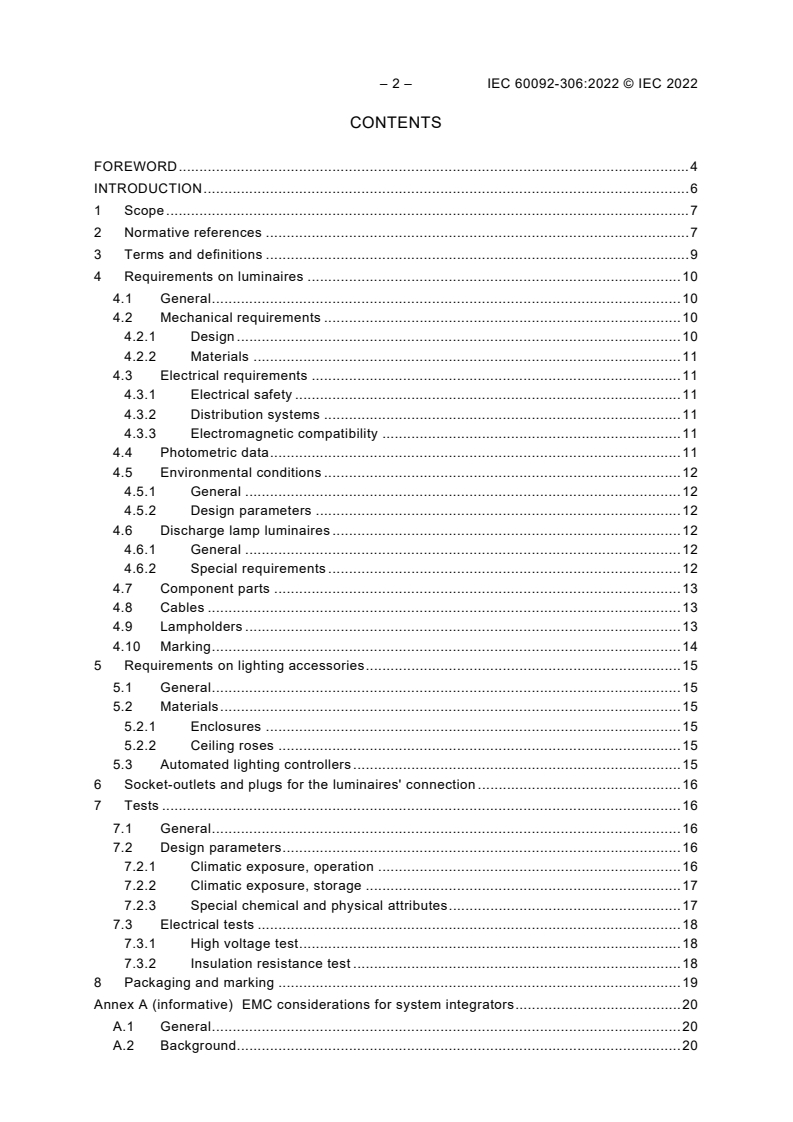
IEC 60092-306:2022 - Electrical installations in ships - Part 306: Equipment - Luminaires and lighting accessories Released:10/13/2022
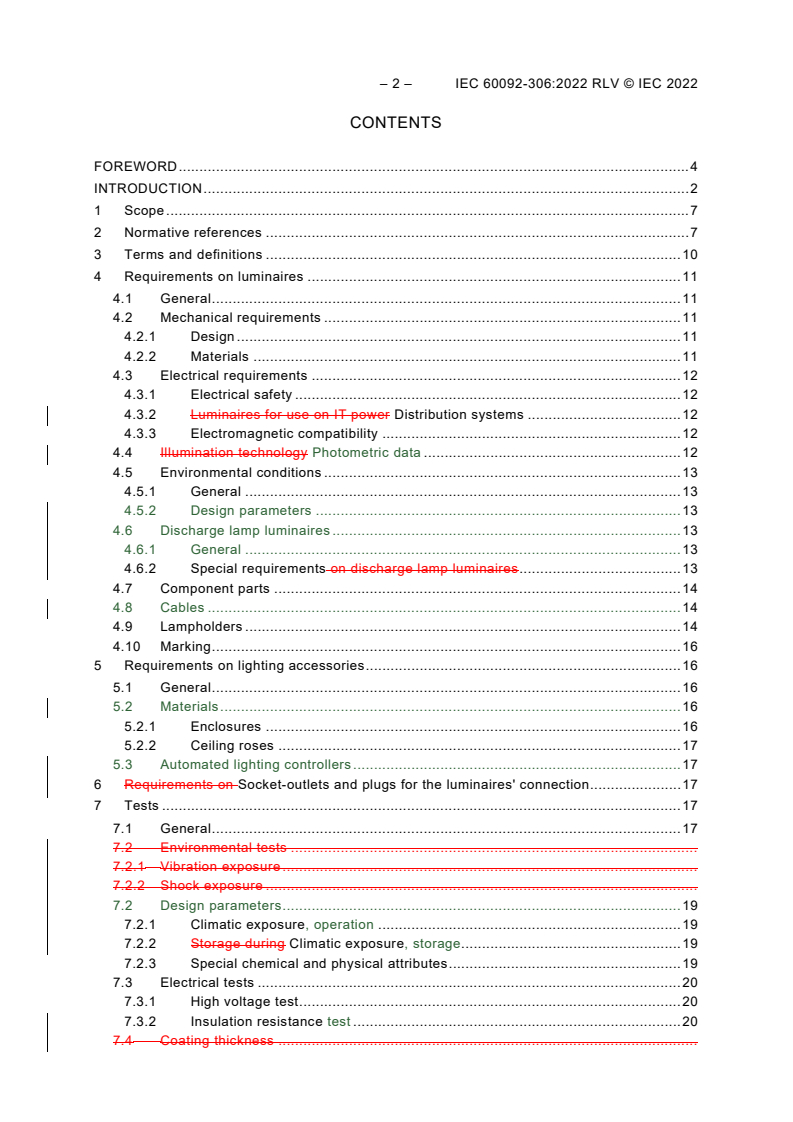
IEC 60092-306:2022 RLV - Electrical installations in ships - Part 306: Equipment - Luminaires and lighting accessories Released:10/13/2022
Overview - IEC 60092-306:2022 (Luminaires and lighting accessories)
IEC 60092-306:2022 is the fifth-edition international standard that specifies requirements for luminaires and lighting accessories used on ships. Focused primarily on fixed luminaires for illumination, the standard sets out mechanical, electrical, photometric and environmental requirements, testing procedures, marking and packaging rules. It is part of the broader IEC 60092 series covering electrical installations in ships and mobile/offshore units. Note: portable luminaires, navigation/search lights, daylight signalling and other navigation aids are excluded.
Key topics and technical requirements
The standard covers the following technical areas:
- Design and materials: mechanical construction, selection of corrosion‑resistant materials suitable for marine environments and guidance on component parts (lampholders, enclosures, ceiling roses).
- Electrical safety and distribution: insulation, earthing/grounding considerations and compatibility with shipboard distribution systems (reference to IEC 60092-201).
- Electromagnetic compatibility (EMC): requirements for emissions and immunity and an informative Annex A with EMC considerations specifically for system integrators.
- Photometric data: requirements for illuminance, light distribution and provision of photometric information to support lighting design.
- Environmental conditions and testing: climatic and mechanical exposure including cold, dry heat, damp heat, salt mist, shock and vibration. Relevant environmental test standards (IEC 60068 series) are referenced.
- Discharge lamp and electronic equipment: special requirements for discharge lamp luminaires and amended high‑voltage testing for electronic parts.
- Accessories and connections: lampholder types, socket‑outlets and plugs for luminaires (references to IEC 60238, IEC 60400, IEC 60309).
- Verification tests: high voltage and insulation resistance tests, climatic exposure and other validation tests required for certification.
- Marking, packaging and documentation: identification, safety symbols (e.g., warning for discharge lamp installations), and manufacturer information for shipboard use.
Practical applications and who uses this standard
IEC 60092-306 is used by:
- Shipbuilders and naval architects specifying lighting equipment for new builds and retrofits
- Marine electrical and electronics engineers designing shipboard lighting systems
- Lighting manufacturers producing marine‑rated luminaires and accessories
- System integrators ensuring EMC and compatibility with ship automation and power systems
- Classification societies and certification bodies assessing compliance for safety and seaworthiness
Practical benefits include reliable marine lighting performance, improved safety, reduced corrosion and electromagnetic interference risks, and consistent documentation for approvals.
Related standards
- IEC 60092 series (general ship electrical requirements)
- IEC 60068 (environmental testing)
- IEC 60079 (explosive atmospheres)
- IEC 60092-201 (system design)
- IEC 60238, IEC 60400 (lampholders), IEC 60309 (plugs/socket‑outlets)
- IEC 60092-401, IEC 60092-504 (installation and automation guidance)
Keywords: IEC 60092-306, marine lighting, luminaires, lighting accessories, shipboard lighting, EMC, photometric data, climatic testing, lampholders.
Relations
- Effective Date
- 05-Sep-2023
Buy Documents
IEC 60092-306:2022 - Electrical installations in ships - Part 306: Equipment - Luminaires and lighting accessories Released:10/13/2022
IEC 60092-306:2022 RLV - Electrical installations in ships - Part 306: Equipment - Luminaires and lighting accessories Released:10/13/2022
Get Certified
Connect with accredited certification bodies for this standard

DNV
DNV is an independent assurance and risk management provider.

Lloyd's Register
Lloyd's Register is a global professional services organisation specialising in engineering and technology.

FSC International
Forest Stewardship Council certification.
Sponsored listings
Frequently Asked Questions
IEC 60092-306:2022 is a standard published by the International Electrotechnical Commission (IEC). Its full title is "Electrical installations in ships - Part 306: Equipment - Luminaires and lighting accessories". This standard covers: IEC 60092-306:2022 applies to luminaires and lighting accessories for use in ships. It applies primarily to luminaires for illumination purposes. This document also applies to lighting accessories associated with the wiring and current consuming appliance of an installation. This document does not apply to portable luminaires, navigation lights, search lights, daylight signalling lamps, signal lights including the relevant control and monitoring equipment and other lights used for navigation in channels, harbours, etc. Annex A provides EMC considerations for system integrators.
IEC 60092-306:2022 applies to luminaires and lighting accessories for use in ships. It applies primarily to luminaires for illumination purposes. This document also applies to lighting accessories associated with the wiring and current consuming appliance of an installation. This document does not apply to portable luminaires, navigation lights, search lights, daylight signalling lamps, signal lights including the relevant control and monitoring equipment and other lights used for navigation in channels, harbours, etc. Annex A provides EMC considerations for system integrators.
IEC 60092-306:2022 is classified under the following ICS (International Classification for Standards) categories: 47.020.60 - Electrical equipment of ships and of marine structures. The ICS classification helps identify the subject area and facilitates finding related standards.
IEC 60092-306:2022 has the following relationships with other standards: It is inter standard links to IEC 60092-306:2009. Understanding these relationships helps ensure you are using the most current and applicable version of the standard.
IEC 60092-306:2022 is available in PDF format for immediate download after purchase. The document can be added to your cart and obtained through the secure checkout process. Digital delivery ensures instant access to the complete standard document.
Standards Content (Sample)
IEC 60092-306 ®
Edition 5.0 2022-10
INTERNATIONAL
STANDARD
Electrical installations in ships –
Part 306: Equipment – Luminaires and lighting accessories
All rights reserved. Unless otherwise specified, no part of this publication may be reproduced or utilized in any form
or by any means, electronic or mechanical, including photocopying and microfilm, without permission in writing from
either IEC or IEC's member National Committee in the country of the requester. If you have any questions about IEC
copyright or have an enquiry about obtaining additional rights to this publication, please contact the address below or
your local IEC member National Committee for further information.
IEC Secretariat Tel.: +41 22 919 02 11
3, rue de Varembé info@iec.ch
CH-1211 Geneva 20 www.iec.ch
Switzerland
About the IEC
The International Electrotechnical Commission (IEC) is the leading global organization that prepares and publishes
International Standards for all electrical, electronic and related technologies.
About IEC publications
The technical content of IEC publications is kept under constant review by the IEC. Please make sure that you have the
latest edition, a corrigendum or an amendment might have been published.
IEC publications search - webstore.iec.ch/advsearchform IEC Products & Services Portal - products.iec.ch
The advanced search enables to find IEC publications by a Discover our powerful search engine and read freely all the
variety of criteria (reference number, text, technical publications previews. With a subscription you will always
committee, …). It also gives information on projects, replaced have access to up to date content tailored to your needs.
and withdrawn publications.
Electropedia - www.electropedia.org
IEC Just Published - webstore.iec.ch/justpublished
The world's leading online dictionary on electrotechnology,
Stay up to date on all new IEC publications. Just Published
containing more than 22 300 terminological entries in English
details all new publications released. Available online and
and French, with equivalent terms in 19 additional languages.
once a month by email.
Also known as the International Electrotechnical Vocabulary
(IEV) online.
IEC Customer Service Centre - webstore.iec.ch/csc
If you wish to give us your feedback on this publication or
need further assistance, please contact the Customer Service
Centre: sales@iec.ch.
IEC 60092-306 ®
Edition 5.0 2022-10
INTERNATIONAL
STANDARD
Electrical installations in ships –
Part 306: Equipment – Luminaires and lighting accessories
INTERNATIONAL
ELECTROTECHNICAL
COMMISSION
ICS 47.020.60 ISBN 978-2-8322-5848-4
– 2 – IEC 60092-306:2022 © IEC 2022
CONTENTS
FOREWORD . 4
INTRODUCTION . 6
1 Scope . 7
2 Normative references . 7
3 Terms and definitions . 9
4 Requirements on luminaires . 10
4.1 General . 10
4.2 Mechanical requirements . 10
4.2.1 Design . 10
4.2.2 Materials . 11
4.3 Electrical requirements . 11
4.3.1 Electrical safety . 11
4.3.2 Distribution systems . 11
4.3.3 Electromagnetic compatibility . 11
4.4 Photometric data . 11
4.5 Environmental conditions . 12
4.5.1 General . 12
4.5.2 Design parameters . 12
4.6 Discharge lamp luminaires . 12
4.6.1 General . 12
4.6.2 Special requirements . 12
4.7 Component parts . 13
4.8 Cables . 13
4.9 Lampholders . 13
4.10 Marking . 14
5 Requirements on lighting accessories . 15
5.1 General . 15
5.2 Materials . 15
5.2.1 Enclosures . 15
5.2.2 Ceiling roses . 15
5.3 Automated lighting controllers . 15
6 Socket-outlets and plugs for the luminaires' connection . 16
7 Tests . 16
7.1 General . 16
7.2 Design parameters . 16
7.2.1 Climatic exposure, operation . 16
7.2.2 Climatic exposure, storage . 17
7.2.3 Special chemical and physical attributes . 17
7.3 Electrical tests . 18
7.3.1 High voltage test . 18
7.3.2 Insulation resistance test . 18
8 Packaging and marking . 19
Annex A (informative) EMC considerations for system integrators . 20
A.1 General . 20
A.2 Background. 20
A.3 Immunity requirements . 20
A.4 Emission requirements . 20
A.5 Harmonic distortion . 21
Bibliography . 22
Figure 1 – Warning symbol for discharge lamp installations . 12
Table 1 – Special requirements on component parts . 13
Table 2 – Standard types of lampholders . 13
Table 3 – Climatic conditions, operation . 17
Table 4 – Climatic conditions, storage . 17
Table 5 – Special chemical and physical attributes . 18
Table 6 – High voltage test . 18
Table 7 – Insulation resistance test . 19
– 4 – IEC 60092-306:2022 © IEC 2022
INTERNATIONAL ELECTROTECHNICAL COMMISSION
____________
ELECTRICAL INSTALLATIONS IN SHIPS –
Part 306: Equipment – Luminaires and lighting accessories
FOREWORD
1) The International Electrotechnical Commission (IEC) is a worldwide organization for standardization comprising
all national electrotechnical committees (IEC National Committees). The object of IEC is to promote international
co-operation on all questions concerning standardization in the electrical and electronic fields. To this end and
in addition to other activities, IEC publishes International Standards, Technical Specifications, Technical Reports,
Publicly Available Specifications (PAS) and Guides (hereafter referred to as “IEC Publication(s)”). Their
preparation is entrusted to technical committees; any IEC National Committee interested in the subject dealt with
may participate in this preparatory work. International, governmental and non-governmental organizations liaising
with the IEC also participate in this preparation. IEC collaborates closely with the International Organization for
Standardization (ISO) in accordance with conditions determined by agreement between the two organizations.
2) The formal decisions or agreements of IEC on technical matters express, as nearly as possible, an international
consensus of opinion on the relevant subjects since each technical committee has representation from all
interested IEC National Committees.
3) IEC Publications have the form of recommendations for international use and are accepted by IEC National
Committees in that sense. While all reasonable efforts are made to ensure that the technical content of IEC
Publications is accurate, IEC cannot be held responsible for the way in which they are used or for any
misinterpretation by any end user.
4) In order to promote international uniformity, IEC National Committees undertake to apply IEC Publications
transparently to the maximum extent possible in their national and regional publications. Any divergence between
any IEC Publication and the corresponding national or regional publication shall be clearly indicated in the latter.
5) IEC itself does not provide any attestation of conformity. Independent certification bodies provide conformity
assessment services and, in some areas, access to IEC marks of conformity. IEC is not responsible for any
services carried out by independent certification bodies.
6) All users should ensure that they have the latest edition of this publication.
7) No liability shall attach to IEC or its directors, employees, servants or agents including individual experts and
members of its technical committees and IEC National Committees for any personal injury, property damage or
other damage of any nature whatsoever, whether direct or indirect, or for costs (including legal fees) and
expenses arising out of the publication, use of, or reliance upon, this IEC Publication or any other IEC
Publications.
8) Attention is drawn to the Normative references cited in this publication. Use of the referenced publications is
indispensable for the correct application of this publication.
9) Attention is drawn to the possibility that some of the elements of this IEC Publication may be the subject of patent
rights. IEC shall not be held responsible for identifying any or all such patent rights.
IEC 60092-306 has been prepared by IEC technical committee 18: Electrical installations of
ships and of mobile and fixed offshore units. It is an International Standard.
This fifth edition cancels and replaces the fourth edition published in 2009. This edition
constitutes a technical revision.
This edition includes the following significant technical changes with respect to the previous
edition:
a) additional technical and environmental requirements have been included;
b) Table 2 "Standard types of lamp holders" has been amended;
c) Subclause 4.3.2 has been amended with a new title "Distribution systems" and a reference
to IEC 60092-201 has been added;
d) environmental requirements and tests, especially regarding shock and vibration have been
changed, and references to IEC 60092-101 and IEC 60092-504 have been added;
e) requirements on coating thickness have been deleted, material requirements in 4.2.2 being
sufficient;
f) the high voltage test has been amended with regard to electronic parts.
The text of this International Standard is based on the following documents:
Draft Report on voting
18/1786/FDIS 18/1790/RVD
Full information on the voting for its approval can be found in the report on voting indicated in
the above table.
The language used for the development of this International Standard is English.
This document was drafted in accordance with ISO/IEC Directives, Part 2, and developed in
accordance with ISO/IEC Directives, Part 1 and ISO/IEC Directives, IEC Supplement, available
at www.iec.ch/members_experts/refdocs. The main document types developed by IEC are
described in greater detail at www.iec.ch/publications.
A list of all parts of the IEC 60092 series, published under the general title Electrical installations
in ships, can be found on the IEC website.
The committee has decided that the contents of this document will remain unchanged until the
stability date indicated on the IEC website under webstore.iec.ch in the data related to the
specific document. At this date, the document will be
• reconfirmed,
• withdrawn,
• replaced by a revised edition, or
• amended.
– 6 – IEC 60092-306:2022 © IEC 2022
INTRODUCTION
IEC 60092 (all parts) forms a series of international standards for electrical installations in sea-
going ships, incorporating good practice and coordinating, as far as possible, existing rules.
These standards form a code of practical interpretation and amplification of the requirements
of the International Convention for the Safety of Life at Sea, a guide for future regulations which
may be prepared and a statement of practice for use by shipowners, shipbuilders and
appropriate organizations.
ELECTRICAL INSTALLATIONS IN SHIPS –
Part 306: Equipment – Luminaires and lighting accessories
1 Scope
This part of IEC 60092 applies to luminaires and lighting accessories for use in ships. It applies
primarily to luminaires for illumination purposes.
This document also applies to lighting accessories associated with the wiring and current
consuming appliance of an installation.
This document does not apply to portable luminaires, navigation lights, search lights, daylight
signalling lamps, signal lights including the relevant control and monitoring equipment and other
lights used for navigation in channels, harbours, etc.
Annex A provides EMC considerations for system integrators.
2 Normative references
The following documents are referred to in the text in such a way that some or all of their content
constitutes requirements of this document. For dated references, only the edition cited applies.
For undated references, the latest edition of the referenced document (including any
amendments) applies.
IEC 60068-2-1, Environmental testing – Part 2-1: Tests – Test A: Cold
IEC 60068-2-2, Environmental testing – Part 2-2: Tests – Test B: Dry heat
IEC 60068-2-30, Environmental testing – Part 2-30: Tests – Test Db: Damp heat, cyclic (12 h +
12 h cycle)
IEC 60068-2-52, Environmental testing – Part 2-52: Tests – Test Kb: Salt mist, cyclic (sodium
chloride solution)
IEC 60068-2-78, Environmental testing – Part 2-78: Tests – Test Cab: Damp heat, steady state
IEC 60079 (all parts), Explosive atmospheres
IEC 60092-101, Electrical installations in ships – Part 101: Definitions and general
requirements
IEC 60092-201, Electrical installations in ships – Part 201: System design – General
IEC 60092-352, Electrical installations in ships – Part 352: Choice and installation of electrical
cables
IEC 60092-353, Electrical installations in ships – Part 353: Power cables for rated voltages 1 kV
and 3 kV
IEC 60092-360, Electrical installations in ships – Part 360: Insulating and sheathing materials
for shipboard and offshore units, power, control, instrumentation and telecommunication cables
– 8 – IEC 60092-306:2022 © IEC 2022
IEC 60092-401, Electrical installations in ships – Part 401: Installation and test of completed
installation
IEC 60092-504, Electrical installations in ships – Part 504: Automation, control and
instrumentation
IEC 60155, Glow-starters for fluorescent lamps
IEC 60238, Edison screw lampholders
IEC 60309 (all parts), Plugs, fixed or portable socket-outlets and appliance inlets for industrial
purposes
IEC 60332-1-2:2004, Tests on electric and optical fibre cables under fire conditions – Part 1-2:
Test for vertical flame propagation for a single insulated wire or cable – Procedure for 1 kW
pre-mixed flame
IEC 60400, Lampholders for tubular fluorescent lamps and starterholders
IEC 60417, Graphical symbols for use on equipment, available at http://www.graphical-
symbols.info/equipment
IEC 60529, Degrees of protection provided by enclosures (IP Code)
IEC 60533, Electrical and electronic installations in ships – Electromagnetic compatibility (EMC)
– Ships with a metallic hull
IEC 60598-1, Luminaires – Part 1: General requirements and tests
IEC 60684-2, Flexible insulating sleeving – Part 2: Methods of test
IEC 60695-7-2, Fire hazard testing – Part 7-2: Toxicity of fire effluent – Summary and relevance
of test methods
IEC 60695-2-11, Fire hazard testing – Part 2-11: Glowing/hot-wire based test methods –
Glow-wire flammability test method for end-products (GWEPT)
IEC 60754-1, Test on gases evolved during combustion of materials from cables – Part 1:
Determination of the halogen acid gas content
IEC 60838-1, Miscellaneous lampholders – Part 1: General requirements and tests
IEC 60945, Maritime navigation and radiocommunication equipment and systems – General
requirements – Methods of testing and required test results
IEC 61184, Bayonet lampholders
IEC 61300-3-2, Fibre optic interconnecting devices and passive components – Basic test and
measurement procedures – Part 3-2: Examination and measurements – Polarization dependent
loss in a single-mode fibre optic device
IEC 61347-2-1, Lamp controlgear – Part 2-1: Particular requirements for starting devices
(other than glow starters)
IEC 61995-1, Devices for the connection of luminaires for household and similar purposes –
Part 1: General requirements
IEC 61995-2, Devices for the connection of luminaires for household and similar purposes –
Part 2: Standard sheets for DCL
IEC 62444, Cable glands for electrical installations
IEC 62471:2006, Photobiological safety of lamps and lamp systems
IEC 62742, Electrical and electronic installations in ships – Electromagnetic compatibility (EMC)
– Ships with a non-metallic hull
IEC TR 62778, Application of IEC 62471 for the assessment of blue light hazard to light sources
and luminaires
ISO 4892-2, Plastics – Methods of exposure to laboratory light sources – Part 2: Xenon-arc
lamps
ISO 4892-3, Plastics – Methods of exposure to laboratory light sources – Part 3: Fluorescent
UV lamps
EN 12206-1, Paints and varnishes – Coating of aluminium and aluminium alloys for architectural
purposes – Part 1: Coatings prepared from thermosetting coating powder
EN 13032-1, Light and lighting – Measurement and presentation of photometric data of lamps
and luminaires – Part 1: Measurement and file format
EN 13438, Paints and varnishes – Powder organic coatings for hot dip galvanized or
sherardised steel products for construction purposes
EN 13032-4, Light and lighting – Measurement and presentation of photometric data of lamps
and luminaires – Part 4: LED lamps, modules and luminaires
3 Terms and definitions
For the purposes of this document, the terms and definitions given in IEC 60598-1 and the
following apply.
ISO and IEC maintain terminological databases for use in standardization at the following
addresses:
• IEC Electropedia: available at http://www.electropedia.org/
• ISO Online browsing platform: available at http://www.iso.org/obp
3.1
luminaire
apparatus which distributes, filters or transforms the light transmitted from one or more lamps
and which includes all the parts necessary for supporting, fixing and protecting the lamps, but
not the lamps themselves, and where necessary, circuit auxiliaries together with the means for
connecting them to the supply
[SOURCE: IEC 60598-1:2020, 1.2.1, modified – The note to entry has been deleted.]
– 10 – IEC 60092-306:2022 © IEC 2022
3.2
lamp
electric light source provided with at least one cap
Note 1 to entry: For products that have the same physical characteristics as electric lamps for general lighting, but
that are built to emit optical radiation mainly in the IR or UV spectrum, the term "IR lamp" or "UV lamp" is often used.
Note 2 to entry: This entry was numbered 845-07-03 in IEC 60050-845:1987.
[SOURCE: IEC 60050-845:2020, 845-27-008, modified – In the term, the word "electric" has
been deleted, as well as the second note to entry.]
3.3
lighting accessories
additional parts which are needed for mounting or for electri
...
IEC 60092-306 ®
Edition 5.0 2022-10
REDLINE VERSION
INTERNATIONAL
STANDARD
colour
inside
Electrical installations in ships –
Part 306: Equipment – Luminaires and lighting accessories
All rights reserved. Unless otherwise specified, no part of this publication may be reproduced or utilized in any form
or by any means, electronic or mechanical, including photocopying and microfilm, without permission in writing from
either IEC or IEC's member National Committee in the country of the requester. If you have any questions about IEC
copyright or have an enquiry about obtaining additional rights to this publication, please contact the address below or
your local IEC member National Committee for further information.
IEC Secretariat Tel.: +41 22 919 02 11
3, rue de Varembé info@iec.ch
CH-1211 Geneva 20 www.iec.ch
Switzerland
About the IEC
The International Electrotechnical Commission (IEC) is the leading global organization that prepares and publishes
International Standards for all electrical, electronic and related technologies.
About IEC publications
The technical content of IEC publications is kept under constant review by the IEC. Please make sure that you have the
latest edition, a corrigendum or an amendment might have been published.
IEC publications search - webstore.iec.ch/advsearchform IEC Products & Services Portal - products.iec.ch
The advanced search enables to find IEC publications by a Discover our powerful search engine and read freely all the
variety of criteria (reference number, text, technical publications previews. With a subscription you will always
committee, …). It also gives information on projects, replaced have access to up to date content tailored to your needs.
and withdrawn publications.
Electropedia - www.electropedia.org
IEC Just Published - webstore.iec.ch/justpublished
The world's leading online dictionary on electrotechnology,
Stay up to date on all new IEC publications. Just Published
containing more than 22 300 terminological entries in English
details all new publications released. Available online and
and French, with equivalent terms in 19 additional languages.
once a month by email.
Also known as the International Electrotechnical Vocabulary
(IEV) online.
IEC Customer Service Centre - webstore.iec.ch/csc
If you wish to give us your feedback on this publication or
need further assistance, please contact the Customer Service
Centre: sales@iec.ch.
IEC 60092-306 ®
Edition 5.0 2022-10
REDLINE VERSION
INTERNATIONAL
STANDARD
colour
inside
Electrical installations in ships –
Part 306: Equipment – Luminaires and lighting accessories
INTERNATIONAL
ELECTROTECHNICAL
COMMISSION
ICS 47.020.60 ISBN 978-2-8322-5887-3
– 2 – IEC 60092-306:2022 RLV © IEC 2022
CONTENTS
FOREWORD . 4
INTRODUCTION . 2
1 Scope . 7
2 Normative references . 7
3 Terms and definitions . 10
4 Requirements on luminaires . 11
4.1 General . 11
4.2 Mechanical requirements . 11
4.2.1 Design . 11
4.2.2 Materials . 11
4.3 Electrical requirements . 12
4.3.1 Electrical safety . 12
4.3.2 Luminaires for use on IT power Distribution systems . 12
4.3.3 Electromagnetic compatibility . 12
4.4 Illumination technology Photometric data . 12
4.5 Environmental conditions . 13
4.5.1 General . 13
4.5.2 Design parameters . 13
4.6 Discharge lamp luminaires . 13
4.6.1 General . 13
4.6.2 Special requirements on discharge lamp luminaires . 13
4.7 Component parts . 14
4.8 Cables . 14
4.9 Lampholders . 14
4.10 Marking . 16
5 Requirements on lighting accessories . 16
5.1 General . 16
5.2 Materials . 16
5.2.1 Enclosures . 16
5.2.2 Ceiling roses . 17
5.3 Automated lighting controllers . 17
6 Requirements on Socket-outlets and plugs for the luminaires' connection . 17
7 Tests . 17
7.1 General . 17
7.2 Environmental tests .
7.2.1 Vibration exposure .
7.2.2 Shock exposure .
7.2 Design parameters . 19
7.2.1 Climatic exposure, operation . 19
7.2.2 Storage during Climatic exposure, storage. 19
7.2.3 Special chemical and physical attributes . 19
7.3 Electrical tests . 20
7.3.1 High voltage test . 20
7.3.2 Insulation resistance test . 20
7.4 Coating thickness .
8 Packaging and marking . 21
Annex A (informative) EMC considerations for system integrators . 22
A.1 General . 22
A.2 Background. 22
A.3 Immunity requirements . 22
A.4 Emission requirements . 22
A.5 Harmonic distortion . 23
Bibliography . 24
Figure 1 – Warning symbol for discharge lamp installations . 14
Table 1 – Special requirements on component parts . 14
Table 2 – Standard types of lampholders . 15
Table 3 – Vibration exposure .
Table 4 – Shock exposure .
Table 3 – Climatic conditions, operation . 19
Table 4 – Exposure to Climatic conditions, storage . 19
Table 5 – Special chemical and physical attributes of non-metallic materials . 20
Table 6 – High voltage test . 20
Table 7 – Insulation resistance test . 21
– 4 – IEC 60092-306:2022 RLV © IEC 2022
INTERNATIONAL ELECTROTECHNICAL COMMISSION
____________
ELECTRICAL INSTALLATIONS IN SHIPS –
Part 306: Equipment – Luminaires and lighting accessories
FOREWORD
1) The International Electrotechnical Commission (IEC) is a worldwide organization for standardization comprising
all national electrotechnical committees (IEC National Committees). The object of IEC is to promote international
co-operation on all questions concerning standardization in the electrical and electronic fields. To this end and
in addition to other activities, IEC publishes International Standards, Technical Specifications, Technical Reports,
Publicly Available Specifications (PAS) and Guides (hereafter referred to as “IEC Publication(s)”). Their
preparation is entrusted to technical committees; any IEC National Committee interested in the subject dealt with
may participate in this preparatory work. International, governmental and non-governmental organizations liaising
with the IEC also participate in this preparation. IEC collaborates closely with the International Organization for
Standardization (ISO) in accordance with conditions determined by agreement between the two organizations.
2) The formal decisions or agreements of IEC on technical matters express, as nearly as possible, an international
consensus of opinion on the relevant subjects since each technical committee has representation from all
interested IEC National Committees.
3) IEC Publications have the form of recommendations for international use and are accepted by IEC National
Committees in that sense. While all reasonable efforts are made to ensure that the technical content of IEC
Publications is accurate, IEC cannot be held responsible for the way in which they are used or for any
misinterpretation by any end user.
4) In order to promote international uniformity, IEC National Committees undertake to apply IEC Publications
transparently to the maximum extent possible in their national and regional publications. Any divergence between
any IEC Publication and the corresponding national or regional publication shall be clearly indicated in the latter.
5) IEC itself does not provide any attestation of conformity. Independent certification bodies provide conformity
assessment services and, in some areas, access to IEC marks of conformity. IEC is not responsible for any
services carried out by independent certification bodies.
6) All users should ensure that they have the latest edition of this publication.
7) No liability shall attach to IEC or its directors, employees, servants or agents including individual experts and
members of its technical committees and IEC National Committees for any personal injury, property damage or
other damage of any nature whatsoever, whether direct or indirect, or for costs (including legal fees) and
expenses arising out of the publication, use of, or reliance upon, this IEC Publication or any other IEC
Publications.
8) Attention is drawn to the Normative references cited in this publication. Use of the referenced publications is
indispensable for the correct application of this publication.
9) Attention is drawn to the possibility that some of the elements of this IEC Publication may be the subject of patent
rights. IEC shall not be held responsible for identifying any or all such patent rights.
This redline version of the official IEC Standard allows the user to identify the changes made to
the previous edition IEC 60092-306:2009. A vertical bar appears in the margin wherever a change
has been made. Additions are in green text, deletions are in strikethrough red text.
IEC 60092-306 has been prepared by IEC technical committee 18: Electrical installations of
ships and of mobile and fixed offshore units. It is an International Standard.
This fifth edition cancels and replaces the fourth edition published in 2009. This edition
constitutes a technical revision.
This edition includes the following significant technical changes with respect to the previous
edition:
a) additional technical and environmental requirements have been included;
b) Table 2 "Standard types of lamp holders" has been amended;
c) Subclause 4.3.2 has been amended with a new title "Distribution systems" and a reference
to IEC 60092-201 has been added;
d) environmental requirements and tests, especially regarding shock and vibration have been
changed, and references to IEC 60092-101 and IEC 60092-504 have been added;
e) requirements on coating thickness have been deleted, material requirements in 4.2.2 being
sufficient;
f) the high voltage test has been amended with regard to electronic parts.
The text of this International Standard is based on the following documents:
Draft Report on voting
18/1786/FDIS 18/1790/RVD
Full information on the voting for its approval can be found in the report on voting indicated in
the above table.
The language used for the development of this International Standard is English.
This document was drafted in accordance with ISO/IEC Directives, Part 2, and developed in
accordance with ISO/IEC Directives, Part 1 and ISO/IEC Directives, IEC Supplement, available
at www.iec.ch/members_experts/refdocs. The main document types developed by IEC are
described in greater detail at www.iec.ch/publications.
A list of all parts of the IEC 60092 series, published under the general title Electrical installations
in ships, can be found on the IEC website.
The committee has decided that the contents of this document will remain unchanged until the
stability date indicated on the IEC website under webstore.iec.ch in the data related to the
specific document. At this date, the document will be
• reconfirmed,
• withdrawn,
• replaced by a revised edition, or
• amended.
IMPORTANT – The "colour inside" logo on the cover page of this document indicates that it
contains colours which are considered to be useful for the correct understanding of its
contents. Users should therefore print this document using a colour printer.
– 6 – IEC 60092-306:2022 RLV © IEC 2022
INTRODUCTION
IEC 60092 (all parts) forms a series of international standards for electrical installations in sea-
going ships, incorporating good practice and coordinating, as far as possible, existing rules.
These standards form a code of practical interpretation and amplification of the requirements
of the International Convention for the Safety of Life at Sea, a guide for future regulations which
may be prepared and a statement of practice for use by shipowners, shipbuilders and
appropriate organizations.
ELECTRICAL INSTALLATIONS IN SHIPS –
Part 306: Equipment – Luminaires and lighting accessories
1 Scope
This part of IEC 60092 applies to luminaires and lighting accessories for use in ships. It applies
primarily to luminaires for illumination purposes.
NOTE Boats, submarines (except naval submarines), watercraft and floating equipment are ships to which this
standard applies.
This document also applies to lighting accessories associated with the wiring and current
consuming appliance of an installation.
This document does not apply to portable luminaires, navigation lights, search lights, daylight
signalling lamps, signal lights including the relevant control and monitoring equipment and other
lights used for navigation in channels, harbours, etc.
For navigation lights, see EN 14744, for search lights, see ISO 17884, for daylight signalling
lamps, see ISO 25861.
Annex A provides EMC considerations for system integrators.
2 Normative references
The following documents are referred to in the text in such a way that some or all of their content
constitutes requirements of this document. For dated references, only the edition cited applies.
For undated references, the latest edition of the referenced document (including any
amendments) applies.
IEC 60068-2-1, Environmental testing – Part 2-1: Tests – Test A: Cold
IEC 60068-2-2, Environmental testing – Part 2-2: Tests – Test B: Dry heat
IEC 60068-2-6, Environmental testing – Part 2-6: Tests – Test Fc: Vibration (sinusoidal)
IEC 60068-2-27, Environmental testing – Part 2-27: Tests – Test Ea and guidance: Shock
IEC 60068-2-30, Environmental testing – Part 2-30: Tests – Test Db: Damp heat, cyclic (12 h +
12 h cycle)
IEC 60068-2-52, Environmental testing – Part 2-52: Tests – Test Kb: Salt mist, cyclic (sodium
chloride solution)
IEC 60068-2-78, Environmental testing – Part 2-78: Tests – Test Cab: Damp heat, steady state
IEC 60079 (all parts), Equipment for Explosive atmospheres
IEC 60092-101, Electrical installations in ships – Part 101: Definitions and general
requirements
– 8 – IEC 60092-306:2022 RLV © IEC 2022
IEC 60092-201:1994, Electrical installations in ships – Part 201: System design – General
IEC 60092-352, Electrical installations in ships – Part 352: Choice and installation of electrical
cables
IEC 60092-353, Electrical installations in ships – Part 353: Power cables for rated voltages 1 kV
and 3 kV
IEC 60092-360, Electrical installations in ships – Part 360: Insulating and sheathing materials
for shipboard and offshore units, power, control, instrumentation and telecommunication cables
IEC 60092-401, Electrical installations in ships – Part 401: Installation and test of completed
installation
IEC 60092-504, Electrical installations in ships – Part 504: Automation, control and
instrumentation
IEC 60155, Glow-starters for fluorescent lamps
IEC 60238, Edison screw lampholders
IEC 60309 (all parts), Plugs, fixed or portable socket-outlets and appliance inlets for industrial
purposes
IEC 60332-1-2:2004, Tests on electric and optical fibre cables under fire conditions – Part 1-2:
Test for vertical flame propagation for a single insulated wire or cable – Procedure for 1 kW
pre-mixed flame
IEC 60400, Lampholders for tubular fluorescent lamps and starterholders
IEC 60417, Graphical symbols for use on equipment, available at http://www.graphical-
symbols.info/equipment
IEC 60529, Degrees of protection provided by enclosures (IP Code)
IEC 60533, Electrical and electronic installations in ships – Electromagnetic compatibility (EMC)
– Ships with a metallic hull
IEC 60598-1, Luminaires – Part 1: General requirements and tests
IEC 60684-2, Flexible insulating sleeving – Part 2: Methods of test
IEC 60695-7-2, Fire hazard testing – Part 7-2: Toxicity of fire effluent – Summary and relevance
of test methods
IEC 60695-2-11, Fire hazard testing – Part 2-11: Glowing/hot-wire based test methods –
Glow-wire flammability test method for end-products (GWEPT)
IEC/TR 60721-4-6, Classification of environmental conditions – Part 4-6: Guidance for the
correlation and transformation of environmental condition classes of IEC 60721-3 to the
environmental tests of IEC 60068 – Ship environment
IEC 60754-1, Test on gases evolved during combustion of materials from cables – Part 1:
Determination of the amount of halogen acid gas content
IEC 60838-1, Miscellaneous lampholders – Part 1: General requirements and tests
IEC 60945, Maritime navigation and radiocommunication equipment and systems – General
requirements – Methods of testing and required test results
IEC 61184, Bayonet lampholders
IEC 61300-3-2, Fibre optic interconnecting devices and passive components – Basic test and
measurement procedures – Part 3-2: Examination and measurements – Polarization dependent
loss in a single-mode fibre optic device
IEC 61347-2-1, Lamp controlgear – Part 2-1: Particular requirements for starting devices
(other than glow starters)
IEC 61995-1, Devices for the connection of luminaires for household and similar purposes –
Part 1: General requirements
IEC 61995-2, Devices for the connection of luminaires for household and similar purposes –
Part 2: Standard sheets for DCL
IEC 62444, Cable glands for electrical installations
IEC 62471:2006, Photobiological safety of lamps and lamp systems
IEC 62742, Electrical and electronic installations in ships – Electromagnetic compatibility (EMC)
– Ships with a non-metallic hull
IEC TR 62778, Application of IEC 62471 for the assessment of blue light hazard to light sources
and luminaires
ISO 2409, Paints and varnishes – Cross-cut test
ISO 3882, Metallic and other inorganic coatings – Review of methods of measurement of
thickness
ISO 4892-2, Plastics – Methods of exposure to laboratory light sources – Part 2: Xenon-arc
lamps
ISO 4892-3, Plastics – Methods of exposure to laboratory light sources – Part 3: Fluorescent
UV lamps
ISO 9001, Quality management systems – Requirements
ISO 17884, Ships and marine technology – Searchlights for high-speed craft
ISO 25861 Ships and marine technology – Navigation – Daylight signalling lamps
Defence Standard 02-713, Determination of the Toxicity Index of the Products of Combustion
from Small Specimens of Materials
EN 12206-1, Paints and varnishes – Coating of aluminium and aluminium alloys for architectural
purposes – Part 1: Coatings prepared from thermosetting coating powder
___________
To be published.
– 10 – IEC 60092-306:2022 RLV © IEC 2022
EN 13032-1, Light and lighting – Measurement and presentation of photometric data of lamps
and luminaires – Part 1: Measurement and file format
EN 13438, Paints and varnishes – Powder organic coatings for hot dip galvanized or
sherardised steel products for construction purposes
EN 13032-4, Light and lighting – Measurement and presentation of photometric data of lamps
and luminaires – Part 4: LED lamps, modules and luminaires
EN 14744, Inland navigation vessels and sea-going vessels – Navigation light
3 Terms and definitions
For the purposes of this document, the terms and definitions given in IEC 60598-1 and the
following apply.
ISO and IEC maintain terminological databases for use in standardization at the following
addresses:
• IEC Electropedia: available at http://www.electropedia.org/
• ISO Online browsing platform: available at http://www.iso.org/obp
3.1
luminaire
apparatus which distributes, filters or transforms the light transmitted from one or more lamps
and which includes all the parts necessary for supporting, fixing and protecting the lamps, but
not the lamps themselves, and where necessary, circuit auxiliaries together with the means for
connecting them to the supply
[SOURCE: IEC 60598-1:2020, 1.2.1, modified – The note to entry has been deleted.]
3.2
lamp
source made in order to produce an optical radiation, usually visible
[IEV 845-07-03]
electric light source provided with at least one cap
Note 1 to entry: For products that have the same physical characteristics as electric lamps for general lighting, but
that are built to emit optical radiation mainly in the IR or UV spectrum, the term "IR lamp" or "UV lamp" is often used.
Note 2 to entry: This entry was numbered 845-07-03 in IEC 60050-845:1987.
[SOURCE: IEC 60050-845:2020, 845-27-008, modified – In the term, the word "electric" has
been deleted, as well as the second note to entry.]
3.3
lighting accessories
additional parts which are needed for mounting or for electrical connection and which are
usually delivered together with the luminaire
EXAMPLE Ceiling rose, cable gland, plug, socket-outlet, fixing material.
3.4
continuous operation
operation for an unlimited period without interruption within the specified environmental
conditions without the specified limits of temperature being exceeded
4 Requirements on luminaires
4.1 General
Luminaires shall comply with the requirements of IEC 60598-1 and with the additional or
divergent requirements included in this document. Luminaires in accordance with this document
shall be suitable for continuous operation.
4.2 Mechanical requirements
4.2.1 Design
The design of luminaires shall comply with the requirements of IEC 60092-101 and with the
following additional requirements.
a) Luminaires shall have sufficient mechanical resistance for the intended use. The mechanical
properties shall be in accordance with intended purpose and installation location. To meet
the requirement of mechanical resistance, the equipment shall withstand the respective
shock and vibration conditions given in the Tables 3 and 4.
The equipment shall withstand the design parameters for vibration according to
IEC 60092-101.
b) Luminaires shall be designed, dimensioned and equipped with mounting devices in such a
way that they will present no hazard to persons, in particular during operation and
maintenance work.
c) The minimum degrees of IP protection in accordance with IEC 60529 required in the
different environmental conditions related to locations are given in IEC 60092-201:1994,
Table 5.
d) Luminaires shall be so constructed as to provide for adequate dissipation of heat from lamps
and related components. The temperature rise of terminals for connection of supply cables
shall not exceed 40 °C above ambient temperature. The insulation material of internal parts
shall be of a temperature class which corresponds to the maximum temperature within the
luminaires.
e) The temperature of surface parts which can be touched during operation shall not exceed
60 °C. If this is not possible, for example in case of floodlights or discharge lamps, these
luminaires shall be mounted in a way that they cannot be reached without the use of
additional facilities.
f) Luminaires shall be constructed in such a way that they can be easily cleaned inside, if
applicable.
g) Lamps Lighting units shall be easily replaceable, if applicable.
h) Luminaires used in hazardous areas shall comply with the relevant part of IEC 60079 series
according to the type of protection. Hazardous spaces of ships can be e. g. paint stores and
battery rooms where, depending on ventilation arrangement, luminaires may be required to
comply with relevant parts of IEC 60079.
i) Special consideration shall should be given to the design of luminaires for installation in
areas where the ambient temperature is ≥ +45 °C or ≤ –25 °C.
4.2.2 Materials
In general, the requirements according to IEC 60092-101 shall be met. With respect to durability
and resistance to environmental conditions, luminaires and lighting accessories shall meet the
requirements specified in Clause 7. The materials shall additionally comply with the following
requirements.
a) The materials used for the luminaires and their mounting parts shall be non-toxic and flame
retardant. See 7.2 for design parameters.
b) Parts which require surface protection shall be designed in a way that functional and
operational safety is ensured.
– 12 – IEC 60092-306:2022 RLV © IEC 2022
c) Non-metallic external parts of luminaires, enclosures and attachments shall withstand the
exposure to UV and visible radiation and shall be halogen-free.
d) External parts and housings of luminaires intended for outdoor installation shall be of metal.
d) If coating of the luminaires or parts or enclosures is necessary to achieve corrosion
resistance, it shall be in accordance with EN 12206-1 in case of aluminium and aluminium
alloy or in accordance with EN 13438 in case of steel.
e) Sulphur containing materials, for example for sealing purposes, shall not be used.
Tests for requirements a) and c) are stated in 7.2.3.
4.3 Electrical requirements
4.3.1 Electrical safety
Electrical safety shall be ensured by compliance with the tests specified in 7.3.
4.3.2 Luminaires for use on IT power Distribution systems
Luminaires intended to be operated on on-board power supply systems shall be designed in
such a way that they may be operated on a power distribution system which is not earthed (IT-
system). Switches in luminaires intended for use on IT-systems shall be bipolar. If fuses are
included in the luminaire, they shall be installed in each line conductor.
The luminaires shall be capable of being operated on secondary distribution systems. The types
of AC and DC distribution systems, nominal voltages and frequencies used on ships are
specified in IEC 60092-201.
4.3.3 Electromagnetic compatibility
In general, the requirements stated in IEC 60533 shall be met. Luminaires specified for use in
the bridge area and radio room shall meet the requirements stated in IEC 60945.
The requirements of IEC 60533 and IEC 62742 shall be met.
Requirements to harmonic distortion shall comply with IEC 61000-3-2.
NOTE 1 IEC 61000-3-2 is developed for low voltage grid. However, it can also be used for ship installations.
NOTE 2 There are no specific requirements to LED as the requirements are the same for all types of lighting
equipment. The same is applicable for IEC 60533 which applies to all types of electrical/electronic equipment,
including LED.
4.4 Illumination technology Photometric data
Photometric data in accordance with EN 13032-1 in general, and EN 13032-4 for LED, shall be
provided by the manufacturer in electronic format suitable for further electronic design and
calculation.
Lamps, luminaires and light systems shall be in accordance with IEC 62471:2006 and
IEC TR 62778 risk group 0 and risk group 1. Risk groups 2 and 3 applications are acceptable
under the condition that it is documented on board with safety instructions and operating
instructions. Risk group 2 and 3 areas shall have markings with warning labels.
NOTE 1 For flashing lights and other intense pulsed light sources, IEC TR 62471-3 provides requirements.
NOTE 2 For image projectors, IEC 62471-5 provides requirements.
NOTE 3 LED lights can have a high blue light content and other high intense light spectra.
4.5 Environmental conditions
4.5.1 General
Luminaires shall be so designed as to withstand the applicable environmental influences during
storage and ship's operation. The recommendations of IEC TR 60721-4-6 should be taken into
account. Guidance for environmental testing can be found in IEC 60068-1. The tests shall be
carried out in accordance with 7.2.
For environmental tests, the recommendations of IEC/TR 60721-4-6 should be taken into
account.
4.5.2 Design parameters
For inclination, motion and vibration, the requirements and tests for general applications given
in IEC 60092-504 shall be met.
4.6 Discharge lamp luminaires
4.6.1 General
The requirements for discharge lamp luminaires with voltages above 250 V, given in
IEC 60092-201, apply.
4.6.2 Special requirements on discharge lamp luminaires
On discharge lamp luminaires, all ballasts, capacitors and other auxiliaries mounted separately
from the luminaires shall be enclosed in an earthed metal casing.
Discharge lamps should be used only in fixed luminaires.
Discharge lamp installations shall be durably marked with the warning symbol given in
IEC 60598-1 Figure 1. The marking shall be of a suitable size.
Transformers should be located as close as possible to the luminaire installation but no more
than 100 m apart from the luminaire's installation.
– 14 – IEC 60092-306:2022 RLV © IEC 2022
(IEC 60417-6042:2010-11)
Figure 1 – Warning symbol for discharge lamp installations
4.7 Component parts
Component parts of luminaires shall comply with their relevant standards and shall be in
accordance with the requirements stated in 4.2 and the requirements stated in the documents
given in Table 1.
Table 1 – Special requirements on component parts
Auxiliary, component, part Requirement
Halogen-free, flame retardant and with low emission
Internal wiring, single core
a
of smoke
Starting devices (other than glow starters) IEC 61347-2-1
Glow starters IEC 60155
Devices for connection of luminaires (DCL) IEC 61995-1 and IEC 61995-2
Cable glands IEC 62444
a 2
For details, see for example HD 22.9 S2 [1] and HD 22.9 S2/A1 [2] EN 50525-3-41 [1] .
4.8 Cables
Choice and installation of electrical cables for external wiring shall be carried out in accordance
with IEC 60092-353, IEC 60092-360, IEC 60092-352 and IEC 60092-401, unless a specific
requirement in this document is given.
4.9 Lampholders
Lampholders allowed to be used in luminaires shall comply with their relevant standard and
shall be of a type listed in Table 2.
Lampholders shall be provided with effective means for locking the lamp in the holder.
___________
Figures in square brackets refer to the Bibliography.
Lampholders of different types have different ability to retain the lamp during vibration. The
effectivity of this combination shall be checked together with the way of fixing the lamp holder
in the luminaire during the tests in 7.2.3.
Table 2 – Standard types of lampholders
Maximum lamp ratings
Lampholder for: Designation Voltage Load power Current
V W A
E40 250 3 000 16
e
250 3 000 15
E39
a
Screw cap lamps E27 250 250 4
e
300 200 6
E26
E14 250 60 2
B22 200 4
b
Bayonet cap lamps B15d 250 4
B15s 55 15 2
G13 115 –
G5 80 –
c
Tubular fluorescent lamps G24q 250 10 to 26 –
GX24q 13 to 57 –
GX24d 13 to 26 –
G23
5 to 11 –
2G7
–
5 to 11
G24d
10 to 26 –
G24q 10 to 26 –
Tubular compact
b
fluorescent lamps
2G10
18 to 36 –
2G11
18 to 55 –
GX24q 13 to 57 –
GX24d 13 to 26 –
G4 12 and 24 5 to 20 –
GU4 5 to 35 –
d
Low voltage halogen lamps
GU5.3 12 10 to 50 –
GY6.35 20 to 150 –
High voltage halogen GU 10, GZ 10 35 to 50 –
d
lamps
e
2 000 20
GY16
e
250 1 000 20
GY9.5
e
650 20
GX9.5
R7S 60 to 2 000 –
a
E40 1 000 –
a
150 –
E27
d
400 –
RX7S
High intensity discharge
G38 400
lamps (HID)
1 000
d
Fc2 400
e
3 000 40
G38
d
750 72 –
G8.5
– 16 – IEC 60092-306:2022 RLV © IEC 2022
Maximum lamp ratings
Lampholder for: Designation Voltage Load power Current
V W A
d
G12 150 –
e
GY16 2 000 20
e
650 10/20
GY9.5
e
Prefocus base lamp 250 500 10
P28s
a
In accordance with IEC 60238.
b
In accordance with IEC 61184.
c
In accordance with IEC 60400.
d
In accordance with IEC 60838-1.
e
These types are used in Japan only.
4.10 Marking
Marking shall be in accordance with the provisions stated in IEC 60598-1.
Luminaires shall be marked for easy identification.
The marking shall at least include the following data:
– type identification;
– manufacturer or manufacturer's reference;
– degree of protection;
– supply voltage;
– indication of each device belonging to the luminaires, for example mounting parts;
– type and number of lamp/s;
– rated power of lamp/s.
The marking shall be durable and not removable as well in hazardous areas.
The marking language shall be English or English and additional language/s.
5 Requirements on lighting accessories
5.1 General
Lighting accessories shall comply with the requirements of IEC 60598-1 and with the additional
or divergent requirements included in this document. Insulated conductors shall be installed in
a way that stress cannot be applied by the conductors to any terminal to which the conductors
may be connected. Lighting accessories shall be so designed as to withstand the appropriate
environmental influences during storage and ship's operation.
5.2 Materials
5.2.1 Enclosures
In general, the requirements on materials according to IEC 60092-101 shall be met.
Enclosures shall preferably be made of cast brass, bronze or iron, or of welded sheet steel with
corrosion-resistant finish, or of corrosion-resistant light alloys, or of flame-retardant and
halogen-free insulating material plastics.
5.2.2 Ceiling roses
Ceiling roses shall be made of flame-retardant, non-conducting and moisture-resistant material.
Materials for ceiling roses shall pass the tests stated in Table 5 and the humid heat test stated
in Table 6 Table 3.
5.3 Automated lighting controllers
Controllers for emergency lighting shall be independent and separated from controllers for main
lighting.
Systems for automatic or remote switching or dimming of lighting shall have the following
functions.
a) Switching to appropriate light intensity in case of:
1) loss of main power
2) loss of emergency power (main power is available)
3) release of fire alarm
4) release of general alarm, and
5) failure in the lighting control system (power failure, hardware failure, communication
failure).
b) Failure of lighting control system shall send an alert signal to the bridge alert system.
c) There shall be a setting for minimum light intensity for the purpose of emergency lighting.
NOTE 5.3 is not intended for local dimming of lights, such as for mess rooms or cabins.
6 Requirements on Socket-outlets and plugs for the luminaires' connection
Generally, the requirements according to the IEC 60309 series apply.
Socket-outlets and plugs shall be dimensioned in a way that they meet the additional
requirements specified in Clause 7 and the following requirements.
a) The electrical clearances and creepage distances of socket-outlets and plugs not
interlocked with switches shall be such that a short-circuit arc cannot be initiated. This
requirement is valid for the plug being normally withdrawn from the socket-outlet, while a
current 50 % higher than the rated current flowing at rated voltage.
b) Where socket-outlets with earthing contacts are required, the socket-outlets and plugs shall
be provided with an additional contact for earthing the casing or frame of appliance. The
earthing contact shall connect in advance of the live contact pins when inserting the plug.
c) Socket-outlets and plugs with a specified degree of protection shall be provided with
effective means to maintain the same degree of protection after the plug is removed from
the socket-outlet. Where a loose cover is used for this purpose, it shall be anchored to its
socket-outlet, for example by means of a chain.
7 Tests
7.1 General
In addition to the tests in accordance with IEC 60598-1, The luminaires shall pass the tests
listed in IEC 60598-1, as modified by Clause 7, and its additional tests as shown.
– 18 – IEC 60092-306:2022 RLV © IEC 2022
If not stated otherwise, a visual inspection and operational test shall be carried out before and
after each test. At least three luminaires of any type shall be tested, and any additional number
of items shall be agreed upon. Unless stated or agreed upon otherwise, proof shall be furnished
in the form of an inspection certificate.
If applicable, luminaires shall be tested with their dedicated lamp(s) and lighting accessories.
Before testing, they shall be fitted (equipped) and mounted for operation. If necessary, for
example in case of vibration and shock test, an appropriate mounting fixture shall be used.
The manufacturer shall maintain a quality assurance system in accordance with ISO 9001.
7.2 Environmental tests
7.2.1 Vibration exposure
The luminaires shall be fitted with the respective lamp, if applicable. The luminaires will have
passed the test if they are fully functional and free of damage during and after the test.
The luminaires shall be subjected to vibration for the given duration in the direction of each axis
of the x, y, z coordinate system given in Table 3.
Table 3 – Vibration exposure
Frequency Displacement Frequency
Exposure Test Acceleration Duration
change amplitude range
Octave
mm min Hz
m/s
per min
+3
±1,0 – 2 to 13,2
−0
General In accordance with
≤1,0 90
vibration IEC 60068-2-6
– 7,0 13,2 to 100
7.2.2 Shock exposure
If the luminaires shall be operated aboard a ship, usually no requirements as regards shock
resistance apply. Exceptions shall be stipulated by the customer.
If shock requirements are stipulated, for example for luminaires to be operated aboard
highspeed watercraft (HSC), the luminaires fitted for operation shall additionally be resistant to
the stipulated number of shocks in both the positive and negative direction of each axis of the
x, y, z coordinate system.
The test may be carried out in accordance with IEC 60068-2-27. The luminaires shall be fitted
with the respective lamp, if applicable. The luminaires will have passed the test, if they are fully
functional and free of damage during and after the test. For each test, the impulse duration and
impulse form, acceleration and number of shocks per axis direction shall be stated. An example
is given in Table 4. The given values are in accordance with IEC/TR 60721-4-6.
Table 4 – Shock exposure
Impulse
Exposure Test Acceleration Impulse form Number
duration
per axis
–2
ms
ms
direction
Recommended In accordance with
250 Half sine 6 100
shock IEC 60068-2-27
...